Single-ventricle CHD is rare, occurring in 2.5–3.5 per 10,000 live births.Reference Gordon, Rodriguez and Lee 1 These patients require a staged surgical palliation for optimal survival. The highest risk of mortality in these patients is after the first-stage palliation, where the death rate is estimated to be between 2 and 15%.Reference Brown, Mangeot and Anderson 2 , Reference Oster, Kelleman and McCracken 3 Cardiac catheterisation is commonly performed before stage II superior cavopulmonary anastomosis surgery for haemodynamic and anatomic assessment for optimal surgical planning and possible transcatheter interventions. Our institutional strategy is to perform cardiac catheterisation for all patients with single-ventricle CHD before stage II palliation and for shunt-dependent biventricular CHD on a case-by-case basis at the discretion of the primary cardiologist and the surgeon.
Substantial variability exists between centres with regard to the use and timing of cardiac catheterisation in this population.Reference Goldstein, Holzer and Trucco 4 More importantly, best practices for post-procedural care following cardiac catheterisation of infants with single-ventricle and shunt-dependent biventricular CHD are unknown. Previous studies from the 1980s have shown that cardiac catheterisation can be safely performed on an outpatient basis, defined as discharge home on the same day of cardiac catheterisation. However, none of these studies included patients with single-ventricle or shunt-dependent biventricular CHD.Reference Figliali, Krajcer and Gonzales-Camid 5 – Reference Clark, Moscovich and Vetrovec 9 Outpatient cardiac catheterisation relieves patient and parental anxiety, reduces cost, and is often more convenient for the family.Reference Figliali, Krajcer and Gonzales-Camid 5 – Reference Clark, Moscovich and Vetrovec 9
The primary objective of this study was to investigate the incidence and causes of readmission of infants with single-ventricle and shunt-dependent biventricular CHD after outpatient cardiac catheterisation. The secondary objective was to determine whether the risk of readmission increased in patients with a diagnosis of hypoplastic left heart syndrome.
Materials and methods
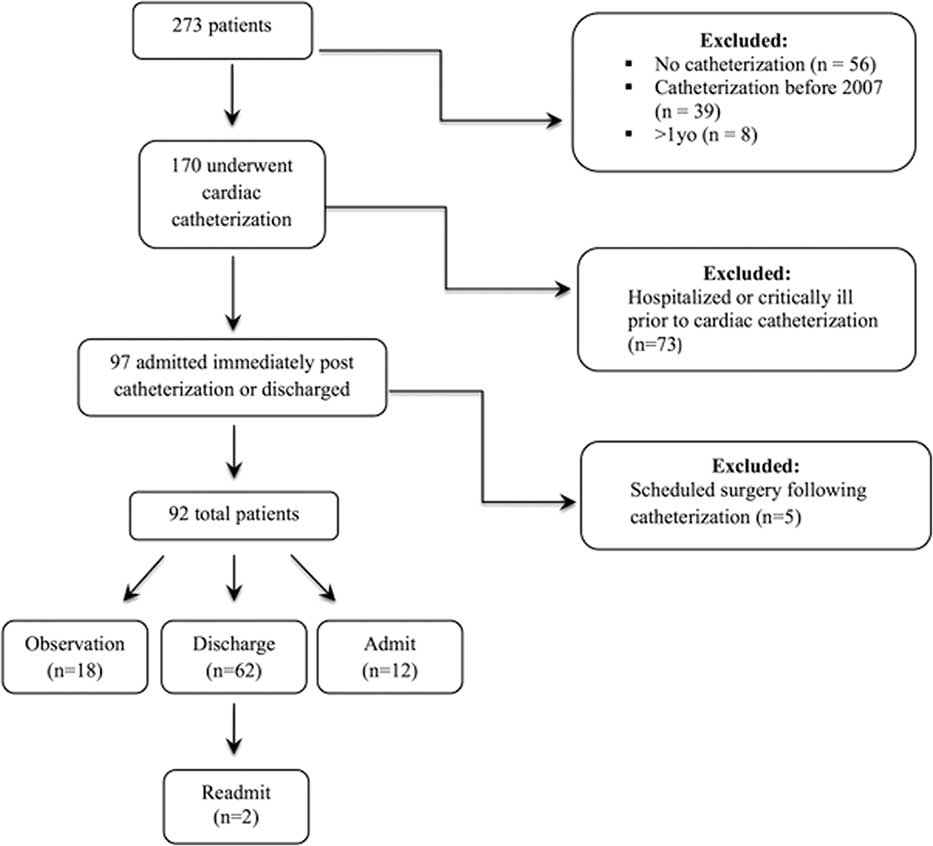
We performed a single-centre retrospective cohort study of all patients with single-ventricle and shunt-dependent biventricular CHD who underwent cardiac catheterisation at our institution between 2007 and 2015. The Society of Thoracic Surgeons Database was queried for all patients <1 year old who underwent a systemic-to-pulmonary artery shunt or stage II palliation. Only catheterisation data acquired before pre-stage II superior cavopulmonary anastomosis surgery were included for those with single-ventricle CHD. As our aim was to evaluate outcomes in the “routine” pre-stage-II cardiac catheterisation for single-ventricle patients or complete repair for patients with shunt-dependent biventricular CHD, only infants arriving to the procedure from an outpatient setting in baseline health were included. Patients were excluded if they were referred for a non-routine cardiac catheterisation, such as hospitalised, critically ill, acutely hypoxaemic, or if there was a planned admission following cardiac catheterisation for scheduled surgery (Fig 1).
Flow diagram. Flow diagram demonstrating patient selection.

Our institutional strategy is to discharge patients following a 4- to 6-hour post-procedure observation period. Decision to discharge the patient was operator-dependent under the supervision of three interventionalists and based on general guidelines, including a well-appearing patient, oxygen saturations at baseline, normal respiratory pattern, appropriate perfusion, and lack of fever. Before discharge, parents were provided with discharge instructions and return precautions. Unplanned readmissions were defined as an admission to the hospital within 48 hours of discharge after cardiac catheterisation.
Institutional Review Board approval was obtained before data collection and maintained throughout the duration of the study. A waiver for informed consent was granted for this study.
Statistical analysis
Continuous variables were assessed for normality using the Shapiro–Wilk test. Categorical variables were compared using χ2-test or Fisher’s exact test as appropriate. Continuous variables were compared using Wilcoxon rank-sum testing. To account for practice differences over time by individual interventionalists, we performed non-parametric linear trend testing on the rates of discharge following hospitalisation. Type I error was set at 0.05. All calculations were performed using Stata/IC 12.1 (Stata Corporation, College Station, TX, USA).
Results
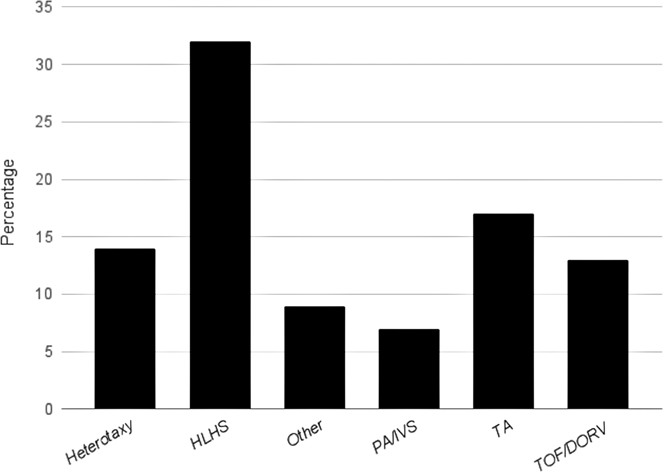
A total of 92 patients met the inclusion criteria and were included in the analysis. The most common diagnosis was hypoplastic left heart syndrome (34.8%) (Fig 2). Among 92 patients, 84 patients (91%) were dependent on a surgical systemic-to-pulmonary shunt or stented patent ductus arteriosus: modified Blalock–Taussig shunt was used in 45 patients, Sano shunt in 31, central shunt in four, and stented patent ductus arteriosus in four patients.
Distribution of CHD. Bar graph representing distribution of patient population by type of CHD. DORV=double-outlet right ventricle; HLHS=hypoplastic left heart syndrome; other=aortic atresia (n=1), hypoplastic right ventricle (n=2), and double-inlet left ventricle (n=6); PA/IVS=pulmonary atresia/intact ventricular septum; TA=tricuspid atresia; TOF=tetralogy of Fallot.

A total of 62 patients (67%) underwent an outpatient cardiac catheterisation and were discharged following a 4- to 6-hour observation period. On comparing patients who had outpatient cardiac catheterisation with the patients admitted to the hospital, we found no differences in baseline characteristics (Table 1). Patients who underwent an intervention were more likely to be admitted (12 out of 30); however, five (8%) patients in the outpatient cardiac catheterisation group did undergo minor interventions, such as coil embolisation of at least one collateral vessel. We observed no difference in the rates of patients discharged home after observation over the period of the study by linear trend testing.
Baseline characteristics for discharged patients versus patients admitted to the hospital (observed+admitted).

Values are median (interquartile range) or n (%). kg=kilogram.
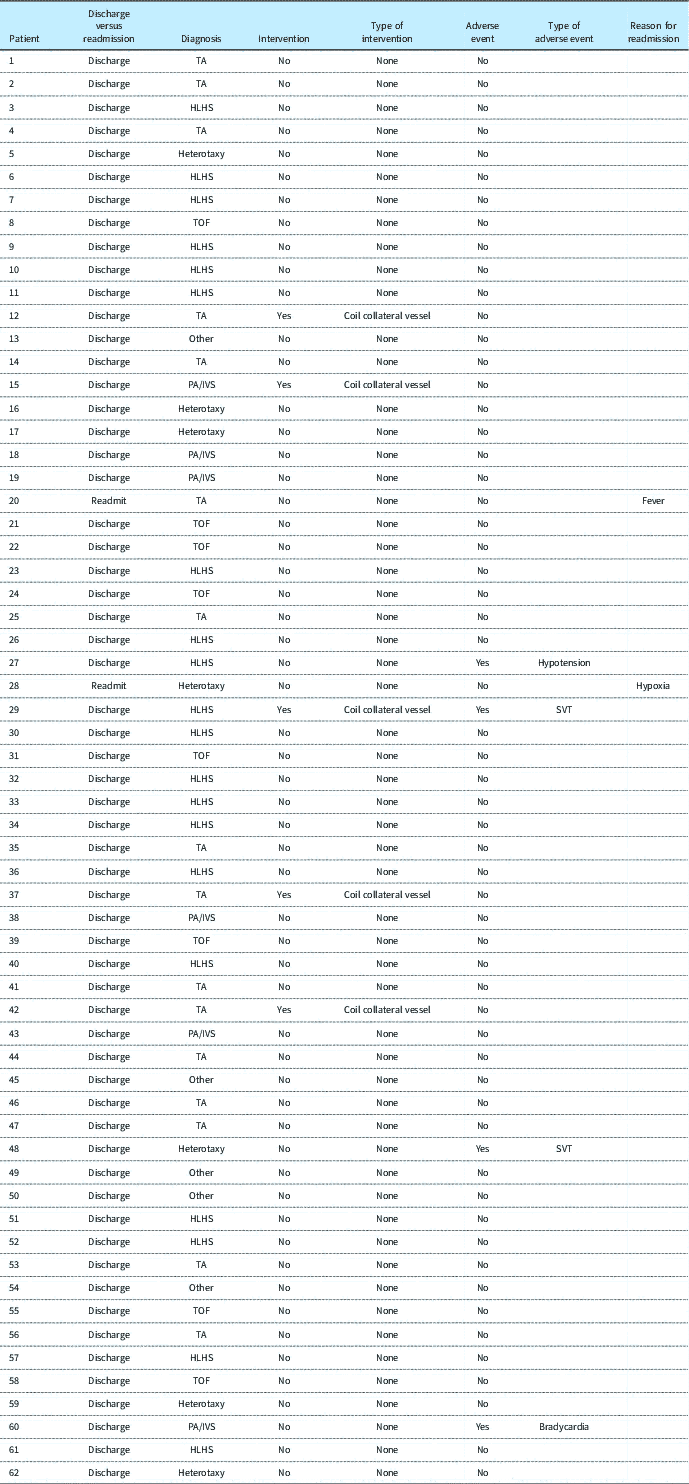
Of the 62 patients (3%), two were readmitted within 48 hours of discharge after outpatient cardiac catheterisation (Table 2). The first patient had unrepaired tricuspid atresia with normally related great vessels and pulmonary stenosis and was readmitted for fever 24 hours after catheterisation. She was diagnosed with a viral process and discharged four days later with resolution of symptoms. The second patient had double-outlet right ventricle, normally related great vessels with a sub-aortic ventricular septal defect, and was readmitted the night of catheterisation for hypoxaemia on home pulse oximeter. Chest X-ray suggested pulmonary oedema; diuretic therapy was initiated with clinical improvement. He was kept in the hospital until stage II palliation for 23 days. It is noteworthy that these patients were not dependent on a systemic-to-pulmonary shunt, nor did they undergo intervention at the time of catheterisation.
Discharged patients.

DORV=double outlet right ventricle; HLHS=hypoplastic left heart syndrome; PA/IVS=pulmonary atresia/intact ventricular septum; SVT=supraventricular tachycardia; TA=tricuspid atresia; TOF=tetralogy of Fallot.
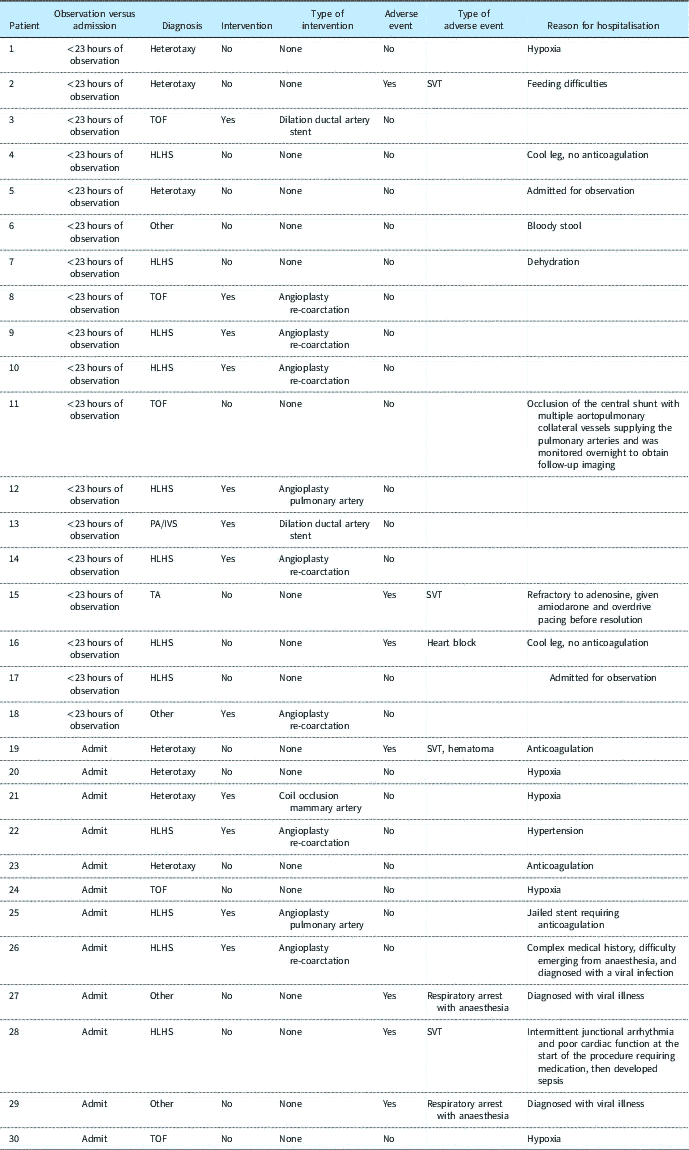
A total of 30 patients (32%) did not meet the discharge criteria after the 4- to 6-hour post-procedure observation period (Table 3); 18 were observed for ≤23 hours and the remaining 12 patients were admitted to the hospital for >23 hours.
Admitted patients.

DORV=double-outlet right ventricle; HLHS=hypoplastic left heart syndrome; PA/IVS=pulmonary atresia/intact ventricular septum; SVT=supraventricular tachycardia; TA=tricuspid atresia; TOF=tetralogy of Fallot.
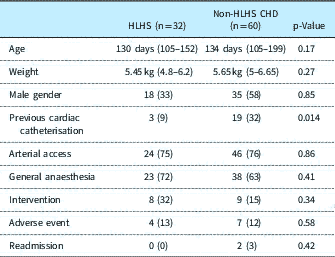
Patients were then stratified according to the type of CHD. Separating out hypoplastic left heart syndrome, there was no difference in baseline characteristics or event-specific data (Table 4). Patients with hypoplastic left heart syndrome were not more likely to be admitted to the hospital after cardiac catheterisation (p=0.47). They did not have an increased number of interventions, major adverse events, or a higher rate of readmission compared with other infants in the study population.
Baseline characteristics comparing patients with hypoplastic left heart syndrome with patients who have other forms of single-ventricle and shunt-dependent biventricular congenital heart disease.

Values are median (interquartile range) or n (%). HLHS=hypoplastic left heart syndrome; kg=kilogram.
No intra- or peri-procedural deaths occurred. There were two major intra-procedural adverse events in which the patients had a cardiac arrest during anaesthesia induction. Owing to catheter-induced arrhythmia, eight patients overall had minor adverse events, such as supraventricular tachycardia in six patients, complete heart block in one patient, and bradycardia in one patient, which resolved before completion of the case. In addition, one patient was hypotensive requiring fluid resuscitation throughout the procedure; she was discharged home without readmission.
Discussion
In this retrospective review of infants <1 year old with single-ventricle or shunt-dependent biventricular CHD who underwent elective cardiac catheterisation, we were able to define the incidence and causes of readmission. A high proportion of patients could be safely discharged on the same day as the procedure. To our knowledge, this is the first report of such findings in the literature.
Few studies have evaluated the safety of outpatient cardiac catheterisation in children. CummingReference Cumming 8 demonstrated that up to 45% of infants <1 year old (excluding newborns) were discharged the same day following cardiac catheterisation without significant complications. He also showed that outpatient cardiac catheterisation reduced anxiety in patients and families, and decreased separation time between the child and the parent, which resulted in less aggressive patient behaviour and improved sleep patterns.Reference Cumming 8 Exposure to nosocomial infection was also reduced, as was the cost of the hospital stay.Reference Cumming 8 , Reference Waldman, Young and Pappelbaum 10 , Reference Cumming 11 Furthermore, same-day discharge decreased the amount of time parents had to miss work and other children in the family had to miss school.Reference Waldman, Young and Pappelbaum 10 , Reference Cumming 11
Although each of these studies showed benefits of outpatient cardiac catheterisation, no study included patients with single-ventricle physiology during the inter-stage period or patients with shunt-dependent biventricular CHD. Complications and mortality rates remain high in patients with shunt-dependent pulmonary blood flow.Reference Gordon, Rodriguez and Lee 1 , Reference Brown, Mangeot and Anderson 2 , Reference Bove, Vandekerckhove and Panzer 12 , Reference Gladman, McCrindle and Williams 13 Studies have shown that infants with complex shunt-dependent biventricular heart disease have a 10% mortality rate following placement of a modified Blalock–Taussig shunt, and up to 11% of these patients will suffer morbidity because of shunt complications.Reference Bove, Vandekerckhove and Panzer 12 , Reference Gladman, McCrindle and Williams 13 This is even higher in the single-ventricle population, with up to 15% mortality following stage I palliation.Reference Brown, Mangeot and Anderson 2 , Reference Oster, Kelleman and McCracken 3
Our study showed an overall low readmission rate with only 3% of patients readmitted after a 4- to 6-hour observational period after cardiac catheterisation. The indications for readmission were similar to those demonstrated in other studies, including fever and hypoxaemia.Reference Waldman, Young and Pappelbaum 10 , Reference Cumming 11 Interestingly, neither patient readmitted in this study carried a diagnosis of hypoplastic left heart syndrome, nor were they dependent on a systemic-to-pulmonary artery shunt.
Infants with hypoplastic left heart syndrome are commonly considered to be a more fragile population compared with those with other forms of single-ventricle disease. These infants are dependent on a systemic right ventricle; they must undergo a prolonged neonatal surgery with hypothermic arrest and often have a lengthy recovery period. They are dependent upon a surgical shunt for pulmonary blood flow and often suffer from both systolic and diastolic dysfunction leading to decreased cardiac output and tissue oxygenation.Reference Feinstein, Benson and Dubin 14 Stage I palliation alone has a 15–20% in-hospital mortality.Reference Brown, Mangeot and Anderson 2 The causes of inter-stage mortality are not always known, but are thought to be related to haemodynamic instability such as shunt compromise, atrioventricular valve dysfunction, systemic outflow tract obstruction, or arrhythmia.Reference Brown, Mangeot and Anderson 2 , Reference Oster, Kelleman and McCracken 3 , Reference Goldberg, Schwartz and Brunberg 15 Despite this fragility, we did not identify a higher readmission rate or number of adverse events in patients with hypoplastic left heart syndrome in the current study.
There is risk with any invasive procedure including infection, bleeding, thrombosis, and even death in these infants. A study in Toronto evaluated the adverse event rate associated with cardiac catheterisation in over 11,000 children.Reference Mehta, Lee and Chaturvedi 16 Patients <6 months of age were at the highest risk for adverse events, and this increased if an intervention was performed.Reference Mehta, Lee and Chaturvedi 16 All patients in our study who underwent intervention, with the exception of coiling of a collateral vessel, were hospitalised after the procedure. Of the 12 patients hospitalised after an intervention, eight were discharged in under 23 hours and four only required a more prolonged hospitalisation. The patients who were discharged in under 23 hours were admitted electively based solely on the perceived need from monitoring after intervention. Patients tolerated the procedure well without complication. The four patients admitted for >23 hours required admission based on medical need for hypertension, hypoxia, or difficulty with anaesthesia.
Major adverse events have been reported in 9% of infants with single-ventricle CHD undergoing cardiac catheterisation before stage II palliation.Reference Goldstein, Holzer and Trucco 4 An additional 20% had minor adverse events.Reference Goldstein, Holzer and Trucco 4 In our study, there were no intra- or peri-procedural deaths, but there were two major adverse events (2%). Cardiac arrest occurred in two patients following induction of anaesthesia; both were diagnosed with a viral process following admission. Airway management and use of general anaesthesia during cardiac catheterisation varies greatly among centres.Reference Goldstein, Holzer and Trucco 4 Although this practice has varied over the past 8 years, it is currently our policy to exclusively use general anaesthesia for all cardiac catheterisations in infants with complex CHD. We did not demonstrate a difference in admission rates between infants who had general anaesthesia and those with procedural sedation. There were also no differences in discharge rates over time as related to multiple providers.
There are several limitations to the current study, including the single-centre retrospective nature. We elected to include patients with both single-ventricle CHD and those who would ultimately undergo a biventricular repair who were shunt-dependent in the neonatal period. This included patients with tetralogy of Fallot, double-outlet right ventricle, and heterotaxy variants. We also opted to include all patients with hypoplastic right ventricle. This could have artificially lowered our readmission rate because having a dominant right ventricle is known to be associated with worse outcomes before stage II palliation.Reference D’Udekem, Xu and Galati 17 However, this is likely to be balanced by the fact that we also included patients with heterotaxy, who are known to have a higher mortality compared with other forms of single-ventricle CHD, which could have increased our readmission rate and need for hospitalisation following cardiac catheterisation.Reference D’Udekem, Xu and Galati 17
Elective, outpatient cardiac catheterisation can be performed safely in infants with single-ventricle and shunt-dependent biventricular CHD with a low readmission rate so long as there is a post-procedure observational period of at least 4–6 hours. Given the fragility of the population, overnight monitoring should be available for all patients who undergo cardiac catheterisation. Moreover, as our primary objective was to establish an incidence of readmission for which no published benchmark exists, our study may lack power in assessing the impact of certain clinical factors, for example, general anaesthesia, on the safety of discharge before the post-procedure observation period. This is an important first step in improving and optimising the care in this complex patient population, as we move towards reducing peri-procedural morbidities and ultimately healthcare costs. Future studies are needed to compare the cost-effectiveness of universal 23-hour overnight observation compared with same-day discharges with potential risk for readmission.
Acknowledgements
None.
Financial Support
This research received no specific grant from any funding agency or from commercial or not-for-profit sectors.
Conflicts of Interest
None.
Ethical Standards
The authors assert that all procedures contributing to this work comply with the ethical standards of the relevant national guidelines on human experimentation and with the Helsinki Declaration of 1975, as revised in 2008, and has been approved by the Institutional Review Board.