Academics have traditionally associated capital punishment most closely with authoritarian regimes.Footnote 1 They have assumed an incompatibility between the death penalty and the presumably humane values of modern liberal democracy. However, recent scholarship on the United States by David Garland has suggested that a considerable degree of direct democratic control over a justice system actually tends to favor the retention and application of the death penalty. The reason why the United States has retained capital punishment after it has been abolished in other Western nations is not because public opinion is more supportive of the death penalty in America than in Europe or in Canada. Rather, it is because popular control over the justice system is greater in the United States than in other countries and this strengthens the influence of America's retentionist majority.Footnote 2 However, the experience of the United States in this regard has not been unique. The same link between democratic control and retention of the death penalty can be seen in the history of the effort to abolish capital punishment in France. In 1908, a bill in the Chamber of Deputies (the lower house of the French Parliament) to abolish capital punishment was defeated, in large part because of strong opposition from the public. In 1981, majority public opinion in France still favored retention of the death penalty, but in that year, the nation's Parliament defied popular sentiment and outlawed the ultimate punishment. Historians have so far provided little insight into why abolition succeeded in 1981 when it failed in 1908. The explanation for the different outcome appears to have been the greater degree of influence public opinion exerted over the nation's justice system at the turn of the twentieth century than at its end.
The Decline of the Death Penalty in France Before 1906
In1906, the opponents of capital punishment in France thought that public opinion was on their side and that the time was ripe for abolition. The death penalty had long been in decline in France, a decline that accelerated markedly in the years near 1900. The movement to abolish capital punishment began during the eighteenth century when Cesare Beccaria and his followers attacked the death penalty as inhumane and ineffective as a deterrent to crime.Footnote 3 Nonetheless, when the revolutionary French Constituent Assembly in 1791 debated the death penalty, the majority of deputies voted to keep it.Footnote 4 Napoleon's Penal Code of 1810 prescribed capital punishment for no less than thirty-six crimes.Footnote 5
However, by the 1820s and 1830s, the movement to abolish capital punishment gained steam, and seemed to have some impact on public opinion. Major French writers of the era, among them Victor Hugo, Alphonse de Lamartine, Félicité Robert de Lamennais, François Réné de Chateaubriand, and a host of minor writers and playwrights, came out strongly against capital punishment. As a consequence, the abolitionist movement, previously restricted to the councils of government and to the circles of philosophes, now spread to the “boulevards.”Footnote 6
But there was still considerable resistance to complete abolition.Footnote 7 Retentionists and abolitionists in the Parliament, therefore, agreed to what one scholar has called the “compromise of 1832.”Footnote 8 The number of capital crimes was reduced from thirty-six to twenty-two. But more importantly, a law was passed that allowed the juries of the felony courts (cours d'assises) to find extenuating circumstances for persons that they convicted of crimes, including capital ones. This obligated the three judges of the cour d'assises to lower the penalty by at least one degree below the minimum prescribed by law. In capital cases, this meant hard labor for life in place of the guillotine.Footnote 9
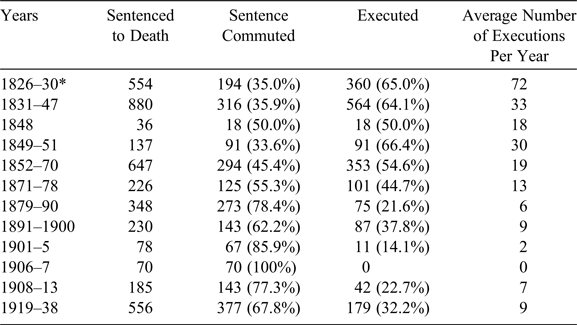
The result was a sharp decline in executions, as juries found extenuating circumstances for the overwhelming majority of persons they convicted of capital crimes. The annual average number of executions in France dropped sharply from seventy-two in the years from 1826 to 1830, to thirty-three from 1831 through 1847, to nineteen from 1852 to 1870, and to thirteen from 1871 to 1878.
The year 1879 marked another important turning point in the decline of capital punishment in France. This was when the monarchist president of the Third Republic, Marshal MacMahon, resigned from the presidency and was replaced by the Republican Jules Grévy. The Republicans had a strong anti-death penalty tradition,Footnote 10 and the heads of state—who had the power to commute sentences—were all henceforth Republicans. Far more often than their monarchist predecessors—Charles X (1824–30), Louis Philippe (1830–48), Napoleon III (1852–70), and the conservative government of the early Third Republic (1871–78)—Republican presidents commuted the sentences of persons juries had condemned to the guillotine. Largely as a consequence, the average annual number of executions in France declined to six in the years 1879–89, and to only two in 1901–05 (see Table 2). The Republican heads of state of the 1879–1905 era were in general opposed to capital punishment, but they did not commute all death sentences, only because they thought that in a democracy justice is rendered in the name of the people, and therefore it is wrong to systematically negate the decisions of juries.Footnote 11
These figures were affected to some extent by prosecutorial discretion in bringing capital cases to trial. The French system of criminal justice was characterized by an extensive pretrial procedure, in which felony cases were filtered through a series of magistrates. Many cases, including capital ones, were abandoned before trial. Under the 1808 Code of Criminal Procedure, in force until 1958, the procureur général (Public Prosecutor) made the initial determination about whether a reported crime should be investigated. If he decided yes, and the offense appeared to be a felony, he was obliged to refer the case to a juge d'instruction (investigating magistrate), who was a member of the judiciary of the bench, enjoying security of tenure, and who was delegated to this position for a 3 year term. There was at least one juge d'instruction in each arrondissement (district). Other than in cases of flagrant délit, the juge d'instruction could only investigate cases referred to him by the procureur général. The investigating magistrate then conducted a very thorough investigation of the case, though under the watch of the procureur général.Footnote 12 Before 1897, the juge d'instruction could interrogate the suspect without the presence of a defense attorney. The 1897 reform, therefore, put a new limit on the investigating magistrate's powers.Footnote 13 Nonetheless, the juge d'instruction essentially decided which investigated cases went to trial. If he recommended trial, the juge d'instruction's decision had to be confirmed by a five judge panel, the chambre des mises en accusation (Chamber of Accusation), which formally indicted the accused.Footnote 14 In most cases, however, the chambre des mises en accusation confirmed the findings of the juge d'instruction.Footnote 15
In the course of the nineteenth and twentieth centuries, the proportion of all reported crimes dropped before trial increased considerably,Footnote 16 but this was not generally true of capital crimes. The overwhelming majority of reported poisoning cases did not go to trial; however, the proportions changed little from the middle of the nineteenth century on.Footnote 17 Parricide cases were so few as to hardly make a difference. The proportion of reported cases of assassinat (the principal capital crime) dropped before trial actually declined from 58% in 1846–50 to 50% in 1907.Footnote 18 Therefore, the decline in executions from 1832 on was generally the result of the growing mercy of the juries and of the executive branch of government, not of prosecutorial discretion.
1906: Abolitionists Seize the Moment
In 1906, the political prospects for abolition of capital punishment suddenly brightened. In January, the Parliament elected Armand Fallières to the presidency of the Republic. Faillières detested capital punishment, and in the first 2 years of his administration, he commuted the sentences of all persons condemned to the guillotine.Footnote 19 Fallières'election was followed by the parliamentary elections of the spring, which gave left-wing Republicans a big majority in the Chamber of Deputies. Georges Clemenceau—a strong opponent of capital punishment—became prime minister.Footnote 20 Several deputies later claimed that there was at this time a majority in the Chamber opposed to capital punishment.Footnote 21 They had reason to believe this, because in October, a proposal to eliminate the salary of the public executioner—and therefore bring about the de facto abolition of the death penalty—was introduced in the Chamber, and it appeared to have majority support. However, Justice Minister Jean Guyot-Dessaigne opposed the amendment because he thought that abolition should be fully and openly debated. Guyot-Dessaigne was able to get the crucial backing of Deputy Joseph Reinach, a leading abolitionist, by promising to introduce a bill for outright abolition of the death penalty. Reinach spoke strongly in favor of this arrangement,Footnote 22 and he was able to win over enough abolitionists to join with those who favored capital punishment to defeat the de-funding proposal, although only by a narrow margin of 247 to 235.Footnote 23 Nonetheless, the budget vote greatly encouraged abolitionists, who now moved ahead with a bill to end capital punishment. At the end of 1906, the eventual success of the abolition bill seemed certain.Footnote 24 According to Jean-Yves Le Naour, Reinach, in particular, was convinced that a vote on capital punishment would be only a “formality” and that the only real debate would be on the punishment to replace it.Footnote 25
The Reaction Against Abolition: 1907–8
By the time debate began on the bill in July, 1908, the tide of public opinion had seemingly turned strongly against abolition. The years 1907–8 were marked by a reaction in favor of the guillotine, because of an outbreak of social fear and a major newspaper campaign against abolition. The campaign began in early 1907 with the atrocious Soleilland murder case. At the end of January, a young man, Albert Soleilland, raped, multilated, and murdered 11-year old Marthe Erbelding. The public (especially parents) was outraged by this murder, which was highly publicized in the press, primarily in the mass-circulation Le Petit Parisien.Footnote 26 Nonetheless, in September, President Faillières commuted Soleilland's death sentence to a life of hard labor.Footnote 27 Such was the angry public reaction to the murder and the commutation, that several abolitionist deputies during the 1908 debate claimed that the case had done much to turn public opinion against abolition.Footnote 28 Modern historians agree that Soleilland's crime, and the publicity over it, were crucial for the ultimate defeat of the abolition bill.Footnote 29
The Soleilland murder was followed by an intense wave of publicity in certain mass-circulation newspapers concerning other “dramatic and bloody” crimes, including the activities of youthful gangs of criminals called “apaches.” These newspapers claimed that the public was being gravely threatened by a rise in violent crimes.Footnote 30 According to Gordon Wright, this encouraged a “sense of panic.”Footnote 31 Robert A. Nye has estimated that most newspapers opposed abolition, and by the eve of the parliamentary debate in mid-1908, the only papers that favored abolition “were of Socialist or center-left conviction.”Footnote 32 The wave of public support for the guillotine was also reflected in the fact that juries in many departments inundated Paris with petitions opposing the abolition bill.Footnote 33 After October 1907, the Ministry of Justice refused to receive any more of these petitions, but this only meant that thereafter juries sent their retentionist statements to the Chamber of Deputies and to the Senate.Footnote 34 The protests of juries were joined by those of many elected town and departmental councils.Footnote 35 Even the Chamber of Deputies' Commission on Judicial Reform, which was initially in favor of abolition of the death penalty, reversed itself, apparently convinced that public opinion had turned against abolition, and that crime was rising.Footnote 36
The retentionists also received intellectual support from criminologists. Modern criminology, or criminal anthropology, originated with the publication of Cesare Lombroso's Uomo delinquente in 1876. Lombroso rejected earlier “free will” theories of crime. In their place, he developed the concept of the ‘born criminal,” an atavistic throwback to earlier stages of human evolution. Criminologists in France tended to reject Lombroso's notion of criminals as evolutionary throwbacks in favor of sociological theories of crime causation. However, as some modern scholars have pointed out, the French school of criminal anthropology, led by Alexandre Lacassagne, Professor of Legal Medicine at the University of Lyon, was not all that removed from the theories of Lombroso.Footnote 37 The scholars of this school held that at least some criminals were the products of hereditary degeneration, in a process Nye has called “Neo-Lamarckian,” with its concept of the inheritance of acquired characteristics, characteristics that might originate from the influence of the social environment, but that then tended to be handed down to future generations. Such notions broke with older ideas of poverty as a cause of crime.Footnote 38
Most pertinent to the debate on capital punishment was the criminal anthropologists’ concept of “social defense.” This included the expulsion of “incorrigibles.” In the late nineteenth century, fear of an apparent rise in recidivism led the French Parliament to pass the Relegation Law of 1885, which provided for the transportation to a penal colony of recidivists convicted of certain crimes, including even some misdemeanors,Footnote 39 but by the early years of the twentieth century, it had become apparent to criminal anthropologists that transportation was not working at adequately defending society from “incorrigibles.” Some criminologists came to believe that capital punishment was the one sure way of doing so.Footnote 40 This opinion was not shared by all criminologists,Footnote 41 and as late as 1906, Lacassagne denied the effectiveness of capital punishment as a deterrent to crime.Footnote 42
By 1908, however, Lacassagne had changed his mind. In that year, he published his Peine de mort et criminalité in response to the death penalty debate. According to Lacassagne: “The lessons of the past teach us that, from the earliest antiquity, one did not hesitate to eliminate antisocials. Death appears to be a rapid and sure procedure.”Footnote 43 Referring to the society of an ant hill, Lacassagne observed that “thieves and assassins are sacrificed; certain parasites are expelled, others serve the community and are exploited for the collective satisfaction and the well-being of all.” But “we preserve too many useless and dangerous dregs; the expense of keeping them is truly excessive…”Footnote 44 Lacassagne concluded by stating: “The public powers must, in regard to the body social, act as prudent and educated doctors: in the serious cases beyond the resources of medicine, do not hesitate to conduct a surgical operation…”Footnote 45 Another major criminal anthropologist, Armand Corre, in the same year wrote: “I ask even, presently, if certain criminals, monstrosities in the midst of the collectivity, merit the bother and expense of keeping them in a cage, and if their suppression pure and simple…would not be a relic to keep in our laws, or a habit to establish.”Footnote 46
In Nyes' opinion, criminologists in 1907–8 were highly sensitive to public opinion and the “debate on capital punishment provided them with an excellent opportunity to present a case for the social utility of criminological theory.” Criminologists now “marshaled the forces of criminological knowledge to illustrate the great advantages of retaining the guillotine.”Footnote 47 In fact, during the parliamentary debate of 1908, several retentionist deputies cited the arguments of criminologists (Lacassagne and Henri Joly) in favor of capital punishment.Footnote 48
In retrospect, Reinach and the abolitionists who had voted with him against de facto abolition in December 1906, in order to get a vote on de jure abolition later, had made a tactical mistake. The delay enabled the retentionists to mobilize against the government proposal.Footnote 49 The legislative process, and stalling tactics (by the abolitionists themselves) kept the proposal from being debated until July 3, 1908. The abolition proposal, introduced by Guyot-Dessaigne in November 1906, with its substitution punishment of 6 years of complete cellular isolation followed by life “internment”Footnote 50 was sent in proper legislative fashion to the Chamber of Deputies' Commission on Judicial Reform. The commission was dominated by abolitionists, including its head, Louis Peuch, and the rapporteur for the bill, Jean Cruppi, a prominent politician-jurist.Footnote 51 The Commission's seventy-five page report, which recommended abolition of the death penalty, contained a historical background on capital punishment and a wealth of data and analysis on criminality and the death penalty in France and in other countries. Therefore, the report took months to complete, and it was not presented to the Chamber of Deputies until October 22, 1907.Footnote 52
This meant that the report was issued following the uproar over the Soleilland murder and pardon. The abolitionists, aware that their proposal stood little chance in the prevailing state of “panic,” delayed consideration of their bill for what they hoped was a more favorable time, while the retentionists, seeing that they now had a real chance to defeat it, pressed for a quick parliamentary debate.Footnote 53 At the end of 1907, Guyot-Dessaigne died. He was replaced as minister of justice by Minister of Commerce Aristide Briand and Cruppi, who now became minister of commerce, was replaced as rapporteur for the abolition proposal by another abolitionist, Raoul Peret. By June 1908, the Commission on Judicial Reform had changed its mind on abolition. Peret's position as rapporteur was taken by the retentionist Henry Castillard. The Commission now scrapped the Cruppi report and in late June issued a new one in favor of retention of the death penalty.Footnote 54
The Parliamentary Debate of 1908 and the Defeat of Abolition
Although the commission rejected abolition, the government still favored the bill outlawing the death penalty. The proposed legislation called for “perpetual internment,” with complete cellular isolation in the first 6 years, after which the convict could work with other prisoners, as an effective deterrent in place of the guillotine.Footnote 55 Briand, however, tried to further stall debate on abolition. On June 26, however, the retentionists were able to get the Chamber of Deputies, by a vote of 341 to 131, to set July 3 for the opening of debate.Footnote 56
The debate continued (with breaks) until December 8. It focused little on the humanitarian and moral dimensions of the capital punishment issue. Most speakers argued on the basis of utilitarian considerations.
This above all meant attention to the alleged deterrent effect of the death penalty on capital crimes. No other issue consumed so much of the debate. The pro-death penalty deputy Maurice Ajam went so far as to state that “our whole quarrel is strictly limited to this question: ‘Yes or no, can the death penalty be considered intimidating?’ That is the whole question, and I declare that there are no others.”Footnote 57 Predictably, pro-capital punishment speakers claimed that fear of the guillotine prevented some would-be murderers from committing their crimes, and just as predictably, abolitionists claimed the death penalty had no deterrent effect.Footnote 58
In the debates on this issue, the retentionists often adopted a rhetoric of fear, warning of the social danger presented by an upsurge of “crimes of blood,” and that only the dread of the guillotine can stop the hand of an assassin. Some of their statements came close to restating the thesis of the early nineteenth century conservative political philosopher Joseph de Maistre that the executioner “is the horror and the bond of human society. Remove him from the world, and order instantly gives way to chaos; thrones decay and society disappears.”Footnote 59 This sort of rhetoric was very evident in Castillard's dismissal of the idea that perpetual internment was at least as effective a deterrent to murder as the guillotine:
The abolitionists claim that the death penalty is ineffective and that it does not stop the arm of the lawbreaker. This assertion, I scarcely need to say, does not rest on any proof, because no one can know how many individuals have been stopped in their projects of assassination by fear of the scaffold. But in place of claiming that it never has, it is, to the contrary, infinitely more natural to think that it often has. It perhaps shows a little too much disdain for the truth to say, as the honorable M. Cruppi says in his report, that perpetual internment is a more effective and more exemplary punishment than the death penalty. It is certain, in fact, that death inspires in a man much more vivid fears than incarceration. The instinct for survival dominates all other sentiments.Footnote 60
Another retentionist deputy, Auguste Failliot, spoke in very similar terms: “The Commision on Pardons [which made its recommendations on pardons and commutations to the President of the Republic] constantly substitutes itself for the juries, and while the latter condemn, the former commute or absolve the most cowardly and odious crimes. From this comes the resurgence of crimes which augment in France, logically, naturally.” Failliot added that, “many scoundrels constantly admit that there is only one penalty they dread, and that is the death penalty.”Footnote 61 Louis de Folleville said much the same thing: “I estimate, that in our state of morals, when crimes of blood follow an ascending level in their number and their frequency, especially when they assume a dreadful character of atrocity and of cruelty, the death penalty could not be suppressed without a real danger for society.”Footnote 62
This view was seemingly related to the retentionists'assumption that certain criminals are irredeemable and, therefore, cannot be rehabilitated. According to de Folleville, “There are, unfortunately, some hardened and absolutely incorrigible criminals; experience has shown that there are some convicts one can not hope to rehabilitate.”Footnote 63 The novelist-deputy Maurice Barrès put it more eloquently: “And, ordinarily, when we are in the presence of a criminal, we find a man in degeneration, a fallen man outside of humanity and a man who has not yet arrived at humanity.”Footnote 64 Antoine Gérard-Varet too said, “I admit…that I have only mediocre confidence in the indefinite rehabilitation of the guilty…”Footnote 65
As abolitionist deputies made clear, these fatalistic assumptions ran counter to both Christian redemptionism and to the modern liberal concept of rehabilitation. When de Folleville made his statement about the irredeemability of certain criminals, the churchman-deputy the Abbé Jules Lemire replied, “You know nothing! No one can know in advance.”Footnote 66 The Socialist leader Jean Jaurès observed of Barres' statement, “It is strange to hear of the irremediable fall proclaimed by Christians of the right.”Footnote 67 At later times in the debate, Juarès—a politician known for his eloquence—further stated his objections to what he called the retentionists' “doctrine of fatality which we oppose. I think I can say that it is contrary to what, for two thousand years, has been humanity's highest thought and most noble dream. It is contrary to the spirit of both Christianity and the Revolution.” Christianity “has proclaimed, with the universal fall, the universal possibility of raising up.”Footnote 68 The guillotine: “Is the signal of voluntary despair, systematic and eternal; it is the red disk projecting its bloody gleams on the rails and signifying that the way is barred, that human hope shall not pass.”Footnote 69
Both sides frequently used the crime statistics published in the Ministry of Justice's annual Compte général de l'administration de la justice criminelle to support its arguments, sometimes using the same data to arrive at opposite conclusions. Proponents of the guillotine used figures that purportedly showed that murders (or “crimes of blood”) had risen considerably since 1900 or thereabouts, when executions became rare, and especially since the de facto abolition of capital punishment in 1906.Footnote 70 Louis Peuch, President of the Commission on Judicial Reform, who (like his commission) had since 1906 been converted to the cause of retention of capital punishment, claimed that the increase in homicides had been “certain, incessant, steady.”Footnote 71 Peuch also produced statistics to show that cases of counterfeiting rose considerably following abolition of the death penalty for the crime in 1832.Footnote 72
However, Minister of Justice Aristide Briand cited the same judicial statistics to show that the retentionists had used the crime data in a misleading way. Briand agreed that murders had increased considerably since 1900 or thereabouts, but the retentionists had included meurtre (second degree murder), which was not punishable by death except when it was accompanied by another crime or misdemeanor, with assassinat (premeditated or first-degree homicide) which was a capital crime. The increase in “crimes of blood” from 1898 to 1907 was actually the result of a big rise in cases of simple or noncapital murder,Footnote 73 “and when one adds the enormous figure of simple murders to ‘grand crimes’ and special murders punishable by death, naturally one can impress the Chamber and impress the country.”Footnote 74
Another very frequently mentioned issue was the irreparability of wrongful executions. In the nineteenth century, this had been one of the strongest objections of abolitionists against the death penalty, and it was related to the era's increased respect for human rights.Footnote 75 The possibility that innocent persons could be guillotined was still a very major concern among abolitionists in1908. The irreparability argument was made by abolitionist deputies many times. Judicial errors are sometimes made, and therefore innocent persons (along with insane people who are not responsible for their crimes) could be sent to the guillotine.Footnote 76 The abolitionists cited what they said were documented cases of wrongful executions.Footnote 77
To this, retentionists replied that by 1908 the French justice system had been perfected to the point that it was virtually impossible for an innocent person to be executed.Footnote 78 Castillard noted that before execution, a capital case had to go through so many meticulous examinations—several levels of pretrial investigation by magistrates, trial in the cour d'assises by three judges and twelve jurors, consideration of clemency requests by the Office of Pardons and the administrative council of the Ministry of Justice, the minister of justice, and finally the president of the Republic—that the “present procedure offers all the guarantees that can be humanly desired, and the irreparability of the death penalty does not present the same danger as in former times.”Footnote 79
Abolitionists responded to this argument by noting that as long as there is human fallibility, there will be errors of justice.Footnote 80 As Paul Deschanel put it, the scaffold was “a hideous monument to human pride, which attests to man's naïve belief in his infallibility!”Footnote 81 Briand, speaking from his experience as minister of justice, stated that the problem of judicial error was “more troubling, more disturbing” than retentionists claimed it to be.Footnote 82 Jean Marie Magnaud, himself a judge, noted that no magistrate is infallible.Footnote 83 Albert Willm summed up the irreparability argument this way: “The very fact that there is a possibility of error is sufficient to justify the disappearance of the death penalty from our codes.”Footnote 84
How many deputies, if any, were persuaded to change or to make up their minds because of these arguments is impossible to measure. One thing is certain, however: both sides in the debate agreed that public opinion in 1908 was hostile to abolition, and that events since 1906—especially as they were reported and commented upon by the newspaper press—were largely responsible for this hostility. Democratically elected politicians (although the democratic and representative character of the legislature of the era was limited by the fact that women were not allowed to vote in France until 1944)Footnote 85 could not ignore this hostility, and majority opinion in the Chamber of Deputies had changed from apparent opposition to the death penalty in 1906 to support of it in 1908. As Briand pointed out in the debate, some deputies, such as Louis Peuch and Fernand Labori, who had voted against funding for executions in 1906, by 1908 had become supporters of the death penalty.Footnote 86
Retentionist deputies spared no opportunity to point out that public opinion was now strongly on their side.Footnote 87 This, they noted, was reflected in the flood of jury petitions in favor of retention of the death penalty,Footnote 88 along with the protests of most local councils against abolition.Footnote 89 Therefore, one of the arguments of the retentionists was a democratic one: deputies, as representatives of the people, should vote as the people wanted them to vote.Footnote 90 Jurors in particular should be listened to, because they were the representatives of the people in the justice system.Footnote 91 Retentionists claimed that the surge of public support for the death penalty in 1907–8 was the result of a well-justified fear created by a real rise in criminal homicides.Footnote 92
Abolitionists did not dispute that public opinion had turned in favor of the guillotine, but it was not because of a real rise in “crimes of blood.” Rather, a press campaign against abolition misled or panicked much of the public into believing that their security was gravely threatened by a wave of murders somehow linked with the rarity of executions followed by the de facto abolition of the guillotine.Footnote 93 Some abolitionists claimed that the retentionist campaign was politically motivated, that it was led by the conservative and moderate opponents of the radical government.Footnote 94 As for the retentionists' claim that public opinion was on their side, abolitionists retorted that even in a democracy the representatives of the people have a duty to resist a majority that has been misled or blinded by demagoguery.Footnote 95 Several abolitionist Republicans also reminded their retentionist brethren that they were breaking with Republican tradition by favoring capital punishment.Footnote 96
But the majority of deputies sided with public opinion, and the abolition bill was defeated by 330 to 201 votes on December 8, 1908.Footnote 97 Many moderate Republicans joined with conservatives to defeat the bill, which was solidly supported only by the Socialists.Footnote 98
Public Opinion and the Defeat of Abolition
Modern historians generally agree with the abolitionists that the retentionist newspaper campaign did much to turn public opinion against abolition, and contributed decisively to the defeat of the bill to end capital punishment in 1908.Footnote 99 There is no doubt that by the turn of the twentieth century, the rise of mass-circulation newspapers (along with the rise of mass literacy) had given the press a great deal of influence on public opinion. As Briand claimed, this made it much easier than in earlier eras to panic the French public, especially since the papers devoted so much space to crime news.Footnote 100
It is very difficult, however, to measure public opinion of the time. National opinion polls did not yet exist. Le Petit Parisien, the leading mass-circulation newspaper of the era, held a “referendum” on the death penalty, conducted from September to November 1907. Among the 1,412,347 respondents, 1,083,655 voted to keep capital punishment, and only 328,692 voted for abolition,Footnote 101 but the result was highly suspect. The respondents were a self-selected group among the readers of the leading retentionist newspaper, run by men of the moderate left who distrusted the radicals who were pushing for abolition.Footnote 102
An attempt can be made to gauge public opinion as it was expressed by juries. Certainly, these panels were very active in the fight to keep the guillotine, as measured by the many jury petitions in favor of capital punishment,Footnote 103 but these were also suspect as a measure of public opinion, because jurors were not representative of the population as a whole. Not only were women excluded from the panels, but the laws governing jury selection at the time ensured that most jurors were bourgeois, many of them by 1900 or thereabouts being men from the middle and lower-middle classes.Footnote 104 Nonetheless, jury opinion is one of the few barometers available of, at least, bourgeois opinion on capital punishment both before and after 1906.
In the 1908 debate, some abolitionists claimed that juries were largely responsible for the decline of the death penalty in France because they so very often found extenuating circumstances for the capital offenders that they convicted.Footnote 105 As Lemire stated, “They tell us: Listen to the petitions of the juries. Yes, I hear what they say, but I also see what they do.”Footnote 106 As for the sharp rise in death sentences in the years 1906–8, the abolitionist deputy Victor Dejeante claimed that it was because “The juries have obeyed your [retentionist] press!”Footnote 107 Or, as Gordon Wright later stated, the juries “turned tough.”Footnote 108
There is evidence, however, that seems to show that the alleged effect of the retentionist newspaper campaign on jurors was exaggerated, and that juries were turning tougher long before 1906. Abolitionists were perhaps too optimistic about how much jury opinion was on their side in 1906. For one thing, according to evidence gathered by Julie Le Quang Sang, already, in January 1907, eighteen juries had sent petitions to the minister of justice, although Le Petit Parisien did not report on the Soleilland crime until the last day of the month, and did not begin the retentionist newspaper campaign until February.Footnote 109
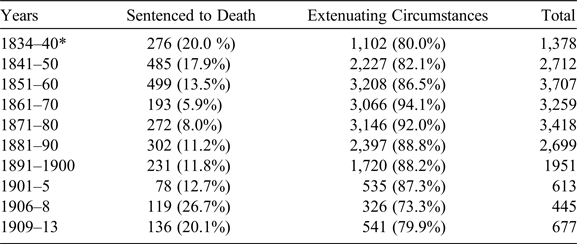
More important, for some four decades before 1906, juries had become increasingly willing to send the persons they convicted of capital crimes to the guillotine. From the 1830s through the 1860s, juries used their right to find extenuating circumstances to spare from the guillotine an increasing proportion of persons whom the panels convicted of capital crimes. The proportion sentenced to death reached a low of less than 6% in the years 1861–70. Thereafter, it rose until it reached almost 13% in 1901–5 (see Table 1).Footnote 110 The only reasons for the continuing decline in executions from the 1870s on were the sharp rise in commutations by Republican presidents, who were elected not by popular vote but by the two houses—Chamber of Deputies and Senate—of the Parliament,Footnote 111 and a decline in convictions.Footnote 112 Even the rise in death sentences from eighteen in 1905 to twenty-nine in 1906 preceded the retentionist press campaign. It is true that death sentences continued to increase to forty-one in 1907 and to forty-nine in 1908.Footnote 113 Moreover, most of the jury petitions against abolition came after the Soleilland murder.Footnote 114 Therefore, the retentionist newspaper campaign appears to have had some significant effect on juries, but press influence on the panels should not be exaggerated.
Persons Convicted of Capital Crimes: Number Sentenced to Death and Number Found Guilty with Extenuating Circumstances

Source: Ministère de la Justice, Compte général de l'administration de la justice criminelle pendant l'année…(hereafter Compte general) (Paris: Imprimerie Nationale, 1836–1915), 1834–35, Table 6, p. 15, and Table, p. 17; 1836–60, Table 6, p. 13, and Table 7, p. 15; 1861–70, Table 6, p. 15, and Table 7, p. 17; 1871–73, Table 6, p. 17, and Table 7, p. 19; 1874–85, Table 7, p. 25, and Table 8, p. 27; 1886–1909, Table 7, p. 19, and Table 8, p. 21; 1910–13, Table 7, p. 21, and Table 8, p. 23.
*The Compte général's tables on findings of extenuating circumstances began in 1834.
A few historians have suggested that a relatively conservative judiciary, still smarting from the Republican purge of magistrates in 1879–83, and distrustful of the radicals in power, in some fashion aided or abetted the drawing up of retentionist jury petitions,Footnote 115 but the influence of judges on jurors was limited. In France in the nineteenth and early twentieth centuries, juries often defied judges—who frequently appear to have had a pro-conviction bias—by acquitting many defendants.Footnote 116 There is no reason to believe that judges had any more influence on jurors in the drawing up of retentionist petitions. Le Naour does mention several instances in which présidents of the cours d'assises spoke in favor of retentionist protests issued by the juries of their courts as evidence that the petitions “were not quite spontaneous,” but the cases he cites suggest that it was the jurors who took the initiative.Footnote 117
The abolitionist deputy Albert Willm sought an explanation for the strong retentionist sentiment of jurors in the psychology of the citizen-judges. When the guillotine was still in use, juries were very keen to save the heads of the capital offenders whom they convicted. When President Faillières commuted all death sentences from 1906 to 1908, however, juries became much more willing to hand down such sentences. One reason was the panels' knowledge that Fallières would not allow any executions. But juries were also not willing to renounce their power to decide life or death. When Faillières commuted all death sentences, jurors thought that the chief executive was completely negating the sentencing power of juries in capital cases.Footnote 118 As Le Naour mentions, juries by the turn of the twentieth century rarely sentenced people to death, but they were jealous of their power to do so.Footnote 119 It seems that jurors wanted at least the option of sentencing persons to the guillotine. By the years near 1900, juries still thought that some criminals—mostly those who had killed to steal—deserved the guillotine.Footnote 120
Evidence from some of the jury petitions of 1907–8 supports the contention that jurors wanted to retain their power over life and death. Several newspapers expressed puzzlement that juries were so insistent on retention of the death penalty when so many of their verdicts were lenient.Footnote 121 Perhaps the contradiction can be explained in part by the panels' resentment that all of their death penalty verdicts were being overturned by the executive branch of government. Expressions of this resentment can be found in the wording of some of the jury petitions.
This was certainly true of the protests of Parisian juries who, “without contest,” led the petition campaign.Footnote 122 Some of their petitions were published in the newspapers. In general, they expressed the fear of the rising crime so characteristic of these years and called for retention of the death penalty as an effective deterrent,Footnote 123 but several of the petitions included protests against President Faillières' refusal to implement the death penalty verdicts handed down by juries. For example, in late September, the jury of the department of the Seine (Paris) wrote a petition expressing regret that “the decisions of the jury and of the court are not sufficiently taken into account and, for the purpose of social defense, ask for the maintenance of the death penalty and its application.”Footnote 124 In mid-October, another Parisian jury wrote in its petition that “the death penalty be maintained for the purpose of social defense and that the generalized application of the right to grant clemency not reverse the sentences of juries.”Footnote 125 At the end of the month, jurors of the next session of the cours d'assises of the Seine called for the continuation of the death penalty and added “that the decisions of the jury be respected.”Footnote 126 In mid-November, another panel expressed support for the death penalty and called for clemency to be granted only in exceptional cases.Footnote 127 In late September 1908, the jury of the Seine once again sent a petition stating that “the death penalty, not being applied, be reestablished following the verdicts handed down by the juries and pronounced by the courts.”Footnote 128
Parisian juries were not the only ones to express such views. In late 1907, a jury in the department of the Nord contended that the right to grant clemency often rendered “illusory the condemnations of the Cours d'assises.”Footnote 129 Jurors in the department of the Bouches-du-Rhône protested in 1908 that a rise in the local crime rate “can be attributed to the fact that the death sentences pronounced by the jury for several years have never been carried out…The below signed jurors express the view that the death penalty be maintained in our codes and applied without weakness.”Footnote 130
Jury opposition to the overturning of verdicts was not limited to the years 1907–8. Bernard Schnapper has found instances in other years (1889 and 1910) when juries protested presidential clemency.Footnote 131 Here is evidence of a conflict between the “democratic” institution of the jury (although its representative character was limited in France in this period) and the traditional monarchical power of grace, now bestowed on the President of the Republic. As James Q. Whitman has observed, in Old Regime France “the power of grace was the exclusive prerogative of the king,” and thereby “linked to the display of royal sovereignty…” It was, therefore, seen by eighteenth century philosophers as inconsistent with a “republic founded on popular sovereignty.”Footnote 132 The power to pardon and to commute sentences for persons tried by jury was abolished in the revolutionary Code pénal of 1791,Footnote 133 but the power of grace was restored under Napoleon and kept in all French constitutions since.Footnote 134 The protests of some juries against the presidential granting of mercy thus harkened back to the revolutionary concept of the sovereignty of the people in penal law.
There is reason to believe that jury decisions reflected a public fear of crime that was already rising in the years before 1906. By the fin de siècle era, the French had become very concerned about the rise of recidivism and the development of urban criminality: the anarchist crimes of the 1890s, soon followed by the wave of fear of “apaches.”Footnote 135 According to Le Naour, the press campaign against crime really began with issues of Le Journal in 1900–101.Footnote 136 When the Compte général in 1903 reported that the crime rate had declined from 1880 to 1900, a number of journalists did not believe the statistics. The Belle Epoque was an era of fear “which cultivated a true psychosis in regard to crime.”Footnote 137 The wave of fear was not totally unjustified: if the judicial statistics on cases tried were any indication, homicides did rise from 1898 to 1907, although, as Briand noted, it was nearly all because of an increase in murders not punishable by death.Footnote 138 However, as Briand had to admit, the public did not make a distinction between the different categories of murder.Footnote 139 The abolitionists of 1906 overlooked the public's fear of crime: the rarity of executions in the years near1900 may have deceived them. As the American experience has shown, a paucity of executions is not necessarily a reflection of public opinion on capital punishment. Opinion polls in the United States from the mid-1980s through the early 2000s indicate that capital punishment has had the support of approximately 65–80% of the public,Footnote 140 but the number of executions has been very small.Footnote 141
The effort to abolish capital punishment in 1906–8 ironically led to a reaffirmation of the death penalty among the French, and in this respect the controversy appears to have had a long-term impact. There was a resurgence of executions after 1908. At the end of that year, Faillières abandoned the policy of no executions.Footnote 142 Through the remaining pre-World War I years, both the proportion of persons convicted of capital crimes who were sentenced to death and the number of executions stayed well above pre-1906 levels. The trend toward more executions continued into the post-World War I era (see Tables 1 and 2), despite an easing of the fear of crime among the French.Footnote 143 Not until the 1950s and after was there a sharp decline in death sentences in France.Footnote 144 The last execution occurred in 1977.Footnote 145 In 1981, under the Socialist President François Mitterand, the Parliament finally enacted a law to formally abolish the death penalty, 73 years after the last serious attempt to do so.Footnote 146
Commutations and Executions of Persons Sentenced to Death and Annual Average Number of Executions
Sources: Ministère de la Justice, Compte général de l'administration de la justice criminelle pendant l'année…(hereafter Compte general) (Paris: Imprimerie Nationale, 1836–1915), 1826–27, Table 12, p. 21; 1828–31, Table 7, p. 13; 1832, Table 7, p. 15; 1833, Table 9, p. 19; 1834–35, Table 10, p. 21; 1836–60, Table 10, p. 19; 1861–69, Table 10, p. 21; 1870, Table 10, p. 20; 1871–73, Table 10, p. 23; 1874, Table 11, p. 31; 1875–85, Table 12, p. 32; 1886–1909, Table 12, Table 12, p. 26; 1910–13, Table 12, p. 28; 1919–38; and Savey–Casard, La peine de mort, 144. The judicial statistics for 1914–18 and 1939 are not available.
*The Compte général's tables on commutations and executions began in 1826.
Abolition and Democracy
The 1908 debate was significant in the history of the death penalty controversy in the Western world because it brought together two broad themes: the movement to abolish capital punishment, and the extent of democratic control over a nation's justice system. Garland has noted that abolition of the death penalty and democracy are both outgrowths of modern liberalism; however, the two have sometimes conflicted. Perhaps the clearest example of this can be found in the United States. By the end of the twentieth century, the movement to abolish capital punishment had triumphed in all Western countries save America. According to Garland, this was not because Americans favored the death penalty more than did Europeans or Canadians. Rather, it was because in Western countries other than America, politicians were able to impose abolition despite majority public opinion in favor of the death penalty.Footnote 147 The French scholar Jean Imbert has claimed that politicians in the United States have legislated in accordance with the wishes of a retentionist majority because “the representatives of the American people have a rather demagogic conception of democracy…”Footnote 148 French abolitionists in 1908 had leveled the same charge of demagoguery against their own country's retentionist deputies.
However, any comparison between the United States and France in regard to the relationship between democratic politics and capital punishment needs to take into account the differences between the two countries. Racism has been seen as an important factor in the imposition of the death penalty in the United States.Footnote 149 Certainly, a disproportionate number of death sentences have been meted out to African-Americans.Footnote 150 However, by the late twentieth century the United States and France did not differ greatly in this respect. According to Robert Badinter, just as the proportions of Latinos and African-Americans among death row inmates has exceeded their proportions in the total United States population, the same has been true of North Africans in France.Footnote 151
One factor that more clearly sets the United States apart from France is the strength of fundamentalist religion in America. In the United States, religious conservatives have often defended capital punishment in the “culture wars” of recent decades. Christian fundamentalists and conservative evangelicals can be found in large numbers in the Midwest and Southwest, but they are strongest in the South. Abolition of the death penalty has been seen by many white Southerners as part of an assault by Northern liberal elites on the Southern way of life. Fundamentalists have also tended to see the death penalty as linked with tradition, “as an integral part of a valued way of life in which masculine honor codes, revenge, and Old Testament values remain strong…So is a stern dislike of those who have offended against the laws of God and man…To put a murderer to death …is thus to uphold morality…”Footnote 152
James Q. Whitman, moreover, claims that the United States differs from both France and Germany in the harshness of the American penal system, especially since 1975. The American tough-on-crime approach has resulted in higher rates of incarceration and a resurgence of capital punishment. This he attributes to two historical factors: the relative lack, in the United States, of both social hierarchy and of state power. Since the late eighteenth century, in France and Germany, the “breakdown of a highly articulated hierarchical order”Footnote 153 has resulted in a “leveling up” of punishment. This means that the dignified forms of punishments once reserved to high-status offenders (such as not being subject to degrading penalties, with the right of prisoners to wear their own clothes rather than uniforms, and a certain degree of privacy) were gradually extended to all prisoners. In the United States, the historical lack of status stratification has resulted in a “leveling down” of punishments, meaning degrading punishments for all offenders. Moreover, state power and autonomy are much greater in France and Germany than in the United States. Therefore, retributive impulses in punishment, which certainly exist in Europe as well as in the United States, have been resisted by governments more successfully in the former. European states are “largely steered by bureaucracies that are far more insulated from democratic pressures than are American bureaucracies.” Therefore, “Americans punish more harshly because the management of the punishment system in the United States is more given over to democratic politics—which is often to say demagogic politics.”Footnote 154
Whitman sees the death penalty as “the most striking example” of how bureaucrats in Europe “set the tone even of political debate.”Footnote 155 There is majority support of the death penalty in every country, just as in the United States, but America is different in that majority sentiment is more easily set into policy. In Europe, “government actors initiate abolition and slowly manage to bring public opinion around.”Footnote 156
Garland agrees that capital punishment has survived in the United States in part because the American system of justice is much more subject to popular control than the justice systems of Europe. Each U.S. state is free to decide whether or not to impose the death penalty, subject to guidelines provided by the Supreme Court. In most states, both judges and district attorneys are elected, whereas in Europe magistrates are ordinarily appointed civil servants.Footnote 157 Even America's appointed federal judges, although they enjoy security of tenure, are nominated by an elected president and confirmed by an elected Senate. Because these judges often reflect the philosophy of those who appoint them, the electorate has some indirect influence on federal judicial decision making.
The jury system is also much stronger in the United States than in Europe, where its use has been either much more restricted or eliminated altogether.Footnote 158 In fact, a series of United States Supreme Court decisions in recent decades have given jurors the sole power to impose the death penalty. Some of the Court's justices have delivered opinions explicitly stating that juries should decide on life or death because the citizen-judges reflect the will of the people,Footnote 159 an opinion reminiscent of some French juristic writings of the nineteenth and twentieth centuries.Footnote 160 As Garland puts it, “democracy can kill.”Footnote 161
Garland's statement could apply to France in 1908. In that year, a left-leaning Chamber of Deputies, elected in 1906 and initially opposed to capital punishment, heeded apparent majority public opinion in voting down a proposal to abolish the death penalty. This was in contrast to what would happen in 1981, when another left-leaning Parliament abolished capital punishment in defiance of majority public opinion.Footnote 162 The explanation for the different outcome seems to be that public opinion had more influence over the nation's justice system at the turn of the twentieth century than at its end.
French politicians were long unwilling to defy public opinion in regard to the death penalty: France was the first European country to institute universal manhood suffrage (in 1848) and the last Western European country to do away with capital punishment.Footnote 163 Even before 1908, the death penalty had been abolished by law in Italy, San Marino, the Netherlands, Norway, Greece, and Romania, and in practice in Belgium, Sweden, Luxembourg, Finland, Denmark, Monaco, and Lichtenstein Imbert has called this “the French paradox.” In the nineteenth and twentieth centuries, France was a center of literary and intellectual abolitionist agitation, but in law and in practice it was slower than other European nations (save those in the Soviet bloc) to eliminate capital punishment.Footnote 164 Part of this reluctance was evidently because of the memory of the abolitionist failure of 1908. Le Naour has suggested another explanation for French retentionism: the nation's long era of political instability after 1789. “In a country shaken by civil war, four successive revolutions, two world wars and the war in Algeria, which was also a war of French against French, no government dared to abandon its ultimate weapon.”Footnote 165 Even after stability was achieved in the 1960s, neither President Charles de Gaulle (1958–69) nor his successor Georges Pompidou (1969–74) called for abolition of the death penalty. Valery Giscard d'Estaing (1974–81) opposed capital punishment, but he still feared to break with public opinion.Footnote 166
However, if Giscard d'Estaing and his predecessors dared not break with the nation's retentionist majority, Mitterrand, elected to the presidency in 1981, and his justice minister Robert Badinter—a notable leader in the movement to abolish capital punishment—did not share this fear. Nor did the left-leaning parliamentary majority elected in 1981. This was apparently because they had less to fear from a retentionist majority public opinion than did their predecessors of 1908.
One reason was that French parties by 1981 were more disciplined than they had been during the Third Republic. The political parties of the turn of the twentieth century were loosely organized. French “individualism,” the splintering of parties into small groups or cells, the existence of bands of independent deputies, made it hard to impose party discipline. In this situation, parliamentary deputies were much more answerable to their local constituents than to national parties.Footnote 167 This made the politicians more beholden to public opinion in their districts, and it probably helps to explain why some deputies who opposed capital punishment in 1906 had changed their minds by 1908.
By 1981, the situation was markedly different. The electoral laws of 1946 strengthened party organizations by requiring candidates to stand as members of lists, with as many names as a district had seats, and electors could vote for only one list.Footnote 168 By the 1950s, according to one scholar, deputies had become subservient “to the directives of their party organization outside parliament.”Footnote 169 Stronger parties made individual deputies less beholden to local electorates than they had been in 1908. The sweeping Socialist victory of 1981 provided a seemingly irresistible impulse for abolition.
The intellectual climate was also more favorable to abolition than it had been in 1908. This was important, as Nye points out, because in France, intellectuals have had more influence on educated public opinion than they have had in other Western countries. In 1908, many intellectuals could be found on both sides of the capital punishment debate. However, by the 1970s, a strong consensus had been formed among French intellectuals in favor of a penal reform movement led by Michel Foucault, which included opposition to the death penalty. The pro-capital punishment position espoused by Barres, the criminologists, and others in 1908 now had few defenders among the French thinking classes.Footnote 170 Nye goes so far as to state: “The abolition of capital punishment in France was accomplished as a coup d'état by a political and intellectual elite against the clearly-established sentiments of the vast majority of the public.”Footnote 171
Another, perhaps more important, reason why public opinion had more influence on the nation's criminal justice system in 1908 than in 1981 was the fact that juries were much stronger in the early twentieth century than toward its end. Certainly in the nineteenth and early twentieth centuries laymen had less influence in France's highly bureaucratized justice system than they did in the United States. Nonetheless, the existence of an independent criminal jury system between 1791 and 1941 meant that nonprofessionals had an important impact on the administration of justice. Frequent instances of apparent jury nullification of the harsh penalties for many crimes in the Napoleonic Penal Code compelled lawmakers more than once to reform penalties, most notably in 1832. These reforms were generally on the side of leniency.Footnote 172 However, jurors appear to have been unwilling to give up the option of imposing the death penalty, however rarely they used it. In this regard, the plethora of retentionist jury petitions to the Ministry of Justice and the Parliament in 1907–8 seem to have had some impact on lawmakers.
Moreover, juries of the era were presided over by judges who were essentially political appointees. Following a brief experiment with elected judgeships during the Revolution, judges in France were appointed by the Ministry of Justice. However, elected politicians (certainly during the Third Republic) often influenced judicial appointments.Footnote 173 And although judges were supposed to enjoy security of tenure, this was often compromised by purges when new regimes came to power.Footnote 174 Moreover, from 1872 on, locally elected officeholders met with members of the judiciary to draw up the annual jury lists for each arrondissement.Footnote 175
By 1981, however, the role of laypeople had been much reduced. Even before 1908, the jury system had been weakened by “correctionalization,” that is, the downgrading of crimes (felonies), which were tried by the juries of the cours d'assises, to délits (midemeanors) which were tried by three judge panels only in the tribunaux correctionnels. This procedure continued to reduce jury trials after 1908 and into the late twentieth century.Footnote 176 Perhaps even more important was the destruction of the jury's independence in 1941. French jurists (most notably magistrates) had long complained of juror “incompetence” and frequent acquittals. In 1941, they had their way when the Vichy regime introduced échevinage. This meant that the three judges of the cours d'assises deliberated with the jurors in deciding both the verdict (which was previously decided by the twelve jurors alone, with conviction requiring a majority vote) and punishment. The number of jurors was also reduced to six.Footnote 177 France's democratic postwar regimes kept the new system, although the number of jurors was increased to seven in 1945 and to nine in 1958.Footnote 178 There is evidence that judges after 1941 had much more influence over jurors than before.Footnote 179
And, by the late 1950s, these judges had become much less susceptible to the wishes of elected politicians. A series of reforms in 1946 and 1958 resulted in the depoliticization and professionalization of judicial appointment and promotion. After 1958, persons bound for the magistracy had to meet rigorous specialized training requirements. Their advancement was now made solely by a High Council of the Magistracy. Although this Council was made up of more political appointees than magistrates,Footnote 180 in the opinion of American jurist George W. Pugh, by 1962, the independence of the French judiciary had been achieved.Footnote 181
The reforms included the juges d'instruction, who were so crucial in determining which cases went to trial.Footnote 182 Under the revised Code of Criminal Procedure of 1958, the authority of these magistrates was scaled back somewhat: counsel for the accused could now argue before the chambre des mises en accusation against the juge d'instruction's recommendation for trial.Footnote 183 This did not, however, prevent a considerable increase in trials for capital crimes from the mid-1970s to 1981.Footnote 184
According to Badinter, it was the juries themselves which by the 1970s had—for all practical purposes—turned against the death penalty. Badinter conceded that the majority of respondents to opinion polls favored the death penalty, but it was quite another matter when, as members of a jury, these citizens had actual responsibility for deciding life or death. Of the more than 9,000 persons convicted of capital crimes in the cours d'assises from 1968 to 1978, approximately 30 were condemned to death. “These decisions,” according to Badinter, “constitute the true referendum.”Footnote 185 The French were abolitionists without knowing it.
However, according to Gordon Wright, by the late 1970s, a renewed fear of “rising” crime—not unlike the “panic” of 1907–8—made juries more inclined to impose the death penalty.Footnote 186 From 1965 through 1976, an average of eleven persons a year were sentenced to death. In 1977, it was only two, and none at all were sentenced to death in 1978. Then the number rose sharply to twenty-six in 1979. It dropped to sixteen in 1980, but still remained well above the average for the years before 1979.Footnote 187
Badinter did not deny that a rising fear of crime contributed to the sudden spike in death sentences in 1979–80. However, he claimed that another cause was the democratization of juries as a consequence of a law of 1978. Before the passage of this law, jurors were chosen from “lists of established members of the community that were compiled by municipal authorities.” This resulted in an overrepresentation of professionals, civil servants, and executives. These jurors were more educated than the average citizen, and this meant that the proportion of death penalty opponents was higher among jurors than among the general public. The 1978 law set up a new system whereby jurors were designated by lottery from electoral lists. Although this better respected “the principles of democracy,” it meant that more members of the less educated classes served on juries, and according to polls, “it was among the working classes that the attachment to the death penalty was the strongest.”Footnote 188 Badinter was well aware that the two modern liberal principles of democracy and opposition to the death penalty could sometimes conflict. Perhaps also, as in 1906–8, juries were more willing to impose the death penalty because they knew it would not be implemented, as there had been no executions after 1977.
All of this was reminiscent of jury behavior toward capital offenders at the turn of the twentieth century, but one crucial difference was that in 1981 juries did not flood the Ministry of Justice or the Parliament with retentionist petitions.Footnote 189 The silence of the juries was in strong contrast to their volubility on not just the death penalty, but also on other issues before World War I. Like the Napoleonic Code of Criminal Procedure of 1808, the revised code of 1958 is silent on the right of juries to issue petitions. Nonetheless, in the nineteenth century, French juries developed the “curious practice” of issuing their opinions on legal and judicial reforms that they thought desirable.Footnote 190 These petitions were formulated by jurors before they were dismissed, and their opinions touched on a wide variety of topics beyond the death penalty, such as measures to combat drunkenness or to let jurors deliberate with judges in the setting of penalties, and stricter regulations on the sale and carrying of revolvers. The petitions were sent to the minister of justice, who then released them to the press.Footnote 191 According to Bernard Schnapper, before World War I, juries often took positions on those penal issues that stirred public debate.Footnote 192 In fact, “juries of the period were too garrulous [bavard] and sought to put pressure on the Parliament…”Footnote 193
In contrast, the silence of juries in 1981 was striking, although the panels handed down five death sentences in that year before the Parliament voted in abolition.Footnote 194 The chief reason for the silence seems to have been the dampening effect of échevinage on the ability of jurors to formulate petitions. As Robert Vouin stated in 1956, “from that day [in 1941] to this the French jury has never deliberated alone nor out of the presence of the magistrates.”Footnote 195 Jurors under the system of échevinage did not have a foreperson, as had been the case from 1808 to 1941. The citizen-judges had to accept the leadership of the professional judges alone, who (wherever it was possible) sat flanked by the jurors during the trial.Footnote 196 Judges during jury deliberations would have probably discouraged the drawing up of petitions on legislative issues. By the 1970s, according to Badinter, a new generation of magistrates, trained in the Ecole de la magistrature, had come to see the independence of the judiciary as “an ethical necessity.”Footnote 197 The professionalized, nonpolitical judges of the era would have hardly seemed willing to take stands with jurors on legislative issues. And where the jurors' oath of 1808 stipulated that the panels not communicate with anyone until after their verdicts, the revised oath of 1958 added a clause that bound jurors to “keep the secret of their deliberations, even after the conclusion of your functions.”Footnote 198 The silence of juries on the controversial issue of the death penalty in 1981 provides yet more evidence that the political role of the panels had withered considerably since 1907–8. Juries no longer served as one of the means by which public opinion on crime and punishment expressed itself to the politicians.
The 1908 death penalty debate at its most fundamental legal-political level involved the issue of who should decide punishment. In the 1981 death penalty debate, Badinter pointed out to the Chamber of Deputies the fact that capital punishment had been abolished in nearly all the democracies.Footnote 199 For a long time in France, however, and to the present day in the United States, majority sentiment stood in the way of abolition. This presented abolitionists with a dilemma: how does one eliminate capital punishment in a democracy when public opinion favors retention? One way was suggested by Badinter in the 1981 debate: when retentionists called for a referendum on the death penalty, the minister of justice replied that it was not only unconstitutional, but that the French people had already spoken by electing a left-wing majority that had run on a platform explicitly calling for abolition.Footnote 200 In the United States, where the courts have the power of judicial review, abolitionists tried to have the death penalty declared unconstitutional as “cruel and unusual” punishment. Their efforts appeared to be successful when the Supreme Court, in Furman v. Georgia (1972), ruled the death penalty unconstitutional as it was then practiced. But as in France after 1906, the move to abolish capital punishment met with a reaction that led to the revival of the death penalty. The Supreme Court, in Gregg v. Georgia (1976), once again allowed federal and state governments to impose capital punishment, and from the late 1970s (and particularly from the mid-1980s), there was an upsurge in executions.Footnote 201 Interestingly, as in France before 1906, there had been a sharp decline in executions in the United States in the several decades preceding the Furman decision.Footnote 202
A compromise “democratic” means of dealing with the dilemma is to allow juries, which presumably express the will of “the people” or the “collective conscience” of the community, to decide on the death penalty for persons they convict of capital crimes, subject to appeals or to executive clemency. This approach was tried in France from 1832 to 1981, and in the United States from the late 1970s. If public sentiment in favor of the death penalty declines, so, presumably, will the number of death sentences.
Some possible evidence in support of this hypothesis can be found in the American record of jury-based capital sentencing. The number of persons sentenced to death by American juries has declined sharply from a peak of more than 300 per year from 1994 though 1996 to only 105 in 2010.Footnote 203 Adding to the significance of this trend is the fact that in the United States opponents of the death penalty are excluded from juries that try capital cases.Footnote 204 The decline in death sentences to some extent tracked public opinion on capital punishment. According to Gallup, the proportion of Americans who approved of the death penalty peaked at 80% in 1994 and then slowly declined to 64% by 2010.Footnote 205
Conclusion
The assumption that jury decisions in capital cases reflect public opinion has its limitations. The decline in death sentences in the United States from the mid-1990s through the early 2000s has been much sharper than the decline in the percentage of Americans who approve of the death penalty, which remains a strong majority. Such a discrepancy between jury decisions and public opinion evidently blindsided the French abolititonist deputies of 1906 when they were faced with the wave of retentionist sentiment that would lead to the defeat of the anti-capital punishment bill in 1908. The defeat of abolition in France in 1908 kept the “compromise of 1832” alive for another 73 years. For the French, jury-based death sentencing was a transitory stage in the long struggle to abolish capital punishment. Whether it will be so in the United States has yet to be seen.