There is an implicit, and sometimes explicit, understanding amongst historians of later medieval urban societies that guilds facilitated easier ‘networking’ within the communities in which they were formed. Guild membership, it is claimed, allowed people to engage socially, religiously, politically and commercially more readily with their neighbours. Ben McRee argues that one of the fundamental features of guild activity was the creation of strong bonds amongst the guilds’ members – a common identity was designed to mould a disparate group of townspeople into an association whose members recognized their mutual interests and concerns and who were committed to helping one another as though they were family.Footnote 1 Historians have suggested that guilds acted as a forum for political action.Footnote 2 This political networking has been identified in the close relationship that existed between merchant guilds and towns’ ruling oligarchies.Footnote 3 Guilds acted ‘as a node or catalyst of political power’ in the towns in which they were operating and that these fraternities were functioning there as ‘surrogate local governments’.Footnote 4
Historians have also explored the mutual interest networks associated with craft and merchant guilds whose functions primarily focused upon economic or commercial affinity or mutual assistance.Footnote 5 It is thought that these guilds’ commercial protectionism was designed to increase the commercial advantages of the brethren by acting as a support network promoting their members’ commercial interests above those of outsiders. Guild membership is thought to have facilitated commercial exchange by opening up a range of social contacts where deals could be made and new customers could be found.Footnote 6 However, demonstrating the networking capabilities of guilds empirically has been difficult. As McRee points out, it is not possible to demonstrate the beneficial impact of a guild's reputation or measure the social unity attained by a guild in any direct or meaningful way.Footnote 7 For example, the link between guilds and oligarchies has often relied on the chance survival of incriminating and unofficial links between the two bodies as in the cases of the towns of Leicester and Stratford upon Avon.Footnote 8
This article seeks to investigate commercial networking possibilities available to the brothers and sisters of an important urban guild in the second half of the fourteenth century: St Mary's guild in Nottingham. It discusses the role of this fraternity as a social network, an organization by which members might gain easier access to economic opportunities or potential customers in the face-to-face world of a later fourteenth-century town by networking with the urban elite. Social, and particularly business, networks have been variously defined as ‘a set of actors, with specific types of connections to one another’; ‘a set of high-trust linkages connecting a set of people’ or ‘any collection of actors that pursue repeated, enduring exchange relations with one another and, at the same time, lack a legitimate organizational authority to arbitrate and resolve disputes that may arise during the exchange’.Footnote 9 The final definition is pertinent because it is argued here that St Mary's guild did not possess any judicial apparatus to resolve disputes, but rather the members relied on Nottingham's borough court to do so. Common to all these definitions of networks is that all networks need something that binds the actors together. It is that role, assigned here to St Mary's guild, that is being tested in this article.
The recent discovery of a previously unknown membership roll of St Mary's guild (indeed this is the first and only evidence for the guild), dated to 29 September 1371, allows important questions to be asked about fraternal networking in Nottingham for the first time (see Appendix).Footnote 10 A considerable amount of research has been undertaken on medieval guilds and fraternities.Footnote 11 One of the important features of the Nottingham evidence is that no Royal Inquisition on guilds and fraternities of 1388–89 returns survive for Nottingham, thus the St Mary's guild roll supplies an early view of guild activities in the town.Footnote 12 The survival of many of Nottingham's borough court rolls from the period in which the St Mary's guild roll was compiled allows questions about networking in Nottingham to be answered with some clarity. The article is divided into three sections. The first discusses the evidence for St Mary's guild and places it into regional context; the second section discusses the commercial relationships of the members and investigates the guild's networking role in these. The third section draws some conclusions about the role of guilds in building medieval business networks.
St Mary's guild and fraternal association in Nottingham
In late 1371, a Nottingham scribe completed a list of the 201 names of the brothers and sisters, both living and dead (in a Nomina Mortuorum at the end of the roll), of the guild of St Mary, a fraternity that was accommodated within the impressive, ancient church of the same name. By comparison, the membership of major guilds in Coventry, Westminster and Norwich in the late Middle Ages numbered between 150 and 282.Footnote 13 Other urban guilds had much smaller memberships, with some guilds in Norfolk having fewer than 50 members.Footnote 14 Bearing in mind the diminutive size of Nottingham, with a population of between 2,000 and 3,000 people in the later fourteenth century, when compared to much larger cities like Coventry and Norwich, the high membership suggests that St Mary's guild was an influential, eminent and popular institution within the region.Footnote 15 The large number of names on the roll, and the inclusion of those who had died (18.4 per cent), suggests that this recorded all of the members since the guild's inception– the date of which is unknown. It is possible too that the foundation was fairly recent – as an ancient guild would have had a higher proportion of deceased members.
The members of St Mary's guild and their wives were listed by street (or occasionally by parish) and those members who lived in villages and towns outside Nottingham were recorded in a separate section (foreigners). The parchment also noted, with a small round mark next to the names, those who had paid their quarterly subscriptions (or possibly their entry fines) to the guild and noted the amount raised by this (26s 11d); the warden – John de Schrusehanne – responsible for its collection and the man responsible– Richard de Bradmer – for looking after the little box or casket in which the money was kept. These payment marks also suggest a fairly recent foundation. The document might have been written during a transitional or opening phase of the guild, wherein it recorded all those (including those who had recently died) who were fully paid-up members as well as those who still owed money. The often high entry fines and annual subscriptions of guilds, and fines for not paying them, meant that it required a considerable disposable income to be a fully paid-up member of a guild. St Mary's entry payments or subscriptions are not known but they are likely to be in line with similar payments made to other guilds. Entry fines for guilds generally fell between 3d to the more typical 6s 8d for men (often half that for women); annual membership subscriptions, regularly paid in quarterly instalments, could range from 2d to 6s per year.Footnote 16 This tended to limit entry to guilds like St Mary's to wealthy, elite members of urban society, like Nottingham's mayor and founder of a hospital for poor widows, and, according to the St Mary's guild roll, fully paid-up member, John de Plumtre.Footnote 17
Medieval guilds were strikingly diverse and fulfilled a variety of functions, but most were dedicated to a particular saint; they often provided chaplains to say mass or candles to burn in the saint's honour. Fraternities like this flourished particularly in the second half of the fourteenth century with 50 per cent of the religious or social guilds listed by Westlake being founded after 1348. Westlake suggested that the later fourteenth-century plagues provided a ‘strong stimulus’ for the foundation of guilds whose principal purpose was making suitable provisions for the souls of dead members.Footnote 18 The pivotal importance of the plague in this process has been challenged but the late fourteenth-century date of the St Mary's guild roll places it within a European-wide expansion in fraternities in the two centuries after 1348.Footnote 19 It seems likely that the ‘names of the dead’ section was compiled in order for the guild's chaplains to celebrate masses for the souls of the members’ departed brothers and sisters.
Rosser identifies the social activities of guilds, particularly the fraternity feast, as being of central importance.Footnote 20 Eating and drinking together, often annually, was intended to sustain the spirit of fraternity, solidarity and encourage brotherly love.Footnote 21 New and useful business contacts might be made amongst a membership of similar social standing over a lavish, and often copious, meal and gallons (literally) of fine ale. The evidence for regular, and often boisterous, feasting in guilds suggests that this was considered a valuable benefit of membership. Some of those invited to the feasts were members of the local gentry.Footnote 22 Gentry members of St Mary's included local knights such as Geoffrey de Staunton and his daughter Isabella and Gervase de Clyfton. It also included Elizabeth, the widow of a local knight Richard de Wylughby, who owned a house in what is now known as Pelham Street (Gretsmythgate) in Nottingham. Networking with the local gentry might have offered commercial benefits. Buyers of the landowners’ agricultural surpluses could be located more easily in the conducive atmosphere of the guild.
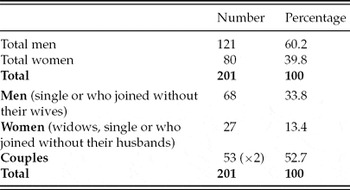
Many who joined the guild were women (see Table 1).Footnote 23 Many joined as married couples (52.7 per cent). Interestingly, wives paid their guild subscriptions independently. In most cases, husbands and wives clearly paid together as the number of marks by their names is generally identical but, in a number of cases wives seem to have paid more regularly than their dilatory husbands. For example, Alice Coupere was up to date with her subscriptions and had paid them in full whilst her husband Robert still owed two quarters’ payment; the same was true of Adam Barry's wife Margaret and a number of other women. This might suggest something about the strength of female lay piety or it might indicate that these were independent women who placed a high value on the religious, social and economic networking potential of the guild. There were also twenty-seven female members who are not listed as ‘wife of’ a male member (representing 13.4 per cent of the guild). Some of these, like Margery Man and Agnes de Beston, were widows of deceased members. Indeed, Margery Man's husband Henry was listed in the ‘names of the dead’ section at the end of the roll. But others seem to have been single women who joined independently, like the fully paid-up Elena de Carleton, the similarly solvent Alice de Newerke and Christiana Wynt (who still owed the guild some of her subscription). It is possible that these women were married but had joined without their husbands or that they were single but wished to obtain the benefits of being part of the guild's extended family. Indeed, a number of such women, for example, Lettice, the wife of a spurrier called Henry, and Alice, the wife of John Asty, amongst others, were enrolled as the wives of men who were not themselves members, thus demonstrating their independent association with the fraternity. There was clearly no bar to female entry to the guild.
Membership of St Mary's Guild in 1371

Core to any guild's religious activities were funerals for its members, masses and the memorialization of the dead, the support for pilgrimage and the provision of charity for the poor or for members who had fallen upon bad times, activities which characterized the involvement of the laity in later medieval religion.Footnote 24 Chaplains maintained by a guild provided one of the key benefits of membership. The members could regularly attend mass and payments for priests were an important component of financing any guild.Footnote 25 St Mary's certainly had members of the clergy amongst its membership: John de Stapelford, vicar, Richard de Lyndeby, clerk, Ralph de Sneynton (a foreigner), Gervase de Barton and Richard de Boney (both deceased) were chaplains. Furthermore, the fraternity's religious credentials were reinforced by having an anchorite, called Emma de Chaterton, who lived in the Broadmarsh area of the town, as a sister of the fraternity (although she had not, and was probably not expected to have, paid her subscription). The guild probably also had some role in dispensing charity to the poor.Footnote 26 As McRee agues, large, wealthy urban guilds, like St Mary's, often provided assistance to members, usually drawn from a guild fund, who had fallen on bad times.Footnote 27 Misfortunes that might befall wealthy, mercantile guild members included calamities which impacted upon their ability to work, such as blindness, injury, leprosy and the onset of old age. Some guilds even offered to help with the living expenses of members who had lost goods in shipwrecks, robberies and fires and other acts of God so that they would not be reduced to destitution.Footnote 28 Many guilds also held processions usually celebrating the feast day of their saint wherein all the members would march through the town in a sober and dignified manner in their full guild livery, often two-by-two, and carrying candles as the town residents looked on.Footnote 29 These processions must have been imposing and colourful spectacles and an important and popular guild like St Mary's may well have processed to St Mary's church to honour their patron saint, the Virgin. These served as visible reminders of the unity, collective identity, dignity and moral rectitude of the members.
St Mary's guild did not exist in a vacuum. There is evidence of a number of other Nottingham guilds which existed contemporaneously with the St Mary's religious fraternity in what appears to have been a web of fraternal associations that spanned late fourteenth-century Nottingham society. King John granted a merchant guild to the burgesses of Nottingham in 1189 who were to be free of toll throughout his lands, who could elect, as part of the apparatus of self-government, their own reeve in return for an bi-annual fee-farm paid (of £52 per annum) to the Exchequer.Footnote 30 That merchant guild, about which remarkably little is known, is mentioned once in the town's borough court rolls in 1365.Footnote 31 John Burre, having been fully examined by the borough court's officials, had it publicly recorded that he had been received into the merchant's guild on 7 June 1365 in the chamber of Roger de Hopwell. This is significant because Roger de Hopwell was acting, in this case, as the merchant guild's principal officer. He was, at the same time, also the mayor of Nottingham. Whilst this relationship has not previously been discerned in Nottingham, it again reinforces the recognized link between merchant guilds and urban government.Footnote 32 The link between this merchant guild and the town's government is reaffirmed with reference to complementary evidence. From at least the early fourteenth century, the mayor of Nottingham and his council conducted town business in a building known as the ‘guild hall’, located near the Weekday Market.Footnote 33 This was, presumably, the principal location for the royally granted merchant guild's activities and meetings whilst, at the same time, acting as the venue for the town's borough court where the leading burgess oligarchs participated in urban government and promulgated law and justice to the community.
Another important late fourteenth-century Nottingham guild was dedicated to the Holy Trinity, which, like St Mary's, was also resident in St Mary's church.Footnote 34 In 1391, the wardens of the guild, Robert of Hauden, John Jors and John Barbur, were suing individuals on behalf of the guild in the borough court. For example, a fletcher called John Thorp owed 40d to the guild which was, by the time of the court hearing, three years in arrears.Footnote 35 The guild's officers energetically pursued late membership fees throughout the 1390s in the borough court.Footnote 36 In 1395, John Jors sued Richard Barynton over 18d for a hood that he (probably on the guild's behalf) had supplied as part of the Holy Trinity guild's livery, and 26d that Barynton still owed as payment towards the guild chaplain's endowment. Barynton denied owing anything for the stipend but did admit that he still owed the 18d for the hood.Footnote 37 By the 1390s, therefore, Holy Trinity, in common with many guilds, funded its own chaplains and possessed a livery. Coloured gowns and hoods (not always worn at the same time) were generally worn by members of English guilds at meetings, religious services, funerals, processions and feasts. In many cases, guilds controlled, and profited from, the manufacture and sale of these items, as the Jors v. Barynton plea above suggests.Footnote 38 Another case of late payment from 1397 details much about the cost of membership of the Holy Trinity guild and more about its livery.Footnote 39 William de Normanton was sued in one action for the 30d entry fine to the guild, 13d payment for the guild's chaplain, 15d for a hood which was to be worn in the first year after entry (presumably as a probationary neophyte) and 14d for a second hood to be worn in the second year of membership, all of which should have been paid at the feast of Holy Trinity in the previous year (28 May 1396). The plea expressly states that this was a requirement of all of the brethren of the said guild. Non-payment of membership and other dues was clearly a common problem because the guild sued another member, Thomas Turnour, for the same misdemeanours a few months later, and a third, John Torlaton, in 1399.Footnote 40 The Holy Trinity guild was particularly litigious and their various plaints in the borough court continued into the 1430s after which the Holy Trinity guild becomes considerably less active in the borough court and may have ceased to exist.
All of the evidence suggests that Holy Trinity was a senior guild, superior to St Mary's, and an important component of Nottingham's medieval social, religious and economic fabric. The guild was certainly in existence from c. 1390 – c. 1410, thus reflecting its popularity. Furthermore, its frequent recourse to the borough court – held in the guild hall – suggests overlapping spheres of influence between the oligarchy and the guild and a familiarity with the judicial milieu which places it closer in character and disposition to a merchant guild than a religious fraternity. Indeed, this is supported by the very limited evidence for membership of the guild. Those who are named in the borough court rolls as wardens, chamberlains and aldermen of the Holy Trinity guild, and some of those sued for late payment of fees, were often members of the town oligarchy as mayors, and particularly bailiffs, such as Robert de Hauden (bailiff, 1380–81), Henry de Normanton (bailiff, 1384–85), John de Lichfield (bailiff, 1386–87) and Thomas Sherman (bailiff, 1392–93). This connection between the administrative machine and the guild, through the vessel of the borough court, can be seen clearly in a case of 1410 wherein the aldermen of the guild, John de Tannesleye and Thomas Kay sued John Jors, a chamberlain of the guild, ‘with the assent of the whole of the brethren of the said guild’ for 4 marks which he was supposed to have paid to the guild but had failed to do so.Footnote 41 Jors said that he only owed 2 marks and that an inquest ought to be tasked with discovering the truth. A jury was elected and delivered its verdict at the following court. The names of the jurors are not included in the record of the plea, but it is tempting to wonder how many of them were members of Holy Trinity guild. They found in favour of Tannesleye and Kay and said that Jors did indeed owe the full 4 marks which he was required to pay to the guildsmen along with 40d in damages. What makes this case illustrative of the symbiosis of oligarchy and guild is the fact that the two complainants were both mayors of Nottingham: Tannesleye became mayor three months after the case was heard and Kay became mayor in 1415–16.Footnote 42 It seems likely that the merchant guild granted in 1189 by King John, which largely disappears from view in documentation of the later fourteenth and fifteenth centuries, simply transmuted into the Holy Trinity guild by c. 1390. It dedicated itself to the Trinity, undertook its religious functions within St Mary's church whilst maintaining its administrative, economic and judicial functions – for which it was originally founded – in the guild hall.
Another guild, also contemporaneous with the St Mary's fraternity, was the guild of All Saints similarly established in St Mary's church. Richard Hanneson and his wife Margery, wool dealers in Nottingham, were sued in 1375 for their arrears owed to the guild of All Saints.Footnote 43 The guild expended considerable energy in collecting late subscriptions through the borough court, as in where John de Crowshawe and Robert Baxter were described as ‘collectors’ for the guild in a similar plea attempting to recover funds owed to the guild by Agnes Smart from a year later.Footnote 44 The court discovered that the payment of 4s 6d had been entrusted to Alice Horner to be paid to the guild but that Horner had failed to deliver it.
St Mary's guild and commercial networks
Most of the members of St Mary's guild were wealthy and successful businessmen. Guildsmen like John Samon, John de Crowshawe and John de Plumtre, amongst others, were all merchants who were exporting wool and other goods in considerable quantities in the 1380s and 1390s to Continental ports such as Middelburg.Footnote 45 In 1392, these three men formed a partnership with other merchants from York and Nottingham and financed a voyage to export 600 marks-worth of herring.Footnote 46 The question that must be asked then is to what extent did members of St Mary's guild transact business with guild members rather than with other business people in the town? Did the guild's untarnishable reputation, combined with contact with fellow members during guild activities impact upon the amount of commercial activity between members? Did being a member of the guild increase the number of commercial contacts, did it bring buyers and sellers together, did it lower transaction costs by making market information more easily accessible amongst the membership? In other words, was guild membership an aid to commercial networking?
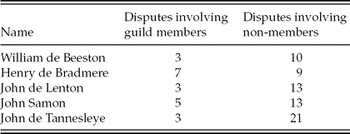
An attempt will be made here to see with whom guild members traded by examining trading disputes in the borough court between 2 October 1364 and 17 September 1376.Footnote 47 If St Mary's was a recent foundation, as suggested above, then these cases would have been contested whilst the guild was operational. The business dealings – commonly disputes over unpaid credit or broken contracts – of twenty-four members of the guild were examined and five representative examples are discussed below. These individuals were selected because they pursued more than five individual cases through the borough court. The individuals discussed below represent the most actively litigious members of the guild. The evidence is summarized in Table 2.
Business pleas involving guild members in the borough court, 1364–76 (N = 87)

In the data used in Table 2, each individual case has only been counted once and the extensions due to repeated essoins, lack of jurors, love-days and so on have not been counted. It must be remembered that these borough court pleas were the result of business deals going wrong and that these must therefore represent only a small proportion of all the business undertaken by these men locally. But the evidence is telling. This suggests that those who used the court most for civil pleas only rarely undertook business with fellow members. These men (and women) used the principal and only forum for commercial settlement dispute open to them: the borough court. The borough court was held, generally, every two or three weeks.Footnote 48 In 1365, Henry de Bradmere was sued by fellow guild member and smith, John Crich, for debt, possibly unpaid credit for some work completed by Crich.Footnote 49 Bradmere appeared several more times in court, attempting to delay proceedings, before the case came to a (now lost) conclusion or an agreement was reached out of court. One of these was an agreement between the two men for court-appointed arbitrators to try and reconcile the dispute, known as a ‘love-day’. It would be tempting to infer that this was the result of their mutual association with the guild and that perhaps guild members might be employed to arbitrate the dispute. Unfortunately, this does not stand up to scrutiny. Love-days were commonly used in the later fourteenth-century court and there is no evidence to suggest that they were used more frequently in disputes between guild members when compared to non-members. Love-days and extensions were a particular legal tactic much used by Henry de Bradmere with all of the cases he was involved in, regardless of his opponents’ guild associations.
A typical case involved a member of the guild called John de Lenton. He seems to have been something of a cloth entrepreneur. For example, he sent wool out to be woven by local women, like Agnes Pys (not a guild member) in 1371, agreeing to pay her 8d for weaving woollen cloth, and later outsourced 22 pounds of plunket wool and two yards of bukkeshorn cloth to a dyer called Robert de Alfreton (also not a member of St Mary's) in 1373.Footnote 50 Unfortunately, Lenton failed to pay either of these people what he owed them for the work they had done for him and they sued him in the borough court. Lenton also dealt with guild members in the course of his business. In 1376, he came up against Alice de Wolaton. Alice was a fully paid-up member of the St Mary's guild; she was probably a widow, as she had a son, but had joined the guild independently. She lived in the street now known as Fletcher Gate (Via Carnific’) and was clearly a wealthy woman.Footnote 51 In her dealings with John de Lenton, it is clear that she supplied the raw materials; he seems to have been one of the links in the cloth production chain, possibly responsible for getting her cloth woven or dyed, the finished cloth then needing to be returned to her. In 1376, she sued him for detaining cloth which should have been handed back to her (the court found him guilty); but he counter-sued her twice saying that she owed him a total of 7s 10d, presumably payment for work undertaken on her behalf which she had not yet paid him (this time the court found in his favour).Footnote 52 Their relationship was more convoluted than that because he had also leased to her a mashing vat worth 20s (used in the brewing of ale to mash the malt in hot water to release the sugars), which she had subsequently broken – so, just for good measure, he sued her for that too.
What the Lenton v. Wolaton cases demonstrate is the complexity of the commercial connections that existed in a small town like Nottingham. It probably would not have been possible to have dealt exclusively with members of the guild even if members had wanted to. The evidence certainly suggests that they did not. The figures in Table 2 suggest that guild members dealt far more often with non-members than with those with whom they regularly prayed and with whom, theoretically, they had mutual interests and a common identity.
Like John de Lenton, John Samon's trade disputes are also representative of the guild members’ commercial interaction with each other and with non-members in Nottingham. In 1367, Samon sued three fellow guild members, John de Trowell, John de Crowshawe and John de Plumtre, individually for debt, over a consignment of peas which he had paid for but they had failed to deliver.Footnote 53 In 1375, he sued William de Beston and Richard de Bradmere for debt and the next year he sued Robert de Houdone also for debt.Footnote 54 As Table 2 suggests, in his business dealings, Samon took many more non-guild members to court over defaulted debts than members. For example, in 1376, he sued three people, Robert Spondon, John Tomworth and Hamon Ireton, none of whom were members of St Mary's in 1371 (but they could have conceivably joined later), for unpaid debts of 10 marks each in the form of a bond (a written credit agreement). Relationships like this seem to suggest that the guild offered little in the way of commercial networking to its mercantile members. This was true also for those members who lived outside the town (foreigners). Local landowners and business people from the region might have viewed St Mary's as a fraternity where business contacts might be made more easily. In reality, however, few of these people ever used the borough court to resolve their disputes. However, the lack of civil pleas by foreigners might suggest that their relationships within the guild were not based primarily upon commerce.
The absence of inter-member disputes in the local court could, of course, be explained as members’ reluctance to broadcast their disagreements and failures publicly in the full glare of the borough court. The guild's supposed attitude to a collective moral rectitude and probity might have resulted in members turning away from the public court and resolving their disputes instead internally, perhaps with the help of guild-appointed arbitrators. The balance of evidence, however, does support this explanation. First, there is no evidence that this fraternity, unlike some craft guilds – whose courts dealt with trade and employee-related disputes – possessed any judicial apparatus.Footnote 55 No such links can be made between any court and St Mary's guild. Secondly, there is no evidence of any other civil courts in the town of Nottingham apart from the borough court.Footnote 56 Most courts, like the borough court, have left copious records, but nothing survives to suggest an alternative venue for dispute resolution in the town. Thirdly, if such an alternative venue existed, why did so many guild members (as Table 2 indicates) turn to the borough court to settle their disputes, even those between members? Craft guilds often specifically forbade members using courts other than their own. The balance of evidence suggests that the borough court had the monopoly on dispute settlement in the town and it was thus the only venue available to the guild members. This in turn suggests that guild members dealt more often with non-members than with their own brothers and sisters.
If the guild did little to facilitate trade amongst its members then perhaps honour and moral standing gained from membership played a role in solidifying or enhancing the reputations of guild members engaged in trade.Footnote 57 A good reputation was an essential part of medieval commerce and a principal component in any credit or debt agreement. Businessmen and women needed to be seen to behave honestly, honour their contracts and agreements and to pay back their debts on time.Footnote 58 Public perceptions of worthiness, like that potentially provided by guild membership, were important because many credit agreements were oral and thus doubts about creditworthiness could be communicated very rapidly.
An examination of the borough court rolls between 1364 and 1376 reveals that guild members were, in fact, more successful in their various pleas than non-members who regularly used the court. Because of the fragmentary nature of the court rolls, the outcomes of many of the suits are lost. But, in some cases, by tracing the pleas through to the stage whereby an inquisition jury was assembled and asked to investigate the case and pass judgment on it, the winners and losers can be identified. Thus, John Samon won five cases and lost one and John de Tannesleye won four cases and did not lose any. This might be compared to the particularly unlucky, and probably incompetent, Martin Tankardmaker (who really did make tankards). He was not a member of St Mary's (but might have been a member of another Nottingham guild) and was frequently being sued in court for not delivering tankards, of various sizes, that had been paid for. For example, John de Crowshawe (a guild member) sued Tankardmaker in 1366 for 18 tankards, worth 4s, which Crowshawe had bought from him but which he had failed to deliver.Footnote 59 This was wholly typical and the court rolls are regularly peppered with pleas against Tankardmaker in this vein. He also got into fights and was sued for assaulting people.Footnote 60 Out of the cases where a conclusion is recorded, Tankardmaker won one and lost six. A similar example is non-member William Garlecseller (who did not sell garlic). He was sued for debt several times, once for failing to repay credit on goods bought, suggesting his mercantile interests; he failed to pay an employee and was sued for that and, like Tankardmaker, regularly got into fights in the late 1360s.Footnote 61 Of the cases where the outcome is locatable, Garlecseller lost three cases and won none.
Might this suggest that enhanced respect and integrity, gained partly through association with St Mary's guild, was advantageous in swaying the judgments of the inquisition juries? Attractive though this hypothesis is, this also does not stand up to close scrutiny. First, other guild members were not as successful as Samon and Tannesleye. Henry de Bradmere won two cases and lost two; John de Lenton won one and lost two. Furthermore, another non-member, the merchant Richard Grinder (one of the men William Garlecseller beat up) won one case and lost another.Footnote 62 Therefore, it was Samon and Tannesleye who were unusually successful in court and Tankardmaker who was unusually unsuccessful. Success in the borough court was not a universal condition of all guild members and the reality for all plaintiffs and defendants in the court, regardless of guild membership, was some losses and some gains.
The situation is further complicated by the sophisticated and nuanced pronouncements of the juries. Thus, in the case of Robert Lyster v. John de Lenton of 1374, wherein Lenton owed money to Lyster, the inquisition maintained that the amount owed was less (5s 7d) than was originally claimed by Lyster. Thus, whilst Lyster got his money back (so technically won the case), both men were fined: Lenton for not repaying the debt and Lyster for filing an unjust suit.Footnote 63 Likewise, in 1376, during one of Martin Tankardmaker's regular trips to court, he was sued by Richard Barre for not supplying three tankards worth 2s that he had ordered.Footnote 64 The inquisition found that Tankardmaker had indeed detained three tankards but they were worth only 12d and therefore judged that Tankardmaker should be fined for an unjust detinue (thus, in principle, losing the case) but that Barre should also be fined for his false claim of the value of the tankards. This suggests two things about justice in Nottingham's borough court. First, that the winning and losing of suits is too blunt a tool to really distinguish any positive effects of guild membership, and, second, that juries seem to have been relatively even-handed in their judgments.
What then separated the virtually unbeaten Samon and Tannesleye from the others? It is unlikely that their success had anything to do with any supplementary respect bestowed upon them by their guild membership (Tannesleye, of course, belonged to at least two guilds). Rather more visible was their social status which came from their regular holding of civic offices – Samon was mayor at least seven times and Tannesleye was bailiff once and mayor twice.Footnote 65 These were public figures, extremely well known in the borough court and in the community and, unlike most of the other suitors, both guild members and non-members, they were never brought to court for brawling drunkenly in the street, they were wealthy merchants and they were prominent landholders. This might have made an impression upon the burgess jurors.
It was their tactics in court that were more important. First, they were regularly plaintiffs and accusers rather than defendants; they initiated the suits rather than answered them and they were on the offensive rather than defensive in the court. Nearly all other suitors in the 1364–76 sample were both plaintiff or defendant at various times, and this impacted upon their success rate in court. Cloth merchant John de Tannesleye sued John Chapman – albeit not in a mercantile plea – for killing three of his hogs in 1371 and claimed damages of 23s.Footnote 66 The inquisition found in Tannesleye's favour, but even he could not convince the court that the loss of his livestock caused him over a £1s-worth of injury and they granted him only 4d in damages. In 1375, he sued Joan Lemeryng for not delivering coal (worth 6s) to his house.Footnote 67 The jury found in his favour again and ordered that Tannesleye should either recover the 6s or Lemeryng should deliver the 20 coals that she owed him.
But the key tactic of these two men was settlement without recourse to juries. For two out of Tannesleye's four successful suits, the defendant buckled before it went to an inquisition. In 1376, he sued William Hopwell and his wife Matilda for an unpaid debt of 4s.Footnote 68 The Hopwells came to court and, instead of fighting the case, they acknowledged the debt and were fined by the court and ordered to pay the outstanding sum. In 1366, Tannesleye sued Henry Goldsmyth for stealing a mazer (a large hardwood drinking bowl) and cash from him.Footnote 69 Goldsmyth, whose business was repairing knives but who had recently fallen on bad times,Footnote 70 came to court and resolutely maintained his innocence, but later changed his mind and acknowledged to the court that he was, in fact, guilty, thus not necessitating an inquiry. The discussions, or pressure, placed upon him to change his plea are not recorded. Perhaps Goldsmyth, as Tannesleye's social inferior, just realized who he was up against and decided to take the fine. But the master of this tactic was John Samon. All of the five suits that he won did not go to the inquisition jury. For example, in a similar way to Tannesleye, Samon sued Richard Chilwell for an unpaid debt in 1376.Footnote 71 Chilwell had failed to turn up to court to answer the suit several times but then finally acknowledged his guilt. Later in the same year, he sued John Fenel, Christiana his wife and John their servant, again in a non-mercantile plea, for stealing barley and oats, worth 10s, from his fields.Footnote 72 The Fenels came and pleaded their innocence. An inquisition was ordered, but before it could return its verdict, Samon and Fenel had come to an out-of-court settlement whereby Fenal admitted to the theft and was fined by the court. Once again, the details of this agreement, admittedly between parties of unequal social standing, were not recorded and the tenor of these discussions can only be guessed at. Only one man stood up to John Samon. He was John Tomworth who was sued in a plea of debt along with Robert Spondon and Hamon Ireton (cited above).Footnote 73 Spondon and Ireton folded immediately they were charged, but Tomworth did not turn up for the hearing and later asked for the case to be adjudicated by court-appointed arbitrators. There is, unfortunately, no surviving record of the outcome of this arbitration. The evidence suggests therefore that guild membership offered little advantage in helping individuals successfully navigate the borough court. Victory in that forum was, more often, a combination of social standing and nimble tactics.
Conclusions
The questions posed here have wider implications to the study of guilds and networks in England and comparative analyses of guilds, networks and borough courts in other centres would be instructive. The case-study of Nottingham needs to be tested in other towns where guild membership evidence survives along with contemporary borough court evidence to see if other guilds produce different results.
The definitions of business networks stress connectivity, high-trust linkages and repeated, enduring, exchange relations. The evidence from the guild of St Mary does not provide evidence to substantiate widespread commercial networking by guild members. This having been said, the source material, especially relating to membership after 1371, is limited and thus, whilst it cannot demonstrate a definite absence of such networking, the balance of evidence suggests that commercial networking was not a principal benefit of membership. In reality, members of most English guilds gathered only a few times a year and, as suggested above, some of the brothers and sisters belonged to more than one guild. These facts likewise lessen the impression of a strong guild solidarity capable of bring buyers and sellers together or lowering transaction and information costs. Any connection between the guild and the commercial relationships was probably entirely coincidental and, most likely, was a function of Nottingham's later medieval population. With a population as small as Nottingham's after the Black Death, it would have been difficult not to have had some connection, be it commercial or social, with almost everybody in the town. The data might be explained with reference to the 1377 poll tax. Every layperson over the age of 14 in Nottingham, with the exception of the very poor, should have been included in this particular taxation experiment. Whilst this is unlikely to have caught everybody due to evasion, the number of recorded taxpayers in the town six years after the St Mary's guild roll was compiled was 1,447.Footnote 74 Thus, bearing in mind the membership of the guild in the late fourteenth century was 201 of the burgess elite of the town and their wives, then it would have been difficult not to have bumped into a guild member at sometime during the course of everyday interactions. The membership of St Mary's thus must have comprised almost 14 per cent of the local population. This significant proportion explains why members of the guild could not help but trade with other members of their fraternity. The mercantile elite did business with whomever they thought solvent enough to extend credit to and this had little to do with where they prayed.
For all guilds, piety was an indispensable constituent. Whilst the religious activities of St Mary's may only be accessed indirectly through conjectural comparisons with other English guilds, it seems likely that the focus of the members’ attention was not economic networking, but rather their relationships with their saint, the Virgin Mary. But the guild was probably not founded with any economic purpose or goals. It was a fraternity dedicated to St Mary and praying, giving alms, feasting and processing were probably the limits of the ambitions of its founders.
Appendix: St Mary's, Nottingham, guild roll transcript
(NA DP 90/1, 1380mm × 125mm, on three membranes sewn together, some small rodent damage to edge of outermost membrane, but of little affect to text, in otherwise good condition. The small, circular ink marks after each name probably represent a record of payment of the quarterly subscriptions to the guild.)
This roll contains in itself the names of the fellow brothers of the Guild of the Blessed Mary in the church of the same that is to say on the feast of St Michael, AD 1371.Footnote 1
Saturday marketFootnote 2
1. John Samon ● ● ● ●
2. Roger Mason ● ● ● ●
3. John de Lenton, sherman ● ●
4. Isabella de Alverton ● ● ● ●
5. Henry de Wylford ● ●
6. [faded] his wife ●
7. John de Crich, smith ● ● ● ●
8. Amice his wife ● ● ●
9. Agnes de Brinby ● ●
10. Robert Coupere ● ●
11. Alice his wife ● ● ● ●
12. Richard de Stanley ● ● ● ●
13. Alice his wife ● ● ● ●
14. John Cotman ● ● ● ●
15. Alice his wife ● ● ● ●
16. John de Crowshawe ● ● ● ●
17. Cecilia his wife ● ● ● ●
18. John de Plumtre ● ● ● ●
19. Annabelle Fraunceys
20. Robert de Houdone ● ● ●
21. Constance his wife ● ●
22. Robert de Colston ● ● ●
23. Alice his wife ● ● ●
24. Robert Baker ● ● ● ●
25. Margaret his wife ● ● ● ●
26. William his wife Coupere ● ● ●
27. Emma his wife ● ● ●
28. John de Tannesleye ● ● ● ●
29. Joan his wife ● ● ● ●
30. William de Greseleye ● ● ●
31. Isabella his wife ●
GretsmythgateFootnote 3
32. Roger de Grantham ● ● ●
33. William de Etewell ● ● ●
34. Nicholas Potere
35. Joan his wife
36. Katherine, wife of William de Etwell ● ● ● ●
37. Margery, widow of Henry ManFootnote 4 ● ● ● ●
38. John Bladesmyth ● ● ● ●
39. Isabella his wife ● ● ● ●
40. Margaret de Wilford ● ● ●
41. John Fletchere ● ● ● ●
42. Sara his wife
43. Lady Elizabeth de Wylughby ● ● ● ●
44. Elena de Carleton ● ● ● ●
John de LedenhamFootnote 5
Felicia his wife
45. William de Ingland ● ● ● ●
46. Margaret his wife ● ● ● ●
47. Richard Welot, grinder ● ●
48. Rose Taylour ● ● ● ●
49. Robert de [faded] ● ● ● ●
50. Agnes his wife [faded] ● ● ● ●
Fletcher GateFootnote 6
51. Peter Mason ● ● ● ●
52. Alice his wife ● ● ● ●
53. Richard Dandesone ● ● ● ●
54. Joan his wife ● ● ● ●
55. Robert de Whyton ● ● ● ●
56. John de Wythe ● ● ● ●
57. Alice de Wolaton ● ● ● ●
58. Richard de Bradleye
Bridge EndFootnote 7
59. Sir John de Stapelford, vicar ● ● ● ●
60. William de Adbolton, school master
61. William Taillor ● ● ● ●
62. Alice his wife ● ● ● ●
63. John Northerne ● ● ● ●
64. John Ropere ● ● ● ●
65. John [faded] ● ● ● ●
66. William Snell ● ● ● ●
67. John Joye, smith ● ● ● ●
68. Margaret his wife ● ● ● ●
69. Thomas de Barton ● ● ● ●
70. Agnes his wife ● ● ● ●
The MarshesFootnote 8
71. Adam Barry ● ● ●
72. Margaret his wife ● ● ● ●
73. William de Derby ● ●
74. Christiana Wynt ● ●
75. John de Trowell ● ● ● ●
76. Juliana his wife ● ● ● ●
77. Nicholas Gay ●
78. Emma de Chaterton, anchoriteFootnote 9
79. Alice de Newerke ● ● ● ●
80. Geoffrey Colyer ● ● ● ●
81. Alice his wife ● ● ● ●
82. John Frauncys ● ● ● ●
PavementFootnote 10
83. Roger de Lenton ● ● ● ●
84. Mathew de Shyteby ● ● ● ●
85. Alice his wife ● ● ● ●
86. John de Thrumpton ● ● ● ●
87. William de Thrumpton ● ● ● ●
88. Geoffrey le Hostelyr ● ● ● ●
89. Isabella de Conysburgh ● ● ● ●
90. Laurence de Cropphill ● ● ● ●
91. Gedman Taillor ● ● ●
92. John Pottere ● ● ● ●
93. John de Staunford ● ●
94. Matilda his wife ● ●
95. William Danyell ● ● ●
96. Joan his wife ● ● ● ●
97. Henry de Bradmere ● ● ●
98. Cecilia his wife ● ● ● ●
99. Richard de Breadmere
Agnes de Barton
100. Roger de Hulm ● ●
101. Agnes his wife ● ● ●
102. Agnes Wytskyn ● ●
103. Margot Barbour ● ● ● ●
104. John de Ledenham ● ● ● ●
105. Felicia his wife ● ● ● ●
106. Agnes Tayte ● ● ● ●
The parishes of St Peter and St NicholasFootnote 11
107. Alan de Eyton ● ● ● ●
108. Dyonisa his wife ● ● ● ●
109. John Fletcher, junior ● ● ● ●
110. Beatrix his wife ● ● ● ●
111. Lettice wife of Henry, spurierFootnote 12 ● ● ● ●
112. Isabella de Staunton ● ● ●
113. William Barbour, junior
114. Rosa his wife
115. Roger Pervis, butcher ● ● ●
116. Isabella Showell ● ● ● ●
117. Elena de Blyd ● ● ●
118. William de Colston, draper ● ● ● ●
119. Emma his wife ● ● ● ●
120. Hugo Draper ● ● ● ●
121. Margery his wife ● ● ● ●
122. Henry de Warewyk ● ●
123. Emma his wife ● ●
124. William de Beston ● ● ●
125. John de Bettes ● ● ●
126. William de Hokyrton ● ● ●
127. John Broumford ● ●
128. Millicent his wife ● ●
ForeignersFootnote 13
129. Sir Geoffrey de Staunton
130. Sir John de AsloctonFootnote 14
131. Sir Gervase de Clyfton, knight
132. Sir Robert de Wilford in castro ● ● ● ●
133. Sir John, rector of the Church of Halum ● ● ● ●
134. Sir William Blake, rector of the Church of Staunton in le Vale
135. Isabella, daughter of Sir Geoffrey de Staunton, knight
136. Robert de Mewes of Aslacton
137. Sir Ralph de Sneynton, chaplain ● ●
Ciecillia de Eland ● ● ● ●
138. William de Chetewynd ● ● ● ●
139. Cecilia his wife ● ● ● ●
140. Henry Erlle of Edwalton
141. Joan his wife
142. William Cost of Adbolton ●
143. Agnes his wife ●
144. John, son of Richard de Sneynton ● ●
145. John Taillour of Radford
146. Margery his wife
147. John son of Adam Stanleye
148. Emma his wife
149. William de Stanleye
150. Alice his wife
151. Alice, wife of John Asty
152. Henry Balle of Westhaham
153. Margaret his wife
154. Thomas Seccere of York ● ● ● ●
155. Matilda his wife ● ● ● ●
156. Alice, wife of Robert de Barton of Lenton
157. Alice Pleyndamour of the same place
158. John de Colston Bassett
159. John Faber of Wilford
160. Agnes his wife
161. John Wryht of the same place
162. Robert Barker of NewsteadFootnote 15 ● ● ● ●
Raised from this roll 26s 11d Footnote 16
163. John de Schrusehanne warden of [erasure] Saint Mary's
164. Richard de Bradmer ————- casketFootnote 17
Names of the deadFootnote 18
165. Richard Bee ● ● ● ●
166. Adam Brerethwysel ● ● ● ●
167. Matilda his wife ● ● ● ●
168. Emma, wife of Robert Clerk ● ● ● ●
169. Gervase de Barton, chaplain ● ● ● ●
170. Walterus de Byrton ● ● ● ●
171. John Kyng ● ● ● ●
172. John Balle ● ● ● ●
173. Agnes, widow of Richard de Stanley ● ● ● ●
174. Roger, father of Richard de Stanley ● ● ● ●
175. Amice, mother of the same Richard ● ● ● ●
176. Roger Steynware ● ● ●
177. Walter de Cropphull
178. Robert Bynnek
179. William Bowere
180. Agnes, widow of William de Beston ● ● ●
181. Walterus del Grene
182. John Parsone, tanner ● ● ● ●
183. Robert Pyaot ● ● ●
184. Henry Pledour
185. Robert de Bilburgh’
186. Richard Metell’
187. Richard de Boney, chaplain
188. William de Ludbyry
189. Dominus Phillipus of Heyford
190. John de Brokestowe
191. John Whasse
192. Jacob Harcher ● ● ●
193. Thomas Walkere
194. Juliana, widow of Ricardi de Bradley
195. Matilda de Gresley ● ● ● ●
196. Matilda le Candelere ● ● ● ●
Bartholemew de Cotegne ● ● ● ●
Richard, mercer, of the same place ● ●
Milisand his wife ● ●
197. John Nasty of Eyton
198. Richard de Lyndeby, clerk ● ● ● ●
199. Sir Geoffrey de Staunton, knight
200. Sir John de Aslacton, one time rector of the church of Bryggeford ad Pontem
201. Henry Mon ● ● ● ●
William de EylandFootnote 19● ● ● ●
Stefan de Strelley ● ● ● ●