INTRODUCTION
The 1990s debate over a multiracial category on the American census opened the most probing examination of race in the United States since the 1960s. The various multiracial activists and organizations involved held divergent goals from the beginning, but they did consistently maintain that the official acknowledgment of multiracial people and interracial love could help American society move beyond divisive and socially constructed racial borders.Footnote 1 They also shared the conviction that it was inaccurate and unacceptable to force multiracial Americans into monoracial categories. The multiracialists' best-known campaign argued for the addition of a “multiracial” category to the 2000 census. While these activists did not get exactly what they wanted, their efforts led to the creation of an unprecedented “mark one or more” (MOOM) option on the 2000 census, allowing individual Americans to identify with as many racial groups as they saw fit. Contrary to the initial portrayal of MOOM by the Office of Management and Budget (OMB) and the Census Bureau as a merely symbolic and negligible policy, I contend that it is deeply entwined with demographic and cultural developments that were not necessarily considered linked to the multiracial population as conceived in the late 1990s, and it may yet be remembered as the beginning of the end of American racial categorization as we know it today.
In general, the odds are against social movements bringing about change at any level of government, yet sometimes they do. In Mark One or More: Civil Rights in Multiracial America, I focused, as most researchers of social movements do, on issues of movement emergence and mobilization. Here I focus instead on the outcomes of the multiracial movement. I view its influence on the state as a “recursive process” involving unintended consequences that continue to reverberate long after the movement itself has faded.Footnote 2
This article is divided into two main sections. The first section offers a brief history of the multiracial movement and then assesses its political outcomes up through the implementation of MOOM. The second section sets that movement and its consequences in a broader context of structural and cultural change.Footnote 3
1. THE MULTIRACIAL MOVEMENT, THE POLITICAL PROCESS, AND THE IMPLEMENTATION OF MOOM
1.1. A Brief History of Racial Categorization and the Multiracial Movement
For most of American history, the U.S. government used racial designations as a tool of dominance, serving to separate and penalize those not defined as white. By the early 1970s, however, the civil rights movement had turned the oppressive use of racial designations on its head, using racial data to argue for the remedy of past discrimination and to measure the life chances of minority groups. In 1977, after several years of deliberation among representatives of federal agencies, the OMB standardized ethnic and racial data collection across government agencies in order to meet these new expectations. Statistical Directive No. 15 (hereinafter, Directive 15) mandated that all federal agencies gathering demographic data must collect and report data on four major racial categories:
-
• White
-
• Black
-
• Asian or Pacific Islander
-
• American Indian or Alaskan Native
Agencies also had to obtain information about people of Spanish origin through one ethnic category inclusive of all races: “Hispanic.”Footnote 4 This “ethnoracial pentagon” served as the final word on the administrative collection and reporting of American racial data for the next twenty years.Footnote 5
In 1979, two years after OMB Directive 15 was issued, the first modern-day multiracial organization—Interracial/Intercultural Pride (I-Pride)—formed in San Francisco with a handful of members.Footnote 6 Led by Carlos Fernández, a lawyer, the small group sought recognition of multiracial identity and urged progressive local school boards in Northern California to add a multiracial designator on school forms. By 1984, twelve such multiracial groups existed across the country; by 1994, there were twenty, and soon after, forty. Most of these groups began and remained primarily as support networks, while three umbrella organizations—A Place for Us Ministries (APFU), the Association for Multiethnic Americans (AMEA), and Project RACE (Reclassify All Children Equally)—focused on political action.
Ruth and Steve White started APFU in 1986 after their minister would not marry them; he is white and she is black. Eventually, they became ministers themselves and began to provide counseling services, perform marriages, organize workshops, and coordinate Bible studies for interracial Christian couples in Southern California. In Northern California, two years later, Carlos Fernández of I-Pride sought to galvanize preexisting grassroots groups around a common agenda by founding AMEA. Then, in 1990, finding no suitable category for her son on the census form, Susan Graham of Marietta, Georgia, called the Census Bureau for instructions. “They kept putting me on hold, then coming back. Finally, [the bureau representative] tells me, ‘I got with the supervisor,’ and his voice became very hushed. ‘Your children would take the race of the mother,’ he said. When I asked why, he said, ‘Because in cases like these, we always know who the mother is and not the father.’”Footnote 7 Graham, a white woman then in her mid-forties, found this explanation unacceptable. She launched Project RACE in 1991 with the intent of having a multiracial category added to all government forms calling for racial identification.
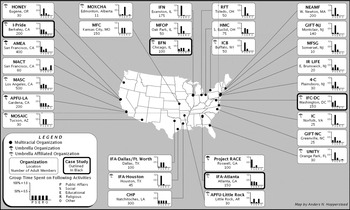
In the late 1990s, my fieldwork for Mark One or More, concentrated on these multiracial advocacy organizations at the height of the movement's activity.Footnote 8 All of the multiracial organizations active at that time operated on shoestring budgets, and gauged by its overall membership base, the multiracial movement involved only about 3,500 adult members across the country. Joined loosely together through the infrastructure depicted in Figure 1, the people involved in multiracial groups were generally more interested in gaining social support than in changing the census. I was surprised to find that few of the adult participants identified as multiracial. It turned out that affluent, well-educated, suburban, white women who were married to black men were leading most of the grassroots groups, on behalf of their children.Footnote 9
Multiracial Organizations at the Height of Movement Activity.

Sometimes on their own initiative and sometimes at the urging of multiracial movement leaders—of whom there were only about twenty, nationwide—these people founded support groups; wrote letters to bureaucrats (often including pictures of their children and asking how they, as parents, should classify the children racially); attended demonstrations; supported lobbying efforts; and participated in encounters with local, state, and federal officials. Multiracial activism involved “collective challenges, based on common purposes and social solidarities, in sustained interaction with elites, opponents, and authorities”; these factors made it a social movement.Footnote 10 The remainder of Section 1 evaluates the political outcomes of this social movement, up through the implementation of MOOM, according to five criteria of policy responsiveness.Footnote 11
1.2. Are Lawmakers Willing to Listen? Access Responsiveness, 1992–1997
In 1992, fortunately for multiracial activists, Representative Thomas Sawyer (D-OH) asked OMB to request that Congress hold hearings on the racial and ethnic standards for federal reporting. The request was prompted by the “growing racial and ethnic diversity of the American population [and] changing attitudes about race and ethnicity”; by longstanding pressure from undercounted minority groups; and by complaints from regular citizens that they could not “find themselves in the choices offered.”Footnote 12 AMEA, angling for an invitation to testify, staged its first major event in Washington, DC, that summer to commemorate the twenty-fifth anniversary of the Supreme Court's decision in Loving v. Virginia, which overturned the sixteen remaining anti-miscegenation laws in the United States. AMEA leaders also met with Rep. Sawyer, who headed the House Subcommittee on the Census, and Nampeo McKinney, who was responsible for racial statistics at the Census Bureau. Sawyer's staff director, TerriAnn Lowenthal, told AMEA leaders that she herself had a biracial daughter and was sympathetic to the group's position. A month later, AMEA received an invitation to participate in the hearings to be held in the following year. AMEA—and the other multiracial organizations that would soon join in—now found itself in an auspicious position. The OMB was openly acknowledging the need for a reassessment of the status quo, and AMEA was part of the process.
Rep. Sawyer opened the hearings on April 14, 1993, explaining why the inquiry was necessary. The existing racial and ethnic categories, he said, “in the view of many, have become misleading over time.”Footnote 13 OMB administrator Sally Katzen followed with a case in point. She said she had received “pictures of children with questions. ‘How shall I record this child's ethnicity?’ ‘How shall I record this child's race?’ The kids are cute. The questions are real and very pressing.”Footnote 14 Carlos Fernández of the Association of Multiethnic Americans (AMEA) also testified before the subcommittee: “The changes we advocate … can be effected immediately with minimal or no adverse impact on anyone or any group and with enormous benefit to everyone.”Footnote 15 Yet civil rights laws require statistics that plainly distinguish between those individuals who are minorities and those who are not. Either multiracial activists did not perceive a civil rights dilemma in their request for a federal “multiracial” category or they refused to come to terms with it.
Meanwhile, those Congressional Democrats who testified did so for specific, constituent-driven reasons. Senator Daniel Akaka (D-HI), for example, called for a new Native Hawaiian and Other Pacific Islander (NHOPI) category. “We have literally fallen through the cracks,” he said, “between definition as Native Americans in many Federal laws and classification as Asian or Pacific Islanders in Federal forms.”Footnote 16 Akaka won his argument, and a new NHOPI category was created.Footnote 17 Rep. Norman Mineta (D-CA) wanted to put a stop to the Census Bureau's plan to collapse separate ethnic categories for Asian-Pacific Americans, which would have eliminated the check-off format used previously. Rep. Barney Frank (D-MA) said he “wouldn't be here … if we knew exactly what percentage” of the people in New Bedford and southeastern Massachusetts were of Cape Verdean ancestry. “People have a problem out there,” he declared. “Are they African-American? Are they Black? Are they Cape Verdean?”Footnote 18
These and other Democrats in Congress, absorbed by other issues, paid little attention to the multiracial category proposal in 1993, and the Republicans paid even less. However, the lone Republican on the subcommittee, Rep. Tom Petri (R-WI), began to mull over the possibilities. He asked civil rights witnesses on June 30, 1993, “Are you worried that if [a multiracial category were instituted] and you … get into court, if they establish discrimination by comparing with the pool in the community and if it drops from ten percent to eight percent because there's a new multiracial category, this might somehow make it harder to win a case or something?”Footnote 19 Stephen Carbo of the Mexican American Legal Defense and Education Fund (MALDEF) responded that he understood the question but was “not sure” of the answer.Footnote 20 Later Petri opined: “When you create a new category, it may complicate litigation and protection in the civil rights area.”Footnote 21 Indeed, the civil rights groups that testified in 1993—including MALDEF, the National Urban League, and the National Council of La Raza—all opposed a multiracial category on the grounds that it would imperil the statistics needed to enforce civil rights laws. Nevertheless, they found themselves backing a growing chorus for more testing and research. After all, they had insisted for years that the Census Bureau and the OMB improve the decennial count.Footnote 22
After the hearings, in March 1994, the OMB created the Interagency Committee for the Review of Racial and Ethnic Standards and tasked this group with submitting final recommendations on the racial categories to be used in the 2000 census. The Interagency Committee, in turn, created a Research Working Group comprising statisticians and other experts to outline a research agenda. That agenda in itself represented a victory for multiracial activists, as many of the major issues identified for exploration related to the topic of multiracial identification.Footnote 23 The agenda's creation, along with the 1994 news that AMEA President Ramona Douglass (successor to Carlos Fernández) had been appointed to the 2000 Census Advisory Committee, proved that lawmakers were willing to listen.
1.3. Was a Bill Introduced? Agenda Responsiveness, 1992–1998
Between 1992 and 1998, eleven states introduced bills to add a multiracial category on state forms. At the federal level, in the fall of 1994, the Research Working Group began to execute its research agenda just as Republicans gained control of the House of Representatives for the first time in forty years. House committees were immediately reorganized. The Republican Rep. Petri took this opportunity to propose legislation that would have specified “multiracial,” in the case of a list of racial classifications, or “multiethnic,” in the case of a list of ethnic classifications, in the collection of information.Footnote 24 After it was tabled, he reintroduced the measure as H.R. 830 and called it the “Tiger Woods Bill.” Though his bill kept the multiracial question in the limelight, his reasons for introducing it were assuredly not those of most in the multiracial movement. It seems probable that Petri, whose voting record on civil rights–related legislation was poor, saw in multiracial recognition a way to undermine civil rights enforcement.Footnote 25 Petri did not consult multiracial activists before unveiling the “Tiger Woods Bill,” and Tiger Woods himself never participated in the multiracial movement, despite fervent efforts to persuade him.
A few years later, in 1996, multiracial activists learned that they would have a final opportunity to assert their views before Congress in a second set of hearings, slated for 1997. At that time, Susan Graham of Project RACE happened to live in then-Speaker of the House Newt Gingrich's district, and she met with him two months before the hearings began. Recounting her meeting with the Speaker, Graham reported that she had waited two years for the opportunity to meet him. “I was told I had TEN MINUTES to talk with him. I quickly outlined the problem.… I handed Newt a bound report with the history of the movement and statistics. He quickly flipped through the report, put it aside, and said ‘This is the right thing to do for the children.’”Footnote 26 In the eight weeks after his meeting with Graham and before the hearings, Gingrich issued a number of statements in favor of a multiracial category on the 2000 census. The Speaker also testified in person:
We should … stop forcing Americans into inaccurate categories aimed at building divisive subgroups and allow them the option of selecting the category “multiracial,” which I believe will be an important step toward transcending racial division and reflecting the melting pot which is America.”Footnote 27
In Mark One or More, I put forward two theories to explain why government bureaucrats and elected officials listened and acted at this time on this topic. The first theory involved political opportunity structures: “Not only when reform is pending, but when institutional access opens, when alignments shift, when conflicts emerge among elites and when allies become available, will challengers find favorable opportunities.”Footnote 28 Access opened in 1992, for example, when the OMB initiated its review of Directive 15. Then, in 1994, shifting alignments in Congress ultimately showed that multiracial recognition appealed, in an era of otherwise sharp partisanship, to elite allies in both major political parties. In my second theory, I used Derrick Bell's interest-convergence principle: “The interest of blacks in achieving racial equality will be accommodated only when it converges with the interests of whites.”Footnote 29 I will return to political opportunity structures and the interest-convergence principle at the end of the article.
1.4. Was a Policy Adopted? Policy Responsiveness, 1992–2000
By the end of the 1990s, the multiracial movement had amassed an impressive record of policy adoption. Six states—Ohio, Illinois, Indiana, Michigan, Maryland, and Georgia—had passed legislation to add a multiracial designation on state forms, and two (Florida and North Carolina) had added a multiracial designation by administrative mandate. In most cases the state bills passed with bipartisan consensus.Footnote 30 Bipartisanship at the state level was facilitated by the fact that neither funding nor the composition of legislative districts were at risk in the states. Nevertheless, these successes did grant legitimacy to multiracial identity and provide visibility and momentum for the movement's larger effort to get a multiple-race option on the decennial census.
I argue in Mark One or More that, at the federal level, Democrats wanted multiracial recognition without adverse civil rights consequences while Republicans wanted multiracial recognition with adverse civil rights consequences. The former approach prevailed in light of the fact that Democrats controlled the executive branch in the late 1990s. The Interagency Committee recommended and President Clinton's OMB adopted the new MOOM policy, announced by OMB Director Franklin Raines on October 30, 1997. Thanks to this policy, there would be no “multiracial” category on the census, but for the first time ever, starting with the 2000 decennial census and extending to all federal data systems by 2003, respondents could identify with as many races as they wished. “We are not closing the door on the expression of multiracial heritage. We are allowing people to express their multiracial heritage in whatever way they view themselves,” Raines declared.Footnote 31 The OMB announced that five major races would be used in the 2000 census:
American Indian and Alaskan Native
Asian
Black or African American
Native Hawaiian and Other Pacific Islander (NHOPI)
White
As before, agencies also included one ethnic category, Hispanic, involving people who could be of any race.
In some ways, the 1997 decision resembled the OMB's Directive 15 of 1977, which required all federal agencies to gather data on four standardized racial categories. But the decision broke conceptually with Directive 15 by allowing respondents to mark more than one race. Although the Interagency Committee had unanimously opposed the addition of a multiracial category, it provided no specific suggestions as to how its proposed—and adopted—alternative could be tabulated. Multiple-race responses, one way or another, would have to be put back into a single box in order to produce numbers for the purposes of civil rights monitoring and for comparison of 2000 data with data from earlier censuses.Footnote 32 Stakeholders had to wait until the newly created Tabulation Working Group issued a set of recommendations, which it did in March 2000, before learning how the policy would be implemented.
1.5. How Was the Policy Implemented? Output Responsiveness: 1997–2000
The OMB managed to produce its tabulation guidelines only a few weeks before the March 2000 census mailing. The delay stemmed from the demands of civil rights groups that the OMB (1) keep intact the data infrastructure necessary for civil rights enforcement and (2) avoid draining minority numbers by tabulating to the minority group when an individual marked a minority race and white. Clinton's OMB responded favorably on both fronts. OMB Bulletin No. 00-02, issued March 9, 2000, instructed federal agencies to use the following rules in civil rights monitoring and enforcement:
Responses in the five single-race categories are not allocated.
Responses that combine one minority race and white are allocated to the minority race.
Responses that include two or more minority races are allocated as follows:
If the enforcement action is in response to a complaint, allocate to the race that the complainant alleges the discrimination was based on.
If the enforcement action requires assessing disparate impact or discriminatory patterns, analyze the patterns based on alternative allocations to each of the minority groups.Footnote 33
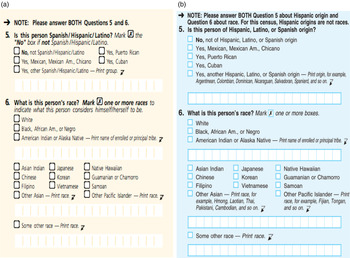
In short, Americans would have the option to identify with multiple races (see Appendix B for a reproduction of the race and ethnicity questions used in 2000 and 2010) and would be counted as belonging to more than one race; but for purposes of monitoring and enforcing civil rights, any person who marked both white and a nonwhite race would be allocated to the nonwhite race. Though this policy contained several controversial elements, its aim was to protect those who have historically experienced discrimination, and the rules satisfied the civil rights groups' most pressing demand: Numbers would not be “drained” from any minority group.
MOOM appealed to Democrats on principle, as a change reflecting racial sensitivity. It also reflected Democrats' determination—and legal obligation—to keep intact the data necessary for civil rights enforcement.Footnote 34 Indeed, a multiracial category was rejected in favor of MOOM primarily because the former would have substantially affected counts in the traditional racial groups. Even with MOOM, it was important that the tabulation avoid such a drain, since civil rights laws require single-race statistics. The OMB's Tabulation Working Group was careful to ensure that the tabulation policy would comply with those laws. In its tabulation guidelines, the OMB indicated that the data infrastructure would remain whole, and it suggested, moreover, that the effect of MOOM would be negligible.Footnote 35
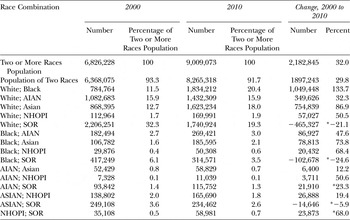
Table 1 reports the largest combinations of two races reported in 2000 and 2010.
Two or More Races Population by Specific Combination: 2000 and 2010

*The percent change for race combinations that include “some other race” are noted with an asterisk and should be assessed with caution because they may be impacted by an error in the Census 2000 “Two or More Races” data. In Census 2000 an error in data processing resulted in an overstatement of the “Two or More Races” population by about one million people (about 15 percent) nationally. Changes in specific race combinations not involving some other race, such as White and Black or Black and Asian, should generally be more comparable.
AIAN refers to American Indian and Alaska Native; Black refers to Black or African American; NHOPI refers to Native Hawaiian and Other Pacific Islander; and SOR refers to “some other race.”
Source: Nicholas A. Jones and Jungmiwha Bullock, The Two or More Races Population: 2010 (Washington, DC: U.S. Census Bureau, 2012), 6.
In 2000, 6.8 million Americans (2.4 percent of the total population) reported multiple races. From this small base, the multiple-race population increased 32 percent in the 2010 census but still represented just 9 million people, or 2.9 percent of the total population. Almost everyone who marked more than one race in 2000 (93.3 percent) and 2010 (91.7 percent) marked only two. In 2010, people who reported being both white and black numbered 1.8 million, up from 784,764 in 2000 (a 133.7 percent increase). The second most common combination in 2010 was white and some other race (1.7 million).Footnote 36 Together, the top five combinations, all involving whites, represented 75 percent of the total multiple-race population. In Census Bureau publications and data releases, these people were reported, as shown in Table 1, as belonging to more than one race. Behind the scenes, however, federal agencies engaged in monitoring and enforcing civil rights counted them as minorities. This quelled civil rights advocates' most immediate worries about dwindling numbers, but the inflation of the minority count was otherwise difficult to justify, and it smacked of the one-drop rule.
It is significant, too, that the Census Bureau typically reports only the top combinations in its publications, thus providing a simplified version of the country's racial landscape, though elsewhere it provides data on all the possible racial and ethnic combinations. Allowing people to mark more than one race resulted in a total of fifty-seven possible multiple-race combinations. Add to that the five official single-race categories plus a sixth option, “some other race,” and the tally increases to sixty-three racial categories. Because each racial category can be subcategorized by a question asking respondents if they are Hispanic, the constellation of race/ethnic mixtures swells to 126 possible combinations. This multiplicity of options demonstrates that the new policy, MOOM, broke down the binary race formulation; but the tabulation scheme, concocted after the decision to enact MOOM, effectively put that binary formulation back in place. Drawing a “Humpty Dumpty” analogy to describe the situation, Roderick Harrison, chief of the racial statistics branch from 1990 to 1997, argued that one-drop redux, inflated minority counts, maximum and minimum counts, and 126 possible racial/ethnic “groups,” ran the risk of making race-based public policies even more controversial than they already were. Harrison's views grew increasingly unwelcome, however, and despite having held a top position in the Census Bureau throughout the 1990s, he was “removed” from the Tabulation Working Group so that the bureau could “speak with one voice.”Footnote 37
1.6. Did Implementation Effectively Assuage Citizen Demands? Impact Responsiveness: 1997–Present
In 1997, when the OMB announced that there would be no multiracial category on the census but that Americans would be allowed to mark as many races as they wanted, most multiracial activists accepted this as sufficient. A few holdouts, however, vowed to continue the fight. In 2000, when the OMB unveiled the tabulation guidelines, the same thing happened: A handful of critics denounced the policy as a violation of the principle of self-identification and as a reformulated one-drop rule, but there was no widespread outcry in multiracial circles.Footnote 38 This was in part because the Census Bureau and other agencies published the census data with multiracial people reporting more than one race. Many people did not realize that the data used for civil rights purposes was being tabulated differently within the agencies.
Another reason why first-wave organizations and activists did not mount much of a challenge to the tabulation scheme is that, in the main, these grassroots activists did not want lawsuits, they wanted acceptance.Footnote 39 For many, MOOM accomplished that, regardless of its accompanying tabulation guidelines. Even today, though people who identify as multiracial are blazing the second-wave trail, they have not rallied consistently around the tabulation issue.Footnote 40 Thus it is arguable that MOOM sufficiently addressed the concern that drove many first-wave activists to band together in the first place.
Nevertheless, an analysis of both the principles and the methods behind the tabulation guidelines and of the census's system of racial categorization more generally reveals inconsistencies and areas of controversy, which, I argue, all but ensure myriad and varied citizen demands on the Census Bureau looking forward. One important example is the bureau's ongoing difficulties with Latino racial and ethnic reporting. Current federal race standards, which define Latino as an “ethnicity” that spans all races, have proven confusing for Latinos and non-Latinos alike.Footnote 41 The media, researchers, and the Census Bureau itself often treat “Latino” as a de facto racial category, but “Latino,” like “multiracial,” does not fall comfortably into current understandings of race.Footnote 42 Moreover, Latinos' mixed roots are well documented.Footnote 43
In this light, it is no surprise that in 2000 Hispanics were more likely than non-Hispanics to identify with multiple races (6.3 percent vs. 1.9 percent) and again in 2010 (6.0 percent vs. 2.3 percent).Footnote 44 What is more, many Latinos reject the standard racial options altogether and mark “some other race,” instead. Just 200,000 Americans chose “other race” in 1960. By 1980, that number was 6.8 million. In 2010, 19.1 million Americans (or 6.2 percent of the population) selected the designator “some other race.” To put this in perspective, 19.1 million is larger than the single-race Asian, American Indian and Alaska Native (AIAN), and Native Hawaiian and Other Pacific Islander (NHOPI) populations combined. Who are these 19 million Americans of “some other” race? It turns out that almost all of them—97 percent in 2010—are Latinos.
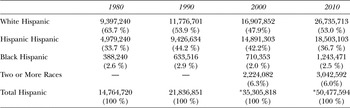
Table 2 documents Latino racial reporting on the census since 1980. More than half of all Latinos (53 percent) identified racially as white in 2010. By comparison, just 2.5 percent identified racially as black. Most of the rest, considered by the Census Bureau to be Hispanic both ethnically and racially (hence the redundancy of “Hispanic Hispanic” in Table 2), identified as “Hispanic/Latino” in response to the question on ethnicity and as “some other” in response to the race question, often writing in a term like “Mexican” on the line provided for explanation. Even though Latinos were offered the option of selecting more than one standard race in 2000, 42.2 percent still opted for “some other race” in that year, and 36.7 percent did so in 2010.Footnote 45 This suggests that the “term itself is the problem.”Footnote 46
Racial Composition of the Hispanic or Latino Population, 1980–2010

*Including Hispanics/Latinos who identified racially as AIAN, Asian, or NHOPI.
Sources:
1980 and 1990: John Logan, How Race Counts for Hispanic Americans (Albany, NY: Lewis Mumford Center for Comparative Urban and Regional Research, 2003).
2000: U.S. Census Bureau, Census 2000 Redistricting Data (P.L. 94–171) Summary File for states, Tables PL1, PL2, PL3, and PL4.
2010: U.S. Census Bureau, Census 2010 Redistricting Data (P.L. 94–171) Summary File for states, Tables PL1, PL2, PL3, and PL4.
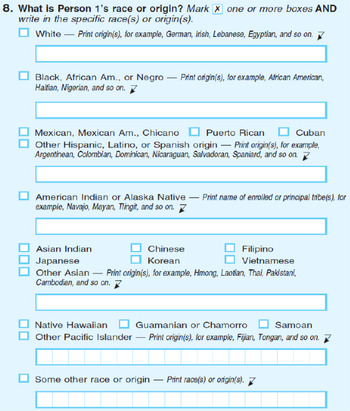
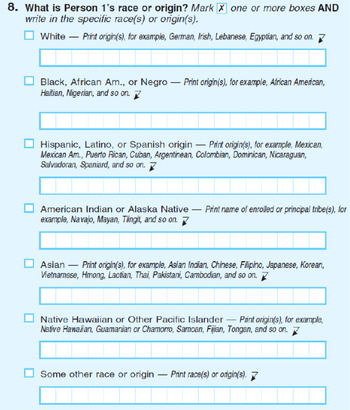
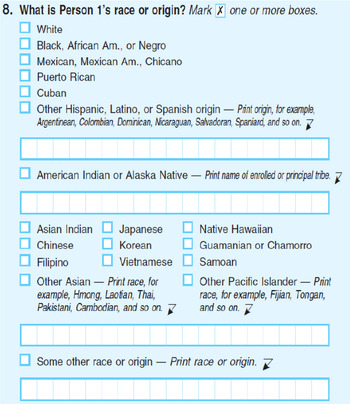
By early 2014, questions about how the census classifies Latinos were front and center in the research and planning for the 2020 census. In order to “improve the completeness and accuracy of race and Hispanic origin data” the Census Bureau conducted the 2010 Census Race and Hispanic Origin Alternative Questionnaire Experiment (AQE).Footnote 47 The AQE, which sought to “increase reporting in the U.S. OMB race and ethnic categories, lower non-item response, increase accuracy and reliability of the results, and elicit reporting of detailed race and ethnic groups,” tested fifteen experimental questionnaire formats.Footnote 48 The results indicated that most of these problems would be ameliorated with the introduction of a combined-format question referring to all six groups, including Latinos, in terms of “race or origin” (see Appendix C).Footnote 49
In an “interesting discovery,” the AQE's combined-format questions also had a “significantly greater proportion of Two or More Responses than the alternative control … panel,” ranging from 4.2 percent to 6.3 percent.Footnote 50 The report called for additional testing to explore the reasons for the increase and speculated that “separate [race and ethnicity] questions are discouraging respondents from reporting their full self-identified race and origin.”Footnote 51 In sum, the Census Bureau seems poised to recommend to the OMB a new, combined-question format for the 2020 census (see Appendix C). If the OMB agrees, Latino will become one of six “race” or “origin” options, and multiple-race reporting will probably increase.Footnote 52
Although MOOM was crafted with multiple-race people in mind (see Figure 1), one wonders whether perhaps it is not multiracials but Latinos who are leading the way in the binary breakdown. Either way, “one-race-only” conceptions of race may be waning for all Americans to a greater extent than census data (see Table 1) suggest. When a 2009 Pew survey asked respondents to describe their race and gave them the option to identify with more than one racial group, just 1 percent chose to identify with more than one category.Footnote 53 Later in the same survey, however, when respondents were asked explicitly if they consider themselves to be of mixed race, fully one in six (16 percent) said they did so identify, “including 20 percent of blacks, 8 percent of whites, and 37 percent of Hispanics.”Footnote 54 It is obvious from this discrepancy that wording and context plague estimates and projections of the multiracial population; but the discrepancy also indicates a profound uncertainty within the American population about the meaning of multiracialism and about people's options in self-identification.Footnote 55
In sum, the cause-and-effect story of Section 1 is as follows. Without the catalyst of the multiracial movement, there would be no MOOM. In turn, MOOM injected new vulnerabilities into the U.S. racial statistical system. The Tabulation Working Group had considered an array of tabulation options; all would have required either fractions or racial reassignment. Fractions had the best statistical goodness-of-fit values, but since fractions also invoked the bookkeeping of slavery, they were politically impractical. The only viable options, therefore, involved racial reassignment. Since all of the seriously considered tabulation options would have required racial reassignment, I suspect that any MOOM solution would have grown technically and politically controversial over time (see Appendix A for details). A related challenge is that the MOOM decision also validated a new identity-based rationale for asking Americans about race, as opposed to a civil rights rationale rooted in mitigating racial disparities.
An untenable situation comes into focus when we bring it all together. The OMB now accepts identity-based rationales for asking Americans about race but also engages in behind-the-scenes racial reassignment. The circumstances call to mind the growing “policy feedback” literature, in which we often find accounts of big beginnings that taper off.Footnote 56 Here, by contrast, the story is one of small beginnings with a potentially big impact over time.Footnote 57 Section 1 has argued that the multiracial movement and MOOM constitute the small beginnings. Section 2 contends that these dynamics will become increasingly unmanageable and may even lead to the unraveling of American racial categories altogether.
2. THE LARGER CONTEXT—STRUCTURAL AND CULTURAL CHANGES IN AMERICAN PERCEPTIONS OF RACE
2.1. Kenneth Prewitt and the End of Racial Categories
Political scientist Kenneth Prewitt became director of the Census Bureau in 1998 and served in that capacity throughout the implementation of MOOM. In a recent book informed by his stint of leading the bureau, Prewitt boldly declares that it is time to “break free of an eighteenth-century race science that has structured how we have understood and experienced race across our history, bequeathing to us the familiar statistical races.”Footnote 58 Prewitt reflects on the 2000 census in outlining his plan for the future. The concerns that a number of scholars, including this author, expressed in the mid-2000s about the tabulation guidelines he dismisses as “scattered grumbling that [MOOM] echoed the one-drop rule of the nation's racist past. But reassignment was politically possible because the multiple-race respondents were fewer than 3 percent of the population and because those politically affected—minorities bringing discrimination complaints to the courts—were protected by the reassignment formulae.”Footnote 59 In a poetic turn of phrase, he writes, “Until the multiple-race population grows to a significant percent of the population, 10 percent or so, ‘mark one or more’ will remain a change that points to the future without disrupting the present.”Footnote 60 But once 10 percent of the population identifies as multiracial, the difficulties of the tabulation guidelines created in 2000 will become overwhelming; finding a new method of assessing America's racial landscape will become crucial.
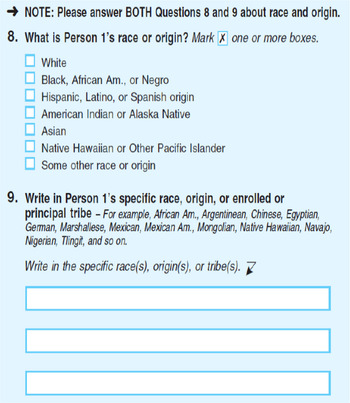
Prewitt recommends three steps, carried out over the next half-century, to solve this and other problems by moving Americans toward the end of racial categories as we know them. The first step is to adopt a new, combined-format questionnaire in the 2020 census (see Appendix C, Figure 3c) that would abolish the distinction between “Hispanic origins” and “races” (see Appendix B, Figure 2b). In effect, Prewitt would drop “ethnicity” from the census lexicon and thus make it possible to refer to all six groups as “origins” or “races” interchangeably (Prewitt prefers “origins”). At the same time, Prewitt advocates removing the race and origin questions from the decennial census altogether and placing them instead on the American Community Survey (ACS).Footnote 61 “The decennial census is not the platform on which to debate the importance of reducing racial inequalities or integrating the foreign born. The decennial census itself should signal that its sole purpose is the constitutional mandate to provide statistics for reapportionment and redistricting. This … does not require race or national origin questions.”Footnote 62
Prewitt's second step would help to end American racial categorization by using generational turnover strategically. He estimates that racial reassignment will become “technically unworkable or politically unacceptable” within a generation or so. By the time of the 2040 census, he says, any policy use of MOOM will be “easily accepted by the generation that grew up with it.”Footnote 63 In order to ease the transition from six statistical races on the decennial census to national-origin statistics on the ACS, Prewitt looks to MOOM as a model. MOOM introduced a major modification in 2000 without disrupting current policy uses; that is its “genius.”Footnote 64 He predicts that eventually, with a growing multiracial population, MOOM will disrupt policy, but by the time there is “debate about the policy uses of ‘mark one or more’ statistics, [the] statistics themselves will be taken for granted. This lesson bears directly on how I believe the country can proceed.”Footnote 65 By 2040, therefore, Prewitt would drop the race question entirely and use only the national-origin question on the ACS. Presumably, this would spell the end of MOOM, since racial categories would cease to exist.Footnote 66
Looking ahead to 2060, Prewitt calls for research, in the third step of his plan, to determine if the national-origin question is still producing “meaningful statistics.”Footnote 67 If and when national-origin statistics cease to inform, then, finally, an America “transformed by immigration, diversity and multiraciality—and one in which cumulative disadvantages will have been erased—will no longer require race statistics.”Footnote 68 In this way, contrary to my own forecast in 2006, the Census Bureau may avoid a day of reckoning on the racial tabulation guidelines. By the time the self-identified multiracial population tops 10 percent and reallocation becomes unmanageable, racial categories could be gone!Footnote 69
Although Prewitt no longer represents the Census Bureau in a formal capacity, he remains influential within it. Indeed, bureau director Robert Groves (2009–12), sworn in less than a year before the 2010 census began, testified that he needed Prewitt's expertise because the Census Bureau “team [in place had] less senior experience in managing censuses than was true in some past censuses,”Footnote 70 and the decennial count was fast approaching. Groves subsequently hired Prewitt as an external consultant for the 2010 enumeration. Prewitt also served as a discussant when, in a 2012 news conference, the bureau unveiled the results of the 2010 AQE. Whatever the extent of Prewitt's current involvement, the extensive testing being carried out by the bureau in preparation for this upcoming census is deeply informed by earlier examinations of racial and ethnic categorization, and the changes that the bureau is considering for 2020 align closely with the recommendations proffered in his book.Footnote 71
2.2. The Role of the Multiracial Movement in a Larger Pattern of Cultural Change
Cultural change often looks like continuity on the surface.Footnote 72 Over time, however, it can—and in this case does—look like real transformation. Consider, for instance, the introduction of the mulatto category on the census in 1850. The category was added initially as a means of testing Josiah Nott's theory that blacks and whites were separate species. Nott believed the progeny of interracial unions to be frailer and, thus, to live shorter lives. “They will follow the fate of the Indians,” he prophesied.Footnote 73 The American Statistical Association and the American Geographical and Statistical Society helped to draw up the census forms that presented Americans with the “mulatto” option in 1850. “Mulatto” appeared on all censuses from 1850 to 1890—at which point “Quadroon” and “Octoroon” made onetime appearances. “Mulatto” was dropped in 1900 and reappeared in 1910. At last, after a final census appearance in 1920, the term was finally abandoned.
The first anti-miscegenation statutes were enacted in Maryland in 1661 and Virginia in 1662.Footnote 74 More than three hundred years later, as part of a larger system of Jim Crow segregation, laws against interracial marriage were still enforced in at least sixteen American states. State laws that enforced segregation in public education were finally overturned in 1954 (Brown v. Board of Education), but the Supreme Court did not decriminalize interracial marriage until thirteen years later, in 1967 (Loving v. Virginia). Activist Judy McGee told me that she had been arrested and thrown in jail for this “crime” as a young woman, simply because she loved a man who was black.Footnote 75 And, as we have seen, the government did not move away from the “absurdity and insult of rules requiring a monoracial response on government forms” until 1997.Footnote 76 Cast in this light, the multiracial movement and MOOM can be seen as part of a larger legal and cultural shift away from state-sponsored and socially enforced segregation and toward a growing acceptance of mixed-race relationships and people. This visible cultural change in American society is due to a range of factors, including the efforts of multiracial activists to legitimize multiracial identity and the willingness of the Census Bureau to oblige.
The remainder of this section evaluates the cultural outcomes of the multiracial movement through the lens of three analytical traditions.Footnote 77 Studies that focus on changes in values, beliefs, and opinions are part of the “social psychological” tradition. For instance, Thomas Rochon's 1988 book, Culture Moves: Ideas, Activism, and Changing Values, fits in this camp. Cultural change, per Rochon, is the product of a “two-step process in which concepts are first created and then spread throughout the society.”Footnote 78 In the first step, a “critical community”—comprising a relatively small number of individuals who identify a grievance, analyze its sources, and come up with solutions—generates new, change-oriented ideas and values (see Figure 1). In the second step, social movements help to diffuse these transformative ideas, which may become new cultural values if they are brought to a broader audience, gain widespread acceptance, and thus make people “think in a different way.”Footnote 79
Consider the change in American opinion on interracial marriage over time. In one of the “largest shifts of public opinion in Gallup history,” 87 percent of Americans approved of marriage between blacks and whites in 2013, up from 4 percent in 1958.Footnote 80 The steepest increase in this span of nearly half a century, from 48 percent to 64 percent, came at the height of movement activity. Whites are catching up to the level of black approval—the black–white gap closed to an all-time low of 12 percent in 2013—but have yet to reach it. Back in the 1990s, multiracial activists made the lofty claim that the recognition of multiracial identity could help Americans move beyond an impasse of racial strife. In 2008–10, according to a Pew survey, about four in ten Americans (43 percent) agreed that “more people of different races marrying each other” has been a change for the “better” in our society; 51 percent of blacks said it was a change for the better, compared to 48 percent of Latinos (±3 points).Footnote 81 Non-Hispanic whites lagged behind at 40 percent. Overall, the survey found that “being a minority, younger, more educated, liberal and living in the Eastern or Western states are all traits associated with those who think more positively about intermarriage.”Footnote 82
Multiracial identity reemerged as a topic of national discussion in the late 2000s, when candidate Barack Obama catapulted to prominence and then to the White House, thanks in part to a moving story about his mother from Kansas and his father from Kenya. Although he championed multiraciality on the campaign trail and benefited from many Americans' hopes that his presidency would somehow transcend race, two years into office, President Obama chose to mark “black” on the 2010 census.Footnote 83 According to a 2009 Pew survey, however, only about one-quarter (27 percent) of Americans viewed him as a black person, while a majority regarded the president as “mixed race” (52 percent).Footnote 84 Again, the results vary notably by race and ethnicity. A majority of Latinos (61 percent) and white non-Hispanics (53 percent), along with just 34 percent of blacks, said that Obama is of mixed race. Blacks were more than twice as likely (55 percent) as white non-Hispanics (24 percent) or Latinos (23 percent) to say that Obama is black. This divide in public opinion on Obama's race could mean that the one-drop definition of blackness, rooted in the institutions of slavery and Jim Crow segregation, today finds most of its support among black people themselves.Footnote 85
Above all, the multiracial activists of the 1990s demanded the right to construct a vocabulary about their experience and to identify as they saw fit. The Bill of Rights for Racially Mixed People, a widely circulated manifesto among first-wave activists, gave voice to these imperatives. It included the right to “change my identity over my lifetime—and more than once.”Footnote 86 Indeed, by 2015, almost a third (29 percent) of adults with a mixed racial background said that they had previously thought of themselves as belonging to only one race.Footnote 87
Changes in public opinion are important results of social movements, but they are not the only meaningful outcomes. Scholars in the “cultural production and practices” tradition regard cultural change from a more symbolic standpoint, exploring visual culture, innovations in language and discourse, and cultural representations in the media, including books and magazines.Footnote 88 In the late 1980s, the United Colors of Benetton released provocative magazine and billboard ads, including a much-discussed image of a black woman breastfeeding a white baby, which ushered in a new era of American advertising. Before then, the world of American advertising and television had been almost entirely white. Since then, marketers have increasingly sought to profit from the diverse, global marketplace.Footnote 89
The evolution of books about interracial relationships serves as another case in point. As late as the 1980s, some retailers “refused to sell romance fiction with African Americans on the cover, much less interracial covers. The latter are now showing up with more frequency, though they are still considered too edgy by a few retailers.”Footnote 90 A July 2015 Amazon.com book search for “interracial marriage” generated 7,173 results, including academic titles like Interracial Intimacies: Sex, Marriage, Identity, and Adoption (2004); self-help publications, including Intercultural Marriage: Promises & Pitfalls (2008); children's books like Black, White, Just Right (1993) and I Love Saturdays y Domingos (2002); and romance novels such as His Chocolate Obsession, a title in the black women/white men “billionaire romance” series. As interracial relationships and marriages grow more common, the market for related cultural products, including books, will continue to grow.Footnote 91
Meanwhile, on television and in advertising, ambiguous racial identities and interracial relationships are now commonplace. Although “racial and ethnic stereotypes are still present in the media,” writes Charles Gallagher, the “degrading imagery that was a ubiquitous mainstay of most television programming history has been replaced by a multiracial approach to entertainment. America's racial ‘presentation of self’ in the mass media is overwhelmingly depicted as an integrated, multiracial environment where individuals consume products in a post-race, color-blind world.”Footnote 92 Indeed, racially ambiguous individuals, along with interracial families, relationships, and sex, appear nowadays in everything from racy television shows like Scandal to commercials selling breakfast cereal. Arguably, such advertisements and shows, depicting either groups of people who are of different identifiable races or individuals who are themselves mixed/ambiguous, speak to the same trend: Images and overtones of close contact across racial groups, once taboo, now proliferate and help to generate corporate profits.
Finally, a third tradition, the “communities and cultures as cultural outcomes” approach, emphasizes the development of new and distinct collective identities.Footnote 93 This often involves creating a new sense of “us” and “them,” but in the case of multiracialism, activists sought to promote a community that straddles boundaries and validates mixture.Footnote 94 At the same time, activists embraced the idea of race as a cultural construct. In this sense, multiracialism is similar to panethnicity, in that both involve a shift in the scale of identification from a smaller group boundary to a larger one, or, in the case of multiracial people, from any boundary to no boundary. What makes Puerto Ricans “Latinos,” Vietnamese “Asians,” Kenyans “African Americans,” or Italians “Whites”? While all panethnic groupings are in fact complicated by real social and genetic diversity, panethnicity focuses attention on the ways in which previously diverse or unrelated groups can identify common interests and assume a shared identity. A fundamental tenet of panethnicity is that “external” defining processes reinforce “internal” solidarity. In short, unless subgroups look alike from the perspective of the outsider, panethnic affiliations are not likely to thrive.Footnote 95 Hence the question of whether or not the growing number of Americans who identify as multiracial will gel as a community because others define them as racially mixed. Second-wave multiracial organizations like the Mavin Foundation and Swirl, websites like Mixed Race Studies and the Multiracial Network Blog, college groups, and college courses like “Betwixt and Between” all endeavor to affirm pan-multiracial alliances and attest to the potential for community building. To date, however, there has been no comprehensive study published on second-wave multiracial activism, and many questions about the second wave remain unanswered.Footnote 96
A 2015 Pew survey adds new elements to the still unfolding story of pan-multiracialism. A basic question for any community concerns its size, and estimates of the multiracial population vary widely. By taking into account how adults describe their own race as well as the racial backgrounds of their parents and grandparents—which the census, by contrast, does not do—a June 2015 Pew Research report estimates that “6.9 percent of the U.S. adult population could be considered multiracial,” compared to the “census's estimate that 2.1 percent of the adult population is multiracial.”Footnote 97 However, only “a third (34 percent) of all multiracial Americans think they have a lot in common with other adults who are the same racial mix that they are, while only half as many (17 percent) think they share a lot with multiracial Americans whose racial background is different from their own.”Footnote 98 Notably, multiracial adults who are perceived as white experience less discrimination than their counterparts who are perceived as black or Latino.Footnote 99 None of this bodes well for cultivating a common identity across the vast span of multiracial experience, though there is hope in the fact that mixed-race identities, appearances, groups, and relationships are finding more acceptance and affirmation in American culture today than ever before.
The multiracial movement and MOOM are part of a larger structural and cultural process in which Americans are inching away from the black/white, one-race-only divide, but they are doing so in ways that often evoke the old, familiar racial hierarchy.Footnote 100 If Americans were moving away from the one-race-only divide in ways that did not call to mind the old hierarchy, then one might expect that positive attitudes about interracial marriage would be more evenly distributed and that public opinion on Obama's racial identity would not vary much by race. One might also expect that interracial marriages would grow more prevalent at about the same rate across all different race and gender combinations, but that is not the case.Footnote 101 It is also telling that about 97 percent of Americans identified with just one race in 2000 and again in 2010. This, along with the fact that almost everyone who did identify with more than one race in these censuses marked just two races (see Table 1), suggests that most adult Americans, especially whites and blacks, remain attached to the myth of racial purity.
To sum up, the causal arrows in Section 2 run both ways. On the one hand, the legal and cultural shift away from state-sponsored segregation and toward growing acceptance of multiracial people and relationships was in motion long before the multiracial movement of the 1990s began. On the other hand, growing acceptance of multiracial people and relationships, spreading doubts about the old racial categories, and increasing numbers of Americans who embrace identity options that do not square with the standard racial categories suggest that the multiracial movement and MOOM accelerated cultural change that was already underway. These developments are results as well as causes. In any case, looking forward, the nature of American racial identity promises to be more fluid rather than static, and some of the changes in the future will have stemmed from the relatively small beginnings of multiracial activists and MOOM.Footnote 102
CONCLUSION
I have argued in this article that the multiracial movement of the 1990s is deeply entwined with demographic and cultural developments that in the 1990s were not considered to be linked to the multiracial population and that MOOM may yet be credited as the beginning of the end of American racial categorization as we know it, as seen, for example, in Prewitt's incremental plan of eliminating racial-identification questions on the census.
The multiracial movement of the 1990s sought and ultimately attained federal recognition of multiple races through the implementation of MOOM on the census. This change in policy came after a probing and lengthy bureaucratic examination that brought with it prolonged media attention and multiple opportunities for public comment. Throughout, civil rights advocates worried that MOOM would compromise civil rights enforcement, but they found it awkward to defend monoracial categories too strenuously and impossible to avoid the logic of more testing. Census Bureau director Robert Groves (2009–12) explained to a reporter why ongoing change in the census's racial categories is warranted, and indeed necessary: “As new immigrant groups came to this country decade after decade, how we measure ethnicity changed to reflect the changing composition of the country. Since that change is never ending and America gets more and more diverse, how we understand and tabulate the information has to be continually open to change.”Footnote 103 Such an attitude indicates both a cause and a consequence of the multiracial activists' successful efforts: The Census Bureau is keenly aware of both America's changing racial landscape and the need to develop new tools to measure and understand it. Thus, while some issues and policies may be especially difficult for social movements to influence, the American system of racial categorization is not one of them.Footnote 104
The Census Bureau's difficulties over the past half-century are patently evident. Many of the bureau's biggest problems since the 1970s have revolved around race, such as last-minute changes imposed by Congress; lawsuits over a systematic net differential undercount of urban, poor, and minority areas; litigation between the bureau and its parent agency over the use of sampling to remedy undercounts; and assailable definitions of racial and ethnic groups.Footnote 105 Against this backdrop, MOOM served to further destabilize a system already plagued with vulnerabilities. The 2000 census added to this instability by demonstrating that small numbers of people (such as multiracial activists and NHOPI proponents) can get heard and win recognition. To the extent that claims by “small” groups or interests (for new racial designations, amended categories, etc.) will proliferate, then this will probably serve to undermine the “big” categories necessary for civil rights enforcement as currently practiced. This raises a related concern: Part of the confusion on the part of individuals answering census and survey questions is that the government refuses to tell Americans exactly why racial classification matters and why it does not. In the latter part of the twentieth century, the reason for the race question was rooted in civil rights reasoning about mitigating disparities. Today, although the bureau's reasons for the race question make no mention of self-esteem or recognition, the government has accepted the “legitimacy of expressive rationales” and thus has “quietly given a new and very twenty-first-century reason for asking Americans what their race is.”Footnote 106
Under the circumstances, it is plausible that OMB and Census Bureau bureaucrats might regard Kenneth Prewitt's plan as a welcome escape from the contentious business of counting by race, assuming that the bureau still provides a means of monitoring discrimination, via the gathering of national-origin data on the ACS.Footnote 107 In any case, in an effort to measure the rapidly changing concepts of race and ethnicity, the bureau has reviewed racial identity and categorization every twenty years since the 1970s, and there is every reason to expect that this cyclical program of testing will continue. Note, too, that Nicholas Jones, a self-identified multiracial man and a protégé of former AMEA president Ramona Douglass, currently holds the position of Chief of Racial Statistics, Roderick Harrison's former job.Footnote 108
It seems clear that MOOM tabulation will become difficult to sustain once the self-identified multiracial population constitutes 10 percent or more of the country's total population.Footnote 109 Recent estimates of the U.S. adult multiracial population range from 2 percent to 7 percent to 16 percent, depending on question wording and other variables.Footnote 110 One thing is certain: The bulk of the self-identified multiracial population is young and growing rapidly.Footnote 111 Moreover, if the OMB moves toward making Latino a “race or origin” in 2020, as seems likely, then we can expect an additional and substantial increase in multiracial reporting.Footnote 112
Most Americans are probably at least somewhat aware that the nation's racial and ethnic mix is changing quickly. Around 2050, we are told, whites will become a numerical minority.Footnote 113 Yet if increasing numbers of people identify as both white and something else, then the boundaries of whiteness may expand.Footnote 114 It would not be the first time. The boundaries of whiteness have changed before, as in the early twentieth century, when people of Irish and Italian origin came to be thought of as white. Alternatively, perhaps by the time we get to 2050, class and skin tone will trump race as criteria of social categorization.
There are of course many unknowns in the future. In the 1990s change occurred when a coalition of interests, albeit for very different political purposes, supported reform. In today's sharply polarized political environment, it is unlikely that Prewitt's plan would satisfy partisans on either side of the aisle. However, since his scheme hinges on incremental bureaucratic change over the next half-century, the real question is: Will the federal government move away from collecting racial statistics in the years to come? This brings me back to Derrick Bell's interest-convergence principle: “The interest of blacks in achieving racial equality will be accommodated only when it converges with the interests of whites.” Bell's thesis begs a difficult question: Is multiracial recognition a step in the direction of blacks' achieving racial equality? Roderick Harrison thought not. He surmised that MOOM and its tortured tabulation scheme would destabilize racial categorization and thus, in the long run, jeopardize laudable social-justice efforts.
Writing about the Supreme Court's landmark 1954 decision in Brown v. Board of Education, Bell voiced a similar concern. Equality as a goal can be made vulnerable by reliance on court orders and racial classification:
The danger with our commitment to the principle of racial equality is that it leads us to confuse tactics with principles. The principle of gaining equal educational opportunity for black children was and is right. But our difficulties came when we viewed racial balance and busing as the only means of achieving that goal. At a much earlier point than we did, we should have recognized that our tactic was making it harder rather than easier to reach our goal. I fear that the tactic of using racial classifications as the vehicle for affirmative action programs will endanger those programs, if not by the Court, then by the political process.Footnote 115
Bell's concerns were prescient with respect to affirmative action and also impinge upon a wide array of policy issues that depend upon racial and ethnic statistics. Research on racial and ethnic politics relies heavily on racial statistics but tends to neglect related inquiries into the political process behind the categories themselves.Footnote 116 Given the controversies surrounding the principles and methods of the government's system of racial categorization, it seems clear that the system deserves more thorough attention from researchers, especially since the stakes are potentially so high.
Like Prewitt, I suspect that the traditional racial categories are breaking down and the days of government racial statistics are numbered. When the government ceases to collect racial data, it will mark the end of a particular strategy of civil rights enforcement that has been in place since the 1960s–70s.Footnote 117 Then, perhaps, some other form of civil rights enforcement will ascend to take its place (e.g., class and/or geography-based, such as the Texas Ten Percent Plan); perhaps not. Unlike Prewitt, I cannot imagine a time when cumulative disadvantages will have been erased. Instead, I share Harrison's skepticism that “Prewitt's visions are realized only at substantially lower levels of inequality [and] achieved at paces far outstripping the progress of the best of decades.”Footnote 118 Nevertheless, we could still face the end of government racial statistics sooner rather than later, per the interest-convergence principle.
In Mark One or More, I argue that the interests of whites helped to explain the multiracial movement's emergence and success. Here I posit that the interests of whites may also profoundly shape the recursive outcomes of the multiracial movement. We need to ask when and if whites will perceive personal benefit in an ability to claim multiple heritages and/or in the idea of multiracialism. Some whites, for instance, might regard multiracialism as a panacea for the nation's age-old divisions or as a way to avert their eyes from the distressing realities of ongoing racial inequality.Footnote 119 Others might embrace a multiracial heritage in an effort to benefit from affirmative-action programs. Multiracialism could also appeal to some whites as a way to demonstrate feelings of solidarity with minorities or to reject the privilege that comes with being white. Especially in light of the ubiquitous advertising that now depicts multiracialism in positive ways, young whites in particular may find “positive cachet” in social circles and more success in online dating by identifying as multiracial.Footnote 120 Older white politicians with nonwhite relatives, such as New York City Mayor Bill de Blasio, have already seen a benefit in featuring their mixed families on the campaign trail as a way to reach minority voters.
In conclusion, and within the larger structural and cultural shifts currently shaping the ways that Americans think about race, MOOM can be seen as both an example and an agent of change; ultimately, it may have marked the beginning of the end of American racial categories. Civil rights groups received assurances in the 1990s that civil rights enforcement would remain intact with MOOM, yet one wonders who will step in to defend the accompanying tabulation guidelines in the years to come if the OMB, creator of those guidelines, backs away from its own directive. Older white conservatives like Tom Petri and Newt Gingrich, who would scrap racial categorization altogether, will not defend them. More significantly, current and future generations of multiracial activists and other young people who grew up with MOOM will most likely not defend them either. A high percentage of the constituencies that Latino, Asian, and Native American civil rights groups claim to represent already identify with multiple races, and those numbers are projected to increase. Looking ahead to the middle of the twenty-first century, one can imagine a scenario in which older white and black liberals split into two camps: colorblind optimists on the one hand and racial-discrimination skeptics on the other. In this situation, black interests surrounding American racial categorization are, however defined, unlikely to drive the political process. In the name of enforcing laudable civil rights goals, blacks, especially those who will be senior citizens thirty or forty years hence, could be the last people left standing to defend the eighteenth-century practice of categorizing Americans by race.
Appendix A. OPTIONS CONSIDERED BY THE TABULATION WORKING GROUP, 1997–2000
Civil rights laws require that statistics plainly distinguish between those individuals who are members of minority groups and those who are not. Thus, the Tabulation Working Group was tasked with devising a standard by which to reallocate multiple-race responses “back” to a single race in order to produce numbers for the purposes of civil rights enforcement and for comparison of 2000 data with data from earlier censuses. The Tabulation Working Group considered an extensive array of statistical possibilities; each would have affected the count of racial groups differently. The most seriously considered options were as follows:
-
• Deterministic Whole Assignment—Largest Group Other Than White: This method of tabulation would have involved reassigning those who checked more than one box to the largest of the nonwhite groups she or he marked. So, a respondent reporting her race as black, white, and Asian would, for tabulation purposes, be counted as black. (This would have artificially inflated the size of large minority groups.)
-
• Deterministic Whole Assignment—Smallest Group: This method would have assigned people selecting two or more racial groups to the group with the smallest population with respect to single-race responses. For example, black, American Indian respondents would be counted as American Indian. (This would have artificially inflated the size of small minority groups.)
-
• Deterministic Whole Assignment—Largest Group: This method would have assigned people selecting two or more racial groups to the group with the largest population with respect to single-race responses. For example, black, Asian respondents would be counted as black; white, Asian respondents would be counted as white. (This would have artificially inflated the size of the largest racial groups.)
-
• Deterministic Whole Assignment—Plurality: When respondents reported more than one race, in this method, they would have been queried about the one race they most strongly identified with. The proportion choosing each of the possibilities would have been calculated accordingly. For example, among persons who identified as white and American Indian, those who chose American Indian as their “main” race would have been assigned to the American Indian population. (This would have served to draw attention to—yet would not have addressed—the initial complaint of multiracial groups regarding a forced choice or a privileging of one parent over the other.)
-
• Deterministic Fractional Assignment—Equal Fractions: This method would have assigned fractions of persons to groups according to the numbers of multiracial responses given by respondents. For instance, an individual identifying as black and white would result in 0.5 person added to each group. (This had the virtue of avoiding the reassignment of mixed-race responses into a single-race group, but this method would have yielded population counts that were not whole numbers. What is the meaning of a count of 2.5 black people? What about three-fifths of a black person? Another problem, then, was that fractions invoked the bookkeeping of slavery.)
-
• Deterministic Fractional Assignment—Unequal Fractions: In this scenario, responses would have been tabulated through an a priori partitioning scheme. For instance, if two-thirds of the white, Asian population responded that Asian was their “main” race (that is, the race they most closely identified with), then these people would have counted toward the aggregate total of the Asian population. One-third would have counted toward the aggregate total of the white population. (This method ran the risk of the “forced choice” problem identified earlier, but its virtue was that it rested on an empirical distribution of “main” responses for determining fractional assignments.)
Source: Office of Management and Budget, Provisional Guidance on the Implementation of the 1997 Standards for the Collection of Federal Data on Race and Ethnicity (Washington, DC: Executive Office of the President, OMB Office of Information and Regulatory Affairs, 2000).
Also see Kim M. Williams, Mark One or More: Civil Rights in Multiracial America (Ann Arbor: University of Michigan Press, 2006), 60–62.
Appendix B. RACE AND ETHNICITY QUESTIONS ON THE 2000 AND 2010 CENSUSES
2000 Census (a); 2010 Census (b).

Appendix C. POSSIBLE FORMATS FOR 2020
The Census Bureau tested fifteen experimental questionnaire panels and two control questionnaire panels (including Figure 2b) in the mail-survey portion of the 2010 Census Race and Hispanic Origin Alternative Questionnaire Experiment (AQE). Four options under serious consideration for 2020 appear below. All would combine previously separated race and Hispanic origin questions (see Figures 2a and 2b), albeit in different ways.
The Detailed Approach.

The Streamlined Approach.

The Very Streamlined Approach (Prewitt's Proposed Format).

The Alternative Control Approach.