Theoretical considerations and new empirical evidence suggest that children's development cannot simply be explained by either biological or contextual factors but that their interaction is important to understanding contributions to child behavior (Ellis & Boyce, Reference Ellis and Boyce2008). There is growing evidence for the importance of Gene × Environment interactions (G × E), in which the relationship between child outcomes (such as cognitive abilities, aggressive tendencies, and externalizing behaviors) and environmental factors (such as socialization patterns, parental abuse, and socioeconomic status) is moderated by genetic factors (Belsky, Bakermans-Kranenburg, & van IJzendoorn, Reference Belsky, Bakermans-Kranenburg and van IJzendoorn2007; Caspi et al., Reference Caspi, McClay, Moffitt, Mill, Martin and Craig2002). In particular, a genetic polymorphism in the exon III repeat region of the dopamine receptor D4 (DRD4) gene has been the focus of interest regarding differential susceptibility to parental influence (Bakermans-Kranenburg & van IJzendoorn, Reference Bakermans-Kranenburg and van IJzendoorn2007).
Research on the development of prosocial behavior has largely focused on parenting (for reviews, see Eisenberg, Fabes, & Spinrad, Reference Eisenberg, Fabes, Spinrad, Eisenberg, Damon and Lerner2006; Hastings, Utendale, & Sullivan, Reference Hastings, Utendale, Sullivan, Grusec and Hastings2007) and to a lesser extent on genetic influences on prosociality (reviewed by Knafo & Israel, Reference Knafo, Israel, Mikulincer and Shaver2009). The current study will address the joint contribution of genetics and the parenting environment to children's prosocial development. Following a brief review of the evidence for the effects of children's genes and the parenting they receive on prosocial development, we will address the issue of G × E, in particular, the topic of genetically based differential susceptibility to parenting. We will then provide evidence from a twin sample for the genetic and environmental influences on observed and mother-rated prosocial behavior. Turning to the core question of the current investigation, we provide evidence for genetic differential susceptibility to parenting with regard to prosocial behavior, focusing on the exon III repeat region of DRD4 (DRD4-III).
Varieties of Prosocial Behavior
Prosocial behavior is defined here as voluntary behavior enacted with the intent of benefiting others (e.g., Eisenberg et al., Reference Eisenberg, Fabes, Spinrad, Eisenberg, Damon and Lerner2006). Exemplary prosocial behaviors include sharing personal resources, providing instrumental help, and supporting others emotionally in times of distress (Eisenberg et al., Reference Eisenberg, Fabes, Spinrad, Eisenberg, Damon and Lerner2006). A related construct is empathy, a vicarious response to others' affective states (e.g., Hoffman, Reference Hoffman, Bornstein and Lamb1988). Empathy has been shown to relate positively to prosocial behavior (e.g., Van Lange, Reference Van Lange2008) and arguably serves as the motivational basis for many prosocial behaviors (Batson, Reference Batson, Shaver and Mikulincer2009; de Waal, Reference De Waal2008). We therefore rely on the literature on empathy in addition to that of prosocial behavior.
In this study we asked mothers to rate children's overall prosocial behavior and observed children's behaviors of helping, sharing, and comforting in an experimental setting. We also made an important distinction between compliant prosocial behavior (following a specific verbal or nonverbal social request) and self-initiated prosocial behavior (performed without an explicit request; Eisenberg, Cameron, & Tryon, Reference Eisenberg, Cameron, Tryon, Staub, Bar-Tal, Karylowski and Reykowski1984). Self-initiated and compliant prosocial behavior have been shown to intercorrelate only weakly or not at all (Eisenberg et al., Reference Eisenberg, Cameron, Tryon, Staub, Bar-Tal, Karylowski and Reykowski1984). The self-initiated/compliant distinction is relevant to age differences in prosocial behavior (Eisenberg, Wolchik, Goldberg, & Engel, Reference Eisenberg, Wolchik, Goldberg and Engel1992; Zarbatany, Hartmann, & Gelfand, Reference Zarbatany, Hartmann and Gelfand1985) and to children's affective knowledge (Knafo, Steinberg, & Goldner, in press). The distinction is also meaningful because it refers to the underlying motivation behind prosocial behavior; a higher level of self-initiated (but not compliant) prosocial behavior has been suggested to require a conviction in justice and/or caring for the well-being of other individuals (Bar-Tal, Reference Bar-Tal1982). In addition, children's moral judgment was found to be related to spontaneous high-cost prosocial behavior but not to compliant prosocial behavior (Eisenberg, Pasternack, Cameron, & Tryon, Reference Eisenberg, Pasternack, Cameron and Tryon1984). It is therefore imperative to study both kinds of prosocial behavior.
Research has shown how parenting techniques can have selective effects on concomitant child prosocial behaviors (Grusec, Reference Grusec1991). For example, parents' reinforcement of prosocial behavior following a request, but not of spontaneous prosocial behavior, related negatively to children's compliant prosocial behavior (Eisenberg et al., Reference Eisenberg, Wolchik, Goldberg and Engel1992). However, no study has addressed separately the genetic influences on the two kinds of prosocial behavior. This study will be the first to estimate the genetic and environmental contributions to self-initiated and compliant prosocial behavior, as well as the role of G × E in the development of the two types of prosociality.
Genetic Influences on Prosocial Behavior
Most studies of genetic and environmental contributions to individual differences in prosocial behavior have used the twin design, which compares monozygotic (MZ) twins, who share virtually all of their genetic sequence, with dizygotic (DZ) twins, who share on average half of their genes (e.g., Gregory, Light-Häusermann, Rijsdijk, & Eley, Reference Gregory, Light-Häusermann, Rijsdijk and Eley2009; Hur & Rushton Reference Hur and Rushton2007). The twin method uses this genetic difference in conjunction with the equal environments assumption, that MZ and DZ twins growing up in their biological families are equal in terms of how similar their environments are, in which case greater similarity of MZ twins indicates genetic influence (heritability). Similarity beyond this genetic effect is attributed to the environment the twins share (shared environment effect), and any further differences between the twins are ascribed to nonshared environment and measurement error (see Plomin, DeFries, McClearn, & McGuffin, Reference Plomin, DeFries, McClearn and McGuffin2001).
Twin studies show a genetic effect on children's prosocial behavior and empathy (Knafo, Zahn-Waxler, Van Hulle, Robinson, & Rhee, Reference Knafo, Zahn-Waxler, Van Hulle, Robinson and Rhee2008; Scourfield, John, Martin, & McGuffin, Reference Scourfield, John, Martin and McGuffin2004; for an exception, see van IJzendoorn, Bakermans-Kranenburg, Pannebakker, & Out, Reference Van IJzendoorn, Bakermans-Kranenburg, Pannebaker and Out2010). Genetic effects increase in importance, whereas shared environment effects decrease in importance throughout childhood, and the rest of the variance is accounted for by the nonshared environment and error (for a review, see Knafo & Israel, Reference Knafo, Israel, Mikulincer and Shaver2009). It is important to note that nonshared environmental effects, which have been shown to increase in importance in early childhood (Knafo & Plomin, Reference Knafo and Plomin2006b), may indicate the presence of within-family differences in susceptibility to parental influences (Belsky, Hsieh, & Crnic, Reference Belsky, Hsieh and Crnic1998; Ellis, Boyce, Belsky, Bakermans-Kranenburg, & van IJzendoorn, Reference Ellis, Boyce, Belsky, Bakermans-Kranenburg and van IJzendoorn2011 [this issue]; Kan, Ploeger, Raijmakers, Dolari, & van der Maas, Reference Kan, Ploeger, Raijmakers, Dolan and van der Maas2010), a topic we address below.
Only a handful of studies have addressed the genetic influences on prosocial behavior with measured genetic polymorphisms. Single nucleotide polymorphisms in the oxytocin receptor gene are associated with donation of money to an unknown stranger in the dictator game (Israel et al., Reference Israel, Lerer, Shalev, Uzefovsky, Riebold and Laiba2009) as is the length of the promoter region of the gene coding for the arginine vasopressin receptor (Knafo, Israel, et al., Reference Knafo, Israel, Darvasi, Bachner-Melman, Uzefovsky and Cohen2008). A functional polymorphism on the DRD4 gene, the variable number tandem repeat on the third exon (DRD4-III), has also been related to young women's self-reported selflessness, a form of extreme prosociality in which one's interests are effaced in favor of others (Bachner-Melman, Gritsenko, Nemanov, Zhoar, & Ebstein, 2005) and to preschool-age twins' sharing with each other (DiLalla, Elam, & Smolen, Reference DiLalla, Elam and Smolen2009). Although our main focus was to test the interaction of parenting with this polymorphism with regard to children's prosocial behavior, our design enabled a conceptual replication test for this finding with children's observed and mother-reported prosocial behavior. Below we provide more details about this polymorphism.
Parenting and Prosocial Behavior
Many environmental forces, such as schools, peer, and the media (Eisenberg et al., Reference Eisenberg, Fabes, Spinrad, Eisenberg, Damon and Lerner2006), may influence prosocial behavior, as indicated by the environmental estimates derived from twin studies. The focus of the current study, as well as most of the environmental research on individual differences in prosociality (Eisenberg et al., Reference Eisenberg, Fabes, Spinrad, Eisenberg, Damon and Lerner2006; Hastings et al., Reference Hastings, Utendale, Sullivan, Grusec and Hastings2007; Staub, Reference Staub1979), is on differences in parental attitudes, affective responses, and behaviors toward their children, often generally referred to as parenting.
In an influential review, Eisenberg et al. (Reference Eisenberg, Fabes, Spinrad, Eisenberg, Damon and Lerner2006) surveyed the extensive literature on the relationship between prosocial behavior and a variety of parenting attitudes and disciplinary practices. The bottom line of this vast literature is that the positive aspects of parenting, such as induction (a reasoning practice that can increase children's awareness of the consequences of their behavior to others), warmth and support toward children (providing a caring model for children, and increasing children's willingness to attend to parental messages), and autonomy support (focusing on the child's needs and abilities rather than imposing rules and directives) are related to children's empathy and prosocial behavior, whereas the opposite is true for power-assertive and negative discipline (Clark & Ladd, Reference Clark and Ladd2000; Hoffman, Reference Hoffman and Mussen1970; Krevans & Gibbs, Reference Krevans and Gibbs1996; Staub, Reference Staub1979; Whiteside-Mansell, Bradley, Tresch Owen, Randolph, & Cauce, Reference Whiteside-Mansell, Bradley, Tresch Owen, Randolph and Cauce2003). In a longitudinal twin study of parental positivity and negativity toward children, these effects were replicated with regard to parent-rated and teacher-rated prosocial behavior, with parental positivity having a longitudinal positive effect on change in prosociality over and above earlier prosociality (Knafo & Plomin, Reference Knafo and Plomin2006a).
Note, however, that Eisenberg et al. (Reference Eisenberg, Fabes, Spinrad, Eisenberg, Damon and Lerner2006) also reviewed a number of null findings in which parenting did not relate to prosocial behavior. These exceptions typically indicated that the effects noted by prior studies are less relevant at certain ages, for one of the sexes, or when a particular measure of prosocial behavior is used. It is therefore important to consider moderating factors affecting the parenting–prosociality relationship. One such factor, children's genetics as a basis for differential susceptibility to parenting, is discussed in the next section. Another important factor concerns the context of the prosocial behavior performed, for example, whether it is performed following a request (Grusec, Reference Grusec1991).
In a recent review of parenting across socialization and parent–child interaction domains, Grusec and Davidov (Reference Grusec and Davidov2010) show strong evidence that parents may be successful in one domain of interaction but not in another, because successful parenting in each domain of interaction requires parents to show different abilities and invest different resources in their interaction with children. It is therefore important to study parenting in relation to different aspects of prosocial behavior. In the current study we used three measures of prosociality: overall mother-rated prosocial behavior, referring mainly to behavior in the peer group; compliant prosocial behavior, in reaction to an experimenter's request; and self-initiated prosocial behavior toward an experimenter without a preceding request.
In addition to overall parental positivity and negativity, one particular aspect of parenting we studied was the role of punishment. Eisenberg et al. (Reference Eisenberg, Fabes, Spinrad, Eisenberg, Damon and Lerner2006) reported in their review that parental punishment was either unrelated or negatively related to prosocial behavior, suggesting a modest negative relationship between punishment and prosociality. However, punishment could relate positively to empathy if it was accompanied by high levels of inductive discipline (Miller, Eisenberg, Fabes, Shell, & Gular, Reference Miller, Eisenberg, Fabes, Shell, Gular and Eisenberg1989). In the current study we operationalized punishment as a punitive behavior performed without explanation of the reason for the punishment. Thus, one could expect unexplained punishment to relate negatively to prosocial behavior. In contrast, avoidance of punishment is a powerful motive that can increase prosocial behavior when children can expect that such behavior would reduce the likelihood of punishment (Eisenberg et al., Reference Eisenberg, Fabes, Spinrad, Eisenberg, Damon and Lerner2006; Hartmann et al., Reference Hartmann, Gelfand, Smith, Paul, Cromer and Page1976). In the following section we propose that some children may be especially sensitive to unexplained punishment, and could react more strongly to punishment by developing a tendency to react prosocially to avoid punishment.
Gene × Parenting Interactions
Developmental research increasingly recognizes that the effects of parenting are dependent on children's tendencies (e.g., Rubin, Burgess, & Hastings, Reference Rubin, Burgess and Hastings2002). For example, in a study of children's internalization of mothers' demand not to touch desired toys in mothers' absence, Kochanska (Reference Kochanska1995) found that maternal discipline deemphasizing power related positively to internalization, but only among fearful/anxious children, whereas for other children a sense of secure attachment predicted internalization. In another study, adolescents' prosocial behavior was not predicted by parental support, but by the interaction of adolescents' temperament and parents' support (Carlo, Roesch, & Melby, Reference Carlo, Roesch and Melby1998). As temperament is substantially heritable (Benish-Weisman, Steinberg, & Knafo, 2011; Plomin et al., Reference Plomin, DeFries, McClearn and McGuffin2001; Saudino, Plomin, & DeFries, Reference Saudino, Plomin and DeFries1996), these interactions between children's and adolescents' temperament and the parenting they receive suggest the need to look for genetic moderators of the relationship between parenting and prosocial behavior.
Although the theoretical importance of G × E has been known for a long time (Plomin, DeFries, & Loehlin, Reference Plomin, DeFries and Loehlin1977), strong empirical evidence in psychological research has emerged only in the last decade (e.g., Caspi et al., Reference Caspi, McClay, Moffitt, Mill, Martin and Craig2002). In our study (Knafo & Israel, Reference Knafo, Israel, Mikulincer and Shaver2009) we approached this issue by comparing the genetic contributions to individual differences across different levels of a measured environmental variable (e.g., Turkheimer, Haley, Waldron, D'Onofrio, & Gottesman, Reference Turkheimer, Haley, Waldron, D'Onofrio and Gottesman2003). Changes in heritability across levels of the environmental variable suggest that the magnitude of genetic effects is influenced by the environment. With regard to prosociality, we focused on the presence of other siblings as the moderating environmental variable and found that in families in which twins were the only children an additive genetic effect of 0.23 and a nonshared environment effect of 0.77 accounted for individual differences in children's mother-reported prosocial behavior. In contrast, in families with additional siblings, a larger nonadditive genetic effect of 0.64 to 0.72 was found, illustrating how genetic and environmental factors interact to affect prosocial behavior (Knafo & Israel, Reference Knafo, Israel, Mikulincer and Shaver2009).
A more powerful approach to G × E compares the association between a phenotype and a measured environmental variable across different measured genetic profiles (Caspi et al., Reference Caspi, McClay, Moffitt, Mill, Martin and Craig2002). Based on Belsky's (1997) evolutionary reasoning that it would be adaptive for children to differ in their susceptibility to environmental influences (see also Boyce & Ellis, Reference Boyce and Ellis2005; Ellis, Boyce, Belsky, Bakermans-Kranenburg, & van IJzendoorn, 2011 [this issue]), the idea that some children are genetically more susceptible to parental influence has been proposed. Belsky's reasoning suggests that even within the same family, children might differ genetically in their susceptibility to rearing experiences (Belsky, Reference Belsky1997), although this within-family effect has not been tested previously in G × E studies.
Several polymorphisms involved in the serotonergic and dopaminergic systems have been shown to underlie differential susceptibility to parental influence (Belsky & Pluess, Reference Belsky and Pluess2009b; Belsky et al., Reference Belsky, Bakermans-Kranenburg and van IJzendoorn2007; Propper & Moore, Reference Propper and Moore2006). The dopaminergic system is a particularly appealing candidate for differential susceptibility because it plays a critical role in the “stamping-in” of motivational importance to environmental stimuli (Wise, Reference Wise2004). This association building likely translates to the parenting domain as well, where the effectiveness of maternal influences on motivation, learning, and reinforcement are fundamentally dependent on dopamine-based mesolimbic reward pathways. Genetic variability in dopaminergic genes can serve as a modulatory mechanism for limiting the sensitivity of maternal influences on developmental outcome. This is particularly relevant for the development of social behavior, where the dopaminergic system plays a critical role (Insel, Reference Insel2003).
To date, the candidate gene showing the most promise for differential susceptibility is the DRD4-III polymorphism, a variable number tandem repeat ranging from 2 to 10 repeats of a 48 base pair sequence; the 2, 4, and 7 repeats are the most common (Ashgari et al., 1995). As noted by David and Munafo (Reference David and Munafo2008), the 7-repeat allele is associated with decreased ligand binding, lower levels of gene expression in vitro, and attenuated cyclic AMP when dopamine is bound to the receptor, resulting in a suboptimal response to dopamine and lower dopaminergic tone. In addition, the 7-repeat allele has been associated with the human temperament of novelty seeking (Benjamin et al., Reference Benjamin, Li, Patterson, Greenberg, Murphy and Hamer1996; Ebstein et al., Reference Ebstein, Novick, Umansky, Priel, Osher and Blaine1996). Although later studies did not find such significant associations with novelty seeking (Canli, Reference Canli, John, Robins and Pervin2008; Munafò, Yalcin, Willis-Owen, & Flint, Reference Munafò, Yalcin, Willis-Owen and Flint2008), evidence suggests that the relationship is more consistent with younger samples (Dillala et al., 2009; Laucht, Becker, & Schmidt, Reference Laucht, Becker and Schmidt2006). In addition, boys carrying the 7-repeat allele exhibit greater rates than carriers of other alleles in visual exploratory behavior, such as response decrement over repeated stimulation, in early infancy (Laucht et al., Reference Laucht, Becker and Schmidt2006). A study of Hungarian infants showed that children with the 7-repeat allele (7-present) were less likely to develop secure attachment (Gervai et al., Reference Gervai, Nemoda, Lakatos, Ronai, Toth and Ney2005). Together with the visual exploratory behavior and novelty seeking findings, a behavioral pattern emerges for 7-present children in which they are more alert, less secure, and possibly constantly scanning the environmental contingencies they face.
Lower dopaminergic tone of 7-present individuals may also modulate sensitivity to reward and increase reward dependence, supporting the hypothesis that 7-present children differ from other children attentionally and motivationally; along these lines van IJzendoorn and Bakermans-Kranenburg (Reference Van IJzendoorn and Bakermans-Kranenburg2006) successfully predicted that 7-present infants would show a stronger association between maternal unresolved loss or trauma and infant attachment disorganization.
Since then, a myriad of studies have provided evidence for DRD4-III as a polymorphism related to susceptibility to parental influence. Bakermans-Kranenburg and van IJzendoorn (Reference Bakermans-Kranenburg and van IJzendoorn2006) reported a sixfold increase in externalizing behaviors in 7-present children exposed to parental insensitive care, in comparison with children without this combination of risk factors. An American study also found an interaction between parental sensitivity and longer versions (≥6 repeats) of child DRD4-III genotype in predicting children's externalizing behaviors (DiLalla et al., Reference DiLalla, Elam and Smolen2009). A powerful demonstration of the interaction between parenting and the DRD4-III polymorphism was provided by Bakermans-Kranenburg, van IJzendoorn, Pijlman, Mesman, and Juffer (Reference Bakermans-Kranenburg, van IJzendoorn, Pijlman, Mesman and Juffer2008). In a randomized controlled trial of Dutch 1- to 3-year-old children with high levels of externalizing behavior, a video-feedback intervention was performed to promote positive parenting and sensitive discipline. For 7-present children, the intervention was effective in decreasing externalizing behavior, whereas for children without the DRD4-III 7-repeat allele (7-absent) the intervention was not effective. In addition, intervention effects were largest in 7-present children whose parents showed the largest increase in the use of positive discipline.
Sheese, Voelker, Rothbart, and Posner (Reference Sheese, Voelker, Rothbart and Posner2007) observed an interaction between DRD4 genotype and the influence of parenting quality on an aggregate measure of child sensation seeking. High-quality parenting predicted reduced levels of activity level, impulsivity, and high-intensity pleasure, but only in the presence of the 7-repeat allele. In 7-absent children, parenting quality did not influence sensation seeking. In interpreting their results, Sheese et al. posited an evolutionary accounting for the increased sensitivity of the 7-repeat allele on parenting style, noting that it could allow caregivers more latitude in influencing child temperament, allowing for greater adaptability to the social environment.
Differential susceptibility to parental influence implies not only the presence of G × E, but also a particular pattern of the interaction (Boyce et al., Reference Boyce, Chesney, Alkon, Tschann, Adams and Chesterman1995). In this pattern of interaction, the more susceptible children are not only affected negatively by inappropriate, insensitive, or incompetent parenting, but also benefit from having the opposite pattern of parenting, to the extent of being better adjusted than low-susceptibility children with competent parents (Bakermans-Kranenburg & van IJzendoorn, Reference Bakermans-Kranenburg and van IJzendoorn2007; Belsky et al., Reference Belsky, Bakermans-Kranenburg and van IJzendoorn2007; Belsky & Pluess, Reference Belsky and Pluess2009a; Boyce & Ellis, Reference Boyce and Ellis2005). However, note that all of these studies had children's malfunctioning (externalizing or disorganized attachment) as their phenotype of interest. More direct evidence for the positive outcomes for susceptible children in favorable parenting environments is needed.
Although one study (DiLalla et al., Reference DiLalla, Elam and Smolen2009) found no significant parenting by DRD4-III interaction in predicting twin children's sharing in a play session with their parents and their co-twins, it is important to study the G × E of prosocial behavior and parenting in additional contexts. For example, in a recent study, an interaction was found in which children's representations of secure attachment to their mothers (possibly an indicator of quality of parenting) were positively associated with donations to UNICEF, but only among carriers of the DRD4-III 7-repeat allele (Bakermans-Kranenburg & van IJzendoorn, Reference Bakermans-Kranenburg and van IJzendoorn2009). Finally, in a small twin sample (partially overlapping with the one reported in the present investigation), mother-reported negativity toward their child correlated negatively with children's empathic concern toward an examiner's simulated pain, again only among 7-present children (Knafo & Uzefovsky, in press).
Based on these considerations, we hypothesized that the relationships between parenting and prosocial behaviors would be stronger among 7-present children than among 7-absent children. Particularly, we expected parental positivity to relate positively, and parental negativity to relate negatively, to children's prosocial behavior mainly when children were carriers of the 7-repeat allele.
However, we do not propose a directional hypothesis with regard to maternal unexplained punishment. As there is some evidence for the negative relationship between punitive parenting and prosocial behavior in children, one possibility is that 7-present children would be less prosocial when they have punitive mothers. However, another possibility should be considered. Typically, mothers are more likely to punish children's noncompliance with requests for prosocial behavior, than they are to punish failure to behave prosocially without a direct request (Grusec, Reference Grusec1991). This pattern of contingent punishment signals to children the conditions in which failure to behave prosocially is likely to elicit punishment. The case for unexplained punishment is more complex, because when mothers do not explain why a punishment is given, children cannot easily determine the appropriate conditions for prosocial behavior. The 7-present children, who are more alert and open to experiences than other children, may be on the lookout for maternal punishment more than their 7-absent peers. Being relatively sensitive to rewards, when their mothers are high in unexplained punishment, they may play it safe and choose to behave prosocially when in doubt about the appropriateness of such behavior, in order to avoid potential punishment.
Establishing the case for differential genetic susceptibility to parenting involves more than a finding of a gene by parenting interaction, as discussed by Belsky et al. (Reference Belsky, Bakermans-Kranenburg and van IJzendoorn2007). The idea that susceptible children are not only more vulnerable to the adverse effects of negative parenting (diathesis–stress), but also more susceptible to the positive aspects of parenting (referred to as plasticity by Belsky & Pluess, Reference Belsky and Pluess2009a) means that a specific interaction pattern is indicative of differential susceptibility: for children with the genotype characterized by low susceptibility (7-absent), parental influence on prosocial behavior should be more restricted. In contrast, children with the 7-present genotype, indicative of differential susceptibility, should demonstrate greater relationships between parenting and prosocial behavior, including both higher and lower prosocial behaviors, dependent on mothers' parenting.
Method
Participants
Families in this study were participants in the Longitudinal Israeli Study of Twins, whose focus is on children's social development as influenced by genetics, abilities, and socialization (Knafo, Reference Knafo2006). All Hebrew-speaking families identified as having twins during 2004 and 2005 by The Israeli Ministry of the Interior were contacted with mail surveys regarding children's development close to the twins' third birthday. The questionnaire included information on twins' zygosity and their behavior problems, as well as additional information described by Knafo (Reference Knafo2006).
Sample 1
At 3.5 years of age, families in which mothers answered the questionnaire mailed at twins' third birthday and identified as living in the Greater Jerusalem area were invited to the lab to participate in an experimental session in which children's prosocial behavior, empathy, and other variables were assessed (Knafo et al., Reference Knafo, Zahn-Waxler, Davidov, Van Hulle, Robinson and Rhee2009).
Twin zygosity was assessed through a parent questionnaire of physical similarity, which has been shown to be 95% accurate when compared to DNA testing (Price et al., Reference Price, Freeman, Craig, Petrill, Ebersole and Plomin2000). In the current study, DNA results from a partial sample were in 95% agreement with assessments made using mothers' reports. In families where zygosity was uncertain from the questionnaires, DNA was used to identify zygosity. When DNA information was not available, zygosity was estimated from videos of the twins (the video assessment was in 94% agreement with DNA results). The final sample included 45 MZ, 70 DZ same-sex, and 53 opposite-sex twin pairs.
Sample 2
This sample included all children from Sample 1 for which DNA was available. (DNA was not available when parents or children did not agree to give samples and in rare cases when the quality of the sample did not enable analysis.) This included 184 individual twins. In addition, a small sample of 19 same-sex sibling pairs (DNA was available from 27 children) participated. This subsample (Knafo et al., in press) was reached through ads in places such as kindergartens, and preliminary analyses showed it did not differ from the twin sample on the study variables. After dropping families in which mothers did not provide parenting data, the final sample included 36 children from 19 MZ twin pairs, 104 children from 53 DZ twin pairs, and 27 children from 19 singleton sibling pairs (N = 167 children).
Procedure
Around age 3.5 years (mean age = 43.81 months, SD = 3.27 months), families (the mother and the two children, sometimes accompanied by additional family members) came to the lab, where they met two female experimenters. Visits were scheduled at a time when mothers estimated children were likely to be at their best. Most visits were completed in less than 2 hr. In the visit, each child was asked to enter a testing room with one of the experimenters, where assessments of children's prosocial behavior and general cognitive abilities were made. Prosociality was assessed by experimenters presenting children with six situations (described below) designed to potentially elicit self-initiated or compliant prosocial responses of help, sharing, and providing emotional support (see Knafo et al., in press). While children were with the experimenters, mothers filled questionnaires providing demographic, zygosity (when relevant), and birth information about the children, as well as describing their own parenting toward each child and the child's behavioral characteristics.
Self-initiated prosocial behavior
This behavior was examined in three situations.
1. Helping: The experimenter “accidentally” knocks a pencil box on the floor. She says, “Oops,” continues writing for 20 s, and retrieves the pencils for 30 s (Iannotti, Reference Iannotti1985). Prosocial behavior is coded if the child helps picking the pencils spontaneously, without being requested to do so and before the experimenter starts picking the pencils up.
2. Providing emotional support: The experimenter pretends to have hurt her knee while getting up. She vocally expresses moderate pain for 30 s, a behavior that subsides over another 30 s (Zahn-Waxler, Schiro, Robinson, Emde, & Schmitz, Reference Zahn-Waxler, Schiro, Robinson, Emde, Schmitz, Emde and Hewitt2001). Prosocial behavior is coded if the child helps or comforts the experimenter.
3. Sharing: The experimenter gives the child and herself a pack of the popular “Bamba” snack, then expresses surprise and disappointment for having in her own pack only 3 (instead of about 20) “Bambas,” her favorite treat, but never asks the child to share with her (adapted from Yarrow et al., Reference Yarrow, Zahn-Waxler, Barrett, King and Pickett1976). Prosocial behavior is coded if the child shares at least one of the Bambas.
Compliant prosocial behavior
This behavior was examined in three situations.
1. Helping: The experimenter pretends to have lost a finger doll, which she has actually hidden earlier in a predetermined location requiring the child to actively look for the doll in order to find it. Experimenter asks the child: “Have you seen Sousou? Can you help me find it?” the request is repeated without pressure in different ways up to three times. Prosocial behavior is coded if the child actively looks for the doll.
2. Providing emotional support: The experimenter holds a finger doll, which has been previously lost, and pretends that the doll is now “very sad and wants to cry.” She then asks the child, “Can you help the doll feel better?” and “Do you want to comfort the doll?” Prosocial behavior is coded if the child behaves in a comforting manner toward the doll (e.g., caressing, soothing voices).
3. Sharing: This is a child version of the Dictator Game (similar to the one used by Benenson, Pascoe, & Radmore, Reference Benenson, Pascoe and Radmore2007). The experimenter gives the child an envelope with six attractive sticker sheets in it as a gift. The experimenter asks, “Would you like to give any stickers to a child you don't know, who has not gotten any stickers?” The experimenter makes it clear the stickers belong to the participating child, and the decision to donate is up to the child only. Children place the donated sticker sheets in a closed envelope and return them to the experimenter. Prosocial behavior is coded if the child shares at least one of the sticker sheets.
Prosocial responses across the six tasks were counted to create two prosociality measures: compliant and self-initiated. Note that the responses of children in most situations could be rated on more than one dimension (e.g., in the sticker task both the presence of sharing and the quantity shared were coded). However, in order to increase comparability across tasks, we treat them here as dichotomous variables, where performance of a prosocial behavior is coded 1, and the lack of it is coded 0. The measures of compliant and self-initiated prosociality had a possible range of 0–3. Another study reports that interrater agreements ranged from 90% to 100% for each of the six prosocial behaviors (Knafo et al., in press).
Mother-rated prosocial behavior
In addition, mothers rated their children's prosocial behavior with the Strengths and Difficulties Questionnaire (Goodman, Reference Goodman1997), a 25-item questionnaire asking parents to indicate whether various symptoms and behaviors are “Not true,” “Somewhat true,” or “Certainly true” of their child. Indicative prosocial behavior items included “Kind to younger children” and “Shares readily with other children.” Items did not refer to the source of the prosocial behavior (compliant or self-initiated).
Parenting
Mothers described parenting toward each child using the Robinson, Mandleco, Olsen, and Hart (Reference Robinson, Mandleco, Olsen and Hart1995) scales, assessing warmth, induction and reasoning, autonomy support, punishment, verbal hostility, and physical coercion. A research review of a wide variety of parenting scales described this measure as good in terms of breadth, reliability, and validity (Locke & Prinz, Reference Locke and Prinz2002). In addition, mothers described their behavior toward each twin using a scale assessing love withdrawal (adapted from Knafo & Schwartz, Reference Knafo and Schwartz2003).
Because we were interested in how children with different alleles of the DRD4-III polymorphism reacted specifically to punishment behavior, we retained the unexplained punishment scale independent of the other parenting scales. To reduce the number of variables, all other scales were subject to a factor analysis in which two components emerged, accounting together for 56% of the variance. Following an oblimin rotation, two factors emerged, with warmth, induction and reasoning, and autonomy support all loading positively (.61 or higher) on a factor we termed maternal positivity. Verbal hostility, physical coercion, and love withdrawal, all loaded positively (.51 or higher) on a second factor we termed maternal negativity. The two factors correlated moderately negatively (r = −.22, p < .01), indicating they were related but independent aspects of parenting.
DRD4-III polymorphism
DNA was extracted with a Master Pure kit (Epicentre, Madison WI). Polymerase chain reaction (PCR) amplification was carried out using a Reddy Mix kit (AB Gene, Surrey, UK). The exon III repeat region of the DRD4 receptor was characterized using the PCR amplification procedure with the following primers: F5′-TTCCTACCCTGCCCGCTCATGCTGCTGCTCATCTGG-3′ and R5′-ACCACCACCGGCAGGACCCTCATGGCCTTGCGCTC-3′. PCR reactions were performed using 5 μl of Master Mix (Thermo scientific), 2 μl of primers (0.5 μM), 0.6 μl of Mg/Cl2 (2.5 mM), 0.4 μl of dimethylsulfoxide 5%, and 1 μl of water for a 9 μl total volume; an additional 1 μl of genomic DNA was added to the mixture. All PCR reactions were employed on a Biometra T1 Thermocycler (Biometra, Güttingem, Germany). PCR reaction conditions were as follows: preheating step at 94.0°C for 5 min, 34 cycles of denaturation at 94.0°C for 30 s, reannealing at 55°C for 30 s, and extension at 72°C for 90 s. The reaction proceeded was then held at 72°C for 5 min. The reaction mixture was then electrophoresed on a 3% agarose gel (AMRESCO) with ethidium bromide to screen for genotypes.
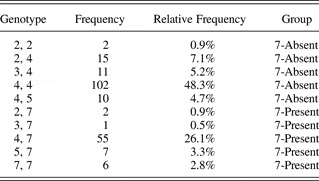
Table 1 provides the genotype distribution of the polymorphism in our sample. Because we were particularly interested in comparing children who carried the 7-repeat allele to other children, we divided children to two groups based on the presence or absence of the 7-repeat allele of the DRD4-III polymorphism. A third of the children (N = 71) were carriers of the 7-repeat allele (with 6 of them having two copies of the allele). Of the remaining 140 7-absent children, all but 2 had at least one copy of the 4-repeat allele.
Distribution of the DRD4-III polymorphism and assignment to groups

Note: DRD4-III, the exon III repeat region of the dopamine receptor D4 gene; 7-Absent, 7-Present, 7-repeat allele is absent or present.
Results
Descriptive statistics
Self-initiated and compliant prosocial behavior did not intercorrelate, as has happened in past studies (Eisenberg et al., Reference Eisenberg, Cameron, Tryon, Staub, Bar-Tal, Karylowski and Reykowski1984), indicating that we were measuring substantially different facets of children's prosociality. No linear correlation was found between mother-rated and observed prosocial behavior, but highly prosocial children (i.e., children who behaved prosocially in at least five of the six observational prosocial behavior tasks) were rated by their mothers as more prosocial (M = 1.63, SD = 0.30) than other children (M = 1.46, SD = 0.41), Wald χ2 (1) = 5.66, p = .017, D = 0.40.
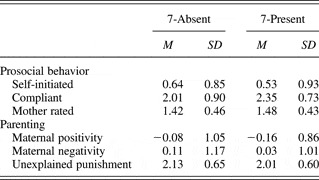
Table 2 presents the means and standard deviations of all study variables for children with the 7-repeat allele of the DRD4-III polymorphism present or absent. An important finding concerns compliant and self-initiated prosocial behavior. On average, children performed 0.53 self-initiated prosocial behaviors out of the possible three, while they performed 2.19 compliant prosocial behaviors. This difference was significant as indicated by the McNemar–Bowker test, χ2 (6) = 53.37, p < .001. Girls performed, on average, more compliant prosocial behaviors than boys (M = 2.33, SD = 0.70 vs. M = 1.97, SD = 0.94), a significant difference as indicated by an independence test for ordinal variables, χ2 (1) = 3.89, p < .05. This replicates past findings of higher prosociality in girls (Eisenberg et al., Reference Eisenberg, Fabes, Spinrad, Eisenberg, Damon and Lerner2006). No significant sex differences were observed for self-initiated or mother-reported prosocial behaviors, or for the parenting variables.
Means and standard deviations of study variables by DRD4-III genotype

Note: DRD4-III, the exon III repeat region of the dopamine receptor D4 gene; 7-Absent, 7-Present, 7-repeat allele is absent or present.
Genetic and environmental influences on prosocial behavior
To examine genetic and environmental influences on prosocial behavior, we first compared twin correlations obtained within MZ and DZ pairs in Sample 1 (Table 3). A positive correlation among MZ twins that was about twice as large as that of the DZ twins suggested a genetic influence with no shared environmental effect for compliant prosocial behavior. In contrast, for self-initiated prosocial behavior, whereas MZ twins correlated positively, same-sex DZ twins did not correlate at all (although a small positive correlation was found between brothers and sisters in mixed-sex twin dyads). This pattern of result is indicative of a nonadditive genetic effect (Plomin et al., Reference Plomin, DeFries, McClearn and McGuffin2001). A similar pattern was found for mother-rated prosocial behavior.
Twin correlations and genetic and environmental variance component estimates in prosocial behavior

Note: DZ, dizygotic; MZ, monozygotic. The values in parentheses are 95% confidence intervals.
*p < .05. **p < .01.
As a more direct test of genetic and environmental effects, we conducted model fitting in the Mx structural equation modeling software (Neale, Boker, Xie, & Maes, Reference Neale, Boker, Xie and Maes1999). The differences in correlations between same-sex and opposite-sex DZ dyads indicated a need for testing sex-limitation models, which could not be performed with our sample size. We therefore estimated genetic and environmental effects only with same-sex dyads; estimates were very similar when opposite-sex DZ twins were added. For all measures of prosocial behavior, it was possible to drop the shared environment component (estimated at 0) from the model without affecting model fit. Table 3 provides the estimates of genetic and environmental influences (with 95% confidence intervals) for all prosocial behavior variables.
Significant genetic effects were found, as hypothesized, accounting for 34% to 53% of the variance in the different prosocial behavior variables. Model fit for compliant prosocial behavior was good, as indicated by several fit indices: χ2 (4) = 4.95, ns, Akaike information criterion (AIC) = −3.05, root mean square error of approximation (RMSEA) = 0.055. Regarding self-initiated prosocial behavior, in a model including both an additive and a nonadditive genetic effect the additive genetic effect was estimated at zero and could be dropped without affecting model fit. The model estimating a nonadditive genetic effect had an excellent fit to the data, χ2 (4) = 0.92, ns, AIC = −7.08, RMSEA = 0.00, better than the fit of the additive model as judged by higher AIC in the latter (−5.027). Similarly, for mother-rated prosocial behavior, the additive genetic effect was estimated at 0.09 and could be dropped without affecting model fit, Δχ2 (1) = 0.02, ns. The model estimating a nonadditive genetic effect had a good fit to the data, χ2 (4) = 5.06, ns; AIC = −2.94, RMSEA = 0.06, better than the fit of the additive model as judged by higher AIC in the latter (−2.42).
The DRD4 polymorphism and prosocial behavior
To test for a specific genetic effect on prosocial behavior, we compared carriers of the DRD4-III 7-repeat allele to 7-absent children in their degree of prosocial behavior. Population-based association tests checked for differences in study variables based on the presence or absence of the 7-repeat allele (see Table 2). No significant association was observed between any of the prosocial behaviors and the DRD4 genotype. Mean comparisons also showed no significant differences in parenting based on the presence or absence of the 7-repeat allele.
Because we were interested in the relationship between prosocial behavior and parenting for 7-present and 7-absent children, we compared the variances for all study variables in the two groups (standard deviations are presented in Table 2). There were no significant differences in the variances between 7-present and 7-absent children.
A Gene × Parenting interaction affecting prosocial behavior
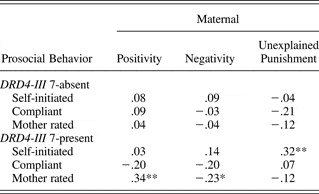
No significant relationship was found between parental positivity, negativity, or unexplained punishment, and any of the three measures of prosocial behavior, looking across 7-present and 7-absent children; but our focus was on the interaction between the DRD4 polymorphism and parenting. We next compared the relationships between parenting and children's prosocial behavior in the presence and absence of the DRD4 7-repeat allele (Table 4). Because in many of the families two children participated, we employed robust estimates, the so-called Huber–White sandwich, with prosocial behavior regressed onto parenting style and twin pairs clustered by family. Among 7-absent children, no significant relationship was found between parenting and prosocial behavior. In contrast, among 7-present children, mother-rated prosocial behavior correlated positively with maternal positivity, and negatively with maternal negativity. In addition, a positive relationship was found between maternal punishment and self-initiated prosocial behavior, again only among 7-present children.
Correlations between parenting and prosocial behavior

Note: Correlations are based on data from 167 children from 91 twin and sibling pairs using robust variance estimators accounting for nonindependence of siblings. DRD4-III, the exon III repeat region of the dopamine receptor D4 gene; 7-absent, 7-present, 7-repeat allele is absent or present.
*p < .05 (one tailed). **p < .05.
As a formal test of the hypothesis that the presence of the DRD4-III 7-repeat allele moderates the association between parenting and prosocial behavior, we predicted children's prosocial behavior with parenting, their DRD4-III polymorphism (where 7-present was coded 1 and 7-absent 0), and the interaction term of these two variables. We did this for the three cases in which a correlation was found for 7-present children but not for 7-absent children. Generalized estimating equations with robust covariance estimators were used, accounting for independence between twins coming from the same families.
Neither maternal positivity (B = 0.019), Wald χ2 (1) = 0.24, ns, nor the DRD4-III polymorphism (B = 0.089), Wald χ2 (1) = 1.69, ns, predicted mother-rated prosocial behavior, yet their interaction was a significant predictor (B = 0.158), Wald χ2 (1) = 5.58, p = .018. However, the interaction between maternal negativity and DRD4-III did not reach significance relating to mother-rated prosocial behavior (B = −0.10), Wald χ2 (1) = 3.47, p = .062. Finally, although there were no main effects of maternal punishment (B = −0.06), Wald χ2 (1) = 0.13, ns, or the DRD4-III polymorphism (B = −0.025), Wald χ2 (1) = 0.27, ns, on self-initiated prosocial behavior, the interaction of the two variables predicted self-initiated prosocial behavior (B = 0.55), Wald χ2 (1) = 4.22, p < .05.
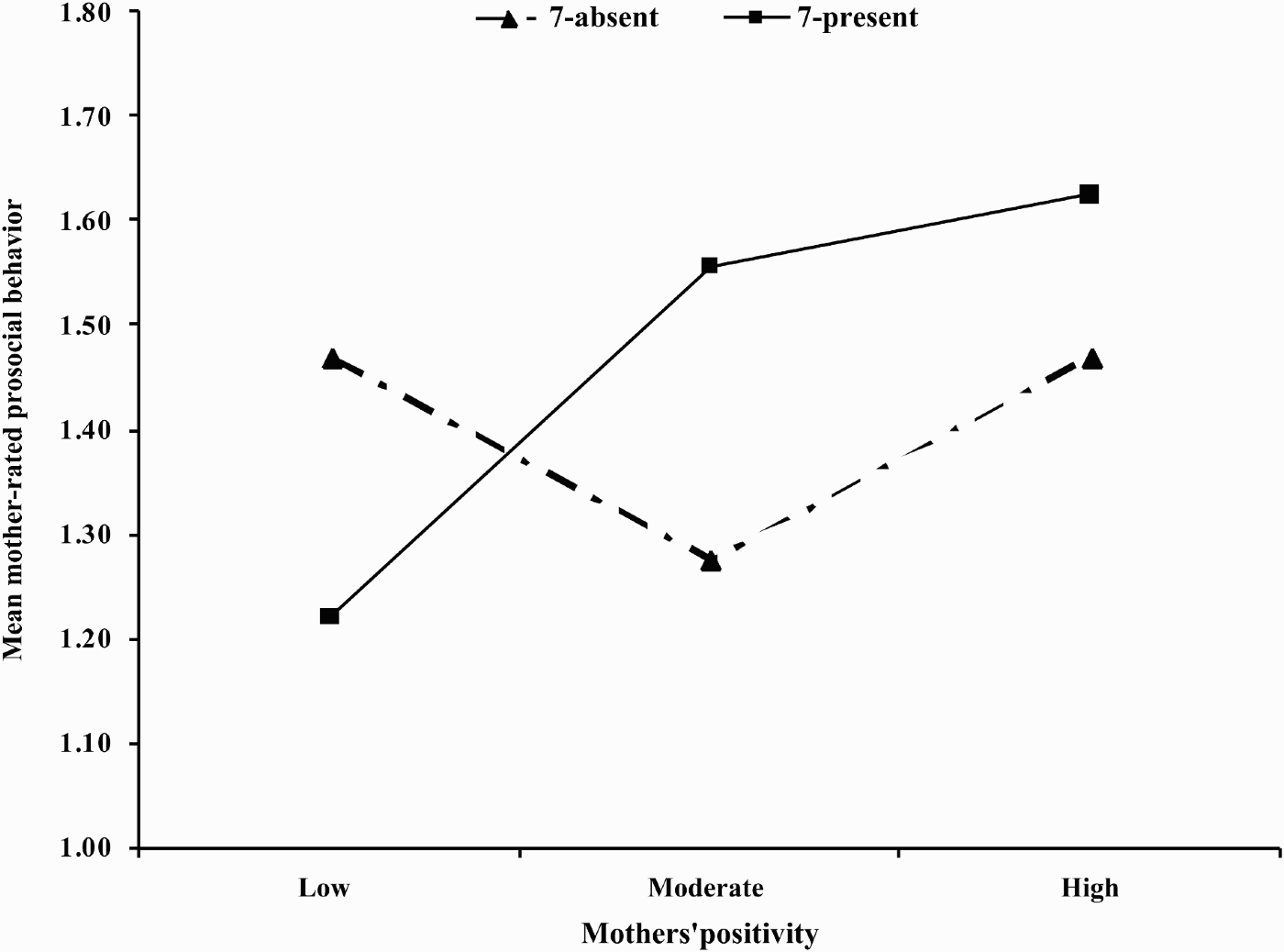
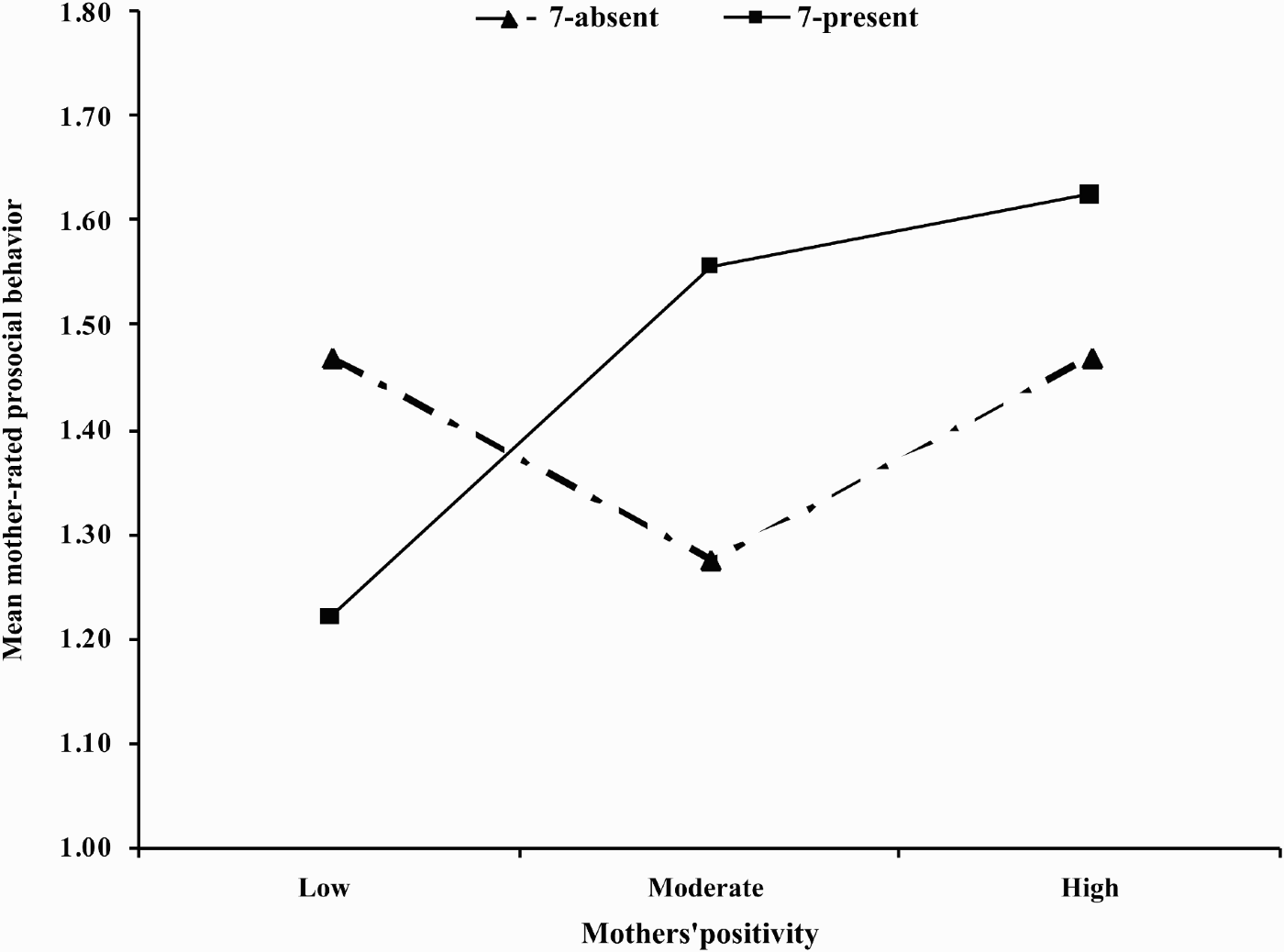
To better understand the G × E interaction, which can take many forms, we examined the relationship of parenting with children's behavior separately for children who differ in their genotype. Figure 1 presents the mean mother-rated prosocial behavior based on the presence of the DRD4-III 7-repeat allele and on maternal positivity. For convenience of presentation, positivity was divided into three levels: low, moderate, and high. The interaction pattern indicated a differential susceptibility to parenting as described by Belsky et al. (Reference Belsky, Bakermans-Kranenburg and van IJzendoorn2007): there was no clear relationship between maternal positivity and children's mother-rated prosocial behavior levels among 7-absent children. In contrast, among 7-present children, a linear relationship was observed, in which prosocial behavior increased with levels of maternal positivity, and in which 7-present children with the most positive mothers were the most prosocial, whereas 7-present children with the least positive mothers were the least prosocial.
Mean mother-rated prosocial behavior based on the presence of the dopamine receptor D4 exon III (DRD4-III) 7-repeat allele and on maternal positivity; 7-present, subjects with the 7-repeat allele present; 7-absent, subjects with the 7-repeat allele absent.
A similar pattern was found for the other significant interaction. Figure 2 presents the proportion of children who performed at least one self-initiated prosocial behavior based on the presence of the DRD4-III 7-repeat allele and on maternal unexplained punishment, which was again divided into three levels: low, moderate, and high. Again, children's levels of prosocial behavior did not vary by maternal punishment levels among 7-absent children, χ2 (1) = 0.66 ns. In contrast, among 7-present children, a linear relationship was observed, χ2 (1) = 5.17, p = .05, in which self-initiated prosocial behavior was four times more frequent among children of punishing mothers than among children of mothers low in punishment. As we did not specifically expect a positive relationship between punishment and prosocial behavior among 7-present children, it is important to note that splitting the sample randomly to include one child per pair resulted in a positive relationship in both subsamples (r = .31 and .34, both p < .05). As was the case with mother-reported prosocial behavior, 7-present children included both the most prosocial and the least prosocial, depending on mothers' degree of unexplained punishment, a pattern compatible with a differential susceptibility to parenting.
The proportion of children performing at least one self-initiated prosocial behavior based on the presence of the dopamine receptor D4 exon III (DRD4-III) 7-repeat allele and on maternal unexplained punishment.

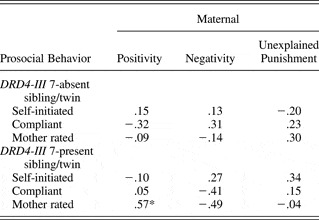
Perhaps the strongest test of the Gene × Parenting interaction would be to compare siblings with different genotypes with regard to how parenting affected these children. The use of DZ and sib pairs discordant for the polymorphism under investigation allows for the matching of socioeconomic status, ethnicity, and other important variables that vary across families, while testing in a more controlled manner for genetic association and interaction. There were only 14 sibling and twin pairs in which one was a carrier of the 7-repeat allele, whereas the other was not. Therefore, we view the results as illustrative. The correlations between the parenting toward the two siblings were all very high (r > .75, p < .001). Nevertheless, the association of parenting with prosocial behavior was quite different for the two siblings, as shown in Table 5. Again, in the absence of the 7-repeat allele, no significant relationship was found between parenting and prosocial behavior. In contrast, among the offspring of the same mothers who were carriers of the 7-repeat allele, a positive relationship was found between maternal positivity and mother-rated prosocial behavior (r = .57, p < .05). A correlation comparison test (DeCoster, Reference DeCoster2007), showed that the correlations for the two siblings differed significantly (Z = 1.75, p < .05, one tailed). In addition, self-initiated prosocial behavior correlated positively, although insignificantly, with unexplained punishment, again only for their 7-present children.
Correlations between parenting and prosocial behavior in sibling/dizygotic twin pairs according to DRD4-III 7-absent or 7-present

Note: Correlations for self-initiated and compliant prosocial behavior are Kendall tau correlations. Correlations for mother-rated prosocial behavior are Pearson correlations. DRD4-III, the exon III repeat region of the dopamine receptor D4 gene; 7-absent, 7-present, 7-repeat allele is absent or present.
*p < .05.
Discussion
The field of child development has focused great efforts on the classic Nature OR Nurture question. The results of our twin study point clearly to the importance of both genetic and environmental factors in explaining individual differences in children's prosociality. Important breakthroughs have shown progress from merely parsing genetic and environmental contributions to showing that genetic and environmental influences are interrelated (gene–environment correlations; e.g., Burt, Reference Burt2008; Jaffee & Price, Reference Jaffee and Price2007) and that genetic and environmental influences often work in a nonadditive manner to affect developmental outcomes (gene–environment interactions; e.g., Bakermans-Kranenburg & van IJzendoorn, Reference Bakermans-Kranenburg and van IJzendoorn2006; Caspi et al., Reference Caspi, McClay, Moffitt, Mill, Martin and Craig2002). Thus, the question has been rephrased to focus on Nature AND Nurture (Plomin, Reference Plomin1994). It is important to emphasize the joint contributions of children's biology and their environment, understanding that genes and contexts are in continuous, dynamic interplay over time (Ellis & Boyce, Reference Ellis and Boyce2008). Our results provide further evidence for the importance of considering the joint contribution of genes and the (parental) environment to children's development.
Genetic influences on prosocial behavior
We used the twin design to examine the magnitude of genetic and environmental contributions to observed and mother-reported prosociality. Out study joins the young but growing literature showing that genetic factors contribute to children's and adolescents' prosocial behavior (Gregory et al., Reference Gregory, Light-Häusermann, Rijsdijk and Eley2009; Hur & Rushton, Reference Hur and Rushton2007; Knafo & Israel, Reference Knafo, Israel, Mikulincer and Shaver2009; Knafo & Plomin, Reference Knafo and Plomin2006b; Scourfield et al., Reference Scourfield, John, Martin and McGuffin2004). Except for three studies of observed empathy (Knafo et al., Reference Knafo, Zahn-Waxler, Davidov, Van Hulle, Robinson and Rhee2009; Volbrecht, Lemery-Chalfant, Aksan, Zahn-Waxler, & Goldsmith, Reference Volbrecht, Lemery-Chalfant, Aksan, Zahn-Waxler and Goldsmith2007; Zahn-Waxler et al., Reference Zahn-Waxler, Schiro, Robinson, Emde, Schmitz, Emde and Hewitt2001) and one study (van IJzendoorn et al., Reference Van IJzendoorn, Bakermans-Kranenburg, Pannebaker and Out2010) that found no heritability for children's donations to UNICEF, all of the other studies were questionnaire based. Similarly, only one set of studies provided evidence for the heritability of adults' observed prosociality (Cesarini, Dawes, Johanhesson, Lichtenstein, & Wallace, Reference Cesarini, Dawes, Johannesson, Lichtenstein and Wallace2009). The finding of substantial genetic effects on a set of mother-reported as well as observed prosocial measures is an important contribution of our study.
Although all three measures of prosociality showed substantial heritability, they showed different patterns of genetic influence. Heritability for compliant prosocial behavior was modest, accounting for a third of the variance, and indicated an additive genetic influence. In contrast, genetic influences on self-initiated and mother-reported prosocial behavior were stronger, and represented nonadditive effects. In addition, the observed prosociality measures did not correlate with each other. It is therefore important to view prosociality as a complex, multifaceted construct (Eisenberg et al., Reference Eisenberg, Fabes, Spinrad, Eisenberg, Damon and Lerner2006). Developmental processes accounting for compliant and self-initiated prosocial behavior may be quite different (Eisenberg, Reference Eisenberg, Leavitt and Hall2004). For example, children's low affective knowledge predicts lower levels of self-initiated but not compliant prosocial behavior (Knafo et al., in press). In addition, the genes partially responsible for variations in compliant prosocial behavior may be different from those accounting for individual differences in self-initiated prosociality. This may explain why the DRD4-III polymorphism, shown in past studies to relate to self-reported selflessness and to sharing in a triadic family play session (Bachner-Melman et al., Reference Bachner-Melman, Gritsenko, Nemanov, Zohar and Ebstein2005; DiLalla et al., Reference DiLalla, Elam and Smolen2009) did not relate to prosocial behavior that was measured very differently in the current study. Multitrait–multimethod genetic studies of prosocial behavior are needed.
Environmental influences on prosocial behavior
The twin analyses, in addition to pointing out the importance of genetics, suggested that about half of the variance in prosociality is accounted for by environmental factors. A review of the literature (Knafo & Israel, Reference Knafo, Israel, Mikulincer and Shaver2009) has shown that in adult studies the environmental influence on prosocial behavior is of the nonshared kind (e.g., Gillespie, Cloninger, Heath, & Martin, Reference Gillespie, Cloninger, Heath and Martin2003) and that from early childhood to adolescence environmental effects that initially are partially of the shared kind, making children growing up in the same family similar to each other become steadily nonshared. That conclusion was based mainly on studies from Western, Anglophone countries. Our Israeli data show no shared environment effects at age 3 (Knafo & Israel, Reference Knafo, Israel, Mikulincer and Shaver2009) and in this study at 3.5 years. This may indicate a cross-cultural effect (e.g., because of the structure of the preschool system in Israel and elsewhere) on genetic and environmental processes (Knafo & Israel, Reference Knafo, Israel, Mikulincer and Shaver2009).
It is tempting to equate the lack of shared environment factors with the lack of direct relationships between prosociality and parenting. However, we should first note that in the twin design, shared environmental effects represent the joint contribution of a wide set of variables, not only that of parenting (e.g., neighborhood effects). Moreover, the effect of parenting could well be of the nonshared kind. In a study focusing on differences in 4-year-old MZ twins' behavior and in the parenting they receive, Asbury, Dunn, Pike, and Plomin (Reference Asbury, Dunn, Pike and Plomin2003) showed that twins receiving more negative parental discipline and affection were less likely than their co-twin to engage in prosocial behavior. As these MZ twins were not only genetically identical, but were also raised together, differences between them could only indicate nonshared environmental influences (and error). Because parental differential treatment has a longitudinal effect on children over and above their own behavioral differences (Caspi et al., Reference Caspi, Moffitt, Morgan, Rutter, Taylor and Arseneault2004), differential treatment is an important venue for studying the effect of parenting. We are currently collecting longitudinal twin data to address this issue. Finally, the relationships between prosociality and parenting can also be seen as moderated by a G × E, as we have demonstrated in the current study.
DRD4-III and susceptibility to parenting
Although parenting did not directly relate to prosociality in this study, a fuller picture of prosocial development is reflected in the interaction between genetics and the environment. This is the first study, to the best of our knowledge, to report a significant Gene × Parenting interaction predicting prosocial behavior. Our finding of no relationship between prosocial behavior and parenting in the 7-absent children was accompanied by meaningful associations among the 7-present children. It is important that all three methods applied to investigate the Gene × Parenting interaction, linear regression, comparisons of the associations between prosociality and parenting in the two genotype groups, and intrafamily comparisons of discordant genotypes provide similar directional results, attesting to the robustness of the interaction.
The differences between siblings in how their mothers' parenting relates to their prosociality, although based on a small sample, provide strong evidence for the differential role of parenting depending on children's genotype. These differences illustrate Belsky's (1997) evolutionary notion of within-family differential susceptibility, which may have evolved to enable children of the same parents to develop different enough phenotypes, conferring to at least some of the offspring an advantage as environmental constraints change.
This is the first study to show that DRD4-III is associated with susceptibility to parenting with regards to a positive trait (prosociality). As Boyce et al. (2005) note, differential susceptibility goes beyond vulnerability (in which susceptible children are more negatively affected by the environment), but pertains also to the better aspects of development, in which susceptible children benefit more than other children from positive environments (Belsky et al., Reference Belsky, Bakermans-Kranenburg and van IJzendoorn2007; Boyce & Ellis, Reference Boyce and Ellis2005). The results for parental positivity and mother-rated prosocial behavior exemplify this pattern. Other research on externalizing behavior and disorganized attachment (Bakermans-Kranenburg et al., Reference Bakermans-Kranenburg, van IJzendoorn, Pijlman, Mesman and Juffer2008; DiLalla et al., Reference DiLalla, Elam and Smolen2009; van IJzendoorn & Bakermans-Kranenburg, 2006) showed a similar pattern with less adjusted aspects of development. The converging evidence makes a strong case for DRD4-III as a differential susceptibility gene. Nevertheless, note that differential susceptibility can be accounted for by multiple genes, which have been proposed to have cumulative effects (Belsky & Pluess, Reference Belsky and Pluess2009b). Gene–Gene interactions and epigenetic changes may also account for susceptibility.
Despite the growing evidence for the role of certain genes as related to differential susceptibility, much research is needed to understand the underlying processes behind this interaction. For example, our 7-present children whose mothers were low in unexplained punishment were the least likely to initiate prosocial behaviors toward the experimenter. Recalling the role of dopaminergic pathways in reward processes, 7-present children may be more sensitive to rewards. Our results may indicate that only when exposed to disciplinary efforts these children are likely to behave prosocially without being asked to. In contrast, 7-present children whose mothers were high in unexplained punishment were the most likely to initiate prosocial behaviors toward the experimenter. This could indicate that 7-present children, being more reward sensitive, try to avoid punishment as much as possible. Being raised by a mother with a strong tendency to punish without explanation, they (more than other children) learn to react when their help is needed. Another possibility is that the 7-present children, who are more alert and tend to explore their environments, are more likely to detect the need to behave prosocially and therefore more likely to initiate prosocial behaviors depending on their mothers' parenting. Thus, the role of socialization in self-initiated prosocial behavior may be very different among 7-present and 7-absent children.
Although spontaneous prosocial behavior is typically considered as reflecting an intrinsically oriented altruistic motivation (Eisenberg et al., Reference Eisenberg, Cameron, Tryon, Staub, Bar-Tal, Karylowski and Reykowski1984), the case of self-initiated prosocial behaviors shown by 7-present children with highly punitive mothers may actually represent a different motivation, perhaps that of ingratiation, avoidance of punishment, or pathogenic guilt. Oakley, Knafo, and McGrath (in press) described a small selected group of 3-year-old children high on prosocial behavior, but very low on self-actualizing behavior, such as enjoying success and autonomous persistence in pursuit of goals. These children were more sociable and exhibited lower levels of conduct problems than their peers; however, they were higher in emotional internalization symptoms, perhaps showing what may be an early form of pathological altruism (Oakley, Knafo, Madhavan, & Wilson, in press). One pathway toward the development of pathological altruism involves empathy-based pathogenic guilt. This process may be more likely in families of depressed or highly critical parents, who base socialization of children's empathy on anxiety and inappropriate blame and responsibility, a process that can have detrimental implications to children's self-worth (Zahn-Waxler & Van Hulle, in press). In sum, some cases of prosocial behavior may not reflect healthy empathic or altruistic development, as can be the case with the 7-present children of highly punitive mothers.
It is important to study development at different levels (Cicchetti & Dawson, Reference Cicchetti and Dawson2002). Although the effects of the DRD4-III polymorphism at the cellular level have been documented (Asghari et al., Reference Asghari, Sanyal, Buchwalt, Paterson, Jovanovic and Van Tol1995), studies about how variations in DRD4-III influence brain activation are ongoing (Durston et al., Reference Durston, Fossella, Casey, Hulshoff Pol, Galvan and Schnack2005; Fan, Fossella, Sommer, Wu, & Posner, Reference Fan, Fossella, Sommer, Wu and Posner2003; McCLernon, Hutchison, Rose, & Kozink, Reference McClernon, Hutchison, Rose and Kozink2007) and will provide additional insights into the processes involved. Finally, the temperamental factors at the behavioral, cognitive, and affective levels that account for this differential susceptibility are still largely unknown. More research into the core endophenotypes, such as the brain processes as well as attentional and behavioral factors associated with differential susceptibility, is needed (Ellis et al., 2011 [this issue]).
Strengths, limitations, and future directions
Our study has several notable methodological strengths. First, the twin study included a quality birth-records-based sample. Second, we went beyond questionnaire reports to testing children's prosociality in the lab, with each twin tested and coded by separate research assistants. Third, our use of a multimethod approach to prosociality enabled the demonstration of the complexity of the findings, depending on type of prosociality, and the use of very different measures (DNA, observation, and maternal questionnaires) reduced the risk of shared method variance.
However, the sample (168 pairs) was relatively small for a twin study, because of the need to use experimental measures. Because MZ correlations were more than twice larger than the DZ correlations, no shared environmental effects needed to be tested, and we had sufficient power to attribute the familial twin similarity in prosociality to genetic factors. In addition, for mother-reported prosociality, estimates for genetic and environmental factors were very similar to those obtained with a larger sample of 491 pairs at age 3 (Knafo & Israel, Reference Knafo, Israel, Mikulincer and Shaver2009). Nevertheless, Sample 2 was quite small, and we would not be able to detect smaller significant interactions. The within-family comparisons corroborated our findings, but we note that these results were based on 14 sibling pairs only. The use of mothers' self-reported parenting ratings is another limitation that we currently address in an ongoing study of parenting observed in mother–child play situations. Nevertheless, the value of mother reports is exemplified by their correlations with observed prosocial behavior.
Finally, our genetic findings point out the need for additional molecular genetic studies of prosocial behavior, applied to different aspects of prosociality. There is promising evidence for the role of the oxytocin receptor (OXTR) and vasopressin receptor (AVPR1a) genes in prosocial behavior (reviewed by Israel et al., Reference Israel, Lerer, Shalev, Uzefovsky, Reibold and Bachner-Melman2008), but other polymorphisms may be important as well. Similarly, the role of gene–environment correlations, in which environmental effects are correlated with children's genotype, should not be ignored (Jaffee & Price, Reference Jaffee and Price2007). For example, Knafo and Plomin (Reference Knafo and Plomin2006a) reported that concurrent and longitudinal associations between prosocial behavior and parenting, especially parental negativity, indicated gene–environment correlation processes. A fuller understanding of gene–environmental interactions should involve the study of epigenetic processes in which environmental processes interact with the way genes are expressed through development (McGowan et al., Reference McGowan, Sasaki, D'Alessio, Dymov, Labonté and Szyf2009). These are just a few of the future avenues for research highlighted by the current investigation.
Conclusions
This study provides evidence for the genetic and environmental contributions to different aspects of children's prosocial behavior, as well as the interplay between children's DRD4-III genotype and mothers' parenting. Our findings provide proof of principle that a molecular genetic strategy, based on genotyping of common polymorphisms and combined with a classic twin approach, provides a fuller description than past studies of how genes and environment interact to shape children's behavior, especially differential sensitivity to parenting. The finding that the role of parenting depends upon children's genotype tells us not only about parents' limits of influence but also about children's increasingly appreciated role in family processes.