INTRODUCTION
Phosphorus (P) is one of the most limiting nutrients for crop production in sub-Saharan Africa (Sanchez, Reference Sanchez1976), and thus a major biophysical cause for low per capita food production in the region. Inorganic P fertilizers can be applied to increase production, but these are often not affordable for small-scale farmers, especially when applied seasonally. Combined application of mineral fertilizers and organic resources has been proposed as an appropriate strategy to improve soil fertility and productivity of agricultural systems (Vanlauwe et al., Reference Vanlauwe, Diels, Aihou, Iwuafor, Lyasse, Sanginga, Merckx, Vanlauwe, Diels, Sanginga and Merckx2002). However, in-situ production of organic matter of reasonable quality and quantity is often limited by the availability of P (Giller and Cadisch, Reference Giller and Cadisch1995).
Within legume-cereal cropping systems, Giller (Reference Giller, Vanlauwe, Diels, Sanginga and Merckx2002) postulated that maximizing N2 fixation and residual benefits from the legume could lead to availability of sufficient amounts of residual P for the subsequent cereal crop. Targeting P application to the legume phase, for example, was hypothesized to have the potential to increase legume efficiency in accessing and solubilizing P through enhanced root growth and release of organic exudates. Legumes require a sufficient amount of P for the legume-rhizobium symbiosis to function optimally, while cereals require substantial amounts of N and P for optimum growth. Since P usually shows substantial residual effects, targeting the P in legume-cereal rotations to a specific phase of the rotation may significantly enhance the growth of both crops. By targeting P also, farmers could save cash by applying P only to certain phases of the rotation and not in every season, as has commonly been thought necessary.
Improved herbaceous or grain legumes usually leave substantial amounts of N in the soil after harvest (Sanginga et al., Reference Sanginga, Dashiell, Diels, Vanlauwe, Lyasse, Carsky, Tarawali, Asafo-Adjei, Menkir, Schulz, Singh, Chikoye, Keatinge and Rodomiro2003), and rotating cereals and legumes is a cheaper means of improving soil fertility and system productivity (Klaij and Ntare, Reference Klaij and Ntare1995). Currently, dual-purpose, promiscuous cowpea and soyabean germplasm is available, which produces substantial amounts of leaves and haulms besides grain, fixes N2 from the atmosphere without the need for inoculation and has a relatively low N harvest index (Sanginga et al., Reference Sanginga, Okogun, Vanlauwe, Diels, Carsky and Dashiell2001). As such, a net N input into the soil can be expected with such dual-purpose germplasm as opposed to ‘traditional’ grain legume germplasm, which usually has low biomass production and low N-fixing potential, and often results in a net N loss (Sanginga et al., Reference Sanginga, Dashiell, Diels, Vanlauwe, Lyasse, Carsky, Tarawali, Asafo-Adjei, Menkir, Schulz, Singh, Chikoye, Keatinge and Rodomiro2003). Strategic application of P could affect the N fertilizer equivalence of the rotated legume on the subsequent cereal crop and lead to higher returns.
The objectives of this study were to: (i) optimize the use of mineral P inputs in legume-cereal rotations from an agronomic and economic perspective and (ii) determine the N fertilizer equivalency (NFE) values of promising herbaceous and grain legume biomass, as affected by fertilizer P application. Two hypotheses were addressed: (i) targeting P application to the legume phase in a legume-cereal rotation system leads to higher system productivity due to higher productivity of the legume and the subsequent effects on maize production, and (ii) rotation systems that use grain legumes lead to greater economic returns than rotation systems that use herbaceous legumes.
MATERIALS AND METHODS
Site description
The study was conducted for four seasons (September 2001 to August 2003) at Nyabeda, western Kenya (altitude 1420 m asl; lat. 0°07′N, long. 34°24′E). The mean annual rainfall is 1800 mm and occurs in two distinct seasons (long rains from March to August and short rains from September to January). Seasonal rainfall recorded during the experiment period is shown in Figure 1. The farm used was previously under a maize (Zea mays)-common bean (Phaseolus vulgaris) intercrop with occasional application of low quality farmyard manure but had not received N or P fertilizer for at least two years prior to trial establishment. Soil sampled before treatment application had pH (in water) of 5.84 (s.d. ± 0.04), clay:sand:silt ratio of 42:33:25,%C of 2.36 (±0.1) and%N of 0.19 (±0.008). Extractable P was 3.10 (±0.8) mg P kg−1 of soil, and exchangeable potassium, calcium and magnesium were 0.25 (±0.05), 4.7 (±0.28) and 2.2 (±0.09) cmol kg−1 soil, respectively.
Cumulative seasonal rainfall observed during the four seasons in Nyabeda, western Kenya.

Treatments
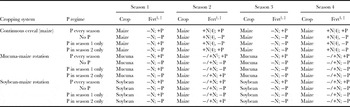
The trial, replicated three times, was laid out as a split plot design with cropping system × P fertilizer application as main plots in a randomized complete block design and N fertilizer application as sub-plots (Table 1). The main plot size was 6 m × 12 m. The cropping system factor contained three levels: continuous maize, mucuna-maize rotation and soybean-maize rotation, while the P fertilizer application contained four levels: no P applied, P applied every season, P applied in season 1 only (legume phase) and P applied in season 2 only (cereal phase). Nitrogen fertilizer was applied during seasons 2 and 4 only. For the continuous cereal system, the plots were split into four (6 m × 3 m) (indicated by +N(4)) and treated with four N rates; 0, 30, 60, 90 kg N ha−1, while the rotation system plots were split into two (6 m × 6 m), one receiving 0 kg N ha−1 and the other 45 kg N ha−1 (indicated by −/+N). In the treatments with N fertilizer application, urea was spot applied and incorporated (1/3 at planting and 2/3 four weeks after planting), while in the treatments with P fertilizer application, triple super phosphate (TSP) was banded within the line at 50 kg P ha−1. All the treatments received a basal application of 60 kg K ha−1 as muriate of potash banded and mixed with soil before the start of each season. Termites attack maize plants at the study site and were controlled by application of Dursban (with chlorpyrifos 44.6% w/w as active ingredient).
Treatment structure targeting P in legume-cereal rotations in Nyabeda, western Kenya.

†P application rate was 50 kg P ha−1.
‡A basal application of K at 60 kg ha−1 was applied on all plots.
§The plots which contain −/+N during the cereal season were split into two; one half received no N and the other received 45 kg N ha−1.
Selection of germplasm
White-seeded Mucuna pruriens (var. utilis) was used as the herbaceous legume based on its adaptability to the agro-ecozone and its potential in biomass production. Soyabean (Glycine max) (TGX 1448–2E, known locally as SB20) was used as the dual-purpose grain legume based on its potential in biomass and grain production and its soil fertility restoration ability through N fixation. Also, soyabean was previously screened in western Kenya with a potentially high demand from farmers (i.e. farmers expressed a desire to grow soyabean). The maize variety used was Hybrid 513 during seasons 1 and 2 but was changed to imidazolinone-resistant maize during seasons 3 and 4 following infestation in season 2 by Striga hermonthica, a noxious weed which substantially reduces maize grain yields in western Kenya (Abayo et al., Reference Abayo, English, Eplee, Kanampiu, Ransom and Gressel1998). Imidazolinone-resistant maize is resistant to striga.
Management and harvest
The experiment was on-farm and researcher-managed. However, most of the operations were carried out by local people, following farmers’ practices. All aboveground fallow biomass was removed from the site before trial establishment. Initial land preparation was done by ploughing using an animal-drawn plough followed by hand hoes for all subsequent seasons. Maize was planted at 0.25 m (between plants) by 0.75 m (between rows) with two seeds per planting hole and thinned to one plant per hole (53 000 hills ha−1). Mucuna was planted at 0.6 m × 0.3 m (55 000 seeds ha−1), and soyabean was planted at 0.75 m × 0.05 m (266 000 seeds ha−1). Two weeding operations (one using a hand hoe and one hand-pulling to uproot weeds) were done on mucuna plots, two weeding operations (both using hand hoe) were done in soyabean plots, and three weeding operations (two using hand hoes and one hand-pulling) were done in maize plots. At 50% flowering, legumes on 1m2 quadrats (constituting 200–240 kg ha−1 of root material (dry weight basis)), were dug out, washed, and the nodules carefully separated, counted and weights determined. This was to enable determination of the effect of P application on N fixation potential of mucuna and soyabean. For harvesting, the net plot size for both maize and legume was 49.5 m2, 22.5 m2 and 9 m2 for treatments without N, with −/+N and with +N(4) respectively. Maize grain and stover yields, and legume grain and biomass (stems plus leaves) yields were measured on an oven-dry basis. Legume biomass was left on the field and incorporated during subsequent land preparation.
Determining economic benefits of mucuna-maize and soybean-maize rotations
Partial budget analysis was carried out following the methodology of CIMMYT (1988). Cumulative input and output data for the four seasons were used. For the continuous cereals, data for the 30 kg N ha−1 treatments were used in the partial budgeting since they were not statistically different from those of higher N levels. To reflect the difference between experimental yield and the yield that farmers could expect, the yields were adjusted downwards for farmer management by 10% (e.g. due to some researcher influences such as termite control and timeliness of weeding) and a further 5% for small plot size (Spencer, Reference Spencer1993). The price of maize seed planted was 50 Kenya Shillings (KShs) per kg (1 US$ to KShs 72). Farm gate price of output at harvest was KShs 1300 for a 90 kg bag of maize and KShs 4500 for a 90 kg bag of soyabean. Since maize stover is often used as a source of fuel and livestock feed in the study area, opportunity cost was used to determine its imputed (derived) price at KShs 1000 ton−1. The value of mucuna (both seed and residue) was taken to be zero since it does not have a monetary value in the study area. Crop value was calculated by multiplying yield data with relevant constant price. Farm gate cost of fertilizer was KShs 1600 per 50 kg bag of urea and KShs 1850 per 50 kg bag of TSP.
Dominance analysis was done to determine those options with lower net returns (and higher total variable costs) than other options with higher net returns (and lower total variable costs); the former options are usually then considered dominated by the latter. Since the dominated options are not the best to be recommended to farmers, they were usually eliminated from further consideration (e.g. in the calculation of marginal rate of returns (MRR) needed to further fine-tune farmer recommendations) in order to focus attention on the non-dominated alternatives (CIMMYT, 1988).
Mathematical and statistical approaches
Analysis of variance (ANOVA) for the agronomic data was done using SAS V 9.1 for Windows XP_PRO platform 2002–2003 release. The analyses of season 2 maize yield data did not include 18 plots (of the 96 plots planted with maize during this season) since striga was found to depress yield in these 18 plots. Generally, such plots had striga counts exceeding 500 and were treated as missing data in the statistical analyses. Data analysis was done using the mixed procedure in SAS where the model was defined by treatment factors, and random error terms defined in random statements according to Federer and King (Reference Federer and King2007). As the main interest of the study was the P regime, data presentation emphasizes the differences at the P application level, although overall model effects are also discussed in the text. Legume nodule count data was log10(n+1)-transformed and linearity of the transformed data tested by plotting (R 2 was 0.93) before the analyses of variance.
The yields obtained from continuous cereal at different N rates (0, 30, 60 and 90 kg N ha−1) for each of the P regimes in seasons 2 and 4 were used to plot N response curves against which maize yields obtained after mucuna and soyabean in the respective seasons were compared to get the NFE of rotation. The no P regime was not used since there was no response to N without mineral P application.
RESULTS
Maize grain yield in continuous cereal system
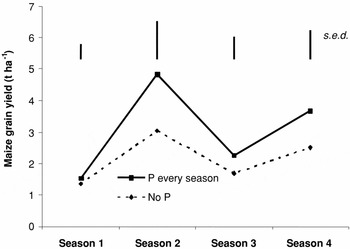
There was positive (though insignificant) effect of P application on the yield of maize for each of the four seasons (Figure 2), and a moderate (also insignificant; p = 0.067) P effect was observed overall (for data averaged over the four seasons). The application of P increased yield of maize grain by 13% in season 1, 27% in season 2, 35% in season 3 and 46% in season 4 above no P treatments. In general, the yield was higher in seasons 2 and 4 than in seasons 1 and 3, because the latter seasons had at least 90 mm less cumulative rainfall than the former at 58 days after planting. Also the lowest yield was in season 1, which had lowest seasonal rainfall. This pattern of yield by seasons is normal, because the short rainy seasons (seasons 1 and 3) usually have lower yield than long rainy seasons (seasons 2 and 4), and it was not expected to adversely affect the investigations of the study.
Effect of P on seasonal maize grain yield in a continuous maize cropping system in Nyabeda, western Kenya (no N was applied to the treatments). s.e.d.: standard error of the differences of means.

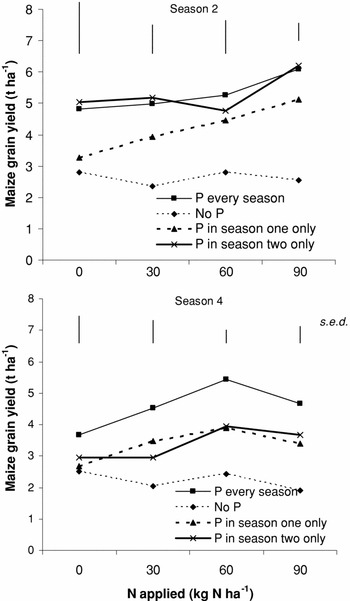
Maize grain yields obtained from continuous maize treatments during the fourth season were affected by both P regime (p < 0.01) and by N applied (p < 0.01; P regime × N applied interaction was not significant), while only a moderate effect of P regime(p = 0.057) was observed in season 2. In both seasons 2 and 4, treatments without P had significantly (p = 0.05) lower maize grain yield than treatments with P (Figure 3). The residual effect of ‘P applied in season 1 only’ resulted in higher grain yields compared to the no P treatments for both season 2 and 4, being significantly higher at 90 kg N ha−1 in season 2, and at 60 and 90 kg N ha−1 in season 4. Similarly, treatments that received ‘P in season 2 only’ recorded significantly higher maize yields than the ‘no P’ treatments, at 30 and 90 kg N ha−1 in season 2, and 60 and 90 kg N ha−1 in season 4. In season 2 also, treatments that received P for the first time (P in season 2 only) were not different from those receiving P in both seasons. The data for season 4 shows that treatments under residual P for two or three seasons had significantly lower maize yield compared to those freshly treated with P, mainly at higher N levels. Under only one season of residual P, maize grain yield although lower was not significantly different from plots freshly treated with P.
Effect of P on maize grain yield (kg ha−1) at different rates of N as observed in a continuous maize cropping system in Nyabeda, western Kenya in two seasons. Season 2: March–July 2002 cropping season; Season 4: March–August 2003 cropping season. s.e.d.: standard error of the differences of means.

There was no response to N in treatments that had no P applied. There was, however, a response to N in treatments under residual P in both seasons 2 and 4 (Figure 3). Data for 30 kg N ha−1 treatments were not statistically different from those of higher N levels.
Soyabean and mucuna yield in legume-maize rotations
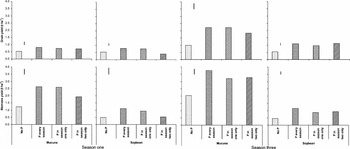
Grain and biomass. The P regime affected soyabean grain yields in both seasons 1 (p < 0.05) and 3 (p < 0.01), with treatments that did not receive P having significantly lower yield than treatments with P (Figure 4). Soyabean biomass yield was affected by the P regime in season 3 (p < 0.05), and it was significantly lower in the ‘no P’ treatment than in treatments applied with P in any of the seasons. During season 1, P application increased soyabean grain yield by 43–99% and biomass yield by 81–122% above the treatments without P. ‘P applied in every season’ increased average soyabean grain yield in season 3 by 104% and biomass by 144% compared to ‘no P’. During season 3, soyabean grain yield in treatment under two residual P seasons (P applied in season 1 only) was increased by 400 kg ha−1 (80%) and biomass by 87% compared to the ‘no P’ treatment. During season 3 also, soyabean grain yield from treatments that received P in either season 1 or 2 were not different from the ‘P applied every season’ treatment.
Effect of targeting P to various legume-cereal phases on legume grain and biomass (stems+leaves) yield in two seasons in Nyabeda, western Kenya. Error bars represent standard errors of the differences of means.

For mucuna, the P regime had a significant effect on grain yield in season 3 (p < 0.05) and on biomass yield in both seasons 1 (p < 0.01) and 3 (p < 0.01). Although the P regime did not have an overall significant effect on grain yield in season 1, application of P to mucuna increased mucuna seed (grain) yield by 5–50% above the treatments without P. P applied in season 2 increased grain yield of subsequent mucuna (season 3 data) by 84% and biomass by 61% above the ‘no P’ treatment. Similarly, ‘P applied in season 1 only’ increased mucuna biomass in season 3 by 57% and its grain yield by 124% more than that of ‘no P’ treatment. Among treatments with P in the mucuna-maize system (as also in soyabean-maize system), there were no significant differences in biomass and grain yield between any of the three P regimes.
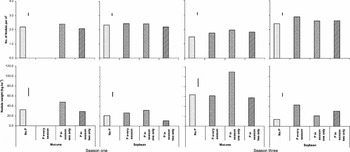
Nodules. The P regime had a significant effect on only soyabean nodule weight in season 3 (p < 0.01), but pairwise comparison of treatment means revealed additional differences. For example, data in Figure 5 shows that ‘no P’ treatments recorded lower nodule count and nodule weight than most of the other treatments, and the differences were significant in season 3. In both soyabean and mucuna, for instance, total nodules were significantly higher in treatments applied with P than ‘no P’ treatment during season 3 but not in season 1. In general, treatments that received P in any season increased nodule count by 4–11% and 8–22% under soyabean, and by 9–15% and 19–32% under mucuna in seasons 1 and 3, respectively, above treatments without P. During season 3, nodule weight was increased by 14–73% and 102–184% under soyabean and mucuna respectively following application of P and residual P effect compared to ‘no P’ treatment. Although the highest nodule count in soyabean plots in season 3 was observed for continuous P treatments, this was not significantly different from the treatments applied with P in season 1 only or season 2 only. During season 3, soyabean nodule weight in ‘P applied in every season’ treatments was similar to that in ‘P in season 2 only’ but different from that in ‘P in season 1 only’, indicating a declining effect of residual P with time (i.e. in general, treatments with P applied most recently had higher nodule biomass).
Effect of targeting P to various legume-cereal phases on legume nodule weight and nodule count (log transformed) in two seasons in Nyabeda, western Kenya, error bars represent standard errors of the differences of means.

Maize grain yield in legume-maize rotations
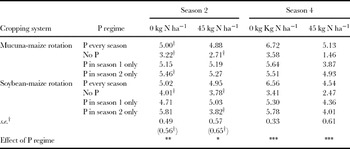
The P regime affected maize grain yields in the legume-cereal rotation system in both seasons 2 (p < 0.05) and 4 (p < 0.001; Table 2). In both soyabean-maize and mucuna-maize rotation systems, ‘no P’ treatments had the lowest maize grain yields for both seasons 2 and 4, being significantly lower than treatments with P in most cases (Table 2). Most ‘P applied every season’ treatments had better yields than treatments with two or three seasons residual P (season 4 data), but not under one season of residual P (season 2 data). The effects were mainly significant at zero N and rarely with some N application. Under the mucuna regime, application of P as well as residual P increased maize grain yields by 55–95% in season 2 and 54–250% in season 4 over the treatment without P application. Similarly, under the soyabean regime, P increased maize grain yields by 1–45% in season 2 and 55–92% in season 4, compared to the treatment without P application. There was no positive response to mineral N in most of the treatments after mucuna or soyabean as previous crop. Rather, maize grain yield was decreased by addition of mineral N in almost all the cases, e.g. the yields were reduced by 0–16% in season 2 and 11–59% in season 4 within the mucuna-maize rotation system. The lowest grain yield observed from the rotation systems was in the mucuna-maize when no P was applied. Averaged over the P regimes, maize grain yield after mucuna and after soyabean was similar; the maximum difference was only 0.2 t ha−1.
Residual effect of legume and target P on subsequent maize grain yield under different N regimes in Nyabeda, western Kenya.

†Data are compared using s.e. in the bracket (the second s.e. is due to missing observations in some of the treatments), *significant at p < 0.05, **significant at p < 0.01, ***significant at p < 0.001.
Nitrogen fertilizer equivalencies of mucuna and soybean
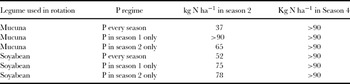
Soybean-maize rotation treatments (at zero N) had a NFE of 52–78 kg N ha−1 in season 2 and mucuna-maize rotation system had 37 to > 90 kg N ha−1, depending on the P fertilization regime (Table 3). All soybean-maize and mucuna-maize rotation treatments had NFE of greater than 90 kg N ha−1 in season 4.
Amount of nitrogen fertilizer required in continuous maize sequence to achieve similar maize yield as maize in soybean- and mucuna-maize rotation systems (nitrogen fertilizer equivalencies) at different P regimes in season 2 and 4 in Nyabeda, western Kenya.

No chemical fertilizer N was applied in any treatement. Season 2: March–July 2002 cropping season, Season 4: March–August 2003 cropping season.
Partial budget analysis and marginal rate of return
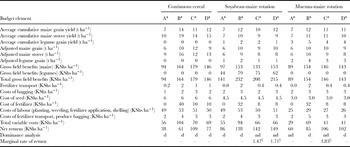
For each of the cropping systems and P regimes, the net returns over the four seasons were positive and ranged from KShs 38 000 in the continuous cereal at 0 kg P ha−1 to KShs 149 000 in the soybean-maize rotation system with ‘P applied in season 2’ (Table 4).
Cumulative yields (t ha−1), variable costs, gross benefits and net returns (KShs,000 ha−1) of different P application regimes and cropping systems over four seasons (September 2001 to August 2003) in Nyabeda, western Kenya.

A: No P applied; B: P every season; C: P in season 1 only; D: P in season 2 only; d: dominated; nd: not dominated.
†Shift from mucuna-maize rotation with ‘P in season 1 only’ to soybean-maize rotation with ‘P in season 1 only’.
‡Shift from mucuna-maize rotation with ‘P in season 1 only’ to soybean-maize rotation with ‘P applied in season 2 only’.
§Shift from ‘No P’ to ‘P in season 1 only’ in mucuna-maize rotation system.
All the continuous maize cropping system treatments (with or without P) had lower net returns (and higher variable costs) than the other treatments (higher returns and lower variable costs) and were thus considered dominated by the latter (Table 4). The other dominated options are: (i) soybean-maize rotation – no P, (ii) soybean-maize rotation – P every season, (iii) mucuna-maize rotation – P every season, and (iv) mucuna-maize rotation – P in season 2 only. This implies that, although these treatments have positive net returns, they are still not the best to be recommended to farmers because compared with the non-dominated options ((i) soybean-maize rotation – P in season 1 only, (ii) soybean-maize rotation – P in season 2 only, (iii) mucuna-maize rotation – No P, and (iv) mucuna-maize rotation – P in season 1 only)), the continuous maize systems have higher variable costs, but lower net returns.
The MRR was computed for the non-dominated alternatives in order to know the returns that farmers stand to gain from a possible switch from one non-dominated option to another. A change from a mucuna-maize rotation system without P to one where P was applied only in the first season attracted a MRR of 380%. A change of mucuna as the rotation crop to dual purpose soyabean attracted an additional MRR of 147% when P was applied to the legume (P in season 1 only) and an MRR of 171% when P was applied to the cereal (P in season 2 only).
DISCUSSION
Application of mineral P in soils of western Kenya is essential for a good legume and subsequent cereal crop yield. P has been shown to increase the efficiency of legumes to fix N (Sanginga et al., Reference Sanginga, Okogun, Vanlauwe, Diels, Carsky and Dashiell2001), enhance nodulation and nodule functioning, increase nodule mass, aboveground biomass and total N in legume residues (Besmer et al., Reference Besmer, Koide, Twomlow and Waddington2003). Nodulation results, for example, show that greater N fixation is expected in systems treated recently with P than those under longer periods after P application. Lower yields observed in treatments without P application relative to other P regimes in the rotation systems in our study shows that P is a main limiting factor to crop growth in this area, and neither mucuna nor soyabean can supply both the needed P and N without some application of mineral P. Similar results were observed by Lungu and Munyinda (Reference Lungu, Munyinda and Waddington2003) who found both the biomass and grain yields of groundnut, cowpea and soyabean to more than double following the application of P. The use of P during the legume phase could increase not only the productivity of the legume crop but will also lead to significant residual effects on the succeeding cereal crop. Sharma et al. (Reference Sharma, Pareek and Chandra1995) also reported increased maize yield (10.5% over the control) after one season of residual P following application of 40 kg P2O5 ha−1 on a previous chickpea crop.
For both soyabean and mucuna, similar yields between treatments in which P was applied one or two seasons earlier and treatment having P every season indicate that these legumes benefited from residual P. The residual P also increased productivity of the succeeding maize crop although the effect reduced in subsequent seasons due, possibly, to P fixation by the generally acidic soils. P fixation in these tropical Ferralsols was observed earlier by Nziguheba et al. (Reference Nziguheba, Merckx, Palm and Mutuo2002). Similar legume grain yields between treatments under two seasons of residual P and P every season treatment in legume-cereal rotation systems suggests that where rotation of legume and cereal is involved, P application can be applied after every three seasons. However, under the continuous cereal system, the performance of maize showed that one season residual P was the best option requiring application of P every second season. These findings agree with Carsky et al. (Reference Carsky, Oyewole and Tian2001) who suggested that application of P to legume cover crops could profit succeeding maize with not only additional N but also residual effects of applied P. Higher yield (about 1 t ha−1 maize grain yield) observed with freshly applied P compared to where P was applied during earlier seasons, however, indicate that season by season application of P is required in this soil. The widening gap in yield between treatments with P applied every season and those under one, two and three seasons residual P suggests the need to study effect of seasonal application using lower quantities of P such as the seasonal 10–20 kg P2O5 ha−1 recommended by Njui and Musandu (Reference Njui and Musandu1999) for western Kenya. In their study, Njui and Musandu (Reference Njui and Musandu1999) observed the lower P quantities (10–20 kg P2O5 ha−1) to be more attractive economically than higher P quantities.
There was no response of maize yield to N without mineral P application. The response was also lower in treatments under residual P compared to those with freshly applied mineral P, confirming the need to apply mineral P in some of the seasons. Lack of statistical differences in maize yield between 30 kg N ha−1 and higher N treatments indicates that the higher rates of N application may not be necessary and suggest a need to review the 75 kg N ha−1 fertilizer N recommendation for this area. On the other hand, P utilization is low in the absence of adequate quantities of N fertilizer, and this explains the yield differences due to the P regime observed at high, but not low, N application rates.
Lack of maize response to mineral N after both mucuna and soyabean even in treatments that had received P is attributed to sufficient amount of N contributed by the legumes to the soil. Mucuna is known to have fertilizer replacement value of up to 120 kg N ha−1 (Carsky et al., Reference Carsky, Oyewole and Tian2001), while soyabean gives a net N supply to the soil in excess of 40 kg N ha−1 (Sanginga et al., Reference Sanginga, Okogun, Vanlauwe, Diels, Carsky and Dashiell2001) and produces a strong effect on cereal in the rotation system (Sanginga et al., Reference Sanginga, Dashiell, Diels, Vanlauwe, Lyasse, Carsky, Tarawali, Asafo-Adjei, Menkir, Schulz, Singh, Chikoye, Keatinge and Rodomiro2003). Incorporation of mucuna biomass grown with addition of P in season 1 would result in 95 kg N ha−1 compared to about 57 kg N ha−1 without addition of P (an average of 3.6% N in mucuna leaves and stems (Cobo-Borrero, Reference Cobo-Borrero1998)). Inclusion of legumes in rotation with cereals can thus be a solution to the problem of N deficiency that limits cereal production in western Kenya. With the additional N from roots and also non-N legume rotational effects on succeeding cereal (see Sanginga et al., Reference Sanginga, Dashiell, Diels, Vanlauwe, Lyasse, Carsky, Tarawali, Asafo-Adjei, Menkir, Schulz, Singh, Chikoye, Keatinge and Rodomiro2003), the mucuna NFE would be higher as shown in the results. Other researchers have also noted legume-cereal rotation benefits. For example, Vanlauwe et al. (Reference Vanlauwe, Wendt, Diels, Tian, Ishida and Keatinge2001), in summarizing legume contribution to cereal yield in West Africa, observed that mucuna created large rotational benefits of 50–350% depending on the fertility status of the soils. Friesen et al. (Reference Friesen, Assenga, Bogale, Mmbaga, Kikafunda, Negassa, Ojiem, Onyango and Waddington2003) reported that legume rotations in East Africa consistently produced higher maize grain yield (1.5–3.5 t ha−1 or 27–134%) than unfertilized maize in monocrop. But such rotational benefits on cereal are lower when chemical fertilizer N is applied than when no N is applied, as shown by the results of the current study. Urea, the form of N applied, could possibly increase exchangeable soil acidity, hence the reduced yield after mineral N application in both legumes. Besides the observed responses, the amount of N fixed by soyabean and mucuna that remains within the root system still needs to be investigated, and there is need also to quantify the amount of N in leaves that drop within the growing season, and the amount in the pods removed and not returned by farmers during harvest.
Lower maize response after mucuna without P compared to soyabean without P could indicate lower efficiency of mucuna N-fixation in the absence of P, but this requires further investigation. It may also be interesting to look at the differences in P tolerance levels for mucuna and soybean. Vanlauwe et al. (Reference Vanlauwe, Nwoke, Diels, Sanginga, Carsky, Deckers and Merckx2000) showed different results where mucuna significantly enhanced Olsen-P content of soil after rock phosphate addition compared to the lablab or maize treatments on the plateau and valley fields in Guinea and Nigeria, but the effect depended on relative initial Olsen-P content of the soil.
Although maize yield after mucuna was generally higher than that after soybean, the domination of some of the mucuna-maize rotation treatments was mainly due to lack of grain value of mucuna seed in this area. Since many options (or treatments) were included in the trial, results based on MRR can confidently be used for immediate recommendations to farmers in the study area and similar environments. This is because the MRR of at least 147% realizable from a switch from the best of the other non-dominated options to soybean-maize rotation with P applied in one of the four seasons (in season 1 or 2) is on the higher side of the minimum rate of return (100% to 150%) acceptable to farmers in the study area (CIMMYT, 1988).
CONCLUSIONS
Since legume data showed response to residual P, even in the third season, for a legume-cereal rotation system, we suggest application of P first to the legume followed by maize (without P) and then legume (without P) before applying P again to maize in the fourth season. For the continuous cereal system, since our agronomic results do not show significant differences between plots freshly applied with P and those under one season residual, we conclude that application of P every two seasons is the best application strategy. Nevertheless, yields from continuous cereal treatments on two or three seasons of residual P, which were significantly higher than those from no P treatments, indicate that a staggered P application could be an appropriate option for poor smallholder farmers, in which case a one time application of P in four seasons could be used instead of no P at all. Freshly applied P is more effective than P applied in previous seasons, and further investigation is needed to find out whether applying 12.5 kg P ha−1 every season, for instance, is better than a single application of 50 kg P ha−1 to cover four seasons. With either mucuna or soyabean as a previous crop, there is no need to apply mineral N to the succeeding cereal crop. Results based on economic analysis indicate it is best to recommend soybean-maize rotation with one season application of P (once in four seasons) since a switch from the best of the other non-dominated options to this option is accompanied by a MRR of 147% or 171%.
Acknowledgements
The authors would like to acknowledge the Rockefeller foundation for supporting this study. Acknowledgement also goes to Richard Coe, Bashir Jama and Wim Buysse for guidance in statistical data analysis and interpretation and the colleagues in the third ECA scientific writing workshop who participated in peer review. The authors also acknowledge James Kinyangi and Catherine Gachengo for their involvement and commitment to this work during its initial stages.