1. Introduction
The Jurassic Period is generally regarded as the zenith of ichthyosaur (Reptilia: Ichthyopterygia) evolution. Early Jurassic deposits, particularly in England (Hettangian–Sinemurian) and Germany (early Toarcian), have yielded a great deal of material, both in diversity and sheer number of specimens (McGowan & Motani, Reference McGowan and Motani2003). Important intervals from the latter part of the Jurassic, such as the late Middle Jurassic Oxford Clay Formation (Callovian) and the Late Jurassic Kimmeridge Clay Formation (Kimmeridgian–Tithonian) and Agardhfjellet Formation (Tithonian) have also produced significant amounts of material (McGowan & Motani, Reference McGowan and Motani2003; Druckenmiller et al. Reference Druckenmiller, Hurum, Knutsen and Nakrem2012). However, the lack of deep-water Lagerstätten during the Aalenian to Bathonian interval creates a major gap in our understanding of ichthyosaur evolution (Benson & Butler, Reference Benson, Butler, McGowan and Smith2011). This gap represents a critical period in the evolutionary history of the clade in that it spans a period when more basal parvipelvians typical of the Toarcian coexisted with the first ophthalmosaurids (Fernández, Reference Fernández1994), which arose prior to the Aalenian–Bajocian boundary (Fernández, Reference Fernández2003) and subsequently become the only surviving clade of ichthyosaurs by the Callovian (McGowan & Motani, Reference McGowan and Motani2003). To date, only three valid ichthyosaur species have been named from the Aalenian–Bathonian interval. Two represent more basal taxa, including Stenopterygius aaleniensis Maxwell, Fernández & Schoch, Reference Maxwell, Fernández and Schoch2012 from the Aalenian of Germany and Chacaicosaurus cayi Fernández, Reference Fernández1994 from the Bajocian of Argentina (now also referred to Stenopterygius (Fernández, Reference Fernández, Gasparini, Salgado and Coria2007a ), but for a different opinion see Maisch & Matzke, Reference Maisch and Matzke2000; Fischer et al. Reference Fischer, Masure, Arkhangelsky and Godefroit2011, Reference Fischer, Maisch, Naish, Kosma, Liston, Joger, Krüger, Pardo Pérez, Tainsh and Appleby2012). The only named ophthalmosaurid material from this interval is Mollesaurus periallus Fernández, Reference Fernández1999, a single partial skeleton from the early Bajocian of Argentina. Thus, our knowledge of ophthalmosaurid diversity during the Aalenian–Bathonian gap remains extremely sparse and diagnostic material from the northern hemisphere is entirely lacking. This gap ends at the Callovian, with the appearance of abundant material in the Oxford Clay Lagerstätte.
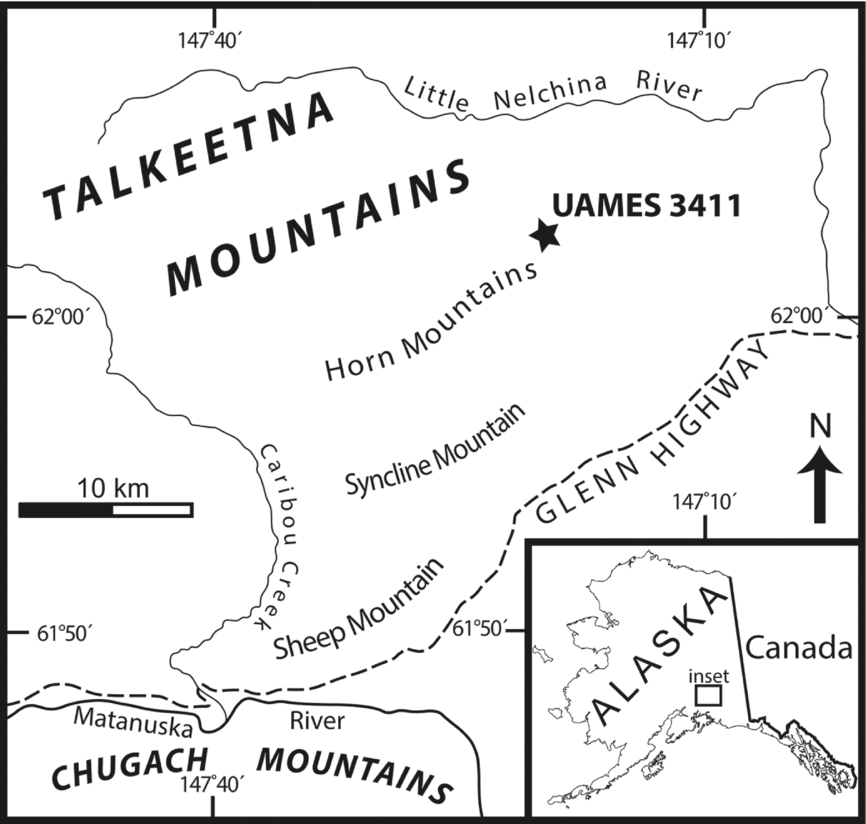
In 2001, a partial disarticulated skull of an ichthyosaur was discovered in the Middle Jurassic Tuxedni Formation in southern Alaska (Fig. 1). The specimen can be confidently referred to Ophthalmosauridae on the basis of its basioccipital morphology, and is significant in several regards. It is the first Jurassic ichthyosaur material described from Alaska and the only Middle Jurassic ichthyosaur material known from North America. It is the only Middle Jurassic ophthalmosaurid recognized from the Northern Hemisphere and one of the oldest diagnostic specimens of Ophthalmosauridae known. Although Ophthalmosauridae has historically been viewed as a taxonomically impoverished clade, studies on the taxonomy and diversity of this group are undergoing a renaissance. Since the publication of the Handbook of Paleoherpetology (McGowan & Motani, Reference McGowan and Motani2003), the number of named genera has doubled, from 8 to 16 (Maxwell & Caldwell, Reference Maxwell and Caldwell2006; Maxwell, Reference Maxwell2010; Druckenmiller & Maxwell, Reference Druckenmiller and Maxwell2010; Fischer et al. Reference Fischer, Masure, Arkhangelsky and Godefroit2011, Reference Fischer, Maisch, Naish, Kosma, Liston, Joger, Krüger, Pardo Pérez, Tainsh and Appleby2012, Reference Fischer, Arkhangelsky, Uspensky, Stenshin and Godroit2013; Druckenmiller et al. Reference Druckenmiller, Hurum, Knutsen and Nakrem2012). However, the early history of this important group remains poorly understood, making the current contribution extremely timely and relevant.
Discovery site of ichthyosaur UAMES 3411 in the southeastern Talkeetna Mountains, Alaska.

Institutional abbreviations. UAMES, University of Alaska Museum, Fairbanks; USGS, United States Geological Survey.
2. Geological setting
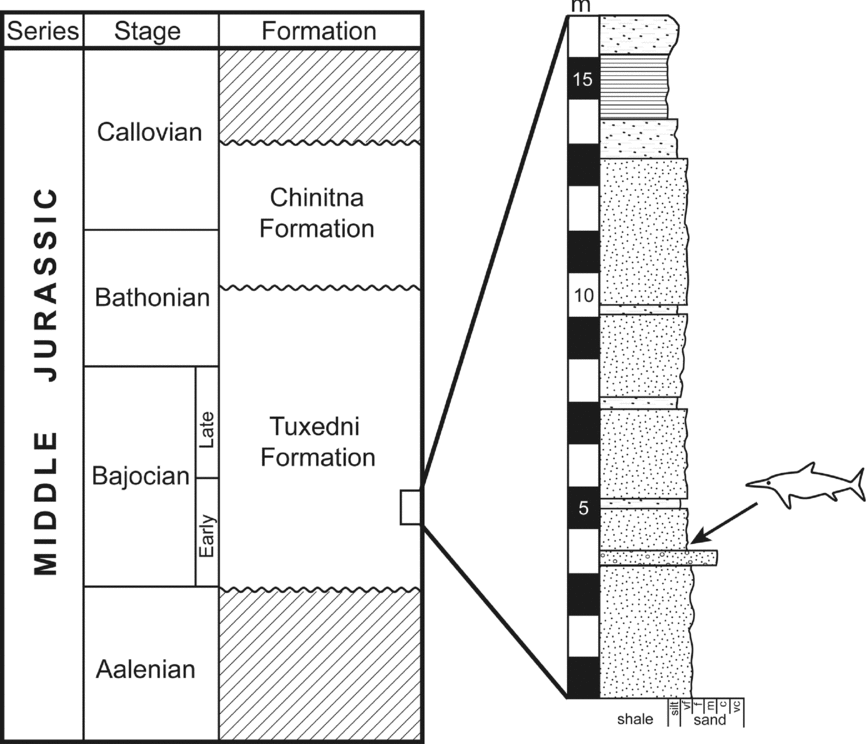
UAMES 3411 was discovered by an amateur palaeontologist in the Tuxedni Formation, where it crops out in the southeastern portion of the Talkeetna Mountains in south-central Alaska (Fig. 1). The Tuxedni Formation is part of the Wrangellia composite terrane, a massive crustal fragment that was translated northward and accreted to the western margin of North America during Jurassic and Cretaceous times (Plafker & Berg, Reference Plafker, Berg, Plafker and Berg1994; Trop & Ridgway, Reference Trop, Ridgway, Ridgway, Trop, Glen and O'Neill2007). In the Talkeetna Mountains, the Tuxedni Formation is approximately 300–400 m thick (Winkler, Reference Winkler1992) and consists entirely of shallow-marine sandstone, siltstone and shale that was deposited on a marine shelf in a forearc setting outboard (south) of a Jurassic arc pluton (Trop et al. Reference Trop, Szuch, Rioux and Blodgett2005; Trop & Ridgway, Reference Trop, Ridgway, Ridgway, Trop, Glen and O'Neill2007). The Tuxedni Formation is Middle Jurassic in age and in the study area lies unconformably on Early Jurassic sediments of the Talkeetna Formation and is unconformably overlain by the Chinitna Formation, which is Bathonian to Callovian in age (Fig. 2; Imlay, Reference Imlay1964; Trop et al. Reference Trop, Szuch, Rioux and Blodgett2005). The Tuxedni Formation consists of six named units in the Cook Region to the south (Detterman, Reference Detterman1963; Detterman & Reed, Reference Detterman and Reed1980), but is only subdivided in the Talkeetna Mountains into two informal units; a lower thin- to thick-bedded sandstone and an upper thin- to medium-bedded siltstone (Imlay, Reference Imlay1964; Winkler, Reference Winkler1992). The ichthyosaur was found in the lower portion of the unnamed upper siltstone unit of the Tuxedni Formation (Imlay, Reference Imlay1964).
Stratigraphic relationships of the Tuxedni Formation in the Talkeetna Mountains, southern Alaska and the position of UAMES 3411 in a measured section at the discovery site. Stratigraphy derived from Imlay (Reference Imlay1964), Winkler (Reference Winkler1992) and Schaff & Gilbert (Reference Schaff and Gilbert1987).

The age of the UAMES 3411 is well constrained on the basis of a rich ammonite fauna associated with the specimen. Ammonoids collected from the discovery site in the course of this study are referred to several taxa also recognized by Imlay (Reference Imlay1964) from the same locale (USGS Mesozoic locality 24113; Imlay, Reference Imlay1961, Reference Imlay1964). Notable members of this assemblage include Parabigotites crassicostatus Imlay, Reference Imlay1961, Stephanoceras obesum Imlay, Reference Imlay1964, Witchellia adnata Imlay, Reference Imlay1964, Bradfordia costidensa Imlay, Reference Imlay1964, and Otoites cf. O. pauper Westermann, Reference Westermann1954 (for a comprehensive list, see Imlay, Reference Imlay1964). Collectively, Imlay (Reference Imlay1964) considered this assemblage equivalent to the European Emileia (formerly Otoites) sauzei Zone, equivalent to the northern Sonninia propinquans Zone (Gradstein, Ogg & Smith, Reference Gradstein, Ogg and Smith2004), which is currently recognized as middle Early Bajocian in age (Gradstein et al. Reference Gradstein, Ogg, Schmitz and Ogg2012).
3. Systematic palaeontology
Order ICHTHYOSAURIA de Blainville, Reference Blainville1835
parvipelvia Motani, Reference Motani1999
Family Ophthalmosauridae Baur, Reference Baur1887
Subfamily Ophthalmosaurinae Baur, Reference Baur1887
Ophthalmosaurinae indet.
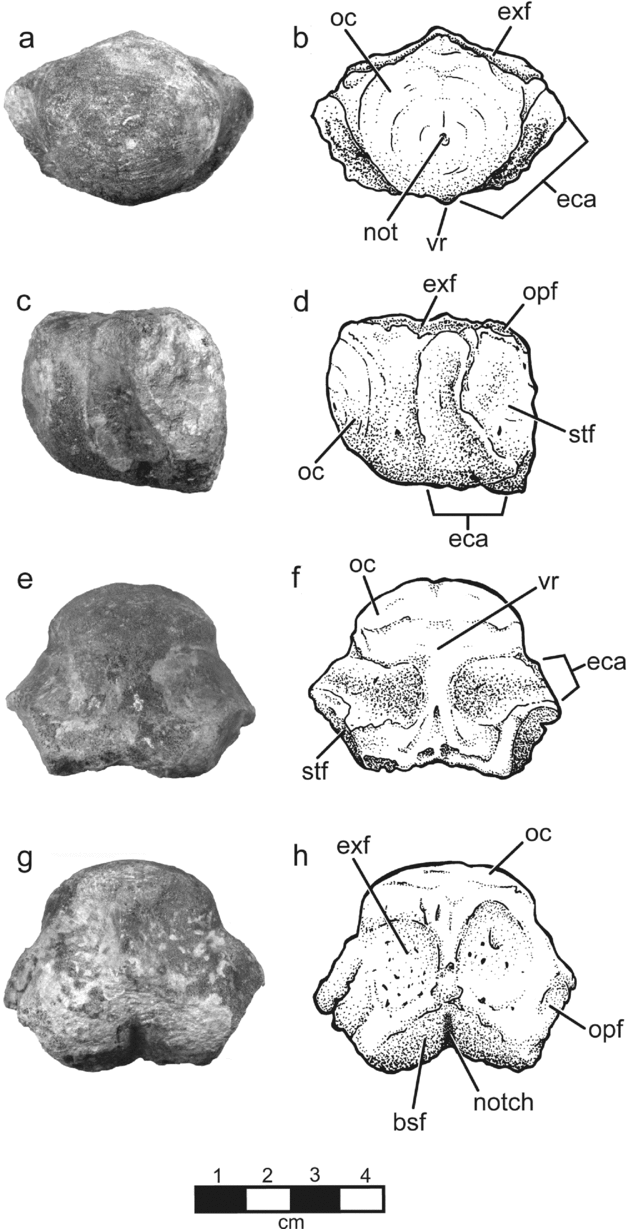
Photographs and interpretations of the basioccipital of UAMES 3411 in occipital (a, b), right lateral (c, d), ventral (e, f), and dorsal (g, h) views. Abbreviations: bsf, basisphenoid facet; exf, exoccipital facet; eca, extracondylar area; not, notochordal pit; oc, occipital condyle; opf, opisthotic facet; stf, stapedial facet; vr, ventral ridge.

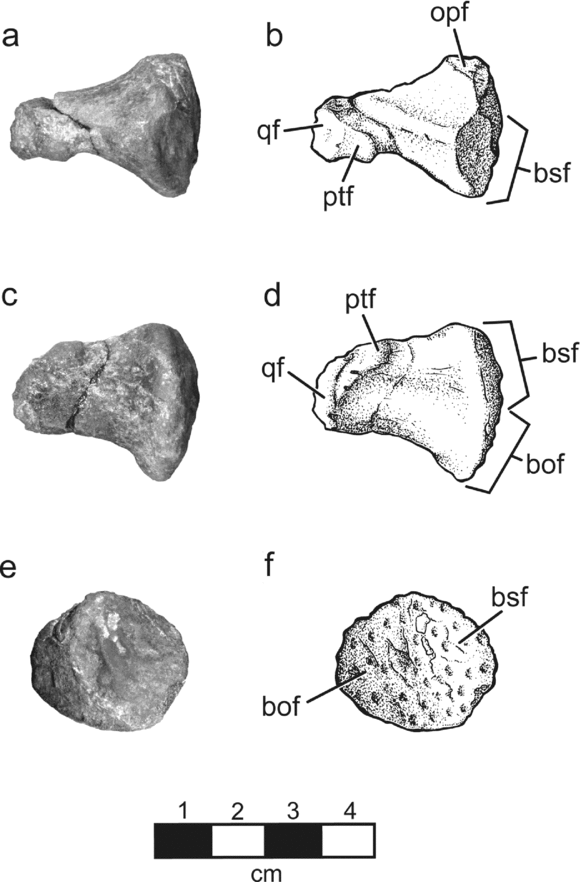
Photographs and interpretations of the right stapes of UAMES 3411 in anterior (a, b), ventral (c, d), and medial (e, f) views. Abbreviations: bof, basioccipital facet; bsf, basisphenoid facet; opf, opisthotic facet; ptf, pterygoid facet; qf, quadrate facet.

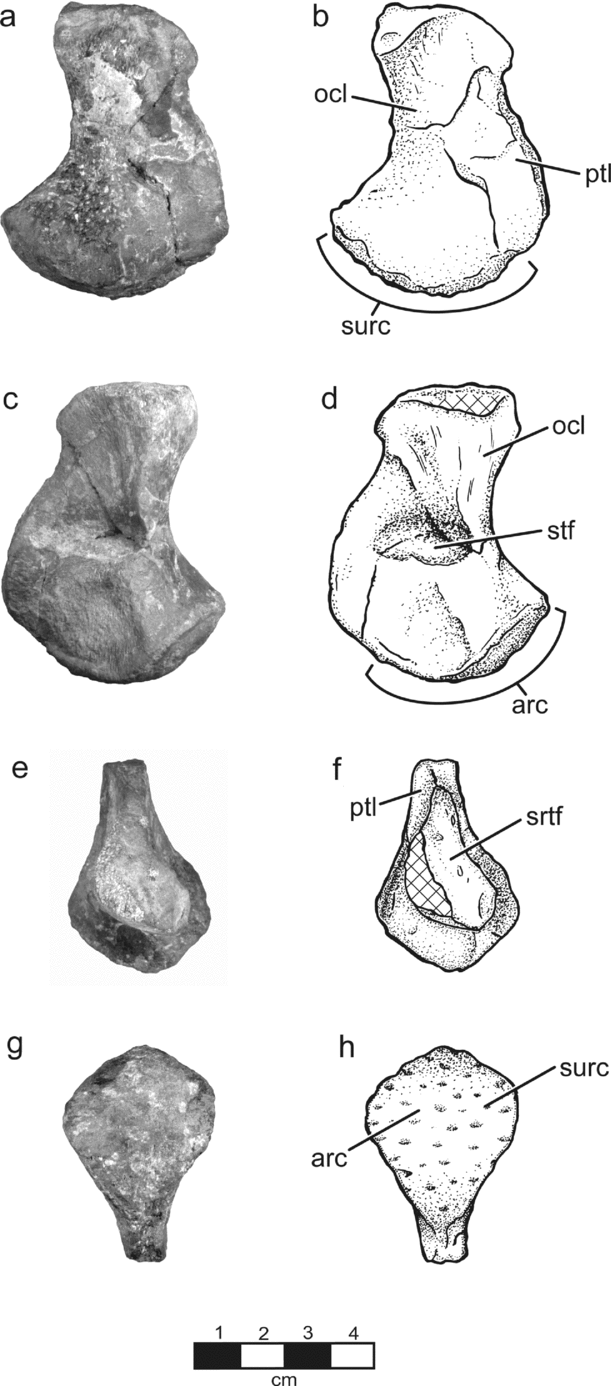
Photographs and interpretations of the right quadrate of UAMES 3411 in anterior (a, b), posterior (c, d), dorsal (e, f), and ventral (g, h) views. Cross-hatched areas represent damage. Abbreviations: arc, articular condyle; ocl, occipital lamella; ptl, pterygoid lamella; srtf, supratemporal facet; stf, stapedial facet; surc, surangular facet.

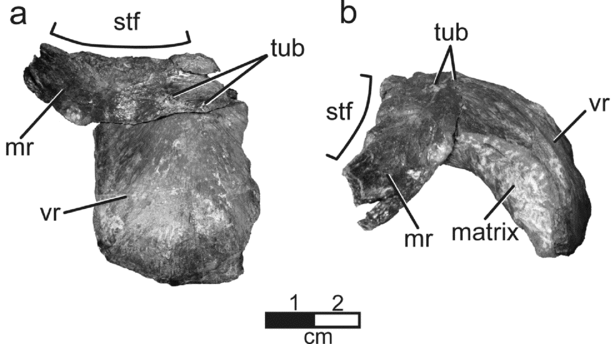
Photographs of the right supratemporal of UAMES 3411 in dorsal (a) and medial (b) views. Abbreviations: mr, medial ramus; stf, supratemporal fenestra; tub, tubercles; vr, ventral ramus.

Referred material. UAMES 3411, a partial disarticulated skull including the basioccipital, stapes, quadrates, partial supratemporal and isolated fragments.
Locality. Approximately 2.4 km north of the mouth of Albert Creek, southeastern Talkeetna Mountains, south-central Alaska; 62°01.698΄N, 147°17.654΄W (NAD 27).
Age and horizon. Lower portion of unnamed siltstone member, Tuxedni Formation; middle Early Bajocian (Imlay, Reference Imlay1964).
3.a. Description
Basioccipital. The basioccipital (Fig. 3) is a robust element, and has suffered little taphonomic distortion (length = 44 mm; width = 77 mm; height = 40 mm). The anterior surface of the basioccipital is pitted and has a deep dorsoventrally-oriented furrow along the midline that is most conspicuous dorsally where it creates a prominent notch on the anterodorsal surface. There is no trace of a basioccipital peg or a notochordal pit on the anterior surface. In dorsal view, the basioccipital is mediolaterally broader than anteroposteriorly long, being broadest at the level of the opisthotic facets. Two large, ventrally depressed exoccipital facets occupy most of the dorsal surface but are separated by a well-defined anteroposterior ridge that forms the floor of the neural canal. The anterolateral surface bears a prominent stapedial facet, which is taller than broad, slightly concave and faces ventrolaterally and slightly anteriorly. Immediately dorsal to this is a much smaller dorsally oriented opisthotic facet. Lying between the stapedial facet and the occipital condyle is the extracondylar area that consists of a prominent concave surface of smooth, finished bone. The extracondylar area is clearly visible in posterior view, where the lateral portions of the basioccipital projects beyond the occipital condyle (Fig. 3a, b). Ventrally, the extracondylar areas of the left and right surfaces are separated by a ridge along the midline. The occipital condyle is broadly convex posteriorly and faces somewhat ventrally in lateral view. The condyle is mediolaterally broadest in its dorsal half and bears a notochordal pit in the centre of the articular surface.
Stapes. A single stapes, interpreted as the right, is preserved in UAMES 3411 (Fig. 4). The stapes is a short (length = 36 mm) and robust element, with a massively expanded medial end. The medial surface is convex and bears a large posterior facet for the basioccipital and a smaller, anteriorly situated basisphenoid facet. These two facets are separated by a shallow dorsoventrally oriented groove. The dorsomedial surface of the stapes bears a narrow roughened surface corresponding to the opisthotic facet, but this area is poorly defined. The stapedial shaft is short, anteroposteriorly broader than tall and unconstricted in dorsal or ventral view. The dorsal surface of the shaft is convex while the ventral surface is concave. The anterior surface of the stapedial shaft is relatively narrower than the broadly rounded posterior margin, forming a ridge. As seen in posterior view, the middle of the shaft connects to the medial portion of stapes at a height just dorsal of its dorsoventral midpoint. In ventral view, the facet for the pterygoid and possibly supratemporal (sensu Kirton, Reference Kirton1983) is small triangular area that lies along the anterolateral margin of the stapedial shaft. The lateral end of the stapes in not expanded and bears a small ventrolaterally-facing facet for the quadrate.
Quadrate. Both quadrates are preserved in UAMES 3411. The right quadrate is most complete (height = 64 mm) and is described here (Fig. 5). As seen in posterior view, the quadrate consists of a relatively narrow dorsal portion and a much wider and more robust ventral portion that includes the articular condyle with the mandible. The element is not ‘C’ shaped in posterior view, unlike the quadrates of many ichthyosaurs (e.g. Ophthalmosaurus; Kirton, Reference Kirton1983), due to the weakly developed lateral and medial portions of the occipital and pterygoid lamellae, respectively. The occipital and pterygoid lamellae are clearly separated by a dorsoventrally oriented ridge. The stapedial facet is a well-defined ovate depression located on the posterior surface of the element. Its lateral margin just contacts the ridge separating the occipital and pterygoid lamellae, forming a notch. In lateral view, the quadrate is concave; the occipital lamella is relatively thickened compared to the anteroposteriorly thin pterygoid lamella. An area of unfinished bone extends along most of the medial margin of the pterygoid lamella but ends ventrally and is not continuous with the mandibular facet. In dorsal view, the quadrate is roughly triangular in shape, with the apex of the triangle composed of the extremely thin dorsal portion of the pterygoid lamella. The dorsal surface is capped with an area of unfinished bone, presumably for articulation with the supratemporal. Ventrally, the articular condyle is largely located on the ventrolateral surface of the quadrate, and is mediolaterally wider than anteroposteriorly long. The surangular and articular facets are poorly differentiated from one another, being separated only by a broad ridge rather than a marked groove, as in Ophthalmosaurus.
Supratemporal. An incomplete supratemporal is associated with UAMES 3411, which is interpreted to be the right (Fig. 6). The lateral ramus has been lost but portions of both the medial and ventral rami are preserved three dimensionally. The medial ramus is a thickened bar of bone that forms the posterior margin of the supratemporal fenestra. Several horizontally oriented ridges and grooves are present along the anterior face of the medial ramus for articulation with the parietal. The ramus gradually tapers in size medially, but its medial-most end is not preserved. Two small tubercles are present along the occipital face of the supratemporal, near the junction of the medial, lateral and ventral rami, similar to that described by Kirton (Reference Kirton1983) for Ophthalmosaurus. The bone fiber orientation on the occipital face of the supratemporal radiates outward from the tubercles and extends ventrally onto the ventral ramus. The occipital surface of the ventral ramus also bears broadly rounded ridges and swales that parallel the bone fiber orientation. The ventral ramus is a thin lamina of bone than curves nearly 90 degrees ventrally from the medial ramus. Other aspects of the morphology of the ramus are difficult to interpret as it is not complete and only partially prepared.
4. Discussion
4.a. Ophthalmosaurid affinities and comparison with Middle Jurassic ichthyosaurs
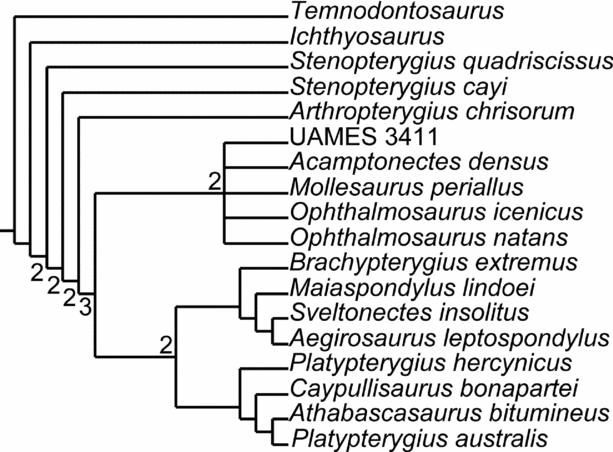
UAMES 3411 is referable to the Ophthalmosauridae, based on the absence of a basioccipital peg and a reduced extracondylar area (McGowan & Motani, Reference McGowan and Motani2003). However, the latter feature has been oversimplified and variably applied and thus requires redefinition. The extracondylar area represents portions of the lateral and ventral surfaces of the basioccipital anterior of the occipital condyle and posterior to the stapedial/opisthotic facets. Typically, the extracondylar area is surfaced in smooth periosteal bone. In basal parvipelvians (e.g. Ichthyosaurus) the extracondylar area is a wide sheet of bone both lateral and ventral of the occipital condyle; in posterior view, this large extracondylar area produces a basioccipital morphology that is almost square in outline, with the exception of a slight ventral notch. In lateral view, the extracondylar area projects ventrally and somewhat anteriorly so that the body of the basioccipital appears triangular (apex pointing ventrally) in outline (McGowan, Reference McGowan1973; McGowan & Motani, Reference McGowan and Motani2003). In more derived Lower Jurassic forms (e.g. Stenopterygius) the extracondylar area has been considerably reduced. In posterior view, the extracondylar area is partially hidden from view by the occipital condyle, and a ventral notch is absent (Maisch, Reference Maisch1998). When seen in lateral view, the anteroventral process is prominently visible, such that the ventral margin of the extracondylar area extends ventral to the ventral margin of the occipital condyle (Fernández, Reference Fernández1994; Maisch, Reference Maisch1998). In UAMES 3411, the extracondylar area is proportionately similar in anteroposterior length to that of Stenopterygius. However, in lateral view, the anteroventral process is absent and the ventral margin of the basioccipital is parallel to the floor of the foramen magnum. Thus, the basioccipital of UAMES 3411 appears square to rectangular in lateral view rather than triangular, which is the typical morphology of ophthalmosaurids (McGowan, Reference McGowan1976; Fischer et al. Reference Fischer, Masure, Arkhangelsky and Godefroit2011; Druckenmiller et al. Reference Druckenmiller, Hurum, Knutsen and Nakrem2012; Fischer et al. Reference Fischer, Maisch, Naish, Kosma, Liston, Joger, Krüger, Pardo Pérez, Tainsh and Appleby2012). Similarly, in posterior view the extracondylar area has been reduced ventrolaterally so that the basioccipital no longer appears square to rectangular in outline, rather it approaches the hexagonal outline seen in Ophthalmosaurus and other ophthalmosaurids (Kirton, Reference Kirton1983). Based on the character optimization proposed by Fischer et al. (Reference Fischer, Maisch, Naish, Kosma, Liston, Joger, Krüger, Pardo Pérez, Tainsh and Appleby2012), the absence of the basioccipital peg suggests that this specimen is not from a basal ophthalmosaurid (e.g. Arthropterygius; Maxwell, Reference Maxwell2010). The extracondylar area in UAMES 3411 is not as reduced as in most platypterygiines, and shows slightly less lateral reduction than ophthalmosaurine ophthalmosaurids (sensu Fischer et al. Reference Fischer, Maisch, Naish, Kosma, Liston, Joger, Krüger, Pardo Pérez, Tainsh and Appleby2012). Even though the Alaskan specimen lacks a ventral notch on the basioccipital, an ophthalmosaurine synapomorphy, reanalysis of the Fischer et al. (Reference Fischer, Maisch, Naish, Kosma, Liston, Joger, Krüger, Pardo Pérez, Tainsh and Appleby2012) matrix places UAMES 3411 within the ophthalmosaurines (scorings: 17.1, 18.1, 19.1; Fig. 7), with the clade receiving the same Bremer support as in the original analysis.
Phylogenetic position of UAMES 3411 and corresponding Bremer support values based on a reanalysis of the matrix of Fischer et al. (Reference Fischer, Maisch, Naish, Kosma, Liston, Joger, Krüger, Pardo Pérez, Tainsh and Appleby2012).

Unlike the isolated forefin material described by Fernández (Reference Fernández2003), the braincase elements described herein are clearly diagnostic beyond the level of Ophthalmosauridae. The specimen differs from other Middle Jurassic ophthalmosaurines (i.e. Ophthalmosaurus icenicus and Mollesaurus periallus) based on the morphology of all three braincase elements (Kirton, Reference Kirton1983; Fernández, Reference Fernández1999). Unlike UAMES 3411, the basioccipital of Ophthalmosaurus bears a notochordal pit and incipient basioccipital peg on its anterior surface. In addition to the features discussed above, the stapedial facets of UAMES 3411 do not extend as far ventrally as in Ophthalmosaurus and Mollesaurus and the opisthotic facet of Ophthalmosaurus is more laterally directed. In the Alaskan specimen the occipital condyle is better defined and more clearly offset from the body of the basioccipital. In overall size relative to the basioccipital, the stapes of UAMES 3411 is relatively less massive compared to Ophthalmosaurus and Mollesaurus. Medially, the opisthotic facet of the stapes of UAMES 3411 is much less prominent than other Middle Jurassic ophthalmosaurids, and the stapedial shaft is also proportionately shorter and more dorsoventrally compressed (Kirton, Reference Kirton1983; Fernández, Reference Fernández1999). The quadrate of UAMES 3411 differs from that of Ophthalmosaurus in the reduction of the anterodorsal portion of the pterygoid lamella. Similarly, the dorsal portion of the occipital lamella is reduced in its posterolateral extent, so that the portion of the quadrate that forms the medial border of the quadrate foramen is less ‘C’ shaped than that of Ophthalmosaurus. Finally, the surangular and articular facets of UAMES 3411 are not as clearly separated as in Ophthalmosaurus (Appleby, Reference Appleby1956; Kirton, Reference Kirton1983). The Late Jurassic – Early Cretaceous genera Caypullisaurus and Acamptonectes have been described as showing a similar basioccipital morphology to Ophthalmosaurus, and hence to UAMES 3411, however, these genera differ dramatically in quadrate (Fernández, Reference Fernández2007b ; Fischer et al. Reference Fischer, Maisch, Naish, Kosma, Liston, Joger, Krüger, Pardo Pérez, Tainsh and Appleby2012) and stapedial (Fischer et al. Reference Fischer, Maisch, Naish, Kosma, Liston, Joger, Krüger, Pardo Pérez, Tainsh and Appleby2012) morphology. Specifically, the quadrate in Caypullisaurus is very reduced, being dorsoventrally about as tall as the occipital condyle is wide, and is strongly ‘C’ shaped, as in Ophthalmosaurus (Fernández, Reference Fernández2007b ). In Acamptonectes, the quadratojugal and surangular facets of the quadrate are much more strongly developed than in UAMES 3411. The stapes of Acamptonectes also has a proportionately longer, more slender shaft, and a more strongly developed medial head than in the Alaskan material (Fischer et al. Reference Fischer, Maisch, Naish, Kosma, Liston, Joger, Krüger, Pardo Pérez, Tainsh and Appleby2012).
Unfortunately, few studies have described the posterior braincase elements of Stenopterygius, the proposed sister taxon to Ophthalmosauridae (Fischer et al. Reference Fischer, Maisch, Naish, Kosma, Liston, Joger, Krüger, Pardo Pérez, Tainsh and Appleby2012). However, in Stenopterygius cayi, from the Bajocian of Argentina and other species of the genus, the basioccipital possesses an expanded extracondylar area as described above. The stapes bears a prominent posterodorsal notch, as described for Ichthyosaurus, and is hypothesized to carry the stapedial artery (McGowan, Reference McGowan1973). The stapedial shaft is far less dorsoventrally compressed, and more slender. The quadrate of Stenopterygius has never been figured in detail, and three-dimensional material of this taxon is rare.
While some authors believe that the braincase changed slowly among ichthyosaurs (McGowan, Reference McGowan1972), recent results have emphasized the taxonomic utility of many different aspects of braincase morphology within ophthalmosaurids (Maxwell, Reference Maxwell2010; Fischer et al. Reference Fischer, Masure, Arkhangelsky and Godefroit2011, Reference Fischer, Maisch, Naish, Kosma, Liston, Joger, Krüger, Pardo Pérez, Tainsh and Appleby2012). There is also evidence that braincase morphology may vary substantially between closely related species (Appleby, Reference Appleby1956), suggesting relatively rapid rates of morphological evolution. Although UAMES 3411 can be distinguished from other ophthalmosaurids based on the material preserved, we refrain from erecting a new taxon based solely on the supratemporal and three braincase elements.
4.b. Evolutionary and palaeobiogeographical implications
Diagnostic material of Middle Jurassic ichthyosaurs is relatively rare, with only three localities producing diagnostic material known worldwide: the Aalenian Opalinuston Formation of Germany (Maxwell, Fernández, & Schoch, Reference Maxwell, Fernández and Schoch2012); the Bajocian Los Molles Formation of Argentina (Fernández, Reference Fernández1994, Reference Fernández1999); and the well known Callovian Oxford Clay Formation of England (Appleby, Reference Appleby1956; Kirton, Reference Kirton1983). Although ichthyosaurian remains are not rare in the Oxford Clay, only a single genus and species is currently considered to be present: Ophthalmosaurus icenicus (Kirton, Reference Kirton1983; McGowan & Motani, Reference McGowan and Motani2003). The Alaskan specimen represents the first diagnostic evidence of Ophthalmosauridae in the Middle Jurassic of North America, and also significantly extends the temporal distribution of the clade backward from Oxfordian-aged material (Ophthalmosaurus natans) in the Redwater Shale Member of the Sundance Formation of Wyoming (McGowan & Motani, Reference McGowan and Motani2003). (Note that a latest-Callovian age has been proposed for the lower part of the Redwater Shale; see Massare et al. Reference Massare, Buchholtz, Kenney and Chomat2006 for a summary.) The occurrence of ophthalmosaurine material in Alaska also suggests that this subclade had achieved a widespread distribution by the Early Bajocian, within approximately one million years after the first occurrence of Ophthalmosauridae at the Aalenian–Bajocian boundary (Fernández, Reference Fernández2003). Apart from the Argentinian material, Bajocian ichthyosaur remains are also reported from Germany and Chile, although these constitute isolated vertebrae and other fragments (Quenstedt, Reference Quenstedt1856–1858; Fraas, Reference Fraas1891; Huene, Reference Huene1922; Fernández, Reference Fernández, Gasparini, Salgado and Coria2007a ) and are not diagnostic at the family level.
In spite of some limitations imposed by the fragmentary nature of the material, it can be stated with confidence that the Alaskan specimen cannot be referred to any known Middle Jurassic ichthyosaur, including Stenopterygius spp., or the ophthalmosaurids Ophthalmosaurus and Mollesaurus. Given the paucity of material from the Aalenian–Bathonian interval, the specimen considerably enhances our knowledge of ichthyosaur diversity in the Middle Jurassic by doubling the number of diagnostic ophthalmosaurids present in the Bajocian (from one to two), and increases to five the total number of forms from the entire Aalenian–Callovian interval. UAMES 3411 also indicates that ophthalmosaurids were widespread and present in both the Northern and Southern hemispheres early in their history. Marine reptile diversity estimates are low for the Bajocian (Bardet, Reference Bardet1994), with the eastern Pacific (Argentina and Chile) representing one of the only regions producing diagnostic material from this time interval (Gasparini & Fernández, Reference Gasparini and Fernández2006). However, globally, the number of fossiliferous marine formations of Bajocian age is relatively high (Benson et al. Reference Benson, Butler, Lindgren and Smith2010). The present study emphasizes the importance of reconnaissance field work in formations not previously known to produce vertebrate material and sampling outside of known localities (i.e. Neuquén Basin and the Oxford Clay) to improve our understanding of the radiation and dispersal of new clades.
Acknowledgements
We acknowledge the discoverer of the specimen, R. Wilk, for informing us of this important find. Field investigations were carried out under BLM Paleontological Resources Use Permits AA-85338 and AA-87983, and State of Alaska permits 2002-04 and 2008-08. We thank K. May, R. Gangloff, J. Rousseau and V. Florey for their assistance in the lab and field and H. Foss for help with the illustrations. R. Schoch (SMNS) provided access to comparative material. We thank B. Kear and J. Massare for reviewing the manuscript. This work was supported by the Lameta Geist Fund at the University of Alaska Museum (PD) and NSERC and the Alexander von Humboldt Foundation postdoctoral fellowships (EM).