Introduction
The urgent needs in energy conversion and storage systems have triggered the development of new generation miniaturized systems and devices for seeking the safe and efficient energy providing systems, which can be framed in small dimensions.[ Reference Lu, Han, Li, Hua and Ouyang 1 , Reference Etacheri, Marom, Elazari, Salitra and Aurbach 2 ] Lithium-ion batteries (LIBs) have been identified as a suitable energy generation and storage system with a high scope for improvement in performance and tailorable in various dimensions.[ Reference Wu, Ren, Xu, Li and Cheng 3 – Reference Chang, Kartick and Doong 6 ] The electrochemical performance of LIBs has been largely improved by application of nano-dimensional metal oxide and chalcogenide materials.[ Reference Su, Xie, Munroe, Dou and Wang 7 – Reference Lim, Huang, Wang, Du, Zhang, Chen, Ang and Yang 10 ] In addition, the electrochemical performance of these anode materials can be significantly enhanced by the presence of carbonaceous material.[ Reference Chen, Yeoh, Liu and Wang 11 – Reference Zhou, Wang, Shao, Deng and Xu 13 ]
The morphology as well as particle size of metal oxides play a crucial role in determination of the electrochemical performance such as capacity, rate capability, and cycling stability of the anode materials.[ Reference Wang, Zhang, Chen, Qu, Lai and Li 14 ] Recently, metal oxide–graphene-based composites have been under limelight due to its superior electrochemical properties and morphological characteristics.[ Reference Prabhakar, Babu, Oh, Lah, Han, Jeong and Pyo 15 , Reference Guan, Nai, Zhang, Pengxi, Yang, Zheng, Zhang and Guo 16 ] Ultrafine Fe3O4/reduced graphene oxide (rGO) with high nitrogen content has shown the excellent electrochemical performance at high-current densities of 2–10 A/g along with high cycling stability.[ Reference Liu, Dong, Zhao, Zhao, Yu, Wang and Qiu 17 ] The N-doped carbon nanosheets with Fe2O3, NiO, and Co3O4 nanostructures can operate at a high-current density of 15 A/g with high specific capacity.[ Reference Dong, Yu, Wang, Liu, Wang, Zhao and Qiu 18 , Reference Dong, Liu, Liu, Tang, Yang, Wang, Wang, Zhao and Qiu 19 ] In addition, NiCoAl-layered double hydroxides–CNT–rGO hybrids showed a high capacity of 1188 F/g at a current density of 1 A/g.[ Reference Yu, Yang, Zhao, Fan, Wang and Qiu 20 ] Among the metal oxides used for LIB application, CoO has the advantage of easy preparation, thermal stability, and high theoretical capacity value of 706 mAh/g, which has been widely used for energy storage application. Guan et al. have used CoO-based octahedral nanocages for lithium ions storage and a specific capacity of 807 mAh/g was delivered after 50 cycles.[ Reference Guan, Wang, Li, Zhi, Zhai, Bando and Golberg 21 ] Rai et al. have used a urea-assisted auto-combustion method to synthesize CoO nanoparticles at 300 °C without post-heat treatment. The as-prepared CoO could exhibit a high specific capacity of 855 mAh/g in the second cycle and retained 66% of capacity after 23 cycles.[ Reference Rai, Anh, Gim and Kim 22 ] Also, the hierarchical CoO nanomaterials prepared by hydrothermal method showed a high discharge capacity of 1148 mAh/g at 100 mA/g after 20 cycles.[ Reference Qin, Yan, Li, Wang, An and Xing 23 ]
The incorporation of CoO with carbon-based nanomaterials can reinforce the electrochemical performance for LIB applications. The porous CoO/carbon polyhedra exhibited a reversible capacity of 510 mAh/g after 50 cycles at 100 mA/g.[ Reference Yuan, Zhang, Xie, Dong, Su and Du 24 ] The graphene-based CoO ultrathin hybrids were found to be excellent anode materials as they can provide a reversible capacity of 1018 mAh/g over 520 cycles with about 100% coulombic efficiency.[ Reference Sun, Hu, Luo and Huang 25 ] More recently, our previous work also showed that the corporation of ultrafine CoO onto rGO sheets exhibited a high specific capacity of 1260 mAh/g at 150 mA/g and 473 mAh/g at 2400 mA/g.[ Reference Kartick, Yeh, Chou, Chang and Doong 26 ] In addition, a binder-free electrode material based on compressible graphene aerogels–CoO nanostructures has delivered a significant specific capacity of 125 mAh/g at 3000 mA/g.[ Reference Dong, Liu, Wang, Liu, Zhao and Qiu 27 ] These results clearly indicate that the electrochemical performance of CoO-based nanomaterials is highly dependent on the excellent morphology and nano-dimensions of nanocomposites. Also, the presence of graphitic carbon provides additional buffering matrix and volume for extra Li ions uptake.[ Reference Kartick, Yeh, Chou, Chang and Doong 26 ] It is well understood that the structural features of nanomaterials can be tailored by varying the reaction parameters. However, only few studies have focused on the development of simple route for preparation of ultrafine CoO/rGO nanocomposites[ Reference Kartick, Yeh, Chou, Chang and Doong 26 ] and the effect of calcination duration on particle size and morphology of CoO nanoparticles has addressed less attention.
Herein, we report a facile and simple route for the synthesis of CoO/rGO nanohybrids as anode materials for LIB applications. The effect of calcination duration on the crystallinity and particle size of ultrafine CoO is examined for the enhanced electrochemical performance of hybrids. The optimized heating time of 60 min can increase the crystallinity and homogeneity of ultrafine CoO nanoparticles onto GO nanosheets to enhance the accessibility of electrons and Li ion onto CoO/rGO nanocomposites, and subsequently results in the high performance of rate capacity for Li storage. Results obtained in this study clearly indicate the excellence of CoO/rGO nanohybrids as the anode materials for the highly electrochemical performance and can open a pathway to fabricate metal oxide/rGO nanocomposites with controllable particle size and crystallinity for LIB applications.
Experimental
Chemicals and materials
Cobalt nitrate [Co(NO3)2·6H2O] was purchased from Katayama Chemicals (Tokyo, Japan). Graphite (carbon content >94%) was obtained from HomyTech Co. (Taipei County, Taiwan). Phosphoric acid (H3PO4, 85%), hydrogen peroxide (H2O2, 34.5–36.5%), sodium borohydride (NaBH4, >98%), carbon black and polyvinylidene fluoride (PVDF) and dimethyl carbonate (99%) were purchased from Sigma-Aldrich. Sulfuric acid (H2SO4, 95–98%), potassium permanganate (KMnO4), hydrochloric acid (HCl, 36.5–38%), and ammonia (NH4OH, >98%) were purchased from J. T. Baker. All the chemicals were used as received without further purification.
Preparation of graphite oxide
Graphite oxide (GO) was prepared according to the similar method reported in our previous work.[ Reference Kartick, Yeh, Chou, Chang and Doong 26 ] In brief, GO was prepared by adding 2 g of graphite into the solutions containing 225 mL of sulfuric acid and 25 mL of phosphoric acid. This mixture was magnetically stirred until the slurry was evenly mixed. Roughly 6 g of potassium permanganate were then added to the mixture slowly over the duration of 5 min to avoid the sudden heating. The mixture was allowed to stir at 60 °C for 10 h. After continuous stirring for 10 h, the mixture was carefully poured into 200 mL of water in ice bath. Later, 2.5 mL of H2O2 were added to the mixture for the removal of unreacted potassium permanganate. Subsequently, products were soaked with 0.1 M HCl three times, centrifuged, and then washed with phosphate buffer at pH 10. Finally, the obtained products were dried in vacuum oven at 45 °C and stored until use.
Preparation of CoO/rGO nanocomposite materials
In a typical process to synthesize CoO/rGO nanocomposite, precursor of Co2+ and GO dispersed in bi-distilled deionized water were simultaneously reduced in situ by NaBH4. Co2+ ions were added gradually to a homogeneous GO dispersion following by the addition of 0.8 g NaBH4 for 1.5 h. The products were filtered, vacuum dried, and heated in a tube furnace in N2 at 450 °C at various calcination durations ranging from 10 to 180 min to form CoO/rGO nanohybrids. The CoO content in CoO/rGO nanocomposites, determined by thermogravimetric analysis from our previous work, was 80 wt.%.[ Reference Kartick, Yeh, Chou, Chang and Doong 26 ]
Characterization
The morphology of CoO/rGO as well as the particle size of CoO was identified by JEOL 2010 transmission electron microscopy (TEM) at 200 kV. The specific surface areas and pore size distribution of CoO/rGO nanohybrids were determined by N2 adsorption–desorption isotherms at 77 K using Micromeritics 2020 analyzer. The crystallinity of nanocomposites was identified with a Bruker D8 x-ray diffractometer with Ni-filtered Cu Kα radiation (λ = 1.5406 Å) and operated at a generator voltage and an emission current of 40 kV and 40 mA, respectively. In addition, the thermogravimetric analysis of the nanocomposites was performed between 35 and 1000 °C in air to evaluate their compositions as well as to identify the residual amount of CoO/rGO. The Raman spectra were determined by Bruker Sentara Micro Raman spectroscopy.
Electrochemical measurements
The electrochemical measurement of half cells was performed by using 2032-type coin cells. The anode materials were prepared by mixing 80 wt.% CoO/rGO nanocomposites with 10 wt.% carbon black and 10 wt.% PVDF in 0.3 mL of N-methylpyrrolidone. This mixture was then ground at 1000 rpm for 10 min to obtain a homogeneous slurry, which was spread onto a copper foil current collector and dried in vacuum at 90 °C for 2 h. The half cells were assembled in a N2-filled glovebox using the CoO/rGO-coated copper foil as the working electrode, Li metal foil as the counter electrode, and 1.15 M solution of LiPF6 in a 1:1:1 (v/v/v) mixture of ethylene carbonate, ethyl methyl carbonate and dimethyl carbonate as the electrolyte. The cells were charged and discharged galvanostatically under a current density range of 150–2400 mA/g in fixed voltage window of 0.5–3 V and cyclic voltammograms testing between the potential window of 0.01–3 V (versus Li+/Li) at a scan rate of 0.1 mV/s by a Maccro Model 4300 battery testing system at room temperature.
Results and discussion
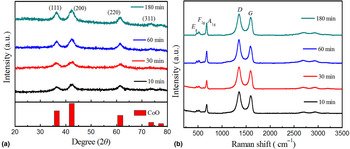
The effect of heating time on the crystallinity of CoO/rGO was first evaluated. Figure 1(a) shows the x-ray diffraction (XRD) patterns of CoO/rGO fabricated at 450 °C and various calcination times in nitrogen. Several XRD peaks located at 36.44°, 42.24°, and 61.39° 2θ, which correspond to (111), (200), and (220) diffraction planes of CoO, are noted in all samples.[ Reference Fu, Chang, Shangguan, Tang, Li, Chang, Yuan and Wang 28 ] Another low intensity of (311) peak at 73.63° 2θ appears only after 180 min of heating. It is important to note that the intensity and crystallinity of CoO are improved gradually with the increase in calcination duration, suggesting the formation of highly oriented lattice planes of nano-dimensional CoO particles. It is also noted that peak corresponding to GO and rGO are absent in all CoO/rGO hybrids, presumably attributed to the complete reduction of GO and presence of well exfoliated nanoplatelets of rGO in the hybrids.[ Reference Zhu, Huang, Gan, Tao, Xia and Zhang 29 ] This result clearly indicates the successful formation of homogeneous CoO/rGO hybrids developed in this study.
The (a) XRD patterns and (b) Raman spectra of CoO/rGO nanocomposites fabricated at various heating times ranging from 10 to 180 min.

Raman spectra of CoO/rGO nanohybrids prepared at various heating times were also recorded to confirm the formation of CoO and rGO as well as to determine the structural changes of nanohybrids. As shown in Fig. 1(b), the Raman spectra show several peaks below 800 cm−1 arising from the existence of CoO nanoparticles. The peaks appearing at 466 and 678 cm−1 are attributed to the E g and A 1g modes of vibrations of CoO, while a weak peak centering at 611 cm−1 is assigned to the F 2g active mode of CoO.[ Reference Guan, Cheng, Li, Wang, Huang, Nie and Ni 30 ] It is noteworthy that the intensity of these peaks increases upon increasing calcination time, presumably attributed to the improvement on crystal structure of CoO nanoparticles, which is in good agreement with the results obtained from XRD patterns [Fig. 1(a)].
In the high wavenumber region, the characteristic D and G peaks bands of rGO can be clearly observed at 1348 and 1593 cm−1, respectively. The D band is attributed to the A 1g phonon vibrations arising from the defect sites, while G band mainly contributed from the E 2g phonon mode of C = C in plane vibrations of sp 2 graphitic backbone.[ Reference Yang, Zang, Sun, Zhao and Cheng 31 ] The Raman spectra in all the CoO/rGO nanohybrids show that the intensity of D band is higher than that of G band, indicating the restoration of rGO fragments due to the removal of oxygenated functional groups. The shift in G bands to the higher wavenumber is also observed when the calcination duration increases from 10 to 180 min, which is attributed to the increment in interaction between rGO nanosheets and CoO nanoparticles. The I D/I G ratios of CoO/rGO hybrids are all higher than unity, confirming the presence of reduced graphene oxide in the hybrids.
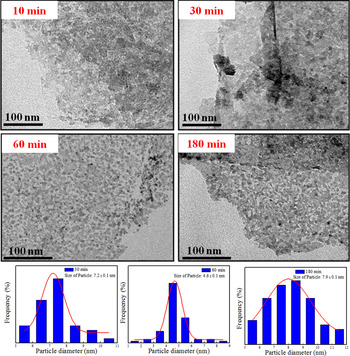
The effect of calcination duration on the dimension and morphology of CoO nanoparticles was further examined. A uniform and homogeneous particles size distribution is always desirable for better electrochemical performance and stability. It can be seen from the TEM images, as shown in Fig. 2, that the CoO nanoparticles onto rGO nanosheets are not completely formed at 10 min of calcination, indicating that short calcination time cannot provide sufficient thermodynamically favorable reaction for alignment of crystal phases in proper orientations. The increase in calcination time to 30 min can trigger the formation of CoO nanoparticles. However, the aggregated structures of CoO in some regions suggest that homogeneity is not achieved.
TEM images and particle size distribution of CoO/rGO hybrids fabricated at various calcination times ranging from 10 to 180 min at 450 °C in N2.

Interestingly, the TEM image recorded on CoO/rGO nanohybrids after 60 min of calcination shows that the ultrafine CoO nanoparticles are well formed and homogeneously distributed over the rGO nanosheets. In addition, the particle size of CoO calcined at 450 °C for 60 min can obtain a narrow-sized distribution pattern. The histogram shows that the CoO nanoparticles calcined at 30 min is in the range of 5–10 nm with mean particle size of 7 nm. The increase in calcination time to 60 min narrows down the particle size of CoO to 4–6 nm with average size of 4.5 nm. The formation of such homogeneous architecture of size distribution would lead to the high mechanical stability of CoO/rGO hybrids for excellent electrochemical performance at high-current density. In addition, such homogenous distribution also favors the fast electron transport through the hybrids. However, when CoO/rGO hybrid is further calcined at the prolonged period of 180 min, the CoO nanoparticles are segregated as big aggregates with the change in particle size toward in-homogeneity. Such aggregation is not beneficial for mechanical stability of CoO/rGO hybrids during consecutive charge/discharge cycling, which may lead to the decrease in electrochemical performance.
The nitrogen adsorption–desorption isotherm and pore size distribution of the nanomaterials synthesized at various calcination times are shown in Fig. 3. All the CoO/rGO nanohybrids exhibit type IV isotherm with hysteresis loop in the relatively pressure range of 0.6–0.97, clearly indicating the presence of mesopores in the material. In addition, the specific surface area of CoO/rGO hybrids increases with the increase in calcination duration. The surface area of 75.8 m2/g is achieved after 10 min and increases to 86.9 m2/g after 60–180 min of calcination. The increase in surface area can be attributed to the decrease in CoO nanoparticle dimension as well as the increase in their uniformity. However, further increase in calcination duration to 180 min does not improve the surface area because of the aggregation of CoO nanoparticles over rGO nanosheets. The resulting pore size distribution illustrated in the inset of figure clearly shows the average pore diameter of about 3.6 nm with a maximum pore volume of 0.027 cm3/g in all cases, which can be contributed from the voids of inter-particle of CoO and the gaps between rGO nanosheets and anchored CoO nanoparticles.
The nitrogen adsorption–desorption isotherms and pore size distribution of CoO/rGO nanohybrids calcined at 450 °C and at various calcination times ranging from 10 to 180 min.

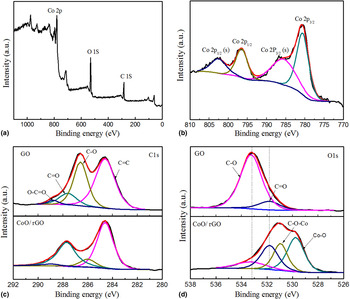
The successful reduction of graphite oxide to rGO and formation of CoO/rGO has also been confirmed by x-ray photoelectron spectroscopy (XPS). The full survey of CoO/rGO nanohybrids shown in Fig. 4(a) confirms the presence of C 1s, O 1s, and Co 2p at 284.06, 530.2, and 780.6 eV, respectively. The deconvolution of Co 2p peak shows two major CoO peaks at 780.6 and 796.5 eV [Fig. 4(b)], which can be attributed to Co 2p 3/2 and Co2+ 2p 1/2, respectively.[ Reference Guan, Cheng, Li, Wang, Huang, Nie and Ni 30 ] In addition, two satellite peaks are clearly observed, which confirm the presence of coordination of Co2+ to oxygen anion (CoO). The details of C1s spectrum also confirm the presence of various oxygenated bonds containing C–O (286.5 eV), C = O (287.6 eV), O–C = O (288.8 eV) and C = C (284.6 eV) [Fig. 4(c)]. The peak intensity arising from oxygenated functional groups are reduced considerably after the formation of CoO/rGO nanohybrids, suggesting the reduction of graphite oxide to rGO.[ Reference Sun, Hu, Luo and Huang 25 ] In addition, the O 1s spectra of CoO/rGO nanohybrids after deconvolution show the contribution from Co–O bonding at 529.7 eV and C–O–Co at 531 eV [Fig. 4(d)]. This further confirms that CoO is the main metal oxide and the generated CoO nanoparticles are closely anchored onto the surface of rGO to form CoO/rGO nanohybrids.[ Reference Guan, Cheng, Li, Wang, Huang, Nie and Ni 30 ]
(a) XPS survey scan and deconvulated spectra for (b) Co 2p, (c) C 1s, and (d) O 1s peaks in CoO/rGO nanohybrids.

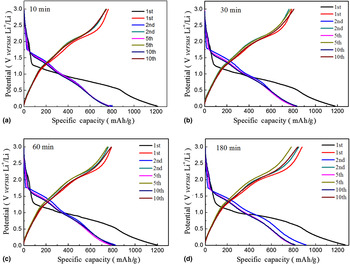
From the surface characterization, it is clear that CoO nanoparticles becomes more crystallized and homogenous when the Co2+ precursors and GO are simultaneously reduced by NaBH4 and then calcined at 450 °C in N2 from 10 to 60 min. Upon increasing the calcination duration to 180 min, CoO aggregates are produced onto the rGO surface, which suggests CoO/rGO calcined at 60 min may exhibit excellent electrochemical performance on Li storage. To evaluate the electrochemical properties of CoO/rGO nanohybrids, galvanostatic charge/discharge measurements were performed in the potential window of 0.5–3 V. Figure 5 shows the charge–discharge profiles of the initial 10 cycles at a current density of 150 mA/g. During the discharge cycle of CoO/rGO nanohybrids, the specific capacity slowly increases with the decrease in potential from 3 to 1.2 V because of the formation of Li x CoO. It also can be seen that the slope of discharge curve decreases gradually with the increased specific capacity between 0.5 and 1.2 V, which can be attributed to the further reduction of CoO. At 1.2 V, the reduction of CoO to zero-valent Co occurs with simultaneous storage of charge and Li ions and formation of solid electrolyte interface (SEI) layer.[ Reference Poizot, Laruella, Grugeon, Dupont and Tarascon 32 , Reference Zhang 33 ] The further decrease in the potential range of 0.5–0.7 V still can reduce CoO with the formation of polymeric gel. In addition, the stability of the discharge profile below 0.5 V is low, presumably attributed to the decomposition of the electrolyte. It is also important to note that an extended slope below 0.25 V is observed in all the initial charge–discharge profiles of CoO/rGO hybrids. This can be attributed to the additional uptake of Li+ ions by rGO sheets, and subsequently enhances the specific capacity of CoO/rGO.[ Reference Zhang, Wang and Jia 34 ]
Galvanostatic charge–discharge profiles after 1st, 2nd, 5th, and 10th cycles of CoO/rGO hybrids after (a) 10, (b) 30, (c) 60, and (d) 180 min of calcination at a current density of 150 mA/g.

For the charging cycle, lithium ions and electrons get transferred from CoO/rGO into the electrolyte solutions through the external circuit. It can be seen from Fig. 5 that a constant plateau with gradual increase in specific capacity is observed between the potential range of 2.0 and 2.3 V, which may be attributed to the decomposition of CoO and formation of Co2+ ions.[ Reference Laruelle, Grugeon, Poizot, Dolle, Dupont and Tarascon 35 ] In electrochemistry, the reversible redox reactions occur when the response toward applied potential is identical during the cycling. However, it is also noticed that the potential for oxidation of CoO takes place is high compared with that of reduction and there exists a 1-V potential difference between the oxidation and reduction cycles. For CoO/rGO nanocomposites calcined at various heating times, the initial discharge capacity of nanocomposites increase form 1172 mAh/g at 10 min to 1268 mAh/g at 180 min. In addition, charge capacity of CoO/rGO calcined at 180 min is 879 mAh/g, which corresponds to the coulombic efficiency of 70% for the first cycle. The coulombic efficiency can be further improved to above 95% after 2nd cycle with the decrease in discharging capacity. In addition, the CoO/rGO obtained after 60 min of calcination exhibits better specific capacity and coulombic efficiency after 2nd discharge cycling because of the ultra-small particle size of CoO and homogenous dispersion onto rGO surface. Interestingly, during the second discharge cycle, a stable platform is observed in the potential range of 1.0–1.5 V, which is attributed to reduction of cobalt oxide to zero valent Co.
Figure 6(a) represents the rate capability measurements at various current densities from 150 to 2400 mA/g. At the low-current density of 150 mA/g, the rate of electrochemical reaction is slow, which allows more electrons and lithium ions to diffuse into the hybrids in high scale. This provides an adequate time for nanohybrids to attain maximum specific capacity up to 800 mAh/g for CoO/rGO, which is similar to the CoO/rGO nanohybrids prepared at various calcination times. When the current density increases from 150 to 300, 600, 1200, and 2400 mA/g, the capacity in all CoO/rGO hybrids decreases gradually. For CoO/rGO hybrids obtained after 60 min of calcination, the specific capacity decreases from 820 mAh/g at 150 mA/g to 520 mAh/g at 2400 mA/g. The specific capacity recovers instantly to about 900 mAh/g when the current density is reverted to 150 mA/g, which is superior or comparable with the reported data.[ Reference Guan, Wang, Li, Zhi, Zhai, Bando and Golberg 21 – Reference Kartick, Yeh, Chou, Chang and Doong 26 ] This result clearly indicates that the CoO/rGO nanohybrids calcined at 450 °C for 60 min is an excellent electrode material with suitable particle size and homogeneous dispersion of CoO nanoparticles onto rGO. The nanohybrids calcined at 180 min also shows similar rate capability, but the capacity is only 845 mAh/g when the current density is again back to 150 mA/g. The relatively low specific capacity compared to that of CoO/rGO calcined at 60 min may be due to the aggregation of CoO nanoparticles onto the rGO nanosheets. It is also noted that the CoO/rGO nanohybrids obtained after 10 and 30 min of calcination show low specific capacity at high-current density of 1200–2400 mA/g compared with those for 60 and 180 min. Since the diffusion of lithium ions into the nanomaterials is highly related to the morphology and crystallinity,[ Reference Kartick, Yeh, Chou, Chang and Doong 26 ] the low capacitance at short calcination time is attributed to the low crystallinity of CoO nanoparticles. In addition, rGO also plays a vital role in sustaining the performance of CoO/rGO at high rates. The rGO sheets act as a buffering matrix which maintains the mechanical integrity of the anode material during cycling. Moreover, the extra Li+ ion uptake by rGO leads to an increased specific capacity, confirming the synergistic effect between CoO and rGO.[ Reference Zhang 33 – Reference Laruelle, Grugeon, Poizot, Dolle, Dupont and Tarascon 35 ]
(a) Rate capability of CoO/rGO nanohybrids prepared at various calcination times from 10 to 180 min at various current densities, (b) retention of capacitance as a function of current density, and (c) IR drop of CoO/rGO prepared at various calcination times from 10 to 180 min.

The retained ratio of specific capacity as a function of current density is illustrated in Fig. 6(b). The CoO/rGO prepared at 10 and 30 min of calcination can only retain 36–40% of specific capacity at 2400 mA/g, while 56–58% of specific capacity can be maintained at the same high-current density when CoO/rGO is calcined for 60 and 180 min. In addition, the comparison between the electrode conductivity of the materials can be compared by using the IR drop. Figure 6(c) shows the IR drop of CoO/rGO prepared at various calcination times from 10 to 180 min. During the heating time between 10 and 60 min, the slope of IR drop decreases from 0.13 to 0.07, which represents the increase in conductivity of CoO/rGO nanomaterials. The decrease in slope is mainly attributed to the increase in homogeneity and crystallization of CoO, leading to the easy transport of electrons and Li ions in CoO/rGO nanohybrids. When the heating time is up to 180 min, however, the slope of IR drop slightly increases to 0.09 because of the formation of larger particle size of the CoO/rGO nanomaterials. These results clearly show that crystallinity and particle size play a crucial role in determination of electrochemical performance of CoO/rGO nanocomposites for LIB application and the well-crystallized ultrafine CoO nanoparticle is suitable for rapid Li ions and electrons transport to enhance the electrochemical performance of Li storage.
Conclusions
In this study, we have demonstrated a simple and facile route to prepare CoO/rGO nanocomposites for LIB applications. The homogenously ultrafine CoO nanoparticles at 4–6 nm can increase the accessibility of electrons and Li ions to CoO/rGO nanohybrids. The electrochemical studies show that the CoO/rGO nanohybrids can exhibit high specific capacity of 1268 mAh/g in the initial cycle and the coulombic efficiency can be improved with the increase in calcination duration from 10 to 60 min. In addition, CoO/rGO hybrids exhibit high specific capacity of 520 mAh/g at a high-current density of 2400 mA/g and the rate capacity can be recovered to 900 mAh/g at 150 mA/g after 60 cycles. Results obtained in this study clearly demonstrate the excellent electrochemical performance of CoO/rGO nanocomposites and can open a gateway to fabricate metal oxide/rGO nanocomposites as the electrode materials for high-performance LIB applications.
Acknowledgements
The authors thank the Ministry of Science and Technology (MOST), Taiwan for financial support under grant numbers MOST 104-2221-E-009-020-MY3 and 105-2113-M-009-023-MY3. K. B. would also like to thank National Chiao Tung University, Taiwan for providing a platform to perform this work.