INTRODUCTION
Multiple plant groups have evolved poricidal anthers where pollen is released via specialized vibration by ‘buzz-pollinators’. Buzz-pollination has evolved multiple times in bees (Michener Reference MICHENER2007), and appears to represent the evolution of plant–bee mutualisms (Fenster et al. Reference FENSTER, ARMBRUSTER, WILSON, DUDASH and THOMSON2004) which benefit bees by reducing the number of competing pollinators, and benefits plants by encouraging more directed pollen delivery to conspecifics (de Luca & Vallejo-Marín Reference DE LUCA and VALLEJO-MARÍN2013).
Plants that require buzz-pollination may be curtailed in their dispersal abilities into new regions where buzz-pollinators are not present and if suitable pollinators do not co-disperse with them. Remote islands present situations where these barriers to dispersal can be examined because: (1) dispersal distances can be very substantial, and (2) remote islands generally have depauperate pollinator diversity (Olesen et al. Reference OLESEN, ESKILDSEN and VENKATASAMY2002) which may not include buzz pollinators. The flip side of this constraint occurs when both plants and their pollinators co-disperse, and can then form an ‘invader complex’. However, Olesen et al. (Reference OLESEN, ESKILDSEN and VENKATASAMY2002) did not find evidence for invader complexes and instead argued that the success of invading plants was due to endemic pollinators having evolved into ‘super-generalists’. Super-generalism is expected to be common in island pollinators because low pollinator diversity leads to low interspecific competition, large pollinator population sizes and, consequently, wide floral niches (Olesen et al. Reference OLESEN, ESKILDSEN and VENKATASAMY2002).
In Fiji 11 species of Solanum are recorded, but only four are likely to be indigenous, viz. S. repandum, S. inamoenum, S. viride and S. polynesicum (Smith Reference SMITH1988). There are no studies to indicate the phylogenetic relationships of these species or when they colonized Fiji, but their combined distributions range from sea level to >1100 m asl (Smith Reference SMITH1988), suggesting Solanum have been a long-term floristic element in Fiji. Of the introduced species, Solanum torvum (Solanaceae) is now locally common (Meyer Reference MEYER and Sherley2000, Whistler Reference WHISTLER1995), but has poricidal anthers that require buzz-pollination (Liu & Pemberton Reference LIU and PEMBERTON2009).
Fiji has an especially low number of endemic bees, with only four described species, all in the halictine genus Homalictus, which does not buzz-pollinate (Groom & Schwarz Reference GROOM and SCHWARZ2011, Michener Reference MICHENER1979). Of these, only H. fijiensis occurs in lowland regions (<800 m asl) where it is highly abundant (Groom et al. Reference GROOM, STEVENS and SCHWARZ2013). Arguments put forward by Olesen et al. (Reference OLESEN, ESKILDSEN and VENKATASAMY2002) suggest that for islands with low pollinator diversity, pollinators should evolve into super-generalists. We therefore expect Homalictus to have evolved the ability to exploit a very wide range of floral hosts. Here we examine whether the floral breadth of Homalictus extends to the introduced weed Solanum torvum, which requires buzz pollination.
MATERIALS AND METHODS
Study species
Solanum torvum (Solanaceae) is native to the Caribbean but now has a pantropical distribution as an invasive weed (Lim Reference LIM2013). It was first recorded in Fiji in the 1860s, and declared a noxious weed in 1926 (Parham Reference PARHAM1958). It is locally common to abundant in disturbed areas such as roadsides and pastures up to 900 m asl (Meyer Reference MEYER and Sherley2000, Whistler Reference WHISTLER1995) and has also impacted native vegetation in Fiji (Tuiwawa Reference TUIWAWA2005). Solanum torvum is a nectarless perennial shrub with poricidal anthers that require buzz-pollination, and when pollinators are excluded seed set does not occur (Liu & Pemberton Reference LIU and PEMBERTON2009). In its native range, buzz-pollinating euglossine bees have been recorded as pollinators (Villanueva-Gutierrez et al. Reference VILLANUEVA-GUTIERREZ, QUEZADA-EUAN and ELTZ2013). In Florida, where S. torvum is an introduced weed, it receives visits from Augochloropsis sp. and Lasioglossum sp. (Halictidae), and from Xylocopa micans, Euglossa viridissima and Bombus impatiens (Apidae) (Liu & Pemberton Reference LIU and PEMBERTON2009). These bees are all buzz-pollinators, but the halictids have low pollination efficacy due to small body size (Liu & Pemberton Reference LIU and PEMBERTON2009).
Study site and collection methods
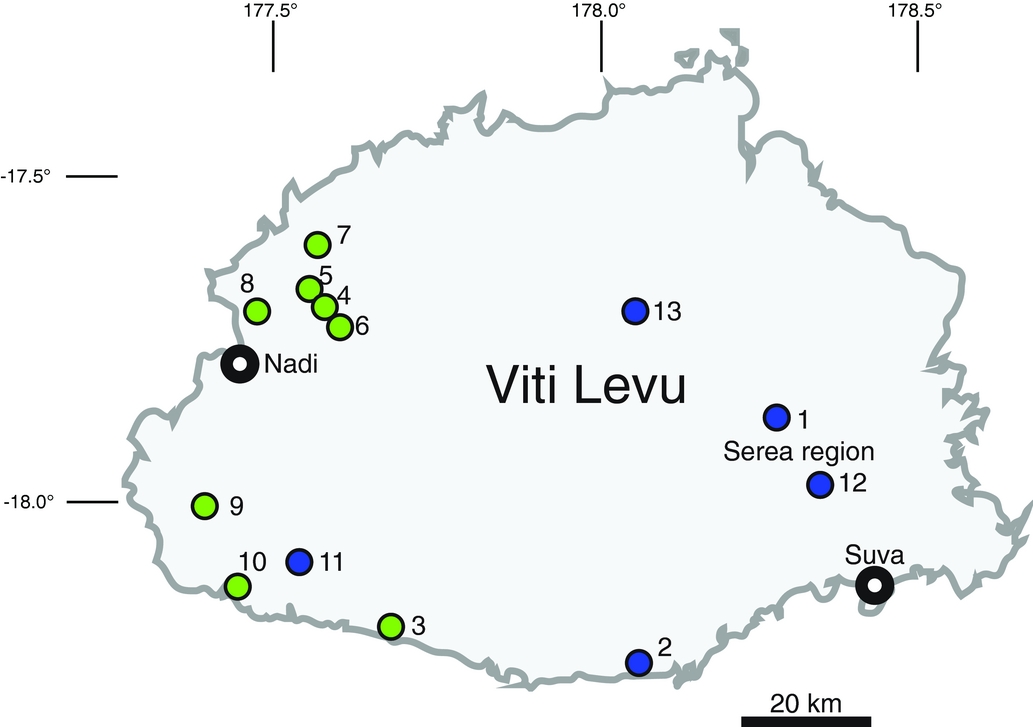
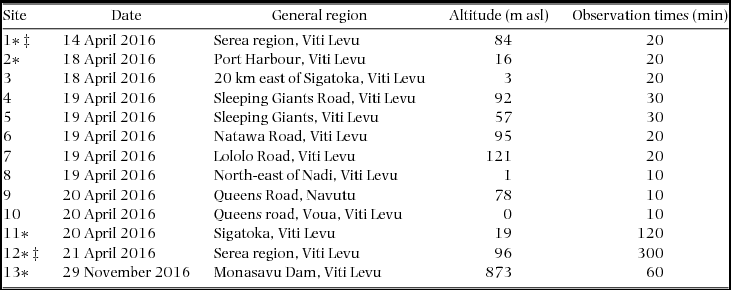
Flowers of S. torvum were observed on Viti Levu at 12 lowland (< 800 m asl) sites at the end of the wet season (Mataki et al. Reference MATAKI, KOSHY and LAL2006), and one highland site (> 800 m asl) at the end of the dry season (Figure 1, Table 1). Observation times varied between sites, ranging from 10 to 120 min, with some observations being curtailed by the onset of rain and, for the Serea region, extended by collection of H. fijiensis specimens for pollen load analyses. The total observation period across all sites was 670 min.
Map of Viti Levu showing field sites where Solanum torvum were examined for the presence of insect visits to flowers. Sites where Homalictus fijiensis were observed to visit S. torvum are given by blue circles, and absence of observed visits by green circles. Refer also to Table 1.

Locations in Viti Levu where Solanum torvum flowers were examined for visits by bees. Observation times represent total time that flowers were observed for bee visits, but the number of flowers under observation varied for each site depending on S. torvum density and flowers per bush. Asterisks indicate sites where Homalictus fijiensis was observed to visit S. torvum flowers, and ‡ indicates sites H. fijiensis was collected for pollen load analyses. See Figure 1 for site locations.

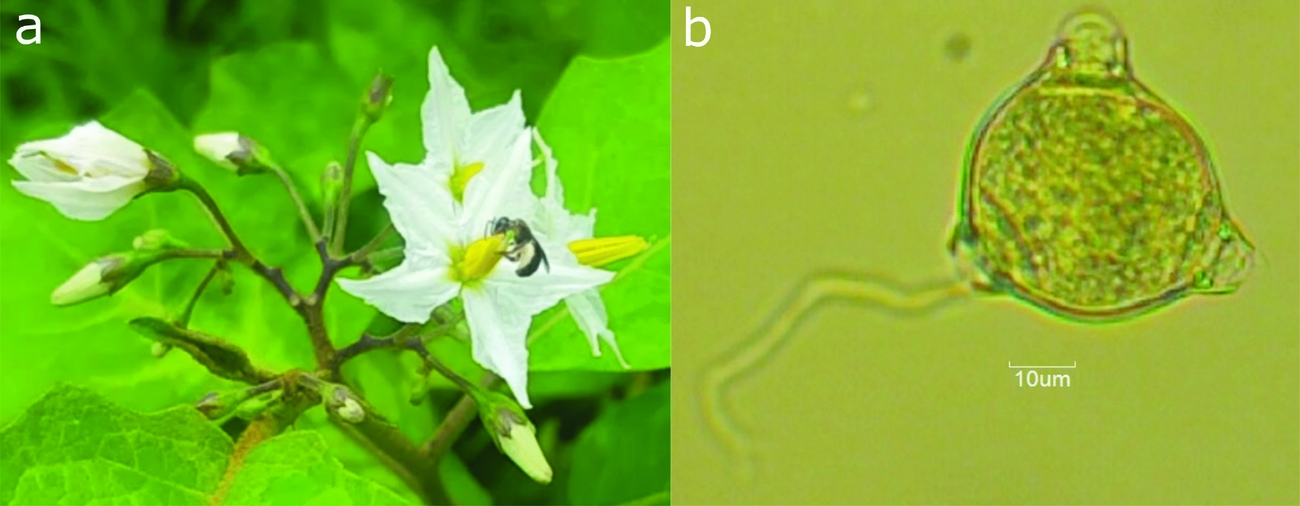
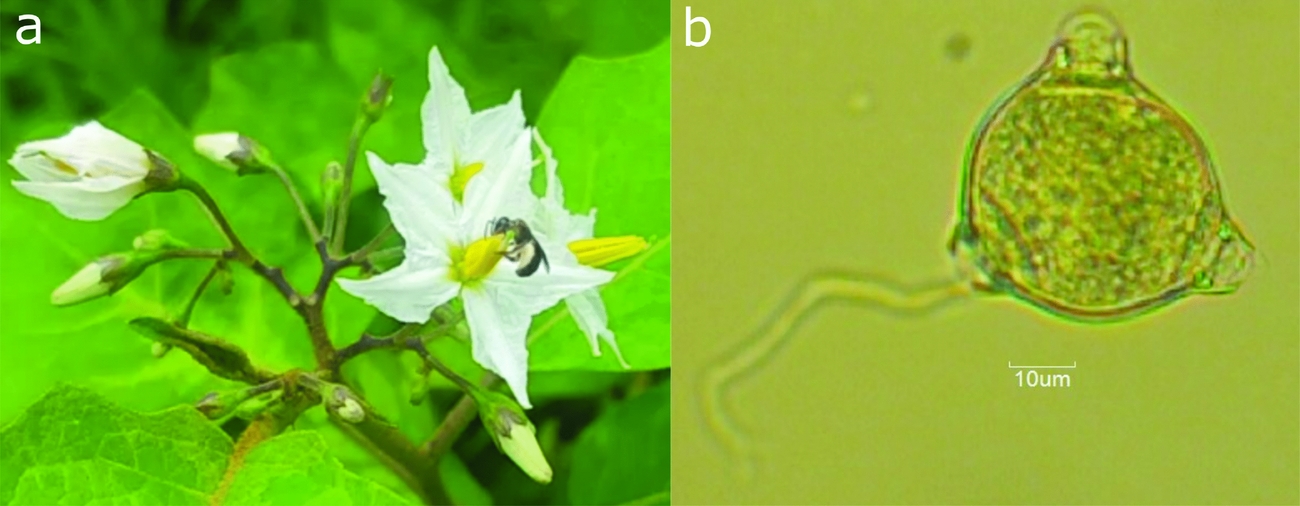
Homalictus fijiensis was the only bee observed visiting S. torvum (see Figure 2a). Homalictus fijiensis individuals that were attending S. torvum flowers were collected in the Serea region for pollen load analyses (Table 1). Females were caught with sweep nets or using our fingers whilst they were on flowers. Catching bees using fingers was easy and the bees often appeared to be unaware of our close presence when they were mandibulating anther tips. Bees were immediately placed in individual 2.5-ml vials of 99% ethanol for pollen load analyses.
Flowers of Solanum torvum with Homalictus fijiensis chewing at anther tips (a); S. torvum pollen grain with a sprouting pollen tube, taken from a H. fijiensis pollen load (b).
Pollen loads
Thirty specimens of H. fijiensis from S. torvum flowers were haphazardly chosen for analyses of pollen loads where bee activity was high (Table 1). Vials containing individual bees in ethanol were vigorously shaken and 30-μl aliquots pipetted into a hemocytometer for counting at 200× magnification. Pollen grains were identified as either S. torvum or ‘other’, where S. torvum pollen was identified by its characteristic size and shape (Figure 2b). Pollen grains were counted with a series of zig-zag transects across the hemocytometer until a minimum of 100 pollen grains were counted. Where pollen density in the hemocytometer was high, counting was finished at the completion of a transect to avoid arbitrary cessation of counts when multiple grains were in the field of view. If pollen counts were very low we used a total of three 30-μl aliquots for hemocytometer counts and this led to four samples with less than 100 pollen grains counted.
RESULTS
Homalictus fijiensis was observed visiting S. torvum flowers at five sites in Viti Levu (Figure 1). Sites where visitation was observed ranged from 5–873 m asl and from coastal to inland regions (Table 1). Visits of H. fijiensis were concentrated to anther tips and involved chewing stamen tips (Figure 2a), and mandibulating and moving the metasoma over styles in hermaphroditic flowers. Examples of video recorded visits to flowers showing these behaviours are given in the Supplementary Material. We never observed vibrating behaviours that could suggest buzz pollination. Anther tips of flowers that had been visited by H. fijiensis showed signs of damage exposing the interior lumens of anthers. We found no evidence of H. fijiensis attempting to access nectar at the bases of petals or stamens where nectaries might otherwise be expected for other angiosperms.
Apart from H. fijjiensis, the only other insect visitors to S. torvum flowers comprised two butterfly visits (both unidentified Lycaenidae species) and two weevils (Curculionidae). Neither of these visitors was observed attempting to remove pollen from anthers.
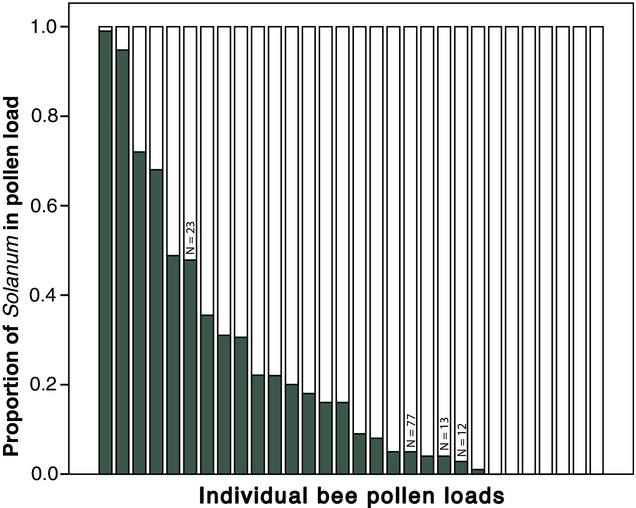
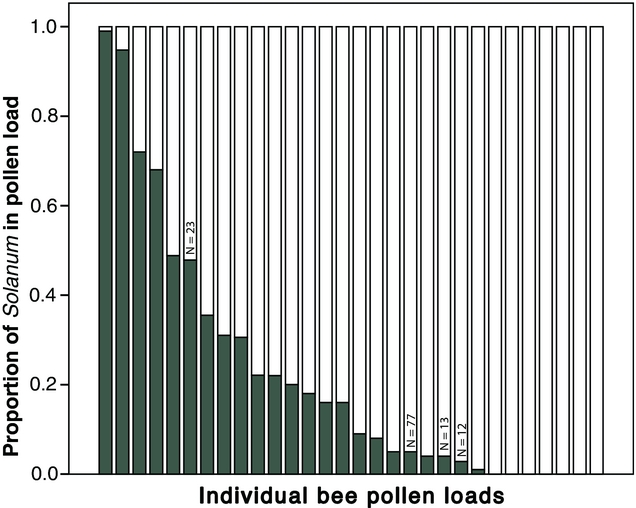
The proportion of Solanum pollen from 30 H. fijiensis females collected on S. torvum flowers is summarized in Figure 3. Of the 30 pollen loads that were analysed, six did not contain Solanum pollen and four comprised >50% Solanum pollen. Another four pollen loads contained fewer than 100 pollen grains in 90-μl aliquots of ethanol, suggesting that some females had recently begun pollen collection. The mean ± proportion of S. torvum among all loads was 0.227 ± 0.052 SEM. Interestingly, some pollen grains showed pollen tube growth (Figure 2b), suggesting they had been collected from pistils and were at the early stages of fertilization.
Bar graph showing the proportion of Solanum torvum pollen grains counted in a hemocytometer from 30 pollen loads of Homalictus fijiensis. Counts are based on a minimum of 100 pollen grains per sample, except for four samples where less than 100 pollen grains were observed from 90-μl aliquots (number of pollen grains for these samples are indicated within bars).
DISCUSSION
Homalictus fijiensis was never observed attempting to retrieve nectar from Solanum torvum (which lacks nectaries). Instead, individuals restricted activity to the tips of anthers, which they chewed, and to styles in hermaphroditic flowers which they crawled over, leading to contact between their metasomal scopae and styles. We did not observe any behaviours that suggested buzz-pollination. Pollen loads from H. fijiensis show that this bee is a vector of S. torvum pollen and that S. torvum can be a significant component of this bee's pollen diet. The presence of some pollen grains with pollen tube growth in bee pollen loads suggests they had previously been transported to the styles and were in the process of fertilization.
Anther-biting behaviour for poricidal flowers has been observed in tropical eusocial meliponine bees, which are the only known bees that chew through anther tips to access pollen (Hargreaves et al. Reference HARGREAVES, HARDER and JOHNSON2009, Renner Reference RENNER1983). In many instances of nectar larceny, bees damage the plant by piercing the corolla tube (Solis-Montero et al. Reference SOLIS-MONTERO, VERGARA and VALLEJO-MARIN2015), but pollen larceny that causes damage is less studied and less common (Solis-Montero et al. Reference SOLIS-MONTERO, VERGARA and VALLEJO-MARIN2015). Pollen larcenists have mostly been observed to bypass sexual organs, rather than destroying anther tissue to access pollen (Hargreaves et al. Reference HARGREAVES, HARDER and JOHNSON2009). Importantly, Homalictus species transport pollen on metasomal scopae and these contact the stigma on hermaphroditic flowers as bees walk over exerted styles.
The behaviour of H. fijiensis on S. torvum flowers appeared to be quite specialized, without any attempt at nectar retrieval and with intensive chewing of anther tips, suggesting an evolved strategy for dealing with solanaceous flowers. Solanum torvum has been recorded in Fiji since 1860 (Parham Reference PARHAM1958) and whilst that could potentially provide enough evolutionary time for such specialized foraging behaviour to evolve, this seems unlikely. Instead, it is possible that this behaviour evolved over a longer timeframe via interactions with the indigenous Solanum species in Fiji. Such a possibility is not unlikely, given that H. fijiensis is the only endemic bee species in lowland Fiji and is highly abundant, which could promote the ability to exploit a wide range of pollen resources (Olesen et al. Reference OLESEN, ESKILDSEN and VENKATASAMY2002). Unfortunately, we were unable to locate indigenous Solanum species, so the behaviour of H. fijiensis on these species is unknown.
Our findings have two major implications: (1) they suggest that the evolution of super-generalism in floral use by H. fijiensis (Hayes Reference HAYES2016) has extended to the ability to exploit floral morphologies that normally require buzz-pollination behaviour; and (2) if H. fijiensis is able to effect pollination in solanaceous plants, this might help explain the highly invasive nature of S. torvum in Fiji despite the lack of indigenous buzz-pollinators.
In a study on two oceanic islands in the Atlantic, Olesen et al. (Reference OLESEN, ESKILDSEN and VENKATASAMY2002) did not find evidence for plant-pollinator invader complexes, but instead they suggested that super-generalist endemic pollinators promoted the spread of invasive plants. Our results suggest a similar situation for Fiji, where a super-generalist has evolved the ability to exploit poricidal flowers that otherwise require buzz-pollination for both autogamy and out-crossing. Further studies are needed to explore the potential for super-generalist pollinators in island ecosystems to extend their host range, and the consequences of this for ecosystem assembly.
Supplementary material
To view supplementary material for this article, please visit https://doi.org/10.1017/S0266467417000098
Supplementary video. Video of Homalictus fijiensis visting Solanum torvum flowers in the Serea region of Viti Levu, Fiji. Video shows bees visiting both staminate and hermaphroditic flowers and mandibulation of both anthers and exerted styles.
ACKNOWLEDGEMENTS
We thank the Australia Pacific Science Foundation and the Australian Federal Government New Colombo Plan for funding that allowed this work to be carried out. We thank two anonymous reviewers for very helpful suggestions on earlier versions of the manuscript.