Rheumatic heart disease continues to be a cause for premature and preventable morbidity and mortality in developing countries. It is estimated that 32.9 million people worldwide are affected, with some suggesting that this may be significantly underestimated.Reference Vos, Barber and Bell 1 , Reference Weinberg, Beaton, Aliku, Lwabi and Sable 2 Screening children with echocardiography for rheumatic heart disease, to identify affected children early in the disease process, has been shown to be superior to auscultation and clinical evaluation for the detection of valvular abnormalities related to rheumatic heart disease.Reference Marijon, Ou and Celermajer 3 – Reference Marijon, Celermajer and Tafflet 7 Early detection allows administration of prophylactic therapy before the development of significant valve disease. Differentiating physiological regurgitation from the early stages of rheumatic heart disease has been difficult and is critical, as those with rheumatic heart disease in the early stages would potentially receive the greatest benefit from prophylactic antibiotic therapy.Reference Tompkins, Bocerbaum and Liebman 8 , Reference Kassem, el-Walili, Zaher and Ayman 9 As there is no gold standard for diagnosing early or subclinical rheumatic heart disease in children, guidelines for utilising echocardiography to screen children in countries endemic for rheumatic heart disease have been proposed and modified over time.Reference Marijon, Celermajer and Tafflet 7 , 10 , Reference Carapetis, Paar and Cherian 11 In 2012, the World Heart Federation published guidelines with the intent to “define the minimum echocardiographic criteria for the diagnosis of rheumatic heart disease” and “allow for consistent and reproducible echocardiographic reporting of rheumatic heart disease worldwide”.Reference Remenyi, Wilson and Steer 12 Data applying the World Heart Federation guidelines and imaging protocols used to diagnose rheumatic heart disease and determine the severity of diseases in endemic countries are limited; therefore, such studies have not been carried out in Samoa.Reference Beaton, Aliku and Okello 13 – Reference Enelman, Kdao and Remenyi 18
The aims of this study were to describe a rapid screening protocol for echocardiography, determine the severity of valve involvement, and determine the prevalence of definite and borderline rheumatic heart disease according to the World Heart Federation Guidelines among schoolchildren in Samoa.
Methods
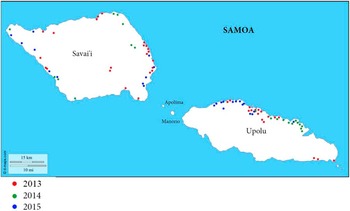
A total of 11,434 children were screened in Samoa during three annual visits between 2013 and 2015 on the islands of Upolu and Savaii (Fig 1). Studies were carried out on schoolchildren present on the day of screening aged 5–17 years during school hours. No previous clinical history was available at the time of screening. Screening was a collaborative effort between Rheumatic Rescue, a multi-disciplinary research and educational programme, the Samoan National Health Services, and Samoan Ministries of Health. The National Health Services selected the schools. We travelled to two to four schools a day and screened ~400–500 students/day, for a total of 28 days of screening, over the 3-year time period. Approval was obtained from the Utah Valley Institutional Review Board and the Samoan Ministry of Health, and consent was obtained according to Samoan protocol.
Locations in Samoa where echocardiography screenings were carried out separated by island and year of screening.

Basic demographic data including age, sex, and island were collected. A rapid screening echocardiogram protocol is defined as an initial brief screening echocardiogram for all students and a more comprehensive echocardiogram limited only to those with pre-determined abnormalities described below (Vivid I or a handheld V Scan; General Electric, Milwaukee, Wisconsin, USA). Sonographers performed ~60 screening echocardiograms per hour. Support staff from the university and National Health Services assisted children by adjusting clothing, helping them get on and off the examination table, and recorded preliminary findings. The rapid screening protocol entailed a parasternal long-axis view, focussed on the mitral and aortic valves with and without colour Doppler for each student. A total of four experienced sonographers performed all studies. A more comprehensive echocardiogram was performed on any student with a mitral regurgitant jet >1 cm, any aortic regurgitation, significant chamber enlargement, or any suspicious finding discovered by the rapid screening echocardiogram. Students with no abnormalities or only closing volume regurgitation were considered normal. Among normal students, 49 were randomly selected as control subjects and underwent a more comprehensive study. Controls were used to determine whether differences in basic demographic data could be identified between the control population and those with borderline or definite disease. No attempt was made to determine the sensitivity and specificity of the rapid screening protocol. Those receiving the comprehensive echocardiogram had their height, weight, body surface area, and heart rate measured. The comprehensive echocardiogram consisted of two-dimensional parasternal long- and short-axis views of the left ventricle and aortic valve with and without colour Doppler. Apical views with and without colour Doppler of the mitral and aortic valves were obtained from the apical 2-, 4-, and 5-chamber views. Mitral stenosis was evaluated from the apical view using Doppler. Continuous-wave Doppler was used to image the mitral and aortic regurgitant jets. Severities of valvular abnormalities were determined by clinical judgement utilising standard quantitative and qualitative measures.Reference Nishimura, Otto and Bonow 19 Echocardiogram scanning parameters were set to those recommended by the World Heart Federation guidelines.Reference Remenyi, Wilson and Steer 12 Images were stored digitally for review and archived using Echo Pac (General Electric) software.
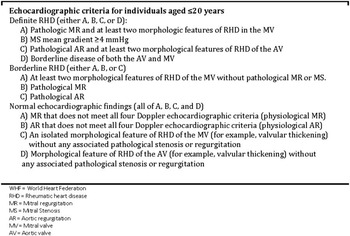
Completed comprehensive examinations were read either in the field at the time of acquisition or later using stored images. A single reviewer (J.W.A.) classified student echocardiograms as definite, borderline, or normal according to the 2012 World Heart Federation guidelines (Fig 2). Children with advanced diseases were classified separately, such as severe regurgitation of the mitral or aortic valve, two valve disease of the mitral and aortic valves, where one valve was at least moderate in severity, and any mitral stenoses. A subset of 60 student echocardiograms were selected and reviewed by an additional reviewer (M.R.A.) blinded to the original reviewer’s diagnosis and the selection of studies chosen to be reviewed. This was used to evaluate inter-observer agreement.
WHF criteria for echocardiographic diagnosis of RHD.

Children identified with definite or borderline rheumatic heart disease were referred to the Samoan National Health Services, and therapy was initiated according to local guidelines. These indigenous medical personnel were available at the time of screening to discuss results and arrange follow-up for affected children. Samoa has a national rheumatic heart disease programme for the delivery of penicillin and access to surgical services in New Zealand.
Statistics
The Kappa statisticReference Landis and Koch 20 was used to determine inter-observer agreement of classifying children according to the World Heart Federation criteria. The Kappa statistic was used to compare dichotomous classification outcomes across observers. In these analyses, the dichotomous classification consists of the outcome of interest – for example, the Kappa statistic “normal” means that the observers agrees that the patient is normal or is not normal; similarly, with borderline versus not borderline, etc.
We also performed Welch’s t-tests, because of the unequal sample sizes of the groups, to compare demographic data of those classified as definite or borderline compared with those classified as normal. The purpose of this analysis was to confirm the original assumption that there were no differences associated with these different demographic groups.
Results
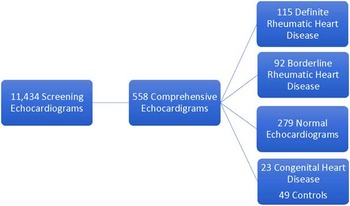
A total of 11,434 students were screened over 28 days, in a 3-year time frame, with a mean age of 10.2 years; 51.1% of them were females; and 55% of them were from the island of Upolu. Echocardiographic findings of 36% of the students demonstrated trivial, or greater, amount of stenosis or regurgitation – no distinction was made in differentiating closing volume regurgitant jets and physiological regurgitant jets <1 cm – and 558 (4.8%) were referred for a comprehensive echocardiogram. Among them, 23 (0.20%) were diagnosed with CHD – 19 with bicuspid aortic valves and four with other conditions – and were excluded from further analyses. Definite rheumatic heart disease was diagnosed in 115 students (10.0 per 1000, 95% confidence interval of 7.7–11.2), including six with previous mitral valve surgery for rheumatic heart disease, with 92 (8.0 per 1000, 95% confidence interval of 6.4–9.7) diagnosed as borderline rheumatic heart disease. The control group included 49 students (Fig 3).
Flow chart demonstrating the analysis of the screening echocardiograms.

A comparison of basic demographic data of all students screened, those selected for a comprehensive echocardiogram, those diagnosed as definite rheumatic heart disease or borderline rheumatic heart disease, and the control group is shown in Table 1. No statistically significant difference was observed with respect to age, sex, body surface area, heart rate, or island screened on between the definite or borderline and the normal groups.
Comparison of basic demographic data; means and standard deviation.

BSA=body surface area; HR=heart rate
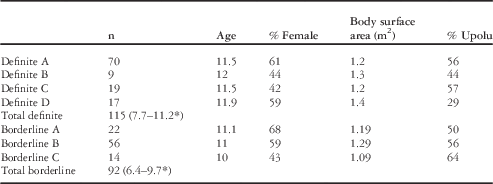
The World Heart Federation guideline sub-classifications are shown in Table 2, demonstrating that mitral regurgitation is the predominant valve lesion for both definite and borderline classifications. A substantial number of students had advanced disease: 20 (1.7 per 1000) children had severe mitral or aortic regurgitation, 11 (1.0 per 1000) had mitral stenosis, and 19 (1.7 per 1000) had mitral and aortic valve disease where at least one valve was moderate in severity.
Comparison of demographic data according to World Heart Federation classification subgroups.

Echocardiographic criteria for individuals aged ⩽20years
Definite rheumatic heart disease (either A, B, C, or D): A, pathological mitral regurgitation, at least two morphological features of rheumatic heart disease of the mitral valve; B, mitral stenosis; C, pathological aortic regurgitation, at least two morphological features of rheumatic heart disease of the aortic valve; D, borderline disease of both aortic and mitral valve
Borderline rheumatic heart disease (either A, B, or C): A, at least two morphological features of rheumatic heart disease of the mitral valve without pathological mitral regurgitation or mitral stenosis; B, pathological mitral regurgitation; C, pathological aortic regurgitation
* Confidence interval
The Kappa score for inter-reader agreement was 0.52 for normal, 0.66 for definite, and 0.29 for borderline, suggesting good agreement on classification for definite, moderate agreement for normal, but poor agreement for borderline students classified according to the World Heart Federation guidelines. Of cases where there was disagreement between reviewers, 53% were related to morphological features, 40% were related to Doppler abnormalities, and 7% were related to both morphological features and Doppler abnormalities.
Discussion
We describe a rapid echocardiographic screening protocol that applied the World Heart Federation guidelines to effectively screen 11,434 students in 28 days over a 3-year time period. Prevalence of definite rheumatic heart disease was 10.0 per 1000 children, and the prevalence of borderline rheumatic heart disease was 8.0 per 1000. A substantial number of students with advanced disease were identified.
Correct determination of the prevalence of rheumatic heart disease in developing countries is important to properly allocate medical and financial resources, as well as evaluate the success of protocols and therapies to limit disease progression. There is currently no gold standard for the diagnosis of subclinical rheumatic heart disease, and thus it is difficult to determine the true prevalence of rheumatic heart disease. Clinical and auscultation criteria were shown to be insensitive for detecting valve disease related to rheumatic heart disease.Reference Marijon, Ou and Celermajer 3 – Reference Marijon, Celermajer and Tafflet 7 The World Heart Federation Guidelines introduced the evaluation of morphological features of the valves suggestive of rheumatic heart disease, which were not included in previous guidelines. This affects the ability to compare studies using previous guidelines.Reference Remenyi, Wilson and Steer 12 It should be recognised that echocardiographic screening of children for rheumatic heart disease should only be considered in areas where reliable penicillin is available, trained medical personnel with adequate medical equipment are available to oversee the rheumatic heart disease programme, a system is in place for follow-up and delivery of monthly penicillin therapy, and there is ideal access to competent surgical services. Samoa has access to penicillin, has trained medical personnel, is currently upgrading its delivery system, and has an agreement with New Zealand for surgical services. Furthermore, five previous echocardiographic screening studies applying the World Heart Federation Guidelines have reported a prevalence rate for definite rheumatic heart disease ranging between 3.4 and 16.5 per 1000 and a prevalence rate for borderline rheumatic heart disease between 3.3 and 29.3 per 1000.Reference Colquhoun, Kado, Remenyi, Wilson, Carapetis and Steer 14 , Reference Beaton, Lu and Aliku 21 – Reference Shrestha, Karki and Mahto 24 Samoa’s prevalence of 10.0 per 1000 for definite rheumatic heart disease is similar to Uganda (10.9 per 1000),Reference Beaton, Lu and Aliku 21 Australia (8.6 per 1000),Reference Roberts, Maguire and Brown 22 and Fiji (8.4 per 1000).Reference Colquhoun, Kado, Remenyi, Wilson, Carapetis and Steer 14 . The reproducibility of diagnosing borderline rheumatic heart disease is challenging.Reference Bacquelin, Tafflet and Rouchon 25 There is a wider range of reporting the prevalence of borderline rheumatic heart disease (3.3–29 per 1000). Our estimates are similar to Fiji and close to those from Uganda. This may reflect a true difference in prevalence of both definite and borderline rheumatic heart disease, variations in interpretation and application of the guidelines, or variations in protocols.
In the routine clinical practice of caring for patients with valvular heart disease, assessment of severity – mild, moderate, or severe – is the standard for evaluating prognosis and need for therapy.Reference Nishimura, Otto and Bonow 19 The World Heart Federation guidelines use regurgitant jet length and presence of a complete Doppler envelope to diagnose significant valve regurgitation. This does not differentiate mild from severe cases. A child identified during echocardiographic screening who has more severe valve disease may be past the point of surgical repair, at increased risk for surgery, or have non-reversible structural changes that will increase the probability of future morbidity and mortality. We report a substantial number of children with advanced disease. Known cases were not excluded because of lack of clinical histories at the time of screening. This may increase the prevalence of disease compared with populations where known cases of acute rheumatic fever or rheumatic heart disease were excluded. This appears to be significantly higher than other studies, where generally no data are reported or are significantly less. Marijon et al studied 2170 children in Mozambique and reported 95% isolated mitral valve involvement and no cases of mitral stenosis or severe regurgitation.Reference Marijon, Celermajer and Tafflet 7 Roberts et al studied 3946 high-risk children in Australia, and identified three cases of mitral stenosis and a single case of severe regurgitation.Reference Roberts, Maguire and Brown 22 This variability may be explained by genetic differences,Reference Parks, Mirabel and Kado 26 environmental factors, a more virulent strain of streptococcus, or differences in reporting. We recommend that, even though not a part of the diagnostic criteria, assessment of severity of valve disease is crucial to fully understand and treat children screened for rheumatic heart disease. Long-term follow-up of children with advanced disease may be just as important as those with borderline rheumatic heart disease to determine whether they require a different treatment and follow-up protocol.
Rheumatic Rescue travels to Samoa on an annual basis to perform echocardiographic screening and to educate schoolchildren during school hours, over a 2-week period. To maximise the number of students we are able to screen and identify with rheumatic heart disease, we implemented a rapid screening examination, lasting ~60 seconds. This allowed us to screen twice the number of children over the same time period assuming a screening protocol of 2 minutes.Reference Mirabel, Fauchier and Bacquelin 15 Initial studies screening for rheumatic heart disease frequently performed a complete analysis on all children; however, with a low prevalence of disease, most investigators utilised a brief screening examination followed by a more comprehensive examination in those with suspicious findings.Reference Enelman, Kdao and Remenyi 18 , Reference Beaton, Lu and Aliku 21 – Reference Shrestha, Karki and Mahto 24 Protocols for the brief screening as well as the comprehensive echocardiogram vary for each investigator. Our rapid protocol identified a similar number of children with definite rheumatic heart disease, combined mitral and aortic valve disease, CHD, and mitral stenoses, suggesting that we did not overlook a significant number of children with these diagnoses.Reference Enelman, Kdao and Remenyi 18 , Reference Beaton, Lu and Aliku 21 – Reference Shrestha, Karki and Mahto 24 We had fewer number of children with borderline rheumatic heart disease. This may be explained by maximal regurgitant jets only seen from the apical views or missed from the parasternal views, because of rapid protocol differences in interpretation and application of the World Heart Federation guidelines or differing true prevalence rates. A simplified rapid screening protocol may also allow less-experienced sonographers to perform brief initial screening studies and to reduce the time demand on more experienced sonographers, allowing them to focus on the comprehensive echocardiograms.Reference Enelman, Kdao and Remenyi 18 Our rapid screening method may be more applicable in areas where large numbers of children need to be screened in a limited time period but could easily be adapted to year-round screening programmes. As many countries endemic for rheumatic heart disease have limited resources and trained medical personnel, a rapid screening over several days to weeks would allow visiting medical teams to maximise their efficiency. Owing to the low prevalence of disease, we did not determine the sensitivity of our rapid protocol compared with a comprehensive study. Standardised imaging protocols and further studies can help optimise protocols to balance accuracy with efficiency.Reference Nascimenti, Nunes and Lopes 27
Limitations
Our study was limited by the short time period for data collection. This could contribute to an underestimation of disease prevalence, particularly in the borderline group. The sample was a convenience sample consisting of all students in the target age group present in school at the time of screening. Students absent from school, who may be at increased risk for rheumatic heart disease, were not studied. No clinical information about past history of rheumatic heart disease, acute rheumatic fever, or other conditions was available. We did not have multiple readers to review each complete study; however, this reflects real-world practice. More readers will be needed to further assess the inter-observer variability.
Conclusions
We used a rapid echocardiographic screening protocol to apply the World Heart Federation guidelines and identified a high prevalence of definite rheumatic heart disease and a significant number of children with advanced rheumatic heart disease. These data need to be combined with other studies, including longitudinal studies, to better understand the optimal method and role of echocardiography in screening children for rheumatic heart disease.
Acknowledgements
None.
Financial Support
Individual staff donated time and paid for expenses with the assistance of private donors. Samoan National Health Services donated staff time.
Conflicts of Interest
None.
Ethical Standards
The authors assert that all procedures contributing to this study comply with the ethical standards of the relevant national guidelines on human experimentation and with the Helsinki Declaration of 1975, as revised in 2008, and has been approved by the institutional committees.