Why do states allow third-party actors to resolve their territorial claims—that is, official disputes regarding the sovereignty of land, river, and maritime areas? One broadly accepted answer involves domestic political cover. When claim resolution requires making domestically unpopular concessions, leaders can allow a third-party to decide a claim’s outcome, commit in advance to abide by the third-party’s decision, and therefore shield themselves from the necessary, unpopular concessions (e.g., removal from office). This need theoretically arises with respect to land, river, and maritime claims, and scholars believe it explains why many states employ arbitration in their claims’ management (Allee and Huth Reference Allee and Huth2006; Gent and Shannon Reference Gent and Shannon2010). Yet a puzzle emerges: within territorial claims, 89 percent of all arbitration efforts are focused on land claim management, while 0 and 11 percent address river and maritime claims, respectively.Footnote 1 Why does arbitration offer political cover in some contexts (e.g., land claims), but not others (e.g., river claims)?
An initial answer to this puzzle invokes claim salience. If river claims score lower in average salience than land claims, states would need political cover less often when managing river issues. The empirical data, however, undermine such a theory. States use arbitration to manage both low-salience and high-salience territorial claims.Footnote 2 Why would states select away from arbitration in all river claims and a qualitatively distinct subset of maritime claims (i.e., those not concerning an exclusive economic zone (EEZ))? The United States and Canada, for example, employed arbitration to settle a land claim, but handled all ten river claims through bilateral negotiations or non-binding conflict management tools (e.g., mediation and good offices). More broadly, why do states disproportionately favor or avoid certain conflict management strategies when handling distinct territorial claim disputes?
We advance a theoretical framework that explains why this occurs. We propose that claim types vary along two dimensions: state interests and transaction costs. State interests motivate involvement in a claim’s management and stem from claim characteristics and interdependence within a given issue area. These interests explain why states would cede control over claim management to additional disputants or third-parties. As more actors join claim management, however, the involved actors find it more challenging to aggregate preferences over what form the conflict management process will take (e.g., mediation or adjudication), what foundational principles guide it (e.g., conceptual definitions, such as “territorial sea”), and what outcomes are acceptable. To minimize these transaction costs, states institutionalize conflict management processes—with the extent of institutionalization dependent on the intersection of state interests and transaction costs.
Because claim types carry different levels of state interests, transaction costs, and therefore institutionalization, our framework predicts unique conflict management behavior across territorial claim types. Land claims possess more salience, more localized interest, and fewer transaction costs. States consequently retain greater control over land claim management; they employ bilateral negotiations, reduce third-party involvement, and institutionalize conflict management minimally. River claims generate somewhat broader state interests and transaction costs because many river basins involve more than two countries and upstream–downstream configurations create shared interests in river issues. States therefore cede some control to third-parties (non-binding) and moderately institutionalize conflict management through fact-finding missions and regional intergovernmental organizations (IGOs). Finally, maritime claims contain the broadest state interests and highest transaction costs. Consequently, states cede the most control over these claims and highly institutionalize their management through arbitration and adjudication. Nonetheless, not all maritime claims are alike. When maritime claims concern an EEZ boundary, they are more similar to land claims (i.e., border disputes)—holding greater salience, more localized state interests, and fewer transaction costs. The framework predicts states will manage EEZ claims like land claims. Empirical analyses confirm these various predictions.
Our framework and findings offer three scholarly and policy contributions. First, few studies theorize about the full gamut of conflict management strategies, often focusing instead on some strategies (e.g., mediation) at the expense of others. Individual strategies, however, are part of a menu of options available to states, and our framework predicts how states choose from this menu. Second, existing work does not generally consider multiple claim types simultaneously. There is tremendous value in doing so, though, for we offer strong theoretical and empirical reasons to believe that states manage territorial claim types differently. Finally, our study highlights the institutionalization of conflict management within highly contentious issue areas. This institutionalization lends the management of contemporary land, river, and maritime claims predictabilityFootnote 3 —a finding that should interest those worried about how contentious claims might affect interstate relations in the future.
Conflict Management Strategies
A territorial claim exists when one state’s leaders officially demand sovereign jurisdiction or access to resources in a territory administered by another state—whether land, river, or maritime space (Hensel et al. Reference Hensel, Mitchell, Sowers and Thyne2008). These claims possess salience to domestic audiences, often persist for long periods of time, are prone to militarization and escalation, and dominate foreign policy agendas. As a result, states have strong incentives to manage territorial claims actively. Although they can do this violently or non-violently, they frequently employ peaceful conflict management strategies—even to resolve the most contentious territorial claims (Dixon Reference Dixon1996).
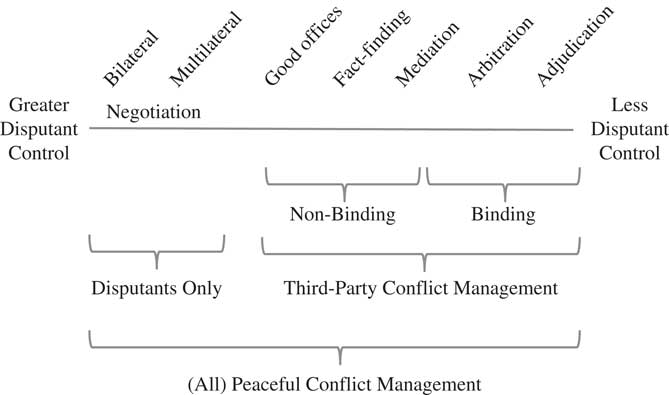
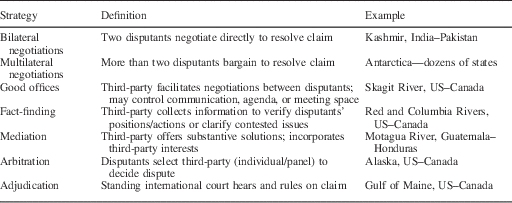
Our analysis focuses on these peaceful management strategies, particularly the seven most commonly used ones: bilateral and multilateral negotiations, good offices, fact-finding missions, mediation, arbitration, and adjudication. As Figure 1 demonstrates, these strategies vary widely along two related dimensions: how much control the disputants retain over the management process and the level of third-party involvement (Bercovitch and Jackson Reference Bercovitch and Jackson2009).Footnote 4 In order to clarify the argument and discussion that follows, we briefly define these strategies and provide an empirical example of a claim in which each was used in Table 1.Footnote 5
Organization of conflict management strategies (dependent variables)

Peaceful Conflict Management Strategies

Although differences exist between the individual conflict management strategies presented in Table 1, previous work on territorial claim management does not theorize fully about how states select among the individual strategies (Owsiak Reference Owsiak2014). Instead, scholars generally focus on a subset (e.g., mediation alone) or broader, aggregate categories (e.g., non-binding versus binding third-party conflict management).Footnote 6 Existing research also does not thoroughly consider the effects of issue claim type—that is, land, river, or maritime—on conflict management behavior.Footnote 7
Admittedly, there are strong theoretical reasons to make such research design decisions. Our point, however, is that this leaves much of the variance in conflict management activities unexplained. Knowing, for example, what prompts states to cede control to binding third-party conflict management offers important insights into state motivations and behavior (Gent and Shannon Reference Gent and Shannon2011). Nonetheless, one can theorize further. Arbitration and adjudication—both binding conflict management—involve ceding different levels of control. Moreover, states disproportionately cede this control in land claims, but avoid doing so altogether in river claims. Mindful of these points, the next section offers a theoretical framework that allows us to make unique predictions about the use of individual conflict management strategies within distinct territorial claim types.
A Theoretical Framework for the Management of Territorial Claims
Competing diplomatic claims to land, river, and maritime areas differ from one another across two dimensions, which subsequently affect how states manage them. First, claim types yield different levels of state interest. These interests derive not only from the characteristics of the claim itself (e.g., the presence of natural resources or access to the sea), but also from interdependence between states and claims (e.g., indirect effects on non-claimants or potential precedents for similar, future claims; Huth et al. Reference Huth and Allee2011). Second, as interests motivate the involvement of additional states, disputants find it more difficult to aggregate their preferences about how to manage and resolve the claim. In other words, transaction costs rise (Keohane Reference Keohane1984; Hopmann Reference Hopmann1996). The product of these two dimensions then leads states to institutionalize conflict management differently across issues. This institutionalization helps states aggregate preferences over what conflict management strategy to select—thereby decreasing the costs associated with conflict management—even if states might still disagree about the substantive terms needed to settle their claim.
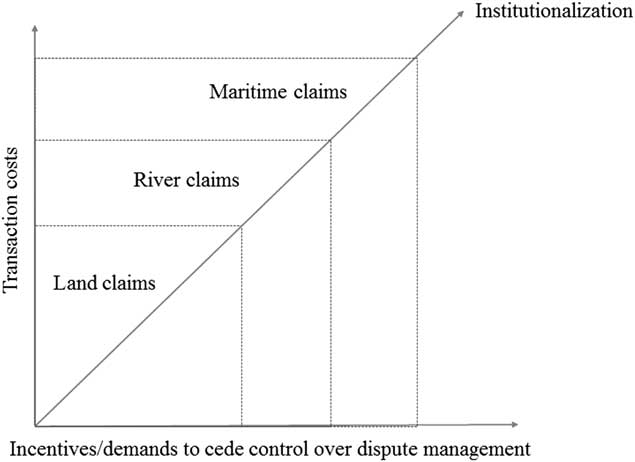
We begin by briefly developing the two dimensions of our framework. Then, we synthesize them and explain how doing so institutionalizes conflict management. The outcome of these efforts appears graphically in Figure 2. Finally, we present a series of empirical predictions that derive from the framework.
Claim management across land, river, and maritime claims

State Interests
States with unsettled territorial claims incur various costs (Simmons Reference Simmons2002). First, contested territory holds value for the disputing states (e.g., oil, water, fish, or a strategic location), but this value often cannot be fully realized while another actor competes for the same territory. Second, the lack of jurisdictional clarity that accompanies territorial claims significantly undermines international trade (Simmons Reference Simmons2002). Finally, unsettled claims constitute a salient external threat to the state, its resources, and its livelihood, which increases the risks of militarized conflict, encourages states to spend more on defense, dominates states’ foreign policy agendas, and diverts resources from other goals. Because territorial claims often persist for many years, these costs can be significant and accumulate over time (Huth and Allee Reference Huth, Croco and Appel2002; Hensel et al. Reference Hensel, Mitchell, Sowers and Thyne2008). States therefore possess strong incentives to settle their territorial claims.
To work toward settlement, states use the conflict management tools outlined earlier.Footnote 8 These tools vary in how much control states must cede over the conflict management process and outcome (see Figure 1 and Table 1). The amount of control a state willingly cedes, in turn, depends on its interests in a given claim, which derive from the claim’s characteristics—particularly the salience of disputed territory (Huth and Allee Reference Huth, Croco and Appel2002; Hensel and Mitchell Reference Hensel and Mitchell2005) and the interdependence between states which establishes precedents for future claims.
First, disputed territory possesses characteristics that make it salient—either for intangible or tangible reasons. Intangible salience refers to state identity, reputation, or prestige.Footnote 9 In contrast, tangible salience involves the concrete resources that a territory provides to the possessing state. These resources offer strategic (e.g., the Golan Heights), economic (e.g., oil, fish, or navigation rights), and human security (e.g., access to fresh water) benefits. States seek to maximize their share of disputed territory to receive a greater distribution of these tangible and intangible benefits. This allows them to achieve their broader goals, such as enhancing security, providing for the population, increasing relative power, or acquiring resources with which to make trade-offs in future negotiations.
If salience motivates claim management, then leaders will attempt to manage claims of higher salience more frequently than those of lower salience. This logic applies both across territorial claim types (i.e., land versus river versus maritime) and within territorial claim types. With respect to the former, Hensel et al. (Reference Hensel, Mitchell, Sowers and Thyne2008) propose a theoretical distinction between land, river, and maritime claims. All three claim types contain relatively high tangible salience, but land claims also possess relatively high intangible salience. States often view specific land as part of their history, culture, and identity; they rarely view river and maritime areas this way, which makes land claims more salient on average. We therefore expect states to attempt peaceful conflict management more frequently within land—as opposed to river or maritime—claims.
Each individual claim type also varies in salience. Land claims, for example, can have strategic or economic value (or none); rivers claims might involve access to resources (e.g., hydroelectric power) or navigation channels; and maritime areas can contain critical resources (e.g., fish, oil) or a strategic position (e.g., access to straits). Variance in such characteristics generates different levels of within issue claim salience. As the salience of a given individual claim type rises, states should employ peaceful conflict management more frequently.
Beyond these general predictions, our argument offers more nuanced ones as well. Actors disputing a valuable object prefer to maintain as much control as possible over that dispute’s management. This incentive exists for two reasons. First, if an actor foregoes this control, it is less likely to obtain a settlement that maximizes its interests. Nigeria, for example, lost control of the resource-rich Bakassi Peninsula to Cameroon by ceding control over claim management to the International Court of Justice. Notably, this occurred despite Nigeria’s power advantage over Cameroon (Mitchell and Hensel Reference Mitchell and Hensel2007). Thus, if a state cedes control over conflict management, being powerful is insufficient for securing preferred settlement terms. As a territory’s salience rises, fear of not maximizing its share of benefits should therefore encourage states to manage their claim using strategies that offer them greater control (see Figure 1).Footnote 10
Second, domestic groups may punish state leaders who cede decision-making control over highly salient territory—even to a third-party conflict manager—since the leader may appear to be weak or “giving away the state” (Putnam Reference Putnam1988; Fearon Reference Fearon1994). Leaders will be more reluctant to involve third-parties as the salience of disputed territory increases. Nonetheless, if states do agree to involve a third-party in the management of their claims, they should increasingly limit third-party control over settlement terms as the disputed territory’s salience rises. We therefore expect that states use third-parties more often in river or maritime disputes, since these are typically less salient than land disputes. Similarly, although states might employ legal strategies within any claim type, they might rely upon arbitration more frequently to manage land issues (i.e., retaining greater control), while finding adjudication more attractive for maritime or river claims (i.e., ceding greater control).Footnote 11
In addition to claim characteristics, interdependence also generates state interests, bringing additional actors into a dispute via two avenues. First, a claim’s management may affect additional actors directly, even though they may not be primary parties to the claim. Conflicts between Lebanon and Israel in the Jordan River, for example, influence other disputes in the basin (e.g., Israel–Syria and Israel–Jordan). Similarly, the United States is not a claimant in the Spratly Island maritime dispute, yet it takes an interest in this dispute because it seeks freedom of navigation in maritime space, economic access to the disputants, and regional stability (Bouchat Reference Bouchat2013). Moreover, a state aspiring to regional leadership may face reputational consequences for remaining aloof during the management of a given claim, which encourages that state’s involvement. Second, the management of one claim may create precedents for future conflict management under international law (Huth et al. Reference Huth and Allee2011). These precedents can arise within claims (e.g., a non-ratified agreement creates a focal point; see Colombia–Venezuela) or across claims (e.g., the United States’ rejection of Peru’s claim to a 200 nautical mile territorial area in 1947 created conflicts with other states in the region making similar claims; e.g., Ecuador–Chile).
Interdependence theoretically varies by claim type. Land claims most often involve the delimitation of interstate borders between two adjacent states with limited externalities (Huth and Allee Reference Huth, Croco and Appel2002). Border settlements can carry precedents, but because few other actors are interested in the claim, they need not. Most land claims therefore remain localized (e.g., Mexico has little interest in the United States/Canada border). In river claims, interest expands slightly wider. Two states might dispute a river’s ownership or usage, but other states in the river basin—particularly those downstream—will be affected by the disputants’ river navigation, pollution, and water resource usage (Dinar Reference Dinar2009; Beck et al. Reference Beck, Bernauer, Siegfried and Bohmelt2014). A claim’s settlement terms can also set precedents for a river’s users, and a state that leads settlement efforts may build a reputation for being a regional leader. Finally, interests widen even further with maritime claims. All maritime states have an interest in free navigation, lower pollution, access to marine resources, and the common definition of maritime zones that they each possess. Many states also seek a reputation as defender of one of the world’s common resources (i.e., the high seas).
In short, interdependence increases as we move from land to river to maritime claims, which has noteworthy implications for conflict management. As interdependence rises, states will cede greater control to additional actors (e.g., third-parties) and outside actors’ interests in helping to settle the contested diplomatic issues increases. This suggests a more involved and controlling role for third-parties in river and maritime claims, particularly because interdependence yields greater transaction costs as well.
Transaction Costs
Any conflict management effort requires bargaining among disputants (Hopmann Reference Hopmann1996). Actors ultimately settle a claim when they find a distribution of the disputed territory that they each prefer to the status quo. Aggregating preferences therefore becomes the dominant goal of bargaining—first to decide the bargaining process’s form (e.g., negotiation, mediation, or arbitration), then to ascertain whether agreement can be had, and finally to determine the precise, mutually acceptable distribution of the disputed territory. Preference aggregation can be challenging enough with two actors (e.g., see the Bolivian–Chilean claim over Antofagasta). Yet, the involvement of more than two actors creates significantly greater complexity—for as Hopmann notes:
With the inclusion of each additional party holding different preferences with respect to the [desired] outcome, one must add an additional dimension in n-dimensional space to the simple bargaining model. Although [bargaining space] might be theoretically possible to calculate mathematically if all of the preferences could be quantified, most international negotiators do not operate in this fashion. They usually find it increasingly difficult to conceive of solutions that are universally acceptable, optimal, and fair at the same time [as additional negotiators enter the process]….’ (Reference Hopmann1996, 246).
Negotiations involving more than two actors therefore proceed through an inefficient, trial-and-error approach, with each participant having the ability to sink any deal. Proposals advance in succession until one emerges that appears acceptable to all.
States can minimize transaction costs in two ways. First, they can limit the number of bargaining actors. This aligns with their preference for greater control and suggests that the default option for claim management will be bilateral negotiations. Interdependence, however, can undercut bilateral preferences by generating incentives for additional actors to join claim management. When this happens, states minimize transaction costs via a second route: institutionalization (Keohane Reference Keohane1984). The institutionalization of conflict management solves one aggregation problem: what form the bargaining process will take. Moreover, it allows states to create commonly accepted definitions, rules, and principles upon which to make decisions. Although they may still disagree over how to apply these rules, institutionalization removes the need to aggregate preferences for each new diplomatic claim.
As interdependence rises, we anticipate that states will increasingly institutionalize claim management (Keohane Reference Keohane1984; Koremenos et al. Reference Koremenos, Lipson and Snidal2001) by signing international agreements that: stipulate common definitions and principles (e.g., the “territorial sea”); prescribe preferences over conflict management strategies and processes (e.g., Part XV of the United Nations Convention on the Law of the Sea (UNCLOS) treaty), and; create additional third-party conflict managers (e.g., the International Tribunal for the Law of the Sea (ITLOS)). Beyond this, actors should embed claim management procedures within existing international organizations (e.g., a river basin organization), as this reduces transaction costs associated with creating new cooperative arrangements.
This argument yields three broad predictions for claim management. First, a highly institutionalized conflict management process governs maritime claims—granting greater control over claim management to a third-party. This arises from the multilateral character of sea access and resource management. Because maritime issues generate global interest and involve greater transaction costs, we anticipate that global IGOs should feature more prominently in the management of maritime claims. Second, land claims generate the least institutionalized process—functioning primarily on a bilateral or ad hoc basis. The more localized interests that accompany land claims also suggest that IGOs will intervene less in these claims. Finally, river claims lie between these two extremes. Interdependence is broader but limited typically to riparian states in the same basin, producing limited institutionalization that favors regional organizations over global ones.
Institutionalization and Claim-Specific Management
A graphic representation of our theoretical framework appears in Figure 2. State interests create incentives and demands for states to cede control over claim management, while the involvement of additional actors generates transaction costs. The combination of these two dimensions encourages states to institutionalize conflict management—with greater cession of control and transaction costs producing higher levels of institutionalization. Because claim types vary with respect to state interests and transaction costs, states institutionalize the management of claims differently across issue types. We dwell briefly on existing institutionalization here, as it creates unique, nuanced predictions about how states manage their claims.
Land claims possess more salience (i.e., both tangible and intangible value), more localized interest (i.e., less interdependence), and fewer transaction costs than other territorial claim types. States should therefore institutionalize land claim management minimally. Indeed, we observe exactly this (Simmons Reference Simmons2002). Although the United Nations Charter codifies the territorial integrity norm (Hensel, Allison and Khanani Reference Hensel, Allison and Khanani2009), it remains silent on precisely how to resolve competing land claims—other than stating a general preference for peaceful resolution. Given states’ desire for control and low institutionalization, land claim management manifests itself as a focus on bilateral negotiations and a limited role for third-parties.
In contrast, maritime claims contain less (intangible) salience, more (global) interest, and greater transaction costs. Indeed, states explicitly recognize this divergence from land claims (Kraska Reference Kraska2011, 108), arguing that the world’s oceans are a “public good” of interest to every state. A central challenge emerges, however: coastal states want sovereignty over areas adjacent to their land (i.e., an extension of the land regime), while the international community seeks access to “the commons.” To reconcile these competing demands, states established the UNCLOS, which institutionalizes commonly defined maritime spaces and establishes detailed claim management processes to decide cases, including the creation of an international court (e.g., ITLOS; see Nemeth et al. Reference Nemeth, Mitchell, Nyman and Hensel2014).
UNCLOS carries four conflict management implications. First, it increases the likelihood of multilateral negotiations within maritime claims. Second, although states can use many strategies, UNCLOS defaults to arbitration for binding settlement (Part XV, Article 287). We should therefore see arbitration play a prominent role in maritime claims. Third, actors need non-binding third-party conflict management less in maritime than other territorial claims. UNCLOS establishes clear institutional rules, principles, processes, norms, and forums, which obviate disagreements over what type of information to consider or how to interpret it (i.e., fact-finding), the need for third-parties to propose solutions (i.e., mediation), or a venue in which to talk (i.e., good offices). Finally, UNCLOS recognizes the use of standing legal bodies to assist states in settling maritime claims (e.g., ITLOS). Adjudication should therefore feature more prominently in maritime than other territorial claims.
However, maritime claims differ on one important dimension, whether or not the disputed issue involves the drawing of a maritime boundary, such as the EEZ. An EEZ is a maritime space of no more than 200 miles from a coastal state’s land in which the coastal state retains the rights to natural resources and scientific endeavors (Klein Reference Klein2011; Kraska Reference Kraska2011). Because these zones contain an abundance of resources, many maritime conflicts involve competing claims to sovereignty over an EEZ (e.g., US–Canada Gulf of Maine dispute)—in effect, mimicking an international land border dispute. This suggests that the management of EEZ claims may mirror that of land claims, while non-EEZ claims follow a different management process.Footnote 12
Finally, river claims lie between land and maritime ones with respect to transaction costs and incentives to cede control, suggesting an intermediate level of institutionalization (Brochmann and Hensel Reference Brochmann and Hensel2009; Zawahri and Mitchell Reference Zawahri and Mitchell2011). Once again, this matches the empirical record. States attempted to institutionalize river claim management via the United Nations Convention on Non-Navigational Uses of International Watercourses (Prescott and Triggs Reference Prescott and Triggs2008). This institution, however, lacks broad support. Although created by the UN General Assembly in 1997, the Convention did not enter into force until 2014 because it lacked the 35 state signatures required. The challenge—simply put—is that river issues do not generate broad state interests.
The UN agreement on watercourses nevertheless helped create several rules and principles for the management of river claims. First, it prioritizes negotiations (Article 17). Second, it proposes regional cooperation to manage river resources jointly (Article 24). We should therefore see greater third-party conflict management than in land claims—a function of this cooperation—with a focus on regional organizations. Third, it creates no standing conflict management forums for disputants to use. We therefore expect a preference for non-binding, as opposed to binding, third-party strategies. Finally, it contains a very detailed fact-finding process that can be initiated at the request of any member state (Article 33). The convention thus stresses fact-finding as a strategy for managing river issues. If states indeed employ this strategy disproportionately for managing river claims, it would offer clear, specific evidence in favor of our institutionalization argument.
Research Design
We use version 1.1 of the ICOW project’s data on contentious issue claims to evaluate our argument (Hensel et al. Reference Hensel, Mitchell, Sowers and Thyne2008). The ICOW project codes when official representatives of two or more states contend over three broad types of territory: land, river, and maritime claims. We also divide the latter category into maritime claims that involve an EEZ and those that do not, as our argument suggests management differences across these sub-types. This version of the ICOW data set includes 838 dyadic territorial claims in the Western Hemisphere and Western Europe (1816–2001); 143 dyadic river claims in the Western Hemisphere, Western Europe, and the Middle East (1900–2001); and 268 dyadic maritime claims in the Western Hemisphere and Europe (1900–2001). ICOW tracks the dyads involved in a claim for each year that the claim is ongoing; thus, the claim-dyad-year constitutes our unit of analysis (N=10,044).
To examine how dyads manage their claims, we employ a number of dichotomous dependent variables throughout our analysis taken from the ICOW project’s data on peaceful settlement attempts. We defined the individual conflict management strategies earlier, including bilateral negotiations, multilateral negotiations, good offices, fact-finding, mediation, arbitration, and adjudication (Table 1). From these strategies, we create a series of more and less aggregated dependent variables. Figure 1 visually outlines the relationships between these variables, which become more aggregated as one moves down the figure. The most general variables therefore appear lower in the figure, while the individual conflict management strategies appear toward the top. As an illustration of our approach, we capture mediation as a separate variable in some analyses, but it is also part of the non-binding third-party conflict management, the third-party conflict management, and the (all) peaceful conflict management variables. The aggregate variables allow us to connect with prior research, which often use broader categories, while the disaggregated variables help us explore the nuances of conflict management behavior. The data set includes 1690 total peaceful conflict management attempts.
We argue that states often institutionalize conflict management through inter-governmental organizations. Two dichotomous dependent variables account for this possibility. Regional IGO denotes whether a regional organization (e.g., the African Union) helps manage a claim in a given claim-dyad-year, while global IGO captures the same information for more universal membership organizations (e.g., the United Nations). An IGO receives credit for conflict management if it uses any third-party conflict management strategy to assist disputants during a given claim-dyad-year.
We also include six control variables that may alter the management of territorial claims. First, we account for salience within issue type using the 12-point ICOW claim salience index (Hensel et al. Reference Hensel, Mitchell, Sowers and Thyne2008, 130). Second, we address the effects of recent MIDs by employing ICOW’s weighted MID score—constructed as the weighted sum of recent MIDs over the claim in question during the 10 years prior to the current observation. Third, we consider recent failed peaceful attempts; this ICOW variable is measured similarly to recent MIDs. Fourth, we control for whether the dyad in question is a joint democracy—that is, whether both states score six or higher on the Polity IV autocracy–democracy index (Marshall and Jaggers Reference Marshall and Jaggers2009). Fifth, relative capabilities accounts for the power (a)symmetry between disputing states, calculated as the ratio of the stronger to the weaker dyad member’s capabilities (Singer Reference Singer1988). Finally, we control for claim duration (in years).
Because our dependent variables are dichotomous, we employ logistic regression models.Footnote 13 When we have less than 100 total “events” for a given dependent variable, we estimate rare events logistic regression models (Tomz, King and Zeng Reference Tomz, King and Zeng2003). Our results are robust to using either logistic or rare events logistic regression.
Empirical Results
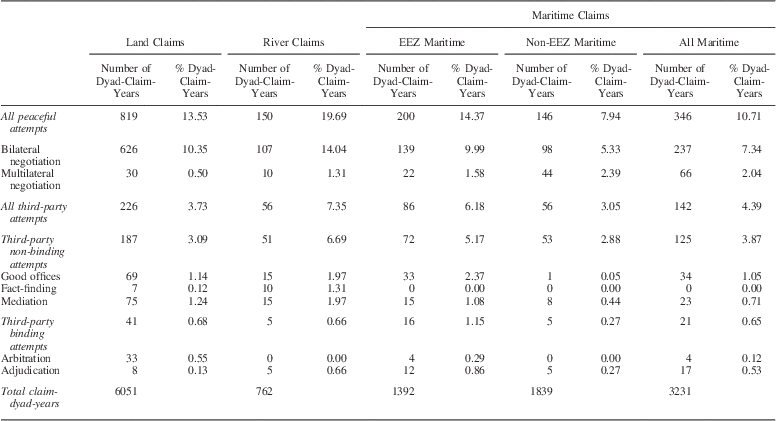
We present descriptive statistics in Table 2, showing variation in conflict management strategies across claim types. These results support our theoretical framework. Disputants rely upon fact-finding more in river claims (1.31 percent) than either land (0.12 percent) or maritime (0.00 percent) claims. The institutionalization of river claim management through the UN Watercourse Agreement provides a compelling explanation for this finding. Fact-finding is innocuous. Disputants voluntarily allow it to occur and can reject any third-party information generated, which suggests no theoretical reason for variation in fact-finding usage across claim types. Yet states use this strategy primarily within river claims. In fact, even when fact-finding appears in land claim management, each of these claims involves an area in which states contest both the land border and cross-border river resources/border. Further, disputants rely upon the closest alternative strategies to fact-finding (good offices and mediation) more often in river claims (1.97 and 1.97 percent, respectively) than in land (1.14 and 1.24 percent, respectively), or maritime claims (1.05 and 0.71 percent, respectively). Such findings offer initial support that river claims experience a moderate level of institutionalization that encourages states to cede control to non-binding third-parties—and that the emphasis on fact-finding stems from existing institutions that cover cross-border river management.
Conflict Management in Land, River, and Maritime Claims, 1816–2001

Note: Aggregate categories appear in italics (see Figure 1).
Sub-categories will not add to aggregate categories, as peace conferences are not included and the aggregate category captures whether one or more conflict management attempts occurred.
EEZ=exclusive economic zone.
Multilateral negotiations offer additional supportive evidence. These occur more often in maritime claims (2.04 percent of claim-dyad-years) than land or river claims (0.50 and 1.31 percent of claim-dyad-years, respectively). Our framework predicts this, as more states have an interest in negotiating maritime claims given the high degree of interdependence and transaction costs for these conflicts. Yet we also predict more nuance—namely, that states treat EEZ and non-EEZ claims differently. We observe this too. Disputants rely upon adjudication more frequently when managing EEZ claims (0.86 percent) than when managing land (0.13 percent), river (0.66 percent), or non-EEZ maritime claims (0.27 percent). Moreover, reliance on multilateral negotiations climbs for non-EEZ maritime claims (to 2.39 percent). As our theory predicts, disputants favor multilateral negotiations and adjudication when managing maritime claims. They select between these two strategies, however, according to whether the maritime claim concerns EEZ or non-EEZ boundaries.
Land claims also display a unique conflict management pattern. Disputants manage land claims more frequently via arbitration (0.55 percent), a peace conference (0.40 percent; not shown), or militarized means (3.24 percent; not shown) than either river (0.00, 0.13, and 2.36 percent, respectively) or maritime claims (0.12, 0.03, and 2.79 percent, respectively). We also see that disputants manage EEZ claims much more frequently than non-EEZ claims, which is consistent with our argument that EEZ conflicts are similar to land disputes (and thus more salient). Yet, the comparison becomes even starker when we consider arbitration and militarized actions. All arbitration of maritime claims occurs within claims that concern an EEZ; militarized conflict remains highly likely for these border-like conflicts as well.
Cumulatively, these patterns offer initial support for our argument. Conflict management varies significantly across territorial claim types. Disputants favor fact-finding and related strategies to manage river claims, multilateral negotiations and adjudication to manage maritime claims, and arbitration and military means to manage land and EEZ maritime claims.
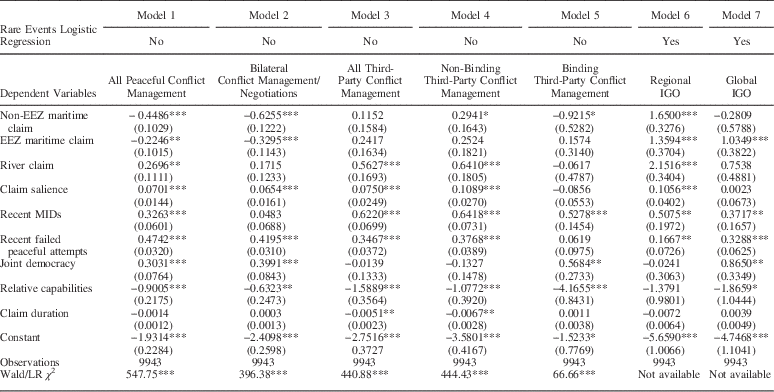
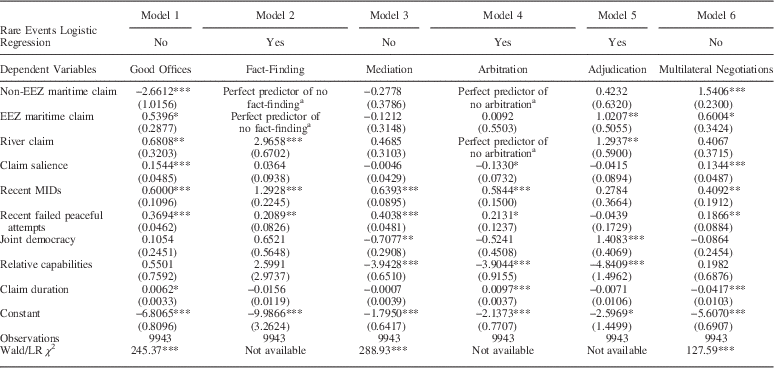
Table 3 estimates multivariate logistic regression models to examine the effects of claim type on peaceful conflict management. It begins with any form of peaceful conflict management (Model 1). As one moves right across the table, we subsequently disaggregate the conflict management dependent variables further. The final columns of Table 3 contain an analysis of IGO intervention. Finally, in Table 4, we disaggregate binding and non-binding third-party conflict management. Throughout all of the presented models, land claims serve as the reference category for the included claim types.
The Management of Land, River, and (EEZ/non-EEZ) Maritime Claims, 1816–2001

Note: Robust standard errors presented in parentheses.
EEZ=exclusive economic zone; IGO=intergovernmental organization; MIDs=militarized interstate disputes.
*p<0.10, **p<0.05, ***p<0.01.
Detailed Breakdown of Third-Party Management of Land, River, and (EEZ/non-EEZ) Maritime Claims, 1816–2001

Note: Robust standard errors presented in parentheses.
EEZ=exclusive economic zone; MIDs=militarizedinterstate disputes.
a Perfect predictors are dropped from the rare events logistic regression before running it.
*p<0.10, **p<0.05, ***p<0.01.
The first hint that states manage claim types differently emerges when we consider maritime claims—divided into EEZ and non-EEZ subsets. Six noteworthy findings emerge. First, regardless of whether a maritime claim involves an EEZ, maritime claims are less likely than land claims to experience conflict management (Model 1). When we disaggregate conflict management, however, we discover that bilateral negotiations drive this aggregate finding; disputants employ bilateral negotiations less frequently to manage a maritime claim (regardless of EEZ) as opposed to a land claim (Model 2). Moreover, maritime claims experience conflict management from regional (both EEZ and non-EEZ claims; Model 6) and global (for EEZ claims; Model 7) IGOs more often than land claims. These findings show that states handle maritime claims more in multilateral, institutionalized settings and less in bilateral ones, as our argument predicts. The higher level of state interests and transaction costs increase institutionalization of maritime claims, resulting in conflict management strategies that cede more disputant control to other parties.
The maritime story gets slightly more nuanced in Table 4. Disputants never use fact-finding to manage maritime claims, regardless of whether the claim involves an EEZ (Model 2). This supports our supposition that fact-finding serves as the cornerstone of river claim management instead. In addition, both types of maritime claims involve multilateral negotiations more frequently than land claims (Model 6). Combined with the earlier finding on bilateral negotiations, we once again see states relying upon more multilateral and less bilateral conflict management strategies in maritime claims.
Finally, the treatment of EEZ and non-EEZ maritime claims diverges in two ways. EEZ maritime claims are more likely than land claims to involve good offices, while non-EEZ claims are less likely than land claims to involve good offices (Model 1). A similar divergence appears in the individual strategies that comprise binding third-party conflict management. Disputants pursue adjudication more often when handling their EEZ maritime claims as opposed to their land ones (Model 5); yet they also never use arbitration to address their non-EEZ maritime claims (Model 4). These two findings provide clear support for disaggregating maritime claims and underscore the descriptive results presented in Table 2. Maritime claim management centers on multilateral negotiations and adjudication, but the involvement of an EEZ boundary determines which of these two strategies receive preference.
Before turning to river claims, we address one additional point. EEZ maritime claims should theoretically be managed similarly to land claims. On this score, the evidence in Tables 3 and 4 is mixed. On one hand, EEZ maritime claims are sometimes treated differently than land claims; for example, EEZ claims experience bilateral negotiations less frequently than land claims and good offices, adjudication, multilateral negotiations, and regional and global IGO involvement more often than territorial claims. When we consider aggregate categories of third-party conflict management (Models 3–5, Table 3), however, we find that EEZ maritime claims are treated no differently than land claims, while non-EEZ maritime claims are. Such evidence is admittedly weak, especially since our more detailed analysis (Table 4) suggests the management of EEZ maritime and land claims differ in meaningful ways. We therefore conclude that the multivariate models are not strongly supportive of this theoretical expectation, although disputants handle maritime claims that involve an EEZ differently than those that do not.
River claims display an entirely different pattern of conflict management, as demonstrated through several findings. First, river claims experience conflict management more often than land claims (Model 1, Table 3). This is consistent with previous research showing that states use cooperative strategies more frequently than conflictual ones to manage shared river resources. Second, when we disaggregate the broad categories of conflict management strategies, we see that—unlike with maritime claims—third-party conflict management drives the aggregate finding. River claims are no more likely than land claims to experience bilateral negotiations, but significantly more likely to involve third-party conflict management (Model 3, Table 3)—especially of the non-binding variety (Models 4–5, Table 3). This is consistent with our argument that river issues are moderately institutionalized, incentivizing disputants to cede a moderate level of control over their claim’s management (see Figure 1).
Third, when we disaggregate non-binding third-party conflict management, we discover that disputants are more likely to use good offices and fact-finding to manage their river—as opposed to land—claims (Models 1–2, Table 4). This latter finding is distinctive; all fact-finding concerns river claims in some way, showing how the UN agreement helped to institutionalize this procedure for managing river conflicts. Fourth, disputants never use arbitration in river claims and resort to adjudication more often in river claims than land claims (Models 4–5, Table 4). If we combine this finding on arbitration with the one noted above for maritime claims, arbitration appears to be primarily a tool for land claims (or EEZ maritime claims) and this characteristic may serve as a hallmark of land claim management. Given the high degree of state interests in land (and EEZ) disputes, it is consistent with our argument that states seek to maintain greater decision-making control over these issues—even when submitting the dispute to a binding forum.
Finally, although the management of river claims may be more multilateral than land claims, it is much more limited than in maritime claims. Regional IGOs perform conflict management more frequently in river claims than land claims (Model 6, Table 3), but global IGOs are no more or less likely to peacefully manage river as opposed to land claims (Model 7, Table 3). Furthermore, multilateral negotiations are no more or less likely in river claims than land ones (Model 6, Table 4). In the end, moderate levels of state interests, transaction costs, and institutionalization encourage states to manage river claims in two distinct ways: a preference for non-binding third-party conflict management (particularly fact-finding) and a limited multilateral framework (regional, but not global in nature). In short, disputants cede moderate levels of control over river claim management.
One additional point is worth noting. Our earlier theoretical discussion said little about mediation as a strategy. This omission was purposive; neither the theoretical framework nor our research into existing institutionalized preferences suggests that mediation will feature prominently in one claim type’s conflict management. The results in Table 4 support this expectation (Model 3). Mediation is no more or less likely to occur during a river or maritime claim (regardless of EEZ status) as opposed to a land claim. Although mediation often helps states settle ongoing conflicts, it requires them to cede much control over conflict management without getting the benefits (e.g., political cover) of more legalized processes. States therefore prioritize and institutionalize other strategies when managing their territorial claims.
The control variables in Tables 3 and 4 behave largely as expected.Footnote 14 First, more (within issue) salient claims receive more conflict management attempts—particularly bilateral negotiations, good offices, and multilateral negotiations. More salient claims are also more likely to involve regional IGOs, though not global ones. Second, as a claim experiences recent MIDs or failed peaceful conflict management attempts, it is more likely to receive additional conflict management. Recent efforts at violent and non-violent conflict management also increase the likelihood that regional and global IGOs will intervene to manage the claim. Third, jointly democratic dyads are more likely than non-democratic dyads to receive assistance from global IGOs and to employ both negotiations and binding third-party conflict management (particularly, adjudication) when addressing their claims.
Fourth, relative capabilities consistently affect the use of conflict management strategies. As the power between disputing states becomes increasingly asymmetric (i.e., the stronger side gains a larger share of the dyad’s resources), the likelihood that the disputants engage in conflict management declines. When we disaggregate categories, we find that increasingly asymmetric dyads are less likely to experience mediation, arbitration, and adjudication, but no more or less likely to experience good offices or fact-finding. These findings align with our theoretical story, for they suggest that stronger states are hesitant to employ strategies in which they lose too much control over the negotiation process (Zawahri and Mitchell Reference Zawahri and Mitchell2011). For similar reasons, claims within more asymmetric dyads are also less likely to feature global IGOs.Footnote 15
Conclusion
Our study addresses why disputants select distinct conflict management strategies for managing territorial claim issue conflicts (land, river, or maritime). We assert that state interests and transaction costs differ across claim types, incentivizing states to cede varying levels of control over claim conflict management. This produces variation in the types of strategies that countries select to manage land and water conflicts. The high level of state interest for land disputes leads to low institutionalization and the selection of tactics that maintain more decision-making control (bilateral negotiations and arbitration). River conflicts involve more moderate institutionalization and shared interests in basins, resulting in more frequent but non-binding forms of conflict management (especially fact-finding missions). Maritime conflicts are the most highly institutionalized type of territorial claim, with countries frequently employing multilateral negotiations and legally binding processes (arbitration or adjudication) to settle disputes.
Our study’s framework and findings offer numerous contributions—most notably, theorizing about and empirically modeling the full menu of individual conflict management strategies, considering various claim types simultaneously, and demonstrating how institutionalization both solves transaction cost problems and creates predictability in claim management. Future work might build upon these contributions in two ways. First, although we study the initiation of conflict management, we do not consider its success. A preliminary analysisFootnote 16 shows findings that might align success rates with our framework’s predictions; fact-finding succeeds most in river claims, bilateral negotiations demonstrate similar success rates across land and EEZ maritime claims, and adjudication succeeds best in maritime claims. Nonetheless, the framework inadequately theorizes about conflict management success, for as we know from existing research, the factors that determine the initiation of conflict management are not always those that increase its success. A modified framework may therefore be needed to understand conflict management success. Second, future work might study the institutionalization of conflict management in greater detail. We suspect, for example, that institutionalization yields regimes that govern claim management. Because institutionalization varies by claim type, claim-specific conflict management regimes likely form. Future research might investigate whether these regimes exist and, if they do, what rules and principles define them and how stable they are. This will ultimately tell us how predictable and effective future claim management will be and help us understand ongoing efforts to settle territorial disputes globally.