INTRODUCTION
Root crops are staples in Vanuatu, a volcanic archipelago in Melanesia, South West Pacific. As sweet potato (Ipomoea batatas), cassava (Manihot esculenta), taro (Colocasia esculenta) and yam (Dioscorea spp.) are vegetatively propagated, conserving genetic resources is complex. In-vitro culture and cryoconservation are possible but maintaining collections is very expensive. For root crops, ex-situ field collections exist, but resources for proper management are limited and the chances of losing or mixing varieties are high (Jackson, Reference Jackson1994). Field gene banks are also vulnerable to pests and diseases and to changing climatic conditions (Taylor et al., Reference Taylor, Hunter, Rao, Jackson, Sivan, Guarino, Rao, Matthews and Eyzaguirre2005). According to Rao and Campilan (Reference Rao and Campilan2002), numerous studies in Asia Pacific countries showed that it would be useful and even necessary to use the on-farm conservation method for sweet potatoes as a complement to ex-situ conservation. In the same way, the recommendations of the Third Taro Symposium underlined the importance of elaborating and promoting on-farm conservation of genetic resources (Guarino et al., Reference Guarino, Taylor and Osborn2004).
Different studies have shown that root crop varieties are constantly exchanged throughout Vanuatu via traditional exchange networks and that the local management of genetic diversity allows cross-pollination between asexually propagated varieties. These observations have been documented for yams (Malapa et al., Reference Malapa, Arnau, Noyer and Lebot2005), taro (Caillon et al., Reference Caillon, Quero-Garcia, Lescure and Lebot2006) and cassava (Sardos et al., Reference Sardos, McKey, Duval, Malapa, Noyer and Lebot2008). Farmers discover and use seedlings originating from sexual reproduction but also fix somatic mutations which appear in their clonal stocks. In traditional cropping systems, farmers' practices have an important impact on the management of root crop diversity; there is a turnover of genotypes within their varietal portfolios through local selection, exchange or introduction. Furthermore, there is a well-developed social structure including a system of gifts and debts that allows the rapid circulation of varieties throughout the archipelago. Similar observations were made for yams in Benin (Mignouna and Dansi, Reference Mignouna and Dansi2003) and cassava in Guyana (Elias et al., Reference Elias, Penet, Vindry, McKey, Panaud and Robert2001). In fact, cropping systems based on clonally propagated crops involve similar cropping techniques throughout the world, and these indirectly favour the discovery of mutants and/or seedlings.
After three decades of failed attempts to preserve germplasm on research stations, it is necessary to develop, test and evaluate the impact of an on-farm conservation system for root crops in Vanuatu (Guarino et al., Reference Guarino, Taylor and Osborn2004). To cope with the disadvantages of ex-situ collections, it would be possible to design an on-farm conservation system for root crop species to fit the traditional cropping system. If applicable, farmers could continue to introduce and select diversity by using local hybrids and mutants. However, in Vanuatu, in the case of taro, the genetic base is narrow and crosses between local varieties could decrease heterozygosity and lead to inbreeding depression (Caillon et al., Reference Caillon, Quero-Garcia, Lescure and Lebot2006; Lebot, Reference Lebot1992). Such a mixed clonal-sexual system is indeed efficient but in some cases – especially in island environments – it would be necessary to broaden the genetic base before attempting to maintain diversity per se within an on-farm collection. Narrow genetic bases lead to vulnerability to introduced pathogens. The introduction of Phytophthora colocasiae, which is responsible for taro leaf blight and caused an epidemic disaster in Samoa in 1993, is a sad example but represents a real threat in Vanuatu where P. colocasiae has not yet been introduced. In addition to epidemics, cyclones and natural disasters are frequent in this part of the world, increasing vulnerability to climatic changes and reinforcing the need for genetic diversity.
Thanks to molecular markers studies, it is known that in most Pacific countries, the genetic bases of root crop species are narrow and vulnerable to introduced pathogens and that they thus need to be broadened. It is also known that there are distinct gene pools in which independent domestication has occurred (Krieke et al., Reference Kreike, Eck and Lebot2004). Introduction of new, exotic genotypes could therefore help broaden local bases. However, in order to be acceptable to farmers, and to be kept as part of their varietal portfolios, any new genotypes must have an attractive attribute or perform better than those the farmers already cultivate. Considering the economic situation of root crop producers, and the low-input cultivation systems in which their crops are grown, an appropriate approach would be to increase farmers' long-term access to useful genes. This can be done by using the geographic distribution of allelic diversity (Lebot et al., Reference Lebot, Ivancic and Abraham2005) as a practical way of maintaining germplasm by:
– assembling a core sample representing the useful diversity of the species;
– distributing genotypes for direct use by farmers;
– distributing genes as clones in segregating progenies;
– selecting locally adapted clones.
To optimize the use of the genotypes selected for the core sample, access to reliable data on genetic distance is needed and these data cannot be obtained by plant morphological descriptors. However, DNA markers can provide relevant information and have been used to create genetically diverse core samples (Krieke et al., Reference Kreike, Eck and Lebot2004; Malapa et al., Reference Malapa, Arnau, Noyer and Lebot2005; Quero-Garcia et al., Reference Quero-García, Noyer, Perrier, Marchand and Lebot2004). The easiest way to distribute allelic diversity is to distribute these core samples directly to farmers. When this is done over a wide geographic area, and the genotypes satisfy their needs, farmers will add the exotic germplasm to their varietal portfolios thereby increasing the allelic diversity maintained on-farm. As these genotypes are clonally propagated, farmers can exchange and distribute them further. The keys to the success of this system are related to traditional farming practices: farmers always prefer to take care of previously cultivated and appreciated species.
The overall objective of the present study was to evaluate the potential of the geographic distribution of allelic diversity as a complementary conservation strategy for root crop species in Vanuatu. The specific objectives were: i) to see whether introduced exotic varieties have been adopted or rejected, ii) to clarify with farmers their reasons for adopting or rejecting varieties, and iii) to assess the extent of spontaneous distribution to other smallholders.
MATERIALS AND METHODS
Experimental sites
The study was conducted in 10 villages located on the 10 most populated islands and which were representative of the diversity present in the archipelago. Most village communities favour a cropping system based on either yam or taro as the major crops. ‘Taro villages’ are those where the most widely cultivated and consumed species is Colocasia esculenta. This is explained by suitable pedo-climatic conditions corresponding to ecosystems of humid forests located at higher altitudes or on the moist windward sides of the islands. ‘Yam villages’ use Dioscorea spp. as the main crop and are generally located in coastal regions, mostly in the drier areas of the leeward sides.
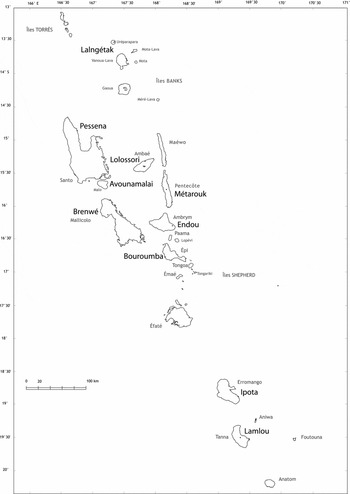
The type of agrosystem is related to a system of beliefs, customs, rites and cultural traditions linked to taro or yam (Bonnemaison, Reference Bonnemaison1986). The experimental design of the study was thus composed of five repetitions per agrosystem (five villages with taro-based cropping systems and five with yam-based cropping systems). Each agrosystem was analysed separately. The selected communities do not speak the same vernacular language. The locations of the 10 villages are shown in Figure 1.
Map of Vanuatu showing location of study villages.

In 2005, participatory rural appraisals (PRAs) were conducted in each village and inventories of local genetic resources were drawn up to understand and record farmers' cultural practices. The number of varieties collected in 2005/06 corresponds to the number of traditional varieties within the farmers' fields when the study started.
Germplasm surveys and composition of core samples
Germplasm collections are maintained at VARTC (Vanuatu Agricultural and Technical Centre, Santo) for yams (Dioscorea alata, D. bulbifera, D. esculenta, D. nummularia), taro, sweet potato and cassava. Although yams and taro are, by far, the most important crops, it was decided to distribute cassava and sweet potato germplasm as well. Today these two American species are increasingly cultivated. Cassava is robust, does not require much care and can grow on poor soils. Sweet potatoes are appreciated for their rapid production of tuberized roots and their resistance to cyclones. These two crops have quickly been integrated into Melanesian gardens and farmers cultivate them to supplement taros and yams.
Characterization of almost 2300 taro varieties from different countries (Indonesia, Malaysia, Philippines, Thailand, Vietnam, Papua-New-Guinea and Vanuatu) has been performed using molecular markers and led to the composition of a core sample of 170 varieties introduced in Vanuatu in the form of virus-free in-vitro plantlets (Krieke et al., Reference Kreike, Eck and Lebot2004). Asian varieties are resistant to P. colocasiae and resistant genotypes were consequently included in the taro core sample. Blind panel tests of the varieties contributed to the assessment of the organoleptic properties followed by selection in each country including Vanuatu.
The yam core sample assembled the 48 best varieties in the archipelago. This selection was also based on organoleptic criteria and agro-morphological descriptors. Anthracnose (Colletotrichum gloeosporioides) resistance and the shape of tubers were also considered.
Sweet potato accessions were hybrids between Indonesian and Vanuatu varieties. Indonesian genotypes from CIP (The International Potato Center) in Bogor (Java) were introduced into Vanuatu as true botanical seeds and were crossed with local varieties to produce selected hybrids. Varieties were propagated in VARTC so these hybrid varieties did not exist in the archipelago prior to the study. The selection focused on resistance to scab (Elsinoe batatas) and weevils, and on root skin and flesh colour (orange being an indicator of carotene content).
Finally, cassava varieties were selected for their organoleptic properties, taste and yield, and were all local varieties originating from different Vanuatu islands (Sardos et al., Reference Sardos, McKey, Duval, Malapa, Noyer and Lebot2008).
Selection of varieties to be distributed to the 10 communities was made in order to broaden genetic bases and to include resistance characters while also corresponding to farmers' expectations (organoleptic and agronomic qualities). Great care was taken to make sure that varieties to be sent to one village were not already present there.
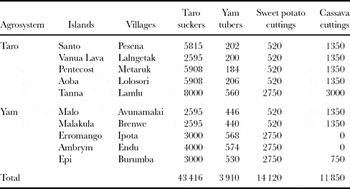
For reasons of logistics, propagules were multiplied in VARTC, Santo, for distribution to the six northern islands (Vanua Lava, Santo, Malo, Aoba, Pentecost and Malakula) and on the island of Efate for distribution to the four southern islands (Tanna, Erromango, Ambrym and Epi). The number of propagules distributed per species and per village is listed in Table 1. These propagules were dispatched in four shipments, one species after the other in the following order: taro, yams, sweet potato and cassava. Taro and yam were sent at the beginning of their traditional cropping cycle (September–November 2005) and sweet potato and cassava cuttings at the beginning of theirs (May–July 2006).
Experimental sites and number of propagules distributed in 2005/06

Field assessment
In May–Sept 2008, two years after planting material distribution, the acceptability of introduced varieties was assessed to quantify their clonal introduction in plots and in varietal portfolios. On-farm quantitative inquiries were aimed at obtaining specific information on introduced varieties. Qualitative inquiries were aimed at gathering explanations of the influence of the various factors that contributed to adoption or rejection by smallholders. During field investigations, we collected information on beneficiary households, on factors favouring acceptance or rejection, the reasons for preservation and rates of losses, the propagation rates of introduced varieties, their management and their circulation within communities.
The study time spent in each village, one full week, was relatively short and necessitated the use of standardized protocols. Upon arrival in a village, explanations were given to the community, the work plan was described and objectives were discussed. Farmers were encouraged to provide as much information as possible on their personal experience of the introduced germplasm and their judgements were recorded.
Each beneficiary household was interviewed individually and each garden plot containing new varieties was visited. Whenever possible, husband and wife were questioned separately in order to double-check the consistency of the information obtained. Either the wife or the husband was always present when counts were made in their gardens. Informal discussions also improved our understanding of the situation of the households and of the whole village community. Once the interviews were completed, the following points were analysed:
1. Preservation of introduced varieties: this was obtained by comparing the number of traditional varieties present in 2005, the number of varieties introduced in 2005/2006 and the number of introduced varieties still present in the varietal portfolio in 2008, along with the reasons for any losses.
2. Sociological impact: recorded by counting the number of households who received introduced varieties and those who kept them in their varietal portfolios, as well as the number of gardens hosting these varieties and the total number of clones for each.
3. Reasons for preserving, adopting and propagating new varieties: recorded by asking beneficiaries for their assessment of the new varieties as well as for the characteristics of the new varieties that were appreciated or not.
4. Subsequent distribution of germplasm by farmers: when redistribution occurred, to whom and to where, and how many varieties were involved.
RESULTS
Overall, 449 people were interviewed at the 10 sites and their gardens were visited in order to morphologically identify varieties and to check the information obtained during interviews.
Preservation of introduced varieties
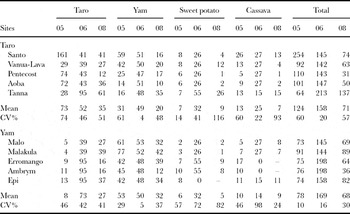
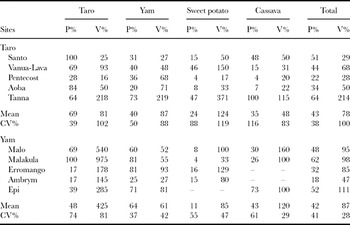
The numbers of varieties collected in 2005/06, of varieties introduced in 2006, and of introduced varieties still preserved in 2008, are listed in Table 2. Taking into account the number of varieties present in 2005 and those distributed as part of the study in 2006 that were still preserved in 2008, it was possible to estimate the gain in diversity (see V% column in Table 3), which corresponded to an increase in the number of varieties present three years later. This rate was generally higher in ‘taro’ villages than in ‘yam’ villages (87% v. 61%). Varietal gains for taro were impressive in both ‘yam’ and ‘taro’ villages (Table 3).
Number of traditional varieties collected in 2005, new varieties introduced in 2006 and number of new introduced varieties preserved in 2008.

Preservation rates of introduced varieties (P%) and varietal increase rates between 2005 and 2008 (V%).

Taro varieties that were planted and maintained but not propagated or destroyed were also taken into account. Indeed, in the case of an epidemic, farmers can rely on these varieties, which were abandoned in old gardens. However, this does not apply to yams (especially D. alata), which are too fragile to survive without maintenance. Furthermore, the fact that varieties are abandoned or not harvested allows subsequent gene flow because plants left in the ground do flower and enable cross-pollination (Caillon et al., Reference Caillon, Quero-Garcia, Lescure and Lebot2006; Sardos et al., Reference Sardos, McKey, Duval, Malapa, Noyer and Lebot2008). Thus, enrichment is not only due to the choice to integrate varieties into varietal portfolios but also the enrichment of local agrobiodiversity. Even if introduced genotypes are later eliminated from varietal portfolios, cross-pollination between new varieties and local ones should allow allelic diversification, but this will have to be assessed with molecular markers.
Generally, introduced varieties considerably enriched farmers' varietal portfolios: there was a total increase of 78% in taro villages and of 87% in yam villages (Table 3). The hypothesis that local varieties are all preserved was confirmed by farmers who claimed they protected their own varieties in spite of the arrival of introduced varieties. However, whether the number of clones per local variety has decreased remains unknown. In some cases, communities decided to establish the introduced propagules in a community plot for the first year in order to propagate them before redistributing them among all farmers. This system was used for taro varieties in Epi, Pentecost and Aoba but did not produce better results than other sites where distribution took place upon the arrival of the introduced varieties.
It became clear that all the households did not preserve varieties in the same way but our results were analysed at the village scale. In these small communities, the presence of some farmers who are particularly receptive to experimentation and willing to assess new germplasm had a significant effect on global results. The global impact on diversity corresponded to the enrichment of varietal portfolios within villages. The composition of core samples based on molecular data was defined to enhance their genetic bases and consequently, new alleles were introduced into species' local diversity.
When a particular variety pleases a farmer, it may be intensively propagated and soon fill one whole garden. Risk increases when the variety becomes the only variety of interest to the farmer. And, as a matter of fact, one variety of sweet potato was adopted by several farmers who now sell only this variety on the market. However, apparently these farmers already only grew one variety of sweet potato but used a different variety.
In Vanuatu, the maintenance of rich diversity is a cultural trait. Cultural factors (local customs in particular) are known to be important for the diversity of varieties and this appeared to be confirmed in Vanuatu. Farmers confirmed that their local varieties were all preserved in 2008 and claimed that they decided to protect their own traditional varieties in spite of the arrival of introduced varieties. They explained that their decision was consistent with their traditional system of introducing and adopting new varieties without discarding old ones. Decline of traditional varieties occurs following a reduction in clones planted per genotype, but not to voluntary elimination, so it takes a decade or so before a declining variety disappears completely from all village gardens, according to farmers.
In all villages studied, richness in diversity was recorded and corresponds to the number of different varieties, regardless of the frequencies of these different varieties. We did not take into consideration the evenness, which measure how similar are the frequencies of the different varieties in farmers' fields because, evenness can change very rapidly from one year to the next, depending on farmers' wishes, and this varies greatly from farmer to farmer within the same village. For example, in Vanuatu, if a farmer decides to produce for the following year a large quantity for a ceremonial or commercial purpose, he will propagate preferably his high yielding varieties and will return to a normal situation as soon as he has achieved his objective (Bonnemaison, Reference Bonnemaison1986; Welegtabit, Reference Welegtabit2001). Other authors have shown that when most of the richness is held at low frequencies, it indicates a management strategy for diversity maintained as an insurance to meet future environmental or social changes. However, when the distribution of varieties has an even distribution, it indicates that farmers are selecting varieties to serve a diversity of current needs. Although Vanuatu was not one of the countries investigated in the study conducted by Jarvis et al., (Reference Jarvis, Brown, Cuong, Collado-Panduro, Latournerie-Moreno, Gyawali, Tanto, Sawadogo, Mar, Sadiki, Thi-Ngoc Hue, Arias-Reyes, Balma, Bajracharya, Castillo, Rijal, Beqadi, Rana, Saidi, Ouedraogo, Zangre, Rhrib, Chavez, Shoen, Sthapit, De Santis, Fadda and Hodgkin2008), the situation is very similar.
There was a high rate of preservation for new yam varieties in villages with yam-based agrosystems (64% on average) and for taro varieties in villages with taro-based agrosystems (69%) (Table 3). The preservation rate of taro varieties was lower in yam villages (48%) and of yam varieties in taro villages (40%). Preservation rates of up to 100% were recorded for taro in Santo and Malakula, for cassava in Tanna and for yam in Malakula. The preservation rates of sweet potatoes and cassava were lower.
The percentages of taros and yams that were preserved were always higher than those of cassava and lower than those of sweet potatoes. However, farmers' interest in taro in taro villages and in yam in yam villages did not contribute to the rejection of other species.
Because of the complex geographical constraints of the Vanuatu archipelago (Figure 1), the reasons most often quoted for losses were poor logistics. The number of propagules dispatched from the propagation plots in bags was overall very high (Table 1), but survival rates were low because of harsh shipping conditions. Many propagules were weakened before their arrival in the villages. They sometimes died during transport or arrived in poor condition. There were also logistical problems: transport conditions were too rough, storage in local airports was too long or local contacts were not properly informed of their arrival. However, the fact that the majority of losses were thought to be due to logistical problems indicates that farmers did not think they themselves were responsible for the losses of many varieties.
Losses other than for logistical reasons had various causes. The farmer's decision to abandon a particular variety was the most frequent one cited. Some varieties were abandoned because of their poor organoleptic properties or unsuitable agro-morphological traits, or simply by an attitude of caution in the face of unknown plants, or sometimes without any clear reason. In taro villages, farmers were harder to please with respect to taro varieties. This is most likely due to the diversity that existed before the arrival of new varieties. In yam villages, the situation was similar with respect to yams, and the farmer's choice was the main cause of varietal losses.
Pedo-climatic factors were reported to be the cause of some losses. These losses mainly concerned yams in taro villages and could be explained by a wet local climate favouring the development of anthracnose (Colletotrichum gloeosporioides). Drought and sometimes water excess were identified as being responsible for some losses. Cyclones were mentioned but more rarely (e.g. in Vanua Lava). Ash from the volcano in Ambrym also destroyed some new planting material.
Sociological impact
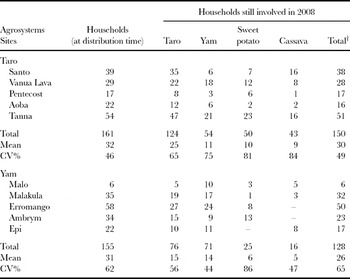
The number of households which kept new varieties is presented in Table 4. Overall, 316 households out of a total population of 449 households received some planting materials. These results need to be interpreted with caution because some households from outside the village who received varieties were counted as beneficiaries even though they were not included in the number of households in the village. For example, in Malo, five of the beneficiaries actually came from Avunamalai while others lived in the neighbouring village of Avunaleleo. In Santo, 30 beneficiaries actually came from Pessena and 9 were from the neighbouring village of Vunap. Therefore, in some cases, more households took new varieties than there were households in the village (in Santo, Pentecost, Erromango and Epi). It was difficult to define the distance at which hamlets should be considered to belong to a single village. Sometimes the village chosen for the study was actually a hamlet and in the end all hamlets surrounding villages were taken into account in the study.
Number of household with new varieties.

†Households could be counted twice if they kept new varieties of different species, i.e. taro and yam, so totals are not necessarily the sum of the four species.
There were approximately 30 beneficiaries per village. These numbers are conservative because it was not always possible to interview all recipients. The total number of beneficiary households presented in Table 4 is the sum of all the households that kept at least one new variety of at least one species. Introductions were positive for 92% of households in taro villages and for 85% of households in yam villages. Not many households lost all the varieties introduced in the 10 villages.
In taro villages, the number of households possessing some new varieties was twice as high for taros as for the other species. On the other hand, in yam villages, an equivalent number of households kept taros and yams.
Whole village or communities appear to be better able to maintain a collection of genotypes than individual farmers (Maxted et al., Reference Maxted, Hawkes, Ford-Lloyd, Williams, Maxted, Ford-Lloyd and Hawkes1997). Our study confirmed this observation. Indeed the impact on germplasm was greater at the village scale than at the household scale. Communities are influenced because individual farmers can go to their neighbours in the case of an epidemic. In the present case, the fact that some farmers had certain new varieties in their varietal portfolios, while others had different varieties, could favour future exchanges between farmers.
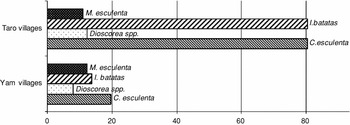
The average number of clones per variety revealed the propagation rate. Taro and sweet potato varieties appeared to be the most widely propagated (80 clones per variety in taro villages) (Figure 2). This could be explained by the presence of numerous suckers on taros and it is thus easy to propagate selected varieties. Sweet potato varieties are very easy to propagate using stem cuttings. This propagation rate, which was higher for taros and sweet potatoes, was obvious in taro villages but not in yam villages. In these yam villages, new varieties were propagated in similar proportions for each species (around 10 clones per new variety) except for taro (20 clones on average). Yams were propagated less rapidly because farmers decided to replant one whole tuber from the previous year to secure their growth.
Mean number of clones per introduced variety.

The mean number of clones per yam variety was higher in taro villages (12) than in yam villages (8), whereas for all varieties taken together, the number of clones was the same in both agrosystems, indicating that diversity was greater in yam villages (Table 2). Farmers in taro villages appear to have the tendency to select yam varieties and to multiply them, while in yam villages they appear to be strict in their selection but to not propagate selected varieties as much their own favoured varieties. Besides, in each yam village there was at least one farmer who preserved many yam varieties without losing one. This is typical of collector farmers as previously described. This behaviour was also observed in taro villages with respect to taro varieties but was not so obvious (Caillon et al., Reference Caillon, Quero-Garcia, Lescure and Lebot2006).
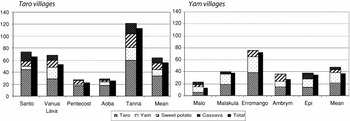
Figure 3 presents the number of gardens hosting at least one introduced variety. We observed more gardens in taro villages than in yam villages (55 v. 38 on average). The difference was even more significant regarding taros (34 v. 19); only the number of yam gardens was higher in yam villages (15 v. 11). The total number of gardens was less than the total number of gardens for all species combined because the same garden may host new varieties of two different species.
Number of gardens hosting new varieties (total and for each individual species) in taro and yam villages.

The mean total number of gardens was higher in taro villages but the number of gardens with new yam varieties was higher in yam villages. This could be due to greater propagation of yam in yam villages or to greater clonal dispersal in more gardens. But the proportions are relatively similar when the means in yam villages and taro villages are compared.
All households which preserved new varieties possessed, on average, one garden per species containing the new varieties, except for taro, for which there were about 1.5 gardens in taro villages and 1.2 gardens per household in yam villages. Finally, the mean number of gardens per household for all species was 1.7 in taro villages and 1.6 in yam villages. Indeed, even if farmers mostly took varieties of several species, they could have planted all the varieties in only one or two gardens.
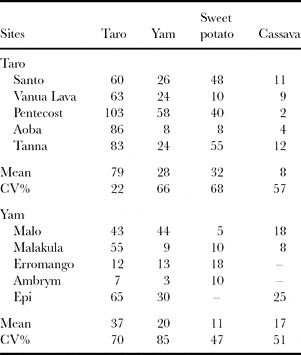
Table 5 indicates that the mean number of plants per garden ranges from 8 for cassava to 79 for taro. Knowing that most crops are planted 1 × 1 m apart, this represents a very small area devoted to introduced varieties and indicates that the impact on the area planted with traditional varieties was not significant.
Mean number of plants per garden.

The number of clones per garden (Table 5) was higher for taros in taro villages (79 v. 37), yams (28 v. 20), sweet potatoes (32 v.11) but not for cassava (8 v. 17). These results show a higher clonal concentration in taro villages whereas yam villages tend to disperse their new planting material more widely. This could be explained by reduced land pressure or simply by the fact the gardens were smaller.
However, the mean number of clones per garden (which was lower than the number that a garden can host) indicates that new varieties were mixed with local ones. This observation is important for future cross-pollination between local and introduced varieties and thus for broadening the genetic base. In the case of biological or natural disasters, risks of losses are reduced compared to a situation where there is only one large plot of land. Globally, we observed that the propagation of new varieties occurred throughout villages and gardens.
Reasons for preserving, adopting and propagating new varieties
Taste criteria were the most important in the adoption of new varieties. This was confirmed for all species and in each village. Taste and texture were the most frequently mentioned qualities. Morphological characteristics and tuber colour were also mentioned but less frequently.
Secondly, farmers appreciated the appearance of new varieties. Indeed, Vanuatu inhabitants like to cultivate diversity; some are real ‘collectors’ and as soon as they obtain a new variety, they include it in their varietal portfolios. They use agro-morphological criteria to identify a new variety. Not only the edible part is taken into consideration but also the aboveground parts. Farmers in Vanuatu are generally interested in morphological variation, and this was confirmed during our field investigations.
Agronomic traits (adaptation to the environment and productivity) are appreciated by farmers but were less frequently cited. Characteristics related to customary uses were also cited but were less important. In taro villages, only taros were concerned, and in yam villages only yams, which is explained by their use in customary ceremonies, which vary with the village agrosystem. Taro and yam villages appeared to use similar criteria when deciding whether or not to adopt a variety.
Unsuitable criteria were classified in three categories: unfavourable agronomic characteristics were the first criterion cited for rejection. The presence of too many runners on taros annoys farmers. In the case of yams, their small size was often quoted, and for sweet potatoes, poor yield. These observations were generally related to the pedo-climatic conditions: yams do not grow well in wet soils and sweet potatoes produce leaves instead of tuberized roots in the presence of excess water. It would have been difficult to select varieties to be distributed due to the diverse environmental conditions. As regards taros producing too many suckers, this is often the case of Indonesian varieties, but they were nevertheless distributed deliberately in order to broaden genetic bases.
The fact that a species is not usually cultivated or little consumed is an important factor. The choice to eliminate a variety is not connected to the variety and its characteristics but to the fact that irrespective of the variety of the species, it is of no use to the household. For example, some households grow only yams and are not used to growing cassava. They could have taken cassava cuttings during the distribution but never showed any interest in doing so. Other farmers started growing cassava or sweet potato varieties although they were not used to doing so. Finally, farmers' fears regarding newly introduced plants also played a role. There are some limitations to this study, in particular the fact that the reasons for losses were identified in the farmers' reports. For example, in the case of disease, agronomic traits could have been quoted whereas poor yield may have resulted from disease. farmers' selection process can therefore be summarized as follows:
– farmers receive varieties and in most cases plant them separately from their own varieties;
– if varieties respond to agronomic expectations (size, yield, few runners), farmers keep them;
– they then decide to test their cooking characteristics in a traditional way;
– if organoleptic qualities and texture are acceptable, farmers propagate them and replant them;
– finally, the more they are appreciated, the more they are propagated.
As mentioned above, the fact that a variety has a new particular trait may mean it is kept whatever the other qualities of the variety. Even if new varieties are not propagated, the fact that they are integrated into varietal portfolios, even for a short time, will allow some hybridization and thus have an impact on genetic diversity. Loss and integration of varieties appears to be constant in Vanuatu farming systems.
In this case, selection was made on newly introduced varieties but the same criteria are used to choose varieties that are constantly included in a farmer's varietal portfolio. They constantly accept new varieties from their neighbours or relatives or find them in fallows for example. They then test these varieties to see if they correspond to their expectations before propagating them. It is therefore important to consider organoleptic preferences in the pre-selection of root crop varieties before distributing them for on-farm conservation. In our study, pre-selection was based on these criteria and most of the varieties corresponded to local expectations and were thus suitable for adoption. Consequently, new genotypes were more easily introduced into varietal portfolios.
The fundamental problem for on-farm conservation is the identification of the varieties to be distributed. Satisfaction criteria are described in their study and the identification of varieties to conserve was made in direct collaboration with the communities concerned. This point was also taken into account in our study. Many taros from Asia enabled enhancement of genetic bases and the introduction of resistance of P. colocasiae. Sweet potatoes resulting from Indonesia × Vanuatu hybridization thus allowed the insertion of new genes in varietal portfolios. Finally cassava, yams and some taros came from the Vanuatu national collection and thus allowed some communities to benefit from varieties from the other islands of the archipelago.
Regarding climatic disasters, the fact of having chosen a total of 10 communities enabled some risks to be avoided. Indeed, there is little chance that an incident would affect 10 sites simultaneously. A similar study of on-farm conservation of sweet potatoes in Irian Jaya (Papua New Guinea) was not conclusive. The climatic phenomenon El Niño in 1997/1998 led to the loss of almost the whole collection, which was established in 1993 in only one location (Yaku and Widyastuti, Reference Yaku and Widyastuti2002).
Subsequent distribution of germplasm by farmers
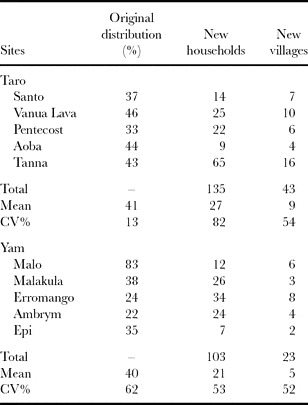
Spontaneous distribution was observed in our 10 study villages (Table 6). Indeed, 40% of the households where introduction was effective told us they redistributed at least one of their new varieties to at least one other household. This redistribution was either to someone within the community or to an outsider. Some households did not redistribute varieties because they had not yet propagated their varieties enough. This redistribution rate is outstandingly important as it only refers to redistributions of which the beneficiaries are aware. Some people take plants from neighbouring plots without telling the owner of the garden and it is thus impossible to know how many other beneficiaries are involved. As previously described, varieties are distributed across the archipelago thanks to numerous exchanges. Vanuatu culture, which is based on a system of exchanges, donations and debts, is probably the major explanation (Bonnemaison, Reference Bonnemaison1986).
Households involved in new distribution

Two years after the beginning of study, the total number of new beneficiaries was 238 which corresponds to a large increase in the total number of beneficiaries (initially 316 households). Furthermore, numerous households did not redistribute varieties because they were waiting to have enough propagules but ‘orders’ have already been placed between families.
There is thus an important circulation of varieties via theft, and donations within the village (in particular to a family absent on the day of the distribution) and to nearby communities (thanks to friends or distant family members). This is consistent with the fact that these plants still have an important exchange value. Most of the redistribution occurred within villages, but the number of new villages reached 66 (plus the initial villages). On Tanna Island for example, 16 villages are now indirectly involved in the distribution of new genotypes which were originally distributed in the village of Lamlu. Even in Vanua Lava redistributions principally occurred on different islands for nine of the ten redistributions with seven redistributions on the nearby island of Mota Lava. So it is possible to predict that some varieties will rapidly be grown in all the villages on the 10 islands and maybe throughout the Vanuatu archipelago. In the case of an epidemic, these 10 villages could be considered as reservoirs of germplasm diversity. Finally, regarding taros, it appears that Asian varieties are appreciated and also well redistributed, and this could pave the way for future introductions.
CONCLUSION
The results obtained during this study illustrate farmers' interest in new root crop varieties, their sustainable management and their wish to maintain diversity. The impact for beneficiaries is related to the enrichment of their varietal portfolios and to protection against risks of an epidemic. Villagers who received many varieties and propagules at the same time admitted being surprised. Deliveries of planting material could have been more spread out over time and this would have minimized losses. Regular insertion of new varieties in varietal portfolios is apparently easier for farmers to manage. However, this type of organization would certainly also increase costs. Several diversity reservoirs now exist in Vanuatu. In spite of the cost of establishing them, these collections do not need any foreign assistance in order to be sustainable because they are now part of local systems. In the absence of the work described here, varieties within villages would also be numerous but genetic diversity would be much lower.
Some of the newly introduced varieties were lost. It is possible that over the years such losses increase until a balance is reached, because the management of varietal portfolios is active and integration and loss occur constantly. However, even if only some of the new varieties are integrated during a few crop cycles and if minimum sexual reproduction occurs, this suffices for the integration of new genes in the traditional cultivation systems (Sardos et al., Reference Sardos, McKey, Duval, Malapa, Noyer and Lebot2008). It appears that the integration of new varieties was not aimed at replacing local varieties. As a matter of fact, at this experimental stage, farmers did their best to preserve and maintain their local varieties. Genetic bases are narrow within the country and thus if, in the long term, a minimum number of local varieties remains after crossing with exotic germplasm, this would allow the introduction of allelic diversity, which is the ultimate aim of this experiment. It will only be possible to measure the real impact of our study in about 10 years or so. Indeed, molecular markers studies on allelic diversity of varieties within villages, on recombination and on the creation of useful diversity would be necessary to measure the impact on germplasm. Subsequently, it would be necessary to wait for several generations of sexual reproduction.
The positive results obtained in the present study might be due to Vanuatu culture which appreciates and respects variation. Furthermore, these crops directly integrate customs and cultural practices (Welegtabit, Reference Welegtabit2001). The geographical experimental design based on 10 different islands located in a country where communication and transport are very restrictive, allowed us to develop an original methodology. The hypothesis is that it will be easier to apply elsewhere, for example, on continental land masses, because there should be fewer logistical constraints involved in introducing and monitoring planting material. It would be interesting to test on-farm conservation methodology in other developing countries where production and consumption of root crops is also important. Some characteristics are shared by smallholders in tropical regions; they cultivate root crops on small plots without inputs and often in association with different crops. On-farm conservation of tropical root crops favours the evolution and adaptation process of plants to their environment and improves farmers' access to genetic resources. This approach could be recommended worldwide. On-farm conservation will not replace ex-situ collections and breeders' work, but it could help reduce the size of collections. It can compensate for non-existent or insufficient national collections and is also a way to make sure farmers are the beneficiaries, since they could be the first victims when problems arise.
Acknowledgments
This research was financially supported by the Fonds Français pour l'Environnement Mondial (FFEM). The authors thank the staff of the Root Crops Section of VARTC at Espiritu Santo, in particular Marie Melteras, Roger Malapa, Tari Molisalé and Sylvano Malres for their helpful collaboration.