Introduction
Cucumber mosaic virus (CMV), the type member of the genus Cucumovirus in the family Bromoviridae, is one of the most important plant viruses. Its host range is very wide; it infects more than 1200 plant species in 100 families, including ornamentals, woody plants and important crops such as pepper, lettuce, beans and cucurbits (Scholthof et al., Reference Scholthof, Adkins, Czosnek, Palukaitis, Jacquot, Hohn, Hohn, Saunders, Candresse, Ahlquist, Hemenway and Foster2011). Affected plants exhibit yellowish leaf areas, green and yellow mottling and stunting. CMV is a non-persistent stylet-borne transmitted pathogen by more than 80 aphid species in 33 genera, with Aphis gossypii (Glover) (Hemiptera: Aphididae) the most effective vector (Labonne et al., Reference Labonne, Quiot and Monestiez1982). CMV is efficiently acquired and inoculated during very brief (5–10 s) intracellular probes on epidermal plant tissues without a latent period. Its retention time in the vector is under 12 h, and it is unable to cross the insect's cuticle at the tip of the stylets (Pirone & Perry, Reference Pirone and Perry2002; Ng & Falk, Reference Ng and Falk2006; Fereres & Moreno, Reference Fereres and Moreno2009). In addition, CMV may be transmitted by mechanical contact, seed and pollen (Palukaitis & García-Arenal, Reference Palukaitis and García-Arenal2003).
The prevention of non-persistent virus diseases is particularly difficult due to the quick transmission process, and chemical control strategies are often not sufficiently efficient (Raccah, Reference Raccah and Maramorosch1986; Collar et al., Reference Collar, Avilla, Duque and Fereres1995), because they do not act fast enough to prevent aphids from inserting their mouthparts into plants (Loebenstein & Raccah, Reference Loebenstein and Raccah1980). This fact forces the search for better alternatives for their control (Thackray et al., Reference Thackray, Jones, Bwye and Coutts2000), developing strategies that maximize the impact of biological control agents, which are currently the focus of Integrated Pest Management (IPM) Programmes. The inoculative release of aphidophagous predators is a commonly used strategy in IPM programmes aiming at the control of aphid foci in commercial greenhouses (Yano, Reference Yano2006). Aphidophagous parasitoids are also a major component in the management of some aphids (Abney et al., Reference Abney, Ruberson, Herzog, Kring, Steinkraus and Roberts2008).
The potential of biological control agents to limit the spread of aphid-borne non-persistent viruses is still not well known (Hooks & Fereres, Reference Hooks and Fereres2006), and their effect depends on their capacity to reduce the number of aphid individuals by predation or parasitization, on the level of disturbance of the aphid colonies and on the time aphids require to acquire and inoculate the virus (Belliure et al., Reference Belliure, Amorós-Jiménez, Fereres and Marcos-García2011). Additionally, different species of natural enemies even within the same genus can induce very different responses in vector colonies and virus epidemiology, resulting in either a reduction or an increase in viral dispersion (Smyrnioudis et al., Reference Smyrnioudis, Harrington, Clark and Katis2001; Hodge & Powell, Reference Hodge and Powell2008; Hodge et al., Reference Hodge, Hardie and Powell2011; Dáder et al., Reference Dáder, Moreno, Viñuela and Fereres2012).
Because the spread of viruses seems to be correlated with the foraging habits of natural enemies (Smyrnioudis et al., Reference Smyrnioudis, Harrington, Clark and Katis2001; Belliure et al., Reference Belliure, Amorós-Jiménez, Fereres and Marcos-García2011), the objective of this study was to determine the dissemination of CMV by A. gossypii in the absence and presence of the following two predators: Chrysoperla carnea (Stephens) (Neuroptera: Chrysopidae) larvae and adult Adalia bipunctata (L.) (Coleoptera: Coccinellidae). C. carnea larvae are very mobile and voracious polyphagous predators in many agricultural systems (Viñuela et al., Reference Viñuela, Händel and Vogt1996; Medina et al., Reference Medina, Budia, Del Estal and Viñuela2003) and one of the indicator species considered for higher testing in the EU for pesticide registration (Candolfi et al., Reference Candolfi, Barret, Campbell, Forster, Grandy, Huet, Lewis, Oomen, Schmuck and Vogt2001). A. bipunctata adults are generalist aphidophagous predators with a wide range of prey (Omkar & Pervez, Reference Omkar and Pervez2005). Both species, which are commercially available, are currently widely used in Spain in protected horticultural crops (Robledo et al., Reference Robledo Camacho, van der Blom, Sánchez Martínez and Torres Jiménez2009).
Materials and methods
Insects
A single virginiparous apterae of A. gossypii collected in a melon crop in Almería (Spain) was used to initiate a clonal population. The aphid colony was kept at low densities on Cucumis melo L. plants cv. Primal in a climatic chamber (20 °C, 60–80% relative humidity (RH), 16:8 L:D photoperiod) in the Crop Protection Laboratory of ETSIA-UPM (Madrid, Spain). For the trials, alate individuals were collected with an aspirator and placed in groups of 100 in Falcon® tubes just before being transferred to the experimental cages. This aphid is a suitable prey species for the two natural enemies used in the tests (Van Steenis, Reference Van Steenis1992).
A laboratory colony of C. carnea was established from L1 larvae obtained from Agrobío (CHRYSOcontrol®, Almería, Spain) following the rearing procedure of Medina et al. (Reference Medina, Budia, Tirry, Smagghe and Viñuela2001). Larvae were fed Ephestia kuehniella (Zeller) (Lepidoptera: Pyralidae) eggs ad libitum, and adults were provided with a very nutritious artificial diet (Vogt et al., Reference Vogt, Bigler, Brown, Candolfi, Kemmeter, Kühner, Moll, Travis, Ufer, Viñuela, Waldburger, Waltersdorfer, Candolfi, Blümel, Forster, Bakker, Grimm, Hassan, Heimbach, Mead-Briggs, Reber, Schmuck and Vogt2000). For the trials, gauze with <24-h-old eggs from the adult rearing cages were allowed to develop up to the L3 instar. Larvae were collected and starved for 1 h before starting the test.
A. bipunctata L1 larvae purchased from Agrobío (ADALIAcontrol®, Almería, Spain) were placed in cages with zigzag folded filter paper and a mixture of E. kuehniella eggs and bee pollen (1:1) that was replaced three times per week (Bonte et al., Reference Bonte, Samih and De Clercq2010) up to L3–L4 emergence. Mature larvae were placed in individual arenas with a small amount of food to avoid cannibalism and guarantee successful pupation. After 6–7 days, newly emerged adults were transferred to cages with a water source (baize soaked with water), and the same diet was provided for the larvae. Once a week, melon leaves with A. gossypii nymphs were added as a dietary supplement and habituation to feeding on live prey. The environmental conditions were similar to those of C. carnea rearing. A. bipunctata adults, 2–3 weeks old, were used in the experiments.
Plant material
Cucumber (Cucumis sativus L. cv. Ashley) plants were grown from seed in 150 alveoli trays (56 cm×36 cm×6 cm) filled with a 1:1 mixture of the soil substrate (Projar, Valencia, Spain) and vermiculite Termita® (Aminco, Donostia, Spain) in an insect-proof chamber at 23–25 °C, 60–80% RH and a 16:8 L:D photoperiod.
Virus acquisition
Cucumber plants were mechanically inoculated 13 days after sowing (BBCH scale=11) and used as viral sources 4 weeks post-inoculation (BBCH scale=65). The CMV isolate used was M96/9 (IA subgroup), obtained from a melon crop in 1996 in Tarragona (Spain) and kindly supplied by Dr. E. Moriones (EELM-CSIC, Spain) (Díaz et al., Reference Díaz, Mallor, Soria, Camero, Garzo, Fereres, Álvarez, Gómez-Guillamón, Luis-Arteaga and Moriones2003). CMV-infected cucumber plants were maintained in an insect-proof chamber at 23–25 °C, 60–80% RH and a 16:8 L:D photoperiod. Plants to be used as CMV-infected source in trials were previously tested for virus infection by double-antibody sandwich enzyme-linked immunosorbent assay (DAS-ELISA) (Clark & Adams, Reference Clark and Adams1977) using the specific commercial antibodies against CMV (Agdia Inc., Indiana, USA).
Experiments
The methodology used in this study was similar to that of Dáder et al. (Reference Dáder, Moreno, Viñuela and Fereres2012) with adaptations due to the different natural enemy or virus studied. The trials started 1 week after transplanting the cucumber test plants (48 seedlings/replicate) and 4 weeks after the inoculation of the CMV-infected source plants (one plant/replicate). Cucumber seedlings at the one true leaf stage (BBCH scale=11) were transplanted to four plastic trays (54 cm×38.5 cm×10 cm) filled with a mixture of soil substrate and vermiculite (2:1) (distance between plants was 12 cm), moved to the greenhouse and placed inside cubic cages (1 m×1 m×1 m) covered by an insect-proof net (90 μm pore Ø). The temperature and RH were remotely controlled in the greenhouse through a central computer, guaranteeing a range of 15–27 °C and 50–85% RH during the experiment.
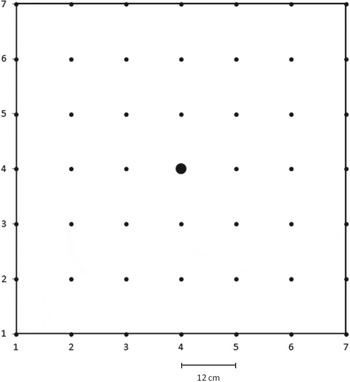
For each natural enemy, the experiments consisted of three replicates of three cages with the natural enemy and three without. In order to allow acclimation to the greenhouse environment, 1 day before insect release a potted CMV-infected cucumber source plant was placed in the centre of the tray surrounded by 48 non-infected cucumber plants placed in a grid but without physical contact with the virus-infected plant (fig. 1). Twenty-four hours later, 100 winged A. gossypii adults were confined in the CMV-infected source plant by means of a plastic cylinder with a ventilated lid and allowed them to establish and acquire the virus for 15 min. Immediately afterward, the cylinder was removed, and three L3 larvae of C. carnea or three adults of A. bipunctata were released in the source plant in half of the cages used for each natural enemy. Natural enemies were released one by one with the help of a brush in those leaves where aphids had been previously established.
Diagram of the experimental unit showing the CMV-source plant, where alate aphids and natural enemies were released (•) and the 48 peripheral plants that were initially non-infected (•). Units on the axes represent the coordinates of each cucumber plant; the real distance between each plant was 12 cm.

Because CMV is acquired and transmitted in very short time periods, lasting few minutes, aphid dispersion and the spread of CMV infection from the source plant were evaluated in the short term (after 1 day) and long term (after 5 days) in the presence and absence of each of the two natural enemies. Immediately after the evaluation, the virus source plant was placed in a bag (number of winged aphids and nymphs was evaluated later with binoculars); the absence/presence, number and development status of A. gossypii individuals in the peripheral plants were recorded, and plants were sprayed with the systemic insecticide Confidor® 20 LS (Bayer CropScience, 200 g l−1 (w/v) imidacloprid as a soluble concentrate, dilution rate 0.75 ml l−1) in order to kill the aphids and prevent further viral transmission. Four weeks after evaluation, leaf samples of receptor plants were frozen at −80 °C, and CMV infection was diagnosed by DAS-ELISA as previously described.
The mean temperature during short-term trials (evaluation after 1 day) was 19.6±0.2 °C (C. carnea) and 22.6±0.7 °C (A. bipunctata); during long-term trials (evaluation after 5 days), it was 20.6±0.6 °C (C. carnea) and 18.4±0.3 °C (A. bipunctata).
During assays, watering was performed by placing the trays with plants in a larger tray partially filled with water in order to not disturb the insects.
Statistical analysis
The density of aphids in the CMV-source plant, dispersal of aphids towards peripheral non-infected plants (percentage of plants occupied by at least one aphid morph) and percentage of CMV-infected plants at the two evaluation periods (1 and 5 days) were compared by Student's t test (P<0.05) after normality checks (Kolmogorov–Smirnov test) in the presence and absence of C. carnea or A. bipunctata. The Statgraphics Plus 5.1 statistical package (Statistical Graphics Corp., 1994–2000) was used for calculations. The percentage reduction in the number of aphids in the central virus-infected plant in the presence of each natural enemy was calculated with Abbott's formula: reduction (%)=(n c −n t )/n c ×100; where n c is the number of aphids in absence of natural enemy, n t is the number of aphids in presence of natural enemy (Abbott, Reference Abbott1925).
Spatially referenced counts in every sampling unit were used to calculate several indices. The spatial distribution of aphids and virus spread was studied through indices used by Korie et al. (Reference Korie, Clark, Perry, Mugglestone, Barlett, Marshall and Mann1998) and the spatial analysis by distance indices (SADIE) methodology, a biologically based method (Perry, Reference Perry1995) currently considered a powerful tool for the study of viral spread and pest and natural enemy displacement in a crop (Díaz et al., Reference Díaz, Legarrea, Marcos-García and Fereres2010; Legarrea et al., Reference Legarrea, Velázquez, Aguado, Fereres, Morales, Rodríguez, Del Estal and Viñuela2014). Korie's indices (Korie et al., Reference Korie, Clark, Perry, Mugglestone, Barlett, Marshall and Mann1998) were calculated to analyse the dispersal around a single focus: the distribution of the aphid dispersal or viral infection from the central plant (δ) measured as the distance between the central plant (x=4, y=4) and the centroid (C), considering C as the average position of aphids or CMV-infected plants in the experimental plot (fig. 1); the spread of the infection as the average distance of infected plants from the central release focus (Δ). The spatial pattern of viral infection and aphid dispersal was described by the SADIE index of aggregation (I a) (aggregated if I a>1; regular if I a<1 or random if I a=1) and the indices of clustering in patches and gaps (v i , vj ) (>1.5 patchiness, <−1.5 insects in the plant are members of a gap; close to 1, a random placement of insects in that plant in relation to others nearby) (Perry, Reference Perry1998). The last indices determine the extent to which each unit contributes to the global clustering; units with numbers greater than the overall mean are assigned to a positive patch cluster index (v i ) and those with counts under the mean to a negative gap cluster index (v j ) (Perry et al., Reference Perry, Winder, Holland and Alston1999). Moreover, the degree of spatial association between aphids and CMV spread was measured by the index of spatial association (X), which correlates the cluster indices of the two datasets previously calculated (Perry & Nixon, Reference Perry and Nixon2002). Similar indices (v i or v j ) are indicative of a local association (P<0.025) at the sample site; if they are different, a local dissociation is indicated (P>0.975) (Díaz et al., Reference Díaz, Legarrea, Marcos-García and Fereres2010). The number of natural enemies/replicate was too low to meet the requirements of SADIE analysis, and their spatial distribution could not be calculated.
Results
A. gossypii density on the central source plant
Both enemies promoted aphid movement from the central CMV-source plant to the peripheral plants (table 1). The presence of C. carnea caused a significant percentage reduction (Abbott, Reference Abbott1925) in the number of A. gossypii adult alates in the central CMV-infected plant both after 1 day (54.88%, t=4.46, P<0.01) and 5 days (93.63%, t=12.17, P<0.01) and in the number of nymphs after 5 days (85.36%, t=5.74, P<0.01). Adalia bipunctata only caused significant reductions in the numbers of adult alates (84.40%, t=6.39, P<0.01) and nymphs (77.10%, t=3.37, P=0.03) after 5 days.
Influence of the presence of L3 C. carnea or adult A. bipunctata on the density of A. gossypii (adult alate morphs and nymphs) in the central CMV-source plant 1 and 5 days after infestation with 100 adult alates. The data are the means±SE of the number of aphids/plant (n=3 replicates) 1 .

1 Student's t test (P<0.05). Significant data presented in bold.
2 Reduction in aphid population (Abbott, Reference Abbott1925).
A. gossypii dispersal from the central source plant
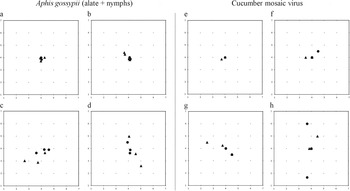
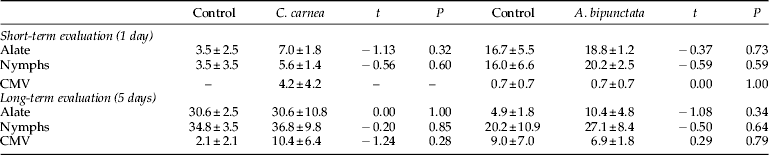
In the peripheral plants, the occupancy rate by at least one aphid (adult alate or nymph) was never significant (P>0.05) (table 2). However, the effect of the chrysopid and coccinellid was different. The percentage of occupancy after 1 day was slightly higher in the presence of L3 C. carnea (alates 7.0±1.8%; nymphs 5.6±1.4%) than in the control (alates 3.5±2.5%; nymphs 3.5±3.5%) but after 5 days, the dispersal of aphids towards the receptor plants increased enormously and similarly for both aphid developmental stages (control 30.6±2.5% alates, 34.8±3.5% nymphs; with natural enemy 30.6±10.8% alates, 36.8±9.8% nymphs). In contrast, when A. bipunctata was present, the number of alate aphids in the peripheral plants after 5 days was lower than after 1 day (10.4±4.8 and 18.8±1.2%), whereas the number of nymphs was similar (27.1±8.4 and 20.2±2.5%). Aphids showed limited movement after 1 day, mostly restricted to the vicinity of the central CMV-source plant, as indicated by the lower values of Δ index (table 3), and a little more movement after 5 days (higher Δ index values for alate+nymphs, table 4), which is graphically shown in fig. 2 (a, b and c, d, respectively), where the centroid position (C) of A. gossypii (alate+nymphs) populations are represented in the presence and absence of both enemies.
A. gossypii dispersal and CMV spread (centroids) from the central source plant in the short and long term (1 and 5 days) in the absence (•) or presence (▲) of natural enemies. Short-term evaluation (1 day): C. carnea (a, e); A. bipunctata (b, f). Long-term evaluation (5 days): C. carnea (c, g); A. bipunctata (d, h). The axes show the co-ordinates for each cucumber plant in the plot; the real distance between each plant was 12 cm.

Influence of the presence of L3 C. carnea or adult A. bipunctata on the percentage of peripheral plants occupied by at least one A. gossypii (adult alate or nymph) and percentage of CMV-infected plants 1 and 5 days after infestation with 100 adult alates in the central CMV-source plant. The data are the means±SE (n=3 replicates) 1 .

1 Student's t test (P<0.05).
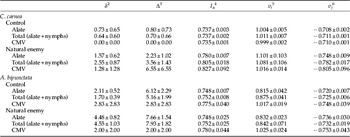
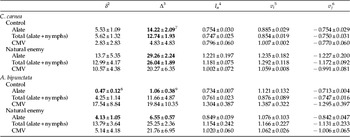
Spatial pattern indices of Aphis gossypii populations and CMV spread after 1 day in the presence and absence (control) of L3 C. carnea or adult A. bipunctata. The data are the means±SE of three replicates/natural enemy 1 .

1 Student's t test was used to compare δ and Δ indices between control and natural enemy replicates, and no statistically significant differences were detected (P>0.05).
2 Mean distance between the centroid of the aphid/virus distribution and the central release plant±SE, in cm.
3 Mean distance of aphid/virus-infected plants positions from the central release focus±SE, in cm.
4 Mean aggregation index calculated by the SADIE method±SE.
5,6 v i , vj are the mean cluster indices calculated by the SADIE methodology and refer to patches and gaps, respectively±SE.
Spatial pattern indices of Aphis gossypii population and CMV spread after 5 days in the presence and absence (control) of L3 C. carnea or adult A. bipunctata. The data are the means±SE of three replicates/natural enemy 1 .

1 Student's t test was used to compare δ and Δ indices between control and natural enemy replicates. Significant data presented in bold.
2 Mean distance between the centroid of the aphid/virus distribution and the central release plant±SE (in cm).
3 Mean distance of aphid/virus-infected plants positions from the central release focus±SE (in cm).
4 Mean aggregation index calculated by the SADIE method±SE.
5,6 v i , vj are the mean cluster indices calculated by the SADIE methodology and refer to patches and gaps, respectively±SE.
7 Alate (t=−4.93, P<0.01), total morphs (t=−4.91, P<0.01).
8 Alate (t=−3.47, P=0.03).
9 Alate (t=−8.03, P<0.01).
CMV spread
The CMV transmission rate by A. gossypii from the central source plant was very low after 1 day and did not change in the presence or absence of both natural enemies (P>0.05; table 2). In the presence of L3 C. carnea larvae, only 12.5% of peripheral plants (6 out of 48) became infected in one replicate and none in the other two. Because of that, the average value was very low, and the SE was very high (4.2±4.2%). In the presence of A. bipunctata adults, the average viral transmission rate was even lower (0.7±0.7%). After 1 day, the infected plants were concentrated in the central area of the experimental unit, near the CMV-source plant, as shown in fig. 2 (e, f). After 5 days, the viral transmission slightly increased, but values were always under 11% and not very homogeneous, so no significant differences were observed between treatments. However, the percentage of infected plants seemed to be higher in the presence of L3 C. carnea larvae (10.4±6.4%) and in the absence of A. bipunctata (9.0±7.0% compared to 6.9±1.8% in the presence of the natural enemy) (table 2). After 5 days, the viral spread from the source to the receptor plants increased somewhat [fig. 2 (g, h)] as indicated by the higher values of indices δ and Δ (table 4).
The low values of the indices measuring the spread of the infection from the CMV-source plant after 1 day [δ, Δ] are also indicative of the limited movement of the aphid colony in the short term, both in the absence and presence of predators, which meant that no statistically significant differences were obtained (table 3). Based on the higher values of index δ in the presence of C. carnea and A. bipunctata, both enemies initially (after 1 day) seemed to promote the dispersal of A. gossypii and CMV infection (2.55±0.87 and 4.55±1.03 cm, respectively) compared to a more centralized distribution in control cages (0.64±0.60 and 1.70±0.39 cm, respectively). Despite this fact, the aggregation index in the short term was lower than 1 (I a<1), irrespective of the presence of the predators, which indicated in this case a concentration of Aphis gossypii individuals in the central infected plant, surrounded by plants with no aphids, and the lack of significance of the clustering indices v i (<1.5) and v j (>−1.5) (table 3).
When the evaluation period was extended (5 days), an increase in the value of the dispersal parameters was observed, especially in the presence of natural enemies, but the viral and aphid distribution patterns were heterogeneous (table 4). Irrespective of the natural enemy present, no statistically significant difference in the spread of CVM could be detected in the displacement and distribution indices with and without natural enemies. When C. carnea was present, the spread of the infection (Δ) by alates (t=−4.93, P<0.01) or total morphs (t=−4.91, P<0.01) was significantly higher than in its absence (P<0.05). A. bipunctata increased both aphid dispersal (δ; t=−3.47, P=0.03) and the spread of infection (Δ; t=−8.03, P<0.01). Both natural enemies seemed to promote the dispersal of aphids because the population centroids were more distant from the CMV-source plant in their presence fig. 2 (c, d). In contrast to the values obtained after 1 day, the distribution pattern of aphid colonies (alate+nymphs) was only concentrated in the central plant (I a<1) in the absence of predators and aggregated (I a>1) when they were present, but neither of the clustering indices were significant (v i <1.5; v j >−1.5) (table 4). A random CMV distribution (I a≈1) was observed in the presence of C. carnea and A. bipunctata based on the I a aggregation index (1.002±0.072 and 1.020±0.060, respectively) and on the clustering indices (v i <1.5 and v j >−1.5) (table 4). The randomness of the CMV spread in the presence of either of the two predators was also reflected by the distribution of infected plants shown in fig. 2 (g, h).
Association patterns between vector and virus
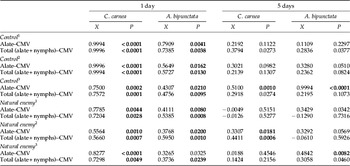
After 1 day, irrespective of the presence or absence of one of the two predators, the distribution patterns of aphid colonies and viral spread around the central cucumber CMV-source plant were similar, and significant association indices (X) were obtained (P<0.025) (table 5). After 5 days, however, a general lack of significance in the association indices between the virus and the vector was detected (table 5).
Association index (X) in every replicate (1, 2 and 3) between A. gossypii and CMV infection, after 1 day or 5 days, in the presence of L3 C. carnea or adult A. bipunctata.

X is the measure of the degree of association, and P is the probability level. Associations are significant (in bold in the table) when P<0.025, and dissociations are significant when P>0.975.
Discussion
As could be expected based on the sedentary behaviour of A. gossypii compared with other aphid species (Adams & Hall, Reference Adams and Hall1990), the dispersal of the aphid colony after the release of adult morphs in the central virus-infected plant was limited, especially after 1 day, and did not increase consistently after 5 days. The preference that many vectors seem to have for staying on infected plants where they exhibit an improvement in their fitness could also have contributed to the observed behaviour (Kennedy, Reference Kennedy1951; McKenzie et al., Reference McKenzie, Shatters, Doostdar, Lee, Inbar and Mayer2002; Maris et al., Reference Maris, Joosten, Goldbach and Peters2004; Jiu et al., Reference Jiu, Zhou, Tong, Xu, Yang, Wan and Liu2007; Jeger et al., Reference Jeger, Chen, Cunningham, Martin and Powell2012). In the presence of natural enemies and in contrast to other aphid species, A. gossypii does not exhibit a typical escape response (Nelson & Rosenheim, Reference Nelson and Rosenheim2006); thus, in our trials, we did not expect immediate movement from the viral source plant after their release. After 5 days, the two natural enemies assessed, C. carnea and A. bipunctata, played the expected conventional role of benefiting the host plant by reducing the pest pressure, and a significantly lower number of A. gossypii were detected in the central source plant. In contrast, after 1 day, a significant decrease in the number of aphids in the central plants was observed only in the lacewing plots. Differences in the consumption rate and mobility between the two natural enemies might account for this. C. carnea seems to be a more voracious species than A. bipunctata based on their larval aphid consumption rates (Gurney & Hussey, Reference Gurney and Hussey1970; Liu & Chen, Reference Liu and Chen2001), which are even a bit lower than those of A. bipunctata adult (Ellingsen, Reference Ellingsen1969). Larvae of C. carnea must be highly mobile in order to follow their soft-bodied prey, which are mostly homopterous (Viñuela et al., Reference Viñuela, Händel and Vogt1996; Duelli, Reference Duelli, McEwen, New and Whittington2001), but they exhibit a much lower movement capacity compared to coccinellid adults, which tend to fly away from the crop soon after the release even in greenhouses (Lommen et al., Reference Lommen, Middendorp, Luijten, van Schelt, Brakefield and de Jong2008). Consequently, Chrysoperla larvae most likely spent more time in the central virus-infected plant than the coccinellid, so its aphid consumption rate was higher.
However, dispersion of aphids in the presence or absence of either of the two natural enemies studied (C. carnea or A. bipunctata) was scarce and similar. The percentage of non-infected peripheral plants occupied by at least one aphid after 1 or 5 days did not significantly differ in either case, as shown by the centroids of the aphid populations, which were located around the central arena point.
The CMV transmission rate observed in our trials was low, and no differences in the viral and vector spatial distributions were detected. CMV is a non-persistent virus, and as such, its transmission is highly promoted if the vector acquires the viral particles during short periods (seconds), as the non-colonizing aphids, the main vectors of this type of virus, typically do. In this case, the general rule is a lack of virus–vector association patterns. However, A. gossypii, which is a good CMV vector, can settle in plants and form colonies, so the viral acquisition time can be increased, and therefore the efficiency of transmission decreases due to the loss of the viral particles linked to the stylet-specific receptors during the ingestion of phloem sap (Ng & Perry, Reference Ng and Perry2004; Moreno et al., Reference Moreno, Tjallingii, Fernández-Mata and Fereres2012). In agreement with this, in our assays, the transmission rate was low, and at a short evaluation period (1 day), the SADIE association indices (X) between vector and virus were significant in practically every replicate (P<0.025). In contrast, after 5 days, non-coincident distribution patterns between A. gossypii and CMV were observed, which is typical in non-persistent transmitted viruses due to the low transmission success after the first visit of an aphid to a plant (low rate of secondary spread) (Kennedy et al., Reference Kennedy, Day and Eastop1962).
The epidemiology of aphid-borne viruses is highly linked to vector movement (Jeger et al., Reference Jeger, Holt, van den Bosch and Madden2004), and the presence of natural enemies can modify that of viruliferous aphids, but this effect is likely imperceptible when compared to environmental influences (Hooks & Fereres, Reference Hooks and Fereres2006). In our trials, there was not a significant effect of the two aphidophagous predators, C. carnea and A. bipunctata, in the incidence and spread of CMV. Infected plants were mainly located around the central virus-infected source plant, and the percentage of aphid occupation and CMV-infected plants did not significantly differ in the absence and presence of natural enemies. However, other studies on the spread of viruses transmitted in a non-persistent manner show that the foraging habit of natural enemies can have an influence on vector dispersal and viral spread (Tamaki et al., Reference Tamaki, Halfhill and Hathaway1970; Roitberg & Myers, Reference Roitberg and Myers1978; Smyrnioudis et al., Reference Smyrnioudis, Harrington, Clark and Katis2001; Belliure et al., Reference Belliure, Amorós-Jiménez, Fereres and Marcos-García2011). Nelson & Rosenheim (Reference Nelson and Rosenheim2006) observed that 96% of the encounters between C. carnea larvae and A. gossypii individuals in a cotton field ended with aphid consumption, whereas only 4% induced an anti-predator response. In the case of coccinellids, their more energetic searching behaviour has been identified as a key factor in the dispersal and epidemiology of several virus–vector systems (Roitberg & Myers, Reference Roitberg and Myers1978; Bailey et al., Reference Bailey, Irwin, Kampmeier, Eastman and Hewings1995; Losey & Denno, Reference Losey and Denno1998; Smyrnioudis et al., Reference Smyrnioudis, Harrington, Clark and Katis2001; Belliure et al., Reference Belliure, Amorós-Jiménez, Fereres and Marcos-García2011). However, in our assays, this characteristic was not reflected by an increase of viral spread because CMV transmission was equal to or even lower in the presence of A. bipunctata after 1 day or 5 days, although any differences were not statistically significant. Dáder et al. (Reference Dáder, Moreno, Viñuela and Fereres2012) with a similar methodology observed that the parasitoid Aphidius colemani Viereck increased CMV transmission by A. gossypii in the short term (2 days) but not in the long term (7 days) in the cucumber.
In conclusion, the results obtained in this work are once again indicative of the complexity involved in trophic interactions among crops, vectors, viruses and predators. Consequently, it is necessary to perform large-scale trials in commercial greenhouses in order to obtain further information about the benefit/damage ratio that aphidophagous predators induce in aphid populations and about the spread of non-persistent transmitted viruses in protected crops.
Acknowledgements
This work was supported by the Spanish Ministry of Science and Innovation (project AGL2010-22196-C02-02). The authors specially thank Beatriz María Díaz for assistance with the SADIE analysis. A. Garzón acknowledges the UPM for the PhD research grant.