INTRODUCTION
Water is indispensable for animal production and productivity is impaired if water requirements are not completely satisfied. One of the important features of desert and dry regions is water scarcity, which could represent a serious constraint for the performance of livestock, particularly when it is coupled with higher ambient temperatures. Therefore, water efficiency could be a key factor of endurance and maintenance of productivity of ruminants known for their adaptation to such zones (Silanikove Reference Silanikove2000). Water requirements and efficiency of water metabolism may vary between species and also between breeds. Desert-adapted sheep and goats are characterized by lower water demands together with the ability to utilize water more economically and efficiently, and these features could be pronounced during periods of limited water supply (Silanikove Reference Silanikove1989). Water intake is affected by heat exposure, since higher ambient temperatures will increase water consumption (Giger-Reverdin & Gihad Reference Giger-Reverdin, Gihad and Morand-Fehr1991) in order to meet the increase in demand of water for evaporative cooling.
Season also has a distinct impact on total body water (TBW) because the body water content is increased during summer compared to winter in sheep (El-Nouty et al. Reference El-Nouty, Hassan, Taher, Samak, Abo-Elezz and Salem1988). Ruminants that dwell in hot areas are characterized by higher TBW: 0·70 compared to 0·50 in animals that inhabit cold areas (Terril Reference Terril and Hafez1968). The higher body water content associated with higher ambient temperatures could be considered as an adaptive means employed by ruminants to cope with higher air temperatures (Yousef & Johnson Reference Yousef, Johnson and Yousef1985). It is well recognized that animals that store a large volume of water in their bodies can endure high ambient temperatures in the desert and dry regions, since higher levels of BW act as a buffer for any rise in body temperature. Sheep and goats are found to be suitable animals for rearing in hot, dry and desert regions where the animals may be subjected to a limited supply of water, together with extreme ambient temperatures during the summer season.
Sheep and goats share many anatomical and physiological characteristics, but some reports have indicated that differences with regard to water requirement and metabolism do exist between the two species. For instance, goats consume less water and have a lower water turnover rate than sheep, but with higher TBW content (Ghosh et al. Reference Ghosh, Singh, Verma, Saxena and Ranjhan1980; El-Hadi Reference El-Hadi1986; El-Nouty et al. Reference El-Nouty, Hassan, Taher, Samak, Abo-Elezz and Salem1988). Awassi sheep and Aardi goats are known for their pronounced adaptation to harsh desert conditions, particularly limited water supply and heat stress (Alamer & Al-Hozab Reference Alamer and Al-Hozab2004; Alamer Reference Alamer2006).
The environmental conditions in desert and arid regions differ between seasons and can be very hostile during the summer; hence, there is considerable need for evaluation of water requirements and BW distribution to assess their adaptability. Little is known regarding water efficiency and body fluid distribution in desert-adapted sheep and goats during different seasons. Therefore, the objectives of this study were to evaluate and compare water consumption and BW distribution in Awassi sheep and Aardi goats during different seasons. Such a study would provide information that would be useful in improving management systems in order to increase the performance and welfare of these well-adapted desert species of livestock during harsh environmental conditions.
MATERIALS AND METHODS
Animals, housing and management
This study was conducted at the Agricultural and Veterinary and Research Station of King Faisal University in Al-Hassa, Saudi Arabia (25°05′–25°040′N, 49°10′–49°55′E, 130–160 m asl, average annual precipitation 74 mm). Ten Awassi sheep ewes and 10 Aardi goats, all aged 12–14 months, were used. They were individually housed (1·5×2·0 m) in shaded pens and each animal was fed 500 g of commercially formulated concentrate daily at 08:00 h (140 g/kg crude protein and gross energy of 3·7 kcal/kg DM); alfalfa hay and water were provided ad libitum. These experimental conditions were maintained for 7 days which was considered as an adaptation period. All the experimental procedures were in compliance with the Guide for the Care and Use of Agricultural Animals in Agricultural Research and Teaching (Consortium 1988).
Experimental design
During the following week, feed and water intake along with body weight were recorded daily before morning feeding by weighing the remains of the previous day. To correct for water evaporation, a similar water container was placed in the pen and the weight of evaporated water was subtracted from that of the consumed water. The corrected drunk water was added to water contained in the consumed feed to determine the total daily water intake. Body weight (BW) was also recorded in the morning prior to feeding.
Body water was determined simultaneously with extracellular fluid (ECF) by urea and sodium thiocyanate (NaSCN) dilution methods, respectively (Gad & Preston Reference Gad and Preston1990). Five animals from each group were used for determining body water and body water compartments. Feed and water were withdrawn overnight before measurements, and were not available to animals during sampling. Animals were catheterized in both jugular veins using an I.V. cannula 14 G×57 mm (Mais Company for Medical Products, Riyadh, Saudi Arabia): c. 50 mm-long microtube (outer diameter 2·14 mm) was inserted into the jugular vein and the catheter secured with tape. One catheter was used for infusion and the other for blood sampling. A solution containing 3·33 M urea (Avonchem Ltd, Oxon, UK) and 0·37 M (w/v) sodium thiocyanate (S 7757, Sigma Steinheir, Germany) was administered through the jugular catheter over 1 min. The working infusate, dissolved in distilled water, was injected at a rate of 0·66 ml/kg body weight (to provide 130 mg of urea and 19·8 mg of NaSCN per kg body weight). The catheter was then flushed with 5 ml of heparinized saline solution (100 IU/ml of 0·154 M saline). Blood samples (5 ml) were taken in heparinized tubes immediately before infusion and at 12 and 28 min post injection. Catheters were flushed with 5 ml of the heparinized saline solution following each sampling to prevent clotting of the catheter. Plasma volume (PV) was determined by dilution of marker T-1824 (Evans blue, E2129, Sigma, Saint Louis, MO, USA). Shortly after the last sampling of body water and ECF determinations, animals were infused with 0·5 mg/kg body weight of Evans blue (EB) solution (dissolved in 0·154 M saline). Blood samples were drained into heparinized tubes before infusion and then at 10 min intervals for 1 h following infusion. Haematocrit (HCT) was determined from whole blood samples by a microhaematocrit centrifuge. Blood was centrifuged at 4°C for 15 min at 3000 g and the plasma was harvested and stored at −20°C until analysis.
Plasma urea was determined in samples 0 and 12 min post infusion using a commercial kit (United Diagnostics Industry, Dammam, Saudi Arabia). Sodium thiocyanate was determined in plasma samples 0 and 28 min post injection following the procedure of Gortel et al. (Reference Gortel, Schaefer, Young and Kawamoto1992). Empty body water (EBW) was recorded as the pool available to the urea and the following formula was followed to calculate urea space (Kock & Preston Reference Kock and Preston1979): Urea space (as proportion of BW)=[volume infused (ml)×concentration of solution (g urea nitrogen/l×100)]/[plasma urea nitrogen/live body weight (kg)]. Plasma urea nitrogen was calculated by subtracting plasma urea of time 12 min from that of time 0. Thiocyanate (SCN) space (litres) was calculated using the formula=injected SNC (mg)/concentration of SCN at time 0 (mg/l). Intracellular fluid (ICF) volume was calculated as the difference between EBW and ECF.
EB was measured in fresh plasma samples (within 2 h of collection) by a spectrophotometer (UV/VIS 220 Spectrophotometer, Aurora, Canada), utilizing the dual-wavelength (620 and 740 nm) absorbance method (Foldager & Blomqvist Reference Foldager and Blomqvist1991). The absorbance at 620 nm was corrected for turbidity following measuring the absorbance at 740 nm. Standards were prepared by adding 5, 10 and 20 ul of infusate to 10 ml of distilled water and read in a similar way to the plasma samples. Values were fitted to a logarithmic decay curve of plasma dye concentrations over time using linear regression to extrapolate to a calculated dye concentration at the time of injection. PV was calculated as the space into which the marker had been diluted and the following formula was applied: PV=(mg dye injected)/(anti-logarithm of y intercept extrapolated to time 0, time of injection). Blood volume (BV) was calculated using the following formula: PV/(1−HCT). Haematocrit was expressed as a proportion.
Measurements were conducted during winter (January) and summer (June), to evaluate water consumption and body water compartments during different seasons. The average maximum and minimum temperatures during winter were 21·8 and 10·3 °C, respectively, and the corresponding values for summer were 43·9 and 28·9°C. Average relative humidity during the daytime was 62 and 44% during winter and summer, respectively.
Statistical analysis
A complete randomized design with factorial arrangement was performed for the statistical analysis of the data. The data were analysed using the General Linear Model (GLM) procedure of SAS (1996). The following model was used:

where Y ij is the dependent variable, μ is the general mean, A is the ith effect of species, B is the jth effect of season, AB is the interaction between species and season and e ij is the random error. Comparisons between means were performed using means and standard errors of the dependent variables and P-values of <0·05 or <0·01 with degrees of freedom of the source of variation.
RESULTS
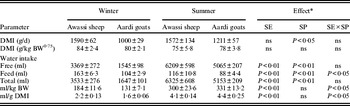
Daily dry matter intake (DMI) was significantly (P<0·05) higher in Awassi sheep irrespective of season, and there was no clear effect of season on DMI in either species (Table 1). DMI per unit of metabolic weight (g/kg BW0·75) was not affected by either season or species.
Average daily intake of feed and water (±s.e.m.) for Awassi sheep and Aardi goats during winter and summer seasons

* Effect: SE, season effect; SP, species effect; SE×SP interaction effect of SE and SP; d.f.=1. Statistical significances are shown as P-value, ns=not significant.
Free and total water consumptions were significantly influenced (P<0·01) by season; all animals consumed more water during summer than winter (Table 1). Analysis of variance also revealed a significant (P<0·01) difference between the two species, with Awassi sheep having higher overall mean value of water consumption than Aardi goats. Even though Aardi goats maintained a lower water intake than that of sheep during winter, they increased their water intake during summer to a similar level to that of sheep. Water intake, expressed on BW and DMI basis, increased significantly (P<0·01) during summer with a greater increase in the Aardi goats compared to Awassi sheep.
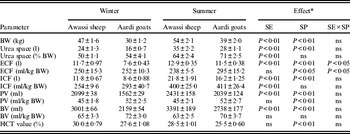
Urea space (litres) was significantly (P<0·01) affected by season and species; it increased during summer at similar rates in both species and higher values in the sheep compared to the goats (Table 2). Urea space is known to be highly correlated with EBW (Preston & Kock Reference Preston and Kock1973) and has been used extensively to measure EBW (TBW less the water in the gastrointestinal tract). EBW, expressed as a proportion of live weight, also increased significantly (P<0·01) during summer. Besides, the overall mean proportion of EBW tended to be greater (P=0·062) in Aardi goats compared to that of Awassi sheep.
Body fluid compartments of Awassi sheep and Aardi goats (±s.e.m.) during winter and summer seasons

* Effect: SE, season effect; SP, species effect; SE×SP interaction effect of SE and SP; d.f.=1. Statistical significances are shown as P-value, ns=not significant.
The absolute values of ECF increased significantly (P<0·01) from winter to summer in both species. However, there was a significant species×season interaction (P<0·05), since the magnitude of increase was larger in the goats (50% increase) compared to sheep (10% increase). The ECF (ml/kg BW) was significantly (P<0·05) increased in Aardi goats, while the Awassi sheep maintained an almost constant mean value. Analysis of variance indicated a significant (P<0·01) difference between species and season in ICF (litres): it was higher in sheep than in goats and it increased significantly (P<0·01) from winter to summer in both species.
Mean absolute values of PV were affected significantly by season and species (P<0·01): it was lower in winter than summer, and goats had lower values compared to sheep. Species also affected (P<0·01) the overall mean values of PV (ml/kg BW); the Aardi goats having higher values than the Awassi sheep. However, the mean values of PV were not affected by season, since the levels were almost constant throughout both seasons regardless of species. The absolute value of BV increased significantly (P<0·01) during the summer in both species. However, when BV was expressed on the basis of BW, the seasonal effect on BV disappeared. HCT value was significantly affected (P<0·01) by species, with goats maintaining lower overall mean HCT values in comparison with the sheep. In addition, HCT tended to decline in both species in summer (P= 0·055), by 8 and 5% in Aardi and Awassi animals, respectively.
DISCUSSION
The results of this study have indicated an interesting finding concerning feed consumption when DMI during summer was maintained at the winter level in both species despite the distinct increase in ambient temperature during summer. Some previous studies found that exposing Awassi wethers and rams to moderate heat stress did not affect feed intake (Bhattacharya & Uwayjan Reference Bhattacharya and Uwayjan1975; Denek et al. Reference Denek, Can, Tufenk, Yazgan, Ipek and Iriadam2006); however, Bhattacharya & Hussain (Reference Bhattacharya and Hussain1974) reported a 14–50% decrease in feed intake on Awassi wethers exposed to 32°C but with a high relative humidity (89%). The DMI expressed on the metabolic BW basis of Aardi goats during summer in this study was higher than that reported in desert-adapted goats during hot summer conditions (Silanikove Reference Silanikove1985; Ahmed & El Kheir Reference Ahmed and El Kheir2004). It has been proposed that the decrease in feed intake associated with seasonal increase in ambient temperature is related to a reduction in heat production, hence maintaining the thermal balance of the animal (Silanikove Reference Silanikove1992). In this study, the ability of local Awassi sheep and Aardi goats to maintain a constant feed intake in the face of increased ambient temperature was suggestive of a great adaptability to hot summer conditions. It has been proposed that ruminants with high heat tolerance are characterized by an ability to maintain reasonably higher levels of feed intake during heat exposure (Garcia & Gall Reference Garcia, Gall and Gall1981; Alamer Reference Alamer2003).
The observed increase in water consumption by animals in this study during the summer season was related to meeting their needs for heat dissipation by means of evaporative cooling (Degen & Young Reference Degen and Young1981; Shafie et al. Reference Shafie, Murad, El-Bedawy and Salem1994). During the winter season, Aardi goats had lower water consumption per kg metabolic body weight and per DMI than sheep. Accordingly, it is feasible to deduce that the reduced water intake in goats was probably related to their ability to budget their water requirements more economically than the Awassi sheep during lower temperatures. Some reports have indicated that goats consume less water than sheep from the same ecological area (Ghosh et al. Reference Ghosh, Singh, Verma, Saxena and Ranjhan1980; El-Nouty et al. Reference El-Nouty, Hassan, Taher, Samak, Abo-Elezz and Salem1988; Qinisa & Boomker Reference Qinisa and Boomker1998), and such variation between the two species may reflect higher water economy in goats (King Reference King1979). Lower water loss through urine and faeces in goats compared to sheep has been reported by Aganga et al. (Reference Aganga, Umunna, Oyedipe and Okoh1989), which suggests a better water saving mechanism. However, the superiority of goats in this respect was lost when the heat burden imposed on them was increased during summer, which resulted in a marked elevation in water intake. This could be ascribed partly to the noted higher DMI in Aardi goats compared to Awassi sheep; this higher feed intake may have necessitated extra water for the elimination of waste products and evaporative cooling to dissipate the excess heat. In addition, animals in this study were not completely protected from sun exposure and the goats might have absorbed more solar radiation due to their black colour compared to the white colour of the Awassi sheep. This might account for the increase in water consumption in order to dissipate the extra heat imposed on them.
Water consumption expressed per DMI in the Awassi sheep of this study (2·2–4·1) was lower than that reported in Awassi lamb rams (2·9–6·2) during both winter and summer seasons (Can et al. Reference Can, Denek and Seker2008). However, the ratio of water consumed per unit DMI of Awassi sheep during summer agreed closely with the results of Laden et al. (Reference Laden, Nehmadi and Yagil1987), who reported 4·5 ml/g DMI in Awassi ewes. The water intake of Aardi goats during summer in this study was similar to that reported by El-Nouty et al. (Reference El-Nouty, Al-Haideray and Basmaeil1990) in Aardi bucks during hot summer conditions. Desert-adapted breeds of ruminants are known to have lower water requirements than their temperate counterparts, which are probably related to their lower energy requirements, in conjunction with lower metabolic rate (Silanikove Reference Silanikove1989).
The significant increase in EBW during summer in both species agrees with earlier reports for goats and sheep (Shebaita & El-Banna Reference Shebaita and El-Banna1982; El-Nouty et al. Reference El-Nouty, Hassan, Taher, Samak, Abo-Elezz and Salem1988). The increase in ambient temperature during summer would induce an increase in water loss through evaporative cooling to dissipate the surplus heat gained by the body. Therefore, the rise in body water content could be regarded as an adaptive mechanism to support higher water demand, which also has been proposed as indicative of heat endurance (Yousef & Johnson Reference Yousef, Johnson and Yousef1985). This rise in EBW could be related to a higher proportion of water ingestion which is induced during summer, and also to the induction of the capacity for water retention (El-Nouty et al. Reference El-Nouty, Elbanna, Davis and Johnson1980) to grant water for intense evaporative heat loss.
The higher overall mean value of EBW in goats compared to that of sheep corresponded with some reports of sheep and goats from subtropical and desert regions (El-Nouty et al. Reference El-Nouty, Hassan, Taher, Samak, Abo-Elezz and Salem1988; Elmansoury et al. Reference Elmansoury, Musa, Majid, Barri, Abdalla and El-Wasela1998). This difference in body water content is likely to reflect variations in body composition between the two species, as sheep contain more fat in their bodies compared to goats (Benjamin et al. Reference Benjamin, Koenig and Becker1993) and there is an inverse relationship between body water and body fat content (Ghosh et al. Reference Ghosh, Verma, Singh and Ranjhan1979; Atti et al. Reference Atti, Bocquier, Theriez, Khaldi and Kayouli2000).
There were differences between the two species in ECF volume expressed per unit of live body weight; it increased by 17% during the summer in goats compared to 5% decline in the sheep breed. It is generally recognized that adaptation to hot climates is associated with a larger ECF space, since ruminants that survive very successfully in such areas are characterized by a larger ECF pool (Shkolnik & Choshniak Reference Shkolnik, Choshniak and Yousef1985). This excess of body fluid in Aardi goats might serve as a reservoir to meet water demands during periods of lack of water. The observed increase in ECF during summer in goats agrees with previous findings in goats (Kamal et al. Reference Kamal, Shehata and Elbanna1972) and calves (Saxena & Joshi Reference Saxena and Joshi1980), when ECF increased during heat exposure. The increase in water content of ECF during the expansion of ECF space that occurred during the summer was caused by an increase in whole body water and a possible displacement of water from other compartments. A possible source of fluid for the expansion of ECF is the digestive tract, which contains considerable amount of water that may be retained, notably in the rumen, and the role of the rumen as a water reservoir is known to be more pronounced in desert species and breeds (Silanikove Reference Silanikove2000). Furthermore, goats have been reported to have a larger rumen capacity compared to sheep (Gihad et al. Reference Gihad, El-Bedawy and Mehrez1980). Therefore, the elevation of water consumption that was contained in the rumen of Aardi goats could account for the maintenance of higher ECF.
The present results revealed a pronounced increment in ICF during summer in both species, which implies more water storage in this body water compartment compared to winter. Gholap & Dixit (Reference Gholap and Dixit2004) reported virtually equivalent ECF values for goats during summer, while Degen (Reference Degen1977) reported slightly higher ECF values for sheep. However, the ICF values obtained in this study during summer agreed closely with those reported by the same investigators who reported ICF values of 41–45% of body weight during summer (Degen Reference Degen1977; Gholap & Dixit Reference Gholap and Dixit2004). Thus, a possible underestimation of the ECF in this study is not accounted for by an increase in ICF. Furthermore, the expansion of ICF during summer in this study is in accordance with other studies that have reported a significant rise in ICF during summer in camels (Ghosal et al. Reference Ghosal, Appana and Dwaraknath1974) and in heat-exposed sheep (Kamal et al. Reference Kamal, Shehata and Elbanna1972). It has been proposed that such expansion of ICF was correlated with heat tolerance, probably by enhancing heat storage capacity and hence heat endurance during hot summer conditions (Kamal et al. Reference Kamal, Shehata and Elbanna1972). Another factor contributing to this increase in ICF is the increasing size of the intercellular compartment as animals grow leading to an increase in intracellular water (Dalinghaus et al. Reference Dalinghaus, Gratama, Koers, Gerding, Meuzelaar, van de Berg, Zijlstra and Kuipers1993).
Although the EBW together with ECF, expressed as a proportion of live weight, tended to be affected by the seasonal changes in both species, the PV remained constant throughout both seasons. This finding agrees with the previous study of Degen (Reference Degen1977), who reported that PV was not affected by season in sheep despite the observed changes in body water and ECF. Apparently, the ability of these animals to maintain a constant PV despite the changes in TBW and ECF is essential for proper circulatory function. Furthermore, maintaining a constant PV during summer despite the continuous loss of water from the blood (ECF) via evaporative cooling is an important feature of desert ruminants for withstanding severe heat exposure. The lower HCT value in goats might be indicative of a larger water pool in the blood compared to sheep. El-Sayed et al. (Reference El-Sayed, Azamel and El-Ganaieny1993) also reported higher HCT values in sheep than that of goats. This is likely to be a reflection of the variation in PV, since it was greater in goats irrespective of season.
At lower temperatures, goats consumed less water than sheep, indicating that goats balanced their water requirements at a lower level. However, the increase of ambient temperature during the summer resulted in a concurrent increase in water consumption in goats, until they matched that of the Awassi sheep. Furthermore, EBW, ECF and PV increased during summer but with greater increases in goats compared to sheep. There was a possible shift of water from other body water compartments towards ECF in goats during the summer to expand the volume of ECF. It can be concluded that Aardi goats opt to increase their body water and expand ECF and PV to support their increasing demand for evaporative water loss during summer. Further studies are needed to assess water turnover rate together with water balance during different seasons evaluate their adaptability to hot desert conditions.
Support provided by the deanship of Scientific Research of King Faisal University is greatly appreciated. Also, the author is grateful to the Agricultural and Veterinary Research Station of King Faisal University for providing the necessary facilities to conduct this study.