CHD is one of the most common birth defects, with a worldwide incidence of eight in every 1000 live births.Reference Moons, Bovijn, Budts, Belmans and Gewillig 1 Half a century ago, only 20% of these children reached 18 years of age. Advances in medical and surgical interventions now mean that almost 90% of children diagnosed with CHD are living well into adulthood.Reference Fteropoulli, Stygall, Cullen, Deanfield and Newman 2 This improved survival has allowed greater attention to be paid to their quality of life and psychosocial well-being as they move through adolescence into adulthood.Reference Eagleson, Justo, Ware, Johnson and Boyle 3
As with most chronic illnesses, patients with CHD require ongoing follow-up and care. They may have multiple and extended absences from school, which tend to interfere with their education, their ability to form close relationships, and their overall sense of “normalcy” through childhood, adolescence, and even into adulthood.Reference Horner, Liberthson and Jellinek 4 They may experience restrictions with regard to exercise, social activities, and their ability to bear children, which their healthy counterparts generally do not experience.Reference Fteropoulli, Stygall, Cullen, Deanfield and Newman 2 , Reference Ladouceur, Iserin, Cohen, Legendre, Boudjemline and Bonnet 5 On the basis of these factors alone, one would hypothesise that adult patients with CHD may have a worse quality of life when compared with healthy controls; however, growing literature from around the world shows conflicting results. Although many investigators have found a worse quality of life,Reference Cohen, Daniela, Yalonetsky, Gagin and Lorber 6 , Reference Gierat Haponiuk, Haponiuk, Chojnicki, Jaworski and Bakuła 7 there are also those who have reported an equal or even better quality of life.Reference Apers, Moons and Goossens 8 – Reference Silva, Vaz and Areias 10 These conflicting results demonstrate that quality of life is likely to be multifactorial.Reference Fteropoulli, Stygall, Cullen, Deanfield and Newman 2 Some researchers have suggested that the increased adversity that these patients experience leads to an increased sense of coherence or optimism, which may explain their higher quality of life.Reference Apers, Moons and Goossens 8 Others have described disease severity and resultant functional capacity as having an impact on their quality of life.Reference Bang, Jo and Kim 9
To assess the impact of CHD in adults, it is necessary to investigate their quality of life and its determinants. This study examined the correlations between patients’ quality of life, symptoms of anxiety and depression, disease severity, and a sense of coherence in Australian adults with CHD recruited from a single ambulatory population.
Materials and methods
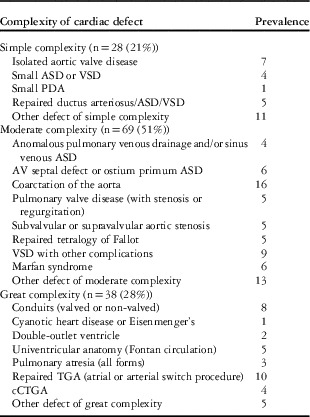
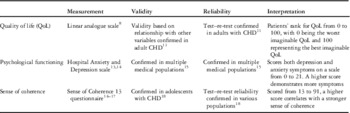
This study was part of a multicentre study entitled “Assessment of Patterns of Patient-Reported Outcomes in Adults with Congenital Heart disease – International Study”. The rationale and methodology followed were set out by the co-ordinators of the study and have been reported in full.Reference Apers, Kovacs and Luyckx 11 The results published in this article are from the Australian arm of this ongoing International study, which is yet to be published in full. Adults aged 18 years and above with CHD were recruited consecutively from a single, community-based consultant paediatric cardiology practice. This practice provides service to both urban and rural patients and continues to care for children as they mature into adults with CHD. Following informed consent, questionnaires were completed describing patient-reported outcomes, including the Linear Analogue Scale for quality of Life,Reference Apers, Kovacs and Luyckx 11 Hospital Anxiety and Depression Scale,Reference Apers, Kovacs and Luyckx 11 and the Sense of Coherence 13-items questionnaire.Reference Apers, Kovacs and Luyckx 11 Patients completed the study questionnaire at the time of attendance or took it home and posted it once it was completed. Clinical information, demographic data, and the patient’s medical history, including current NYHA classification, were provided by the patients’ cardiologists. Patient’s severity of disease was defined by the study protocol, highlighting their initial diagnosis, surgical, and/or catheter interventions and followed the categories developed by Task Force One of the 32nd Bethesda Conference of the American College of Cardiology.Reference Moons, Van Deyk, De Geest, Gewillig and Budts 12 Disease severity was assigned to each patients on the basis of their original diagnosis into simple complexity defect, moderate complexity defect, or great complexity defect. Simple complexity defects included, for example, isolated mild aortic valve disease, small atrial septal defects, or closed ductus arteriosus. Moderate complexity lesions included atrioventricular septal defects, coarctation of the aorta, or repaired tetralogy of Fallot. Lesions that required conduits such as pulmonary atresia/VSD or the Rastelli repair for transposition of the great arteries/pulmonary stenosis were included in the great complexity categoryReference Moons, Van Deyk, De Geest, Gewillig and Budts 12 (Table 1). NYHA classification was used to rate each patient’s current level of functional capacity.
Diagnostic groups of adults with CHD (n=135).

ASD=atrial septal defect; AV=atrioventricular; cCTGA=congenitally corrected transposition of the great arteries; PDA=patent ductus arteriosus; TGA=transposition of the great arteries; VSD=ventricular septal defect
Data analysis was performed using SPSS version 22 software. Descriptive data were calculated using mean±standard deviation if normally distributed or using medians, ranges, and first (Q1) and third (Q3) quartiles if data were not normally distributed. Associations among quality of life, sense of coherence, symptoms of anxiety and depression, and severity of disease were examined using Pearson’s correlation, and statistical significance was accepted as p⩽0.05. Ethics approval was obtained from the Human Research Ethics Committee at Monash Health (Table 2).
Instruments used in this study.

Results
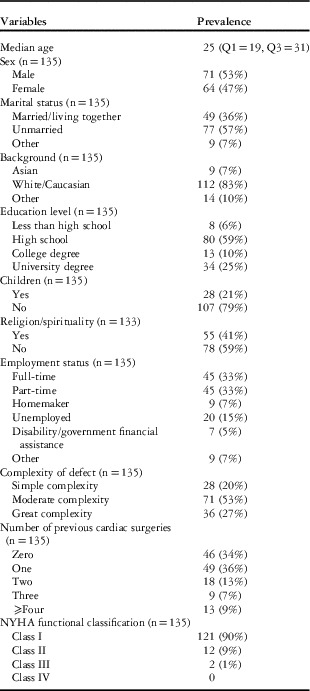
A total of 149 patients were asked to participate in this study between July, 2013 and March, 2016. Among them, three refused, nine patients did not return their surveys, and two were incompletely or incorrectly filled out. This resulted in an analysis of 135 patients. Demographic data and clinical characteristics are summarised in Table 3. Their ages ranged from 18 to 49 years, with a median age of 25. This included 71 males (53%) and 64 females (47%). The majority of patients were unmarried (57%), which is unsurprising considering the low median age. Only 28 patients (21%) had children. There was little variation in ethnicity, with 112 (83%) Caucasians, 9 (7%) Asians, and 14 (10%) others. Patients who answered “other” were asked to name their background; answers included Italian, European, Turkish, Polynesian, Mauritian, and Aboriginal. A large proportion of patients (35%) had college- or university-level education, whereas 40% reported themselves as current full-time or part-time students, and 67% were currently employed. Just under half of the patients (41%) considered themselves religious or spiritual. Dividing patients on the basis of complexity of their congenital defect showed that the majority (53%) of them had moderate complexity defects, with 27% having great complexity and 20% having simple complexity. The most common cardiac defects included coarctation of the aorta (n=16), repaired transposition of the great arteries (n=10), ventricular septal defect with other lesions (n=9), and valved or non-valved conduits (n=8). The diversity and distribution of our sample is summarised in Table 1. Among all, 46 patients (34%) had not undergone any surgical intervention, and 121 (90%) were classified as NYHA class I.
Demographic data and clinical characteristics of adults with CHD.

Q1=first quartile; Q3=third quartile
The sample size of the completed linear analogue scale quality of life included 135 patients. The scores ranged from 35 to 100 with a median of 90 (75–90) (Q1–Q3).
Both anxiety and depression components of the Hospital Anxiety and Depression Scale questionnaire were completed by 135 patients. The anxiety component revealed that 97 (73%) patients experienced normal levels of anxiety (score <8), 20 (15%) had mild symptoms of anxiety (score 8–10), and 16 (12%) patients experienced significant anxiety (score >10). The symptoms of depression were significantly lower. A total of 123 (94%) patients described minimal symptoms of depression (score <8), six (5%) reported mild symptoms of depression (score 8–10), and two (1%) patients revealed significant symptoms of depression (>10). Our study included one patient who was known to have a clinical diagnosis of depression in the past.
The Sense of Coherence questionnaire was completed by 135; it revealed a normal distribution with a mean of 61.8±12.75. Scores ranged from 29 to 90, with a higher number indicating an enhanced sense of coherence.Reference Neuner, Busch and Singer 16
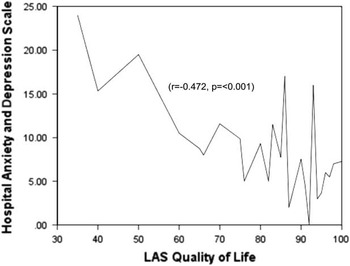
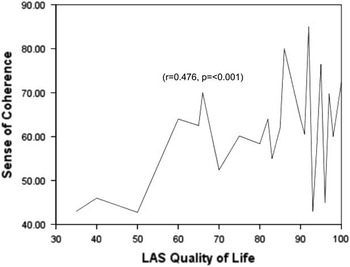
To analyse possible determinants of quality of life in this patient group, correlations were made between quality of life, anxiety and depression, sense of coherence, and disease severity. It was found that quality of life and symptoms of anxiety and depression had a statistically significant negative correlation (r=−0.472, p=<0.001) (Fig 1). This finding demonstrated that quality of life was increased if patients had less anxiety and/or depression, without applying causation. There was a statistically significant positive correlation between quality of life and sense of coherence (r=0.476, p=0.001) (Fig 2). When quality of life was correlated with complexity of cardiac defect, there was no significant correlation (r=0.082, p=0.35), and only a minor correlation between quality of life and NYHA (r=−0.286, p=0.001).
Correlation between symptoms of anxiety and depression and quality of life. LAS=linear analogue scale.

Correlation between sense of coherence and quality of life. LAS=linear analogue scale.

Discussion
A decrease in the morbidity and mortality of CHD patients including those in Australia over the last two decades has allowed increased attention towards their quality of life and psychosocial functioning in the community.Reference Bang, Jo and Kim 9 Although the present study highlighted the prevalence of anxiety and depression symptoms, as a whole, the quality of life of this ambulatory Australian sample was excellent – the best when compared with other centres involved in this international study.Reference Apers, Kovacs and Luyckx 17
The linear analogue scale graphically illustrates quality of life. Studies around the world have shown similarly high quality-of-life scores when using the linear analogue scale, both when comparing adults with CHD with a control group and when analysing them alone.Reference Apers, Moons and Goossens 8 Although we used a single-component questionnaire, which resulted in a broad measure of quality of life, adults with CHD also showed a good quality of life in various studies around the world when multifactorial questionnaires were used.Reference Cohen, Daniela, Yalonetsky, Gagin and Lorber 6 , Reference Loup, von Weissenfluh, Gahl, Schwerzmann, Carrel and Kadner 14 , Reference Berghammer, Karlsson, Ekman, Eriksson and Dellborg 19 A large study from Belgium showed that adolescents with CHD actually have a higher quality of life than their peers, partly explained by a higher sense of coherence reported in the CHD groupReference Apers, Moons and Goossens 8 – a finding replicated in an Australian cohort of adolescents.Reference Wang, Hay, Clarke and Menahem 20
Sense of coherence is a concept that was introduced and studied extensively by an American Israeli medical Sociologist Aaron Antonovsky over 30 years ago.Reference Eriksson and Lindström 18 It revolves around four elements – comprehensibility, manageability, meaningfulness, and general resistance resources, leading to an increased ability to cope with stress. These elements form the scaffolding of the way patients view their lives and health, which strengthens resilience and develops a positive subjective state of health.Reference Eriksson and Lindström 18 A higher sense of coherence was demonstrated in our study to correlate with increased quality of life in adults with CHD. This result suggests the need for further investigation as to how improvement in the sense of coherence may be achieved. In addition to demonstrating that patients with a higher sense of coherence experienced a higher quality of life, those with fewer symptoms of anxiety and depression also reported a higher quality of life. Wang et alReference Wang, Hay, Clarke and Menahem 20 have reported similar findings in an Australian-based study on the determinants of quality of life in adolescents with heart disease. They found, as we did, a correlation between increased symptoms of anxiety and depression and worse health-related quality of life, and also showed a positive correlation between higher sense of coherence and better quality of life.Reference Wang, Hay, Clarke and Menahem 20 Those with a strong sense of coherence have been shown to be more resilient to stressors and develop more effective solutions to problems.Reference Apers, Moons and Goossens 8 It has been hypothesised that patients with CHD and other chronic health conditions might develop a stronger sense of coherence than the control population, leading to a better quality of life.Reference Wang, Hay, Clarke and Menahem 20
An important finding from this study was the high prevalence of unrecognised anxiety in this cohort of adult CHD patients. We found that 27% of our patients reported experiencing higher-than-normal levels of anxiety when using the Hospital Anxiety and Depression Scale. Depression symptoms were much lower, with only 6% of patients describing increased symptoms of depression. The Hospital Anxiety and Depression Scale is a screening tool only, and as such cannot be used to diagnose anxiety or mood disorders; however, it can alert clinicians to increased symptoms of anxiety and depression or reduced psychological functioning in their patients who may then benefit from appropriate assessment and treatment.Reference Wang, Hay, Clarke and Menahem 13 No statistically significant correlation was found between disease severity and quality of life in this study when patients were divided into complexity of cardiac defect according to the Task Force One of the 32nd Bethesda Conference categories. Only minimal correlation was found between NYHA classification and quality of life in this cohort. These results are limited by our small sample size and our narrow spectrum of variation in NYHA patients; 90% of our study population were classified as NYHA class 1. The lack of correlation between disease severity and quality of life found in this study has been noted previously.Reference Fteropoulli, Stygall, Cullen, Deanfield and Newman 2 The majority of research articles and literature reviews published demonstrate that when a diagnosis was used to divide patients into severity of disease categories, there was no correlation between patients’ disease severity and their quality of life.Reference Fteropoulli, Stygall, Cullen, Deanfield and Newman 2 , Reference Moons, Van Deyk, De Geest, Gewillig and Budts 12 , Reference Apers, Luyckx and Moons 21
A limitation of this study is that it included a relatively healthy ambulatory cohort of adults with CHD, although nearly half of them had undergone surgical or catheter intervention. Recruitment was from a single cardiology practice. Many had stayed with the same cardiologist from infancy/childhood and were well known to that doctor. Given this fact, it is questionable whether these results can be generalised to other Australian samples of adults with CHD. Australia offers universal health care for all citizens, allowing all patients access to hospitals and specialists for their ongoing needs. This sample therefore also included patients of low socio-economic status who were able to gain benefits without additional co-payments. The provision of individualised and ongoing care for each patient seeking out further specialist help when intervention was needed may have been an additional factor in the patients’ high quality of life when compared with the findings from the other centres in this multicentre study.
Conclusion
Quality of life in this Australian cohort of adult CHD patients was generally good. Despite this, there was an increased prevalence of anxiety that was not readily recognisable. Patients with higher levels of sense of coherence and less symptoms of anxiety or depression experienced a higher quality of life. On the other hand, there was no correlation between disease severity and quality of life, and only a minimal relationship between quality of life and NYHA classification.
This study suggests the need to sensitise cardiologists and others to be conscious of the emotional well-being of adults with CHD, as even those whom we regard as being functionally normal (NYHA1) or having a defect of mild complexity may still harbour symptoms of anxiety and depression correlating with a poorer quality of life. A multidisciplinary approach may allow those at-risk patients to have the additional support required. In particular, the provision of routine, non-stigmatising access to mental health professionals for each patient may be especially beneficial to the well-being of adults with CHD. Failing which, ongoing individualised care by the cardiologist will allow for attention to these issues as they arise, with he or she acting as the patient’s advocate and seeking out specialised help when needed.
Acknowledgements
Dr Silke Apers and Professor Phillip Moons initiated this multicentre study, designed the questionnaires, and provided ongoing assistance. They also constructively reviewed the manuscript. The authors thank all patients for their willingness to participate.
Financial Support
This research received no specific grant from any funding agency, commercial, or not-for-profit sectors.
Conflicts of Interest
None.