1. Introduction
The study of variation in the pronunciation of words and sounds in words in running speech has a rich history in the field of language variation and change, and is now also used as a source of evidence in the psycholinguistic study of language processing. Such variation may also provide evidence about the nature of the cognitive representation of language, that is, grammar, from a usage-based perspective (Bybee, Reference Bybee2006).
2. Factors affecting phonetic variation
Variation in the phonetics of the consonants and vowels in words has been shown to be conditioned by linguistic factors, most traditionally by the phonetic context of the consonant or vowel in question (for example, the studies of American English deletion of /t/ and /d/ by Guy, Reference Guy1991). In addition, the probability of a word’s occurrence in context has been shown to affect phonetic reduction. This includes prior probability (token frequency) (Bybee, Reference Bybee, Barlow and Kemmer2000; Hooper, Reference Hooper and Christie1976; Phillips, 2006; and others), and probability given the following and sometimes preceding word (Jurafsky, Bell, Gregory, & Raymond, Reference Jurafsky, Bell, Gregory, Raymond, Bybee and Hopper2001). Usage history is another factor recently implicated in conditioning phonetic variation. That is, the frequency with which a word is used in the context for change can affect its pronunciation by making it more likely to exhibit the change both in the context for the change and in other contexts (E. K. Brown, Reference Brown, Smith and Nordquist2018; E. L. Brown, Reference Brown2004, Reference Brown, Smith and Nordquist2018; E. L. Brown & Raymond, Reference Brown and Raymond2012; Bybee, Reference Bybee2002b). Sóskuthy and Hay (Reference Sóskuthy and Hay2017, p. 298) demonstrate over a 130-year period of New Zealand English “substantial patterns of co-adaptation between word usage and word duration”. They demonstrate changes in word duration based on how often the word is used phrase-finally (which makes it longer) and how predictable it is (which makes it shorter).
Less often studied is the syntactic context in which the word is used. Some of these studies are based on the prior use of verbs in particular syntactic constructions, and show greater reduction in a predictable context (Gahl & Garnsey, Reference Gahl and Garnsey2004; Kuperman & Bresnan, Reference Kuperman and Bresnan2012; Tily, Gahl, Arnon, Snider, Kothari, & Bresnan, Reference Thompson and Hawkins2009). The approach taken here investigates the effect of the host construction on particular words by examining the duration of vowels in adjectives in predicative (it’s so hot, my father is dead) vs. attributive (hot weather, dead cell phone) constructions. The only other study of this nature that we know of is Sereno and Jongman (Reference Rosenfelder, Fruehwald, Evanini, Seyfarth, Gorman, Prichard and Yuan1995), who found that English lexical items that could be used as both nouns and verbs (without a concomitant stress shift) had different phonetic properties when read as a noun vs. a verb, and also different properties depending upon whether their uses were predominantly one or the other.
In the current study we explore the role of lexical item and syntactic construction on vowel duration in a selected set of adjectives in predicative and attributive constructions. It is known that some constructions such as questions and imperatives have prosodic features associated with them, and that stress and duration are affected by whether an adjective is used in a compound (White House) or attributive phrase (white house) (Morrill, Reference Matsuki, Kuperman and Van Dyke2011). We reason that there may be phonetic features associated with attributive and predicative constructions as well, in particular the length of the vowel. We hypothesize that the vowel of an adjective in a predicative construction will be longer than one used attributively. As argued in Thompson (Reference Thomas1988) and Englebretson (Reference Englebretson1997), the discourse pragmatic functions of adjectives are quite different in the two different constructions. An attributive adjective is part of a noun phrase that introduces a new referent into the discourse, while a predicative adjective offers a comment on a referent already established in the discourse. In both cases, the function of the adjective is to introduce information into the discourse, but in the case of the attributive adjective this function is shared with the noun it modifies. The attributive adjective is always with a noun in identifying a new referent, while the predicative adjective stands alone in making its comment.Footnote 1 While we do not analyze the function of the adjectives in these constructions in this study, we suggest that an adjective used in a predicative construction can be manipulated to a greater extent by the speaker for discourse or expressive purposes, which may lead to its having a longer vowel than in an attributive construction. For example, a speaker might say That is so sad, lengthening the vowel of sad for special emphasis. Thus we propose that there may be constructional effects that go beyond the effects of probability of occurrence in the context (as mentioned above and described in the next section) or the communicative efficiency as described in Jaeger (Reference Jaeger2010) and Jaeger and Tily (Reference Jaeger and Tily2011). To test this hypothesis, we compare the effect of host construction to other factors, including contextual probability measures, but also the identity of the vowel, token frequency, use in pre-pausal position, and use in clause-final position.
3. The other variables: probability measures
Recent studies have presented evidence that speakers reduce words when they are more predictable in the local context and when they are more frequent overall (for a recent review see Seyfarth, Reference Sereno and Jongman2014). Studies of the predictability of content words in English have shown that they tend to be more reduced on various phonetic parameters if they are predictable from the following word (Bell, Brenier, Gregory, Girand, & Jurafsky, Reference Bell, Brenier, Gregory, Girand and Jurafsky2009; Seyfarth, Reference Sereno and Jongman2014) and sometimes from the preceding word (Jurafsky, Bell, Gregory, & Raymond, Reference Jurafsky, Bell, Gregory, Raymond, Bybee and Hopper2001). These findings lead to “the probabilistic reduction hypothesis – words with a higher probability are articulatorily reduced, for a variety of local and global probabilistic measures” (Seyfarth, Reference Sereno and Jongman2014, p. 140). Some explanations for this tendency refer to the interaction of the speaker and listener: the speaker aims to save effort through articulatory reduction, but is mindful of the needs of the listener and thus constrains reduction in order to get the message across, especially where words are less predictable from context (Lindblom, Reference Levshina1990). Other explanations cite processing ease: higher-frequency and more predictable words are easier to access (Bell et al., Reference Bell, Brenier, Gregory, Girand and Jurafsky2009), though it is not made explicit how ease of access leads to articulatory reduction.
Most studies of conditional probability generalize over many types of words and constructions. For example, consider the following excerpt from the data to be used in this study:Footnote 2
(1) i mean if it were summer you’re all right because it probably wasn’t too cold but uh (sw02108A)
Extracting two-word sequences we find the following sequences: I mean (subject–predicate), mean if (verb–conjunction), if it (conjunction–pronoun), it were (subject–copula), were summer (copula–noun), summer you (noun–pronoun), and so on. It seems doubtful that speakers process words in pairs without regard for the categories or constituents they belong to.
Taking the usage-based perspective that grammatical structure and processing during language usage are closely related (Bybee, Reference Bybee, Givón and Malle2002a, Reference Bybee2006), we hypothesize that processes affecting the duration of segments in words may be related to the constructions those words appear in as much as or more than an overall measure of probability covering all manner of word combinations. As mentioned above, our specific hypothesis is that, given the function of a predicate adjective as the potential locus of new information and the expression of the speaker’s evaluation, the speaker may lengthen the vowel of that adjective more than s/he would when it modifies a noun.
4. Constructions and Usage history
If prior usage can affect the phonetic representation of words (e.g., E. K. Brown, Reference Brown, Smith and Nordquist2018; E. L. Brown, Reference Brown2004, Reference Brown, Smith and Nordquist2018; E. L. Brown & Raymond, Reference Brown and Raymond2012; Bybee, Reference Bybee2002b; Seyfarth, Reference Sereno and Jongman2014; and Sóskuthy & Hay, Reference Sóskuthy and Hay2017), the phonetic shape of words in constructions might also be affected by their prior usage in the construction, leading to an association of the construction with certain phonetic or prosodic features, such as duration. Our study aims to test the association of duration in adjectives with occurrence in the host construction. It also investigates the durational properties of individual adjectives that might have been accrued from prior usage in certain constructions. Thus, we predict that adjectives used more often in predicative constructions might be longer in all uses than those more often used in attributive constructions.
5. Methods
5.1. adjective selection and data extraction
For the study, we selected ten monosyllabic adjectives ending in a /t/ or /d/ and containing a ‘lax’ vowel.Footnote 3 Limiting the phonetic shape of the adjectives allows us to control for differences due to consonant context, word size, and stress-related effects. Table 1 summarizes the phonetic characteristics of the words investigated.
Phonetic characteristics of adjectives in the study

Subsets of two corpora of spontaneous spoken American English provided the adjective tokens: the Switchboard Corpus Release 2 (Godfrey & Holliman, Reference Godfrey and Holliman1993) and the Fisher English Training Part 2 Corpus (Cieri, Graff, Kimball, Miller, & Walker, Reference Cieri, Graff, Kimball, Miller and Walker2005). Two corpora were necessary because there were too few tokens of wet and broad in a single corpus. Both Switchboard and Fisher comprise telephone conversations between randomly assigned speakers. They were compiled in similar ways between 1990 (Switchboard) and 2003 (Fisher) and contain conversations of the same speech style. Participants originated from various regions of the United States, and represent different ages, socioeconomic backgrounds, and genders.
We selected only the first use of an adjective in any given conversation, since previous mentions of the same word, either by the speaker or the hearer, may lead to a decrease in acoustic duration (Bell et al., Reference Bell, Brenier, Gregory, Girand and Jurafsky2009; Fowler & Housum, Reference Fowler and Housum1987). No single speaker produced two tokens of the same adjective in our sample, but a few speakers provided tokens of two or three different adjectives. Tokens were sampled randomly, based on the search results pool, with the adjective selected always being the first produced in a given conversation. We extracted one hundred tokens of each individual adjective produced by 904 speakers, totaling 1,000 tokens for analysis. Only tokens produced by native speakers of American English were analyzed. No effort was made to control for speaker gender, age, or geographical origin. The LDC Online interface (LDC, 1992–) allowed us to extract the audio files containing individual speech passages, most often a full speaking turn.
5.2. variables and measurements
This paper investigates whether the grammatical construction in which an adjective appears might influence the duration of its vowel.Footnote 4 Independent variables that may contribute to differences in vowel duration belong to three broad types: syntactic, probabilistic, and phonetic–phonological.
5.2.1. Dependent variable: vowel duration
Vowel duration is the acoustic duration of the syllabic nucleus of an adjective measured in milliseconds. Each audio file extracted was segmented down to the phone level through an automatic forced aligner plug-in for Praat (Rosenfelder et al., 2014), and hand-corrected as needed. We used the onset and offset of the second formant (F2) spectrum, as displayed in the spectrogram on Praat, as reference points for hand corrections. Praat scripts provided the duration data automatically.
Unlike previous studies of similar phenomena, we include items that occur before pauses and at the edges of utterances / speaking turns in the sample. Furthermore, we include outliers that appeared to be within the normal range of language use after manual inspection of the tokens. However, we replaced adjective tokens that contained unexpected prosody (e.g., laughter) and dysfluencies with other tokens from the corpora. In total, 981 adjectives were deemed appropriate for analysis.
5.2.2. Independent variables: syntactic predictors
a. Construction type: a categorical variable describing the use of an adjective as attributive or predicative in each sentence in the sample. For the purposes of this study, attributive constructions are phrases in which the adjective modifies a referring expression, either a nominal or a pronoun (examples (2) and (3) below). Predicative constructions are clauses in which the adjective is the complement of the verb, including verbs like get, become, turn, make, as illustrated in (4). The following examples from our sample show the constructions under study underlined:
(2) mhm oh you feed ’em wet feed (fe_03_09610A)
(3) and then feeling something wet and warm (fe_03_03049A)
(4) you know oh it made me fat you know (fe_03_10131A)
We coded every adjective for construction type, given the immediate context in which it appeared. Both authors analyzed the data separately, and the final sample contained only tokens for which there was 100 percent agreement regarding construction type.
b. Proportion of uses in predicative function: the proportion of uses of each adjective in predicative constructions based on all its tokens in the spoken section of the Corpus of Contemporary American English (Davies, 2008–). This factor tests the hypothesis that the frequency of uses of a word in specific contexts may affect its phonetic shape even when the word is used in another context. Because our sample contains fewer than a thousand tokens, we used a larger corpus to determine the proportion of uses in a predicative construction. We conducted a series of searches in COCA specifying syntactic criteria associated with adjectives in predicative constructions (e.g., use near a copula verb, etc.), which were then added up. The proportion was then calculated based on the sum of the different searches and the total number of the occurrences of the adjective in the corpus. We predict that the greater proportion of uses in predicative adjective constructions, the longer the vowel duration in all uses.
c. Position within predicative construction: a categorical variable based on the syntactic classification of the word following the adjective, if any. In predicative constructions, the adjective may end a clause, or it may precede other material in the same clause. Due to interactions of prosody with syntax, the vowel in the clause-final adjective may be longer than one that is internal to the clause. The categorical values are determined as follows.
C: The next word begins a new clause.
Ex.: it made me really mad three times i wanted to write him
CC: The next word begins a new clause with a conjunction.
Ex.: i think that’s sad because that doesn’t allow for any individuality
CE: The next word begins an embedded clause that is a complement to the adjective.
Ex.: too bad they didn’t kill him the first time
D: The next word is in a discourse marker; these are often clause-final.
Ex.: you know oh it made me fat you know
S: The next word is in the same clause as the adjective.
Ex.: it wasn’t as bad as this
d. Occurrence of an intensifier preceding the adjective: a categorical variable describing whether an adjective was immediately preceded by a modifying adverb such as very, so, really, incredibly, and so forth. It is predicted that the adjectives preceded by an intensifier will be longer than those that are not.
e. Occurrence in a prefab: a categorical variable referring to the occurrence of the adjective in a conventionalized expression in the Oxford Collocation Dictionary (2002). A prefab is a conventionalized multiword expression (Erman & Warren, Reference Erman and Warren2000), such as red alert or broad topic. We predict that the vowel of the adjective may be shorter in such expressions.
5.2.3. Probabilistic predictors
Contextual probability depends on the combined frequencies of different items, most often those in the immediate vicinity of the item used as reference. We test contextual probability of the adjectives in the sample using Conditional Probability scores (cf. Bell et al., Reference Bell, Brenier, Gregory, Girand and Jurafsky2009). One unigram frequency measure and two contextual bigram scores are calculated for each adjective token in the data, as follows:
f. Token frequency: the number of occurrences of each adjective form per million in the spoken section of COCA, log-transformed.
g. Conditional probability given the preceding word (P prec): the probability of an adjective y given the occurrence of a preceding word x in COCA. For instance, the Conditional Probability of the adjective sad given the preceding word looks is estimated by the ratio of the frequency of occurrence (F) of the bigram looks sad given the size of the corpus (N) divided by the relative frequency of looks (cf. Bell et al., Reference Bell, Brenier, Gregory, Girand and Jurafsky2009):
(5) Pprec = log10 [(Flooks sad / N) / (Flooks / N)]
h. Conditional probability given the following word (P foll): the probability of an adjective y given the occurrence of a following word z in the corpus. Thus, the Conditional Probability of the adjective sad given the following word today in the bigram sad today is calculated as follows:
(6) Pfoll = log10 [(Fsad today / N) / (Ftoday / N)]
The probabilistic measures above were calculated based on the spoken section of COCA, a much larger corpus than the ones from which we extracted data, but one that is similar in genre. We used word-forms rather than lemmas, and we specified part of speech for the other words in the bigram to determine their frequencies in the corpus (e.g., Bell et al., Reference Bell, Brenier, Gregory, Girand and Jurafsky2009; Gahl, Reference Gahl2008; Sóskuthy & Hay, Reference Sóskuthy and Hay2017). Research suggests that different forms of the same lemma have different frequencies of use leading to different phonetic effects (e.g., Bell et al., Reference Bell, Brenier, Gregory, Girand and Jurafsky2009; Gahl, Reference Gahl2008; Sóskuthy & Hay, Reference Sóskuthy and Hay2017). We follow these previous studies in calculating probabilistic scores from frequency data of word forms rather than using the frequency of the lemma. For instance, the bigram sadder that occurs only two times in the subset of COCA we used, whereas the sequence sad that occurs 320 times. Additionally, based on the immediate context of a word in the sample, we specified the part of speech of the words in each bigram in our searches. For words that occur in contracted forms (e.g.,’re for are), scores derive from the sum of tokens of contracted and full forms. For example, if ’re sad occurred 10 times and are sad occurred 23 times, we based the bigram score on the number 33 (i.e., 10 + 23).
5.2.4. Phonetic and phonological predictors
The variables discussed in this section test the role of phonetic and phonological factors that have been reported to influence duration. Note that by only using the first rendering of each adjective in a conversation, we have already controlled for shortening due to previous mentions in discourse.
i. Vowel identity: describes the quality of the vowel in the adjective nucleus. Reports that English vowels have intrinsic durational differences (e.g., Hillenbrand, Getty, Clark, & Wheeler, Reference Hillenbrand, Getty, Clark and Wheeler1995), show that lower lax vowels sampled under experimental control are longer.
j. Voicing of the coda consonant: classifies whether the alveolar consonant following the vowel was voiced or voiceless. It is well known that vowels followed by a voiced consonant in the same syllable are longer in English (Chen, Reference Chen1970).
k. Articulation rate: defined as the number of syllables by phonation time, excluding long silent pauses of 300 milliseconds or more. A Praat script calculated articulation rate by first detecting all potential syllable nuclei in an audio file, and then dividing that number by the total time period in which phonation was observed (de Jong & Wempe, Reference De Jong and Wempe2009). It is predicted that the faster the articulation rate, the shorter the vowel in the adjective nucleus will be (Fónagy & Magdics, Reference Fónagy and Magdics1960).
l. Length of a following silent interval: the period with no phonation following the adjective, measured in milliseconds. Words occurring before pauses in English are subject to a lengthening effect related to their position at the end of a prosodic domain (Cole, Reference Cole2015). Pause duration is a robust cue of phrase boundaries (Krivokapić, 2014; Wightman, Shattuck-Hufnagel, Ostendorf, & Price, Reference Tily, Gahl, Arnon, Snider, Kothari and Bresnan1992). It is expected that the longer the duration of a following silent interval, the longer the vowel in the adjective preceding it will be.
m. Following turn end / categorically long pause: this is a categorical variable that combines occurrences of speakers’ conversational turn ends, and long silent intervals of 200 milliseconds or more (cf. Thomas, Reference Tagliamonte and Baayen2010). Adjectives that occurred as the last word in the orthographic transcription of the corpus were coded as preceding a turn end. This variable is used here as a proxy for the right edge of a prosodic unit, where it is predicted that vowels in adjectives will be longer than those occurring in the middle of the speech stream.
5.3. statistical analyses
We used two sets of complementary statistical techniques to evaluate our hypotheses: a Mixed-effects regression model, a Conditional Inference Tree, and the related Random Forest model. We address the last two, less familiar methods first.
Conditional Inference Tree (CIT) is a non-parametric method that uses binary recursive partitioning to determine which independent variables most strongly correlate with the response variable. CITs estimate the likelihood of the value of the response variable (adjective vowel duration) based on a series of questions about predictor variables through an algorithm. The algorithm works through all predictors, partitioning the sample into subsets (i.e., branches) wherever statistically justified, recursively considering the contribution of every predictor variable against the individual subsets until further splitting no longer achieves statistical significance (cf. Levshina, Reference Labov2015; Tagliamonte & Baayen, Reference Sóskuthy and Hay2012). The output of the model is visualized as a tree graph comprised of a number of hierarchically connected nodes.
The Random Forest (RF) model directly relates to CITs. It considers the correlations among the variables in multiple CITs to provide an assessment of predictor importance. A Random Forest analysis uses the same algorithm that creates a single CIT to generate a large, random collection of individual trees based on the same binary recursive partitioning criteria. This collection (the Random Forest) allows one to estimate the importance measure of every variable included in the model averaged over the entire forest of CITs. In turn, calculating measures of variable importance makes it possible to rank which variables most accurately predict the response variable.
The use of the Mixed-effects model has two goals. First, it makes it possible to obtain adjective vowel duration slopes adjusted for nuisance variables (i.e., random factors) such as lexical adjective and speaker. For instance, including lexical adjective as a random factor in the Mixed-effects model allows it to address the idiosyncrasies in the uses of individual adjective while coming up with generalizations over all of them. Second, this regression technique allows us to test whether syntactic factors contribute to vowel durations independently of probabilistic and/or phonological effects.
The aim of utilizing Conditional Inference Tree and Random Forest models in addition to the Mixed-effects model is fourfold: first, it allows us to include variables that show high-order interactions in our model, such as token frequency and Conditional Probability. Second, it is a more appropriate technique for analyzing the large number of predictors we tested relative to the size of our sample (cf. Levshina, Reference Labov2015; Matsuki, Kuperman, & Van Dyke, Reference Local and Walker2016). Third, it enables us to include Position within Predicative Construction as a variable even though it pertains only to predicative uses of the adjectives. This is because this type of model maintains accuracy even when a large proportion of the data are missing (Breiman & Cutler, Reference Breiman and Cutler2004), unlike Mixed-effects models. Last, the Conditional Inference Tree and Random Forest models allow us to include all datapoints without normalization or scaling. This was especially relevant in our study, given that a manual inspection of our sample revealed that outliers tended to correspond to perfectly unremarkable uses of adjectives.
5.3.1. Modeling procedures
Mixed-effects: a linear Mixed-effects model was fit to the data from the Switchboard and Fisher English corpora, using the lmer() function in the lme4 package (Bates, Mächler, Bolker, & Walker, Reference Bates, Mächler, Bolker and Walker2015) for R (R Core Team, 2013), with the full set of variables as predictors. The response variable (vowel duration in ms) was log-transformed to decrease the influence of outliers. All other numeric predictors were log-transformed and centered around their respective means (z-scaled) using the generic function scale() in R (cf. Bell et al., Reference Bell, Brenier, Gregory, Girand and Jurafsky2009; Gries, Reference Gries2013). Variables were introduced through a backward model selection procedure to help guard against model overfitting. Following this procedure, the first model was fit with all individual predictors and theoretically relevant interactions. After each model was fit, it was compared to a set of models with one fewer predictor using the Akaike Information Criterion (AIC) as a goodness-of-fit measure. The predictor that contributed the least to model fit was then removed from the full model. The process was repeated until the final model was significantly better than all possible alternatives with one fewer predictor. The lmer() function generated p-values for the likelihood ratio test.
Conditional Inference Tree: a Conditional Inference Tree model was fit to the entirety of the dataset with the full set of variables as predictors using the ctree() function from the ‘party’ package for R (Hothorn, Hornik, & Zeileis, Reference Hothorn, Hornik and Zeileis2006). The number 50 was used as the starting point in the generation of a sequence of random numbers via the function set.seed(), and the minimum number of observations was set to 20 per bin, at a significance level of .05. This technique required no simplifying to avoid overfitting, given that the algorithm explained above returns the p-values that justify every split.
Random Forest: a Random Forest was grown from 2,000 Conditional Inference Trees using the cforest() function also from the ‘party’ package. The full set of variables used in the CIT was also included in the Random Forest model, and the number of preselected predictors at each split was set at 4 (Levshina, Reference Labov2015). In order to estimate the relative importance of each variable, the measures of variable importance were computed using the varimp() function also from the ‘party’ package for R.
6. Results
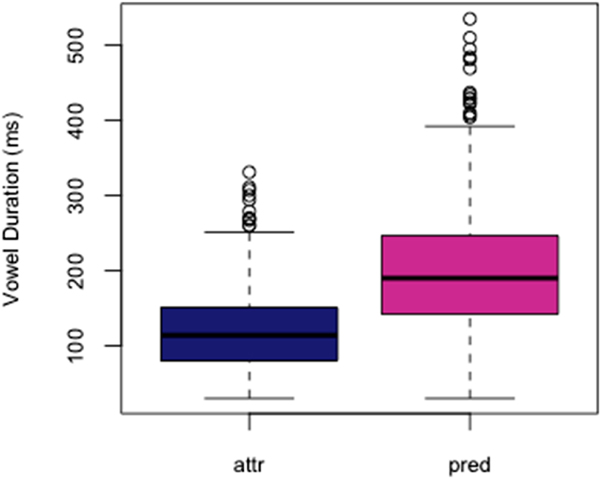
The results of the present study confirmed our main hypothesis that syntactic construction and idiosyncrasies in adjective usage significantly influence the phonetic duration of vowels in monosyllabic adjectives. The CIT and related Random Forest analyses found that syntactic construction and lexical adjective show the largest overall influence on vowel duration. Figure 1 shows how the distribution of the vowel duration data in our sample reflects patterns of usage (raw values).
Vowel duration as a function of construction type (raw values).

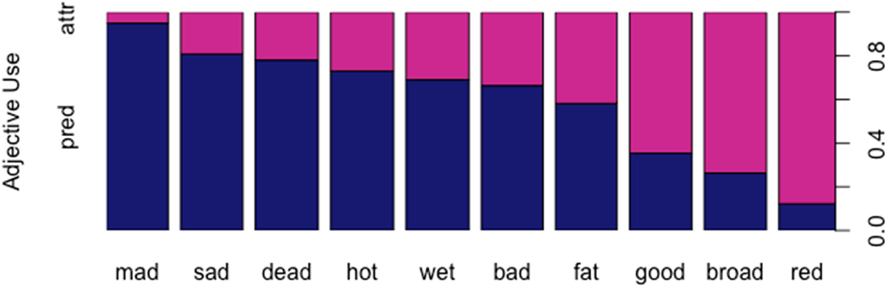
The usage patterns of the different adjectives in attributive and predicative constructions in our sample reveal that each adjective has different distributions in the two constructions (see Figure 2). The adjectives broad and red occurred in predicative constructions in fewer than a third of the tokens, whereas good was only used predicatively in slightly more than a third (.35) of its tokens. However, mad, sad, and dead were used in predicative constructions most of the time (.95, .81, and .78, respectively).
Proportion of uses of 981 tokens of adjectives in predicative versus attributive constructions in the Switchboard and Fisher English corpora.

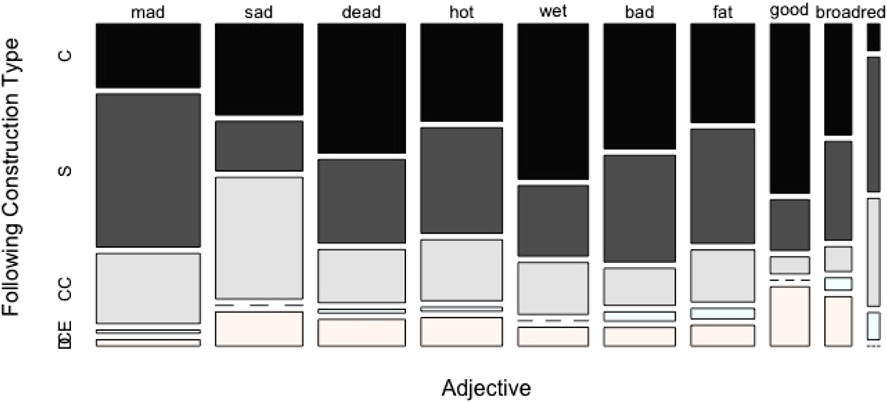
There is also substantial lexical variation in the position of the adjective within the predicative construction, as seen in Figure 3. The categories of importance here are the S (adjective is followed by a word in the same clause) and the others in which the adjective is at the end of the clause or followed by a discourse marker.
Mosaic plot with the distribution of adjectives based on their position within predicative constructions. The width of the bar represents the number of tokens in predicative constructions in our sample, and the size of the bar on the vertical axis represents the proportion of predicative uses of each type. Key: C = next word begins a new clause; S = next word is in the same clause; CC = next word is conjunction beginning a new clause; CE = next word begins an embedded clause that is complement to the adjective; D = next word is in a discourse marker.

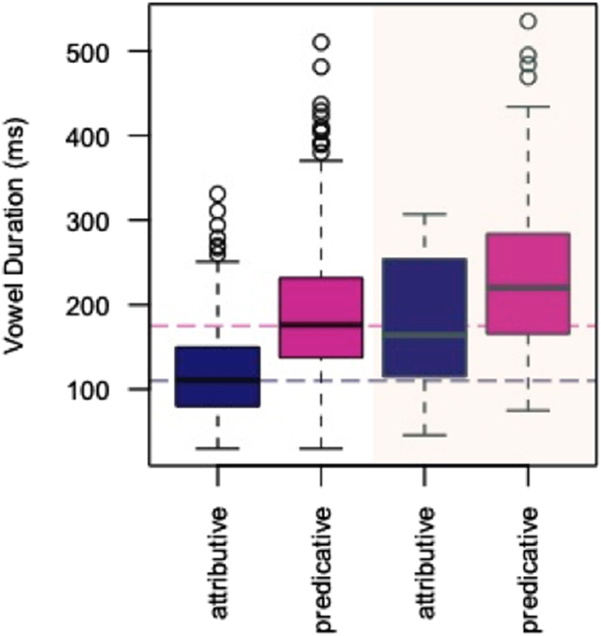
A related set of results addresses the issue of how clauses, prosodic phrases, and adjective constructions interact. Adjectives in predicative constructions are more likely than attributive uses to occur at the end of a clause, which may coincide with the final edge of a prosodic phrase and thus be subject to domain-final lengthening (see also Cole, Reference Cole2015; Shattuck-Hufnagel & Turk, Reference Seyfarth1996, for discussions). Pauses are the most oft-cited correlate of the end of prosodic phrase. In our data, the occurrence of a turn end and/or categorically long pause did correlate with longer vowel duration, but those were neither restricted to adjectives in predicative constructions nor were they mandatory after predicative uses of an adjective. Figure 4 shows that, while the occurrence of an adjective before a putative phrase-final boundary (the two boxes on the right) increases vowel duration, the effect of the construction in which the adjective occurred is also relevant.
Distribution of vowel duration in adjectives in attributive and predicative constructions by occurrence before a 200 ms pause or turn end. The boxes on the right in the shaded area correspond to the pre-pausal tokens. The horizontal dotted lines are given for comparison.

Figure 4 illustrates an important finding in our study: the construction in which the adjective is used influences its duration independently of possible phrase-final lengthening. In addition, the position of the adjective within the predicative construction influenced its duration in our dataset (statistical tests follow in Sections 6.1 and 6.2).
6.1. Mixed-effects model
The data analyzed included 819 out of 981 tokens due to missing values in one or more cells. As mentioned above, duration values were log-transformed for the Mixed-effects analysis. Predictors that failed to improve fit (p > .05) were excluded from the final model. The predictors excluded were thus Occurrence in a Prefab, Occurrence of an Intensifier Preceding the Adjective, Proportion of Predicative Uses in COCA, Length of the Following Pause, and Token Frequency. The variable Position within Predicative Construction was not entered in any Mixed-effects model since it only refers to adjectives in predicative uses. Finally, Speaker and Adjective were entered as random effect variables.
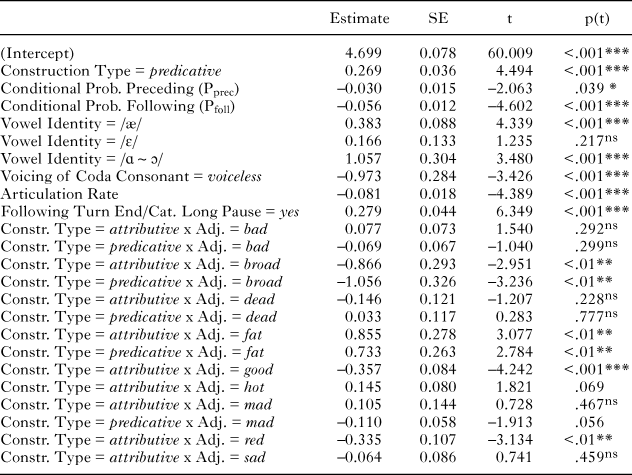
The best model included Speaker and Adjective as random effects, and the following variables as fixed effects: Construction Type (two levels: attributive, or predicative), Conditional Probability Given the Previous Word, Conditional Probability Given the Following Word, Vowel Identity (four levels: /æ/, /ɛ/, /ʊ/, or /ɑ∼ɔ/), Voicing of Coda Consonant (two levels: voiced, or voiceless), Articulation Rate, and Following Turn End / Categorically Long Pause (two levels: yes, or no). Finally, the following interaction significantly improved fit: Adjective (ten levels: bad, broad, dead, fat, good, hot, mad, red, sad, wet) X Construction Type. The lmer() R function automatically calculated p-values. The final fixed and random effects estimates appear in Tables 2 and 3, respectively, shown in log-transformed values.
Fixed effects summary of a generalized Mixed-effects model with random intercepts for Speaker and Adjective. Reference levels for categorical predictors in the table are: attributive (Construction Type), /ʊ/ (Vowel Identity), voiced (Voicing of Coda Consonant), and no (Following Turn End/Categorically Long Pause). In the interaction of Adjective (sum-coded) and Construction Type, values refer to the grand mean.

notes: Significance levels: ***: p < .001; **: p < .01; *: p < .05; ns: p > .1.
Random effects summary

As predicted by our main hypothesis, the Mixed-effects analysis revealed that Construction Type significantly influences vowel duration in adjectives. In predicative constructions, adjectives in our data are significantly longer than those used attributively. In addition, the model revealed a significant interaction of syntactic construction with lexical adjective in determining vowel duration. Also, the phonetic and phonological factors of identity of the vowel, the voicing of the following stop, and articulation rate are significant factors influencing vowel duration.
In agreement with previous literature, Conditional Probability Given the Following Word also has an effect on adjective vowel duration. The results of the Mixed-effects model also suggest that higher scores in Conditional Probability Given the Preceding Word may predict shorter duration in adjective vowels. The other probabilistic measure, Token Frequency, failed to improve the overall fit of the model. This result is not unexpected given that only 10 adjectives are included and these have a narrow range of token frequency scores in the data (i.e., from 1.07 for wet to 3.17 for good).
The occurrence of a Following Turn End /Categorically Long Pause also predicts longer vowel duration in adjectives. Note that this variable included both the end of a speaking turn and silent intervals of 200 milliseconds or more. It should be emphasized, however, that vowels are overall longer in adjectives used in predicative constructions even when no categorically long pauses occurred. In fact, categorically long pauses followed adjectives used in predicative constructions in fewer than 30 percent of the predicative tokens (163/587) in our data.
6.2. Conditional Inference Tree and Random Forest models
6.2.1. Conditional Inference Tree
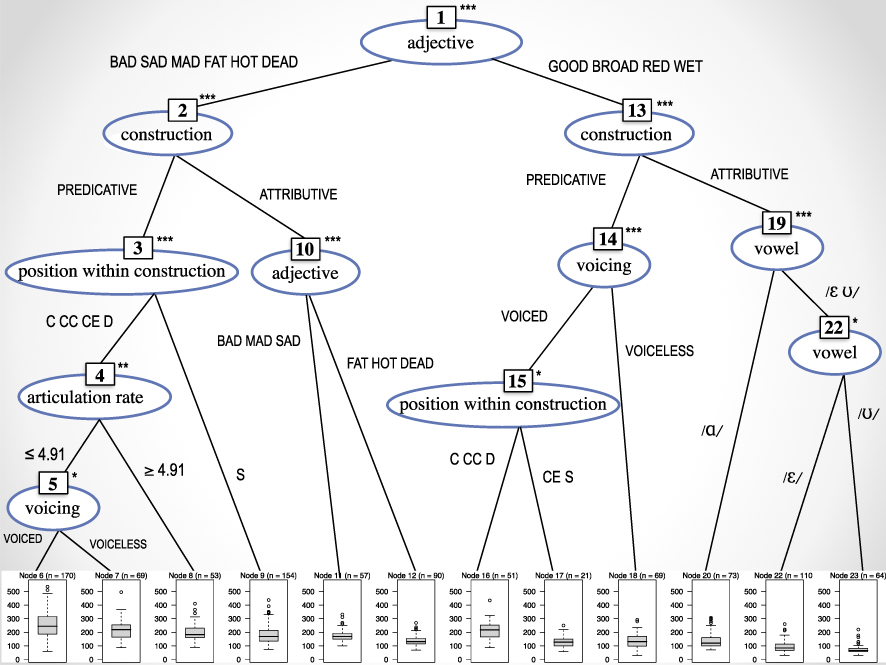
A Conditional Inference Tree was fit with a full set of variables using the ctree() function in the ‘party’ R package (Hothorn et al., Reference Hothorn, Hornik and Zeileis2006). The minimum number of observations was set to 20 per bin at a significance level of .05. Figure 5 depicts a single tree grown with these predictors. The overall model fit for a single tree was R 2 = .44.
Sample conditional inference tree (CIT) fit to the entirety of the data.

It is important to bear in mind that Figure 5 shows only one of the many CITs that we generated and which constitute the Random Forest. However, in all the CITs examined, the first split was determined by a lexical variable, with six adjectives on one side (group 1: bad, dead, fat, hot, mad, sad) and four on the other (group 2: broad, good, red, wet). This perhaps indicates a great deal of variability due to multiple factors, and demonstrates clearly that the category ‘adjective’ is not homogeneous at the lexical level.
Similarly, all the CITs examined show Construction Type as the next most important variable. Both lexical groups show a split for this factor at the first level under Lexical Adjective (Nodes 2 and 13). At lower levels, in the particular CIT discussed here, the two lexical groups diverge: Predicative uses in group 1 next split on Position within Predicative Construction (Node 3), with tokens that occur before other words within the same clause showing shorter vowels than those at the end of a clause. The predicative uses in clause-final position (C, CC, CE, D) show an effect of Articulation Rate and the Voicing of the Coda (Nodes 4 and 5, respectively). The attributive uses in group 1 split again by the individual adjectives (Node 10), with bad, mad, and sad having longer vowels than dead, fat, and hot.
Among the group 2 adjectives in this CIT, after the split between predicative and attributive, phonological factors become important. For attributive uses, the vowel determines the next split (Node 19), with broad, which has been shown to be longer than other lax vowels in other studies on one side, and the shortest vowels /ɛ/ and /ʊ/ on the other. For predicative uses, the Voicing of the Coda conditions a significant split (Node 14), and for the three adjectives in this group with a voiced coda (broad, good, and red), the Position within the Predicative Clause is important (Node 15). However, here the grouping distinguishes the tokens that are in the same clause with the few tokens of adjectives occurring before a complement clause.
This sample CIT reveals that lexical and grammatical factors outweigh all others. Probability factors do not show up at all, and phonological factors are important for some adjectives only.
6.2.2. Random Forest
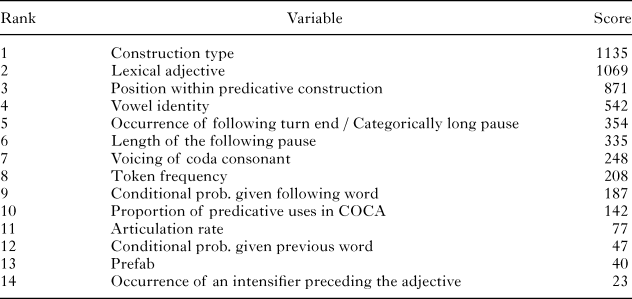
From the results of the Random Forest we calculated the measures of variable importance, shown in Table 4. Table 4 depicts the relative importance of the predictors, using conditional permutation-based variable importance, in which inconsequential predictors have values close to 0 (Tagliamonte & Baayen, Reference Sóskuthy and Hay2012).
Variable importance in a Random Forest with 2,000 trees (R2 = 0.57)

The Random Forest analysis shows that Construction Type is far and away the most important predictor of vowel duration in adjectives. Lexical Adjective is a close second in importance, again showing that the category of adjective is quite heterogeneous. Construction Type is also significant in the Mixed-effects model, and Lexical Adjective comes into play in its interaction with Construction Type in that model. Also in agreement with the Mixed-effects model, the phonological factors of Vowel Identity and following pause also contribute to the duration of the vowel, though in this case both measures of the following pause make similar contributions.
Why are there differences between the results using the two different modeling techniques? One reason is that the Random Forest analysis can use predictors that are not applicable to all datapoints in the sample. In particular, Position within Predicative Construction could be included in the analysis whose results are shown in Table 4. We see in the CIT that this factor was significant for all adjectives (see Nodes 3 and 15). A second point is that CITs and resulting RF segment the data in ways that reveal local interactions among variables. This is particularly important for a study in which lexical item closely interacts with construction type.
A comparison of the two sets of analyses shows that phonological variables such as Vowel Identity, and Occurrence of a Following Turn End / Long Pause are significant in both analyses. Both sets of techniques also reveal a relationship between Lexical Adjective and Construction Type. For the Mixed-effects model, the interaction of Lexical Adjective and Construction Type was the only interaction tested that improved model fit. In the Random Forest analysis, Construction Type and Lexical Adjective are at the top ranks of importance, and the subsets defined by Lexical Adjective and Construction Type yield a variety of significant effects.
The CIT analyses and resulting Random Forest analysis are valuable because they compartmentalize the data to find relations within subsets, while the Mixed-effects model generalizes over all the data in it. The sample CIT (Figure 5) shows how this works. In the Mixed Effect model, Voicing of the Coda Consonant is highly significant, but it is ranked lower in the Random Forest analysis. In the sample CIT we see that Voicing of the Coda Consonant shows up as significant only in the Predicative Construction. This important restriction is not apparent in the Mixed-effects model. Also, Articulation Rate is significant in the Mixed-effects model, but ranked very low in the Random Forest analysis. The sample CIT shows Articulation Rate as significant, but only in the Predicative uses, and only for certain adjectives. Again, this restriction does not emerge in the Mixed-effects analysis.
A perhaps surprising difference between the models is the strong showing of the occurrence of a Following Turn End / Categorically Long Pause and Conditional Probability Given the Following Word in the Mixed-effects Model and their relatively lower rank in the Random Forest analysis. This may indicate that these factors appear significant when generalizing over all the trimmed data, but in fact are restricted to subsets of the data.
7. Discussion
Despite the large number of variables considered, Construction Type plays a role in all the analyses, as it is highly significant in the Mixed-effects model and emerges as one of the most important predictors in the CIT and Random Forest analyses for determining the length of the vowel in the adjective. As predicted, adjectives used in predicative constructions have longer vowels than those in attributive constructions. In the latter two analyses, this factor is more important than the presence of a pause, predictability from surrounding words, and position within the construction. This result suggests that constructions may have prosodic features associated with them. Of course, we know this to be true of some linguistic constructions, such as interrogatives, but further study may reveal subtle phonetic effects associated with other constructions.
7.1. construction type and ‘final lengthening’
Before examining the data, one might suppose that a longer vowel in a predicative use is due to ‘final lengthening’, a phenomenon thought to link prosody with grammatical structure. As Beckman and Edwards (1990, p.152) characterize it: “this effect is usually interpreted as a durational correlate of the sort of disjuncture that can cause a momentary cessation of speech.” If predicative uses place adjectives at the end of the clause, that might account for their greater duration. Viewed another way, if an attributive adjective is always in an NP and precedes the N, then it might be shortened due to its internal position. Many of the studies of ‘final lengthening’ use data from laboratory settings. Analyses of conversation, such as Local and Walker (Reference Lindblom, Hardcastle and Marchal2012), find that not all syntactic completion points lead to lengthening; rather lengthening is prominent at turn ends. Thus, questions remain as to whether lengthening is due to a syntactic endpoint, an upcoming pause, especially the end of a turn, or a particular construction.
Our study was designed to test the effect of ‘final lengthening’ in two ways. First, we used the two measures of a following pause reasoning that pauses would correlate well with ‘final lengthening’ because silent pauses have been shown to co-occur with prosodic boundaries in many studies (cf. Krivokapić, 2014), and many experiments use pauses (indicated by punctuation in experimental material) to elicit final lengthening (see Beckman & Edwards, Reference Beckman, Edwards, Kingston and Beckman1990). Second, we coded the position of the adjective in the predicative construction to determine if its occurrence at the end of the clause would trigger lengthening.
As mentioned earlier, Construction Type was a more powerful predictor of vowel length than any of the three factors that might cause final lengthening. We suggest that the reason for this is that the adjective in predicative position may allow speaker manipulation, as it is the main reason for producing the clause. It is interesting that, in the CIT, Occurrence before a Voiced Coda and Articulation Rate were significant only in Predicative Constructions. This suggests that attributive position allows less variation in length than the predicative position, which can more easily be manipulated for expressive purposes. In fact, the range of variation for vowel length in predicative adjectives is much greater than for attributive adjectives, as show in Table 5, providing additional evidence that Construction Type rather than ‘final lengthening’ alone accounts for the vowel duration.
Minimum, maximum, median, and median absolute deviation (MAD) values for vowel duration in adjectives in the two construction types

Lengthening before a pause, however, does explain some of that data, and may figure in the ultimate explanation for prosodic variables being associated with constructions. Occurrence Preceding a Turn End / Categorically Long Pause is significant in the Mixed-effects model, and Position within Predicative Construction and the two pause measures occur in positions 3, 5, and 6 in the Random Forest analysis. These factors may be part of the diachronic explanation for the duration effect in adjective constructions. Since production history can have an effect on phonetic properties such as duration, it follows that online production features such as shortening of an attributive adjective within a NP and lengthening of a predicative adjective before a pause could become associated with the particular host construction. Thus online prosodic durational effects might be one of the sources of prosody associated with constructions.
7.2. predictability and construction type
Some corpus studies have determined that online word duration is affected by the predictability of the word in context. The effect found for English by Bell and colleagues (2009) and Seyfarth (Reference Sereno and Jongman2014) is that a lexical word is shorter if it is predictable from the following word. Given that such studies generalize over many different syntactic relations within bigrams, a question arises as to whether or not this effect is epiphenomenal – that is, it might arise simply because of the types of constructions that occur in English and may be hiding a more direct effect of construction type on duration. By testing predictability while controlling for construction type, we hoped to shed some light on this question.
The Mixed-effects model corroborated earlier studies by showing that the Conditional Probability Given the Following Word was highly significant in predicting a shorter vowel. In the case of attributive adjectives, there might be a plausible explanation for the duration of the vowel in the adjective being shorter when the adjective is predictable from the following word. Some nouns are more likely to occur with certain adjectives: for instance, wine is often preceded by red, white, sparking, good, fine, French (the top six adjectives listed in COCA). If these adjectives are shorter because they frequently occur with a particular noun, it could be that these adjective + noun pairs form lexical units and are undergoing reduction because of their joint frequency. An attempt to test this hypothesis gave us the category Prefab, which indicated if the bigram was listed in the Oxford Collocation Dictionary. This factor, however, was not significant in any of the models.
In contrast, 75 percent (442/587) of the words following predicative adjectives are function words, (conjunctions, pronouns, prepositions, deictics, and discourse markers such as well and yeah). Of these, 65 percent (379/587) are in the next clause, or are discourse markers (see Figure 4). The general high frequency of function words and words in the next clause means that the conditional probability scores for predicative use and those for attributive use generalize over very different types of bigrams (e.g., sad because vs. fat dude). This fact leads us to question the linguistic significance of this variable. Our suspicions were corroborated by the results of the Random Forest analysis, which ranked this factor much lower than Construction Type and Lexical Adjective.
As the role of the adjective in the predicative vs. attributive constructions is quite different in terms of the presentation of information within a discourse, we suggest that speaker expressiveness may play a bigger role in determining phonetic factors such as vowel duration than predictability as measured without regard for construction type. Thus future studies might address other construction types so that the results of predictability studies might be reconsidered taking into account the types of constructions that occur in a language.
7.3. individual adjective
Our study revealed a great deal of lexical variability, showing that the category of adjective is not homogeneous. Figure 2 illustrates this variability with regard to syntax: individual adjectives occur in attributive and predicate constructions at different rates. We hypothesized that adjectives that are used more in predicative position would have a longer duration in all positions. This measure did not turn out to be significant in any of the models, though it outranked a few other factors in the Random Forest model. Some evidence for this hypothesis may be read into the grouping of adjectives that turned up in a number of the CITs we examined. The two groups of lexical adjectives are: group 1: bad, dead, fat, hot, mad, sad and group 2: broad, good, red, wet. Three of the latter, broad, good, and red are ranked first, second, and third for use in attributive constructions, which could contribute to their shorter vowels. The other member of this groups, wet, is in sixth position. However, the vowel /ɛ/ is inherently short and in wet it occurs before a voiceless stop, making it potentially the shortest vowel in our study. So this might be an indication that the history of usage of the adjective affects its vowel duration. A final note is that better results with this factor might have been obtained with more adjectives, because our study used with only ten adjectives and thus only ten scores for Proportion of Use in Predicative Constructions.
Other lexical differences contribute to the importance of lexical identity in the Random Forest analysis and to the interaction of specific adjectives with Construction Type in the Mixed-effects model. Figure 4 illustrates the differences among the adjectives in their occurrence in different predicative contexts. For example, good and wet have more tokens that occur at the end of a clause; mad and sad have more tokens that occur before a conjunction starting the next clause. Dead and sad are followed by discourse markers more often than the other adjectives. What emerged from the Random Forest and CIT analyses is that these distributional differences in combination with phonological differences, such as the inherent duration of the lax vowel, affect different adjectives in different ways.
8. Conclusion
In contrast to studies that examine word duration and other phonetic properties of words based on their current and prior usage in bigrams, this study examined the direct effect of usage in a construction on vowel duration by comparing the same adjectives as used in two different constructions. All analyses found that adjectives have longer vowels in predicative constructions than they do in attributive constructions. The association of duration with these constructions could arise from repeated prosodic effects internal to the NP or clause-finally, but the online effect associates durational differences directly with the construction type.
The findings of this study have implications for the way that sound change affects individual words. It was motivated in part by differences in the raising of /æ/ in Philadelphia English which exceptionally affected three words ending in final /d/ – bad, mad, glad (Labov, Reference Krivokapić1994, pp. 429–435). As these are all adjectives, one might look for a category effect except that sad was not affected. Bybee (Reference Bybee2017) proposed that the raising, which is associated with a longer vowel, occurred in adjectives that occur frequently in predicative constructions, speculating that the adjective is longer in such constructions. As mad and glad are used almost exclusively in predicative constructions and bad is highly frequent in general, the lack of raising in sad might be attributed to its high percentage of attributive uses. The current study did not find as big a difference between sad and the other adjectives as the 2017 study of earlier time periods did, but the current study does demonstrate that occurrence in particular constructions can affect phonetic properties and thus might be a factor in the lexical diffusion of sound change.
Given our results, we concur with previous studies (Matsuki et al., Reference Local and Walker2016; Tagliamonte & Baayen, Reference Sóskuthy and Hay2012) that found that Mixed-effects and CIT / Random Forest models each offer relevant contributions to the analysis of language data. Both approaches revealed important generalizations over our sample. However, given the inherent variability of conversational speech, and the great number of variables that affect duration, modeling language data with tools that handle this variation well, such as the CIT / Random Forest techniques, may provide sets of results that predict the properties of language in use in a more faithful fashion.
The main conclusion from this study is that the association of particular phonetic features, such as vowel duration, with syntactic constructions should be examined in future studies. This association may be a factor in online comprehension and on native-like use of constructions, and it may indicate that syntactic constructions are not just abstractions over instances of use containing only information about syntactic relations, but they may also have specific prosodic and/or phonetic content.