Implications
Stray voltage (<10 V), for example, caused by a faulty connection between the electrical circuit and the earth or a wiring problem, can occur in farms and may impair animal welfare. However, most of the studies carried out on stray voltage focus on species of major economical values such as dairy cows and pigs, but nearly nothing is known in sheep. The aim of the experiment was to determine the threshold voltage at which lambs express avoidance behaviour. This experiment was the first step in a larger project whose objectives were to determine the long-term effects of stray voltage in farm animals.
Introduction
Stray voltages are intermittent, unpredictable and of low level, generally <10 V. Although they are most of the time imperceptible to humans, animals can feel them because their muzzles and hooves are very conductive (review by Hultgren, Reference Hultgren1990). On farms, stray voltage can be found not only around equipments such as the milking machine and suppliers of food and milk, but also around metallic features such as feeders and troughs. Any electrical status with a rather large potential difference between two contact points of an animal is likely to create stray voltage. Animals are not affected by the voltage itself but by the electrical current produced by the voltage. Ohm's law equation relates the voltage (V) to the current (I) and the impedance (R): V = R × I. In addition, the impedance of the body is a complex function of the pathway through the body (review by Appleman and Gustafson, Reference Appleman and Gustafson1985) and of individual variation due to factors such as age or wither height (Norell et al., Reference Norell, Gustafson, Appleman and Overmier1983).
Stray voltage could have negative consequences on farm animal welfare, even if the results of the performed experiments are often conflicting. Although a decrease in milk production and increase in milk cells were frequently reported in relation to stray voltages in farms, very few scientific experiments have confirmed these effects. However, behavioural and physiological responses are often reported after exposition to current (Rigalma et al., Reference Rigalma, Duvaux-Ponter, Barrier, Charles, Ponter, Deschamps and Roussel2010 and in press). Behavioural responses appear to be a more sensitive indicator of response to short-term current exposure than physiological measures such as cortisol concentration, as observed by Reinemann et al. (Reference Reinemann, Wiltbank, Rasmussen, Sheffield and LeMire2003) in dairy cows exposed to 0.25 up to 4 mA current applied from front to rear hooves. Lefcourt et al. (Reference Lefcourt, Akers, Miller and Weinland1985) applied 3.6 and 6.0 mA current to the legs of the animals at the morning and evening milking during 7 days. Although milk production remained unaffected, an increase in heart rate for both currents and a delay in oxytocin response during milking for 3.6 mA were observed. Similar studies were carried out on pigs with the application of stray voltage on feeders or troughs. Some experiments did not show any change in the eating, drinking and lying activities (Godcharles et al., Reference Godcharles, Robert, Matte, Bertin-Mahieux and Martineau1993), whereas others showed that 5 V-voltage decreased drinking and eating frequencies as well as daily weight gain of fattening pigs (Robert et al., Reference Robert, Matte, Bertin-Mahieux and Martineau1991). So far, research on this topic has been carried out primarily on dairy cows and pigs and very little information is available on sheep sensitivity to stray voltages.
Tests such as a conditioned suppression test (to train an animal to perform some behaviour and to measure when the behaviour is suppressed when the signal announcing an aversive stimulus is presented), punishment (to give an aversive stimulus immediately after the animal performed a learned behaviour and to measure the suppression of this behaviour) and avoidance learning (to give an aversive stimulus if a given behaviour is not performed and to measure the increase in the occurrence of this behaviour; review by Rushen, Reference Rushen1986a) can be used to study the aversiveness of electric shock (Grandin et al., Reference Grandin, Curtis, Widowski and Thurmon1986; Rushen, Reference Rushen1986b). However, high voltages (kV) and short duration pulses were used most of the time rather than small continuous and intermittent currents, characteristics of stray voltages (mainly 60 Hz standard) (review by Hultgren, Reference Hultgren1990).
The aims of this study were (i) to determine the threshold voltage at which ewe lambs start to express avoidance behaviour when they are submitted to stray voltage from 0 to 8 V on feeders and (ii) to test if the contextual conditions (i.e. choice v. no-choice conditions) influence the determination of the threshold voltage. Two groups of animals were submitted to experimental conditions that differed by the presence or absence of a non-electrified feeder in addition to an electrified feeder. The possibility to switch from the electrified feeder to the non-electrified feeder gave the choice to the animal to terminate the aversive event and allowed some controllability of the aversive situation. This kind of controllability of the situation can be referred to as ‘a behavioural control’ (Dantzer, Reference Dantzer2002). In contrast, the lambs having only one feeder did not have the possibility to avoid electricity if they wanted to carry on eating the palatable feed.
Material and methods
Animals
A total of 34 ewe lambs from two breeds (eight Berrichon-du-Cher and 26 Romane) were used in this study. At the age of 4.5 months, at the beginning of the experiment, they were housed on straw in two home pens (5 × 7 m) according to their weight (heavier v. lighter) in order to reduce competition during feeding. The animals received a mixture of maize, barley and oats (1 kg/day) in three meals and had free access to hay, water and a mineral supplement. Lambs were equally distributed between two treatments according to their weight, age and pen. The experiment started in February with a temperature ranging from 1°C up to 18°C during the experimental period.
Experimental device
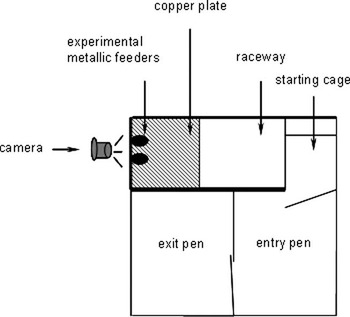
The experimental set-up was adjacent to the home pens. Two waiting pens (2.5 × 3.5 m) allowed access to and exit from a raceway (4.0 × 1.5 m). A starting cage (1.5 × 1.0 m) gave access to the raceway by a guillotine door (Figure 1). At the end of the raceway, a copper plate (1.2 × 1.4 m) isolated from the ground was placed on the floor. Above it, one or two metallic feeders isolated from the rest of the metallic structure were fitted according to the lamb's treatment (1F: lambs having only one feeder i.e. no-choice treatment, 2F: lambs having two feeders, i.e. choice treatment). These feeders contained the same quantity of a palatable mixture of barley and maize silage, and allowed feeding without restriction during the 2-min test. The sides of the raceway were built in plain wood to isolate visually the tested lamb from the rest of the flock. Two cameras were placed above the apparatus to record the lamb's behaviour.
Experimental device used to study the reaction threshold to stray voltage. One or two metallic feeders were fitted according to the lamb's treatment (1F: lambs having only one feeder i.e. no-choice treatment, 2F: lambs having two feeders, i.e. choice treatment).

EDF R&D (Electricité de France Research & Development, France) provided the electrical circuit allowing exposure to the chosen alternating (50 Hz) voltage. A multi-channel transient recorder (Nicolet Data Acquisition System, Nicolet Technologies, Madison, WI, USA) associated with an analyzer software (Nicolet Vision version 3.50, Nicolet Technologies, Madison, WI, USA) was configured to record current and voltage. Current measurements were taken using a current probe (A6302, Tektronix S.A., Les Ulis, France) associated with a current probe amplifier (AM503, Tektronix S.A., Les Ulis, France) placed in the circuit at the exit of the power supply box. This current probe was connected to the Nicolet Data Acquisition System through a 50 Ω coaxial link. The voltage was measured between the electrified trough and the copper plate. Each day for each lamb, the current (root mean square) crossing the animal was measured using the software Team Pro (Thermo Fisher Scientific Inc., Waltham, MA, USA). When available, three measures of current were averaged per lamb and per day. Using the Ohm's law equation V = R × I, which relates the voltage (V) to the current (I) and the impedance (R), the average impedance was calculated per voltage (i.e. day) and per lamb. Because of the sensitivity properties of the program used, the current could not be measured for the voltage below 1 V.
Procedure
The test consisted of two phases: a learning phase and a test phase. During the learning phase, the ewe lambs were trained to walk through the raceway and eat in one or two metallic feeders according to their treatment. They were trained once in a day, 4 to 5 days a week over a 6-week period, two animals at a time to limit stress for the first week and individually thereafter. Lambs from each treatment were alternated, with the ones that came spontaneously at the entrance of the starting cage tested first in order to limit the handling. Once the lamb was in the starting cage, a heart rate monitor Polar S810 (Polar Electro Oy, Finland) and the two electrodes of the Horse Transmitter T52 H (Polar, Fleurier, Switzerland), fitted on an elastic belt, were adjusted to the thorax of the animal. The receiver was set to record the mean heart rate for every 5-s period. The lambs were left alone for 15 s before the guillotine door was opened. The test started once the lamb was in the raceway and lasted 2 min. At the end of the learning phase, only lambs that learned to eat in the feeders were kept (n = 13 for each treatment). In order to avoid a strong stress response with no return to the feeder the following day, the voltage was increased progressively. During the test phase, stray voltage was applied every day (n = 16 days), in steps of 0.5 V from 0 up to 8 V to either the single feeder for the 1F treatment or to the first feeder in which the lamb started to eat for the 2F treatment, until the end of the test. For both treatments, stray voltage was applied after the lamb had eaten for at least 3 s in the feeder. For the 2F treatment, the second feeder was never electrified. This allowed the 2F lambs to switch to the non-electrified feeder if they wanted to.
Measurements
The quantity of feed in each feeder was measured before and after each test. The behaviour of the lambs was analysed using the Observer® program (Noldus, Netherlands). For the 2F lambs, the relative quantity of feed eaten in the electrified feeder (quantity eaten in the electrified feeder divided by the total quantity eaten), the percentage of time spent eating in the electrified feeder (out of the 2-min test), the percentage of time spent eating in the non-electrified feeder (out of the 2-min test) and the latency to switch to the non-electrified feeder after the application of the voltage were measured. For the 1F lambs, the quantity of feed eaten in the only feeder (electrified feeder) and the percentage of time spent eating in the electrified feeder (out of the 2-min test) were recorded. For both treatments, the number of animals having urinated at least once during the test or just after the end of the test, the average heart rate and the maximum heart rate during the first 30 s of the test and during the entire test were measured. Heart rate measurements were downloaded using the Polar Equine Software (Polar Electro Oy, Finland).
Air temperature was recorded twice a day during the experimental period.
Statistical analysis
For unknown reasons, two 2F lambs did not eat in the feeders from the first day of the test phase to the end of it and were excluded from the statistical analysis. Seven times over the 456 tests conducted, a lamb did not eat or ate for <3 s. These data were considered as missing data.
As no direct comparison was possible between the no-choice treatment (1F) and the choice treatment (2F) for the latency in switching feeders, for the relative quantity of feed eaten in the electrified feeder (variables not existing for the 1F treatment), for the percentage of time spent eating in the electrified feeder, for the percentage of time spent eating in the non-electrified feeder and for the quantity of feed eaten in the electrified feeder (presence of a non-electrified feeder for the 2F treatment), analyses were conducted separately for each treatment for these variables. The model included the factors voltage, breed and pen as fixed effects, the factor lamb as a random effect and the outside temperature and lamb weight as a covariate. For the heart rate measurements, comparisons were made between treatments (1F v. 2F) and therefore the number of feeders was included in the model as a fixed effect. When an effect of the voltage was found, further analyses using Student's t-test for paired observations were taken for comparing two consecutive voltages. When normal distribution of the residuals was not verified, log, square root or inverse transformations were used.
For the number of lambs having urinated, comparisons between 1F and 2F treatments were made using Fisher's test analysis. On account of the small number of animals having urinated for each voltage, data were grouped together in three equivalent periods: a low voltage period from 0.5 to 2.5 V; a medium voltage period from 3.0 to 5.0 V (beginning of behavioural modifications for some of the animals); and a high voltage period from 5.5 to 8.0 V (extensive behavioural modifications for most of the animals).
A regression analysis with all the results (1F and 2F) was carried out between the current measured with the Nicolet and the voltage applied to the feeder. In order to relate the observed effects to the current rather than to the voltage, regressions between the behavioural variables and the measured current were performed (separately for the 1F and the 2F lambs). For each variable, the linear, quadratic and log-linear models were tested and the most appropriate one was selected.
As no meaningful evidence of the effect of the home pen was found on any variable, only results for the effects of voltages are presented.
The experiment was conducted under the guidelines given by the French Agriculture Ministry.
Results
Feeding behaviour
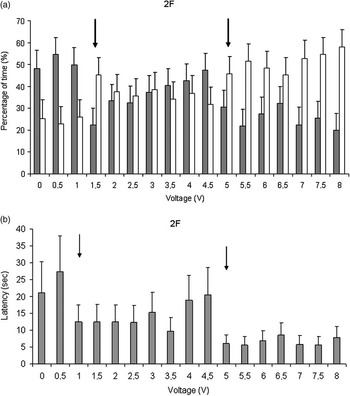
For 2F lambs, a voltage effect was found for the percentage of time spent eating in the electrified (P < 0.01) and non-electrified feeders (P < 0.05; Figure 2a): a first decrease in the percentage of time spent eating in the electrified feeder was observed at 1.5 V (1 v. 1.5 V, P < 0.05) with a progressive increase until 5 V and a trend for a second decrease at 5 V (4.5 v. 5 V, P = 0.058) with no return to initial value for higher voltages. The opposite pattern was observed for the non-electrified feeder. A trend for a voltage effect was observed for the relative quantity of feed eaten in the electrified feeder (P = 0.055, square root transformation): a first decrease in the relative quantity of feed eaten in the electrified feeder was observed at 1.5 V (1 v. 1.5 V, P < 0.05) with a progressive increase until 5 V and a second decrease at 5 V (4.5 v. 5 V, P = 0.075) with no return to initial value for higher voltages. In addition, the latency to switch to the non-electrified feeder was influenced by voltages (P < 0.05, log transformation): lambs were quicker to change to the non-electrified feeder for voltages higher than 4.5 V (4.5 v. 5 V, P < 0.05; Figure 2b).
(a) Percentage of time spent eating in the electrified feeder (grey) and in the non-electrified feeder (white) and (b) latency to switch to the non-electrified feeder after the application of the voltage in lambs (n = 11). Stray voltage was applied from 0 to 8 V in steps of 0.5 V each day during a 2-min test of the first feeder (out of two) in which the lambs started to eat (2F, choice situation). LSmeans and s.e.m. are shown. The arrows indicate where a threshold could be detected (P < 0.05 compared to the previous day).

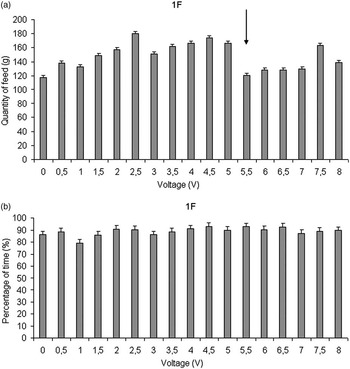
For 1F lambs, a voltage effect was found for the quantity of feed eaten in the electrified feeder (P < 0.001): although the quantity of feed eaten in the electrified feeder increased until 5 V, a large decrease in the quantity of feed eaten was observed for voltages higher than 5 V (5 v. 5.5 V, P < 0.001), with a transient rise at 7.5 V (Figure 3a). A voltage effect was found for the percentage of time spent eating (P < 0.05): lambs ate irregularly from 1 day to another with no obvious threshold (Figure 3b).
(a) Quantity of feed eaten and (b) percentage of time spent eating in an electrified feeder in lambs (n = 13) exposed to stray voltage. Stray voltage was applied from 0 to 8 V in steps of 0.5 V each day during a 2-min test to a single feeder (1F). LSmeans and s.e. are shown. The arrow indicates where a threshold could be detected (P < 0.05 compared to the previous day).

Urination
More urinations (1F and 2F grouped together) were recorded during the 5.5 to 8.0 V period compared with the 0.5 to 2.5 V period (17 urinations during the 127 tests for the 5.5 to 8.0 V period v. one urination during the 119 tests for the 0.5 to 2.5 V period, P < 0.001). In addition, more 1F lambs urinated during the whole experiment compared with 2F lambs. During the 208 tests for the 1F treatment, 22 urinations were recorded, whereas only four urinations were recorded during the 176 tests for the 2F treatment (P < 0.001). In addition, although no differences were observed for the 0.5 to 2.5 V period and the 3.0 to 5.0 V period, more urinations were recorded for the 1F lambs compared with the 2F lambs during the 5.5 to 8 V period (15 urinations were recorded for the 1F treatment during the 78 tests v. two urinations during the 66 tests for the 2F treatment; P < 0.01).
Heart rate
No voltage effect was observed for the maximum heart rate, the average heart rate during the first 30 s and during the entire test.
Current and impedance measurements
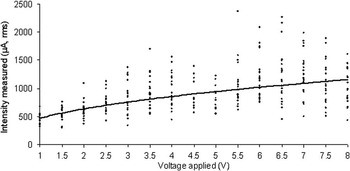
A positive relationship was observed between the current measured with the Nicolet and the voltage applied: log (current measured) = 0.11 (voltage applied) + 6.25 (P < 0.001; R 2 = 0.34; Figure 4). A large variability was found during the experiment when calculating the impedance for each lamb and each day of test (Table 1). An intra-lamb coefficient of variation of 48% was found. No relationships were found between the behavioural variables and the current measured with the Nicolet.
Positive relationship between the voltage applied to a feeder and the intensity of the current measured with a current probe placed on the electric circuit (can be assimilated to the current crossing the circuit feeder – lamb – metallic plate): log (current measured) = 0.11 (voltage applied) + 6.25 (P < 0.001; R 2 = 0.34). Each dot represents the intensity value for one lamb, averaged from a maximum of three measures per day (μA; root mean square, r.m.s.) when available. Non-transformed data are presented.

Impedance (Ω) distribution for a feeder – lamb (muzzle – all hooves pathway) – metallic plate circuit when stray voltages were applied from 0 to 8 V to a feeder

The percentiles were calculated from the average impedance values obtained per lamb for each voltage (i.e. day of test). In total, 305 measures from 24 lambs were obtained.
*The percentiles are the value (feeder – lamb – metallic plate pathway impedance) below which a certain percentage (10%, 25%, 50%, 75% and 90%) of the observations may be found.
Discussion
A value of 5 V seems to be the threshold at which extensive and permanent changes in feeding behaviour are observed in the lambs having the choice to switch to a non-electrified feeder: they spent less time eating in the electrified feeder, ate less feed in this feeder and changed more quickly to the non-electrified feeder. Indeed, for a voltage higher than 4.5 V, lambs were probably not motivated enough to carry on eating in the electrified feeder compared with the aversiveness of the electric stimulus. In addition, it can be put forward that a transient modification of behaviour was observed at 1.5 V, similar to the one observed at 5 V, but feeding behaviour returned quickly back to the initial pattern. From the results of this experiment, two different behavioural thresholds could be defined: first, a transient reaction threshold described as a voltage at which a transient modification of behaviour is observed, followed by a rapid behavioural habituation. The lambs perceived a change in their environment, but not aversive enough to permanently modify their feeding behaviour in the presence of palatable food. Second, a persistent reaction threshold could be defined as the threshold at which extensive and permanent changes in behaviour are expressed by the animal. The disagreement due to the electric stimulus is then higher than the motivation to eat. Similar thresholds have also been identified in heifers submitted to the same procedure (Rigalma et al., in press).
The contextual conditions are of particular importance to determine the reaction and intolerance voltage thresholds. Although the transient and persistent reaction thresholds could be easily identified when the lambs had the choice to switch to a non-electrified feeder, these two thresholds were not found when the lambs could not switch to a non-electrified feeder. Indeed, the transient and more discrete change of behaviour at 1.5 V was not observed in the lambs with only one feeder. A decrease in the quantity of feed eaten in the electrified feeder was found for voltages higher than 5 V but no clear threshold was found for the time spent eating in the electrified feeder. For Rushen (Reference Rushen1986a), punishment tests (i.e. tests based on stimuli that reduce the probability of a behaviour leading to the delivery of a reinforcer) allow a good discrimination to be obtained between different intensities and durations of electric shocks, and are less stressful than classical conditioning procedures. When a wide range of intensities of electric shock were studied, a progressive avoidance response was found in rats with this technique. However, choice test procedures associated with punishment procedure seem to be more sensitive than other types of conditioning procedures. Indeed, Woolverton (Reference Woolverton2003) showed that choice test is a more sensitive and selective method for studying the effect of drugs as punishers in rhesus monkeys. In comparison to other experiments performed on the same topic, this method was approximately 10-fold more sensitive than a method not using the choice test procedure (Woolverton, Reference Woolverton2003). Even if the difference between the two behavioural avoidance thresholds measured with the choice v. non-choice procedures was not very high, we still observed that when lambs had the opportunity to change the feeder, more variables changed compared to when the lambs had only one feeder. Lambs were placed in situations opposing two motivations against each other: the motivation to eat palatable food in the first feeder they started to eat and the motivation to avoid electricity. The lambs having two feeders could solve the conflict: they could reallocate their motivation to eat food by changing the feeder. However, the animals are ready to pay a relatively high price for palatable food, even if this food is not necessary for their survival, as they were fed ad libitum when not being tested. Experiments performed in rats corroborated the fact that animals are ready to pay for palatable food: for example, Cabanac and Johnson (Reference Cabanac and Johnson1983) observed that rats were venturing repeatedly into a potentially lethal cold alley in order to get palatable food even if standard food was provided ad libitum in a thermoneutral refuge. In the case of lambs with only one feeder, they had to pay a higher price compared with lambs with two feeders, which could decrease the unpleasantness of the situation by changing the feeder even if individual lateralization could have been a bridle to changes (Versace et al., Reference Versace, Morgante, Pulina and Vallortigara2007).
It is interesting to note that lambs with one feeder urinated more compared with lambs with two feeders for voltages higher than 5 V. Urination is considered to be a fear-related behaviour (Erhard et al., Reference Erhard, Elston and Davidson2006), even if an increase is not always observed during stressful situations (Beausoleil et al., Reference Beausoleil, Stafford and Mellor2005). According to Scherer (Reference Scherer2001), a number of elementary characteristics such as novelty, predictability and controllability are relevant for the evaluation process of the situation. In the case of our study, the controllability could correspond to the capacity to terminate the aversive event by switching from the electrified feeder to the non-electrified feeder. Indeed, few experiments in animals show that they can appraise an aversive event as controllable v. uncontrollable. Pioneer studies conducted in rats by Weiss (Reference Weiss1972) show that controllability of the termination of electric shocks decreases the detrimental effects of those aversive events. Several subsequent studies fully support this first study. For instance, the ability to terminate an aversive event reduces its negative effects (review by Miller, Reference Miller1979), whereas a lack of controllability exacerbates negative emotions such as fear (review by Armfield, Reference Armfield2006). In farm animals, the idea that controllability could contribute to the emotional responses of animals and thus to animal welfare was put forward in the 80 s by Wiepkema (Reference Wiepkema1987). Uncontrollability may have been involved as a triggering agent of stress response. When control is lacking, a stress response can appear as reviewed in humans and rats by Zvolensky et al. (Reference Zvolensky, Lejuez and Eifert2000) and demonstrated lately in sheep in the presence of aversive events (Greiveldinger et al., Reference Greiveldinger, Veissier and Boissy2009). The aversiveness of the higher voltages reinforced by a lack of control could have induced increased urination. However, it should be noted that no effect was found for the heart rate measurements even if a change in heart rate could be a relevant parameter to study the reactions of animals to a stressful event (von Borell et al., Reference von Borell, Langbein, Despres, Hansen, Leterrier, Marchant-Forde, Marchant-Forde, Minero, Mohr, Prunier, Valance and Veissier2007). Even if the voltage treatment induced some stress, the progressive increase in the voltage may have allowed the animals to adapt to it progressively, with no effect of novelty or suddenness. Another alternative hypothesis to explain the increase in urination in the lambs having only one feeder above 5.5 V is the quantity of disagreement experienced during the test. As the lambs could not change the feeder and preferred to carry on eating in the electrified feeder instead of stopping, they experienced a longer exposition to stray voltages, receiving numerically a larger quantity of electricity and unpleasant stimulation compared with the lambs having the possibility to change the feeder.
The current crossing the animal varies according to several parameters such as the impedance of the body point contact, the impedance of the source of contact (feeder or feed in the feeder), the pathways followed by the current through the body and the duration of contact. In this experiment, the current and impedance measured corresponded to the circuit feeder – animal – hooves. A large intra-lamb variability in impedance was observed. The source of contact was standardized by using a floor in copper, but the contact point with the feeder could not be completely standardized in comparison to experiments in which electricity was applied with an electrode using gel for the contact. For example, the changes in the amount of food in the trough between the start of the test and the end of the test could have modified the contact with an increased probability of direct contacts with the metallic feeder. The large individual variability in impedance could also result from a modification of feeding behaviour as shown by Reinemann et al. (Reference Reinemann, Stetson, Laughlin and LeMire2005) who observed a modification in drinking behaviour (submerging their entire muzzle) when current was applied to a drinking bowl. When taking into account the impedance values obtained for each lamb and each day of test, a wide distribution was observed. Individual variation due to age, sex, size and skin or hoof conditions can explain part of this variability. For example, the impedance can vary according to several criteria such as the thickness of the skin and of the horny layer or the presence of fat in the epidermis, which tend to increase the impedance (Brugère, Reference Brugère2002). Using the equation, voltages of 1.5 V and 5 V would correspond to intensities of 0.63 and 0.89 mA, respectively. It is quite difficult to compare these values to the ones obtained in the literature because very few studies have been carried out in sheep. Non-pregnant ewes exposed repetitively to 4 mA at their forelimb presented an increase in blood cortisol concentrations only on the first and second footchock days but not anymore on the third day. Owing to intense agitation, the behaviour changed progressively to mild restlessness during the periods of footshocking (Przekop et al., Reference Przekop, Stupnicka, Wolińska-Witort, Mateusiak, Sadowski and Domański1985). In cows, some behavioural changes were observed (such as flinching, jumping, humping of the back and vocalizing) for current intensities that varied from 0.75 to 7 mA, depending on the experiment and the pathway (hooves, udder, back and mouth pathway) (review by Hultgren, Reference Hultgren1990).
Our experiment cannot be generalized directly to farm condition for several reasons. First, it was a short-term study (2-min test per day) without any analysis of the long-term consequences of stray voltages on the physiology, growth and reproduction of the sheep. Second, the threshold should be taken with some caution due to the fact that 10 lambs out of the 34 present at the beginning of the experiment could not be tested. These 10 lambs did not learn and/or were too afraid to eat while being tested in isolation during the habituation period (without electricity). This means that some of the more susceptible to stress lambs were probably removed from the experiment, keeping only the lambs able to support stress, and then maybe creating a bias towards a higher voltage threshold. Third, several problems can arise with the use of punishment studies such as an adaptation to shock and a bias depending on the level of feed motivation (Rushen, Reference Rushen1986a). In order to avoid a strong stress response with no return to the feeder the following day, the voltage was increased progressively. However, it is known that previous experience with mild electric shock reduces the effectiveness of subsequent stronger shocks in a punishment test in rats (Karsh, Reference Karsh1963). The procedure followed may have increased the intolerance threshold. In addition, lambs were not feed restricted before the tests (they received concentrate 1 h before the beginning of the test), but were still very motivated to eat because of the palatability of the feed used. The results may have been different if we had used less palatable feed such as only silage.
Conclusion and implication
Faulty connection between the electrical circuit and the earth can arise from different sources and may be found quite frequently in farms. Improperly earthed electrical material as well as wiring and equipment problems can be a source of stray voltage. For example, a fault in water heater elements and breakdown of insulation due to animals or vibration are quite common in farms (Kirk et al., Reference Kirk, Reese and Bartlett1984). This experiment was the first stage of a project to determine the effects of stray voltage in sheep. The next step will be to study the mean term effects of stray voltage on stress physiology, behaviour and performance. The contextual conditions in which animals are exposed to stray voltage influence their subsequent reactions: the first clear behavioural reaction threshold is easier to detect in choice than in no-choice conditions.
Acknowledgements
The authors thank RTE for financial support, François Fortin and Jean-Pierre Gernez from EDF Research and Development for the installation of the electrical apparatus, Ludovic Cressent from the experimental farm of AgroParisTech for building the experimental device and helping with the animals during the experiment, Christine Ficheux for the cortisol assays and Andrew Ponter for re-reading the English version.