


Introduction
Avicenna, known in Arabic as Ibn Sīnā and one of the most famous Muslim philosophers, was a celebrated physician and scientist who lived between the eleventh and twelfth centuries. Fakhr al-Dīn al-Rāzī (d. 1209) was an anti-mu‘tazilite, or orthodox, theologian who was deeply familiar with the work of Avicenna and who criticized him sharply on many occasions.
We will consider here the question of earthquakes as addressed by these authors with the aim of checking the well-known hypothesis according to which Muslim theologians, who were generally less influenced by Aristotle, sometimes set out doctrines that were much more innovative from a scientific point of view than those of philosophers. This paper thus contributes to the history of Graeco-Arabic translations and the history of science.
Aristotle was a major source for theories about earthquakes, so we must first recall the extent to which his views were known to the Arabs. Aristotle dealt with earthquakes in Book II of his Meteorologica: in Chapter 7 he confutes the positions of Anaxagoras of Clazomenes, Democritus of Abdera and Anaximenes of Miletus and in Chapter 8 he expounds his own ideas.
Aristotle on earthquakes
According to Aristotle, earthquakes are caused by the pressure of air (pneuma) produced when the earth, which is in itself dry but may be moistened by rain, is heated by the sun and by its internal fire. Earthquakes mostly occur when this pneuma makes rising vapour (anathymiasis) flow back into the earth: this happens mainly in calm weather, though earthquakes may occur when winds (ànemoi) blow because they contribute to making the pneumata turn inwards. Severe earthquakes occur when the sea is full of currents and when the earth is porous: in these cases seawater fills the pores of the earth, forcing out pneumata. Rains and droughts produce similar effects.
Phenomena related to earthquakes such as dimming of the sun are noted. This occurrence is not explained, but Aristotle does explain why calm and cold usually precede an earthquake and why a long streak of fine cloud may herald one; he later explains why earthquakes can occur at an eclipse of the moon. Aristotle also states that the effects of severe shocks frequently persist for 40 days and even for periods of one year or two. Subterranean noises during earthquakes are discussed, and the reasons why water may come out of the earth – in this case, the pneuma exerts its force from beneath. Tidal waves are caused by pneumata acting in the opposite direction.
Aristotle remarks that earthquakes are confined to one locality while winds (ànemoi) are not. He considers that horizontal shocks are determined by large quantities of pneuma; on rare occasions, shocks may run up from below, when large quantities of stones come to the surface. Finally, he explains why earthquakes are rarer in islands.
Aristotle's Meteorologica in Arabic is known through the translation by Yahyā ibn al-Bitrīq,1 who died in 830. A summary by Hunayn ibn Ishāq (808–873), the most famous of Arabic translators, is also available.2
Yahyā ibn al-Bitrīq's version
Yahyā's version of the chapters on earthquakes appears to be more of a summary than a translation, which is strange because his translation of Book IV of the Meteorologica is very faithful to the original.Reference Baffioni3
The main points of Aristotle's arguments are summarized, though not always in the same order. Chapter 7 briefly resumes the theories of Anaxagoras, Democritus and Anaximenes. But let us turn to Chapter 8.
In Greek, there are three terms for the main agents of the phenomena described. In the English version by Lee, which I have quoted in this work, pneuma and ànemos are both translated as ‘wind’; anathymìasis is rendered as ‘exhalation’. To these we must add atmìs (vapour).
The Arabic sources speak of rīh (wind) and bukhār (vapour) only. The first can translate pneuma and ànemos, the second anathymìasis and atmìs. This may explain some departures from Aristotle's text and some misunderstandings by the Arabic authors.
Yahyā attempts to resolve the inconsistencies resulting from this shift in terminology:
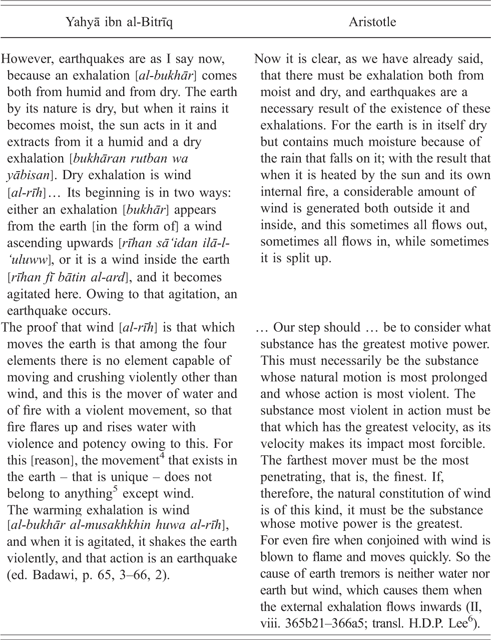
We should note that though Aristotle added the idea of ‘splitting (merìzetai) the pneuma’ as a third possibility, Yahyā ibn al-Bitrīq here introduces only two processes leading to earthquakes: a wind formed outside or inside the earth.
The differences are largely philological. We can recall at least that Yahyā misunderstands the names, as in his statement that ‘… in some places an earthquake occurs and it does not stop until when the earth gets cleft, so that the wind comes out from that cleft and a noise is heard …’ (pp. 67, 9–11), which is a faithful translation of 366b33–35: ‘… in some places there has been an earthquake which has not ceased until the wind which was its motive force has broken out like a hurricane and risen into the upper region …’. But the examples given by Aristotle – Heracleia in Pontus and Hiera, one of the Aeolian islands – are completely misunderstood by Yahyā, who incorrectly transliterates the names (pp. 67, 11–68, 1), although it is clear that the same places are referred to, as the continuation of Yahyā's text also demonstrates (pp. 68, 1–6 and 367a3–12).
Another example: Yahyā explains floods caused by earthquakes in terms of the blowing of different winds, and cites the south and the north winds, whereas Aristotle spoke of different forces exerted by wind from the surface or from beneath, mentioning the case of a ‘tidal wave’, and he referred to the south and the north wind (notos and boreas) only in reporting what happened in Achaea, which is also cited by Yahyā.
In terms of content, Yahyā adds an explanation of the fact that the sun is obscured in the case of earthquakes: ‘… because together with the wind soil and dust have come out from the earth’. And when recalling earthquakes during eclipses Yahyā mentions eclipses of the sun and of the moon, whereas Aristotle spoke of eclipses of the moon only. Yahyā's explanation is different, too:
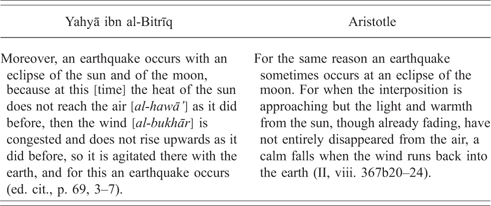
Lastly, Aristotle spoke of a shock running horizontally in the case of abundant winds and of rare cases of shock running up from below, whereas Yahyā states that abundant winds move the earth from side to side and few winds – oligàkis (occasionally) in Greek – move it upwards and downwards.
Hunayn ibn Ishāq's summary
Hunayn's summary – three pages in the edited version – merely lists some of Aristotle's arguments and ignores the overview of his predecessors. Wherever it differs from the original it follows Yahyā's version, starting with the first lines of Chapter 8 where the third kind of earthquake listed by Aristotle is omitted:

Hunayn shares with Yahyā the explanation of the dusty colour of the sun, the references to solar and lunar eclipses and the explanation of earthquakes in eclipses of the moon, the mention of the north and the south winds to explain floods after an earthquake and the horizontal and vertical movements of the earth resulting from different winds.
In addition, Hunayn – like Yahyā, but at odds with Aristotle – distinguishes between floodwaters and water from sources, which are partially retained in the earth, and between turbid and very hot waters. Unlike Yahyā, Hunayn strictly follows the order of Aristotle's text. These facts could indicate a pre-existing version to which both authors referred. Bio-bibliographers, who do not mention Yahyā's version,Reference Baffioni7 refer to a translation by Abū Bishr Mattā ibn Yūnus that has not survived. But this does not help because Abū Bishr lived between 870 and 940, later than Yahyā and Hunayn. Ibn al-Nadīm (d. 995) relates a paraphrase of the Meteorologica to the even later Abu 'l-Khayr al-Hasan b. Suwār (d. ca. 1017).Reference Baffioni8 As far as we know, the only earlier possible source remains a Greek compendium of the original work with its Syriac version, probably made by Sarjīs of Rish‘aynā (d. 536) on the basis of an Alexandrian model, mentioned by Petraitis.Reference Baffioni9
Avicenna's explanation of earthquakes
Avicenna discusses earthquakes in Chapter 4 of the section on natural sciences in his famous Kitāb al-Shifā’, the ‘Book of healing’ (in the sense of ‘healing of soul from ignorance’, just as Avicenna describes how to cure the body in his Canon of Medicine), in which Aristotle's doctrines are set out, often in an original way.
According to Avicenna, an earthquake is caused by the movement of some parts of the earth, caused by a ‘windy body’ (al-jism al-rīhī) that originates beneath the earth. Like Aristotle, he identifies a vaporous, windy or fiery (bukhārī rīhī aw nārī) body as the main cause of an earthquake. After this brief introduction, Avicenna examines the doctrines of Democritus, Anaximenes and Anaxagoras before returning to Aristotle, whose ideas he introduces with some significant modifications.
In the introductory lines, for example, only one possibility is selected from those given by Aristotle: that earthquakes originate beneath the earth. This is considered the main cause of earthquakes, which is different from Aristotle. And water bursting from the earth as a result of earthquakes is introduced as a useful effect because it results in the formation of water sources; this may be borrowed from the original additions in Hunayn's summary. The same consideration is repeated at the end of the chapter to give a religious conclusion. The dangerous effects of earthquakes, such as fires and loud sounds, are also noted. Immediately after this, Democritus’ theory is related to water as one of the causes of earthquakes – a possibility denied by Aristotle.
When the ‘real’ second cause of an earthquake, with its origin ‘above’ the earth, is approached, Avicenna links it to the fact that mountains break into pieces. This theory is attributed to a certain ‘Arakimas’, who from the context must be Anaximenes, even though Aristotle's report of his theory is different in that it refers to the breaking of the earth (tēs gēs) because of drought or heavy rains, an issue that Avicenna accounts for later.
Having mentioned the noises preceding earthquakes, Avicenna adds that a proof that the main cause of an earthquake is congested winds is that earthquakes diminish when wells and pipes are dug to increase the space for winds and vapours. Lastly, Avicenna emphasizes the variety of earthquakes in terms of their strength at the beginning and the end.
Avicenna often reflects the influence of Yahyā and Hunayn. When, for example, he explains, following Aristotle, why wind is the most important motive power, he lists all the possibilities linked to the four elements as does Yahyā, who, contrary to Aristotle, refers explicitly to ustuqusāt, ‘elements’. He is also prone to the terminological confusion noted above, speaking first of ‘…a body made of vapour or smoke … like wind’ (jism bukhārī dukhānī… ka-l-rīh) from beneath the earth – where the example of jars shows that Avicenna is thinking of ‘air’ – then of a ‘windy body, made of fire or not’ (al-jism al-rīhī, nāriyyan kāna aw ghayr nārī) and then of a ‘body made of air’ (al-jism al-hawā’ī) that belongs ‘to the dominion of that which is made of wind, of vapour or of smoke’ (an yakūna fī hukm al-rīhī wa-l-bukhārī wa-l-dukhānī), all of which point to the Greek pneuma.
Avicenna also mentions the ‘elongated clouds’ heralding an earthquake. He refers to eclipses as possible causes of earthquakes, and his explanation subsumes those by Yahyā and Hunayn. Avicenna also develops Aristotle's notion of horizontal and vertical shocks determined by different winds, on the basis of Yahyā and Hunayn.
Hence, Avicenna adds many new details to the Meteorologica and ignores Aristotle's points in only a few cases, such as the persistence of shocks in cases of severe earthquakes, the link between earthquakes and tidal waves, the local character of earthquakes but not of winds, and the infrequency of earthquakes in islands far out at sea.
Fakhr al-Dīn al-Rāzī's explanation of earthquakes
There are, as one might expect, a number of similarities with Avicenna in Fakhr al-Dīn al-Rāzī, who deals with earthquakes in his Mabāhith al-mashriqiyya, ‘The oriental queries’, a juvenile philosophical work. When he reports Anaximenes’ theory, for example, which he does anonymously (perhaps because he was unable to identify Arakimas), he introduces it as an example of the second cause of the origin of earthquakes, following Avicenna:

Like Avicenna, Fakhr al-Dīn also mentions the excavation of wells as an expedient to liberate vapours (al-abkhira; al-riyāh wa-l-abkhira in Avicenna) to reduce the occurrence of earthquakes.
In spite of these common themes, Fakhr al-Din leaves out many issues referred to by Avicenna, perhaps because his chapter is shorter than those of Avicenna and Aristotle. He omits the advantages and damage brought about by earthquakes, the kinds of cloud formed in earthquakes, the seasons in which earthquakes occur more or less often, eclipses, references to the human body and the different strength and kinds of earthquakes.
Nonetheless, and despite the fact that he omits many Aristotelian elements, Fakhr al-Dīn's treatment of earthquakes is much closer to Aristotle than was Avicenna's. He is the only author among those considered to preserve the initial three-fold distinction made by Aristotle in that he resumes his arguments with: ‘The cause of earthquakes [can be] either under the earth, or above it, or [something] composed of both of them’. Fakhr al-Dīn relates the opposition of winds to this ‘third’ explanation of the earthquakes, which had been introduced by Aristotle through the verb merizesthai, ‘to split’, with reference to pneuma:

Conclusion
Although our research goes against the initial hypothesis, because Fakhr al-Dīn was much influenced by Aristotle, the sources confirm that he worked from the ideas of his predecessors, Avicenna in particular, in an original way: for example, it is significant that he considers earthquake noise from a scientific point of view rather than as damage related to earthquakes, as does Avicenna. On the other hand, he must have had at his disposal translations of Greek texts. I have elsewhere noted this with regard to the study by Fakhr al-Dīn of the science of embryology and the related doctrines of Aristotle and Galen.Reference Baffioni12
In terms of content, the introductory lines of his presentation are the closest to the brief account of earthquakes in Epistle 19 On minerals by the Ikhwān al-Safā’, the ‘Brethren of Purity’, who wrote the oldest encyclopaedia of sciences in the Middle Ages, a tenth century Muslim survey based on the view of Aristotle and others:

This comparison further confirms the hypotheses of the availability of a different version of Aristotle's Meteorologica from that by Yahyā ibn al-Bitrīq and of continuity in the scientific heritage from the translation period to Fakhr al-Dīn al-Rāzī.14
Carmela Baffioni is full professor of History of Islamic Philosophy at the Università degli Studi di Napoli ‘L'Orientale’. She is member of the Academia Europaea (Section ‘Classical and Oriental Studies’); founder member of the Section of Studies on Near East – Arabic Session of the Accademia Ambrosiana; and membre correspondant of the Académie Internationale d'Histoire des Sciences. Her publications include studies on the Greek heritage in Islam and its Latin elaborations; various aspects of religion and heresiography; philosophers such as al-Kindī, al-Fārābī, Yahyā b. ‘Adī, Avicenna, Averroes, and the Isma‘ilis. Her scientific interests concern logic, atomism, alchemy, mineralogy, botanic and embryology. A major topic is the Ikhwān al-Safā’, to whom she has devoted four monographs and more than 50 articles. Her last work is the new critical edition with English translation and commentary of the logical treatises of the Ikhwān al-Safā’ (Oxford University Press in Association with the Institute of Ismaili Studies 2010), within the project launched by the Institute of Ismaili Studies. She is now involved in the edition and translation of the treatises 15–21 on the philosophy of nature.


