I. INTRODUCTION
Over the last decades, microwave sintering has been under constant development for the rapid preparation of high-performance powder materials, such as ceramics and ceramic matrix composites. Reference Yadoji, Peelamedu, Agrawal and Roy1–Reference Cheng, Agrawal, Zhang and Roy6 Recently, Roy and his co-author reported for the first time that pure metals can be sintered to full density by microwave processing. Reference Roy, Agrawal, Cheng and Gedevanishvili7 Subsequently, experiments on microwave sintering of various kinds of metals and alloys were carried out. It shows that the microwave heating not only enhances the densification rate of metallic materials, but also makes the products have better mechanical properties than that prepared by the conventional sintering. Reference Wilson, Lee and Case8–Reference Janney, Kimrey, Allen and Kiggans10
Thus far, much work has been carried out to study the mechanisms of microwave sintering to understand its superiority over conventional approaches. Many have attributed the advantages of microwave sintering to the effect induced by high-frequency alternating microwave fields, such as the enhancement of the diffusion coefficient, Reference Wilson, Lee and Case8,Reference Janney, Kimrey, Schmidt and Kiggans9 the reduction in activation energy Reference Janney, Kimrey, Allen and Kiggans10,Reference Demirskyi, Agrawal and Ragulya11 and the ion conductance, Reference Yoshikawa12 nonconventional diffusion mechanism, Reference Demirskyi, Agrawal and Ragulya13 micro-plasma discharges, Reference Demirskyi, Agrawal and Ragulya14 etc. Moreover, during microwave processing, the microwave provides the direct energy source for sintering. So, the distribution of electro-magnetic microwave in the particle system plays an important role for the sintering process. Some researchers investigated the mechanisms of microwave sintering from the propagation and distribution characteristics of electro–magnetic microwave fields. For example, Saji Reference Saji, Iskander, Kiggins and Bolomey15 argued that the fields inside a ceramic material are 1/e lower than the fields in the void in a system consisting of layers of void and ceramic in planes perpendicular to externally applied fields. Later, Birnboim et al. Reference Birnboim, Calame and Carmel16 noted that in some common microstructures, the local electric fields inside certain ceramic regions, such as the neck of two ceramic spherical particles, could greatly exceed not only the average fields in the void but also the applied fields. This effect will lead to a highly nonuniform energy deposition and accelerated mass transfer rate. Birnboim et al. considered this effect to be the characteristic of electro-magnetic microwave micro-focusing. This view has been accepted by most of the research community. However, these studies are focusing on the distribution characteristics of microwave electromagnetic fields in ceramic materials, and seldom work related to this on metallic materials has been carried out. As we know, the microwave can propagate in ceramic particles. But in the metal particles whose diameter is much larger than the skin depth of the microwave (the depth to which a high-frequency electromagnetic field will penetrate a conducting medium), the microwave fields will reflect on the particle surface. So, the microwave can only propagate on the metallic particle surface or in the void, and its distribution within this particle system will be different from ceramic materials.
Recently, it is believed that the microwave absorption of metallic powders is predominantly determined by the magnetic polarization of particles. The alternating magnetic fields (called H-fields) induce a rotational electric field within the particle, which in turn drives eddy currents that generate heat. So the distribution of microwave H-fields within this particle-void system will directly influence the heating of metallic particle. Some researchers have investigated the microwave absorption, heating of metal powders, Reference Ma, Diehl, Johnson, Martin, Miskovsky, Smith, Weisel, Weiss and Zimmerman17 and the interaction between electro–magnetic microwave fields and the metal surface. Reference Galek, Porath, Burkel and van Rienen18 But these studies almost did not consider the influence of the distribution of electro–magnetic microwave fields on the sintering behavior. Besides, as the sintering process goes on, the microstructure of the powder system will change, which could influence the distribution of microwave H-fields as a result. However, there has been a seldom study on this area recently.
In the present paper, the intensity of microwave H-fields in the case of a spherical aluminum metallic particle system at different stages of the neck growth process has been analyzed by numerical simulations. The results show that there is a focusing effect of microwave H-fields in the region of neck, and the microscopic mechanisms of this focusing effect have been analyzed. This effect may be an important factor for the promoted rapid densification characteristic of microwave sintering. However, further study shows that the focusing effect will decline as the neck grows larger. The simulation results were supported by SR-CT (synchrotron radiation x-ray computed tomography) experimental observations of the microstructure evolution of metallic powders during the entire uninterrupted microwave sintering process. Furthermore, the micro-focusing effect within a loosely packed powder sample has also been studied. It indicates that the focusing effect will decline from outside to inside within the sample, which will result in the decline of sintering rate during the subsequent sintering stages.
II. INTRODUCTION OF SIMULATION AND EXPERIMENTAL PROCESSING
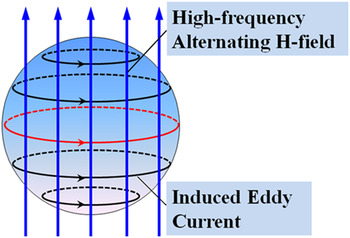
Generally speaking, the dissipation of microwave energy is mainly induced by electric fields and magnetic fields, and there are different effects on materials by separated microwave electric and magnetic fields. Reference Cheng, Roy and Agrawal19–Reference Roy, Peelamedu, Hurtt, Cheng and Agrawal21 For most electrically conductive materials such as metals, the external electric field may be suppressed inside the particle. So, the heating of such conductive materials can be more efficiently heated when the sample is placed in the magnetic field. Reference Cheng, Roy and Agrawal19,Reference Rybakov, Semenov, Egorov, Eremeev, Plotnikov and Bykov20 The heating in this case remains “electric” in nature, i.e., the high-frequency alternating H-fields induce a rotational electric field on the surface layer of particles, which in turn drives eddy currents and generate Ohmic losses (Fig. 1). The power released in a conductive spherical sample is Reference Rybakov, Semenov, Egorov, Eremeev, Plotnikov and Bykov20
 $$P = 3\pi {\mu _0}R{\delta ^2}\omega \left[ {{R \over \delta }{{\sinh \left( {{{2R} \mathord{\left/ {\vphantom {{2R} \delta }} \right. \kern-\nulldelimiterspace} \delta }} \right) + \sin \left( {{{2R} \mathord{\left/ {\vphantom {{2R} \delta }} \right. \kern-\nulldelimiterspace} \delta }} \right)} \over {\cosh \left( {{{2R} \mathord{\left/ {\vphantom {{2R} \delta }} \right. \kern-\nulldelimiterspace} \delta }} \right) - \cos \left( {{{2R} \mathord{\left/ {\vphantom {{2R} \delta }} \right. \kern-\nulldelimiterspace} \delta }} \right)}} - 1} \right]\mathop {{H_{\rm{0}}}}\nolimits^2 \quad ,$$
where ω is the field frequency, R is the radius of the sample, μ0 is the magnetic permeability of free space, H 0 is magnetic-field strength, and δ is the skin depth.
The diagrammatic sketch of eddy current induced by the alternating H-fields.

To study this behavior of microwave H-fields, the TE103 rectangular single-mode resonator (109.2 mm × 54.6 mm × 222 mm) was used. With this resonator, the distribution of microwave H-fields was analyzed using the High Frequency Structure Simulator (called HFSS) finite element analysis software. The TE103 mode resonator is a single-mode microwave resonator. It sets 1 and 3 standing wave cycles of the electric fields in the direction of the x and z axes, respectively, and sets the electric fields to be uniform and parallel to the y axis. In this resonator, the electric fields and magnetic fields satisfy the periodical distribution, and there is a phase difference of π/2 between them. To investigate the behavior of the microwave H-fields independently, the particles were placed in the region where the H-fields are at a maximum and where the electric fields are almost zero. In this way, the investigation on the propagation characteristics of microwave H-fields in a certain direction can be performed using this resonator. Comparing the size of the particles (diameter: 0.12 mm) with the half wave length of the standing wave (an operating frequency of 2.45 GHz will produce a wave length around 122.5 mm, and the half wave length of the standing wave are 109.2 and 74 mm in the direction of the x and z axes, respectively), the microwave electric fields in the sample can be considered to be approximately homogeneous prior to the introduction of the particles. To compare the obtained results with those obtained experimentally, the microwave frequency is set to 2.45 GHz, the microwave output is set to 3 kW and the solution type is set to driven modal. The metallic particle of aluminum (Al) with a diameter of 120 μm is selected as the material model, which is identical to that used experimentally (detailed information of the experiment is provided in Sec. III. A). Moreover, because the microstructure will influence the distribution of H-fields, it is likely that the distribution of the H-fields of the particles will be affected by adjacent particles. In this regard, a model composed of 49 particles in total with 7 particles in each row and 7 rows altogether was simulated to more closely mimic a realistic situation. Using this model, the H-field distribution between two of the connected particles was examined. The appropriate relative permittivity and relative magnetic permeability of 1.0 and 1.0, respectively, are assigned to the metallic cells, which correspond to aluminum. Note that other values can be chosen for these two parameters if other materials are simulated.
In order to compare the simulation with the experimental result, the in situ investigation by the SR-CT technology on the microstructure evolution of aluminum during microwave processing was carried out. The experiment was carried out on the BL13W1 beam line at Shanghai Synchrotron Radiation Facility (SSRF, China). In our experiment, aluminum powders (Al, purity: 96%, average diameter: 120 μm) were used. Before the experiment, aluminum powders were mixed uniformly and encapsulated loosely in a closed quartz capillary (height: 10 mm, internal radius: 0.5 mm, the quartz capillary that contain powders was vacuum pumped first and sealed by high temperature glue at the same time), and then introduced into a SR-CT technique-dedicated microwave furnace (2.45 GHz, output power 3 kW) and put on a SiC crucible. During microwave processing, the specimen was sintered at the temperature of 650 °C, which was measured by using an infrared thermal imager (type: TH5104, range: −10 to 800 °C, temperature resolution: 0.1 °C, accuracy ±1.0% (display value) and emissivity: 0.3). In the experiment, marking points (on capillary surface) and the related algorithm were used to identify the same cross-section at different sintering times.
III. RESULTS AND DISCUSSION
A. The focusing effect of microwave H-fields on metallic particle system
As stated before, for most metallic materials, the eddy current on the particle surface induced by high-frequency alternating H-fields plays an important role during microwave heating. So this paper mainly discusses the distribution of microwave H-fields on the particles surface.
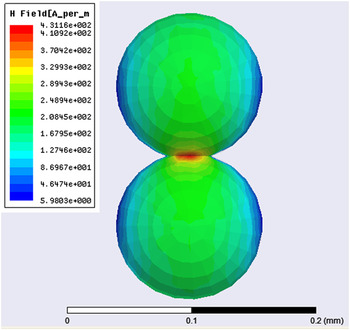
Birnboim et al. Reference Birnboim, Calame and Carmel16 have investigated the distribution of electric fields in the two touching ZnO dielectric spheres. They pointed out that in some microstructure such as the neck, the local electric fields can greatly exceed not only the average fields in the void, but also the applied fields, which will lead to a highly nonuniform energy deposition and accelerated mass transfer rate. Birnboim et al. Reference Birnboim, Calame and Carmel16 considered this characteristic of microwave as micro-focusing effects. In this paper, the distribution of H-fields on two touching aluminum sphere particles' surface has been studied. The direction of the axis that connects the particle center is perpendicular to the direction of microwave H-fields. Figure 2 shows the distribution of microwave H-fields when the distance between the centers of two particles equal to 118 μm (corresponds to the second point in Fig. 6(b)).
Distribution of microwave H-fields on the surface of two aluminum particles.

From Fig. 2, it can be seen that the H-fields in metallic particle surface near the neck is quite larger than the average fields. It means that the H-fields converge within this micro-region, and lead to a focusing effect like the distribution of microwave electric fields in ceramic particles which were described by Birnboim et al. Reference Birnboim, Calame and Carmel16 For example, the focusing effect is outstanding in the sintering neck. The peak H-fields in aluminum particles in the neck region (4.31 × 10² A/m) is 4.75 times of the applied fields (0.907 × 10² v/m). As we know, the H-fields will induce the eddy current and generate heat for metallic materials. The square amplitude of H-fields for the metallic particle is directly related to the power density of microwave and thus the heating rate. So this focusing effect will induce more than 24 times energy deposition than the applied fields, and lead to much higher sintering temperature in the region of neck. Equation (1) shows that the atomic self-diffusion coefficient is related to the temperature.
 $$D = {D_0}{\rm{exp}}\left( { - {{\Delta G} \over {RT}}} \right)\quad ,$$
Here, D 0 is the pre-exponential factor, ΔG is the activation energy of self-diffusion, R is the gas constant, and T is the temperature. Therefore, considering the increased temperature, the atomic self-diffusion coefficient will increase as well, so the mass diffusion in the region of the neck will be accelerated and the sintering process will be promoted quite a lot. Besides, as we know, the microwave H-field is a vector field and it can be decomposed into two orthogonal components. One is parallel to the z axis and the other is perpendicular to the z axis. For example, if there is an angle (0–90°) between the microwave H-fields and the z axis, the H-fields can also be decomposed into two such orthogonal components. As discussed above, when the component is perpendicular to the z axis, there is a focusing effect within this region of the sintering-neck. So, there is a focusing effect as the parallel and perpendicular component superimpose together. As a result, the mass diffusion in the region of the neck will be accelerated and the sintering process will be promoted as well.
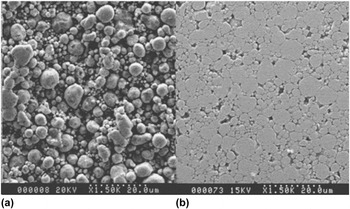
As discussed above, the focusing effect may promote the sintering process. So, it may be an important mechanism for the rapid microwave sintering of metallic materials. This effect may explain the reported sintering phenomenon of Cu particles heated by microwave in the separated H-fields. Reference Ma, Diehl, Johnson, Martin, Miskovsky, Smith, Weisel, Weiss and Zimmerman17 In their experiment, significant inter-particle connections developed rapidly during exposure (in only 9 s) to microwaves under the temperature 300–500 °C (<melting point of copper: 1083 °C, as shown in Fig. 3(b)). The reason may be that, in the beginning, there was only connection between particles and the degree of focusing is very high (focusing effect was also obtained in our simulation in the Cu particles), so much of microwave energy was focused within the microregion of connections. Although the overall temperature of the sample was not high, the temperature within this microregion may be very high and significant interparticle connections developed rapidly.
SEM micrographs of polished cross-sections for (a) unheated, green sample and (b) green sample heated in the H-field for 9 s. Reference Ma, Diehl, Johnson, Martin, Miskovsky, Smith, Weisel, Weiss and Zimmerman17

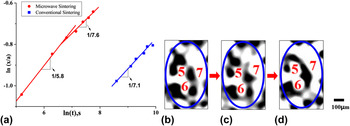
A similar case has also been observed in our previous study. Reference Xu, Li, Hu, Niu, Zhao and Zhang22 It is on the investigation of sintering behavior of aluminum's microwave sintering by the technology of SR-CT. Unlike the technology of scanning electronic microscopy (SEM), transmission electron microscope (TEM), and hot-stage microscopes, the SR-CT technology Reference Li and Hu23 does not require the specimen to be cut or polished, and the sintering process does not need to be stopped. This technology can observe the in situ microstructure evolution under extreme conditions (e.g., high temperature and intense radiation) in a 3-D, online and nondestructive way. Depending on this technology, the observation and quantitative analysis (e.g., statistics of the neck size) of the full-field (i.e., surface and inside) microstructure evolution during the entire microwave heating process can be performed, which provides valuable information for the study of electromagnetic microwave sintering mechanisms. In the experiment, a packing of Al (purity: 96%, average diameter: 120 μm, sintering temperature: 650 °C, in a quartz capillary which was vacuum pumped first and sealed by high temperature glue at the same time) has been investigated. Depending on the reconstructed cross-sections of Al, the watershed algorithm was adopted to extract the sintering-neck of Al at different sintering times. Figure 4 shows the neck growth kinetics curve of log(x/a) − log(t) (x: size of neck, a: mean size of neck, t: sintering time), and three of the typical tomograms of microstructure evolution of aluminum at the 3rd, 9th, and 27th min. The details of the experiment can be available elsewhere. Reference Xu, Li, Hu, Niu, Zhao and Zhang22
(a) Neck growth curve of log(x/a) − log(t), (b)–(d) microstructure of the same cross-section of aluminum at different times, (b) t = 3 min, (c) t = 9 min, and (d) t = 27 min. (b)–(d) corresponding with the first three red points in (a).

From Fig. 4, it can be seen that in the early sintering time (corresponding to the first three points), the slope of log(x/a) − log(t) is 1/5.8 for microwave sintering and 1/7.1 for conventional sintering. It means that the neck growth rate in electromagnetic microwave sintering is quite faster than conventional sintering in the beginning. For this phenomenon, except for the effects induced by high-frequency alternating electromagnetic microwave fields, such as the enhancement of the diffusion coefficient, the reduction in activation energy, etc., the focusing effect may be a very important factor. The detailed sintering phenomena can be observed in Figs. 4(b) to 4(d). Figure 4(b) show that there is a connection between particles 5, 6, and 7 at the 3rd min. However, maybe due to the focusing effect, the H-field intensity is very strong in this region. So the temperature is much larger in the region of connections (maybe the Al particle is even melt). Besides, maybe due to the traction force from the other particles that connected with particles 5 and 6, after a short time, these two particles separated from particle 7. Later, maybe also due to the focusing effect, the surface of particle 7 became very smooth quickly.
One thing that needs explanation is that, in the experiment, the Al powders were loosely stacked in a closed quartz capillary (internal radius: 0.5 mm, height 10 mm). Considering the body-centered cubic packing of the powders, there was only about 7.5 × 10⁻⁷ L oxygen in this closed quartz capillary. The oxidation of Al will stop as the oxygen was all consumed (about 1/104 of or only about 2 nm thickness of the 120 μm Al particles was oxidized). So the value of normalized thickness of the Al2O3 shells d (d = t/R = shell size/metal core radius, “shell size” represents the thickness of oxide layer t, “metal core radius” represents the radius of metal core R) was just about 1/105. Though the presence of even very thin insulating layers (e.g., d = 10−3–10−2 for conductive powder of Al) has great influence on the dielectric permittivity of the specimen, Reference Rybakov, Semenov, Egorov, Eremeev, Plotnikov and Bykov20,Reference Rybakov, Olevsky and Krikun24 this influence will be very small when the value of normalized thickness of the Al2O3 shells d is as small as 10−5 in our experiment. So, the influence of oxidation on the dielectric losses will be quite small and was not taken into account in this study.
B. The mechanism of the focusing effect of microwave H-fields
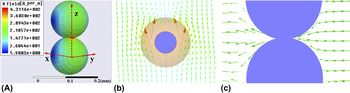
Figure 2 shows the distribution of microwave H-fields on the surface of two sintered Al particles. It can be seen that there is a focusing effect in the region of the sintering neck. In this section, the distribution characteristic within the void and the surface of the metallic particles will be analyzed.
As we know, when the metallic particles were placed in the TE103 mode resonator, the microwave H-fields will reflect on the particles surface. So, in the metal particle system, the microwave H-fields are the superposition of the incident and reflected H-fields. It also means that the internal microstructure of the particle system will influence the distribution of microwave H-fields. Figure 5(a) shows the distribution of microwave H-fields on the surface of aluminum particles. Figure 5(b) shows the H-field vectors on the particle surface and in the void on the plane that passes the sintering neck, and Fig. 5(c) that parallels to the zoy plane and pass the particle centers. From Figs. 5(b) and 5(c), it can be seen that the distribution of the magnetic vector field becomes quite nonuniform when it encounters the metallic particles. It can also be seen that the magnetic vector will deflect or reflect when it reaches the interface between the particle surface and void within the region of the neck, which implies that the magnetic vector field can spread “around” the particle surface and converges on the surface within the microregion of the neck. Thus, the H-field intensity is reinforced (as stated in Sec. III. A, the peak H-fields in the neck region is 4.75 times of the applied fields) and the focusing effect forms. This may be the microscopic mechanism of the focusing effect of microwave H-fields in the region of the neck. This effect may lead to much higher sintering temperature and promote the mass diffusion in the region of the neck, which is advantageous to the acceleration of the sintering rate and grain refinement.
(a) Microwave H-fields distribution on the surface of aluminum particles, (b) Magnetic field vector in the void on the plane which passes the sintering neck. (c) Magnetic field vector in the void on the plane that parallels to the zoy plane and pass the two particle centers.

C. The decline of the focusing effect of microwave H-fields
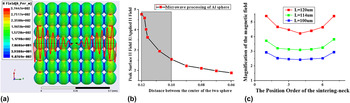
In Sec. III. A and III. B, the focusing effect of microwave H-fields and its microscopic mechanism in metallic particle system has been discussed. It shows that due to the reflection, the microwave magnetic vector field will converge on the surface within the microregion of the sintering neck. This will induce the increase of H-fields intensity. So the sintering temperature within this microregion will increase quite fast, and the mass diffusion rate will be promoted greatly as a result. This result is in agreement with the experimental results. Like the sintering neck growth kinetic curve of log(x/a) − log(t) shown in Fig. 4(a), the slope of the curve of microwave sintering (n = 1/5.8) is larger than the conventional sintering (n = 1/7.1), which means that the sintering rate of microwave sintering is faster than conventional sintering. However, as the sintering process goes on, the microstructure of the particle system will change gradually. So, the intensity distribution of microwave H-fields will be influenced. Thus, the sintering rate will be influenced as a result. To research this, the distribution of microwave H-fields within the metallic particle system at different neck growth stages has been studied, and the results are shown in Fig. 6.
(a) The distribution of the microwave magnetic field from outside to inside within the loosely packed sample (7 × 7 particles). (b) The curve of the ratio of “peak H-fields/applied H-field” between two of the particles within the sample (the first row). (c) The ratio of “peak H-fields/applied H-field” on the different place from left to right.

Figure 6(a) shows the intensity distribution of microwave H-fields from outside to inside within the loosely packed aluminum powder sample when the x/a = 0.34 [corresponds to the first point in Fig. 4(a)]. Figure 6(b) shows the curve of the ratio of “peak H-fields/applied H-fields” between two of the particles in the first row within the sample in Fig. 6(a) [the red points corresponds to the sintering state in the experiment in Fig. 4(a)]. Figure 6(c) shows the ratio of “peak H-fields/applied H-fields” on the different row from left to right. From Fig. 6(b), it can be seen that at the beginning, the value of “peak H-fields/applied H-field” equals to 5.4, so the peak microwave magnetic energy on the neck is 29.2 times of the applied fields. So, the sintering temperature will be much higher than the other place and the sintering process may be accelerated. However, as the sintering neck grows, this ratio decreases gradually. When the distance between the two particle centers equals to 100 μm, the value of this ratio equals to 2.3. So, the microwave energy decreases from 29.2 times to 5.3 times. During this period, the focusing effect is quite significant and the sintering process will still be accelerated, like the first three points in Fig. 4(a). However, with the further growth of the sintering neck, the value of “peak H-fields/applied H-fields” further becomes smaller (about 2 times), and the surface area where the H-fields are reinforced decrease as well. This means that there is hardly any focusing effect on the region of the neck. So, the acceleration of the sintering process is almost disappeared. A similar phenomenon can be observed between particles in the other place within the sample. This may be the reason why the sintering rate slow down in the later sintering stage in Fig. 4(a). Because in the beginning, the focusing effect is significant in the region of the neck, so the sintering process is very fast during this period, like the first three points shown in Fig. 4(a) [the sizes range of the sintering neck for these points are corresponding to the first 4 red points in Fig. 6(b)]. However, as the sintering necks grow larger, the microstructure especially the neck of the particle system changes, and the degree of focusing effect gradually become increasingly weak. So the sintering neck growth rate slowdown, like the points from the 4th to 7th shown in Fig. 4(a) [corresponding with the last 4 red points in Fig. 6(b)].
In Fig. 6(a), there is another special phenomenon that the value of the ratio of “peak H-fields/applied H-fields” decreases from outside to inside within the powder sample. Besides, as the sintering necks grow on, this ratio from outside to inside within the sample decreases simultaneously [as shown in Fig. 6(c), L represents the distance between two of the particle centers]. This may be due to the shielding effect of the metallic material for microwave fields. Because, when the microwave propagates in the metallic particle system, the microwave intensity will attenuate. As the specimen grows in densification, the overall electrical conductivity σ will increase at the same time for the porous metallic system. So, the skin depth of microwave δ will reduce quite a lot, Reference Ma, Diehl, Johnson, Martin, Miskovsky, Smith, Weisel, Weiss and Zimmerman17
 $$\delta = \sqrt {{2 \over {\mu \omega \sigma }}} \quad ,$$
(μ is the real part of the permeability, σ is the electrical conductivity, and ω is the angular frequency). It means that the intensity of electromagnetic microwave fields in the specimen will attenuate quite a large and the heating efficiency will drop as a result. This result may be another reason for the experimental phenomenon in Fig. 4(a). That is because, as the sample becomes more and more dense, the attenuation of magnetic fields will be further intensified. So, the sintering rate and the slope of neck growth kinetic curve of log(x/a) − log(t) start to decline (from 1/5.8 to 1/7.6), like the points from the 4th to the 7th shown in Fig. 4(a).
IV. CONCLUSION
In this paper, the distribution of electromagnetic microwave fields in the metallic powder system (aluminum, Al) has been analyzed. The following conclusions can be drawn out:
-
(1) The distribution of microwave magnetic fields in the metallic Al particle system has been studied. The result shows that there is a focusing effect in the region of the sintering neck. For example, the simulation shows that the peak H-fields on the particle surface within the neck region is more than 4.75 times of the applied H-fields, which means that the microwave magnetic energy is more than 29.2 times than those of applied H fields. This focusing effect may accelerate the sintering rate.
-
(2) The distribution of the superposition microwave magnetic vector field in the metallic particle system has also been studied. The results show that the magnetic vector will deflect or reflect when it reaches the interface between the metallic particle surface and void within the region of the neck. It implies that the magnetic vector field can spread “around” the particle surface and converges on the surface within the microregion of the sintering neck. This may be the microscopic mechanism of the focusing effect of microwave magnetic fields in the metallic particle system.
-
(3) The simulation indicates that the focusing effects will decline as the neck grows larger. For example, in the beginning of sintering, the peak H-fields on the particle surface are nearly 4.75 times of the applied H-fields. However, as the sintering neck grows large, the magnification starts to reduce gradually. Besides, the focusing effect will decrease from outside to inside within the loosely packed powder sample at the same time. These two factors may lead to the slowdown of the sintering rate. These results are in accordance with the experimental results of electromagnetic microwave sintering of aluminum powders.
ACKNOWLEDGMENT
This work was supported by National Nature Science Foundation of China under the Contract Nos. 11272305, 11402160 and 11390362. The authors warmly thank Niu Yu, Hongyan Qu and Kang Dan for the assistance in conducting the experiment.