Introduction
Cacao (Theobroma cacao L.) is a neotropical allogamous fruit tree crop. Its seeds are used in a range of products resulting in a worldwide commodity expected to exceed 4 million tonnes in 2010 (Eyre, Reference Eyre2007). Cacao was domesticated and utilized by Amerindian civilizations including the Mayas (300–900 AD) and the Olmecs (400–1200 BC; Henderson et al., Reference Henderson, Joyce, Hall, Hurst and McGovern2007). These early civilizations utilized Criollo cacao, which is distinct from the traditional Forastero and Trinitario groups (Cheesman, Reference Cheesman1944). Other groups include Refractario accessions collected in Ecuador (1920s–1930s) for field resistance to witches' broom disease (Pound, Reference Pound1938; Bartley, Reference Bartley2001) and Nacional and Amelonado (Motamayor et al., Reference Motamayor, Risterucci, Heath and Lanaud2003). Recently, Motamayor et al. (Reference Motamayor, Lachneaud, da Silva e Mota, Loor, Kuhn, Brown and Schnell2008) have proposed that T. cacao had ten phylogenetic clusters, one of which was Criollo.
Although Criollo cacao is of historical and cultural significance, the group is underrepresented in most field collections. For instance, the International Cocoa Genebank, Trinidad (ICG, T) is one of the two universal collection depositories (IBPGR, 1981) but contained only five accessions (CRIOLLO 22, MXC 67, PENTAGONA 1, PENTAGONA 2 and STAHEL) with Criollo background, representing 0.25% of the approximately 2000 accessions within the ICG, T (see Iwaro et al., (Reference Iwaro, Bekele and Butler2003) and Bekele et al., (Reference Bekele, Bekele, Butler and Bidaisee2006) for groupings and Turnbull et al. (Reference Turnbull, Cryer, Ford, Daymond, Wadsworth and Hadley2004) for confirmation and historical notes).
An expedition was therefore undertaken in 1994 to locate wild or historic stands of Criollo cacao trees within the Columbia River Forest Reserve (Cayo district of northwestern Belize) and the Bladen River Nature Reserve (Toledo district of southwestern Belize) in collaboration with the Ministry of Agriculture of the Government of Belize and in conjunction with The Maya Mountain Archaeological Project of Cleveland State University (Mooleedhar et al., Reference Mooleedhar, Maharaj and O'Brien1995; Mooleedhar, Reference Mooleedhar1998).
It is believed that Criollo cacao grown in Trinidad up until the 16th century was devastated in 1727 by an unknown cause. Thereafter, Forastero cacao from the South American mainland was brought to the island, and the resultant hybridization between the survivors of 1727 and the introduced material generated Trinidad Trinitario (Wood and Lass, Reference Wood and Lass1985). This population was extensively surveyed for 100 most productive clonal trees (Imperial College Selections, ICS; Pound, Reference Pound1934, Reference Pound1935, Reference Pound1936). These reference ICS accessions are maintained as clonal replicates over five blocks at the San Juan Estate, Trinidad. Further information on ICS clones is available (Johnson et al., Reference Johnson, Bekele, Brown, Song, Zhang, Meinhardt and Schnell2009).
Elucidation of genetic variability among and within cacao accessions is reliant on clone identification (Saunders et al., Reference Saunders, Mischke, Leamy and Hemeida2004; Cryer et al., Reference Cryer, Fenn, Turnbull and Wilkinson2006; Zhang et al., Reference Zhang, Mischke, Goenaga, Hemeida and Saunders2006) and minimizing mislabelling (Takrama et al., Reference Takrama, Cervantes-Martinez, Philips-Mora, Brown, Motamayor and Schnell2005; Motamayor et al., Reference Motamayor, Lachneaud, da Silva e Mota, Loor, Kuhn, Brown and Schnell2008; Zhang et al., Reference Zhang, Boccara, Motilal, Butler, Umaharan, Mischke and Meinhardt2008, Reference Zhang, Boccara, Motilal, Mischke, Johnson, Butler, Bailey and Meinhardt2009). Mislabelling is a known issue in cacao germplasm collections (Motilal and Butler, Reference Motilal and Butler2003). The ICS material was assessed with microsatellites for parentage (Motamayor et al., Reference Motamayor, Risterucci, Heath and Lanaud2003) and diversity (Johnson et al., Reference Johnson, Bekele and Schnell2004). Model-based clustering showed that ICS formed a homogenous group with other Trinidad Trinitario material and clustered with Criollo accessions suggesting a significant role for Criollo in the origin of the Trinitario group (Johnson et al., Reference Johnson, Bekele, Brown, Song, Zhang, Meinhardt and Schnell2009). However, there were only two Criollo accessions in the latter study, which may not have permitted the analysis of the inter-population relationship between Criollo and ICS Trinitario. The relic Criollo collection from Belize therefore presented an opportunity to (1) understand the genetic diversity within this relic Criollo population, (2) examine the genetic relationship of the above population with other Criollo accessions within the ICG, T and (3) reassess the genetic contribution of the Criollo to the parentage of the ICS accessions.
Materials and methods
Plant material
Seventy-seven grafted Belizean Criollo plants held at the University of the West Indies, Trinidad and 20 ICS accessions from San Juan Estate, Trinidad were sampled. There were 42 reference samples that included: (1) five accessions reportedly with Criollo make-up from the ICG, T (six trees) and eight Criollo references from Costa Rica, Honduras and Venezuela; (2) six Upper Amazon Forastero accessions; (3) nine Lower Amazon Forastero accessions; (4) seven Refractarios; (5) four French Guiana accessions; and (6) three accessions of uncertain grouping. Groupings were based on Iwaro et al. (Reference Iwaro, Bekele and Butler2003), Bekele et al. (Reference Bekele, Bekele, Butler and Bidaisee2006) and Turnbull et al. (Reference Turnbull, Cryer, Ford, Daymond, Wadsworth and Hadley2004). Accession details are presented in Supplementary Table S1, available online only at http://journals.cambridge.org. Tree locations in the ICG, T are available upon request.
DNA extraction, amplification and fragment analysis
Cacao DNA was extracted from leaf tissue, either with a modified Kobayashi protocol (Kobayashi et al., Reference Kobayashi, Horikoshi, Katsuyama, Handa and Takayanagi1998) described earlier (Motilal et al., Reference Motilal, Zhang, Umaharan, Mischke, Boccara and Pinney2008), or the DNeasy Plant System (Qiagen Inc., Valencia, CA, USA) according to Saunders et al. (Reference Saunders, Mischke, Leamy and Hemeida2004).
Cacao microsatellite markers have been previously described (Lanaud et al., Reference Lanaud, Risterucci, Pieretti, Falque, Bouet and Lagoda1999; Risterucci et al., Reference Risterucci, Grivet, N'Goran, Pieretti, Flament and Lanaud2000; Saunders et al., Reference Saunders, Mischke, Leamy and Hemeida2004). Primers were synthesized by Proligo (Boulder, CO, USA) or Sigma-Aldrich Corp. (St Louis, MO, USA). Forward primers were 5′-labelled using WellRED fluorescent dyes (Beckman Coulter, Inc., Fullerton, CA, USA). DNA was separately amplified (annealing at 51°C) and scored for 30 microsatellite primer pairs (MPPs; mTcCIR1, 3, 6, 7, 8, 9, 10, 11, 12, 15, 18, 22, 24, 26, 29, 33, 37, 40, 42, 43, 57, 58, 60, 184, 210, 229, 243, 244, 274 and SHRSTc016) similar to Motilal et al. (Reference Motilal, Zhang, Umaharan, Mischke, Boccara and Pinney2008). The reaction mix contained, in final volume, 2.5 mM magnesium, 0.35 μM MPP, 0.2 mM total dNTP, 0.25 U DNA polymerase and 0.3–0.7 ng DNA. Amplified sequences were separated on a CEQ™ 8000 or 8800 (Beckmann Coulter Inc.) sequencer.
Dataset preparation for population analysis
The allelic dataset was assessed for duplicate accessions with GenAlEx v6.1 (Peakall and Smouse, Reference Peakall and Smouse2006). Missing data were treated as null alleles and were not interpolated. Accessions that were fully matched based on pairwise comparisons across the 30 loci were deemed synonymous. In such instances, ‘type’ accessions were selected to represent the synonymous groups before analysing for genetic diversity and population structure. The 140 accessions were sorted into 74 groups in GIMLET v1.3.3 (Valière, Reference Valière2002), primarily as a result of synonymous Belizean and Criollo material. Eleven samples (61B_2, 61B_6, AC 2 T1, AGUACARTE 3, BANANA CREEK 2, C 61, CC 7, CC 8, HF 3_1, HF 8 and ST 4_1) typified the Belizean material. The probability of identity values (Waits et al., Reference Waits, Luikart and Taberlet2001) per microsatellite locus is presented in Supplementary Table S2, available online only at http://journals.cambridge.org.
Microsatellite diversity and population analysis
Primary summary statistics were computed for each marker locus with GenAlEx v6.1 (Peakall and Smouse, Reference Peakall and Smouse2006). Pairwise estimates of Nei's genetic distance (Nei et al., Reference Nei, Tajima and Tateno1983) among individual accessions (n = 74) with 100 bootstrap resamplings across loci were calculated with Microsatellite Analyser (Dieringer and Schlötterer, Reference Dieringer and Schlötterer2002). Trees were generated from the resulting distance matrix with the neighbour-joining algorithm (Saitou and Nei, Reference Saitou and Nei1987) available in PHYLIP (Felsenstein, Reference Felsenstein1989). A consensus tree (50% majority rule) based on 100 bootstrapped trees was created using the CONSENSE procedure implemented in PHYLIP (Felsenstein, Reference Felsenstein1989). The dendrogram was visualized with TreeView version 1.6.6 (Page, Reference Page1996). Principal coordinate analysis (PCoA), as implemented in GenAlEx (Peakall and Smouse, Reference Peakall and Smouse2006), was performed and the results were presented as a two-axis PCoA plot.
Population structure and inference of admixed ancestry (hybrids or ancestral forms) were assessed with a model-based clustering method, implemented in STRUCTURE (Pritchard et al., Reference Pritchard, Stephens and Donnelly2000). The K value was set from 2 to 10, and the analysis was carried out (200,000 iterations after a burn-in period of 100,000) without assuming any prior information about the genetic group or geographic origin of the samples. Fifty independent runs were assessed for each K value. Results of the five iterations with highest score in each replicated run were matched by permutation in CLUMPP to generate the optimum alignment over multiple runs (Jakobsson and Rosenberg, Reference Jakobsson and Rosenberg2007).
To test whether the Criollo and Lower Amazon Forastero accessions are the hypothesized parents of the ICS Trinitario, we used a likelihood-based method implemented in the program CERVUS 3.0 (Marshall et al., Reference Marshall, Slate, Kruuk and Pemberton1998; Kalinowski et al., Reference Kalinowski, Taper and Marshall2007). All the ICS Trinitario clones plus MXC 67 and OC 61 (22 genotypes) were treated as putative offspring, whereas all the non-Trinitario clones plus PENTAGONA and STAHEL (52 genotypes) were treated as putative mothers. For each mother–offspring pair, the natural logarithm of the likelihood ratio (LOD score) was calculated. This score is the likelihood of maternity of a particular candidate parent, relative to an arbitrary individual. Critical LOD scores were determined for the assignment of maternity to all the ICS clones. The most probable single mother for each produced offspring was identified on the basis of the LOD scores for assignment at greater than 95% confidence.
Results
Population genetic analysis
Summary population statistics from a reduced subset of 74 accessions are presented in Supplementary Table S3, available online only at http://journals.cambridge.org. Gene diversity ranged from 0.447 (SHRSTc016) to 0.824 (mTcCIR58).
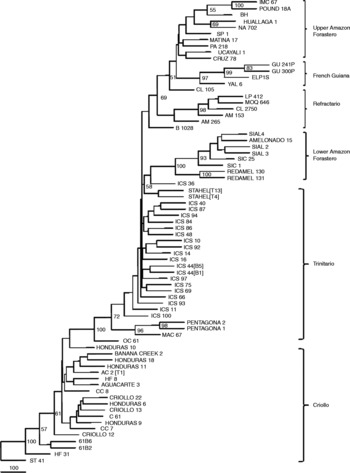
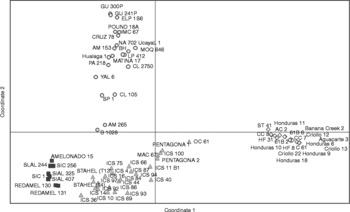
Microsatellite loci that detected differences in the Belizean material were mTcCIR10, 15, 26, 33, 37, 42 and 60, whereas mTcCIR6, 8, 11, 33, 37 and 244 were useful in discriminating among the reference Criollo material. The genetic relationships among the 74 accessions are represented in a distance-based dendrogram (Fig. 1). Accessions clustered together according to traditional genetic groups of Criollo, French Guiana, Lower Amazon Forastero, Upper Amazon Forastero, Refractario and Trinitario. The PCoA (Fig. 2) accounted for 67.5% of the variation with 51.7% on the first axis and 15.8% on the second axis. Criollo, Trinitario, Lower Amazon Forastero and Upper Amazon Forastero were clearly separated. The Refractario accessions fell in between Upper Amazon Forastero and Trinitario.
Consensus dendrogram depicting the relationship between relic Belizean Criollo material and other reference accessions. Nei et al. (Reference Nei, Tajima and Tateno1983) genetic distance with 100 bootstrapping and a 50% consensus majority rule was used.

Multivariate analysis of genetic distances among 74 cacao accessions. Groupings are: ■, Lower Amazon Forastero;  , Trinitario;
 , Criollo;
 , others (Upper Amazon Forastero, Refractario and French Guiana).

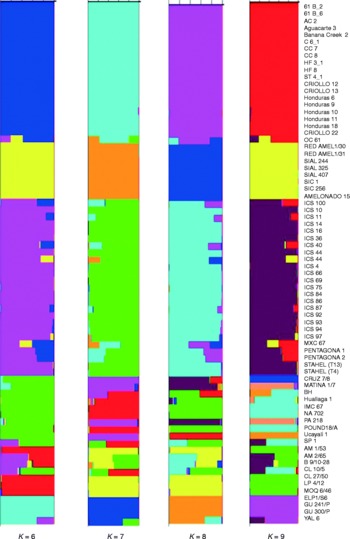
The results of Bayesian clustering analysis were compatible with the distance-based multivariate analysis. At K = 6–9, the assigned population only changed in the Upper Amazon Forasteros, whereas the rest of the populations remained largely the same (Fig. 3). At all different K values, only a small fraction of the 20 ICS Trinitario genotypes showed significant levels of admixture. Four accessions originally at San Juan Estate (ICS 11 Block 1, ICS 40 Block 2; ICS 87 Block 2; ICS 100 Block 2) had at least 10% Criollo ancestry. The other 16 accessions had minimal Criollo ancestry (Fig. 3).
Population stratification (for K groups 6–9) of 74 cacao accessions from a microsatellite dataset of 30 primers based on CLUMPP (Jakobsson and Rosenberg, Reference Jakobsson and Rosenberg2007) alignment of STRUCTURE (Pritchard et al., Reference Pritchard, Stephens and Donnelly2000) output.

Resolved genetic grouping
Several accessions based on the clustering, ordination and STRUCTURE output had their genetic grouping clarified. OC 61 originating from Venezuela appeared to be a mixture of Criollo, Lower Amazon Forastero and Trinitario, and grouped with the latter. CRUZ 7/8, initially designated as Lower Amazon Forastero, was better placed on its own or constrained into the Upper Amazon Forastero group. MATINA 1/7 and SP 1, both previously of undetermined genetic origin, fell into the Upper Amazon Forastero group. The accession BH, originating from Ecuador but of undetermined genetic group, was placed into the Upper Amazon Forastero group. The two trees of the STAHEL accession previously designated as Criollo types fell within the Trinitario cluster. MXC 67, PENTAGONA 1 and PENTAGONA 2 were previously designated as selected Criollo material from cultivated areas in Mexico (MXC 67) or from the wild in Costa Rica (PENTAGONA). However, the data analysis indicated that these accessions were more Trinitario in nature, although they contained approximately 30% Criollo ancestry.
Parentage analysis
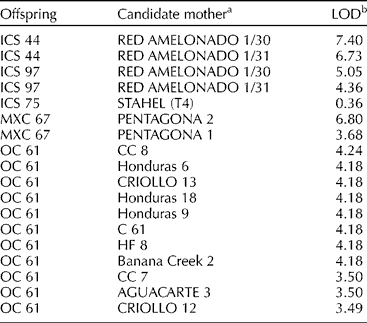
Of the 48 genotypes used as candidate parents, only 16 of them were identified at 95% confidence level as probable mothers of five Trinitario clones (ICS 44, ICS 75, ICS 97, MXC 67 and OC 61) by parentage analysis (Table 1). The identified probable mothers include RED AMELONADO 1/30 and 1/31 from the Lower Amazon Forastero group and STAHEL and PENTAGONA from the Trinitario group. None of the Criollo clones were identified as probable parents for the ICS Trinitario clones. In contrast, the accessions OC 61 could have been derived from any one of the 11 Belizean Criollo accessions (Table 1).
Likelihood assignment for five Trinitario accessions (18 mother–offspring pairs) based on 13 candidate mother genotypes

a Putative mother trees in the assessed Criollo and Lower Amazon Forastero clones.
b Critical natural logarithm of the likelihood (LOD) ratios for assignment of maternity are 1.46 at >95% confidence and 0.19 at >80% confidence.
Discussion
Identity and germplasm management
The present study confirmed that the Belizean material sampled and proposed as relic Criollo (Mooleedhar et al., Reference Mooleedhar, Maharaj and O'Brien1995; Mooleedhar, Reference Mooleedhar1998, Reference Mooleedhar2000) was authentic Criollo material. A low genetic diversity and heterozygosity were found in the Criollo samples in accordance with other authors (Mooleedhar, Reference Mooleedhar2000; Motamayor et al., Reference Motamayor, Risterucci, Lopez, Ortiz, Moreno and Lanaud2002). Furthermore, the ability to compress the genetic diversity of this Belize group through a substantial reduction of 85.7% and the tight cluster of Criollo individuals regardless of geographic origin suggested that the Criollo group can be adequately represented by a few individuals. Indeed, our results indicated that 11 accessions would be sufficient to represent the Belizean germplasm that was collected.
The present study found that of the five Criollo-allocated accessions in the ICG, T, three of these (MXC 67, PENTAGONA 1 and PENTAGONA 2) were introgressed material. These introgressed Criollos were better grouped with the Trinitarios confirming the results of Motamayor et al. (Reference Motamayor, Risterucci, Lopez, Ortiz, Moreno and Lanaud2002). The true Criollo at the ICG, T (CRIOLLO 22) has since died and the Belizean material therefore represents an important pool for conservation. It is therefore recommended that the 11 type accessions be prioritised for preservation and safeguarding.
The sampled STAHEL trees had very little Criollo ancestry and may either be cases of mislabelling or reflect the true nature of this accession. Prior published work listed STAHEL as a Forastero type (Mooleedhar et al., Reference Mooleedhar, Bekele, Cassie, Warren and Spence1991) and was described as collected from cultivated areas in Suriname but probably originated from Venezuela (Lockwood and Gyamfi, Reference Lockwood and Gyamfi1979; Turnbull et al., Reference Turnbull, Cryer, Ford, Daymond, Wadsworth and Hadley2004). However, our results suggest that this accession may be Trinitario in nature, which agrees with the hybridization thought to have occurred in Venezuela (Bartley, Reference Bartley2005).
The accession SP 1 (held in the ICG, T) grouped with the Upper Amazon Forastero group rather than the Criollo group. This suggests that the SP 1 used here may be mislabelled or another clone with the same name exists in Venezuela and was utilized by Motamayor et al. (Reference Motamayor, Risterucci, Heath and Lanaud2003).
Bartley (Reference Bartley2005) indicated that the first varieties grown in Martinique were Amazonian and were exported to Costa Rica being renamed as MATINA. The seeds first introduced to Martinique may have come from Brazil (Bartley, Reference Bartley2005). However, the present study assigned the accession MATINA 1/7 as an Upper Amazon rather than Lower Amazon.
The accession OC 61 had moderately high Criollo ancestry in agreement with its putative history (Turnbull et al., Reference Turnbull, Cryer, Ford, Daymond, Wadsworth and Hadley2004). Furthermore, the population assignment (Fig. 3) indicated that OC 61 was derived from both Lower Amazon Amelonado Forastero and Trinitario, which agreed with the hypothesis that material from Trinidad, introduced into Ocumare de la Costa in Venezuela (Turnbull et al., Reference Turnbull, Cryer, Ford, Daymond, Wadsworth and Hadley2004), could have hybridized with the remnant Criollo material in this country (Bartley, Reference Bartley2005).
The correction of mislabelling in genebanks, proper passport data and consistent nomenclature applied globally would be invaluable to resolve these conflicts and allow for better comparative research. This study has clarified the uncertainties surrounding the historical documentation for these accessions.
Trinitario ancestry
The origin of the Trinidad Trinitarios, from which the ICS material was selected, is uncertain (Wood and Lass, Reference Wood and Lass1985). It is believed that Amelonado seed, either from Guyana or from Orinoco estuary in Venezuela, may have been introduced into Trinidad by the cocoa planters, which then crossed naturally with the remaining Criollo following the devastation of cacao plantations in 1727, to form the Trinitario population (Cheesman, Reference Cheesman1944; Wood and Lass, Reference Wood and Lass1985). Bartley (Reference Bartley2005) mentioned that Capuchin priests introduced seed in 1757 after arrival in Trinidad and suggested that this seed was from the Rio Amazon. Another theory is that hybrids of Venezuelan Criollos and Lower Amazon Forasteros that occurred in the Orinoco Estuary in Venezuela (Wood and Lass, Reference Wood and Lass1985; Figueira and Cascardo, Reference Figueira, Cascardo and Dias2001) were subsequently transported to Trinidad.
The present study confirmed a Lower Amazon Amelonado ancestry for a limited number of accessions including OC 61, a few ICS (ICS 4, 40 and 97) accessions and MXC 67, indicating that Amelonado had a minor contribution to the Trinitario population. This was in contrast to Motamayor et al. (Reference Motamayor, Risterucci, Heath and Lanaud2003) but in agreement with Johnson et al. (Reference Johnson, Bekele, Brown, Song, Zhang, Meinhardt and Schnell2009). The present study suggested that the Trinitario samples contained Upper Amazon ancestry, which agreed in part with Johnson et al. (Reference Johnson, Bekele, Brown, Song, Zhang, Meinhardt and Schnell2009). However, the Refractario accessions SP 1, AM 2/65, B 9/10-28 and CL 10/5 had Trinitario composition and may represent the early movement of Trinitario material to Ecuador from Trinidad (Pound, Reference Pound1938) or Venezuela (Wood and Lass, Reference Wood and Lass1985; Bartley, Reference Bartley2005) or indicate that a hybridization process occurred in Ecuador similar to that of Trinidad.
In this study, the overall Trinitario group of ICS accessions had little Criollo background. The present finding, of little Criollo ancestry in the ICS accessions, is not in agreement with the result of Johnson et al. (Reference Johnson, Bekele, Brown, Song, Zhang, Meinhardt and Schnell2009), which showed that Criollo and ICS Trinitario belong to same Bayesian cluster. This may be due to several factors: (1) the ICS group is heterogeneous and the subset used here captured more of the low Criollo ancestry accessions; (2) the composition of the dataset influences the STRUCTURE output; (3) if (2) is true, then the few (two) Criollo accessions used by Johnson et al. (Reference Johnson, Bekele, Brown, Song, Zhang, Meinhardt and Schnell2009) could adversely influence the final output; and (4) the above authors used a low K value, which may have constrained the accessions into a smaller number of groups.
The existing body of literature defines Trinitario as a hybrid between Criollo and Forastero. However, the present finding casts some doubts on this. Johnson et al. (Reference Johnson, Bekele, Brown, Song, Zhang, Meinhardt and Schnell2009) cited Ciferri and Ciferri (Reference Ciferri and Ciferri1957):
the distinction between what was called Forastero cacao of Trinidad and Criollo cacao of Venezuela was really based on the commercial bean grading system in Venezuela and that the two populations actually shared a common genealogy.
Furthermore, Criollo may be translated as ‘native’ or ‘first grown’ in Spanish-speaking countries of South America (Bartley, Reference Bartley2005). It is therefore highly probable that the cacao being cultivated in Trinidad prior to 1727 was an introgressed Criollo material rather than what is now known as pure Criollo. We concur with Bartley (Reference Bartley2005) that the term Criollo was a convenient naming system for a miscellaneous genetic group of plants that may have been introduced multiple times into Trinidad. It is stated that the cacao industry was decimated by the blast of 1727; therefore, we can expect that the surviving plants would have been of hardier stock or lucky escapees. However, it is well known that Forastero hybrids are hardier and more disease resistant, which would then suggest that the remaining individuals were introgressions of predominantly Forastero ancestry. The introduction of further Forastero material and the ensuing hybridizations over the 200 years until the selection by Pound in 1932–35 would mean that there would have been an increased probability of obtaining more Forastero × Forastero hybrids than that of Criollo × Forastero introgressions. Since Pound collected over the entire island of Trinidad, the chance that he obtained a diverse group is increased. Additionally, it seems more probable that individuals from parents with high Forastero ancestry would be selected over other individuals, due to their higher vigour or heavier yields. In this regard, the ‘limited Criollo × Forastero hybrids within a larger introduced Forastero population’ hypothesis proposed by Mooleedhar (Reference Mooleedhar2000) for the genesis of the Trinitario accessions is supported. A similar hypothesis accounted for 40% of the modern Nacional genotypes in Ecuador (Loor et al., Reference Loor, Risterucci, Courtois, Fouet, Jeanneau, Rosenquist, Amores, Vasco, Medina and Lanaud2009).
The relic Belizean Criollo material was employed in this study to review the origin of the Trinitario ICS accessions that probably arose sub-spontaneously in Trinidad. The study showed that the ICS material possessed a more varied parentage than had been previously envisaged. It appeared that both Upper and Lower Amazon material, in addition to Criollo, contributed to the ICS group. It is proposed that repeated introgressions of Amazonian material and early farmer selections of vigorous material may have led to a limited Criollo ancestry in the ICS accessions.
Acknowledgements
The financial support of the Biscuit Cake Chocolate Confectionery Alliance (now Cocoa Research Association Ltd) of the United Kingdom towards the germplasm mission to Belize is gratefully acknowledged. The Maya Mountain Archaeological Project was partially funded by the National Geographic Society. Kevin Moro, Perfecto Nal and Isidro Bol of the Belizean Defence Force as well as Irideo Bolen and Hugh O'Brien of the Ministry of Agriculture of Belize among others were invaluable to the expedition. Winston Maharaj of the Cocoa Research Unit is also thanked for his role in the expedition. We also thank Dr David Butler, then head of Cocoa Research Unit, for his permission to use the Belizean Criollo material and support for this paper. Two anonymous reviewers are thanked for checking the manuscript.