I. INTRODUCTION
The John Bates Clark Medal (JBCM) is the oldest award still conferred by the American Economic Association (AEA). Established seventy-three years ago in 1947 to reward an American economist under the age of forty for “most significant contribution to economic thought and knowledge,” it has become a widely acknowledged professional and public marker of excellence in economics research.Footnote 1 It was created alongside another prize, the Walker Medal, awarded every five years and discontinued in 1977, for “exceptional lifetime contribution to economics.” Like AEA’s Award of Distinguished Fellow and the Nobel Prize in Economics established in 1965 and 1969, respectively, the Walker Medal represented ex post recognition of past contributions to the discipline. In contrast, the JBCM with its age limit is as much a recognition of medalists’ achievements as it is a reflection of what are considered to be the current state and promising future directions of the discipline. Selecting a laureate involves identifying, evaluating, and ranking new trends in economics research as they develop and are represented by young scholars under forty. Our purpose, in this paper, is therefore to use the history of the JBCM as a window into the changing understanding of excellence in economics, and into what is valued and rewarded in the profession.
Although the history of the John Bates Clark Medal has never been told, other scientific prizes have garnered attention from historians, notably the Nobel Prize. Although exceptional talent is a shared feature of scientists who become laureates, Robert M. Friedman in his study of the history of the Nobel prizes makes a general point that “prizes, by definition, are political, are a form of governing marked as much by interests and intrigues as by insightful judgment” (Reference Friedman2001, p. 1). His extensive survey of discussions surrounding the Nobel prizes in chemistry, physics, and biology shows how awarding and not awarding the prize to particular scientists reflected the changing scientific, cultural, political, and personal agendas of the various Nobel committees. He argues that the history of the Nobel prizes demonstrates that “excellence is not an unambiguous concept, not even in science” (Friedman Reference Friedman2001, p. ix). The much younger Nobel Prize in Economics is not any different from the other Nobel prizes. Avner Offer and Gabriel Söderberg (Reference Offer and Söderberg2016) relate how the prize was born out of the frustration of economists at the Sveriges Riksbank and their lack of independence in setting the Swedish monetary policy.
Michael Barany’s recent history of the Fields Medal is another case in point. Barany argues that the Fields Medal in mathematics was not established as a substitute for a missing Nobel Prize in Mathematics but as a way to unify a discipline riven with political and methodological divides in the 1930s. While “exceptional talent seems a prerequisite for a Fields Medal,” he argues, “so does being the right kind of person in the right place at the right time.” Acknowledging various types of contingencies “does not diminish the impressive feats of individual past medalists.” The laureates as a group represent “the products of societies and institutions in which mathematicians have not been mere bystanders” (Barany Reference Barany2014, p. 19). Prizes thus often conceal a messier reality, and their histories convey rich information about a discipline’s standards and identity. Both Friedman and Barany emphasize the lack of diversity within selecting committees as well as among laureates in terms of gender and educational and employment background. For instance, Barany bluntly observes that “with few exceptions, the Fields Medal (along with the Wolf and Abel Prizes) has been an award for white European and American men. Their educations and careers, with few exceptions, traverse a small collection of elite institutions disproportionately located in the United States and France” (Barany Reference Barany2014, p. 19).
These case studies all suggest that there could be tensions in what exactly is valued by the profession and rewarded by the JBCM. We therefore intend to show for whom the medal was established, which type of contribution it was meant to reward, and whether any intellectual contributions or institutional trajectories ended up being singled out by the prize. We demonstrate that the medal was originally founded more as a signal of excellence to policy-makers, patrons, and other scientists with more established credentials than to economists themselves. We also uncover that in its early years the medal was repeatedly contested. What should be considered as a “major contribution” to economics was never explicitly stated and was left to members of the AEA Committee on Honors and Awards to decide. With mounting disagreement on its purpose and criteria, the medal was almost discontinued three times and not awarded in 1953. Controversies settled only in the 1960s when it finally gained acceptance in the profession. The narrative we provide in the first two sections capitalizes on a wealth of untapped archival material stored in the AEA archival collection deposited at the Economists Paper Project at Duke University.
True, with a fifty-year access restriction to AEA records, we were able to consult AEA materials only until the 1960s. Yet, in order to understand how the nature and diversity of the “right kind of person in the right place at the right time” have evolved over decades (Barany Reference Barany2014, p. 19), we needed a more comprehensive picture of the intellectual and institutional trajectories of the laureates. In our third section, we thus rely on a quantitative analysis of the trajectories and characteristics of the forty medalists to document how uniform, and increasingly so, their careers have been. This quantitative collective biography approach, while still rare in the history of economics, is known and routinely used in history under the name “prosopography” (Svorenčík Reference Svorenčík2018). Combining historical data of very different nature is not yet standard practice in our field, but as we have argued in a recent article (Cherrier and Svorenčík Reference Cherrier and Svorenčík2018), we nevertheless believe it offers an interesting method to overcome archival embargos and study various facets of a historical object—in the present case, a scientific prize.
II. MEDAL FOR MANY PURPOSES
In the spring of 1944, AEA President John S. Davis appointed an Exploratory Committee on Honors and Awards “to inquire into the types, purposes, and effects of systems of honors and awards maintained for various American scientific, engineering, and professional societies and to explore the desirability of instituting a specific scheme in the American Economic Association.”Footnote 2 The committee was chaired by Sumner Schlichter, a Harvard labor economist, and included AEA Secretary Jim Washington Bell, NBER business cycle statistician Frederick C. Mills, and Brookings agricultural economist Edwin G. Nourse.
The underlying motives for the establishment of this committee were diverse. AEA officials wanted a system that would stimulate distinguished work, yet allow them to honor a member without nominating him for the distinguished position of the president of the AEA. The burden of organizing an annual meeting was expanding, and not every distinguished scholar was up for such an administrative task. The archival records also show that, as World War II was nearing its end, the AEA Executive Committee grew increasingly aware that whoever was chairing the society needed not only to manage the society’s internal business but also to build relationships with other scientific societies and public bodies, and speak out for economists and establish their scientific credentials on the public scene. These challenging tasks required not just intellectual merit but also a diplomatic and political knack that some of the most renowned scholars in the profession lacked. Rewarding intellectual achievement needed to be separated from filling positions of power.
They were also aware that the public face of their discipline was going to matter more and more. They wanted to signal who were those individuals who “could speak with authority on behalf of economists … in defense of objectivity and integrity in the work of fed[eral] agencies.” For instance, Leon C. Marshall from the American University in Washington wrote to Davis that he was “impressed by the degree to which [scientific societies] are dependent upon government for their factual foundations and upon the corresponding need of instruments, by which high soc.[iety] might review the work of agencies, and channels through which they might maintain … continuing contact with those agencies.” The first report of the Exploratory Committee stated that “[t]he Association has increasing demands for the best judgment on who is good in what field and who is good in the general field of economics” (1945, p. 499). Prizes, medals, and fellowships were perceived to be a marker of expertise in that respect. Without a system of honors and awards, the AEA quickly realized that it was lagging behind. Thirty-seven of the forty-seven scientific and professional societies that were polled—including major disciplinary societies such as the American Chemical Society, the American College of Physicians, the American Geographical Society, the American Mathematical Society, the American Sociological Society, the American Psychological Association, and the American Historical Association—reported that they regularly conferred honors and awards. Most frequently awarded were medals, cash prizes (sometimes together, sometimes not), and membership distinctions. The principal categories were general scholarship and achievement, specific achievement such as a best paper or a landmark book, and great promise. The process of selection was quite uniform. A standing committee collected nominations, screened them, and forwarded recommendations to the chief governing body of a society for a vote (1945, pp. 495–496).Footnote 3
The Exploratory Committee, which was soon transformed into the Committee on Honors and Awards (CHA), also pointed out, on many occasions, that the experience of other associations yielded no clear evidence that honors and awards had any effect in stimulating distinguished work, but it nonetheless suggested that a “distinguished contribution award” should be established, as well as a distinct class of “Fellows” within the AEA (1945). A proposal to establish an “Adam Smith medal” was circulated. At the same time, the Social Science Research Council was considering modifying its fellowship plan in order to encourage those young men drafted during the war to resume their careers as social science researchers. This may have influenced the AEA Executive Committee’s final decision to establish not one but two medals. It was made clear, in the inauguration of the prizes, that these awards should not be given for excellence in administration, teaching, or public service, or for contributions in “special branches of economics,” but for “contributions to the main body of economic thought and knowledge” (1948, p. x). The name given to the medals were those of the AEA’s first and third presidents, Francis Amasa Walker (1840–1897) and John Bates Clark (1847–1938). The former, an MIT economic historian, presided over the development of the society during its first six years from 1886 until 1892. After a one-year interim by Harvard’s Charles Dunbar (1830–1900), Clark, a marginalist from Columbia who had been extremely influential on the development of the discipline, took over the presidency from 1894 to 1895.Footnote 4
The AEA leadership thus exhibited a wide array of motivations for establishing the Walker and Clark awards in 1947. Rewarding scientific excellence was just one of them. The desire to signal the scientific character of economics to other sciences and the policy realm was another. In this respect, the AEA awards were not different from other famous science prizes. Barany (Reference Barany2014), for instance, uncovered that it was only in 1966, three decades after the establishment of the Fields Medal, that the parallel with the Nobel Prize was actually made and took hold.Footnote 5 The Nobel Prize in Economics was, according to some historians, designed to promote a certain type of economics, in particular that it was captured by market-oriented scholarship (Mirowski and Nik-Khah Reference Mirowski and Nik-Khah2017; Offer and Söderberg Reference Offer and Söderberg2016).
III. DEFINING EXCELLENCE: WHAT COUNTS AS A “MAJOR CONTRIBUTION”?
Building Balance into the Selection Process: The Three First Medals
From the beginning of JBCM, a key concern was to ensure that each award reflected a wide agreement on what counted as a major contribution to economics. One way was to build balance between different types of contributions into the nomination procedure, which the AEA carefully considered. Their choice was to set up a six-member Committee on Honors and Awards, with two slots renewed every two years. The chair of the committee, chosen for his “sense of values,” his wide command of economics across institutions and fields, and his “judgment and objectivity,” and for being “in touch with the young generation,” was to solicit nominations and relevant information inside and outside the committee. The list of nominees—judging from those available in the AEA archive—exhibited some path dependency, as most chairs started from the previous election’s list, crossing out those who had reached the age limit and adding new names. The committee then had to agree on a list of two or three names by the end of March, which was then transmitted to the Executive Committee of the AEA. Every other April, the Executive Committee would add its ballots to the ballots of the CHA members, which determined the next medalist.Footnote 6
There was some ingenuity in the voting procedure itself. Typically, one to four rounds were devoted to the choice of three to five finalists, and there was considerable diversity in the procedure adopted. Some CHA chairs asked members to rank all candidates, then ascribed them points; others asked them to rank according to A/B/C categories and then kept only category A participants; and yet others did their own selection on the basis of ranking. Final ballots also evolved from ranking the candidates, then using a 5-3-1 system under the influence of CHA Chair James Buchanan, then using both a 5-3-1 and a ten-point system under the impulse of Jacob Marschak in 1955. The use of several ballot systems sometimes broke ties, but it never resulted in rankings of nominees inconsistent with one another.
In practice, the voting system worked unevenly. The committee embodied a diversity of methodological practices and interests. The 1947 committee was chaired by the empirical economist Frederick Mills. The other committee members were: Raymond T. Bye (University of Pennsylvania), who had published an extensive critique of Frederick Mills’s research on price behavior (Woirol Reference Woirol1999); Duke’s Calvin Hoover, a student of John Commons who had written on Soviet economics; Frederic Garver, co-author of an influential textbook with Alvin Hansen; the Chicago human capital theorist Theodore W. Schultz; and Stuart Daggett, a transportation engineer from Berkeley.
In spite of the applied orientation of most members, Paul Samuelson was chosen over Kenneth Boulding and George Stigler by a wide margin (46/33/26 points).Footnote 7 Only Bye had ranked Samuelson third, with half of the other CHA and Executive Committee members ranking Samuelson first and half second. The details of the 1949 and 1951 ballots with Boulding and Friedman as winners, respectively, are not preserved in the AEA archives. Leo Sharfman, Lee Bach, and Stanford’s Edward S. Shaw had replaced Mills, Schultz, and Daggett, respectively, and the finalists included Joe Bain, Stigler, Milton Friedman, and Lloyd Reynolds. By the next election, Stigler had become too old to be nominated again. Later, successive AEA leaders would often refer to individual excellence of the first three laureates and the balance achieved in these first three elections. Though they were all selected for their theoretical contributions, the three medalists exhibited very different conceptions of how theory should be done and matched with facts. According to Juan Carvajalino (Reference Carvajalino2018, p. 13), Samuelson wanted to “impose certain mathematical structures of equilibrium upon conventional working hypothesis in economics, when studying the individual and the aggregate levels as being in stable equilibrium,” while Boulding was skeptical about this way of using mathematics. Though identifying himself as a Marshallian price theorist who used mathematical tools, Friedman was foremost an empirical economist trained in the inductivist tradition of the NBER.Footnote 8
Procedural Disagreements: The 1950s Crises
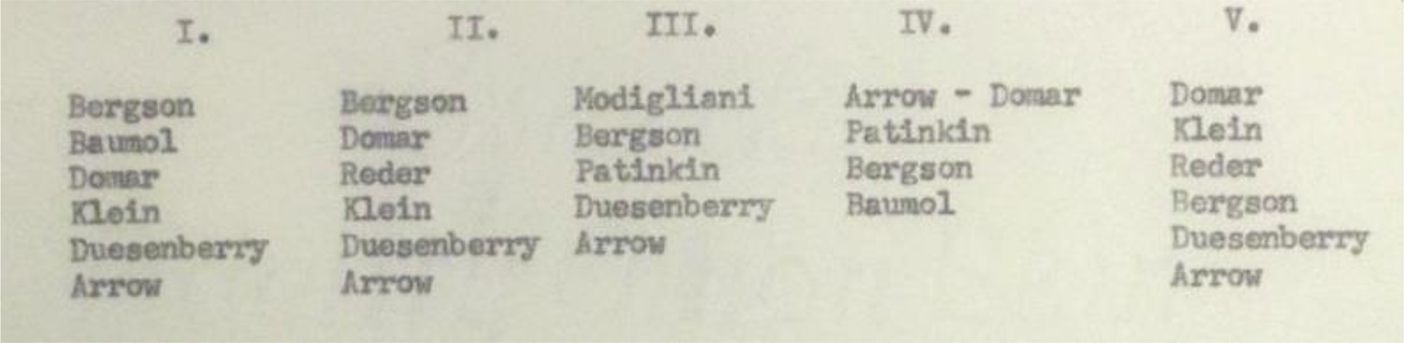
In contrast, the 1953 election did not run smoothly. The new CHA chair, Norman Buchanan, conducted preliminary polls in a hurried and messy way.Footnote 9 Nominees included Moses Abramovitz, James Duesenberry, Joe Bain, Lawrence Klein, Abram Bergson, Lloyd Meltzer, Donald Patinkin, Martin Bronfenbrenner, John Dunlop, Jacob Mozak, and Melvin Reder (see Figure 1).
CHA members’ lists of nominees. Column I is Mason, II is Shaw, III is Bach, IV is Machlup, and V is Buchanan.

Buchanan followed an obscure ad hoc procedure to select the second poll of candidates from the initial extensive list, and several members of the committee thought he had been unfair to some nominees. The committee could not meet even once in camera. Two members of the committee ranked Meltzer first, after which his name was taken down as he had just reached the age limit. Duke economist and historian Joseph Spengler, who had just been nominated to sit on AEA’s Committee on Honors and Awards, refused to vote.Footnote 10 On April 10, 1953, he sent a resignation note that made it clear that he
disagree[d] thoroughly with the principle of the award and, therefore, must abstain from giving a recommendation … I cannot conscientiously rate the people in question. If I were to make a new rating each week … I am sure that I would come up with a somewhat different rating each time. … I question very seriously whether we can make an effective appraisal, and whether, if we do, we can do much to advance the cause of economics.Footnote 11
The final poll resulted in the unambiguous proposal that Abram Bergson be awarded the 1953 JBCM, with Evsey Domar and Lawrence Klein as runners-up.
Yet the vote was dismissed by the Executive Committee. More precisely, most members voted in accordance with the CHA ranking, but Frank Knight, David Wright, and Paul T. Ellworth did not provide any vote, and the medal was not awarded. The reasons for this outcome are unclear, but it seems some AEA leaders had found the whole nomination process extremely muddled, especially in light of CHA’s own misgiving about the existence of the prize. The scope and breadth of Bergson’s contribution was also questioned. It was suggested that his research had affected some specific fields within economics rather than the whole discipline itself. By the early 1950s, Bergson’s early development of the social welfare function may have been overshadowed by his more recent work, which identified him as a Soviet specialist (Igersheim Reference Igersheim2019).Footnote 12
While the decision to give no award that year also reflected several types of concern, it triggered a reassessment of the relevance of conferring the award.Footnote 13 The AEA leadership was deeply divided on the matter. Buchanan circulated a memorandum asking whether it was “wise for the AEA to make invidious distinctions by an official award that draws a sharper line than can [be] adequately justified.” Manpower economist J. Douglas Brown thought that “the field of economics is so subdivided by specializations, university groupings, occupational connections, etc., that no group of judges can really comprehend the ‘values’ of the contributions of all candidates.” The impossibility to set meaningful age and geographical boundaries was also discussed repeatedly over the next years. Stigler and Meltzer had to be eliminated from previous elections. The 1957 nominating committee was especially frustrated with having to dismiss the nomination of Richard Ruggles (too old), Guy Orcutt, Frank Adelman and Leonid Hurwicz (turning forty just days before the prize announcement), and Lawrence Klein and Don Patinkin (considered residents of England and Israel).Footnote 14
Executive Committee members also complained about either the shortage or the excess of good candidates. Fritz Machlup suggested to maintain the award but to skip as many years as necessary until an “exceptional nominee” was found. In any case, the main bone of contention was the usefulness of the JBC Medal. Given the variety of motives presiding over its establishment, “usefulness” was difficult to assess. Several AEA officials, including the 1953 AEA president, Calvin Hoover, industrial organization specialist Edward Mason, agricultural economist Blair Steward, and Brown endorsed Edward Shaw’s statement that “the fruits of the award do not seem very important, from the standpoint of the winners. But I rather suspect that failure to receive the award has preyed on some minds.” In other words, it was not clear that the medal was stimulating excellence.Footnote 15 But Samuelson and Chicago’s Theodore W. Schultz disagreed that the medal was more damaging than beneficial to economics. In particular, the former, a medalist himself, unsurprisingly emphasized the importance of signaling excellence to non-economist audiences. Though Samuelson’s argument that it was important that AEA practices emulate other scientific societies eventually prevailed, controversies re-erupted every year between 1954 and 1959.Footnote 16
In the following years, the Executive Committee nevertheless systematically aligned with the decision of the CHA. The 1955 election resulted in a tie: Kenneth Arrow, William Baumol, and James Tobin ended up with twelve points each, because they were ranked differently by committee members under the 5-3-1 system. The ten-points system returned close results (Tobin 13.5, Arrow 13, Baumol 10), and another final ballot singled out Tobin. The next election in 1957 was more clear-cut. The CHA was chaired by industrial organization pioneer George Stocking and was composed of Mason, Steward, Brown, Samuelson, and Marschak. They were choosing among Arrow, Baumol, Duesenberry, Carl Kaysen, Franco Modigliani, and Robert Solow. Marschak and Samuelson ranked Arrow first, Brown placed him after Baumol, and only Steward excluded him from the list of the three favorites (Duesenberry, Modigliani, and Baumol), with the consequence that Arrow was designated by a substantial margin. As the 1950s closed, a long-term nominee, Klein, was eventually rewarded, and some others like Modigliani, Duesenberry, and Baumol, whose name had ended up in the final three at least three times, reached the age limit. It was around that time that the diversity in the methodological orientations of the laureates most explicitly came under fire, suggesting that geographical, methodological, and field diversity in the nominating committee had not translated into poll outcomes.
From Theory to Empirical and Policy-Oriented Research
It was the 1958 AEA president, Morris Copeland, who put the issue of research methods balance on the table. The author of a landmark study of money flows and income in the US and a long-term NBER affiliate, he had also spent decades in Washington, working for the Central Statistical Board, the Bureau of Budget, and the War Production Board.Footnote 17 At the 1958 annual business meeting, Copeland complained about the higher prestige of abstract over empirical economics:
Purely deductive exercises … offer young men prompter and surer professional recognition than does any form of empirical research. … There is something wrong with the incentives under which economists work in the early stages of their careers. I believe the Association ought to undertake a systematic canvass to determine what steps should be taken to change these incentives so as to make studies that are both theoretical and factual more attractive than mere a priori model analysis inquiries.
(1958, p. 610)This dominance was seen in the fields of John Bates Clark medalists, he explained, who had all reported micro and macro theory as their main field of interest in the 1956 AEA Handbook, with statistical methods and monetary theory coming second. Yet the Clark Medal should have been used “to help to overcome the disadvantage of the laborious and time-consuming type of economic inquiry that combines precise reasoning with empirical investigation and to make it more attractive than most purely deductive theorizing, mathematical or otherwise,” he asserted (1958, p. 610).
The issue of theory versus empirical research balance was not new to the AEA. In 1945, the Exploratory Committee on Honors and Awards had already warned about the difficulty of choosing “whether emphasis should be upon methodology, contributions to theory, or contributions to the verification of generalizations and propositions” (p. 499). In 1958, Copeland appointed an Exploratory Committee on Additional Award to examine possible amendment to the JBCM. The committee sent out two identical sets of questionnaires, the first to former members of nominating committees and the second to a set of young economists sampled from the Handbook. They asked whether “a new award might be made … to that younger member of the association … who is adjudged to have made the most significant contribution to economics through an effective combination of empirical research and theoretical analysis.” Senior and junior economists who were polled reacted very differently. Only seven of the eighteen senior scholars supported the establishment of the new award. Several of them nonetheless agreed that other types of work were being discouraged: “I am concerned that we are developing fewer and fewer economists … willing to take the long, hard road of studying problems of public policy and of working to improve public policy,” former CHA member Brown wrote. Labor economist Sumner Slichter concurred, suggesting that the Brookings or Ford foundations could fund such a prize. Public finance specialist Harold Somers proposed to make an annual citation in each major field. Marschak ventured the idea that, had the prize existed from 1930 to 1945, it would have been granted for national income measurement, and that it will be given for economic history or development at some point.Footnote 18
By contrast, an overwhelming majority of thirty-two out of the thirty-five young economists sampled thought a new award should be established. Many of them complained about the difficulty to get policy-oriented work published in top journals. “The best reward is the space in the American Economic Review,” one respondent asserted. Others campaigned for the addition of economic philosophy and teaching to the contributions worthy of an award. The political context of the 1950s was also on many economists’ minds. A youngster “working in the field of military, political, social and economic intelligence” explained that “the job of maintaining the Free World will be a lot easier if we have more data and more empirical research.”Footnote 19 That a young respondent suggested to establish one award for blending theory and empirical analysis and another “covering contributions of empirical research to public policy,” as well as the mentions of data gathering, field research, and econometrics, illustrates the lack of agreement on what counted as “empirical” analysis.Footnote 20
In its final report, the Exploratory Committee pointed out that proper theory–empirical research balance would require making the award annual and making “substantial accomplishment in the way of empirical research” a necessary condition, and even so, “it would take at least take half a dozen years to achieve a reasonable balance.” This, the committee continued, was a major reason for the committee to support the establishment of a new medal. It was to be awarded in each even-numbered year to a young economist “concerned with the public policy implications of his work who has made an outstanding contribution through an effective combination of empirical research and theoretical work,” and named after Wesley Clair Mitchell. The Executive Committee nevertheless found that no clear consensus had emerged in the poll conducted by the ad hoc committee, and voted down the proposal. But Klein’s 1959 award was, for the first time, accompanied by a separate citation, drafted by CHA Chair Clair Wilcox, that emphasized that the laureate “has insisted that theory be grounded in empirical facts.”Footnote 21
The Exploratory Committee’s prediction was partly vindicated. It took a dozen years to change the balance, but no fundamental change in the way the award operated was necessary. Two immediate awards—to Solow in 1961, and Hendrik Houthakker, a consumer choice theorist, in 1963—highlighted in their citations “the emphasis [Solow] has placed, not on mathematical or statistical method, but on the economic significance of his work, and by his ability to contribute … to the formulation of economic policy,” and the intertwining of theoretical and empirical aspects of consumption research (Houthakker).Footnote 22 The next medal went to Zvi Griliches (1965). It emphasized the “measurement of capital and of quality change in price index number” (emphasis added).Footnote 23 The rationale behind citation writing is never discussed in the archives, and beginning with Griliches, the AEA website ceased to provide authorship information for them. Probably written by CHA chairs yet unsigned, they stand as a collective public statement by the AEA on what counts as a “major contribution.” Though not intended as a methodological tract, their pattern is nonetheless interesting.
Griliches’s prize inaugurated a shift in the type of contribution rewarded by the AEA. In the course of the subsequent thirty years, just over one medalist in three was rewarded for theoretical contributions only.Footnote 24 Citations for other laureates generally emphasized both theoretical and empirical contributions (Dale Jorgensen 1971, Franklin Fisher 1973, Daniel McFadden 1975, Martin Feldstein 1977, James Heckman 1983, Jerry Hausman 1985) and, increasingly, econometrics. Contributions to specific fields were also more systematically emphasized, ranging from transportation and agriculture to taxation, social security, demography, health labor economics, or energy.
The 1990s saw a second stream of medals awarded for path-breaking empirical work. The 1993 citation for Lawrence Summers closed with the announcement that his research “has been at the forefront of a remarkable resurgence of empirical economics over the past decade. This research has restored the primacy of actual economies over abstract models … his work has inspired a new generation of economists … who are now reconstructing the empirical foundations of the discipline.”Footnote 25 The citation was substantiated by the two subsequent medals that were awarded to labor economists David Card (1995) and Kevin Murphy (1997). Though the term already appeared in Fisher’s 1973 and Hausman’s 1985 citations, the citations of medalists from the 2000s onward made more systematic use of the word “applied” (“applied theorist,” as in the case of Susan Athey’s 2007 citation, “applied econometrician,” and “applied microeconomist”). The term was meant to characterize a nexus of theoretical, empirical, and policy-oriented work. Amy Finkelstein’s 2012 citation explained that her work shows how “theory and empirics can be combined in creative ways … to inform policy design.” Even the citation for game theorist Yuliy Sannikov’s medal (2016), the first theorist-only awarded in fifteen years, emphasized the many “applications” of his work.
Overall, the debates on the relevance of the medal waned in the 1960s, though—still classified—deliberations about the most deserving scholars probably continued. Absent any articulation on why candidates were nominated—names were usually sent with CVs—or why the laureate had gathered a majority of votes, we can only speculate on why debates cooled down in the 1960s. The nature and content of early challenges suggest that signaling excellence required that, prior to arguing over what counted as a major contribution to “central body of economic knowledge,” economists had to agree that there existed such a body. Yet it is only in the 1960s that the picture of a discipline centered on a common “core” stabilized within the economic community (Cherrier Reference Cherrier2017; Backhouse and Cherrier Reference Backhouse and Cherrier2017; Ruggles Reference Ruggles1970). Up to the 1960s, the quality of laureate selection seemed to derive from convergence in the judgments of a variety of recognized seniors, and this convergence tacitly pointed to contributions to the theory of price, allocation, income, money, employment, and growth—though not a convergence in methods or tools. The laureates who, from the 1960s onward, were rewarded for their contributions to empirical methods or specific fields all used mathematical models in which consumers and producers optimize over time.Footnote 26 While diversification in fields and methods came with an underlying unification in approach, another standardization was at work: the laureates were drawn from a small set of institutions.
IV. INSTITUTIONAL TRAJECTORIES REWARDED?
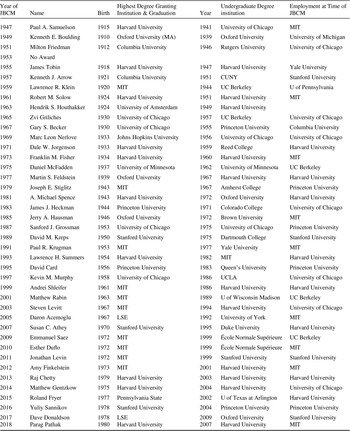
By 2018, seventy-two years after the JBCM’s establishment, forty medalists were announced. A full list of medalists with their educational background and affiliation at the time of the award can be found in Table 1. The youngest medalist ever was also the first one: Paul A. Samuelson, who was only thirty-two. Sanford Grossman and Raj Chetty at thirty-four years are runner-ups. Most medalists, fifteen of them, gained the medal at the age of thirty-nine, the last eligible age. Twelve became medalists at the age of thirty-eight.Footnote 27 The pool of laureates includes only three women (Susan Athey in 2007, Esther Duflo in 2010, and Amy Finkelstein in 2012), one African American (Roland Fryer), and two researchers born in India (Raj Chetty in 2013 and Parag Pathak in 2018). Economics academe in the US is infamous for underrepresenting women and racial minorities relative both to other sciences and to the overall population (Price Reference Price2009; Darity Jr. and Arden Reference Darity and Arden2014; Bayer and Rouse Reference Bayer and Rouse2016; Lundberg and Stearns Reference Lundberg and Stearns2019; Boustan and Langan Reference Boustan and Langan2019). Yet a closer look at the aggregate profile of laureates reveals that beyond age, gender, and race homogeneity (close to forty, male, and white), their networks and institutional background are also narrow, and have gotten increasingly so over time.
LIST OF JBC MEDALISTS AND THEIR BASIC BIOGRAPHICAL DATA

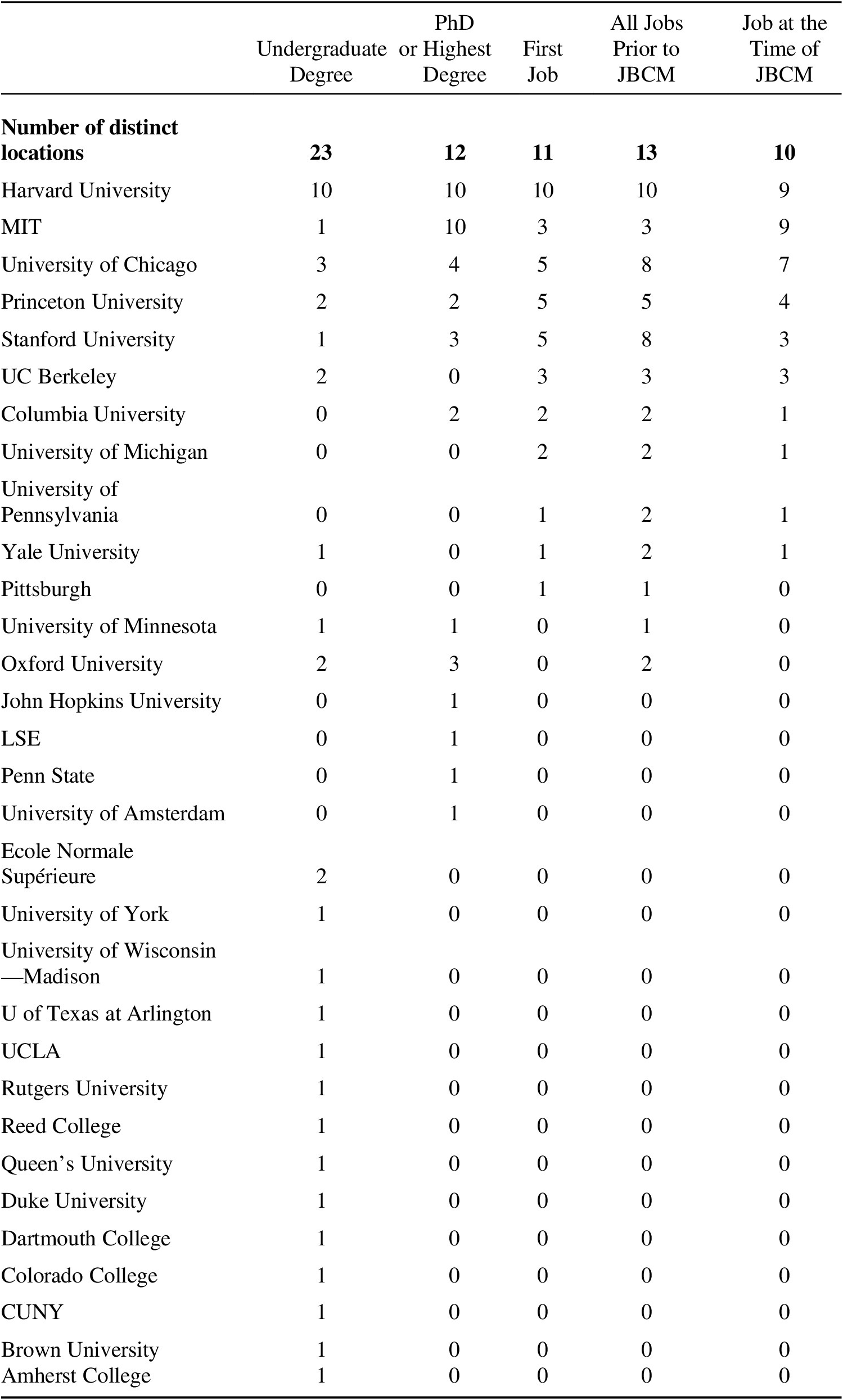
JBC medalists on the whole exhibit increasing concentration of their location as they progress in their careers (Table 2). They received their undergraduate degree from twenty-three different institutions, but PhD degrees from only twelve universities. Their first jobs were at eleven institutions, and they worked at just ten institutions at the time of the award. A detailed look at the undergraduate institutions reveals that eighteen of these institutions, however, educated only one medalist each. On the other side of the spectrum, Harvard trained ten, followed by Chicago and Berkeley with three each, and Princeton, Oxford, and École Normale Supérieure with two each. MIT does not appear in the top five most frequent undergraduate institutions. This is in no small part due to the fact that there was not an undergraduate program in economics at MIT before 1965. For more details, see Cherrier (Reference Cherrier2014).
CUMULATIVE DATA ON EDUCATION AND JOB LOCATIONS OF JBC MEDALISTS

Increasing concentration of locations where JBC medalists studied and worked. The fifth column provides a cumulative count of all jobs for all forty medalists—some worked at multiple institutions before becoming a medalist.
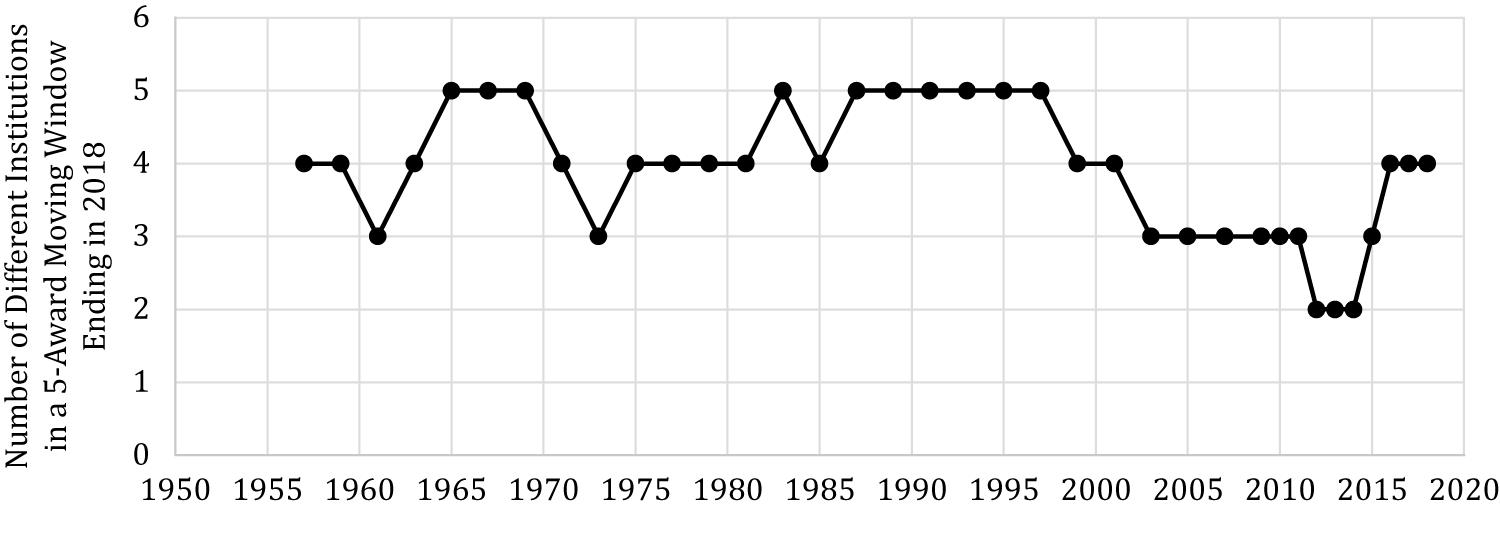
All but one medalist earned a doctorate.Footnote 28 Medalists graduated from twelve different institutions, approximately just half the number of distinct undergraduate degree institutions. Harvard and MIT together account for half of the medalists. Both educated at least twice as many graduates as the third most frequent institution, Chicago, with four medalists. The pool of PhD-granting institutions is not only smaller than the undergraduate pool, it has also narrowed over time. When we take a twenty-year moving window, then in the first twenty years of JBCM, the fifteen medalists graduated at eight universities. In the last available window, 1998 to 2018, the fifteen medalists graduated at just five universities. When we consider a moving window of the past five awards—which accounts better for changing frequency of the medals and no JBCM in 1953—then windows ending between 1975 and 2001 have medalists from four or even five different institutions. Five different institutions in a five-award window is the most diverse possible outcome and happened in the windows ending 1987 through 1997 (see Figure 2). After 2001, the diversity decreased, first down to three different institutions and then even to just two institutions (Harvard and MIT) in the windows ending in 2012 through 2014. This drop in diversity is not observed for job locations at the time of award.
The number of different PhD granting institutions of JBCMs in a moving five-award window. The first datapoint in 1957 covers the period of the first five awards from 1949 until 1957.

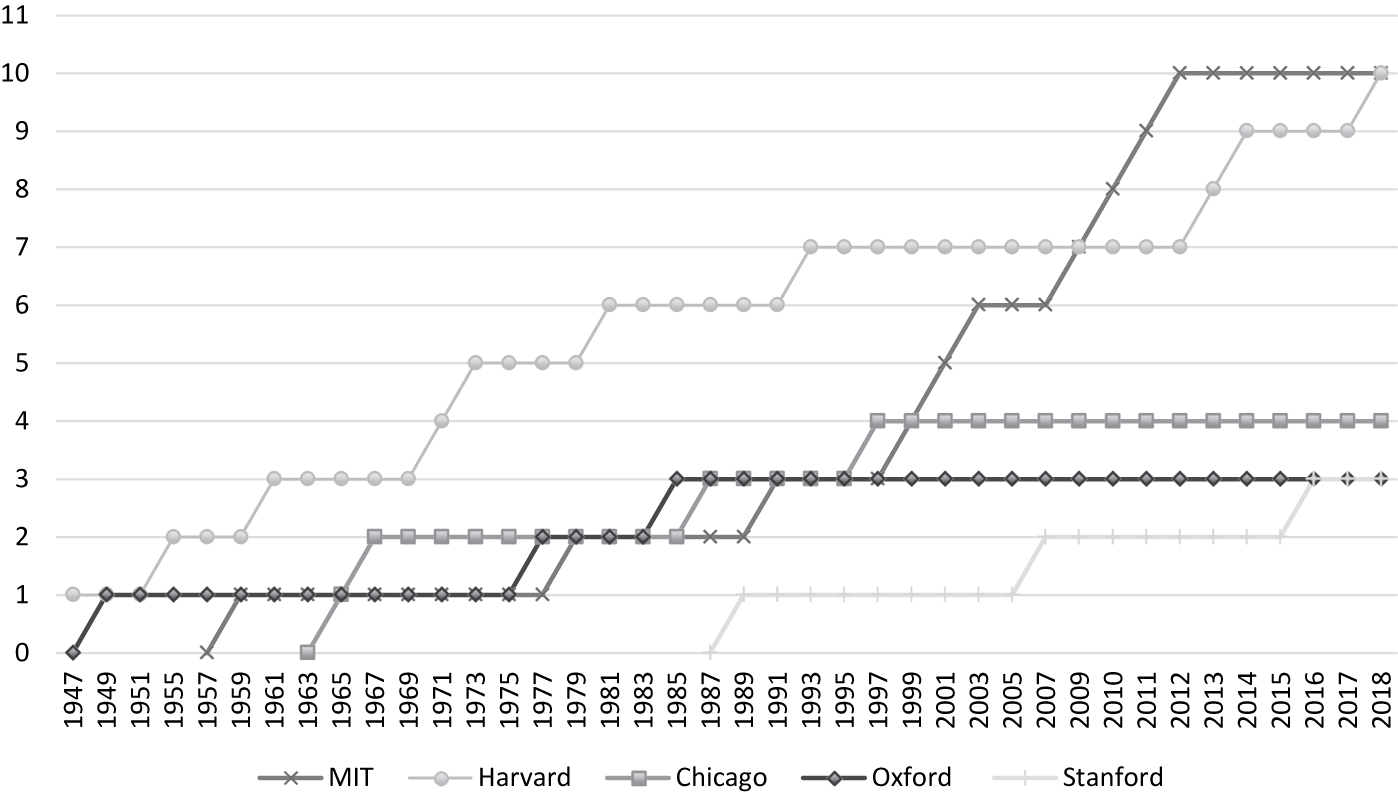
Figure 3 shows that from 1951 until 2007, medalists have predominantly come from Harvard, growing from one medalist to seven. From 2009, MIT took over, only to be tied with Harvard again in 2018 with ten medalists. MIT’s meteoric rise started in 1999. Until 1989, it had only two medalists and ranked fourth jointly with Columbia. In 1997, it had three medalists and tied third with Oxford. In the period from 1999 to 2012, nine medalists were announced and seven were MIT graduates.Footnote 29
Cumulative count of JBCM’s doctoral degree institutions. Harvard’s long-standing dominance was present until the late 2000s and MIT’s surge in the 2000s and dominance in the 2010s.

Diversity in institutional background further shrinks when employment locations are considered. As seen in Table 2, the overall number of distinct locations where medalists were first employed and where they were active at the time of the award is even smaller than the number of graduate degree institutions. They belonged to only ten different universities at the time of the award. Harvard and MIT each have nine, and Chicago seven. Interestingly, twelve of the forty medalists never changed jobs and stayed at one institution—six of them worked at MIT, and two each at Harvard, Stanford, and Chicago. The concentration of locations—from undergraduate, then graduate education, first employment, and to employment at the time of the JBCM—follows the same pattern that is observed among the AEA leadership documented by Kevin Hoover and Andrej Svorenčík (Reference Svorenčík, Düppe and Weintraub2019).
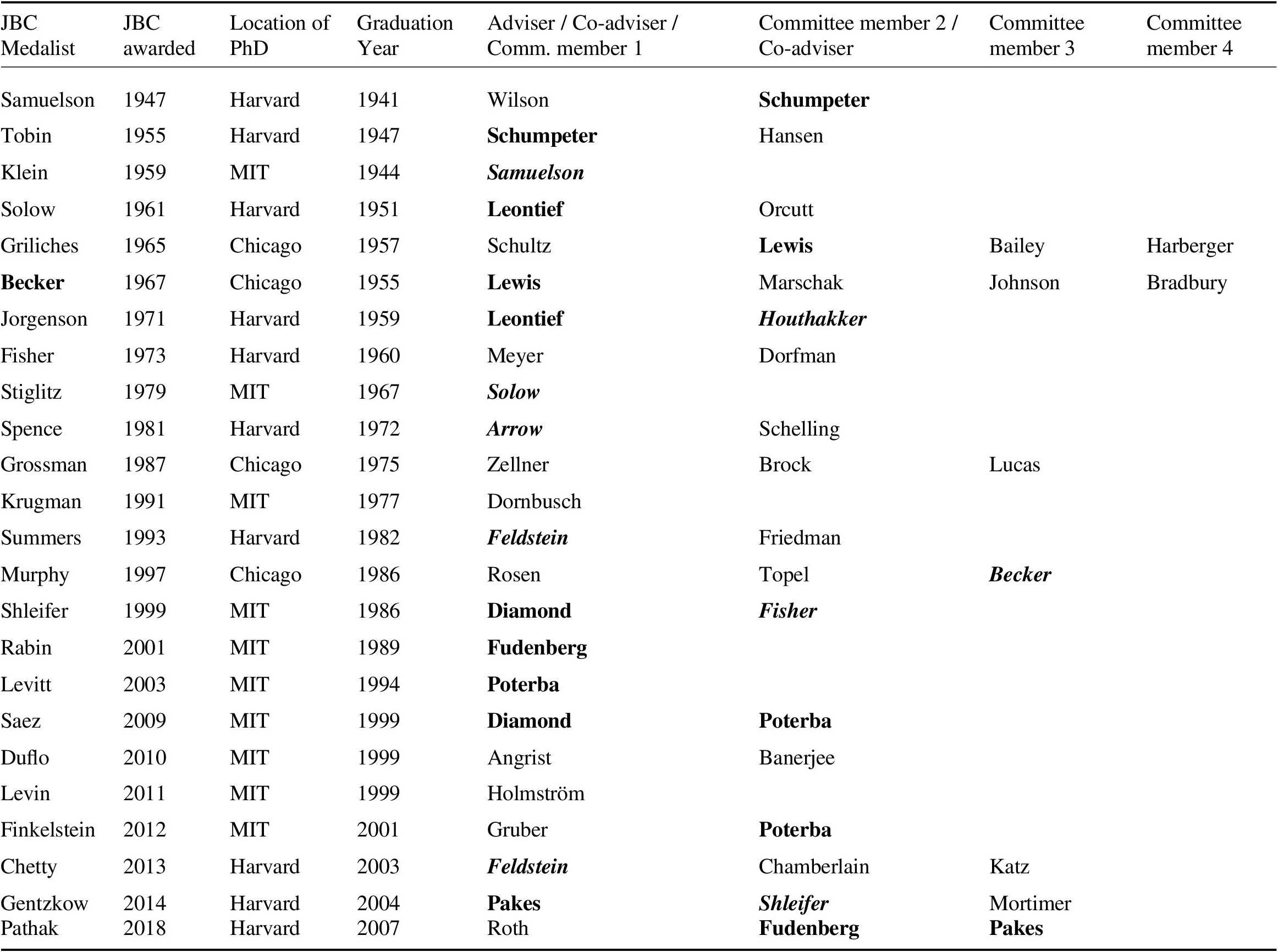
Evidence therefore suggests that, beyond or perhaps because of contributing work that peers deemed a “major contribution to the discipline,” being the right (white) man at the right place indeed mattered. The right place may, however, not just have been the right university: Harvard, MIT, or Chicago. As explained by Svorenčík (Reference Svorenčík2018, Reference Svorenčík, Düppe and Weintraub2019), each of these leading departments exhibits a core group of advisors, often graduates of the same department, who supervised a disproportionately large number of PhD students, thus connecting generations of PhD students and providing intellectual and institutional continuity. We therefore summarize details about the advisers of those medalists trained at Harvard, MIT, and Chicago in Table 3, so as to identify possible patterns in these networks.Footnote 30 Eighteen of them are connected to at least one other JBC medalist through a shared adviser or defense committee member. For instance, Wassily Leontief advised both Robert Solow (1961) and Dale Jorgenson (1971). Furthermore, Jorgenson’s committee member was Hendrik Houthakker (1963). Martin Feldstein (1977) advised both Lawrence Summers (1993) and Raj Chetty (2013). James Poterba advised Steven Levitt (2003), and co-advised Emmanuel Saez (2009) and Amy Finkelstein (2012). From the forty-two people involved in advising the twenty-three medalists from Harvard, MIT, and Chicago, only ten were involved with the AEA Committee on Honors and Awards. Only two, Samuelson and Poterba, sat on the committee when their students—Klein (1959) and Saez (2009)—received the medal.Footnote 31 Overall, there does not appear to be any clear JBCM lineage of medalists training new medalists.
ADVISERS OF SELECTED JBC MEDALISTS WHO GRADUATED FROM HARVARD, MIT, AND CHICAGO

Advisers or committee members in bold type supervised or sat on a committee of more than one JBC medalist. Those in bold italic type are JBC medalists themselves.
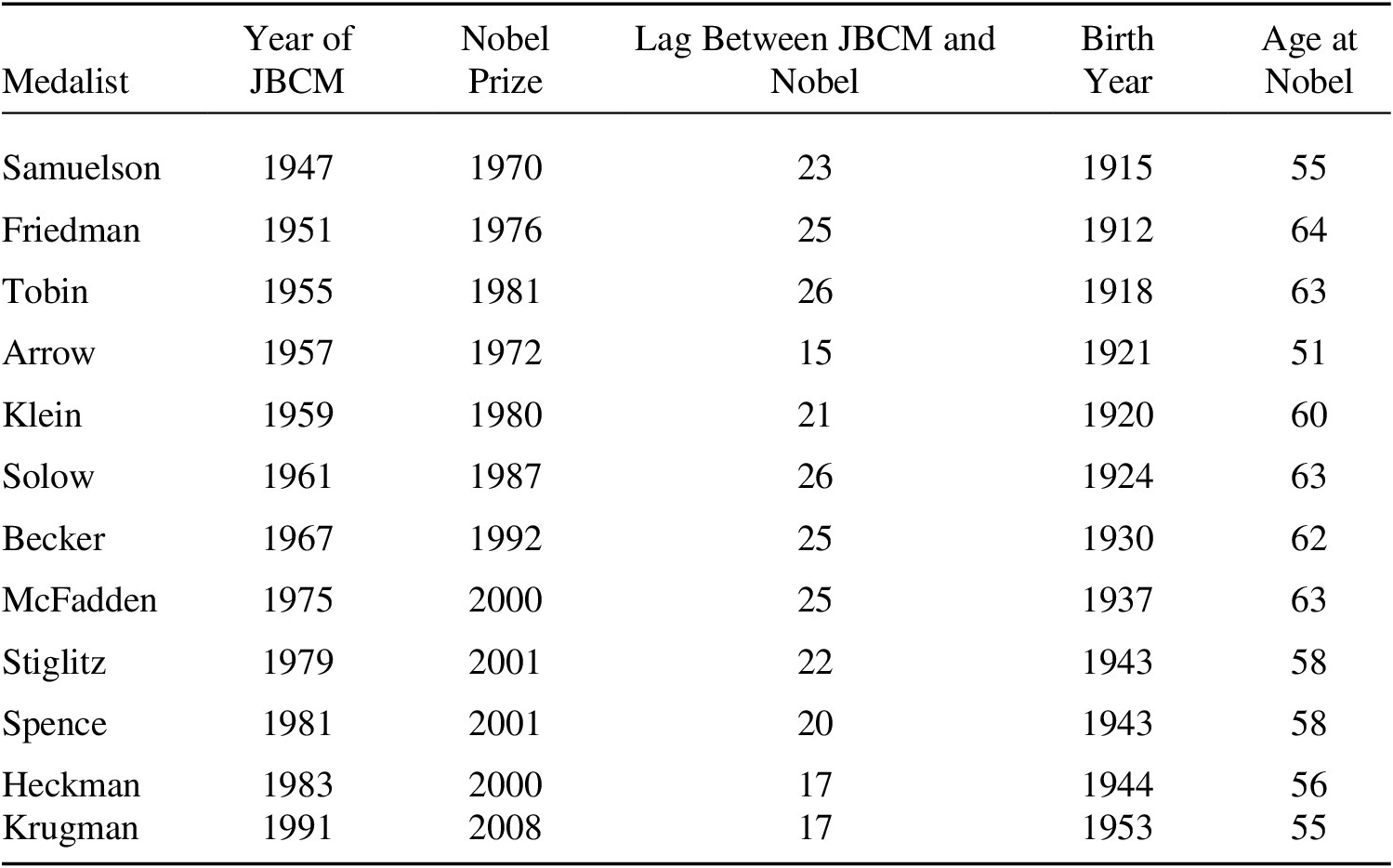
Twelve of these JBCMs have gone on to win the Nobel Prize in Economics (Table 4). These favorable odds improve even more once the average time between the two prizes—which currently stands at almost twenty-two years—is accounted for. Excluding all medalists of the past twenty-two years, then out of the remaining twenty-five medalists, twelve (48%) have received the Nobel Prize. No wonder that the JBC Medal is frequently dubbed the “baby Nobel Prize.” The average age of medalists who become Nobel laureates is fifty-nine years. This is eight years below the average age of all economics Nobelists.Footnote 32
JBC MEDALISTS WITH A NOBEL PRIZE

V. CONCLUSION: EXCELLENCE AND PRIVILEGE
The history of the John Bates Clark Medal emphasizes the difficulty of agreeing on how to define “excellence” in economics and the difficulty of disentangling intellectual and institutional markers of the laureates. The selection of the laureates described in this paper does not appear as a pure intellectual culmination but as a social process. First, part of the controversies plaguing the first decade of the award derived from the fact that the John Bates Clark Medal was not primarily intended to signal excellence to economists, but scientificity and expertise to other scientists, policy-makers, and the public. Many AEA officials, including members of the Committee on Honors and Awards and the Executive Committee, remained skeptical that, within the profession, such a prize was doing more good than harm. Though balance was built into the selection of the members of the Committee on Honors and Awards and the nominating and voting system, they did not necessarily agree, at first, that there existed a unified and consistent body of “core” work the medalists should have contributed to, and even less on the theoretical, empirical, or policy-oriented and methodological characteristics of such fundamental contributions.
Nevertheless, it seemed that in the first decades of the medal, being the “right person in the right place” meant being a white male theorist with a PhD from Harvard. The gender imbalance began to change slowly only in the past decade.Footnote 33 We found no evidence that the perceived theoretical bias of the first ten awards was deliberate. In those years the committee was in majority composed of applied economists, in particular labor or industrial, and there was no sign that they explicitly believed that a “fundamental contribution” was necessarily theoretical. As the identity of the discipline stabilized in the postwar period, research that reflected a combination of theory, econometrics, measurement efforts, and empirical creativity was increasingly rewarded. That was concomitant with a decrease in the diversity of laureates in terms of which institutions they studied and worked at. While Harvard had been the dominant employment institution for laureates, Chicago gained traction, and MIT achieved domination as the most frequent PhD-granting institution for laureates by the early 2010s.