Introduction
All the members of the family Cimicidae (Heteroptera: Cimicomorpha) are temporary bloodsuckers on vertebrates, with birds and bats as primary hosts, and humans as secondary hosts (Usinger, Reference Usinger1966). As it is characteristic of Heteroptera, cimicids have holokinetic chromosomes, i.e., without a primary constriction and, thus, without a localized centromere. The 53 species studied so far exhibit a wide range of diploid number of autosomes from 8 to 40 with simple (XY/XX, male/female) and multiple sex chromosome systems (X n Y/X n X n , male/female) (Ryckman & Ueshima, Reference Ryckman and Ueshima1964; Ueshima, Reference Ueshima and Usinger1966, Reference Ueshima and John1979; Grozeva & Nokkala, Reference Grozeva and Nokkala2002; Grozeva et al., Reference Grozeva, Kuznetsova and Anokhin2010; Kuznetsova et al., Reference Kuznetsova, Grozeva, Nokkala and Nokkala2011; Sadílek et al., Reference Sadílek, Št'áhlavský, Vilímová and Zima2013).
The classical cytogenetic analysis performed on the two species of the subfamily Haematosiphoninae, Acanthocrios furnarii (Cordero & Vogelsang, 1928) (2n=10+XY, male) and Psitticimex uritui (Lent & Abalos, 1946) (2n=28+X1X2Y, male), has revealed that they have achiasmatic male meiosis of collochore type (Poggio et al., Reference Poggio, Bressa, Papeschi, Di Iorio and Turienzo2009), which seems to be characteristic of all the members of Cimicidae (Grozeva & Nokkala, Reference Grozeva and Nokkala2002). Neither species shows diplotene or diakinesis, whereas both show homologous chromosomes lying side by side and connected with each other through their medial region by achiasmatic associations at metaphase I. However, the terminal regions are separated. At anaphase I, sex chromosomes segregate sister chromatids (equational division), whereas autosomal bivalents segregate homologous chromosomes (reductional division). During this stage, both the sex chromatids and the homologous autosomes migrate parallel to the equatorial plane, and at anaphase II the chromosomes segregate also with their long axes parallel to the equator, showing kinetic activity along all the chromosome/chromatid (Poggio et al., Reference Poggio, Bressa, Papeschi, Di Iorio and Turienzo2009).
The members of Cimicidae have attracted considerable interest for their achiasmatic male meiosis (Grozeva & Nokkala, Reference Grozeva and Nokkala2002; Poggio et al., Reference Poggio, Bressa, Papeschi, Di Iorio and Turienzo2009; Grozeva et al., Reference Grozeva, Kuznetsova and Anokhin2010). Nevertheless, cytogenetic studies with relation to the content, distribution and composition of heterochromatin, and to the number and location of rDNA loci are still scarce (Grozeva & Nokkala, Reference Grozeva and Nokkala2002; Grozeva et al., Reference Grozeva, Kuznetsova and Anokhin2010). With this in mind, we used several approaches to perform a detailed characterization of the male meiotic karyotype in A. furnarii, which has a simple XY sex chromosome system, and in P. uritui, which has a derived X1X2Y system.
Material and methods
Thirteen males of A. furnarii from Río Luján (Buenos Aires) and La Falda (Córdoba) (Argentina), and 55 males of P. uritui from Toay (La Pampa), La Falda (Córdoba), Chascomús (Buenos Aires), and Ciudad Autónoma de Buenos Aires (Argentina) were collected by Osvaldo Di Iorio and Paola Turienzo from different birds’ nests in 2009. The specimens were brought alive to the laboratory and the testes dissected out in physiological saline solution as earlier described for the Pyralid moth, Ephestia sp. (Glaser, Reference Glaser1917 cited by Lockwood, Reference Lockwood1961), swollen in a hypotonic solution, and fixed as described in Poggio et al. (Reference Poggio, Bressa and Papeschi2011). Spread chromosome preparations were made as described in Traut (Reference Traut1976). Then the preparations were dehydrated in an ethanol series (70, 80, and 96%, 30 s each) and stored at –20 °C until further use. C-banding and fluorescent bandings were performed according to Poggio et al. (Reference Poggio, Bressa and Papeschi2011). For C-banding, the pre-treated slides were stained with 4′6-diamidino-2-phenylindole (DAPI; Fluka BioChemika, Sigma Aldrich Production GmbH, Buchs, Switzerland) for a better resolution of C-bands (Poggio et al., Reference Poggio, Bressa and Papeschi2011). It has been shown that the C-DAPI banding technique reveals the same heterochromatic regions as the C-Giemsa banding (Barros e Silva & Guerra, Reference Barros e Silva and Guerra2010). Fluorescent in situ hybridization (FISH) with a biotinylated 18S rDNA probe was performed essentially following the procedure described in Fuková et al. (Reference Fuková, Nguyen and Marec2005) and Bressa et al. (Reference Bressa, Papeschi, Vitková, Kubíčková, Fuková, Pigozzi and Marec2009).
Preparations were observed in a Leica DMLB microscope equipped with a Leica DFC350 FX CCD camera and Leica IM50 software, version 4.0 (Leica Microsystems Imaging Solutions Ltd, Cambridge, UK). Black-and-white images of chromosomes were recorded separately for each fluorescent dye. Images were pseudocoloured (light blue for DAPI, green for CMA3, red for Cy3) and processed with an appropriate software.
Results
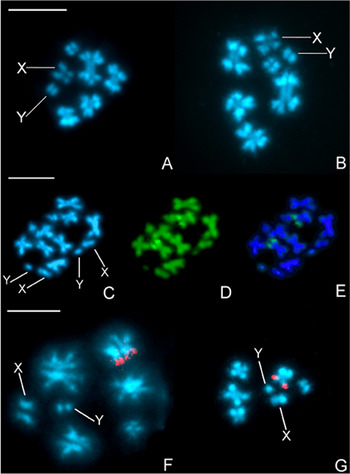
In A. furnarii (2n=12=10A+XY, n=6=5A+X/Y, male), C-positive blocks were observed at both terminal regions in all autosomes, the X chromosome had a small band at one terminal region and a larger one at the other terminal region, and the Y chromosome was completely C-positive (fig. 1A, B). One of the largest autosomal pairs of this species had a DAPI-negative/CMA3-positive band at a terminal region, whereas the remaining autosomal pairs and the X chromosome showed uniform staining with each DAPI and CMA3 fluorochromes (fig. 1C–E). The Y chromosome was stained homogenously with DAPI but negatively with CMA3 (fig. 1C–E). FISH experiments with 18S rDNA probes revealed that the probe hybridized to one terminal region of one of the largest autosomal pairs (fig. 1F, G).
C-banding followed by staining with DAPI (A, B), DAPI banding (C), CMA3 banding (D), DAPI-CMA3 merged image (E), and FISH with rDNA 18S probe (F, G) in male meiotic chromosomes of A. furnarii. A, B – Prometaphase I. C–E – Anaphase I. F – Prometaphase I. G – Metaphase II. X, Y: sex chromosomes. Hybridization signals: red. Bar=10 μm. (See online for a colour version of the figure.)

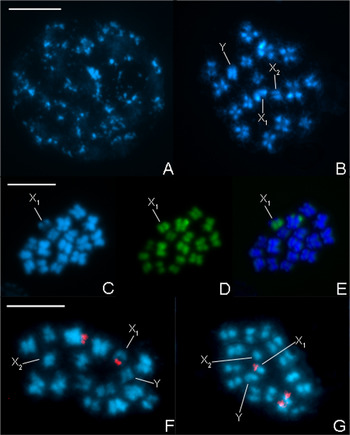
In early male meiotic prophase I of P. uritui (2n=31=28A+X1X2Y, n=16/15=14A+X1X2/Y), significant C-positive dots were scattered in the nuclei (fig. 2A). From meiotic prometaphase I onwards, C-positive bands of different sizes and intensities were detected at both terminal regions in all autosomal bivalents. One of the sex chromosomes was completely C-positive, the second one had a terminal C-positive band and the third sex chromosome showed no C-positive bands (fig. 2B). The fluorescent banding revealed two conspicuous DAPI-negative/CMA3-positive terminal blocks, one placed on a sex chromosome and the other on an autosomal bivalent (fig. 2C–E). In rDNA-FISH preparations from testes of P. uritui, both an autosomal pair and a sex chromosome showed a cluster of hybridization signals at one terminal region (fig. 2F, G).
C-banding followed by staining with DAPI (A, B), DAPI banding (C), CMA3 banding (D), DAPI-CMA3 merged image (E), and FISH with rDNA 18S probe (F, G) in male meiotic chromosomes of P. uritui. A – Diffuse stage. B – Prometaphase I. C–E – Metaphase I. F – Prometaphase I. G – Metaphase II. X1, X2, and Y: sex chromosomes. Hybridization signals: red. Bar=10 μm. (See online for a colour version of the figure.)

Discussion
Four species of Haematosiphoninae, all of which feed on diverse avian hosts in their nests, are known from Argentina: A. furnarii, Ornithocoris toledoi Pinto, 1927, P. uritui, and Cyanolicimex patagonicus Carpintero, Di Iorio, Masello & Turienzo, 2010. Acanthocrios and Psitticimex are two of the five monotypic genera in this subfamily, an unusual feature in Cimicidae (Poggio et al., Reference Poggio, Bressa, Papeschi, Di Iorio and Turienzo2009). The cytogenetic analysis previously performed on the two Argentinean bloodsucker bugs, A. furnarii (2n=12=10A+XY, male) and P. uritui (2n=31=28A+X1X2Y, male), showed that their male meiosis is achiasmatic and of collochore type (Poggio et al., Reference Poggio, Bressa, Papeschi, Di Iorio and Turienzo2009). According to previous results (Grozeva & Nokkala, Reference Grozeva and Nokkala2002; Poggio et al., Reference Poggio, Bressa, Papeschi, Di Iorio and Turienzo2009), the achiasmatic male meiosis of collochore type should be considered as a cytogenetic feature shared by all the members of Cimicidae. In addition, we have previously proposed the following evolutionary trends for the subfamily Haematosiphoninae: (i) autosomal fusions that brought about a reduction in the autosomal number (genera Acanthocrios Del Ponte & Riesel and Ornithocoris Pinto); (ii) fragmentation of the ancestral X chromosome that originated a derived multiple sex chromosome system (X1X2Y) (genera Psitticimex Usinger, Synxenoderus List, and Haematosiphon Champion); and (iii) autosomal fragmentations that resulted in an increase in the number of autosomes (genus Hesperocimex List) (Poggio et al., Reference Poggio, Bressa, Papeschi, Di Iorio and Turienzo2009).
Constitutive heterochromatin
In Cimicidae, studies on the content, distribution and composition of constitutive heterochromatin have been performed in only two species of the genus Cimex Linnaeus (Cimicinae) by C- and/or DAPI-CMA3 fluorescent bandings (Grozeva & Nokkala, Reference Grozeva and Nokkala2002; Grozeva et al., Reference Grozeva, Kuznetsova and Anokhin2010). In the present study, carried out in A. furnarii and P. uritui, we found a high constitutive heterochromatin content, located in both terminal regions of each autosome. This pattern is consistent with that previously described for Cimex emarginatus Simov, Ivanova & Schunger 2006 (Grozeva & Nokkala, Reference Grozeva and Nokkala2002).
Constitutive heterochromatic blocks may be placed in any chromosomal region; however, these blocks are preferentially localized in specific sites in specific chromosomes (Sumner, Reference Sumner2003). Early reports on C-positive heterochromatin in heteropterans showed that C-bands are terminally located. This led to the suggestion that the principle of equilocal heterochromatin distribution of Heitz (Reference Heitz1933, Reference Heitz1935) (i.e., the tendency of heterochromatin of non-homologous chromosomes to be located at similar positions) is also applied to Heteroptera (reviewed in Papeschi & Bressa, Reference Papeschi and Bressa2006). The terminal chromosomal location of constitutive heterochromatin in both cimicid species studied is consistent with previous reports in Heteroptera (Solari & Agopian, Reference Solari and Agopian1987; Papeschi, Reference Papeschi1991; Panzera et al., Reference Panzera, Scvortzoff, Pérez, Panzera, Hornos, Cestau, Nicolini, Delgado, Alvarez, Mazzella, Cossio, Martinez, Salvatella, Carcavallo, Galindez Girón, Jurberg and Lent1998; Bressa et al., Reference Bressa, Larramendy and Papeschi2005).
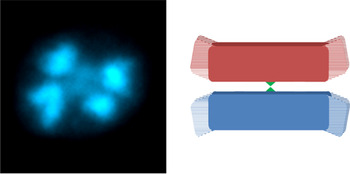
Considering the male meiotic behaviour and the distribution of constitutive heterochromatin in both species analysed, we propose that A. furnarii and P. uritui have a pattern of achiasmatic meiosis, in which three regions can be differentiated in autosomal bivalents: (i) terminal heterochromatic regions in repulsion; (ii) a euchromatic central region, where the homologous chromosomes are located parallel but without contact between them; and (iii) small areas within the central region where no chiasmatic attachment points, i.e., collochores, are detected (fig. 3).
Photograph (left) and diagram (right) showing an autosomal bivalent of A. furnarii with achiasmatic male meiosis of collochore type. The diagram illustrates three autosomal bivalent regions: (i) heterochromatic terminal region (red and blue lines), (ii) euchromatic middle region (red and blue), and (iii) achiasmatic attachment points or collochores (green). (See online for a colour version of the figure.)

It has been proposed that constitutive heterochromatin has an important role in homologous chromosome pairing in meiosis and some negative effects on meiotic pairing and crossing-over (Sumner, Reference Sumner2003). Crossing-over is usually absent in heterochromatin (John, Reference John1990), a fact often associated with a lack or delay of synaptonemal complex (SC) formation in such regions (John, Reference John and Verma1988). This could also be due to differences in the structure of the SC in heterochromatic regions (Stack, Reference Stack1984; John, Reference John1990; Toscani et al., Reference Toscani, Papeschi and Pigozzi2011). These differences could be related to the heterochromatic region size, i.e., large terminal blocks would prevent the synapsis of the homologous chromosome ends and the proper formation of the SCs (Stack, Reference Stack1984; Toscani et al., Reference Toscani, Papeschi and Pigozzi2011). In A. furnarii and P. uritui, the presence of heterochromatic terminal blocks on the autosomal bivalents might inhibit both the meiotic pairing and the regular SC formation in these regions. As a result, terminal heterochromatic blocks are observed in repulsion in both species (figs 1 and 2).
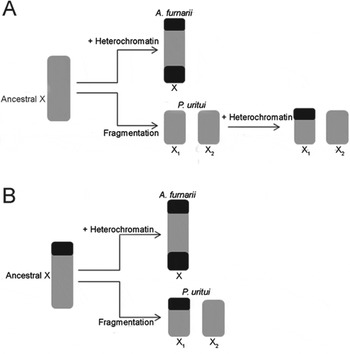
In A. furnarii, the X and Y sex chromosomes are clearly distinguished from each other by their C-banding patterns. The X chromosome had C-positive blocks of different size in each terminal region, whereas the Y chromosome was entirely C-positive. On the other hand, in P. uritui, each sex chromosome showed different C-banding patterns. Since neither male meiotic cells at anaphase II nor female meiotic cells were observed, we were unable to assign a C-banding pattern for the X1, X2, and Y sex chromosomes and, thus, to distinguish one from another. Nevertheless, taking into account the C-banding pattern of A. furnarii described in the present study and the fact that the Y chromosome is usually entirely heterochromatic in families belonging to Cimicomorpha (Panzera et al., Reference Panzera, Scvortzoff, Pérez, Panzera, Hornos, Cestau, Nicolini, Delgado, Alvarez, Mazzella, Cossio, Martinez, Salvatella, Carcavallo, Galindez Girón, Jurberg and Lent1998; Poggio et al., Reference Poggio, Bressa and Papeschi2007) we propose that the completely heterochromatic sex chromosome of P. uritui would be the Y chromosome. Based on the fact that the multiple sex chromosome system of this species has arisen from a simple XY/XX system through X chromosome fragmentation (Poggio et al., Reference Poggio, Bressa, Papeschi, Di Iorio and Turienzo2009) and that A. furnarii has an X chromosome with heterochromatic blocks in both terminal regions, we hypothesize two possible scenarios on the origin of sex chromosomes in the species studied:
-
(i) the ancestral X chromosome would be devoid of heterochromatin and, therefore, the presence of terminal C-positive heterochromatic bands on the X chromosome of A. furnarii and in one of the X chromosomes (X1) of P. uritui could result from the addition of heterochromatin at terminal positions; in the latter, the addition of heterochromatin may have taken place after the fragmentation event (fig. 4A);
-
(ii) the ancestral X chromosome would have a terminal C-positive heterochromatic region; thus, in A. furnarii, the presence of a C-positive heterochromatic band on the other terminal region of the X chromosome could be due to the addition of heterochromatin, whereas in P. uritui, the X1 and X2 sex chromosomes may have originated only by the ancestral X chromosome fragmentation (fig. 4B).
The use of fluorescent DNA-binding dyes with different specificities allows a better characterization of heterochromatic regions in terms of their relative enrichment with A+T or G+C base pairs. The results after DAPI/CMA3 banding indicate that the C-positive blocks in the species here analysed are not rich in A+T or G+C base pairs, with the exception of: (i) a DAPI dull/CMA3 bright band observed in an autosomal pair of A. furnarii and P. uritui, and (ii) a DAPI dull/CMA3 bright band on the X1 chromosome of P. uritui. In view of the constitutive heterochromatin analysis and the hypotheses proposed of the origin of sex chromosomes, we may conclude that the addition of highly repeated sequences in P. uritui would be of a more recent origin and would have occurred after a fragmentation event. The presence of heterochromatic band enrichment with G+C base pairs in the X1 chromosome of P. uritui and the absence of these types of band in the X and Y chromosomes of A. furnarii support this hypothesis.
(A, B) Diagrams showing two possible origins of sex chromosome systems in A. furnarii and P. uritui. We detail the X, X1, and X2 chromosomes in grey, heterochromatic regions in black and the evolutionary mechanisms.

Ribosomal DNA
In Cimicidae, previous molecular cytogenetic reports comprise only those related to a single species, Cimex lectularius Linneaus, 1758 (2n=29=26A+X1X2Y, male). Grozeva et al. (Reference Grozeva, Kuznetsova and Anokhin2010) concluded that 18S rDNA clusters are located on the X1 and Y sex chromosomes. These authors also found that each hybridization signal co-localizes with DAPI dull/CMA3 bright bands, whereby rDNA sequences are rich in G+C (Grozeva et al., Reference Grozeva, Kuznetsova and Anokhin2010).
In the present study, we described for the first time the number and location of nucleolus organizer regions (NORs) using FISH with an 18S rDNA probe in A. furnarii and P. uritui. FISH experiments revealed a single NOR located at the terminal region of an autosomal pair in A. furnarii, and two NORs in P. uritui, one located at the terminal region of an autosomal pair and the other on one of the sex chromosomes. Since CG-rich constitutive heterochromatin often occurs in the NOR regions (Papeschi & Bressa, Reference Papeschi and Bressa2006; Severi-Aguiar et al., Reference Severi-Aguiar, Lourenço, Bicudo and Azeredo-Oliveira2006; Morielle-Souza & Azeredo-Oliveira, Reference Morielle-Souza and Azeredo-Oliveira2007; Criniti et al., Reference Criniti, Simonazzi, Cassanelli, Ferrari, Bizzaro and Manicardi2009), we conclude that the DAPI dull/CMA3 bright bands in both species are associated with the rDNA clusters revealed by rDNA-FISH.
Considering the previous reports together with the rDNA-FISH results here presented, we may infer that the chromosomal distribution of the 18S rDNA clusters is highly variable in the three cimicid species analysed to date: the number of NORs varies from one to two and locates either on one autosomal pair, on the sex chromosomes, or both. Based on our results, we can infer that the location and number of NOR would not be associated with a kind of sex chromosome systems within this family. The high diversity of the chromosomal distribution of the 18S rDNA clusters suggests that the ‘movement’ and ‘multiplication’ of the ribosomal genes could be attributed to ectopic recombination, transposition and/or chromosomal rearrangements within the genome. The ability of rDNA clusters to move and vary in number was first observed by Schubert (Reference Schubert1984) in Allium Linnaeus. Since then, some additional reports have supported the hypothesis of the intra-genomic mobility of rDNA genes (Bressa et al., Reference Bressa, Papeschi, Vitková, Kubíčková, Fuková, Pigozzi and Marec2009; Cabral-de-Mello et al., Reference Cabral-de-Mello, Oliveira, Moura and Martins2011). The rDNA repetitive nature is an ideal target for transposable elements. Recent studies have proposed that transposable elements are a potential source for the movement of rDNA (Schubert, Reference Schubert2007; Raskina et al., Reference Raskina, Barber, Nevo and Belyayev2008; Zhang et al., Reference Zhang, Eickbush and Eickbush2008) and other genes to different regions of the genome (Cabral-de-Mello et al., Reference Cabral-de-Mello, Oliveira, Moura and Martins2011). Besides, unequal recombination can increase the number of rDNA units and, consequently, either provide new insertion sites of transposable elements or eliminate those elements and open inactive sites where active elements can be inserted (Zhang et al., Reference Zhang, Eickbush and Eickbush2008).
Lastly, from a cytogenetic point of view, Cimicidae constitutes a very interesting heteropteran family, because it exhibits a great variety of chromosome complements with achiasmatic male meiosis, and simple and multiple sex chromosome systems. However, cytogenetic and evolutionary studies are very difficult due to the holokinetic nature of the chromosomes of this family, which lack a primary constriction and have no clear longitudinal differentiation. In contrast, C- and fluorescent bandings and FISH are very useful tools for the study of chromosome structure and organization, meiotic behaviour and karyotype evolution in groups with holokinetic chromosomes. In the present study, the implementation of such approaches also contributed to the analysis of changes in karyotype related to the evolutionary process in two bloodsucker bugs, A. furnarii and P. uritui.
Acknowledgements
This work was funded by grants UBACyT W917 of the University of Buenos Aires (UBA), PIP 0281 of the Consejo Nacional de Investigaciones Científicas y Técnicas (CONICET), and PICT 2007-00635 of the ANPCyT from Argentina. María Georgina Poggio and María José Bressa thank CONICET, IEGEBA and EGE (FCEyN, UBA). Osvaldo Di Iorio and Paola Turienzo thank CONICET and DBBE (FCEyN, UBA).