


Introduction
Cognitive behavioural models of social anxiety disorder (SAD) suggest that negative self-images are involved in the maintenance of social anxiety (Clark and Wells, Reference Clark, Wells, Heimberg, Liebowitz, Hope and Schneier1995). Under conditions of social threat, individuals with social anxiety direct their attention inwards. They may also spend considerable time anticipating social situations and deconstructing a social situation. In these situations, Clark and Wells (Reference Clark, Wells, Heimberg, Liebowitz, Hope and Schneier1995) suggest that intrusive images of potential or past social events may occur.
Accordingly, several studies suggest that negative imagery may play a role in the maintenance of SAD (Hirsch et al., Reference Hirsch, Clark, Mathews and Williams2003; Makkar and Grisham, Reference Makkar and Grisham2011; Morgan and Banerjee, Reference Morgan and Banerjee2008; Stopa and Jenkins, Reference Stopa and Jenkins2007). Individuals with SAD report higher anxiety and believe that their symptoms of anxiety are more visible (Hirsch et al., Reference Hirsch, Clark, Mathews and Williams2003). Individuals with SAD also perform more poorly while holding a negative compared with a positive image in mind during a social interaction (Hirsch et al., Reference Hirsch, Clark, Mathews and Williams2003). Some studies have found that this is specific to high (compared with low) social anxiety (Stopa and Jenkins, Reference Stopa and Jenkins2007), although others have found that negative imagery increases anxiety regardless of level of social anxiety (Makkar and Grisham, Reference Makkar and Grisham2011).
Findings have been mixed regarding whether individuals with social anxiety actually have more frequent negative intrusive social images or memories. Rapee et al. (Reference Rapee, McCallum, Melville, Ravenscroft and Rodney1994) found no differences between individuals with and without SAD in the frequency of autobiographical memories generated in response to social threat words. Moscovitch et al. (Reference Moscovitch, Gavric, Merrifield, Bielak and Moscovitch2011) found that 74% of high socially anxious and 64% of low socially anxious participants reported experiencing intrusive images, although this difference was not statistically significant. Hackmann et al. (Reference Hackmann, Surawy and Clark1998) found that intrusive images were more frequent in people with SAD compared with people without SAD. Socially anxious participants reported experiencing a greater frequency of intrusive images, which interfered more with their concentration compared with non-anxious individuals (Rachman et al., Reference Rachman, Gruter-Andrew and Shafran2000).
Although research is mixed regarding whether individuals with social anxiety experience intrusive images and memories more frequently than people without social anxiety, the characteristics of intrusive images may be different among individuals with high and low levels of social anxiety. People with high social anxiety appear to recall more negative than positive images, whereas people with low social anxiety appear to recall a mixture of both negative and positive images (Moscovitch et al., Reference Moscovitch, Gavric, Merrifield, Bielak and Moscovitch2011). Furthermore, these images contain less sensory detail, are less vivid, and are self-referent in high versus low social anxiety (D’Argembeau et al., Reference D’Argembeau, Van der Linden, d’Acremont and Mayer2006; Hackmann et al., Reference Hackmann, Surawy and Clark1998; Moscovitch et al., Reference Moscovitch, Gavric, Merrifield, Bielak and Moscovitch2011).
Intrusive images can perceived as if from one’s own eyes (field perspective), or through the eyes of an outside individual (observer perspective). Clark and Wells (Reference Clark, Wells, Heimberg, Liebowitz, Hope and Schneier1995) propose that individuals with SAD generate negative impressions of how they appear to others, which tend to manifest in the form of visual images from an observer perspective. Individuals with social anxiety have been found to preferentially retrieve images from an observer perspective (D’Argembeau et al., Reference D’Argembeau, Van der Linden, d’Acremont and Mayer2006; Spurr and Stopa, Reference Spurr and Stopa2003), and retrieval of images and memories from an observer perspective is associated with greater negative self-evaluation, more negative thoughts, and greater avoidance (Kuyken and Moulds, Reference Kuyken and Moulds2009; Spurr and Stopa, Reference Spurr and Stopa2003).
Common themes identified in the images of individuals with SAD include fear of being criticized, visibility of anxiety symptoms, fear of others noticing those symptoms, feeling self-conscious, feeling bad about one’s self-image, and feeling disinterest from others (Hackmann et al., Reference Hackmann, Clark and McManus2000). There is little research examining if these themes occur among individuals without SAD. Homer and Deeprose (Reference Homer and Deeprose2017) found that highly socially anxious undergraduate students reported experiencing intrusive images at least every 2 weeks, and commonly before social interactions. These participants also reported higher emotionality (shame, embarrassment) associated with intrusive images compared with deliberately generated images. The content of images commonly featured negative reactions from others, experiencing of anxiety symptoms, and performance anxiety (confrontation). However, participants in this study were selected based upon high self-reported anxiety, and thus it is still to be determined if these themes are specific to people with high social anxiety.
In summary, models of SAD posit that negative social memories play a prominent role in SAD (Clark and Wells, Reference Clark, Wells, Heimberg, Liebowitz, Hope and Schneier1995). Research suggests that such negative memories heighten anxiety in social situations, and that negative social situations increase the recall of negative autobiographical memories. However, it remains unclear whether intrusive social imagery is more frequent or phenomenologically different in people with high versus low levels of social anxiety.
Several limitations of the current research exist. Many existing studies relied on a single method to assess intrusive imagery or suffered from other methodological limitations, such as an absence of a comparison group or small sample sizes. Additionally, several of these studies (e.g. Hackmann et al., Reference Hackmann, Clark and McManus2000; Moscovitch et al., Reference Moscovitch, Gavric, Merrifield, Bielak and Moscovitch2011) only assessed intrusive memories during social threat, leaving unknown the possibility that such intrusions occur outside this context. Although cognitive models predict that intrusive imagery is most likely to occur during times of immediate social threat, they also suggest that such images may be relevant when anticipating social interactions or following social interactions. Such temporal factors have yet to be examined in low and high socially anxious individuals.
The current study examined the nature of intrusive social images in individuals with a range of social anxiety symptoms. Our first goal was to examine the occurrence of intrusive social images using a large sample of undergraduate students. We predicted that symptoms of social anxiety would be higher in individuals reporting intrusive social images compared with individuals who did not report such intrusions. The second goal was to examine the temporal characteristics of intrusive social images reported by individuals with high and low levels of social anxiety. We explored the frequency, duration and context in which intrusive images occur. We also examined whether these images were related to memories of a particular past social event. We predicted that higher social anxiety (HSA) would be associated with more frequent and prolonged intrusions and more functional interference compared with individuals low in social anxiety (LSA). The final goal was to examine additional phenomenological characteristics of intrusive social images using a multi-method approach. Participants completed the short-form version of the Memory Experiences Questionnaire (Luchetti and Sutin, Reference Luchetti and Sutin2016), which assesses various characteristics of autobiographical memory, including its vividness, sensory detail, valence, emotional intensity, and visual perspective. Participants also wrote a brief account of the content of their intrusive images. Content analysis by independent raters blind to the level of participants’ social anxiety was used to examine characteristics of these narratives. We predicted that HSA participants would rate their intrusive memories as more vivid, as containing greater sensory detail, as being more negative and more emotionally intense, and as occurring more often from an observer perspective compared with LSA participants. We predicted that similar patterns would be observed in the content analysis.
Method
The study was approved by the University of Ottawa ethics board. Informed consent was obtained from all participants.
Participants
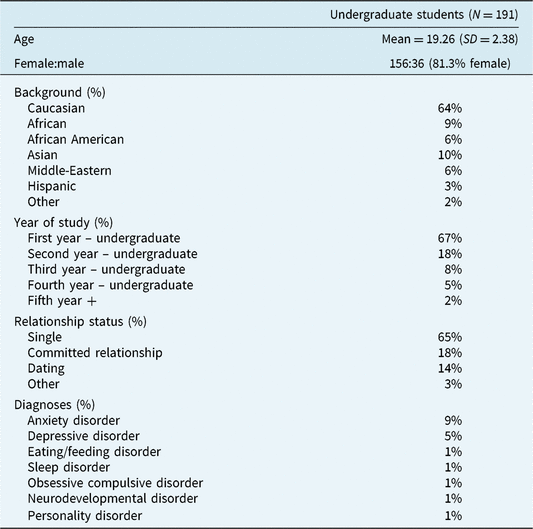
Participants were 314 undergraduate students from the University of Ottawa recruited through the University’s psychology participant pool. Participants were excluded if they completed less than 20% of the survey (n = 55), or described intrusive images that were unrelated to social events (e.g. trauma-related) or were too vague to determine if they were related to social events (n = 68). The final sample consisted of 191 participants (81.3% female, mean age = 19.26 years, SD = 2.38). See Table 1 for additional characteristics.
Participant characteristics

Measures
Intrusive Imagery
Frequency
Participants rated how frequently in the past month they experienced the specific intrusive social image they reported from 0 (never) to 7 (several times a day).
Relation to a memory
Participants indicated if the intrusive social image was of a specific memory, was related but different from the specific memory, or was unrelated to a specific memory.
Onset of image
Participants indicated how long they had experienced this specific intrusive social image (since childhood, for several years, for several months, in the past month, in the past week, or if this was the first time).
Triggers
Participants indicated when these images were most likely to occur (randomly, right before entering a social situation, or right after they exit a social situation).
Duration
Participants indicated how long the intrusive image typically lasts (a few seconds to more than a few hours).
Interference
Participants rated how much the intrusive image interfered with their ability to carry on with their day-to-day activities on a scale from 0 (does not interfere at all) to 10 (cannot carry on at all with my daily activities).
Memory Experiences Questionnaire-Short Form (MEQ-SF; Luchetti and Sutin, Reference Luchetti and Sutin2016)
The MEQ-SF is a 31-item self-report questionnaire assessing a specific memory along 10 dimensions: vividness (e.g. visual clarity of the memory), coherence (e.g. the extent to which the memory involves a logical story rather than fragments), accessibility (e.g. how easily the memory is retrieved), sensory detail (e.g. the extent to which sensory details are re-experienced during retrieval), emotional intensity, visual perspective (e.g. the extent to which the individual views the memory from a field versus observer perspective), time perspective (e.g. perceived clarity of when the memory took place), sharing (e.g. the extent to which individuals shares the memories with others), distancing (e.g. the extent to which the individual can psychologically distance him/herself from the remembered experience), and valence (e.g. the extent to which the memory is perceived as either positive or negative). For each question participants rated the item on a Likert scale from 1 (strongly disagree) to 5 (strongly agree). The internal consistency of the sub-scales in the current sample ranged from .73 to .88. The subscales of accessibility (α = .30) and sensory detail (α = .38) had unacceptably low internal consistency and were excluded from analyses.
Social Interaction Anxiety Scale (SIAS) and the Social Phobia Scale (SPS; Mattick and Clarke, Reference Mattick and Clarke1998)
These each contain 20 items asking about anxiety in social situations or fear of scrutiny by others, respectively. Both instruments use a Likert-type scale from 0 (not at all characteristic or true of me) to 4 (extremely characteristic or true of me). The SPS and SIAS exhibit high convergent validity and excellent reliability (Brown et al., Reference Brown, Turovsky, Heimberg, Juster, Brown and Barlow1997; Heimberg et al., Reference Heimberg, Mueller, Holt, Hope and Liebowitz1992), and have been used together to assess symptoms of social anxiety (Peters, Reference Peters2000). Internal consistency was .94 for the SIAS and .95 for the SPS in this sample.
Depression Anxiety Stress Scale-21 (DASS-21; Lovibond SH and Lovibond PF, Reference Lovibond and Lovibond1995)
The DASS-21 is a 21-item self-report instrument assessing symptoms depression (7 items), anxiety (7 items), and stress (7 items) over the past week using a Likert-type scale from 0 (did not apply to me at all) to 3 (applied to me very much or most of the time). The DASS-21 sub-scales have demonstrated high construct validity (Henry and Crawford, Reference Henry and Crawford2005; Lovibond PF and Lovibond SH, Reference Lovibond and Lovibond1995), and strong internal consistency and convergent validity (Ng et al., Reference Ng, Trauer, Dodd, Callaly, Campbell and Berk2007; Sinclair et al., Reference Sinclair, Siefert, Slavin-Mulford, Stein, Renna and Blais2011). The DASS-21 was used to control for symptoms of depression. The internal consistency in this sample was .87 for the depression subscale.
Procedure
Participants were invited to participate in the online survey, hosted via Qualtrics (2016). After providing informed consent, sociodemographic information was completed, and the following definition of intrusive images was provided:
Intrusive images are images that can be experienced via involuntary thoughts or pictures in your mind, flashbacks, or dreams about a real or imagined event. They can either be positive or negative and are often accompanied by feeling emotions associated with the image (e.g. a sense of immediate impending threat or a sense of immediate happiness). Typically, they are experienced as intensely as if the event was actually occurring. Intrusions can be repetitive and uncontrollable. Intrusive memories can be short or long in duration, and result in physiological reactions, such as changes in heart rate or breathing.
Participants were asked to indicate if they ever experienced such intrusive social images. If they did report experiencing intrusive images, they were asked to describe one of their intrusive images in a social context, then completed the intrusive image questions and the MEQ-SF with regard to that image. All participants (i.e. those who did and did not report intrusive images) then completed the SIAS, SPS and DASS-21.
Data analysis
Missing data were handled using expectation maximization. There were less than 2% missing cases for each questionnaire. Quantitative data were analysed using IBM SPSS Statistics, version 24 (IBM Corp., 2016). A combined cut-off score of ≥34 on the SIAS and ≥24 on the SPS has yielded optimal specificity and sensitivity in identifying individuals with SAD (Heimberg et al., Reference Heimberg, Mueller, Holt, Hope and Liebowitz1992). This combined score was used to classify participants into high and low social anxiety groups (e.g. 35 on SIAS and 23 on SPS = LSA).
For individuals who reported experiencing intrusive social images, chi-square for categorical data and Kendall’s tau for ranked data were used to examine differences between the HSA and LSA groups on intrusive memory items. t-tests were used to examine differences in phenomenological characteristics of intrusive social images reported on the MEQ-SF sub-scales (dependent variables) between the HSA and LSA groups. A Bonferroni correction of .006 was used to correct for multiple comparisons based on the eight valid MEQ scales.
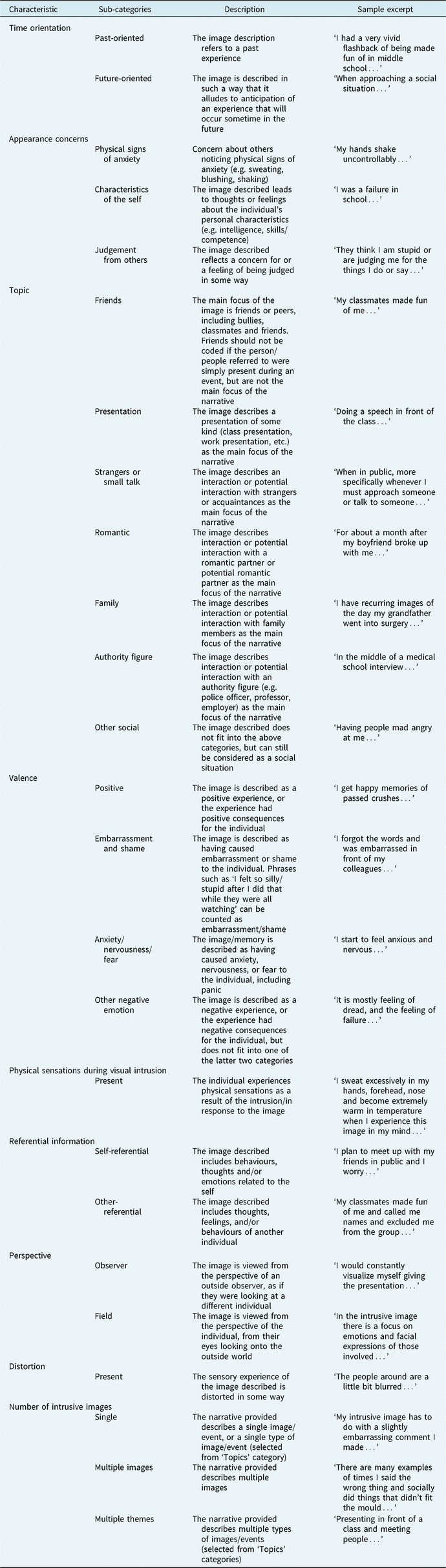
Content analysis of narrative descriptions was performed using QDA Miner (QDA, 2011). Braun and Clark’s (Reference Braun and Clarke2006) six-stage approach was combined with a coding reliability procedure (described below) to identify common characteristics of intrusive images. A coding structure for common characteristics was developed by the authors and used to assess coding reliability. Each characteristic or theme contained a series of sub-categories or codes, a description of the codes, and a sample excerpt exemplifying each code (see Table 2). For example, the characteristic ‘Perspective’ was divided into two sub-categories, ‘Observer’ and ‘Field’, described respectively as ‘the image is viewed from the perspective of an outside observer, as if they were looking at a different individual’ and ‘the image is viewed from the perspective of the individual, from their eyes looking onto the outside world’. Two independent raters coded a random sample of 30% of the narratives to assess agreement, and then met to discuss codes that were inconsistently applied. This process was repeated until coding agreement reached a high level of agreement [i.e. Krippendorf’s alpha, a measure of coding agreement similar to Cohen’s kappa, reached > .80 (Krippendorff, Reference Krippendorff2004)].
Coding structure applied in narrative analysis of intrusive images

A dataset was then extracted from QDA Miner whereby each code represented a dichotomous variable, indicating the presence or absence of a given code for each narrative. For each coding category, the proportion of cases coded for each characteristic were compared between participants with high and low social anxiety using z-tests where possible.
For all analyses, the appropriate effect sizes were calculated and interpreted using guidelines put forth by Ferguson (Reference Ferguson2009) (i.e. η2 p : RMPEFootnote 1 = .04; moderate effect = .25; strong effect = .64; Cramer’s V and r: RMPE = .20; moderate effect = .50; strong effect = .80; Cohen’s d: RMPE = .41; moderate effect = 1.15; strong effect = 2.70).
Results
Social anxiety and depression
On average, participants scored 23.44 (SD = 17.25, min = 0, max = 77) on the SPS, and 33.51 (SD = 16.42, min = 2, max = 72) on the SIAS. Thirty-nine per cent (n = 74) were classified as HSA, and 61% (n = 117) were classified as LSA based upon recommended combined cut-offs of the SIAS and SPS (Heimberg et al., Reference Heimberg, Mueller, Holt, Hope and Liebowitz1992). As expected, HSA participants scored significantly higher (all p < .001) than LSA participants on the SIAS (mean = 49.22, SD = 8.92 vs mean = 23.57, SD = 11.59), SPS (mean = 41.16, SD = 11.82 vs mean = 12.23, SD = 8.50), and DASS-21 depression (mean = 14.22, SD = 9.39 vs mean = 5.76, SD = 6.94).
Intrusive social images
Occurrence
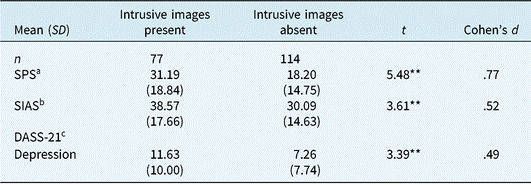
Forty per cent (n = 77) of participants reported experiencing intrusive social images. Participants reporting intrusive social images scored significantly higher on the SPS, the SIAS and DASS-21 depression (see Table 3). Differences on the SPS, F (2,189) = 17.72, p < .001, η2 p = .09, and SIAS, F (2,189) = 4.21, p = .04, η2 p = .02 remained significant after controlling for depression. Notably, both means of the SIAS and SPS in the intrusive image group were higher than the recommended clinical cut-offs, whereas they were below the clinical cut-off scores in the no intrusive image group. Among HSA participants, 57% (n = 42) reported intrusive images, whereas only 30% (n = 35) of LSA participants reported intrusive images, χ 22 = 13.57, p < 0.001, Cramer’s V = .27
Scores on symptom measures for participants with and without intrusive images

**p < .001; aSocial Phobia Scale (Mattick and Clarke, Reference Mattick and Clarke1998); bSocial Interaction Anxiety Scale (Mattick and Clarke, Reference Mattick and Clarke1998); cDepression, Anxiety, Stress Scale – 21 item version (Lovibond SH and Lovibond PF, Reference Lovibond and Lovibond1995).
Temporal characteristics
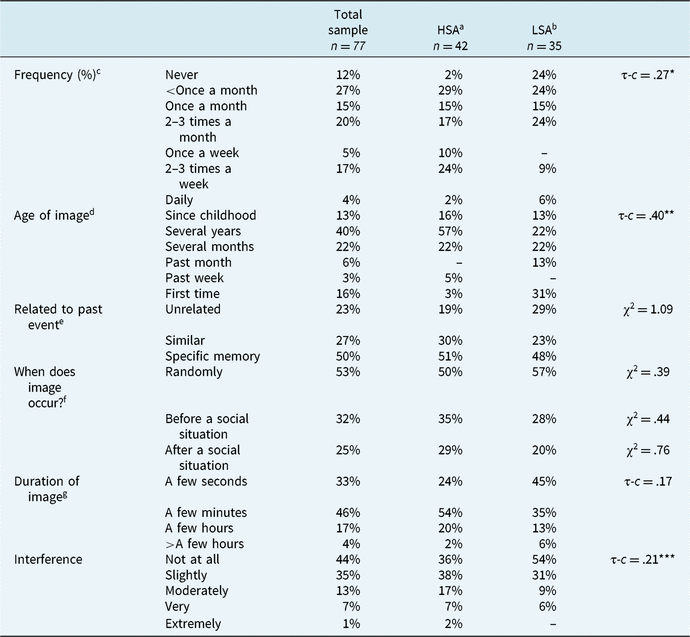
Only results from participants who reported intrusive images are included (HSA, n = 42; LSA, n = 35); see Table 4
Characteristics of images in participants experiencing intrusive social images

*p < .05; **p < .01, ***p < .10; aHSA, high social anxiety; bLSA, low social anxiety; cone missing case in the HSA group, and one missing case in the LSA group; dfive missing cases in the HSA group, and three missing cases in the LSA group; efive missing cases in the HSA group, and four missing cases in the LSA group; ffor this question participants could select any that applied to them, thus percentages add up to more than 100%; gone missing case in the HSA group, and four missing cases in the LSA group.
Frequency
Intrusive images occurred on average one to three times in the past month. HSA participants reported more frequent intrusions than LSA participants, τ-c = .27, p = .03, Cramer’s V = .43.
Onset
Most participants reported that the image has been occurring for at least several months. Intrusive images were reported as older in the HSA compared with LSA group, τ-c = .40, p < .01, Cramer’s V = .54.
Relation to past social events
Intrusive images were often related or similar to a past social event. No differences were observed between HSA and LSA participants, χ2 = 1.09, p = .58, Cramer’s V = .13.
When the image occurs
Most participants indicated the images occurred randomly, although a sizable minority indicated they occurred before or after a social situation. There were no differences between HSA and LSA participants regarding when the images occurred, χ2 < .76, p > .05, Cramer’s V < .19..
We also examined the number of contexts in which participants reported experiencing intrusive images. Seventy-two per cent reported experiencing intrusive social images in one context, 13% in two contexts, 4% in all three possible contexts, and 10% declined to answer. There was no significant difference between HSA and LSA participants regarding the number of contexts, τ c = .10, p = .36, Cramer’s V = .36.
Duration
Intrusive images reportedly lasted from a few seconds to a few minutes. There was no significant difference between HSA and LSA participants regarding the duration of the intrusion, τ-c = .17, p = .18, Cramer’s V = .26.
Interference
Most participants reported that intrusions caused no or slight interference. HSA participants reported marginally more interference from intrusive social images compared with LSA participants, τ-c = .21, p = .07, Cramer’s V = .22.
Phenomenological characteristics
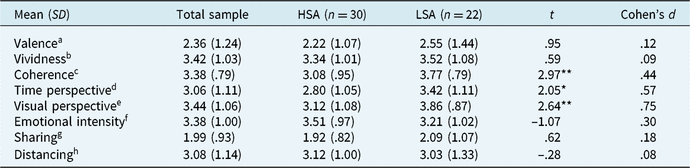
We next examined the phenomenological characteristics of intrusive images related to a memory using the eight MEQ-SF sub-scales with acceptable reliability. As the MEQ-SF is designed to assess characteristics of autobiographical memories, only participants who reported that the intrusive social image was related to a memory of a social event were included in these analyses (HSA n = 30; LSA n = 22; see Table 5). For all eight sub-scales of the MEQ-SF, scores were in the middle range, with the exception of sharing. Participants indicated that they were unlikely to share this memory with others.
Average ratings for subscales of the memory experiences questionnaire-short form

**p < .01, * p < .05. aHigher scores indicate a more positive valence (min: 1; max: 5); bhigher scores indicate greater vividness (min: 1; max: 5); chigher scores indicate greater coherence (min: 1; max: 5); dhigher scores indicate greater perceived clarity of when the event occurred (min: 1; max: 5); ehigher scores indicate greater perceptions from a field perspective (‘through one’s own eyes’) (min: 1; max: 5); fhigher scores indicate greater emotional intensity (min: 1; max: 5); ghigher scores indicate more sharing of the image with others (min: 1; max: 5); hhigher scores indicate more distancing from the image (min: 1; max: 5).
Using the Bonferroni correction of p < .006, independent t-tests for each subscale revealed no significant differences between HSA and LSA participants. The sub-scales of coherence and visual perspective did approach the corrected p-value. HSA participants reported less coherent memories and reported that their memory was more often from an observer perspective, whereas LSA participants reported more often experiencing their images from a field perspective. After controlling for symptoms of depression, the differences between HSA and LSA participants for coherence, F (1,48) = 3.69, p = .05, η2 p = .07, and visual perspective, F (1,48) = 6.03, p = .02, η2 p = .11, remained significant at traditional levels of significance, but not with the Bonferroni correction.
Content analysis
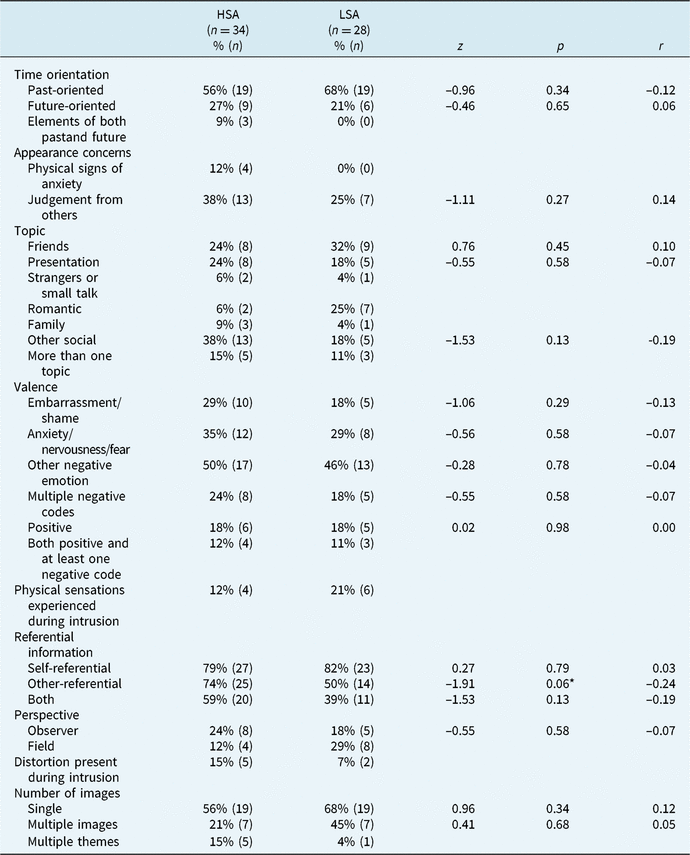
Fifteen participants were excluded from the narrative analysis because they failed to provide a description of an intrusive image, despite reporting that they did experience intrusive social images. Table 6 provides a summary of the content analysis. The median number of words written was 42 (range 6–356), and the mean number of codes per participant was 8.7 (SD = 4.2, range 2–26). There were few differences between the narratives of HSA and LSA participants. Most narratives were about past events and covered a range of topics, but often referenced a single event. Most were negative in valence, but nearly 20% contained reference to positive emotions. Interestingly, a larger proportion of LSA than HSA narratives (21% compared with 12%) contained reference to experiencing physical sensations of anxiety while recalling the image. Furthermore, a higher proportion of LSA narratives (25 versus 6%) were about romantic relationships. Both HSA and LSA narratives referenced concerns about judgement from others, however no LSA narratives contained reference to worries that other people would notice anxiety symptoms. Self-referential information was common in HSA and LSA narratives, but a larger proportion of HSA narratives (74 versus 50%) contained reference to other-referential information (e.g. what others thought, did, or said), an effect that approached statistical significance. Sensory distortion of the intrusive image was twice as common in HSA compared with LSA narratives. Finally, more LSA than HSA narratives were coded as being from a field perspective (29 versus 12%). Although non-significant, the opposite pattern was observed for coding of the observer perspective were more HSA than LSA narratives (24 versus 18%) were from an observer perspective. Notably, none of the narratives contained elements of both observer and field perspectives.
Proportion of occurrence of intrusive social images characteristics in low and high social anxiety

*p < .10; for comparisons with less than five participants per group, z-tests could not be performed.
Discussion
This study examined the relationship between the characteristics of intrusive social images and social anxiety. Intrusive social images were common, with approximately 40% of the sample reporting an intrusive image. They were often related to past experiences, occurred randomly, and were brief.
As predicted, participants who reported intrusive social images also reported higher distress on measures of social anxiety compared with participants who did not experience intrusive images. The average score on both social anxiety measures was above the recommended clinical cut-offs among participants reporting intrusive social images, and was below these cut-offs among participants who did not report experiencing such images. The frequency of intrusive social images was higher among HSA compared with LSA individuals, among whom these images were older and caused marginally more interference, although these effects were small.
There were few phenomenological differences in intrusive images between HSA and LSA participants. On the MEQ-SF, HSA participants scored lower on the visual perspective subscale than LSA participants. This indicated that intrusive social images for LSA participants occurred from more of a field perspective. This difference, however, was not significant with the Bonferroni correction and the effect size was small. This is consistent with results of the content analysis, where slightly more HSA than LSA participants provided descriptions from an observer perspective, and twice as many LSA compared with HSA participants described images from a field perspective. On the MEQ-SF, a small difference also emerged regarding the coherence of participants’ intrusive images (e.g. ‘The order of events in the memory is clear’), with HSA participants reporting less coherent intrusive images compared with LSA participants, although again this was not significant after the Bonferroni correction and the effect was small.
Similarities across social anxiety groups also emerged in the qualitative analysis. HSA individuals were just as likely to describe positive emotions in their narrative as LSA individuals, and LSA individuals were just as likely to include words related to anxiety and embarrassment as HSA individuals. Narratives from both groups included spontaneous comments concerning experiencing physiological signs of anxiety while recalling the intrusive image, suggesting that these images can be distressing for all individuals, regardless of the level of social anxiety.
There were a few additional differences that warrant mention. LSA participants were more likely to describe intrusive images related to romantic relationships compared with HSA participants. Additionally, although both groups described concerns about being judged by others, only HSA participants described concerns about other people noticing their anxiety. Self-referent information was present in the narratives of both groups. However, a higher proportion of narratives in the HSA group contained other-referent information, an effect that approached statistical significance at the conventional level and yielded a small effect size (Ferguson, Reference Ferguson2009). Furthermore, although statistically insignificant, a higher proportion of narratives in the HSA group contained both self- and other-referential information, with an effect size that approached small.
How do these results inform our understanding of the role of imagery in social anxiety? First, high levels of social anxiety appear to be related to a greater likelihood of experiencing intrusive social images, as well more frequent intrusions that cause greater distress compared with low levels of social anxiety. This is consistent with other studies demonstrating that intrusive images are more frequent and distressing in high socially anxious populations (Hackmann et al., Reference Hackmann, Surawy and Clark1998, Reference Hackmann, Clark and McManus2000; Moscovitch et al., Reference Moscovitch, Gavric, Merrifield, Bielak and Moscovitch2011). However, previous research (Moscovitch et al., Reference Moscovitch, Gavric, Merrifield, Bielak and Moscovitch2011) and the current study suggest that the presence of intrusive images per se are common across all levels of social anxiety.
Clark and Wells (Reference Clark, Wells, Heimberg, Liebowitz, Hope and Schneier1995) suggested that these images are likely to arise and affect symptoms of anxiety when anticipating a social situation, and also following a social situation. Our results indicate that these images were most often perceived as occurring randomly in both HSA and LSA participants.
Furthermore, we were unable to identify any strong differences regarding vividness, emotional intensity, or other phenomenological characteristics of the intrusive social images between HSA and LSA participants. One phenomenological characteristic that may (though non-significantly) differentiate images of HSA and LSA participants was visual perspective. Consistent with previous studies (Coles et al., Reference Coles, Turk, Heimberg and Fresco2001, Reference Coles, Turk and Heimberg2002; D’Argembeau et al., Reference D’Argembeau, Van der Linden, d’Acremont and Mayer2006; Hackmann et al., Reference Hackmann, Surawy and Clark1998; Wells and Papageorgiou, Reference Wells and Papageorgiou1999), results from comparisons on the MEQ-SF demonstrated that HSA individuals reported experiencing their intrusive images through an observer perspective marginally more often than LSA individuals, who experienced intrusive images more often from a field perspective. However, this difference was not statistically apparent in the content analysis, possibly due to the low number of exemplars in each category for the context analysis. Consistent with this finding, research demonstrates that taking an observer perspective is associated with more negative thoughts, worse self-evaluations, more safety behaviours, and more emotionally charged imagery (Holmes and Mathews, Reference Holmes and Mathews2010; Kuyken and Moulds, Reference Kuyken and Moulds2009; Spurr and Stopa, Reference Spurr and Stopa2003).
The discrepancy between qualitative and quantitative findings with regard to the observer perspective could be due to differences in the way the qualitative and quantitative data were analysed. First, as not all narratives included elements that could be coded as from an observer or field perspective, the content analysis was underpowered. Additionally, observer perspective as measured by the MEQ-SF was examined only for images that were related to a specific memory, whereas the qualitative analysis included all intrusive social images, nearly 30% of which were reported as being unrelated to a specific memory. Studies examining observer perspective in social anxiety have either prompted participants to take a particular perspective in producing imagery (e.g. Spurr and Stopa), or were asked to recall autobiographical memories of a specific event (e.g. D’Argembeau et al., Reference D’Argembeau, Van der Linden, d’Acremont and Mayer2006; Hackmann et al., Reference Hackmann, Clark and McManus2000; Moscovitch et al., Reference Moscovitch, Gavric, Merrifield, Bielak and Moscovitch2011). Furthermore, previous studies demonstrating high frequencies of observer perspective imagery were conducted among individuals diagnosed with SAD (e.g. Hackmann et al., Reference Hackmann, Surawy and Clark1998, Reference Hackmann, Clark and McManus2000; Wells and Papageorgiou, Reference Wells and Papageorgiou1999), whereas results in less symptomatic individuals show more modest rates of observer perspective (Moscovitch et al., Reference Moscovitch, Gavric, Merrifield, Bielak and Moscovitch2011; Homer et al., Reference Homer, Deeprose and Andrade2016; Homer and Deeprose, Reference Homer and Deeprose2017). Our results therefore suggest that the role of visual perspective in intrusive social imagery may be more nuanced than previously thought. Future research should more carefully examine the role of visual perspective of images related and unrelated to memories in larger samples that include not only high and low socially anxious participants but also those with SAD.
Several similarities in the characteristics of intrusive images between HSA and LSA participants were apparent. Both included images about performance situations and interactions with strangers or small talk, themes commonly associated with social anxiety. Both contained reference to feelings of embarrassment, and concern about judgement from others. However, two notable differences did emerge. First, 12% of the HSA narratives contained reference to concern of others noticing physical signs of anxiety, whereas none of the LSA narratives contained this feature. This focus on physical signs of anxiety is consistent with Clark and Wells’ (Reference Clark, Wells, Heimberg, Liebowitz, Hope and Schneier1995) model suggesting that attention towards the self, including signs of anxiety, is a key component of social anxiety, and with experimental studies demonstrating enhanced attention towards and memory for internal cues of anxiety (Ashbaugh and Radomsky, Reference Ashbaugh and Radomsky2009, Reference Ashbaugh and Radomsky2011; Mansell et al., Reference Mansell, Clark and Ehlers2003; Pineles and Mineka, Reference Pineles and Mineka2005).
Secondly, although narratives from both social anxiety groups contained self-referential information (i.e. reference to thoughts, emotions and behaviours of the self), a larger proportion of HSA narratives contained other-referential information (i.e. reference to thoughts, emotions and behaviours of others) – an effect that approached statistical significance. Intrusive images in HSA individuals may not only reflect fear of how they might appear to others, but also fear about how others will or have responded to them. This concurs with Moscovitch’s (Reference Moscovitch2009) assertion that the core fear in social anxiety is having characteristics of the self that are deficient according to perceived expectations of others.
The above point speaks to the need to examine how patterns in phenomenological characteristics of intrusive images may relate to the mechanisms believed to maintain social anxiety and the distress and interference that result from intrusive social images in social anxiety. For instance, it has been consistently found that imagery experienced from the observer perspective has been linked to clinically relevant phenomena, but it is unclear if this effect is observed more often when intrusions also contain features such as self- and other-relevant information. Our results show that HSA individuals included more content related to the thoughts, actions and beliefs of others in their narratives, implying that attention to interpretations and judgements of others, a core feature of social anxiety, is also an important feature of imagery related to social anxiety. It may also be true that what distinguishes HSA from LSA participants is the degree to which both self- and other-relevant information is featured in the individuals’ intrusive images. An example from one participant in this study illustrates how both types information can be present in an intrusive image:
People staring at me while I blabber on and on about something, but they don’t seem to relate to what I’m saying therefore I keep talking as it progressively gets more awkward. Eventually my constant blubbering means nothing even to me and I start shaking.
Unfortunately due to the small number of participants classified as taking an observer versus field perspective we were unable to examine the relationship between the perspective taken and the distress/interference caused by the image. Future studies are needed to assess how patterns in the different phenomenological features of intrusive imagery may co-occur and relate to psychopathology.
Our findings, particularly concerning the likelihood of having and frequency of intrusive social imagery in high social anxiety, supports the notion that imagery-based interventions may be helpful in the treatment of SAD. Several small studies have found that imagery rescripting is effective in reducing social anxiety (Frets et al., Reference Frets, Kevenaar and van der Heiden2014; Nilsson et al., Reference Nilsson, Lundh and Viborg2012; Wild et al., Reference Wild, Hackmann and Clark2008). Teaching clients to shift from an observer to a field perspective and reducing the degree to which images focus on perceived reactions of others may be particularly useful targets in treatment.
There are a few limitations of the current study that warrant mention. First, participants completed the study online. As a result, it was not possible to control whether participants held their intrusive image in mind as they completed the MEQ-SF, nor the length of the narrative provided by participants, which were brief. Statistical comparisons were not possible for many of the categories in the content analysis due to small cell sizes. Future studies should have participants complete longer descriptions of the intrusive images to enhance the quality of information obtained from qualitative analysis. Second, participants were not formally diagnosed with social anxiety and it is possible that the characteristics of intrusive social images differ among individuals with clinical levels of social anxiety. Nonetheless, this is one of the first studies to compare intrusive social images between individuals with high and low social anxiety using both quantitative and qualitative methods.
Intrusive social imagery is similar in content and quality across individuals with high and low social anxiety, both with respect to how the person experiences those images and how independent coders rate the content of those images. What differentiates HSA and LSA individuals is the likelihood and frequency of intrusions, and the distress these cause. Visual perspective and concern of others noticing anxiety symptoms may also differentiate images experienced in HSA and LSA individuals. These results are consistent with models of social anxiety that emphasize that the core fear of social anxiety is that the individual will act in a way that is inconsistent with the expectations of others (Moscovitch, Reference Moscovitch2009). This finding supports the notion that imagery rescripting may be beneficial in the treatment of social anxiety.
Acknowledgements
The authors would like to thank Emilie Bellehumeur for her help in the content analysis of the narratives.
Conflicts of interest
The authors declare no conflicts of interest.
Ethical statement
This study was approved by the University of Ottawa Health Sciences REB (certificate: H11-15-18). All study authors abided by the Ethical Principles of Psychologists and Code of Conduct as set out by the APA.
Financial support
This research received no specific grant from any funding agency, commercial or not-for-profit sectors.



Comments
No Comments have been published for this article.