Childhood irritability, characterized by low frustration tolerance and temper outbursts, is common, impairing and a frequent reason for psychiatric referral (Brotman et al., Reference Brotman, Kircanski and Leibenluft2017). Longitudinal studies consistently support links between youth irritability and later internalizing disorders, particularly depression and anxiety, and suicide in later childhood and adulthood (Orri et al., Reference Orri, Galera, Turecki, Boivin, Tremblay, Geoffroy and Côté2019; Stringaris et al., Reference Stringaris, Cohen, Pine and Leibenluft2009; Vidal-Ribas et al., Reference Vidal-Ribas, Brotman, Valdivieso, Leibenluft and Stringaris2016). Additionally, studies have found that irritability predates the emergence of externalizing problems and the co-occurrence of internalizing and externalizing disorders in later childhood and adolescence (Eyre et al., Reference Eyre, Hughes, Thapar, Leibenluft, Stringaris, Davey Smith, Stergiakouli, Collishaw and Thapar2019; Hawes et al., Reference Hawes, Carlson, Finsaas, Olino, Seely and Klein2019; Humphreys et al., Reference Humphreys, Schouboe, Kircanski, Leibenluft, Stringaris and Gotlib2019) and in young children (Dougherty et al., Reference Dougherty, Smith, Bufferd, Stringaris, Leibenluft, Carlson and Klein2013; Wakschlag et al., Reference Wakschlag, Estabrook, Petitclerc, Henry, Burns, Perlman, Voss, Pine, Leibenluft and Briggs-Gowan2015). These findings suggest that irritability may be a nonspecific risk factor for multiple psychiatric problems (Beauchaine & Tackett, Reference Beauchaine and Tackett2020).
Importantly, prior longitudinal work has largely relied on between-person approaches that compare average levels of irritability across individuals in a sample. However, it is unknown whether within-person effects are also important and exhibit similar relations to other symptom dimensions as between-person effects. Parsing within-person effects would reveal whether a child’s increase in irritability relative their own mean would lead to an increase in other symptoms. In some ways, within-person effects are more clinically useful than between-person effects, as clinicians are generally concerned with change in individual patient’s symptoms over time (e.g., detecting and predicting worsening symptoms, identifying and making use of factors associated with improvement). These different sources of variability are independent of one another and within-person effects may yield distinct, more specific relations between irritability and later psychopathology (Curran & Bauer, Reference Curran and Bauer2011).
Associations between youth irritability and psychiatric symptoms
In terms of concurrent associations, irritability consistently co-occurs with depression, anxiety, oppositional defiant disorder (ODD), and attention-deficit/ hyperactivity disorder (ADHD; Brotman et al., Reference Brotman, Kircanski and Leibenluft2017). Prospectively, robust evidence supports irritability as a predictor of later internalizing disorders, yet the literature has not reached consensus on whether irritability is a meaningful risk factor for later ODD or ADHD after accounting for item-overlap and prior symptoms. According to a recent meta-analysis, children with high levels of irritability incur an almost two-fold risk of developing later internalizing psychopathology (Vidal-Ribas et al., Reference Vidal-Ribas, Brotman, Valdivieso, Leibenluft and Stringaris2016). While this meta-analysis also found that children with high levels of irritability are at increased risk for ODD, the authors noted shared item overlap may explain this link. Furthermore, there was minimal support for prospective links between irritability and later ADHD (Vidal-Ribas et al., Reference Vidal-Ribas, Brotman, Valdivieso, Leibenluft and Stringaris2016). Similarly, we previously reported in the current sample that chronic irritability at age 3 predicted ADHD at age 6 years old, but the association was no longer significant after adjusting for a prior diagnosis of ADHD (Dougherty et al. Reference Dougherty, Smith, Bufferd, Stringaris, Leibenluft, Carlson and Klein2013). Thus, irritability may not be a unique predictor of later ADHD after accounting prior ADHD and co-occurring symptoms.
Despite prior work on associations between irritability and psychiatric symptoms, little work has examined unique associations, controlling for co-occurring psychopathology, from early childhood through adolescence. This is important because irritability is a symptom of multiple disorders, including depression, ODD, and anxiety. Therefore, it is necessary to separate irritable from non-irritable symptoms to determine their unique predictive validity over and above non-irritable symptoms, on later psychopathology; otherwise, associations could merely reflect overlap with co-occurring internalizing and externalizing problems. Furthermore, little work has examined the directionality of these associations. Prior findings show that irritability in middle childhood predicts later internalizing symptoms in adolescence, but not vice versa, whereas irritability and internalizing problems demonstrate bidirectional associations in later adolescence and early adulthood (Savage et al., Reference Savage, Verhulst, Copeland, Althoff, Lichtenstein and Roberson-Nay2015). A bidirectional association has also been found between irritability and externalizing symptoms at ages 3 and 12 years, controlling for age 3 internalizing symptoms, but only in the context of blunted diurnal cortisol (Kessel et al., Reference Kessel, Frost, Goldstein, Black, Dougherty, Carlson and Klein2019). More work is needed examining the directionality of associations between irritability and non-irritable symptoms of internalizing and externalizing symptoms throughout childhood and adolescence to identify unique and shared pathways to psychological dysfunction.
Between- and within-person effects
Between- and within-person effects provide complementary, distinct, and sometimes opposite information (Curran & Bauer, Reference Curran and Bauer2011; Wang & Maxwell, Reference Wang and Maxwell2015). Between-person variability reflects individual differences in irritability and psychopathology between individuals. In contrast, within-person variability captures how irritability and other psychopathology fluctuate within the same individual over time (Curran & Bauer, Reference Curran and Bauer2011). Despite prior models largely relying on between-person data, a fundamental question in irritability and developmental psychopathology research more generally, is a within-person question: when a child experiences an increase in irritability, are they more likely to experience an increase in other symptoms? This question can only be answered with a within-person design. For example, a child may exhibit high levels of irritability and depressive symptoms relative to their peers (between-person effect); however, we cannot infer from this between-person effect that when children experience irritability, they are more likely to experience depression symptoms (within-person effect). By examining change in repeated assessments over time, within-person models can test this within-person hypothesis, which may elucidate transient factors that may be responsible for changes in the severity of psychiatric symptoms. Thus, parsing within-person effects could yield unique information about how the child’s irritability compared to their typical functioning contributes to developmental pathways of psychopathology.
Prior work examining within-person change in irritability have used latent class analyses to identify distinct trajectories of irritability across childhood (Ezpeleta et al., Reference Ezpeleta, Granero, de la Osa, Trepat and Domènech2016; Forte et al., Reference Forte, Orri, Turecki, Galera, Pompili, Boivin, Tremblay, Côté and Geoffroy2021; Galera et al., Reference Galera, Orri, Vergunst, Melchior, der Waerden, Bouvard, Collet, Boivin, Tremblay and Côté2021; Orri et al., Reference Orri, Galera, Turecki, Forte, Renaud, Boivin, Tremblay, Côté and Geoffroy2018, Reference Orri, Galera, Turecki, Boivin, Tremblay, Geoffroy and Côté2019; Pagliaccio et al., Reference Pagliaccio, Pine, Barch, Luby and Leibenluft2018; Wiggins et al., Reference Wiggins, Mitchell, Stringaris and Leibenluft2014). These studies linked different developmental trajectories of irritability (increasing, declining, and stable) to mental health outcomes in childhood, adolescence, and early adulthood (Caprara et al., Reference Caprara, Paciello, Gerbino and Cugini2007; Ezpeleta et al., Reference Ezpeleta, Granero, de la Osa, Trepat and Domènech2016; Galera et al., Reference Galera, Orri, Vergunst, Melchior, der Waerden, Bouvard, Collet, Boivin, Tremblay and Côté2021; Orri et al., Reference Orri, Galera, Turecki, Forte, Renaud, Boivin, Tremblay, Côté and Geoffroy2018, Reference Orri, Galera, Turecki, Boivin, Tremblay, Geoffroy and Côté2019; Pagliaccio et al., Reference Pagliaccio, Pine, Barch, Luby and Leibenluft2018). While these prior studies focused on classes of irritability trajectories over time, no study, to our knowledge, has examined whether within-person change predicts within-person change in other symptoms over time. This fine-grained approach captures the dynamic unfolding of irritability alongside other symptoms over time. Furthermore, no work has parsed both within- and between-person levels of irritability and examined their unique effects on later psychiatric symptoms across childhood and adolescence.
Current study
We filled this important gap by examining the effectsFootnote 1 of time-invariant between-person differences and time-varying within-person changes in childhood irritability on depressive, anxiety, ADHD, and defiance symptoms from early childhood through adolescence. We examined these aims in a community sample of 605 children from the Stonybrook Temperament Study (Klein & Finsaas, Reference Klein and Finsaas2017). At ages 3, 6, 9, 12, and 15 years old, mothers completed the parent-report Child Behavior Checklist (CBCL) which yielded non-overlapping measures of irritability, depression, anxiety, ADHD, and defiance (Achenbach & Rescorla Reference Achenbach and Rescorla2001). We examined 1) concurrent between- and within-person associations between irritability and depressive, anxiety, ADHD, and defiance symptoms, adjusting for co-occurring symptoms across five waves and 2) prospective bidirectional within-person associations between childhood irritability and internalizing and externalizing symptoms, adjusting for prior symptoms.
We hypothesized that higher levels of between-person and greater variability in within-person irritability would be concurrently associated with greater depressive, anxiety, ADHD, and defiance symptoms and that greater within-person irritability would predict greater next wave depression, anxiety, and defiance, controlling for prior levels of internalizing and externalizing symptoms and these effects may be bidirectional, though prior literature is sparse. We did not expect within-person irritability to predict next wave ADHD, given findings that prior ADHD accounts for longitudinal links between irritability and later ADHD (Dougherty et al. Reference Dougherty, Smith, Bufferd, Stringaris, Leibenluft, Carlson and Klein2013; Vidal-Ribas et al. Reference Vidal-Ribas, Brotman, Valdivieso, Leibenluft and Stringaris2016).
We also explored the moderating roles of child sex and parental depressive disorders on associations between irritability (between- and within-person effects) and internalizing and externalizing symptoms. Some findings support sex differences in associations between irritability and internalizing and externalizing problems at different developmental periods. In childhood, males showed stronger co-occurring trajectories of irritability and internalizing symptoms than females (Orri et al., Reference Orri, Galera, Turecki, Forte, Renaud, Boivin, Tremblay, Côté and Geoffroy2018). In adolescence, females showed stronger concurrent associations between irritability and internalizing symptoms than males, but similar concurrent and longitudinal associations between irritability and externalizing symptoms (Humphreys et al., Reference Humphreys, Schouboe, Kircanski, Leibenluft, Stringaris and Gotlib2019). In addition, prior findings in the current sample demonstrated sex-specific pathways at an earlier assessment: chronic irritability in early childhood predicted anxiety disorders for males only and ADHD for females only at age 9 (Dougherty et al., Reference Dougherty, Smith, Bufferd, Kessel, Carlson and Klein2015). Given limited prior work, we did not have specific hypotheses about the moderation of sex.
A history of parental depression has also been linked to childhood irritability in the current sample (Dougherty et al., Reference Dougherty, Smith, Bufferd, Stringaris, Leibenluft, Carlson and Klein2013) and other samples (Krieger et al., Reference Krieger, Polanczyk, Goodman, Rohde, Graeff-Martins, Salum, Gadelha, Pan, Stahl and Stringaris2013; Wiggins et al., Reference Wiggins, Mitchell, Stringaris and Leibenluft2014); it is also a well-established risk factor for both internalizing and externalizing problems in offspring (Goodman, Reference Goodman2007; Goodman & Gotlib, Reference Goodman and Gotlib1999; Klein et al., Reference Klein, Lewinsohn, Rohde, Seeley and Olino2005; Weijers et al., Reference Weijers, van Steensel and Bögels2018; Weissman et al., Reference Weissman, Wickramaratne, Nomura, Warner, Pilowsky and Verdeli2006, Reference Weissman, Wickramaratne, Gameroff, Warner, Pilowsky, Kohad, Verdeli, Skipper and Talati2016). Given that parents with depression are more likely to have both irritability and other forms of psychopathology (Steffen et al., Reference Steffen, Nübel, Jacobi, Bätzing and Holstiege2020), associations between youth irritability and other symptoms may be strongest in high-risk offspring. Parents with depression may also use less positive parenting, more negative parenting, and less engagement with their children, which may limit their abilities to support the development of emotion regulation in their children (England & Sim Reference England and Sim2009; Lovejoy et al. Reference Lovejoy, Graczyk, O’Hare and Neuman2000; Tsotsi et al. Reference Tsotsi, Broekman, Sim, Shek, Tan, Chong, Qiu, Chen, Meaney and Rifkin-Graboi2019), placing their offspring at greater risk for maladjustment. Thus, we hypothesized that between- and within-person effects of irritability on internalizing and externalizing symptoms would be stronger in children of parents with a history of parental depressive disorders.
Methods
Participants
Participants were selected from the Stony Brook Temperament Study, a longitudinal study examining the role of early childhood temperament on the development of internalizing disorders (for detailed description see Klein and Finsaas, Reference Klein and Finsaas2017). Families with a 3-year-old child were recruited within 20 contiguous miles of Stony Brook University and identified via commercial mailing lists. Eligible families had a child between 3 and 4 years old with no developmental disabilities or serious medical conditions and at least one English-speaking biological parent. The study was approved by the human subjects review committee. Parents provided informed consent, and after age 9 children provided assent. Families were compensated for participating in the study.
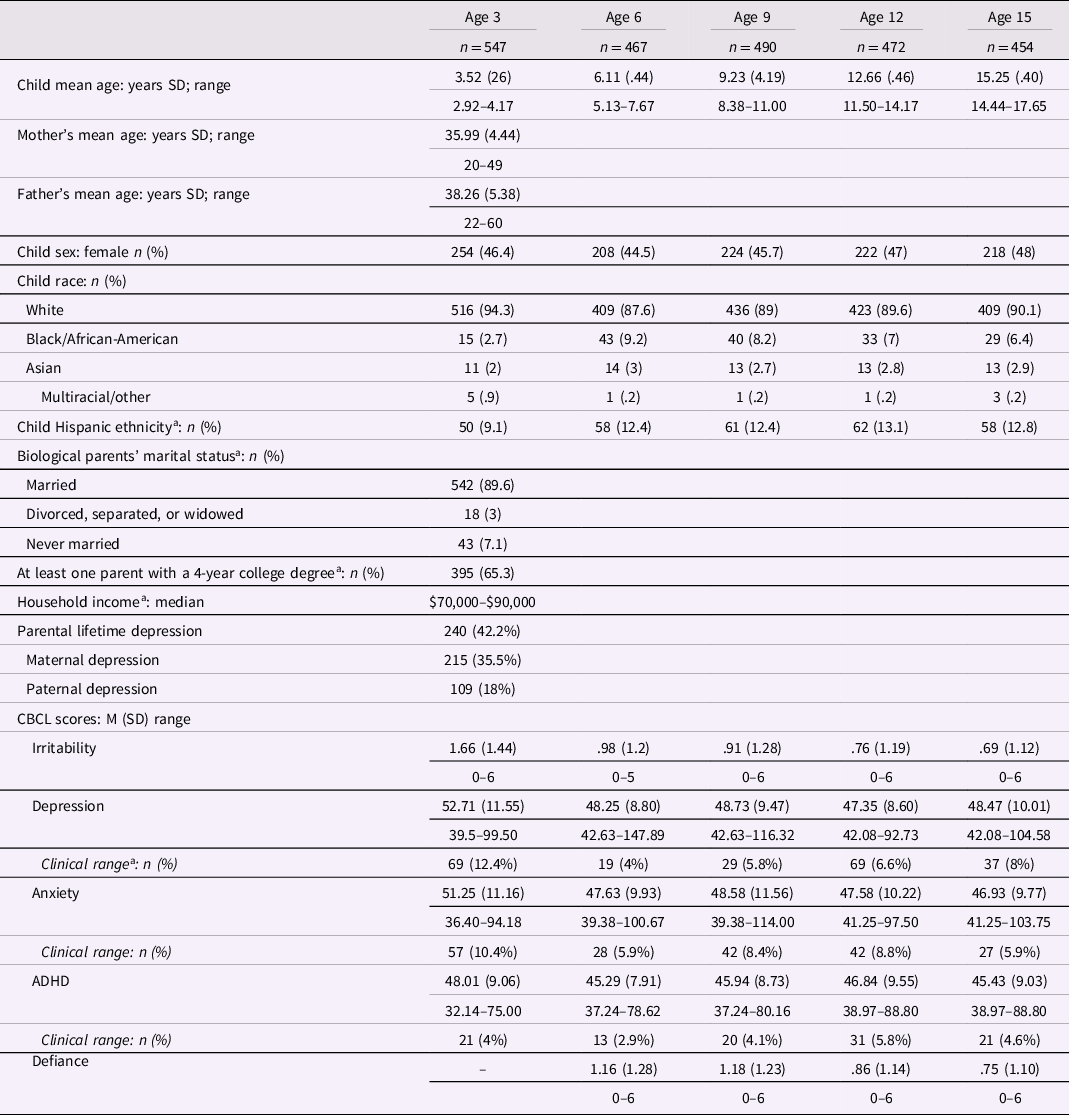
Participants were assessed at ages 3, 6, 9, 12, and 15 years-old. At baseline, 559 families entered the study and 547 mothers completed the CBCL. At the age 6 assessment, an additional 50 minority/non-White families were recruited to increase the diversity of the sample, and 467 mothers completed the CBCL; 490, 472 and 454 mothers contributed CBCL data at the age 9, age 12, and age 15 assessments, respectively. The current study included all children whose mothers completed at least one CBCL at any timepoint (n = 605, 45.6% female; Table 1).
Sample characteristics (n = 605)

Notes: Sample includes any child whose mother completed an irritability measure at any timepoint (N = 605). CBCL = Child Behavior Checklist; ADHD = Attention-Deficit Hyperactivity Disorder.
a Clinical range is 1.5 SD above the mean.
Measures
Childhood psychiatric symptoms
At all timepoints, mothers completed the parent-report CBCL (Achenbach, Reference Achenbach2000; Achenbach & Rescorla, Reference Achenbach and Rescorla2001), which has been used extensively to assess children’s internalizing and externalizing symptoms in longitudinal studies (Achenbach & Ruffle, Reference Achenbach and Ruffle2000). The CBCL captures the past 6 months. At age 3, mothers completed the CBCL 1.5–5 (Achenbach, Reference Achenbach2000) and at ages 6 and older, mothers completed the CBCL 6–18 version (Achenbach & Rescorla, Reference Achenbach and Rescorla2001). Items on the CBCL are rated by parents on a 3-point scale (0 = never/not true; 1 = sometimes; 2 = often/very true). Scales have been previously derived from the CBCL to examine irritability and related problems without overlap. Factor analyses have identified separate empirically derived irritability and defiance factors from the CBCL (Evans et al., Reference Evans, Bonadio, Bearman, Ugueto, Chorpita and Weisz2020). Research has shown that these separate dimensions (irritability and oppositionality/defiance) predict unique outcomes (Evans et al., Reference Evans, Bonadio, Bearman, Ugueto, Chorpita and Weisz2020; Johnston et al., Reference Johnston, Cruess and Burke2020; Stringaris & Goodman, Reference Stringaris and Goodman2009). To assess child irritability, we used the empirically-derived CBCL-irritability factor score (Evans et al., Reference Evans, Bonadio, Bearman, Ugueto, Chorpita and Weisz2020; Roberson-Nay et al., Reference Roberson-Nay, Leibenluft, Brotman, Myers, Larsson, Lichtenstein and Kendler2015; Stringaris et al., Reference Stringaris, Zavos, Leibenluft, Maughan and Eley2012). The CBCL-irritability factor score sums three items assessing irritable mood, sudden changes in mood, and temper outbursts. The parent-report CBCL-irritability factor score has been used with children ranging from preschool-age through adolescence and demonstrates acceptable reliability, convergent validity, and structural invariance over time (Aebi et al., Reference Aebi, Plattner, Metzke, Bessler and Steinhausen2013; Roberson-Nay et al., Reference Roberson-Nay, Leibenluft, Brotman, Myers, Larsson, Lichtenstein and Kendler2015; Stringaris, Zavos, et al., Reference Stringaris, Zavos, Leibenluft, Maughan and Eley2012; Tseng et al., Reference Tseng, Moroney, Machlin, Roberson-Nay, Hettema, Carney, Stoddard, Towbin, Pine, Leibenluft and Brotman2017; Wiggins et al., Reference Wiggins, Mitchell, Stringaris and Leibenluft2014). Internal consistency of the irritability score was acceptable across assessments (median α = .73, range: α = .68–.77). We calculated children’s defiance with the three-item empirically-derived CBCL-defiance factor score, which sums three items assessing disobedience at home, disobedience at school, and a tendency to argue from the CBCL 6–18 form (Evans et al., Reference Evans, Bonadio, Bearman, Ugueto, Chorpita and Weisz2020). The defiance scale items are not included in the CBCL-1.5-5 version and thus were not assessed at age 3. The defiance scale had acceptable internal consistency across assessments (median: α = .62, range: α = .62–.69).
We used the Diagnostic and Statistical Manual (DSM)-oriented CBCL scales to assess children’s symptoms of depression (Affective Problems scale), anxiety (Anxiety Problems scale), and ADHD (ADHD Problems scale) (Achenbach, Reference Achenbach2000; Achenbach & Rescorla, Reference Achenbach and Rescorla2001). These scales contained no overlapping items with the CBCL-irritability factor scale. These scales had acceptable internal consistency at each timepoint (Affective Problems: median: α = .68, range: α = .62–.78; Anxiety Problems: median: α = .72, range: α = .64–.76; ADHD Problems: median: α = .83, range: α = .76–.85). Given that the different versions of the CBCL include different items, we converted the raw DSM-oriented scales into age- and sex-based T-scores, with higher scores indicating more frequent symptoms (Achenbach, Reference Achenbach2000; Achenbach & Rescorla, Reference Achenbach and Rescorla2001). Unlike standardized z-scores, T-scores are sample independent and do not remove between-person and within-person variability.
Parental lifetime depressive disorder
Children’s biological parents were interviewed using the non-patient Structured Clinical Interview for DSM-IV (SCID; First et al., Reference First, Spitzer, Gibbon and Williams2002) to assess parent’s lifetime history of any depressive disorder (major depressive disorder and/or dysthymic disorder). Clinical interviews with parents were conducted at study entry, which was at the age 3 assessment for most participants and at age 6 for the additional 50 minority/non-White participants recruited at age 6. The Kappa for interrater reliability was based on 30 audio recordings and was excellent for lifetime depressive disorder (age 3 kappa = .93). Two hundred and forty children (42.2%) had at least one biological parent with a lifetime depressive disorder (215 mothers and 109 fathers).
Data analysis plan
To examine between-person and within-person associations between irritability and childhood internalizing and externalizing psychopathology, we used linear mixed models (LMM; West, Reference West2009) in IBM SPSS Statistics Version 24. LMM accounts for the unique statistical properties of repeated-measures data and uses restricted maximum likelihood to estimate conditional parameters and accommodate missing data (West, Reference West2009). While all data were included in concurrent analyses, 70 participants with only one wave of data were excluded from prospective models.
To assess between-person effects of the time-varying predictor variables (i.e., irritability, depression, anxiety, ADHD, and defiance), we calculated the participant’s average score across all time points. These person-means were centered on the grand mean and entered as predictors in the models. Given that they vary across people, but not across waves, effects of these predictors reflect only between-person effects (Enders & Tofighi, Reference Enders and Tofighi2007). To assess within-person effects of these time-varying predictors, we used person-mean centering for which each assessment at a particular time point was centered on the participant’s mean value across all of his/her assessments. Each of the symptom scores thus reflected the difference between the child’s overall individual average score across all timepoints and the score at a given timepoint. These person-centered variables vary within people across time, but do not contain between-person variance, and so they have a zero-correlation with all between-person variables (Enders & Tofighi, Reference Enders and Tofighi2007; Raudenbush & Bryk, Reference Raudenbush and Bryk2001). Hence, effects of these variables reflect only within-person effects over time. In all models, we allowed intercepts to vary randomly across individuals to model the multiple assessments as nested within person. Across all models, parental education and child sexFootnote 2 (level 2 variables), and co-occurring symptoms (depressive, anxiety, ADHD, and defiance; level 1 variables) were included as covariates to examine unique associations between irritability and each problem scale.Footnote 3 Parental education was included as a covariate, given links between low socioeconomic status and psychiatric symptoms across development (Conger et al., Reference Conger, Conger and Martin2010).
We first examined between- and within-person associations between irritability and concurrent depressive, anxiety, ADHD, and defiance in separate models. In each model, we controlled for between- and within-person effects of the other internalizing and externalizing symptoms (e.g., for a model predicting depressive symptoms we controlled for anxiety, ADHD, and defiance). The equation representing concurrent associations between irritability and depression is described below:
-
Level 1: η ij (depression) = β0j + β1j (Person-centered irritability) + β2j (Person-centered anxiety) + β3j (Person-centered ADHD) + β4j (Person-centered defiance) + β5j (Person-centered age) + r ij .
-
Level 2: β0j = γ00 + γ01(Person-mean irritability) + γ02(Person-mean anxiety) + γ03(Person-mean ADHD) + γ04 (Person-mean defiance) + γ05(child sex) + γ06(parental education) + u 0j ; β1–5j = γ1–50, where ij reflects wave i for person j.
We next examined prospective within-person associations between irritability and children’s later depression, anxiety, ADHD, and defiance in separate models. For these analyses, we lagged depressive, anxiety, ADHD, and defiance symptoms by one wave, such that children’s prior wave irritability predicted their later psychiatric symptoms in separate models. We assessed whether irritability on a particular wave (measured on wave w) was associated with later symptoms (measured on wave w+1), controlling for prior symptoms (also measured on wave w) as well as time, parental education and child sex. In order to examine the effects of the time-varying predictor variables independently of how these variables change over time, we created difference scores (wave w + 1 − wave w) capturing change from one wave to the next in these predictor variables and included them as covariates in the model. For prospective models, we did not include between-person effects because these variables do not vary across time and their effects are the same as what was presented in the concurrent models described above.Footnote 4 We continued the practice of centering all time-varying predictors on person-means in these lagged models. The equation for prospective associations between irritability and depression is described below:
-
Level 1: η ij (lagged depression i ) = β0j + β1j (person-centered irritability i−1) + β2j (person-centered depression i−1) + β3j (person-centered anxiety i−1) + β4j (person-centered ADHD i−1) +β5j (person-centered defiance i−1) + β6j (person-centered age) + r ij .
-
Level 2: β0j = γ00 + γ01(child sex) + γ02(parental education) + u 0j . (β1j = γ10) where ij reflects wave i for person j, i reflects later symptoms, i−1 reflects prior symptoms.
Finally, we explored the cross product of the level-2 moderators (child sex, parental depressive disorders) and between- and within-person irritability on the concurrent and prospective associations detailed above in separate models. In each model, we controlled for all concurrent or prior internalizing and externalizing symptoms, time, and parental education. We additionally controlled for child sex in models examining parental depression as the moderator. Significant interactions were probed using simple slopes analyses (Aiken & West, Reference Aiken and West1991).
Results
Descriptive statistics
As detailed in Supplementary Table 1, boys showed greater symptoms of irritability at age 9, anxiety at age 6, depression at age 12, defiance at age 6, defiance at age 9, and defiance at age 12 than girls. Children’s whose parents did not have a 4-year college degree had higher levels of irritability at ages 6 and 9, depressive symptoms at ages 3 and 6, anxiety symptoms at ages 3, 6, and 9, ADHD symptoms at ages 3, 6, and 9, and defiance at age 9 than children who had at least one parent with a college degree. As shown in Supplementary Table 2, all corresponding symptoms were moderately stable over time. All concurrent correlations (rs = .26–.60) and prospective correlations between symptoms were significantly positively correlated (rs = .10–.72), with the exception of age 3 anxiety and age 15 depression (r = .09, p = .06; Supplementary Table 2).
Concurrent associations between irritability and psychiatric symptoms
Unconditional models (1-ICC) indicated that 58% of the variance in irritability, 65% of the variance in depression, 59% of the variance in anxiety, 45% of the variance in ADHD, and 48% of the variance in defiance was attributable to within-person factors. Variance and covariance results demonstrated significant between-person variation (intercept variance) and within-person variance across waves (ps < .001).
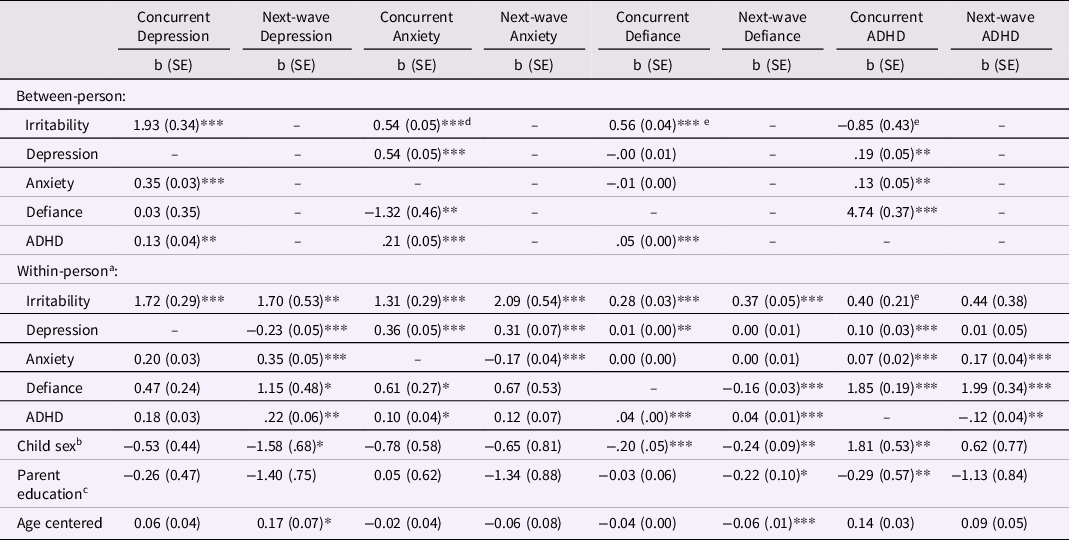
Between- and within-person irritability were both uniquely associated with concurrent depressive, anxiety, and defiance symptoms, controlling for co-occurring symptoms, parental education, and child sex (see Table 2). However, irritability was not associated with concurrent ADHD symptoms at the between- or within-persons levels.
Concurrent and prospective associations between irritability and psychiatric symptoms from ages 3–15 years old

Notes. * p < .05, **p < .01, ***p < .001.
a We controlled for difference scores (wave w+1 − wave w) to independently examine effects of time-varying predictors from how they change over time. Across all models, the inverse effect of prior within-person symptoms on the corresponding next wave symptom scales indicated that symptoms fluctuated around each individual’s mean over time.
b 0 = male, 1 = female.
c 0 = neither parent with college degree, 1 = at least one parent with 4-year college degree.
d Effect moderated by parental lifetime depression; see Supplementary Table 3.
e Effects moderated by child sex; see Supplementary Table 2.
Co-occurring symptoms also demonstrated significant concurrent associations among themselves. As seen in Table 2, greater between-person anxiety and ADHD, but not between-person defiance, were uniquely associated with concurrent depressive symptoms. However, at the within-person level, no co-occurring symptoms were uniquely related to concurrent depressive symptoms. Additionally, between- and within-person depression, defiance, and ADHD were uniquely associated with anxiety symptoms. Furthermore, between-person ADHD was concurrently associated with defiance, whereas within-person depression and ADHD, but not within-person anxiety, were associated with defiance. Finally, between-person depression, anxiety, and defiance were concurrently associated with ADHD, whereas within-person anxiety and defiance, but not within-person depression, were associated with ADHD.
Prospective associations between within-person irritability and later psychiatric symptoms
Similar to the within-person concurrent effects, within-person irritability was associated with next wave depressive, anxiety, and defiance symptoms, but not ADHD symptoms, controlling for all prior symptoms, time, parental education, and child sex (Table 2).
We further tested the directionality of the prospective associations with irritability in one model. Within-person depression (b = .02 SE = .01, t = 3.57, p < .001, CI [.01, .04]), anxiety (b = .02 SE = .01, t = 4.14, p < .001, CI [.01, .03]), and defiance (b = .45 SE = .06, t = 7.83, p < .001, CI [.34, .57]), but not within-person ADHD symptoms, were associated with next wave irritability, controlling for prior irritability, child sex, and parental education.
As seen in Table 2, within-person anxiety, defiance, and ADHD were associated with next wave depression, controlling for covariates; within-person depression, but not within-person defiance or ADHD, was associated with next wave anxiety; within-person ADHD, but not within-person depression or anxiety, was associated with next wave defiance; and within-person anxiety and defiance, but not within-person irritability or depression, was associated with next wave ADHD. Across all models, the inverse effect of prior within-person symptoms on the corresponding next wave symptom scales (e.g., prior depression and next wave depression) indicated that symptoms fluctuated around each individual’s mean over time (Table 2).
Moderators of concurrent associations over time
Child sex
Child sex moderated the between- and within-person associations between irritability and ADHD (between-person: b = 1.49, SE = .58, t = 2.57, p = .010, 95% CI [.35, 2.63]; within-person: b = .81, SE = .32, t = 2.55, p = .012, 95% CI [.18, 1.43]). Between-person irritability was associated with fewer ADHD symptoms for males (b = −1.68, SE = .55, t = −3.06, p = .002, 95% CI [−2.76, −.60] but not for females, whereas within-person irritability was associated with greater ADHD symptoms for females (b = .76, SE = .24, t = 3.15, p = .002, 95% CI [.28, 1.24]) but not for males. Child sex also moderated the between-person association between irritability and defiance (b = −.19, SE = .06, t = −3.18, p = .002, 95% CI [−.31, −.07]). The between-person association between irritability and defiance was stronger for males (b = .69, SE = .05, t = 13.84, p < .001, 95% CI [.59, .73]) than for females (b = .49, SE = .05, t = 9.48, p < .001, 95% CI [.39, .60]). Child sex did not moderate any other between- or within-person effects (Supplementary Table 3).
Parent lifetime depressive disorder
Parent lifetime depressive disorder moderated the concurrent between-person association between irritability and anxiety (b = 1.59, SE = .69, t = 3.00, p = .022, 95% CI [.23, 2.95]). Between-person irritability was more strongly associated with greater anxiety symptoms for children whose parents had a depressive disorder (b = 2.65, SE = .54, t = 4.95, p < .001, 95% CI [1.60, 3.70], than children whose parents did not (b = 1.45, SE = .68, t = 2.14, p = .033, 95% CI [.12, 2.79]. Parental depressive psychopathology did not moderate any other between- or within-person concurrent effects (Supplementary Table 4).
Moderators of prospective associations
Child sex
Child sex did not significantly interact with within-person prior irritability to predict later depressive, anxiety, ADHD, or defiance symptoms.
Parent lifetime depressive disorder
Parental lifetime depressive disorder did not interact with within-person irritability to predict later depressive, anxiety, ADHD, or defiance symptoms.
Discussion
This was the first study to examine unique between- and within-person associations between irritability and psychiatric symptoms from early childhood through adolescence. With regard to between-person effects, we found that children with high levels of irritability relative to their peers experienced greater concurrent depressive, anxiety, and defiance symptoms, relative to their peers. With regard to within-person effects, children who experienced high levels of irritability at a particular point in time, relative to their own baseline, experienced heightened depression, anxiety, and defiance symptoms at that point in time, relative to their typical levels. Importantly, these findings emerged while controlling for co-occurring symptoms, which demonstrates an important predictive effect of irritability that is not attributable to its overlap with other psychiatric symptoms. These findings emphasize the importance of considering both a child’s irritability relative to their peers as well as their changes in irritability relative to their own baseline when assessing risk for internalizing and externalizing psychopathology across development. Our within-person findings provide support for conceptualizing irritability as a clinical problem in its own right that is uniquely associated with the development of other later problems.
Concurrent and prospective effects of irritability on psychopathology
Our findings align with prior literature documenting concurrent and prospective links between irritability and depression, anxiety, and ODD (e.g., Orri et al., Reference Orri, Galera, Turecki, Forte, Renaud, Boivin, Tremblay, Côté and Geoffroy2018; Stringaris et al., Reference Stringaris, Cohen, Pine and Leibenluft2009, Reference Stringaris, Zavos, Leibenluft, Maughan and Eley2012; Vidal-Ribas et al., Reference Vidal-Ribas, Brotman, Valdivieso, Leibenluft and Stringaris2016). We extend prior work by showing distinct between- and within-person patterns of effects with irritability and internalizing and externalizing symptomatology. Studies of the etiology of childhood psychopathology often focus on between-person differences in individuals and effects of environmental characteristics on risk for disorders. While these studies are necessary and informative, our findings suggest the importance of simultaneously considering how changes within a child’s symptoms contribute to risk for psychopathology. Our between- and within-person findings highlight that elevated levels of irritability compared to one’s peers and change within oneself are both important risk factors; these findings highlight that within-person differences provide unique information about children’s risk. The bidirectional findings with irritability and internalizing and defiance symptoms underscore the negative downward spiral that can occur when within-person increases in irritability are left unaddressed. Our novel findings that both between- and within-person irritability predicts later psychiatric symptoms have implications for identification of, and clinical intervention, for at-risk youth. From a prevention and early detection perspective, our results are the first to demonstrate that we should be most concerned both about children who are high in irritability compared to their peers and also about the times when children are elevated compared to their own baseline. This approach has the potential to identify a larger proportion of youth who are at risk for long term psychiatric problems.
Consistent with other findings, later depression is predicted by a number of earlier problems, including irritability, anxiety and externalizing problems (Blain-Arcaro & Vaillancourt, Reference Blain-Arcaro and Vaillancourt2019; Weeks et al., Reference Weeks, Ploubidis, Cairney, Wild, Naicker and Colman2016). Yet, our findings add to this work by demonstrating that these findings also hold for within-person effects over time. We also found that next wave anxiety was predicted by prior within-person irritability and depression, but not externalizing problems; this aligns with work showing anxiety is predated by irritability and mood problems, but not necessarily externalizing problems (Humphreys et al., Reference Humphreys, Aguirre and Lee2012). In line with some prior work that did not parse between- from within-person effects (Dougherty et al. Reference Dougherty, Smith, Bufferd, Stringaris, Leibenluft, Carlson and Klein2013; Harvey et al. Reference Harvey, Breaux and Lugo-Candelas2016), we found that next wave within-person defiance was predicted by irritability and ADHD symptoms, but not depressive or anxiety symptoms; additionally, next wave within-person ADHD symptoms were predicted by anxiety and defiance, but not irritability or depressive symptoms. Our lack of within-person findings with irritability and ADHD are consistent with prior work showing that despite a co-occurrence between irritability and ADHD, irritability does not predict ADHD (Costello et al., Reference Costello, Mustillo, Erkanli, Keeler and Angold2003; Spencer et al., Reference Spencer, Biederman and Mick2007). Overall, our findings demonstrate similar patterns of effects at the between- and within-person level and the importance of disaggregating effects to understand more nuanced relations among irritability and internalizing and externalizing psychopathology in youth across development and pathways to later symptomatology.
Multiple factors may explain links between irritability and other psychiatric problems. Several studies demonstrated support for shared genetic factors between irritability and internalizing and externalizing psychopathology (Merwood et al., Reference Merwood, Chen, Rijsdijk, Skirrow, Larsson, Thapar, Kuntsi and Asherson2014; Riglin et al., Reference Riglin, Eyre, Cooper, Collishaw, Martin, Langley, Leibenluft, Stringaris, Thapar, Maughan, O’Donovan and Thapar2017; Savage et al., Reference Savage, Verhulst, Copeland, Althoff, Lichtenstein and Roberson-Nay2015; Stringaris et al., Reference Stringaris, Zavos, Leibenluft, Maughan and Eley2012, Reference Stringaris, Vidal-Ribas, Brotman and Leibenluft2018). In addition, aberrant reward processing has been proposed as a common neural correlate of affective processing underlying irritability, internalizing, and externalizing disorders (Stringaris et al., Reference Stringaris, Vidal-Ribas, Brotman and Leibenluft2018). These links may also be explained by the evocative hypothesis, which posits that children’s behaviors evoke negative experiences in their environments, such as negative parenting and peer responses, which further contribute to increasing irritability and other forms of psychiatric problems (Stringaris et al., Reference Stringaris, Vidal-Ribas, Brotman and Leibenluft2018; Yan et al., Reference Yan, Ansari and Peng2020). Further research testing these mechanistic pathways between irritability and other forms of psychopathology is needed, especially research that aims to analyze the extent to which these pathways operate at the within-person level, between-person level, or both.
Moderators of the associations between irritability and psychopathology
We found that child sex moderated the association between irritability and externalizing psychopathology (ADHD, defiance), but not depression or anxiety. Concurrently, child sex moderated the between- and within-person associations between irritability and ADHD. Higher irritability relative to peers (between-person) was associated with fewer ADHD symptoms for males, but was not associated with irritability for females, whereas higher irritability relative to one’s own baseline (within-person) was associated with greater ADHD symptoms for females, but was not associated with irritability for males. These findings suggest sex-specific pathways may differ across between- and within-person longitudinal associations. These findings also highlight differences when disaggregating between- and within-person effects. We previously reported that chronic irritability at age 3 predicted a diagnosis of ADHD at age 9 in females but not males (Dougherty et al., Reference Dougherty, Smith, Bufferd, Kessel, Carlson and Klein2015). Our between-person effects were not consistent with the previous findings, perhaps because the previous findings confounded between- and within-person findings. Our new findings suggest that these female-specific associations were in fact driven by within-person effects. Notably, prior work on sex differences in the links between youth irritability and ADHD has demonstrated that relations between irritability and ADHD vary based on both sex and subtype of ADHD (Ambrosini et al., Reference Ambrosini, Bennett and Elia2013). Ambrosini and colleagues (Reference Ambrosini, Bennett and Elia2013) found that irritable females had the highest rates of ADHD-inattentive type, while irritable males had the lowest rates. In contrast, irritable males had the highest rates of ADHD-combined type and irritable girls had the lowest rate. Our measure of ADHD symptoms did not distinguish between different ADHD subtypes; however, our findings may be related to differences in ADHD symptom presentation in males versus females and at different levels of effects.
Concurrently, child sex also moderated the between-person association between irritability and defiance. Higher irritability relative to peers was more strongly associated with concurrent defiance for males than for females. In contrast, Humphreys and colleagues (Reference Humphreys, Schouboe, Kircanski, Leibenluft, Stringaris and Gotlib2019) reported similar concurrent associations between irritability and externalizing symptoms between males and females in adolescence; however, different levels of variance were not parsed and between- and within-person effects were thus confounded, suggesting that aggregating between- and within-person levels of variance may obscure important information.
Parent lifetime depressive disorder moderated the between-person association between irritability and anxiety, building on prior work linking greater irritability in youth and parental depression (Dougherty et al., Reference Dougherty, Smith, Bufferd, Stringaris, Leibenluft, Carlson and Klein2013; Krieger et al., Reference Krieger, Polanczyk, Goodman, Rohde, Graeff-Martins, Salum, Gadelha, Pan, Stahl and Stringaris2013; Wiggins et al., Reference Wiggins, Mitchell, Stringaris and Leibenluft2014). Between-person irritability was more strongly associated with greater anxiety symptoms for children whose parents had a depressive disorder, whereas the association was weaker for children whose parents did not. A number of factors may explain this moderation effect. First, a broad genetic predisposition for internalizing psychopathology may lead irritable youth to manifest increased anxiety behaviors. Second, parents with depression may have difficulty in supporting self-regulation due to less use of positive and greater use of negative parenting skills, and less engagement with their children (England & Sim Reference England and Sim2009; Lovejoy et al. Reference Lovejoy, Graczyk, O’Hare and Neuman2000; Tsotsi et al. Reference Tsotsi, Broekman, Sim, Shek, Tan, Chong, Qiu, Chen, Meaney and Rifkin-Graboi2019), placing their youth at greater risk for maladjustment. Thus, having a parent with depression may compound the effects of irritability, increasing risk for co-occurring anxiety in their children relative to others. We did not observe moderators of longitudinal within-person prospective associations; this is an important avenue for future work.
Strengths and limitations
This work has several strengths, including the use of longitudinal data tracking outcomes from the preschool period to adolescence and the parsing of between- and within-person effects. Moreover, because we assessed multiple forms of psychopathology concurrently, we were able to examine unique between- and within-person associations between irritability and internalizing and externalizing psychopathology. We also used non-overlapping measures of irritability and defiance to examine symptoms separately.
This work is not without limitations. First, this work was conducted with a community sample of largely White and educated families, limiting the generalizability of our findings to more diverse samples and clinical settings. Second, although the CBCL is an adequate measure of irritability, especially in younger samples, other measures, such as the Affective Reactivity Index are better at assessing irritability, especially at more severe levels (Dougherty et al., Reference Dougherty, Galano, Chad-Friedman, Olino, Bufferd and Klein2021). More rigorous assessment of irritability would help to further disentangle the complex relations between irritability and the development of childhood psychopathology. Third, we used a single reporter (mothers) to measure irritability and psychiatric symptoms, which may bias our findings due to shared method variance and omit important symptomatology from the youth’s perspective. Fourth, although we used previously developed T-scores that allowed us to model symptoms over a wide age range, T-scores are limited by their use of population means that are not necessarily representative of the whole population. T-scores may also restrict or change the variance in the outcomes. Fifth, although we used non-overlapping, empirically-derived scales from the CBCL, items in the defiance scale (i.e., tendency to argue) overlap with facets of irritability. Future research should continue to examine the distinction between these constructs, especially with ODD. Finally, although we used a longitudinal design, our approach did not examine unique relations at different stages in development. This is an important avenue for future research. Future research should also examine trajectories (slope and curvature) of irritability and their effects on the slope of other symptom scales over time.
Conclusions
The results of this study provide further evidence that irritability has a significant role in the etiology and maintenance of psychopathology across development. This study also demonstrates the importance of parsing between- and within-person effects of risk factors for psychopathology, as they these effects are confounded in traditional designs and can have distinct effects in each domain. This study highlights the need to further examine mechanisms that may explain effects of within-person irritability on later psychiatric symptoms (e.g., tests of the evocative hypothesis). Furthermore, this study uncovered bi-directional effects of within-person irritability and psychiatric symptoms; future research should investigate factors that maintain these bi-directional associations over time.
Supplementary material
For supplementary material accompanying this paper visit https://doi.org/10.1017/S0954579421001267
Funding statement
Support for this research was provided by funding through NIMH R01 MH069942 (Klein) and the National Science Foundation Graduate Research Fellowship Program (Chad-Friedman). We assert that all procedures contributing to this work comply with APA ethical standards and Stony Brook University’s institutional review board and with the Helsinki Declaration of 1975, as revised in 2008. Written informed consent was obtained by parents after the procedures had been fully explained.
Conflict of interest
The authors report no conflicts of interest.