Introduction
In Australia, between the years 1990–91 and 2014–15 adoptions declined by 25.5%. (AIHW, 2015a, Table A2). In fact in the year 2014–15, the latest year for which data is available, there were only 292 adoptions nationwide with only 94 being by carers, presumably foster carers (AIHW, 2015a, Figure 3.1). The other adoptions included 83 inter-country adoptions and 209 local or known adoptions (56 local and 153 known adoptions consisting of 94 carers, 52 step parents, four other relatives and three others) (AIHW, 2015a, Figure 3.1). In this period in New South Wales (NSW), there were 108 known adoptions (AIHW, 2015a, Table 3.11). There were also nine local adoptions in NSW (AIHW, 2015a, Table 3.6).
The background to the decline in the use of adoption between 1990–91 and 2014–15 is the historic involvement of Australian child welfare services in the widespread practice of removing Aboriginal children from parental care, as well as the forced adoption of babies born to single mothers in the past (Commonwealth Senate Inquiry, 2012; HREOC, 1997; NSW Legislative Council, 2000). This commentary focusses on the shifting context of adoption in NSW, Australia.
The Amendments to the Legislation
The Child Protection Legislative Amendment Bill 2014 that amended the NSW Children and Young Persons (Care and Protection) Act 1998 and the Adoptions Act 2000 was passed by the NSW Parliament in May 2014. The new legislation creates under a new section 10A a hierarchy of permanency planning preferences as follows:
-
10A (3)
-
(a) if it is practicable and in the best interests of a child or young person, the first preference for permanent placement of the child or young person to be restored to the care of his or her parent (within the meaning of section 83) or parents so as to preserve the family relationship,
-
(b) if it is not practicable or in the best interests of a child or young person to be placed in accordance with paragraph (a), the second preference for permanent placement of the child or young person is guardianship of a relative, kin or other suitable person,
-
(c) if it is not practicable or in the best interests of a child or young person to be placed in accordance with paragraph (a) or (b), the next preference is (except in the case of an Aboriginal or Torres Strait Islander child or young person) (italics added) for the child or young person to be adopted,
-
(d) if it is not practicable or in the best interests of a child or young person to be placed in accordance with paragraph (a), (b) or (c), the last next preference is for the child or young person to be placed under the parental responsibility of the Minister under the Act or any other law,
-
(e) if it is not practicable or in the best interests of an Aboriginal or Torres Strait Islander child or young person to be placed in accordance with paragraph (a), (b) or (d), the last next preference is for the child or young person to be adopted.
The exemption under (c) is because of the kin structure of the Aboriginal community who are opposed to adoption. In fact, there was only one adoption of an Aboriginal child in 2014–15 and this was by Aboriginal adoptive parents (AIHW, 2015a. Table 4.2). No other cultural or ethnic group is accorded the same exemption. The exemption given to Australia's first nation people is accepted by the wider community.
Section 10A of the amendments changes Departmental placement priorities. Prior to this change, the Department of Family and Community Services (FaCS) last placement preference was adoption, whilst now it is the first preference where restoration to parent or guardianship to relative, kin or other suitable person is not practicable.
Section 83 (5) was also amended as follows:
-
(5) The Children's Court is to decide whether to accept the Director-general's assessment of whether or not there is a realistic possibility of restoration:
-
(a) in the case of a child who is less than 2 years of age on the date, the Children's Court makes an interim order allocating responsibility for the child to a person other than a parent – within 6 months after the Children's Court makes the interim order, and
-
(b) in the case of a child who is 2 years or more of age on the date, the Children's Court makes an interim order allocating responsibility for the child to a person other than a parent – within 12 months after the Children's Court makes the interim order.
A further amendment was made to section 137 of the Act that deals with the authorisation of foster carers. At the end of section 137 (1) (c), the following was added:
-
(c) Subject to the regulations, a person who is assessed to be suitable to be approved to adopt a child under section 45 of the Adoption Act 2000.
Also amended was the NSW Adoptions Act 2000 with the insertion at section 45D of the following:
-
45D Application to Adopt
The Director-General may in accordance with the regulation, invite an authorised carer of a child who is in out-of-home care to submit an application to adopt the child (italics added).
This invitation underlines the extent to which FaCS is actively promoting adoption from care at this time. Furthermore, these two amendments mean that a person who is authorised as a foster carer is also at the same time approved as a potential adopter. What were two separate processes have now been merged. The argument used to promote this dual authorisation is that, pending a Children's Court finding of no realistic possibility of restoration to the birth parents, it will enable a child who was placed in foster care to stay in the same placement and be adopted by the current carers, thereby providing continuity and stability of care for the child.
This places foster carers in a strong position as such a procedure, and an invitation when issued, guarantees that FaCS will support a foster carer's application to the NSW Supreme Court (the court of standing) for adoption, with or without the consent of the birth parents.
In effect, taken together these amendments will make freeing children for consideration for adoption much easier. The changes are designed to reduce the number and the cost of children and young persons who are under the care of the Minister by making adoption a fast route out of care. It was also said by some commentators, as is almost always the case, that these changes are ‘in the best interests of the child’ (Goldstein, Freud, & Solnit, Reference Goldstein, Freud and Solnit1973; Sammut, Reference Sammut2015), and this is the criteria applied in the Supreme Court when dispensing with parental consent.
Will the Changes Work?
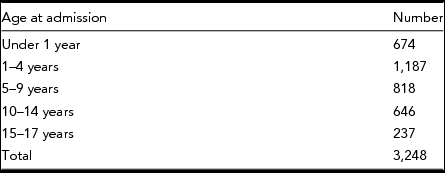
In NSW, there were 20,520 children and young persons in out-of-home care at June 30, 2014 (AIHW, 2015b, Table 2.1). Of these children and young persons, 6,520 were identified as Aboriginal (AIHW, 2015b, Table 5.4). Given the partial exemption of Aboriginal children and young persons under 10A (3) (c) and (e) from the adoption provision made in the new legislation, the potential number of children and young persons who may be considered for adoption falls to 14,000. This figure may be further reduced if the opposition of other ethnic and cultural groups to adoption is given consideration. Some of the 14,000 children and young persons are also likely to be older, not babies, and it is well known that it is less easy to find adoptive parents for older children and young persons. In fact, of the new admissions to out-of-home care in NSW in 2013–14 that numbered 3,248, 674 were under the age of 1 year, 875 were between the ages of 1 and 4 years, 818 were aged 5 to 9 years, 646 were 10 to 14 years and 237 were 14 to 17 years which confirms this point (AIHW, 2015b, See Table 1).
TABLE 1
New admissions to out-of-home care in NSW in 2013–14 by age.
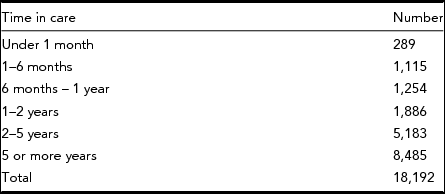
What also has to be considered alongside the above figures is the length of time children have been in out-of-home care. For NSW, these figures are: under 1 month 289; 1 to 6 months 1,115; 6 months to 1 year 1,254; 1 year to 2 years 1,886; 2 to 5 years 5,183 and 5 years or more 8,485 of a total of 18,192 children in out-of- home care. (AIHW, 2015b, See Table 2).
TABLE 2
Length of time in out-of-home care in NSW as at 2013–14.
Exactly what these figures mean is unclear. It may be reasonable to suggest that the 2,658 children under the age of 2 years might be considered for adoption. However, this may not be the case as some of these children may, across that time period, be restored to parental care by way of a decision to rescind or vary an earlier Court order (CYP(CP) Act 1998, section 90). What is also unclear is how many of the 8,485 older children aged 5 years or more may seek to be adopted by their long-term foster carers given the extended period they have spent in care and given they are in a long-term stable placement. In any case, if this were to occur it would be a one off, rather than a recurring event, taking account of the wish of some long-term carers to adopt their foster child that has, until now, been a complex process. This suggests that the ambition of FaCS to reduce the number of children in Ministerial care through the process of adoption from care may be less achievable, numerically, than is anticipated.
A contentious issue in the new legislation are the timelines set for a Children's Court ruling as to whether there is a realistic possibility, or otherwise, of restoration of a child to parental care. These are, as indicated earlier: 6 months for a child under the age of 2 years and 12 months for a child over the age of 2 years. This potentially affects the 674 children under the age of 1 year and an unknown percentage of those between the age of 1 and 4 years.
The starting date for this time count is the date on which an interim order to allocate parental responsibility to the Minister for FaCS is made. This order is usually made at the first Court date. Following this action, considerable time may pass before a case goes to a full hearing of the Children's Court. Frequently this is more than 6 months after a first interim order is made. Before the hearing, assessments and further evidence must be presented to the Court.
An added issue is the availability of rehabilitation services for parents where drug and alcohol misuse is a prime factor in FaCS initiating a care and protection application. In NSW, rehabilitation services, especially in rural areas, are not always immediately available and the time necessary for successful completion of rehabilitation is often longer than 6 months (AIHW, 2015c). In effect, this rules out a parent being able to meet the 6 month timeline now being imposed for a decision about the possibility of restoration of a child under the age of 2 years to parental care. This timeline may be seen as lacking fairness.
It has to be noted that after section 83 (5) in (5A) there is a variation:
(5A) However, the Children's Court may, having regard to the circumstances of the case and if it considers it appropriate and in the best interests of the child or young person, decide, after the end of the applicable period referred to in subsection (5), whether or not there is a realistic possibility of restoration.
This gives the Children's Court discretion to vary the 6 month timeline if circumstances favour this course of action. Whether the Court will use this discretion, especially if FaCS oppose such a decision, remains to be seen.
There may be more challenges in the NSW Supreme Court to applications for adoption by foster carers than has been the case so far. This may depend on birth parents being able to get a government awarded Legal Aid grant to support a challenge. Parents can, of course, represent themselves in a NSW Supreme Court adoption hearing, although this is an extremely difficult task.
Through professional experience in the NSW Children's Court, the authors’ know that parents react strongly against the possibility of foster carers adopting their child and indicate that they wish to oppose any such action. Emotionally, these parents already grieve the loss of a child to foster care. The process of possible adoption by foster carers of their child, potentially without their consent, further compounds this sense of grief and loss (Burgheim, Reference Burgheim2005; Schofield et al., Reference Schofield, Moldestad, Hojer, Ward, Skilbred, Young and Havik2010).
The Size of the Australian and NSW Problem
As at 2014 June 30, there were 43,009 children in out-of-home care in Australia. This is a national a rate of 8.1 per 1,000 children under the age of 18 years (AIHW, 2015b). Of those children in care nationally, 17,654 (41.1%) are in family (non-relative) foster care. A further 20,847 (48.5%) are in relative/kin care. For NSW, the number of children in out-of-home care at the same date was 18,192. Of these children, 7,550 (41.5%) and 10,004 (54.9%), respectively, were in family (non-relative) foster care or relative/kin care.
The enormous financial cost ($39,844.91 annually in NSW for a single general (non-relative) foster care placement as at 2014) (Ainsworth & Hansen, Reference Ainsworth and Hansen2015), plus evidence about the poor outcomes of family foster care (Ainsworth & Hansen, Reference Ainsworth and Hansen2014), provides part of the justification for a renewed emphasis on adoption and a potential increase in the number of children being adopted from care.
International Data
The adoptions from care data for England and the US helps to place the NSW adoption developments in perspective.
England
At 2015 March 31, there were 68,540 looked after children (the term for children in out-of-home care) in England. During the year that ended at that date, 5,330 children were adopted from care. This was an increase of 5% from 2014. In sum, this was 7.7% of the 2015 looked after population. The majority of children adopted from care in England during that period were aged between 1 and 4 years. Of all the children adopted in England in the same year up to 76% were in this age group with the average age at adoption being 3 years and 2 months (Department of Education, 2013).
United States
The US data is for the federal fiscal year ending 2014 September 30. In that year, the estimated out-of-home care population was 415,129. It was estimated that there were 50,644 children and young persons adopted from care in the same period. This suggests an adoption rate of 12.1% of the in-care population. Only 2% of the children who were adopted were under 1 year of age. In the 1–4 year age range, the number was 47% (Children's Bureau, AFCARS, 2015).
Australia
At 2014 June 30, there were 43,009 children in out-of-home care in Australia. As indicated earlier, the number of adoptions nationwide in the period 2014–15 was 292 with only 94 appearing to be adoptions from care. This is 0.6% of the in-care population.
This three nations comparison puts into perspective the extent to which Australia is at odds with other child welfare systems in terms of the use of adoption as a route out of care. The figures which show an English rate of adoption from care of 7.7% and a US rate of 12.1% suggests that in NSW under the new legislation it might be possible to achieve a rate of adoption from care of close to 10% (7.7% + 12.1% = 9.9% average). Given the 18,192 children currently in out-of-home care in NSW, this suggests that 1,819 may be considered for adoption from care.
This estimate does not however allow for the 11,667 Aboriginal children in the out-of-home care system especially in relative/kin care who are exempt from the new adoption provision of the Act. As a result, the figure of 1,819 children who may be considered for adoption from care is almost certainly an over-estimate of the number of adoptions from care that is likely to be achieved in NSW. The more likely figure given the 6,525 non Aboriginal children in out- of-home care where the outcome may be adoption from care is 652 or 3.6% of the in care population in NSW. Many of these children are over the age of 4 years and as a result may be less likely to be adopted than those of a younger age.
The Issues for Parents
The removal of a child from parental care is always a heart wrenching experience for parents and traumatising for the child, especially when they have reached an age when they can recognise their parents. It is acknowledged that a few children talk about the relief of being removed from parental care (Cox, Moggach, & Smith, Reference Cox, Moggach and Smith2007). As Schofield et al. (Reference Schofield, Moldestad, Hojer, Ward, Skilbred, Young and Havik2010) indicate, removal of a child from parental care and the sense of loss that is associated with the removal threatens the identity of the parents and causes them to question their ability to parent. This is especially so when no other source of identity and self-worth, such as an occupation, is available. For a mother, removal can be particularly devastating given the importance for many mothers of the female image of the good mother (White, Morris, Featherstone, Brandon, & Thoburn, Reference White, Morris, Featherstone, Brandon, Thoburn and Blyth2014). In fact, many mothers we meet in the Children's Court say to us ‘I am a good parent’ as a way of protecting themselves against this threat to their identity.
The threat to identity is further heightened by the issue of adoption from care. Most of the parents we meet in the NSW Children's Court after final orders have been made hope that they will, at some point, be able to return to Court to seek restoration of their child to their care. This is often unrealistic, but the hope they hold remains important for the parents as it suggests the possibility of a better family future.
The possible adoption of their child by foster carers severs all hope of the child being restored to their care. It is the final blow that can take place without their consent given, as indicated earlier, that the NSW Supreme Court can dispense with parental consent if adoption is considered to be in the best interests of the child. The NSW Supreme Court can also sanction a surname change for the child to that of the adoptive parents. For the natural parents, the child then ceases to exist as part of their family.
Open adoption, the hallmark of the NSW legislation, is now being explored via a joint University of Sydney/Barnardos Institute for Open Adoption which has initial funding from FaCS. Open adoption, that seemingly includes parental and extended family contact after adoption (Neil, Beek, & Ward, Reference Neil, Beek and Ward2013), and which is what FaCS is promoting, is still not reassuring enough. For parents, adoption is finality and it is this that makes parents very scared. It also affects an entire family, not just the mother and father of child who may be adopted. Two sets of grandparents fear the loss of a grandchild. Brother and sisters, aunts and uncles, nieces and nephews all face loss. Adoption may be in the best interests of the child, but it is not without pain. Many pay a price when the state pursues a policy of adoption from care as a route out of care, even when this is justified.
Note
Dr Patricia Hansen is a solicitor who practices in the NSW Children's Court. Dr Frank Ainsworth is a Guardian ad Litem who regularly appears in Children's Courts throughout NSW.





 You have
Access
Introduction
In Australia, between the years 1990–91 and 2014–15 adoptions declined by 25.5%. (AIHW, 2015a, Table A2). In fact in the year 2014–15, the latest year for which data is available, there were only 292 adoptions nationwide with only 94 being by carers, presumably foster carers (AIHW, 2015a, Figure 3.1). The other adoptions included 83 inter-country adoptions and 209 local or known adoptions (56 local and 153 known adoptions consisting of 94 carers, 52 step parents, four other relatives and three others) (AIHW, 2015a, Figure 3.1). In this period in New South Wales (NSW), there were 108 known adoptions (AIHW, 2015a, Table 3.11). There were also nine local adoptions in NSW (AIHW, 2015a, Table 3.6).
The background to the decline in the use of adoption between 1990–91 and 2014–15 is the historic involvement of Australian child welfare services in the widespread practice of removing Aboriginal children from parental care, as well as the forced adoption of babies born to single mothers in the past (Commonwealth Senate Inquiry, 2012; HREOC, 1997; NSW Legislative Council, 2000). This commentary focusses on the shifting context of adoption in NSW, Australia.
The Amendments to the Legislation
The Child Protection Legislative Amendment Bill 2014 that amended the NSW Children and Young Persons (Care and Protection) Act 1998 and the Adoptions Act 2000 was passed by the NSW Parliament in May 2014. The new legislation creates under a new section 10A a hierarchy of permanency planning preferences as follows:
(a) if it is practicable and in the best interests of a child or young person, the first preference for permanent placement of the child or young person to be restored to the care of his or her parent (within the meaning of section 83) or parents so as to preserve the family relationship,
(b) if it is not practicable or in the best interests of a child or young person to be placed in accordance with paragraph (a), the second preference for permanent placement of the child or young person is guardianship of a relative, kin or other suitable person,
(c) if it is not practicable or in the best interests of a child or young person to be placed in accordance with paragraph (a) or (b), the next preference is (except in the case of an Aboriginal or Torres Strait Islander child or young person) (italics added) for the child or young person to be adopted,
(d) if it is not practicable or in the best interests of a child or young person to be placed in accordance with paragraph (a), (b) or (c), the last next preference is for the child or young person to be placed under the parental responsibility of the Minister under the Act or any other law,
(e) if it is not practicable or in the best interests of an Aboriginal or Torres Strait Islander child or young person to be placed in accordance with paragraph (a), (b) or (d), the last next preference is for the child or young person to be adopted.
The exemption under (c) is because of the kin structure of the Aboriginal community who are opposed to adoption. In fact, there was only one adoption of an Aboriginal child in 2014–15 and this was by Aboriginal adoptive parents (AIHW, 2015a. Table 4.2). No other cultural or ethnic group is accorded the same exemption. The exemption given to Australia's first nation people is accepted by the wider community.
Section 10A of the amendments changes Departmental placement priorities. Prior to this change, the Department of Family and Community Services (FaCS) last placement preference was adoption, whilst now it is the first preference where restoration to parent or guardianship to relative, kin or other suitable person is not practicable.
Section 83 (5) was also amended as follows:
(5) The Children's Court is to decide whether to accept the Director-general's assessment of whether or not there is a realistic possibility of restoration:
(a) in the case of a child who is less than 2 years of age on the date, the Children's Court makes an interim order allocating responsibility for the child to a person other than a parent – within 6 months after the Children's Court makes the interim order, and
(b) in the case of a child who is 2 years or more of age on the date, the Children's Court makes an interim order allocating responsibility for the child to a person other than a parent – within 12 months after the Children's Court makes the interim order.
A further amendment was made to section 137 of the Act that deals with the authorisation of foster carers. At the end of section 137 (1) (c), the following was added:
(c) Subject to the regulations, a person who is assessed to be suitable to be approved to adopt a child under section 45 of the Adoption Act 2000.
Also amended was the NSW Adoptions Act 2000 with the insertion at section 45D of the following:
45D Application to Adopt
The Director-General may in accordance with the regulation, invite an authorised carer of a child who is in out-of-home care to submit an application to adopt the child (italics added).
This invitation underlines the extent to which FaCS is actively promoting adoption from care at this time. Furthermore, these two amendments mean that a person who is authorised as a foster carer is also at the same time approved as a potential adopter. What were two separate processes have now been merged. The argument used to promote this dual authorisation is that, pending a Children's Court finding of no realistic possibility of restoration to the birth parents, it will enable a child who was placed in foster care to stay in the same placement and be adopted by the current carers, thereby providing continuity and stability of care for the child.
This places foster carers in a strong position as such a procedure, and an invitation when issued, guarantees that FaCS will support a foster carer's application to the NSW Supreme Court (the court of standing) for adoption, with or without the consent of the birth parents.
In effect, taken together these amendments will make freeing children for consideration for adoption much easier. The changes are designed to reduce the number and the cost of children and young persons who are under the care of the Minister by making adoption a fast route out of care. It was also said by some commentators, as is almost always the case, that these changes are ‘in the best interests of the child’ (Goldstein, Freud, & Solnit, Reference Goldstein, Freud and Solnit1973; Sammut, Reference Sammut2015), and this is the criteria applied in the Supreme Court when dispensing with parental consent.
Will the Changes Work?
In NSW, there were 20,520 children and young persons in out-of-home care at June 30, 2014 (AIHW, 2015b, Table 2.1). Of these children and young persons, 6,520 were identified as Aboriginal (AIHW, 2015b, Table 5.4). Given the partial exemption of Aboriginal children and young persons under 10A (3) (c) and (e) from the adoption provision made in the new legislation, the potential number of children and young persons who may be considered for adoption falls to 14,000. This figure may be further reduced if the opposition of other ethnic and cultural groups to adoption is given consideration. Some of the 14,000 children and young persons are also likely to be older, not babies, and it is well known that it is less easy to find adoptive parents for older children and young persons. In fact, of the new admissions to out-of-home care in NSW in 2013–14 that numbered 3,248, 674 were under the age of 1 year, 875 were between the ages of 1 and 4 years, 818 were aged 5 to 9 years, 646 were 10 to 14 years and 237 were 14 to 17 years which confirms this point (AIHW, 2015b, See Table 1).
New admissions to out-of-home care in NSW in 2013–14 by age.
Source: AIHW, 2015b, Table A26.
What also has to be considered alongside the above figures is the length of time children have been in out-of-home care. For NSW, these figures are: under 1 month 289; 1 to 6 months 1,115; 6 months to 1 year 1,254; 1 year to 2 years 1,886; 2 to 5 years 5,183 and 5 years or more 8,485 of a total of 18,192 children in out-of- home care. (AIHW, 2015b, See Table 2).
Length of time in out-of-home care in NSW as at 2013–14.
Source: AIHW, (2015b), Table 5.2.
Exactly what these figures mean is unclear. It may be reasonable to suggest that the 2,658 children under the age of 2 years might be considered for adoption. However, this may not be the case as some of these children may, across that time period, be restored to parental care by way of a decision to rescind or vary an earlier Court order (CYP(CP) Act 1998, section 90). What is also unclear is how many of the 8,485 older children aged 5 years or more may seek to be adopted by their long-term foster carers given the extended period they have spent in care and given they are in a long-term stable placement. In any case, if this were to occur it would be a one off, rather than a recurring event, taking account of the wish of some long-term carers to adopt their foster child that has, until now, been a complex process. This suggests that the ambition of FaCS to reduce the number of children in Ministerial care through the process of adoption from care may be less achievable, numerically, than is anticipated.
A contentious issue in the new legislation are the timelines set for a Children's Court ruling as to whether there is a realistic possibility, or otherwise, of restoration of a child to parental care. These are, as indicated earlier: 6 months for a child under the age of 2 years and 12 months for a child over the age of 2 years. This potentially affects the 674 children under the age of 1 year and an unknown percentage of those between the age of 1 and 4 years.
The starting date for this time count is the date on which an interim order to allocate parental responsibility to the Minister for FaCS is made. This order is usually made at the first Court date. Following this action, considerable time may pass before a case goes to a full hearing of the Children's Court. Frequently this is more than 6 months after a first interim order is made. Before the hearing, assessments and further evidence must be presented to the Court.
An added issue is the availability of rehabilitation services for parents where drug and alcohol misuse is a prime factor in FaCS initiating a care and protection application. In NSW, rehabilitation services, especially in rural areas, are not always immediately available and the time necessary for successful completion of rehabilitation is often longer than 6 months (AIHW, 2015c). In effect, this rules out a parent being able to meet the 6 month timeline now being imposed for a decision about the possibility of restoration of a child under the age of 2 years to parental care. This timeline may be seen as lacking fairness.
It has to be noted that after section 83 (5) in (5A) there is a variation:
(5A) However, the Children's Court may, having regard to the circumstances of the case and if it considers it appropriate and in the best interests of the child or young person, decide, after the end of the applicable period referred to in subsection (5), whether or not there is a realistic possibility of restoration.
This gives the Children's Court discretion to vary the 6 month timeline if circumstances favour this course of action. Whether the Court will use this discretion, especially if FaCS oppose such a decision, remains to be seen.
There may be more challenges in the NSW Supreme Court to applications for adoption by foster carers than has been the case so far. This may depend on birth parents being able to get a government awarded Legal Aid grant to support a challenge. Parents can, of course, represent themselves in a NSW Supreme Court adoption hearing, although this is an extremely difficult task.
Through professional experience in the NSW Children's Court, the authors’ know that parents react strongly against the possibility of foster carers adopting their child and indicate that they wish to oppose any such action. Emotionally, these parents already grieve the loss of a child to foster care. The process of possible adoption by foster carers of their child, potentially without their consent, further compounds this sense of grief and loss (Burgheim, Reference Burgheim2005; Schofield et al., Reference Schofield, Moldestad, Hojer, Ward, Skilbred, Young and Havik2010).
The Size of the Australian and NSW Problem
As at 2014 June 30, there were 43,009 children in out-of-home care in Australia. This is a national a rate of 8.1 per 1,000 children under the age of 18 years (AIHW, 2015b). Of those children in care nationally, 17,654 (41.1%) are in family (non-relative) foster care. A further 20,847 (48.5%) are in relative/kin care. For NSW, the number of children in out-of-home care at the same date was 18,192. Of these children, 7,550 (41.5%) and 10,004 (54.9%), respectively, were in family (non-relative) foster care or relative/kin care.
The enormous financial cost ($39,844.91 annually in NSW for a single general (non-relative) foster care placement as at 2014) (Ainsworth & Hansen, Reference Ainsworth and Hansen2015), plus evidence about the poor outcomes of family foster care (Ainsworth & Hansen, Reference Ainsworth and Hansen2014), provides part of the justification for a renewed emphasis on adoption and a potential increase in the number of children being adopted from care.
International Data
The adoptions from care data for England and the US helps to place the NSW adoption developments in perspective.
England
At 2015 March 31, there were 68,540 looked after children (the term for children in out-of-home care) in England. During the year that ended at that date, 5,330 children were adopted from care. This was an increase of 5% from 2014. In sum, this was 7.7% of the 2015 looked after population. The majority of children adopted from care in England during that period were aged between 1 and 4 years. Of all the children adopted in England in the same year up to 76% were in this age group with the average age at adoption being 3 years and 2 months (Department of Education, 2013).
United States
The US data is for the federal fiscal year ending 2014 September 30. In that year, the estimated out-of-home care population was 415,129. It was estimated that there were 50,644 children and young persons adopted from care in the same period. This suggests an adoption rate of 12.1% of the in-care population. Only 2% of the children who were adopted were under 1 year of age. In the 1–4 year age range, the number was 47% (Children's Bureau, AFCARS, 2015).
Australia
At 2014 June 30, there were 43,009 children in out-of-home care in Australia. As indicated earlier, the number of adoptions nationwide in the period 2014–15 was 292 with only 94 appearing to be adoptions from care. This is 0.6% of the in-care population.
This three nations comparison puts into perspective the extent to which Australia is at odds with other child welfare systems in terms of the use of adoption as a route out of care. The figures which show an English rate of adoption from care of 7.7% and a US rate of 12.1% suggests that in NSW under the new legislation it might be possible to achieve a rate of adoption from care of close to 10% (7.7% + 12.1% = 9.9% average). Given the 18,192 children currently in out-of-home care in NSW, this suggests that 1,819 may be considered for adoption from care.
This estimate does not however allow for the 11,667 Aboriginal children in the out-of-home care system especially in relative/kin care who are exempt from the new adoption provision of the Act. As a result, the figure of 1,819 children who may be considered for adoption from care is almost certainly an over-estimate of the number of adoptions from care that is likely to be achieved in NSW. The more likely figure given the 6,525 non Aboriginal children in out- of-home care where the outcome may be adoption from care is 652 or 3.6% of the in care population in NSW. Many of these children are over the age of 4 years and as a result may be less likely to be adopted than those of a younger age.
The Issues for Parents
The removal of a child from parental care is always a heart wrenching experience for parents and traumatising for the child, especially when they have reached an age when they can recognise their parents. It is acknowledged that a few children talk about the relief of being removed from parental care (Cox, Moggach, & Smith, Reference Cox, Moggach and Smith2007). As Schofield et al. (Reference Schofield, Moldestad, Hojer, Ward, Skilbred, Young and Havik2010) indicate, removal of a child from parental care and the sense of loss that is associated with the removal threatens the identity of the parents and causes them to question their ability to parent. This is especially so when no other source of identity and self-worth, such as an occupation, is available. For a mother, removal can be particularly devastating given the importance for many mothers of the female image of the good mother (White, Morris, Featherstone, Brandon, & Thoburn, Reference White, Morris, Featherstone, Brandon, Thoburn and Blyth2014). In fact, many mothers we meet in the Children's Court say to us ‘I am a good parent’ as a way of protecting themselves against this threat to their identity.
The threat to identity is further heightened by the issue of adoption from care. Most of the parents we meet in the NSW Children's Court after final orders have been made hope that they will, at some point, be able to return to Court to seek restoration of their child to their care. This is often unrealistic, but the hope they hold remains important for the parents as it suggests the possibility of a better family future.
The possible adoption of their child by foster carers severs all hope of the child being restored to their care. It is the final blow that can take place without their consent given, as indicated earlier, that the NSW Supreme Court can dispense with parental consent if adoption is considered to be in the best interests of the child. The NSW Supreme Court can also sanction a surname change for the child to that of the adoptive parents. For the natural parents, the child then ceases to exist as part of their family.
Open adoption, the hallmark of the NSW legislation, is now being explored via a joint University of Sydney/Barnardos Institute for Open Adoption which has initial funding from FaCS. Open adoption, that seemingly includes parental and extended family contact after adoption (Neil, Beek, & Ward, Reference Neil, Beek and Ward2013), and which is what FaCS is promoting, is still not reassuring enough. For parents, adoption is finality and it is this that makes parents very scared. It also affects an entire family, not just the mother and father of child who may be adopted. Two sets of grandparents fear the loss of a grandchild. Brother and sisters, aunts and uncles, nieces and nephews all face loss. Adoption may be in the best interests of the child, but it is not without pain. Many pay a price when the state pursues a policy of adoption from care as a route out of care, even when this is justified.
Note
Dr Patricia Hansen is a solicitor who practices in the NSW Children's Court. Dr Frank Ainsworth is a Guardian ad Litem who regularly appears in Children's Courts throughout NSW.