Introduction
Attention deficit hyperactivity disorder (ADHD) is a common childhood-onset neuropsychiatric disorder with developmentally inappropriate inattention, hyperactivity and impulsivity (Rowland et al. Reference Rowland, Lesesne and Abramowitz2002). ADHD has been proved to have high heritability by twin, adoption, genetic linkage and candidate gene studies (Doyle et al. Reference Doyle, Faraone, Seidman, Willcutt, Nigg, Waldman, Pennington, Peart and Biederman2005a ). Similar to most psychiatric disorders, the clinical manifestation of ADHD is considered as a complex phenotype that originates from the influence of multiple genes (Faraone & Mick, Reference Faraone and Mick2010). Exploring the biomarkers with more genetic basis than clinical symptoms is important to the understanding of the heredity mechanism of ADHD (Doyle et al. Reference Doyle, Willcutt, Seidman, Biederman, Chouinard, Silva and Faraone2005b ). Therefore, flourishing research focuses on the exploration of endophenotypes. Among the psychological features, impaired sustained attention and prolonged reaction time (RT) are related to the core symptoms of ADHD [such as the criteria ‘often has difficulty sustaining attention in tasks or play activities’, ‘is often easily distracted by extraneous stimuli’ in the Diagnostic and Statistical Manual of Mental Disorders, Fourth Edition (DSM-IV)], and can be measured by quantitative tools (Chiang & Gau, Reference Chiang and Gau2008; Bolfer et al. Reference Bolfer, Casella, Baldo, Mota, Tsunemi, Pacheco and Reed2010; Klotz et al. Reference Klotz, Johnson, Wu, Isaacs and Gilbert2012). The two features have been assumed to be associated with dopaminergic dysregulation in frontal circuits that may have a hereditary basis (Coull et al. Reference Coull, Frith, Frackowiak and Grasby1996; Szekely et al. Reference Szekely, Balota, Duchek, Nemoda, Vereczkei and Sasvari-Szekely2011).
Endophenotypes are defined as measurable cognitive or physiological values that can reflect biological etiologies more than behavioral phenotypes (Gottesman & Gould, Reference Gottesman and Gould2003). Doyle et al. (Reference Doyle, Faraone, Seidman, Willcutt, Nigg, Waldman, Pennington, Peart and Biederman2005a ) proposed an ideal endophenotype of ADHD as follows: (a) it co-occurs with the diagnosis of ADHD; (b) it can be measured by reliable psychometric tools; (c) it shows evidence of familial and genetic transmission; and (d) it should appear in individuals carrying genes without expressing the disorder. The criteria provide a practical direction to examine potential endophenotypes.
Neuropsychological, neurophysiological and neuroimaging paradigms have been brought up as candidate ADHD endophenotypes (Doyle et al. Reference Doyle, Willcutt, Seidman, Biederman, Chouinard, Silva and Faraone2005b ; Bidwell et al. Reference Bidwell, Willcutt, Defries and Pennington2007). Among neuropsychological tasks, Wide Range Assessment of Memory and Learning, Trails B, Stroop, and Wide Range Achievement Test that, respectively, represent verbal learning, processing speed, interference control and mathematic skills were found to reveal impaired performance in both ADHD probands and their unaffected relatives (Seidman et al. Reference Seidman, Biederman, Monuteaux, Weber and Faraone2000; Nigg et al. Reference Nigg, Blaskey, Stawicki and Sachek2004; Doyle et al. Reference Doyle, Willcutt, Seidman, Biederman, Chouinard, Silva and Faraone2005b ). Deficit in sustained attention, a core symptom of ADHD, can also be measured by neuropsychological tests (Luciana, Reference Luciana2003). One of the most widely used neuropsychological tasks involving sustained attention is Conners' Continuous Performance Test (CCPT; McGee et al. Reference McGee, Clark and Symons2000). However, past studies did not reveal CCPT performance to be impaired in unaffected relatives of ADHD (Seidman et al. Reference Seidman, Biederman, Monuteaux, Weber and Faraone2000). The results disclose that performance in the CCPT is suitable to be a state marker. Whether there is another task measuring sustained attention showing features of an ADHD endophenotype is worthy of further investigation.
The Cambridge Neuropsychological Test Automated Battery (CANTAB) is a computerized test battery that covers several cognitive domains, such as induction, visual memory, executive function, attention and semantic memory (Sahakian & Owen, Reference Sahakian and Owen1992; Robbins et al. Reference Robbins, James, Owen, Sahakian, McInnes and Rabbitt1994). It has been used in exploring cognitive deficits of dementia, schizophrenia and mood disorders (Sweeney et al. Reference Sweeney, Kmiec and Kupfer2000; O'Connell et al. Reference O'Connell, Coen, Kidd, Warsi, Chin and Lawlor2004; Levaux et al. Reference Levaux, Potvin, Sepehry, Sablier, Mendrek and Stip2007). Because of its standardized procedure and graphic interface, the CANTAB is suitable to be applied to explore whether visuospatial neuropsychological functions can be candidate endophenotypes in various cultural circumstances. In our previous studies, probands with ADHD and their unaffected siblings revealed worse performance in the Intra-dimensional/Extra-dimensional Shifts, Spatial Span, Spatial Working Memory, Stockings of Cambridge, Delayed Matching to Sample, and Spatial Recognition Memory tasks, suggesting these tasks involving executive function (Gau & Shang, Reference Gau and Shang2010) and visual memory to be potential ADHD endophenotypes (Shang & Gau, Reference Shang and Gau2011). However, data of CANTAB attention tests in non-Western samples are still lacking.
The primary aim of this study was to compare the performance of the CCPT, and the Rapid Visual Information Processing (RVP), Reaction Time (RTI) and Matching to Sample Visual Searching (MTS) tasks of the CANTAB in a large sample of probands with ADHD, unaffected siblings and unaffected controls. We hypothesized that the ADHD probands and unaffected siblings would show similar pattern in some parameters of the above-mentioned tasks, particularly the RVP task, which can be viewed as a potential candidate ADHD endophenotype.
Method
Participants
Probands were 438 patients (male, 84.9%) who had had overt symptoms noted at the age of 4.9 [standard deviation (s.d.) = 2.0] years and had been clinically diagnosed with DSM-IV ADHD at the mean age of 8.5 (s.d. = 2.8) years. They were recruited consecutively from the child psychiatric clinic of the National Taiwan University Hospital (n = 399; 91%) and referred by schools or other hospitals. Their current and lifetime ADHD and other psychiatric diagnoses were confirmed by the Chinese Kiddie epidemiologic version of the Schedule for Affective Disorders and Schizophrenia (K-SADS-E) interview (Gau et al. Reference Gau, Chong, Chen and Cheng2005) at the mean age of 11.8 (s.d. = 2.1) years after a clinical diagnosis of ADHD had been made by the corresponding author (S.S.-F.G.) according to DSM-IV diagnostic criteria. The ADHD subtype distributions at the first clinical diagnosis and at the assessment in adolescence were 267 (61.0%) and 199 (45.4%) for combined type, 138 (31.5%) and 173 (39.5%) for predominantly inattentive type, and 33 (7.5%) and 36 (8.2%) for predominantly hyperactive-impulsive type, respectively. Of the participants, 30 (6.9%) did not reach the full criteria of DSM-IV ADHD at the current assessment. The weighted κ for the temporal agreement of ADHD subtypes was 0.62 (95% confidence interval 0.54–0.69).
We screened 245 biological siblings (male, 41.6%) of the probands, who were 8 years old or older to identify unaffected siblings for the study. They and their parents first received the Chinese K-SADS-E interview at the mean age of 12.0 (s.d. = 3.3) years for ADHD diagnosis. Among them, 52 either had a history of ADHD, regardless of medication use, and/or met the ADHD diagnosis based on the Chinese K-SADS-E interview, and 13 had been treated with methylphenidate because of having ADHD symptoms. These 65 siblings were excluded from the analysis. Therefore, the unaffected sibling group consisted of 180 siblings (male, 36.7%) who had not been treated with any medication for ADHD, namely methylphenidate in Taiwan, and/or did not meet the DSM-IV ADHD diagnostic criteria in the past and at the current Chinese K-SADS-E assessment for both participant and parent interviews at the mean age of 12.3 (s.d. = 3.5) years. Hence, only 180 unaffected siblings were included in the analysis and were further assessed with the Chinese K-SADS-E interview for other psychiatric disorders.
There were 173 school controls (male, 72.8%) recruited from the same school districts of the probands with ADHD through the help of principals and teachers rather than through advertisement. The school controls were assessed to have no lifetime ADHD by inquiring childhood and current symptoms using the Chinese K-SADS-E at the mean age of 12.6 (s.d. = 1.5) years. All the participants who had clinical diagnoses of psychosis, autism spectrum disorders, learning disability or an intelligence quotient (IQ) score less than 80 were excluded.
We categorized probands with a childhood diagnosis of ADHD (n = 438) into (1) probands with persistent ADHD (n = 408), if their current symptoms reached the definite category (meeting all DSM-IV ADHD diagnostic criteria including impairment), based on the best estimate, and (2) otherwise, probands without persistent ADHD (n = 30).
Measures
Chinese K-SADS-E
The Chinese K-SADS-E was prepared by a two-stage translation and modification of several items with psycholinguistic equivalents relevant to the Taiwanese culture and further modification to meet the DSM-IV diagnostic criteria (Gau & Soong, Reference Gau and Soong1999; Gau et al. Reference Gau, Chong, Chen and Cheng2005). It has been extensively used in a variety of clinical and community studies (Gau et al. Reference Gau, Chong, Chen and Cheng2005; Shang & Gau, Reference Shang and Gau2011) in Taiwan.
The details of interview training and best estimate of each psychiatric disorder have been described elsewhere (Gau & Chiang, Reference Gau and Chiang2009; Gau et al. Reference Gau, Ni, Shang, Soong, Wu, Lin and Chiu2010). In short, four interviewers, who had undergone 1 year of intensive clinical and research training in child psychiatry before the Chinese K-SADS-E interview training, reached over 90% agreement on all mental disorders assessed by the Chinese K-SADS-E [ranging from 98.25 (s.d. = 1.91) to 99.38 (s.d. = 1.06)] against the rating of each item in the K-SADS-E by the corresponding author (S.S.-F.G.) for 30 clinical subjects before study implementation. The inter-rater reliability among them using 12 subjects was satisfactory for all mental disorders, with generalized κ for each diagnosis ranging from 0.86 to 1.00. The corresponding author (S.S.-F.G.) was blind to the diagnostic status and name of the participants and was not involved in the direct K-SADS-E interviews. She made all the best estimates of each psychiatric diagnosis according to the data from the K-SADS-E interviews of participants and their mothers, medical records, and other self-administered questionnaires reported by the participants, parents and teachers. The diagnostic coding was categorized into definite (meeting all DSM-IV diagnostic criteria), probable (either not meeting all DSM-IV symptoms criteria but more than half or no functional impairment), possible (some symptoms but no impairment), and no diagnosis. The participants who received a rating as definite or probable by best estimate were categorized as having a particular mental disorder.
CCPT
The CCPT, first designed for measuring deficit in sustained attention among brain-injured patients, has been modified to be used extensively in studies of ADHD (Wu et al. Reference Wu, Gau, Lo and Tseng2012) and schizophrenia (Losier et al. Reference Losier, McGrath and Klein1996). The main feature of the CCPT is a rapid presentation of visual or auditory stimuli over a definite period of time. The subjects respond by pressing a switch button in response to a critical stimulus (CS). The CS may be defined either as a particular single stimulus out of the available set, or a particular sequence of two stimuli out of the available set. Visual stimuli normally consist of letters, whereas auditory stimuli are typically tones or spoken renditions of the visual task letters. The CCPT used in this study required tapping on the space key when any character besides X was shown on the screen. There were six sets in total with 20 characters within each set. The inter-stimulus intervals (ISIs) were 1, 2 and 4 s, and different ISIs varied between sets. Each character was maintained on the screen for 250 ms. Correct hits, omission errors, commission errors and RT were collected as indices of response selection and capacity/focus. The d' value, known as a discriminate factor, is one of the indices for sustained attention. A large number of perseverations are probably the result of anticipatory responding (which may indicate impulsivity), random responding (which may indicate a severe impairment), or frequent very slow responses to the preceding stimuli (which may indicate inattentiveness).
RVP
The RVP task, a 4-min visual continuous performance task (CPT) modified and simplified from Wesnes and Warburton's task (Wesnes & Warburton, Reference Wesnes and Warburton1984), is designed to assess sustained attention capacity (Sahakian et al. Reference Sahakian, Jones, Levy, Gray and Warburton1989). Digits (ranging from 2 to 9) appeared one at a time (100 digits/min) in the center of the screen in a random order. Participants were asked to press a response pad when they detected any one of three number sequences (3–5–7, 2–4–6, 4–6–8). A total of seven indices were presented: (1) total misses (occasions the participant failed to respond); (2) probability of hits (h, the participant responding correctly), i.e. total hits divided by the sum of total hits and total misses; (3) total correct rejections (stimuli that were correctly rejected); (4) probability of false alarms (f, the participant responding inappropriately), i.e. total false alarms divided by the sum of total false alarms and total correct rejections; (5) A’ (calculated as 0.5 + [(h − f) + (h − f)2]/[4 × h × (1 − f)]), a signal detection measure of sensitivity to the target, regardless of response tendency (Sahgal, Reference Sahgal1987); (6) B” (calculated as [(h − h 2) − (f − f 2)]/[(h − h 2) + (f − f 2)]), a signal detection measure of the strength of trace required to elicit a response (Sahgal, Reference Sahgal1987); and (7) mean latency (mean time taken to respond in correct responses).
RTI
This task is designed to measure the participants' speed of response to a visual target where the stimulus is either predictable (simple RT) or unpredictable (choice RT). This task acts as a simple single-choice and multiple-choice RT task. The task is divided into five stages, which require increasingly complex chains of responses. In each case, the subjects must react as soon as a yellow dot appears. In some stages the dot may appear in one of five locations, and the participants must sometimes respond by using the press-pad, sometimes by touching the screen, and sometimes both. The four outcome measures in RTI were divided into RT (simple and five-choice) and movement time (simple and five-choice).
MTS
This task is a two-stimuli visual discrimination and category achievement test (Kempton et al. Reference Kempton, Vance, Maruff, Luk, Costin and Pantelis1999; Egerhazi et al. Reference Egerhazi, Berecz, Bartok and Degrell2007), which measures the participants' ability to remember a complex target stimulus (a rectangular shape consisting of different arrangements of shape and color components). The participants were shown a visual pattern (the sample) in the middle of the screen, and then, after a brief delay, a varying number of similar patterns were shown in a circle of boxes around the edge of the screen. Only one of these boxes matched the pattern in the center of the screen, and the participants had to indicate which it was by touching it. RT was measured on the basis of the release of the press-pad, which allowed for its more accurate measurement. Three major indices were: (1) the percentage of correct responses; (2) mean latency of correct responses (the time taken to respond to trials correctly); (3) mean latency of error responses (the time taken to respond to trials incorrectly).
Procedures
The Research Ethics Committee of the National Taiwan University Hospital (IRB no. 9361700470 and 200612114R; ClinicalTrials.gov no. NCT00417781 and NCT00529906) approved this study prior to the implementation from January 2005 to December 2010. Written informed consent was obtained from the participants and parents. All participants received the same psychiatric and neuropsychological assessments. The participants and their parents were interviewed independently by separate well-trained interviewers to confirm participants’ past and current ADHD diagnosis and other psychiatric disorders according to the DSM-IV diagnostic criteria using the Chinese K-SADS-E. The participants received the Wechsler Intelligence Scale for Children – 3rd edition (WISC-III) to ensure that their full-scale and performance IQ was greater than 80. They then received the CANTAB and CCPT assessments. The participants who took methylphenidate (probands only, n = 249), SSRIs (n = 18) and risperidone (n = 17) were asked to halt medication starting from the day before the assessment, i.e. at least 24 h up to 48 h before the tests.
Data analyses
We used SAS 9.1 (SAS Institute Inc., USA) to conduct data analysis. The three comparison groups were probands with ADHD, unaffected siblings and unaffected school controls. The descriptive results were displayed as frequency and percentage for categorical variables; for continuous variables, mean and standard deviation. We used a multi-level model with random and fixed effects to address the lack of independence between the probands and their siblings within the same family. The proc glimmix procedure with binomial distribution and logit link for non-linear mixed model was used to compare the rate of psychiatric disorders. For comparing CCPT and CANTAB performances, several potential confounding factors (sex, age, co-morbidity, parental educational levels and IQ) were controlled in all the multivariate analyses using a linear multi-level model. Bonferroni correction was then performed to adjust p values for multiple comparisons among the three groups in post-hoc analysis.
We further examined the effects of persistent ADHD, co-morbidities, and current use and duration of methylphenidate treatment on executive function among ADHD probands. Without any interaction between the three groups and sex or age in the performance of the CCPT and the RVP, MTS and RTI tasks of the CANTAB, we, therefore, did not stratify our analyses by sex and age. The value pre-selected for α was p < 0.05.
Results
Demographic data
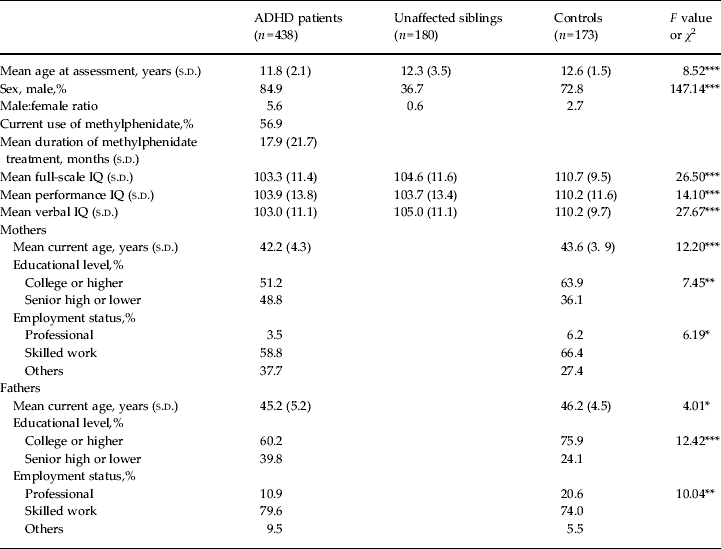
Of the 245 siblings, 180 did not have ADHD diagnosis and/or had not been treated with methylphenidate. Also, 65 diagnosed with ADHD (26.5%) were excluded from further analysis involving co-morbidities and neuropsychological tasks. The prevalence of ADHD in siblings was about four times more than that in the general population (Polanczyk et al. Reference Polanczyk, de Lima, Horta, Biederman and Rohde2007). There were significant group differences for sex, performance and verbal IQ, age at assessment, age of parents, educational level of parents, and employment status of parents. There were 59.6% of ADHD probands having taken methylphenidate, with a mean treatment duration of 17.9 months (Table 1).
Demographics, IQ, and medication for patients with ADHD, their siblings and the controls

IQ, Intelligence quotient; ADHD, attention deficit hyperactivity disorder; s.d., standard deviation.
* p < 0.05, ** p < 0.01, *** p < 0.001.
Psychiatric co-morbidities
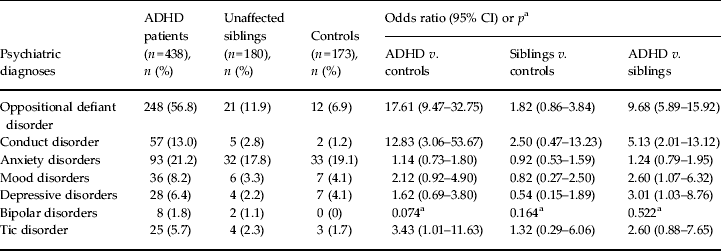
Probands with ADHD were significantly more likely to have oppositional defiant disorder (ODD), conduct disorder (CD) and tic disorder than unaffected controls; and to have ODD, CD and mood disorders than unaffected siblings (Table 2).
Current psychiatric diagnosis for patients with ADHD, their siblings and the controls

ADHD, Attention deficit hyperactivity disorder; CI, confidence interval.
a Fisher's exact p value.
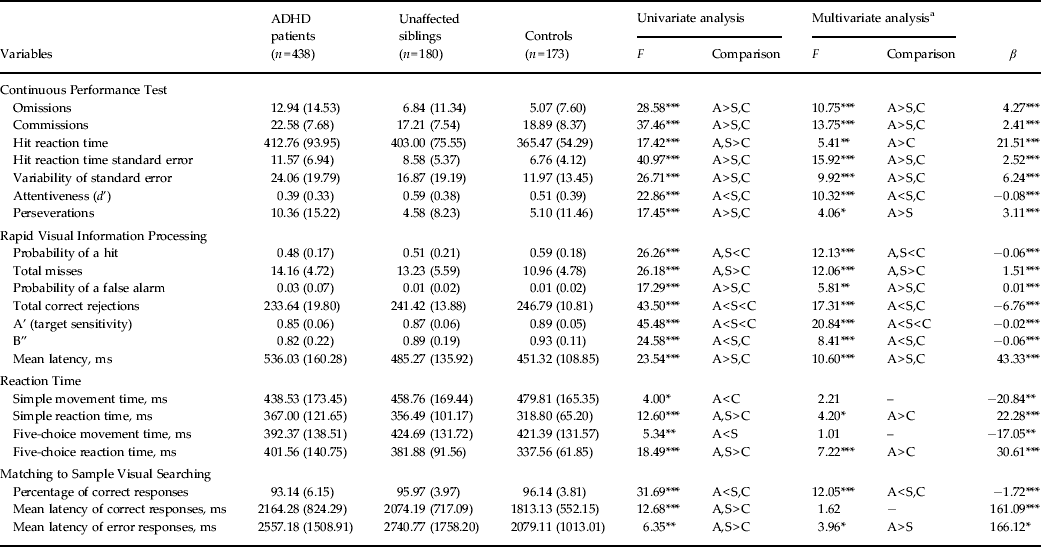
Attention performance (Table 3)
CCPT
Both univariate and multivariate analyses revealed that ADHD probands had higher omissions, commissions, hit RT standard error (s.e.), variability of s.e. and perseverations than unaffected siblings and controls. Attentiveness was significantly lowest in probands with ADHD.
Performances in attention tests among patients with ADHD, their unaffected siblings and the controls

Data are given as mean (standard deviation).
ADHD, Attention deficit hyperactivity disorder; β, regression coefficient estimates for linear trend from the controls, unaffected siblings, to patients with ADHD; A, ADHD; S, siblings; C, controls; A', a signal detection measure of sensitivity to the target, regardless of response tendency; B”, a signal detection measure of the strength of trace required to elicit a response; IQ, intelligence quotient.
a Controlling for sex, age, co-morbidity, performance IQ and parental educational levels.
* p < 0.05, ** p < 0.01, *** p < 0.001.
RVP
Both univariate and multivariate analyses revealed that ADHD probands and unaffected siblings had higher total misses, a lower probability of a hit, and a lower A' (target sensitivity) than controls. Moreover, ADHD probands had lower target sensitivity than unaffected siblings. ADHD probands had higher probability of a false alarm, longer mean latency, less B” (strength of the trace to elicit a response), and fewer total correct rejections than unaffected siblings and controls.
RTI
Univariate analyses revealed that ADHD probands and unaffected siblings had longer five-choice RT than controls. However, in multivariate analyses, only ADHD probands showed significantly longer five-choice RT than controls.
MTS
Univariate analysis revealed that ADHD probands and unaffected siblings had longer mean latency of correct and error responses than controls, and that probands with ADHD had a lower percentage of correct responses than the other two groups. The significant group differences on mean latency of correct responses and between probands with ADHD and controls on mean latency to error responses disappeared after controlling for confounding factors.
Effects of persistent ADHD, methylphenidate and co-morbidity
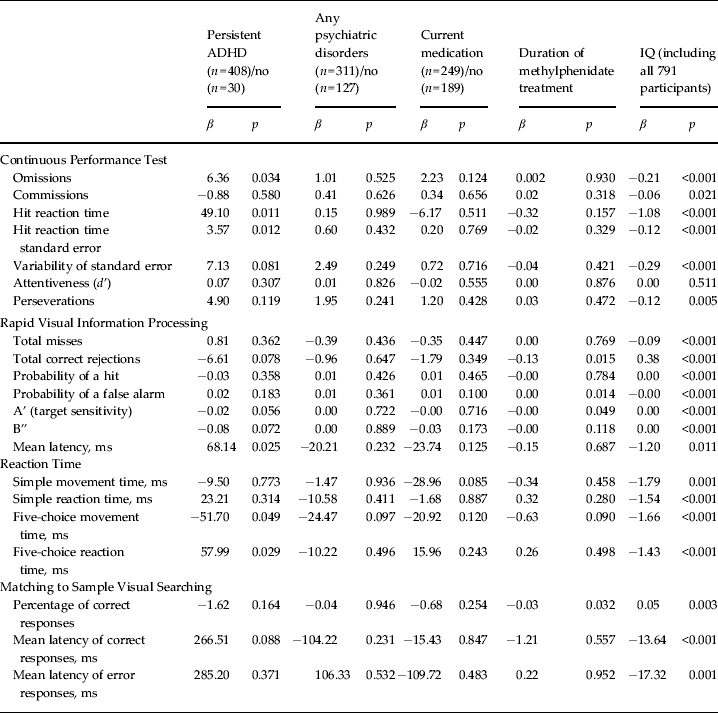
Probands with persistent ADHD (n = 408) had greater omissions, hit RT and its s.e. in the CCPT, longer mean latency in the RVP task, shorter five-choice movement time but longer five-choice RT in the RTI than their non-persistent counterparts (Table 4). In general, psychiatric co-morbidities and current use of medication did not show predictive meaning to any task performance (Table 4). The duration of methylphenidate treatment was positively correlated with total correct rejections, probability of a false alarm, A’ of the RVP task and percentage of correct responses on the MTS task (Table 4). Lastly, IQ score was significantly correlated with all attention measures except Attentiveness (d') on the CCPT (Table 4).
Effects of persistent ADHD, co-morbidities, and current use and duration of methylphenidate treatment among ADHD probands
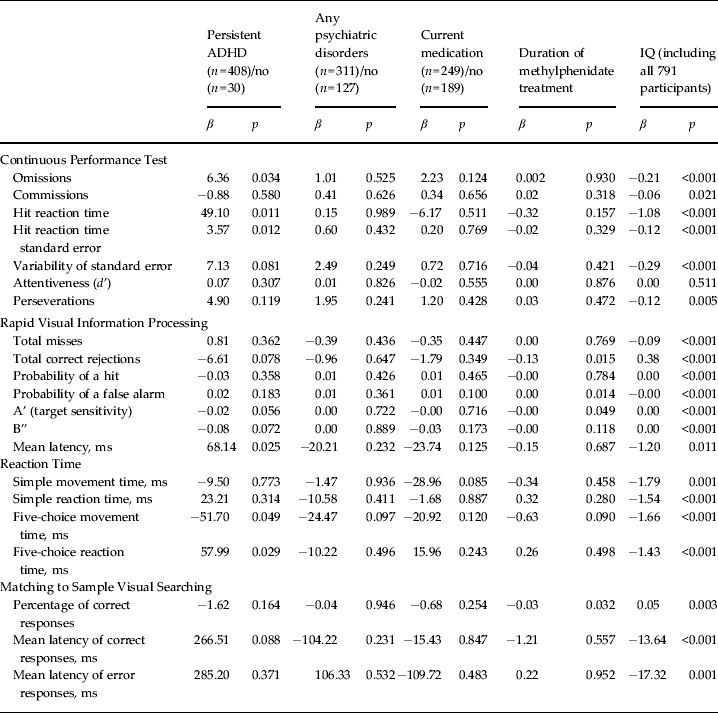
ADHD, Attention deficit hyperactivity disorder; IQ, intelligence quotient; β, regression coefficient estimate; A', a signal detection measure of sensitivity to the target, regardless of response tendency; B”, a signal detection measure of the strength of trace required to elicit a response.
Discussion
This is the first study comprehensively applying attention tests of the CANTAB in the non-Western ADHD population and unaffected relatives of probands with ADHD (unaffected siblings in this study). Our study has three major findings. First, according to multivariate analysis, several parameters of the RVP task (probability of a hit, total misses, and target sensitivity) fit in with the features of ADHD endophenotype, whereas the CCPT and the RTI and MTS tasks do not show the same pattern. The finding corresponds to our hypothesis that sustained attention assessed by the RVP task may be an endophenotype of ADHD. Second, multivariate analysis disclosed that probands with ADHD and the other groups reveal distinct performance in some parameters of the CCPT (omissions, commissions, hit RT s.e., variability of s.e., d'), MTS (percentage of correct responses) and RVP (probability of a false alarm, total correct rejections, mean latency). It suggests these values to be state markers of ADHD. Third, in probands with ADHD, duration of using methylphenidate and full-scale IQ have significant influence on their attention performance.
After correcting the available confounding factors, ADHD probands and unaffected siblings still showed similar patterns in total misses, and probability of a hit of in the RVP task. Their performance in these parameters was significantly different from that of unaffected controls. The results indicate that sustained attention measured by the RVP task has a significant heredity component; it reflects the genetic transmission more than ADHD phenotypes. These findings fulfill the criteria of an ADHD endophenotype proposed by Doyle et al. (Reference Doyle, Faraone, Seidman, Willcutt, Nigg, Waldman, Pennington, Peart and Biederman2005a ).
The RVP task is considered a modified version of the CCPT, measuring both sustained attention and working memory (Coull et al. Reference Coull, Frith, Frackowiak and Grasby1996). Impaired RVP performance was found in patients with schizophrenia and bipolar disorder (Clark et al. Reference Clark, Iversen and Goodwin2002; Cattapan-Ludewig et al. Reference Cattapan-Ludewig, Hilti, Ludewig, Vollenweider and Feldon2005). The target sensitivity index A’ is also a candidate schizophrenic endophenotype (Hilti et al. Reference Hilti, Hilti, Heinemann, Robbins, Seifritz and Cattapan-Ludewig2010). The RVP task involves activation of the bilateral inferior frontal gyrus, parietal cortex, fusiform gyrus and right frontal superior gyrus (Coull et al. Reference Coull, Frith, Frackowiak and Grasby1996). Functional imaging studies of the RVP task reveal that the cognitive processing involves two independent brain circuits (Garavan, Reference Garavan2003). The performance of sustained attention is related to the right fronto-parietal network, while left frontal activation corresponds to working memory (Coull et al. Reference Coull, Frith, Frackowiak and Grasby1996). Scopolamine and nicotine have effects on performance of RVP, implying the relationship between the task and the cholinergic pathway (Wesnes & Warburton, Reference Wesnes and Warburton1984). At the genetic level, dopamine receptor D2 (DRD2) genotype is reported to be correlated with RVP (Gilbert et al. Reference Gilbert, Izetelny, Radtke, Hammersley, Rabinovich, Jameson and Huggenvik2005). The association of the DRD2 polymorphism and ADHD has been proved by several studies, providing reasonable explanations of the genetic basis of RVP (Serý et al. Reference Serý, Drtílková, Theiner, Pitelová, Staif, Znojil, Lochman and Didden2006; Kollins et al. Reference Kollins, Anastopoulos, Lachiewicz, FitzGerald, Morrissey-Kane, Garrett, Keatts and Ashley-Koch2008; Paclt et al. Reference Paclt, Drtilkova, Kopeckova, Theiner, Serý and Cermakova2010).
Though univariate analyses revealed that simple-choice RT and five-choice RT of the RTI task were compatible with the features of ADHD endophenotypes, the significance between unaffected siblings and other groups disappeared in multivariate analyses. Therefore, the biological meaning of RT seemed not as solid as RVP. Several studies found that the performance of RT has a prominent heritable component (Kuntsi et al. Reference Kuntsi, Oosterlaan and Stevenson2001, Reference Kuntsi, Rogers, Swinard, Borger, van der Meere, Rijsdijk and Asherson2006; Gottesman & Gould, Reference Gottesman and Gould2003; Andreou et al. Reference Andreou, Neale, Chen, Christiansen, Gabriels, Heise, Meidad, Muller, Uebel, Banaschewski, Manor, Oades, Roeyers, Rothenberger, Sham, Steinhausen, Asherson and Kuntsi2007). The RT task has been reported to be related to the dopamine receptor D4 (DRD4) polymorphism (Szekely et al. Reference Szekely, Balota, Duchek, Nemoda, Vereczkei and Sasvari-Szekely2011). The five-choice serial RT task, a behavioral test measuring the impulsivity and visual attention of rats, is associated with the cholinergic pathway in the prefrontal cortex (Muir et al. Reference Muir, Everitt and Robbins1996; McGaughy et al. Reference McGaughy, Dalley, Morrison, Everitt and Robbins2002). These results provide an explainable biological basis for the relationship between ADHD and RT tasks, but further clarification is needed.
In some parameters of the CCPT and CANTAB attention tests, unaffected siblings and controls showed similar patterns that were significantly different from the performance of probands with ADHD. These factors seem to be dependent on the state of ADHD. Parameters with the features of ADHD state markers include omission errors, commission errors, hit RT s.e., variability of s.e., and attentiveness in the CCPT; total correct rejections, probability of a false alarm, B”, and mean latency in the RVP task; and percentage of correct responses in the MTS task. Other parameters could not differentiate probands with ADHD from their unaffected siblings. The CCPT has been reported to effectively distinguish children and adults with ADHD from their normal counterparts (Losier et al. Reference Losier, McGrath and Klein1996; Advokat et al. Reference Advokat, Martino, Hill and Gouvier2007). Our results support that the partial parameters of the CCPT can be applied as an assistant tool for ADHD diagnosis. We also noticed that the index of attentiveness (d') in the CCPT (ADHD < unaffected siblings and controls) and the index of target sensitivity (A') in the RVP task (ADHD < unaffected siblings < controls) showed distinct patterns, though they are considered to have similar concepts of attention. This implies that minor deficits in unaffected siblings could be detected by measuring A'. Therefore, target sensitivity assessed by the RVP task (A') might be a potential endophenotype of ADHD and that assessed by CCPT (d') may be a state marker for ADHD.
Psychiatric co-morbidities and concurrent use of medication did not show predictive meanings on task performance among ADHD probands, whereas the duration of methylphenidate treatment had prominent influence on the performance of some attention tasks. Previous studies reveal that chronic use of methylphenidate is related to improved performance of recognition memory (Coghill et al. Reference Coghill, Rhodes and Matthews2007), whereas the acute effect of methylphenidate is improving self-regulatory ability, which presents as faster response of RT (Rhodes et al. Reference Rhodes, Coghill and Matthews2006). In our study, because participants were asked to stay off medications for at least 24 h, the chronic effect of methylphenidate was mainly preserved. It explains that the duration of treatment shows a stronger correlation with task performance than the concurrent medication use. The long-term neuropsychological benefit of methylphenidate is reported to be predicted by the short-term effect that it has on an individual (Kurscheidt et al. Reference Kurscheidt, Peiler, Behnken, Abel, Pedersen, Suslow and Deckert2008). Whether treatment response can be predicted by performance of attention tasks warrants further exploration.
Due to a cross-sectional design of our study, the causation between impaired sustained attention and declined IQ cannot be confirmed. It is possible that the symptoms of inattention interfere with the IQ measurement and cause underestimation of IQ in probands with ADHD, while poor performance in tasks that resulted from low IQ cannot be ruled out. Considering only probands with ADHD, the influence of IQ on task performance generally reduced but was still significant. Intelligence is believed to be an important factor to individuals with ADHD; it can modulate functional performance and affect prognosis (Aman et al. Reference Aman, Armstrong, Buican and Sillick2002). The interaction between attentional defects and intelligence awaits further clarification.
Another interesting issue is that the findings of these attention tasks are cognitive phenotypes or cognitive endophenotypes. Castellanos & Tannock (Reference Castellanos and Tannock2002) discussed the concept of ADHD endophenotypes. They separated four levels in the causal model of ADHD: etiological factors, putative brain abnormalities, candidate endophenotypes, and behaviors. Their theory suggested that candidate endophenotypes should be anchored in neuroscience. In this sense, the measurable poor performance of sustained attention is more likely to be a behavior (or cognitive phenotype), resulting from working memory deficits, the actual ‘cognitive endophenotype’. However, considering other definitions of endophenotype (such as the definition by Doyle et al. adopted in this study), the performance in attention tasks still fits in with most features (Doyle et al. Reference Doyle, Faraone, Seidman, Willcutt, Nigg, Waldman, Pennington, Peart and Biederman2005a ).
The strengths of the present study are the comprehensive examinations of attention performance combining both the CANTAB and CCPT in the largest sample size of a child population and also the first study investigating attention assessed by the CANTAB in unaffected siblings of ADHD probands. The major limitation is the male predominance in the ADHD group. Although the influence of sex was corrected by the multivariate analysis, it is possible that female subjects and their siblings show distinct performance in the attention tasks. Besides, no biological examinations were performed to confirm if medication was actually not taken for more than 24 h, and the negative effects of cognitive performance resulted from the withdrawal from medication could not be excluded.
In summary, our findings suggest that some indexes of impaired sustained attention assessed by the RVP task are independent of clinical inattentive symptoms and may be a cognitive endophenotype of ADHD. The CCPT, the MTS task and some other indexes of RVP are associated with the state of disorder and cannot reflect the heredity etiologies. This study supports that the attention tests of the CANTAB can be applied in a large non-Western sample with good internal validity. They play an important role in clarifying the genetic mechanism of ADHD, as we see in executive functions and visual memory assessed by the CANTAB. For better understanding the relationship between RVP and underlying mechanisms, an integrated design to connect genetic and functional imaging studies is warranted.
Acknowledgements
The present study was supported by grants from the National Health Research Institute (NHRI-EX94-9407PC, NHRI-EX95-9407PC, NHRI-EX96-9407PC, NHRI-EX97-9407PC, NHRI-EX98-9407PC) and from the National Science Council (NSC96-2628-B-002-069-MY3). The authors thank Ming-Fang Chen for her assistance in data analysis.
Declaration of Interest
None.