Introduction
It is well accepted in the literature that the main factors that might affect the partitioning of energy in lactating cow are level of dry matter intake (DMI), environmental conditions that might affect both DMI, energy expenditure as heat production (HP), the production level of milk and body tissue gain and individual variability between cows with respect to the efficiency of energy utilization for maintenance and production (Berman, Reference Berman2005; Brosh, Reference Brosh2007).
Under heat-stress conditions, lactating cows tend to reduce DMI and milk production (West et al., Reference West, Mullinix and Bernard2003). Voluntary DMI can decrease by as much as 6% when ambient temperatures rise above 30°C (Eastridge et al., Reference Eastridge, Bucholtz, Slate and Hall1998). Therefore, under hot weather conditions during the summer, most of the dairy farms in Israel cool the lactating cows by ‘evaporative cooling’, namely an arrangement whereby first the cows are made wet using sprinklers and then exposed to fans to promote evaporation (Flamenbaum et al., Reference Flamenbaum, Wolfenson, Maman and Berman1986; Berman, Reference Berman2005). At present, in Israel only minor changes are made to the total mixed ration (TMR) composition in order to adapt it to the hot weather conditions.
In this respect, we have demonstrated (Miron et al., Reference Miron, Yosef, Maltz and Halachmi2003; Halachmi et al., Reference Halachmi, Maltz, Livshin, Antler, Ben-Ghedalia and Miron2004) that partial replacement of the roughage component of the TMR with readily digestible neutral detergent fiber (NDF)-rich by-products may increase the milk yield of lactating cows by 10% under hot weather conditions. Unfortunately, those studies were operated under inadequate cooling of the cows. There is limited information in the literature concerning the effect of combining intensive evaporative cooling with such a feeding regime, which uses highly digestible by-products such as roughage replacer, on the voluntary DMI, energy status and performance of lactating cows experiencing heat load conditions.
A major part of the metabolizable energy intake (MEI) by cows is dissipated as HP and another part is retained in milk and body tissue (retained energy, RE). Recently, the research group of Brosh and Aharoni developed a new method that can directly measure the HP and RE in milking cows held under commercial dairy barn conditions (Aharoni et al., Reference Aharoni, Brosh and Harari2005; Brosh, Reference Brosh2007). The HP is quantitatively assayed by measuring the volume of O2 consumption (VO2). In mammals, most of the measured VO2 is transferred to the tissues through the heart; therefore, multiplying of daily measured heart rate (HR) by a short measurement of VO2 per heart beat was used for estimation of cows’ HP (Brosh, Reference Brosh2007).
This new method provides a powerful tool to understand the effect of changing the in vitro digestibility and roughage content of the TMR, on the partitioning of the MEI between HP and RE.
The objective of this study was to measure the effect of feeding two rations, differing in their roughage content and in vitro DM digestibility, on the physiological response, DMI, performance and partitioning of the MEI between HP and RE of lactating cows held under hot weather conditions and external evaporative cooling.
Material and methods
Cows, diets, environmental conditions and sampling procedures
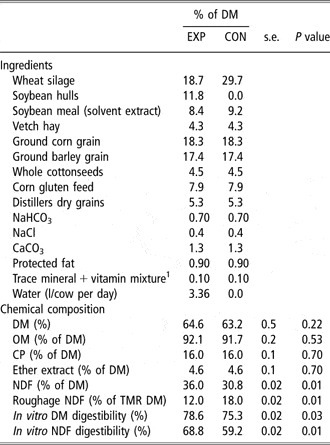
In all, 42 lactating multiparous Holstein cows (average of 2.9 ± 0.1 lactations) were fed for a pre-experimental period of 3 weeks the control TMR described below (Table 1). After the standardization period, the cows were divided into two feeding groups, each of 21 cows, similar in average (means ± s.e.) days in milk (125 ± 5.3), daily milk yield (39.0 ± 0.75 kg) and DMI (23 ± 1 kg) that were fed for 2 adaptation weeks plus additional 6 weeks of experiment, two different TMR. The control TMR fed to the CON group contained 18% roughage NDF, whereas the EXP TMR fed to the EXP cows contained just 12% roughage NDF, in which one-third of the dietary wheat silage was replaced with soy hulls (Table 1). All the cows were housed at the Agricultural Research Organization (ARO) dairy farm, in one shaded corral with free access to water, and were cooled in the milking parlor holding yard. Evaporative cooling was repeated seven times per day, at 0415, 0800, 1115, 1400, 1700, 1915 and 2200 h. Each cooling period lasted 45 min and comprised nine repeated cycles: 1 min of wetting the cows with water using sprinklers, followed by 4 min exposure to fans promoting evaporation. Thus, the total shower cooling time of the cows lasted about 5.25 h/day, which allows enough time for eating and rumination as seen in the high intake and milk production levels of the cows. The cooling system makes use of 10 high-velocity fans (air speed of 3 m/s). The two TMRs were offered once daily at 1030 h with ad libitum intake, allowing for 5% to 10% orts, and the cows were milked three times daily at 0500, 1200 and 2000 h. Cows were fed individually via a computerized monitoring system, designed to electronically identify individual cows and to control and automatically record daily individual feed intake (Miron et al., Reference Miron, Yosef, Maltz and Halachmi2003).
Ingredients and chemical composition of the two total mixed rations

EXP = experimental total mixed ration (TMR) containing 12% NDF of roughage origin; CON = control TMR containing 18% NDF of forage origin; DM = dry matter; OM = organic matter.
1Trace minerals + vitamins mix contained (g/kg DM): Zn, 24; Fe, 24; Cu, 12.8; Mn, 24; I, 1.44; Co, 0.32; Se, 0.32; vitamin A, 16 000 000 IU; vitamin D3, 3 200 000 IU; vitamin E, 48 000 IU.
TMRs were sampled daily and pooled on a weekly basis to produce 10 samples for each dietary treatment. DMI was determined by oven drying at 105°C for 24 h a portion of the weekly TMR samples. The rest of the weekly TMR samples were oven dried at 60°C for 48 h, ground through a 1-mm sieve and used for in vitro digestibility evaluation and chemical analyses.
The milk yield of each cow was recorded daily by automatic meters (Afimilk SAE, Kibbutz Afikim, Israel). Milk samples were collected during three sequential milkings on a weekly basis throughout the study. Each set of milk samples for each cow was stored at 4°C in the presence of a preservative Bronopol (2-bromo-2-nitropropane-1,3-diol) tablet, until analyzed for content of fat, true protein, lactose and urea by infrared analysis (Israeli Cattle Breeders Association Laboratory, Caesaria, Israel, using Milkoscan 4000, Foss Electric, Hillerod, Denmark). Body weight (BW) data were recorded by an automated walkover weigher each time the cow entered the milking parlor. The animal performance study was carried out according to the guidelines and under the supervision of the ARO Animal Care Committee.
Chemical analyses and in vitro digestibility measurements
Replicate samples of the weekly composites of each TMR and of the orts of the individual cows were assayed in triplicate for DM content (drying at 105°C for 24 h) and residual ash (4 h at 600°C). Dry TMR samples were ground through a 1-mm sieve, and analyzed for crude protein (CP) content according to the Kjeldahl method (AOAC, 2001) and for the content of NDF (without sodium sulfite and with heat-stable amylase, Van Soest et al., Reference Van Soest, Robertson and Lewis1991). The Ankom apparatus (Ankom220; Fairport, NY, USA) was used for extracting and filtering the NDF. Net energy (NEL) content of each TMR was calculated based on the NEL content of the individual feeds (NRC, 2001).
In vitro digestibility of DM and NDF in the weekly composites of TMR was analyzed in triplicate for each sample. The procedure involved incubating 0.5 g dry plant material with rumen fluid for 48 h and then with 0.1 N HCl and 0.2% pepsin for another 48 h, according to the two-stage fermentation technique of Tilley and Terry (Reference Tilley and Terry1963). Rumen fluid was obtained before morning feeding via rumen fistula from three dry cows fed a mixture of the CON and EXP diets. Residual NDF in the in vitro tubes was determined according to Van Soest et al. (Reference Van Soest, Robertson and Lewis1991).
Calculations and statistical methods
Yield of energy-corrected milk (ECM) was calculated according to the NRC (2001) equation, ECM (kg/day) = milk yield (kg/day) × [(0.3887 × % milk fat) + (0.2356 × % milk protein − urea) + (0.1653 × % milk lactose)]/3.1338 MJ/kg.
Comparison between the two feeding groups with respect to physiology, individual intake, performance and energy status parameters was carried out according to the repeated measurement Proc mixed model of SAS (SAS, 1996), and presented in Tables 2 and 3 as the daily mean for the 6-week experimental period. The F-test was used to differentiate between means (SAS, 1996).
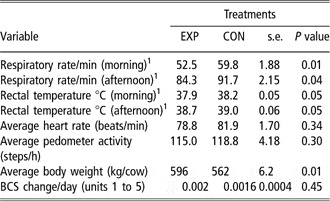
Respiratory rate, rectal temperature, heart rate, pedometer activity, body weight and body condition score (BCS) changes, of cows fed the two total mixed rations

EXP = experiment total mixed ration (TMR) containing 12% roughage NDF; CON = control TMR containing 18% roughage NDF.
1Morning measurements at 0700 h (immediately after cooling) and afternoon measurement at 1700 h (2 h post cooling).
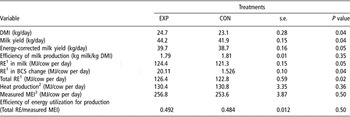
Milk performance and energy partitioning in cows fed the two dietary treatments

EXP = experiment TMR containing 12% roughage NDF; CON = control TMR containing 18% roughage NDF; DMI = dry matter intake; RE = retained energy; BCS = body condition score; MEI = metabolizable energy intake.
1RE in milk and/or BCS change according to Aharoni et al. (Reference Aharoni, Brosh and Kafchuk2006).
2Total heat production (HP) = heart rate (HR) × O2P × 20.47/1000 × 60 × 24.
3Measured MEI = total RE + HP.
Differences between the two TMRs (six weekly composites of each TMR) with respect to composition and in vitro digestibility were tested for significance using an analysis of variance (SAS, 1996).
Physiological measurements
Rectal temperature was measured with a digital electronic thermometer (Toshiba Glass Co. Ltd, Shizuoka, Japan) and respiration rate (RR) was visually measured in each cow 3 days per week of the experiment at 700 and 1700 h. A trained veterinarian, the same one throughout the study, measured body condition scores (BCS) on a weekly basis in a scale of 1 to 5 according to NRC (2001).
The HR and HP of the individual cows were measured as described previously by Aharoni et al. (Reference Aharoni, Brosh and Harari2005) and Brosh (Reference Brosh2007). These parameters were measured in each cow twice, at 3-week intervals, during the experimental period.
The HR was recorded with a Polar instrument (Polar Electro Oy, Kempele, Finland), a model T51H HR transmitter, and a watch model S610 data logger and receiver (details in Aharoni et al., 2006). The devices were attached to the thorax behind the forelegs by means of a specifically designed elastic belt (Pegasus, Eli-ad, Israel). HR was measured continuously for 4 days in each measurement; the data logger was programmed to record HR at 1-min intervals. VO2 was measured for in each cow with a facemask open-circuit respiratory system simultaneously with the HR for 10 to 15 min for each cow from 0900 to 1100 h immediately after 4 days of HR measurement. The HP (kJ kg BW−0.75/day) was calculated by multiplying the means of HR measured throughout 3 to 4 days by the VO2 per heartbeat O2 pulse (O2P), and by 20.47 kJ/l VO2 (Nicol and Young, Reference Nicol and Young1990). For the non-cooled cows, O2P during the hot hours was corrected for the effect of temperature humidity index (THI) on O2P, as suggested by Aharoni et al. (Reference Aharoni, Brosh, Kourilov and Arieli2003). The HP and the energy retained in the milk and BW gain were measured for each cow in each treatment. The equation used to calculate HP was (Brosh, Reference Brosh2007)

where

HR = heart rate (beats/min), O2P = l of O2/(beat × kg BW0.75), 20.47 = kJ/l O2 consumption.
Environmental climate data in the barn including ambient temperature, humidity, wind speed and directions were monitored continuously during the experimental period using a weather monitoring station (RWMS-8; Rotem Computerized Controllers, Petach-Tikva, Israel).
The THI was calculated (Aharoni et al., Reference Aharoni, Brosh, Kourilov and Arieli2003) with the equation

where td is the dry bulb temperature (°F), RH is the relative humidity expressed as a decimal.
Results and discussion
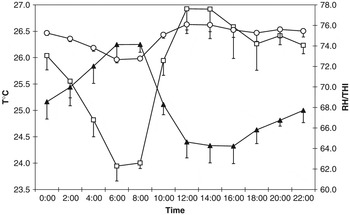
The distribution in the barn of ambient air temperature, relative humidity and THI data over an average day and night of the experimental period is illustrated in Figure 1. Environmental conditions in the barn were similar for the two dietary groups and stable throughout the 6 weeks of the experiment. Ambient temperature was high (26°C to 27°C) during most of the day hours and early evening, with daily averages of 25.7°C.
Average diurnal pattern of ambient air temperature (T°C ± s.e.) □; relative humidity (RH ± s.e.) ▴; and temperature humidity index (THI ± s.e.) ○ in the barn.

RH was the highest in the early morning hours and its daily average was 66.6%. Thus, THI was confined within a narrow range (74 to 76) during the experimental period, which was typical of heat load conditions. Therefore, we have used an external evaporative cooling method to improve the voluntary intake and performance of all the cows.
The in vitro digestibility of the EXP TMR was significantly higher than the CON TMR (78.6 v. 75.3, Table 1) and reflected the large difference in NDF digestibility of the two TMR (68.8% v. 59.2%). This difference affected the RR and rectal temperature of the cows and their voluntary DMI (Table 2). Cows fed the EXP TMR responded by a decrease of their RR by 13% in the morning hours and by 9% in the afternoon hours, as compared with the CON group. A positive significant effect of the feeding regime on reducing rectal temperature of the cows by 0.3°C was manifested in both the morning and afternoon measurements (Table 2). However, the effect of the feeding regime on HR and daily steps (activity) was not significant. Unfortunately, there is limited information in the literature regarding the relationship between body temperatures and feeding of high-energy diets to lactating cows under heat load conditions.
Total daily DMI of cows fed EXP TMR relative to cows fed CON TMR was higher by 6.9% (24.7 v. 23.1 kg/day per cow, P < 0.04, Table 3). This higher DMI of the EXP cows might be attributable partially to their better heat balance status reflected in lower rectal temperatures and RR (Table 2), and to improved digestibility and increased rate of passage for the soy hull-containing diet. Similar daily DMI differences in mid-lactating cows were reported in previous studies employing soy hulls as corn silage replacement under heat load conditions without evaporative cooling of the cows (Miron et al., Reference Miron, Yosef, Maltz and Halachmi2003; Halachmi et al., Reference Halachmi, Maltz, Livshin, Antler, Ben-Ghedalia and Miron2004). The higher DMI observed for cows fed the EXP TMR and the higher DM and NDF in vitro digestibility of this TMR as compared with the CON diet (Table 1) were reflected in concomitant increase of 5.5% in milk production and only by 2.4% in ECM yield of the cows (P < 0.05, Table 3).
These moderated although significant differences in digestibility, DMI and ECM yield between the two dietary treatments resulted in a 2.9% increase (P < 0.05) in RE for milk + body tissue production of the cows fed the EXP TMR, as compared with the CON group. This increase in RE was not followed by any significant increase in the HP of the cooled cows, which was maintained at a constant level of 130.4 to 130.8 MJ/cow per day. Similar constant levels of total HP in the range of 122.6 to 135.6 MJ/cow per day were also measured in previous studies with lactating non-cooled Holstein cows, held under various feeding regimes, climate conditions and over different stages of lactation (Aharoni et al., Reference Aharoni, Brosh and Harari2005 and Reference Aharoni, Brosh and Kafchuk2006; Miron et al., 2007, unpublished). The finding of this study and of the previous ones that shower cooling and various feeding regimes hardly affect the HP of mid-lactation Holstein cows deserves further investigation. Total HP is actually the sum of HPp (HP for milk and body tissue production) plus HPm (HP for maintenance including pregnancy and embryo needs). The constant level of HPp + HPm = 130 MJ/cow per day, found in this study, in accordance with previous data (Aharoni et al., Reference Aharoni, Brosh and Harari2005 and Reference Aharoni, Brosh and Kafchuk2006; Miron et al., 2007 unpublished), suggests that any increase in HPp of the cows is enabled by a concomitant decrease in their HPm. Thus, under severe heat load conditions without external cooling, HPm of the lactating cows might increase (see Berman, Reference Berman2005) and therefore HPp should be concomitantly decreased to maintain the total HP level. However, under external evaporative cooling, the HPm might decrease as demonstrated previously (Berman, Reference Berman2005), allowing for concomitant increase in HPp. Based on this study and on the previous ones (Aharoni et al., Reference Aharoni, Brosh and Harari2005 and Reference Aharoni, Brosh and Kafchuk2006; Miron et al., 2007 unpublished), we suggest that an HP level of around 130 MJ/cow per day is the upper limiting range of heat disposal capability that a high-producing mid-lactation cow (yielding 35 to 45 kg milk/day) can handle under Israeli heat load conditions, while maintaining its body rectal temperature at a level below 40°C. Consequently the cows respond to external heat load conditions by reducing the level of production and HPp in order to maintain their internal HP level.
The possible mechanism involved in the control of voluntary DMI by the lactating cow under heat load versus external cooling conditions is still unknown. Forbes (Reference Forbes1986) suggested that temperature receptors occur in many parts of the cow body, including in the skin and anterior hypothalamus as well as in the rumen wall and the abdomen, with the afferent fibers in the splanchnic nerves, and in this way heating or cooling may affect the short-term control of voluntary DMI. Based on the present study findings we suggest that the cow’s heat loss capability limits its total HP, which indirectly affects its voluntary intake and milk production level.
The constant level of total HP found in this study suggests that since calculated MEI = RE + HP, there should be a linear correlation between RE and calculated MEI. Indeed, in this study the r 2 value of the correlation between MEI and RE was 0.93. This finding suggests that changes in the composition and/or digestibility of the TMR, which affect DMI and may increase MEI, affect directly the level of production expressed by RE and has a minor effect, if any, on the HP.
Milk production efficiency (kg milk /kg DMI, Table 3) and efficiency of energy utilization for milk and tissue production (total RE/measured MEI, Table 3) were hardly influenced by the dietary treatments, despite the higher in vitro digestibility of the EXP TMR (Table 1). This finding implies that the increased DM and NDF potential digestibility (in vitro) of EXP TMR is expressed mostly in increasing daily DMI, which in turn elevates milk and ECM production, and is not manifested by improved feed utilization efficiency along the digestive tract. This premise is supported by the high coefficient of correlation for the linear regression in this study between DMI and ECM yield (r 2 = 0.94). This high correlation supports the important influence of DMI on milk production, as described also in previous reports (Van Soest, Reference Van Soest1994).
One possible explanation for the low effect of in vitro TMR digestibility on ECM yield (Table 3) is that the higher DM and NDF voluntary intake by cows fed the EXP TMR increased, in turn, the passage rate of particles and NDF from the rumen, causing a reduced rate and extent of NDF digestion along the gastrointestinal tract (Van Soest, Reference Van Soest1994; NRC, 2001). Similar findings have been documented in previous studies that compared various diets differing in their potential in vitro DM digestibility, where a great effect on voluntary DMI was observed, but with little influence on milk production efficiency (Solomon et al., Reference Solomon, Adin, Mabjeesh, Nikbachat, Yosef, Ben-Ghedalia and Miron2005; Miron et al., Reference Miron, Yosef, Nikbachat, Zenou, Maltz, Halachmi and Ben-Ghedalia2004a and Reference Miron, Nikbachat, Zenou, Ben-Ghedalia, Solomon, Shoshani, Halachmi, Livshin, Antler and Maltz2004b).
Data of this study, based on direct measurements of total HP and total RE, enable comparison between the predicted NEL value of the diets, which was 6.67 and 6.58 MJ/kg DMI in the EXP and CON diets, respectively (based on NRC, 2001 data)and the direct measurements of RE in the two treatments (Table 3). This comparison shows the under-estimation of 20% to 24% in the total RE measured in this study as compared with the predicted NEL values (NRC, 2001). This gap between estimated and measured NEL values probably originated from the higher HP values measured in this study (130 MJ/cow per day operated under hot summer conditions) as compared with the lower HP estimations (∼90 MJ/cow per day) used by NRC (2001). Additional explanation for this gap is the lower quality of Israeli forages as compared with National Research Council standard (NRC), which contributes to the higher HP in the digestive tract that might further increase the HP level. This gap between predicted and measured NEL values suggests that the methodology used for the estimation of the nutritive value of forages in Israel (NEL estimation according to NRC (2001) Tables) should be re-evaluated and adapted to the quality of Israeli forages and to the actual HP values measured under Israeli conditions.
Conclusions
This study demonstrates that feeding lactating cows with soy hulls as partial roughage replacer increased DMI by 6.9% and milk yield by 5.5% (P < 0.05). The feeding regime hardly affected the efficiency of energy utilization for ECM and BCS production, suggesting that the EXP treatment affected mostly the intake level rather than the digestibility along the gastrointestinal tract. This was reflected by an increase in the total RE for milk and body tissue reserves, while the HP was maintained fairly constant at a level of 130 MJ/cow per day. Based on the present study findings, supported by previous studies, we can hypothesize that the cow’s total HP capability (upper level of about 130 MJ/cow per day) limits its voluntary intake, level of production and RE.
Acknowledgments
We wish to express our appreciation to the Volcani Center dairy farm team for their efforts in cooling and feedings the cows, and to Mr Zwi Sarid and his team from ‘Yavne Feeding Center’ for preparing and delivering the two TMR. This study was supported by a research grant # 362-071-06 of the Israeli Milk Council.