Implications
Reducing crude protein concentration in diets for fattening rabbits without impairing growth performance and meat quality would reduce feeding costs and control nitrogenexcretion in rabbit farms.
This paper describes that feeding growing rabbits with low-protein and high-soluble fibre-to-starch ratio diets reduces mortality, improves digestive efficiency and intestinal environment and enhances the meat quality without affecting growth performance, with advantages for breeders (lower production costs), consumers (improved meat safety) and the environment (lower nitrogen excretion).
Introduction
Starch is the main source of energy in feeding rabbits, but in young rabbits, soon after weaning, high-starch low-NDF diets have been considered responsible for digestive troubles for a long time (Blas and Gidenne, Reference Blas and Gidenne2010; De Blas and Mateos, Reference De Blas and Mateos2010). In contrast, soluble fibre, particularly pectins and β-glucans that are the more readily digestible cell wall carbohydrates (Van Soest et al., Reference Van Soest, Robertson and Lewis1991), can increase the energy value of diets and improve feed conversion in growing rabbits (Perez et al., Reference Perez, Gidenne, Bouvarel, Arveaux, Bourdillon, Briens, La Naour, Messager and Mirabito2000; Trocino et al., Reference Trocino, Fragkiadakis, Majolini, Carabaño and Xiccato2011) while playing a positive role on gut health and caecal fermentations (García et al., Reference García, Carabaño, Perez-Alba and De Blas2000; Gidenne and Bellier, Reference Gidenne and Bellier2000; Falcão-e-Cunha et al., Reference Falcão-e-Cunha, Peres, Freire and Castro-Solla2004), intestinal mucosa integrity (Álvarez et al., Reference Álvarez, Margüenda, García-Rebollar, Carabaño, De Blas, Corujo and García-Ruiz2007; Gómez-Conde et al., Reference Gómez-Conde, García, Chamorro, Eiras, García-Rebollar, Perez De Rozas, Badiola, De Blas and Carabaño2007) and microbiota composition (Gómez-Conde et al., Reference Gómez-Conde, Pérez de Rozas, Badiola, Pérez-Alba, de Blas, Carabaño and García2009). At constant ADF level, the substitution of starch with soluble fibre often reduced mortality (Gidenne and Perez, Reference Gidenne and Perez2000; Soler et al., Reference Soler, Blas, Cano, Pascual, Cervera and Fernández-Carmona2004; Xiccato et al., Reference Xiccato, Trocino, Carraro, Fragkiadakis and Majolini2008).
In addition, a high dietary protein (DP) level, besides affecting growth performance and nitrogen excretion of rabbits (Xiccato and Trocino, Reference Xiccato and Trocino2010), may impair caecal fermentations and alter gut microflora composition and thus is considered to be among the causes of increased mortality in rabbits (De Blas et al., Reference De Blas, Pérez, Fraga, Rodríguez and Gálvez1981; Carabaño et al., Reference Carabaño, Villamide, García, Nicodemus, Llorente, Chamorro, Menoyo, García-Rebollar, García-Ruiz and De Blas2009). Possible interactions between the protein level and the soluble fibre-to-starch ratio may be hypothesised (Gidenne et al., Reference Gidenne, Kerdiles, Jehl, Arveux, Briens, Eckenfelder, Fortun, Montessuy and Muraz2001; Carabaño et al., Reference Carabaño, Villamide, García, Nicodemus, Llorente, Chamorro, Menoyo, García-Rebollar, García-Ruiz and De Blas2009), but needs to be proven.
This paper aims to assess whether decreasing crude protein (CP) concentration (162 to 152 g/kg) and increasing soluble fibre-to-starch ratio (from 0.2 to 0.6 to 1.5) by replacing starch (from 209 to 91 g/kg) with soluble fibre (from 48 to 136 g/kg) in iso-ADF diets might affect feed efficiency, growth performance and slaughter results, besides improving gut conditions of fattening rabbits.
Material and methods
Animals and diets
This paper was approved by the Ethical Committee for Animal Experimentation of the University of Padova and by the Italian Ministry of Education, University and Research and all animals were handled according to the principles stated by the EC Directive 86/609/EEC with regard to the protection of animals used for experimental and other scientific purposes.
A total of 246 rabbits of both genders from a hybrid line (Grimaud Frères, France) were reared in individual cages (28.5 × 41.0 × 28.5 cm) from weaning, at 33 days of age. The rabbits were kept in a brick shed equipped with a forced heating and cooling system to maintain the temperature within the range of 16°C to 21°C and submitted to a natural photoperiod during the months of March and April.
The rabbits were divided into six groups (41 rabbits each), homogeneous in average live weight (LW) and variability, and given ad libitum access to six experimental pelleted diets and water. A total of 210 rabbits (35 per dietary treatment) were used for the 42-days growth trial (33 to 75 days of age) and 36 rabbits (6 per dietary treatment) were slaughtered at 55 days of age for sampling caecal content and intestinal mucosa.
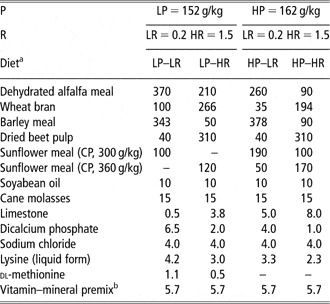
Four diets (low protein–low ratio (LP–LR), LP–HR (high ratio), (high protein) HP–LR, HP–HR) were formulated as a combination of two levels of CP (LP = 152 g/kg and HP = 162 g/kg) and two soluble fibre-to-starch ratios (LR = 0.2 and HR = 1.5; Table 1). Dilution technique was used to obtain two more diets with intermediate soluble fibre-to-starch ratio (medium ratio, MR = 0.6): diet LP–MR (0.5 LP–LR + 0.5 LP–HR) and diet HP–MR (0.5 HP–LR + 0.5 HP–HR). All diets were integrated with synthetic lysine and methionine, macro- and micro-minerals and vitamins to satisfy the nutritional requirements of growing rabbits (De Blas and Mateos, Reference De Blas and Mateos2010).
Ingredient composition (g/kg) of experimental diets

P = protein level; LP = low protein; HP = high protein; R = soluble fibre-to-starch ratio; LR = low ratio; HR = high ratio.
aDiet LP–MR was obtained as 0.5 diet LP–LR+0.5 diet LP–HR; diet HP–MR was obtained as 0.5 diet HP–LR + 0.5 diet HP–HR.
bPremix provided per kilogram of complete diet: vitamin A, 12 000 IU; vitamin D3, 1000 IU; vitamin E acetate, 50 mg; vitamin K3, 2 mg; biotin, 0.1 mg; thiamin, 2 mg; riboflavin, 4 mg; vitamin B6, 2 mg; vitamin B12, 0.1 mg; niacin, 40 mg; pantothenic acid, 12 mg; folic acid, 1 mg; choline chloride, 300 mg; Fe, 100 mg; Cu, 20 mg; Mn, 50 mg; Co, 2 mg; I, 1 mg; Zn, 100 mg; Se, 0.1 mg; Robenidine, 66 mg.
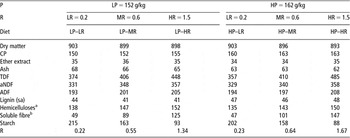
The different proportions of two types of sunflower meals (CP, 300 and 360 g/kg) accounted for the lower dietary CP measured in diets LP (on average 152 g/kg) compared with diets HP (162 g/kg; Table 2). On average, diets LP and HP presented a similar concentration of ADF (200 g/kg), soluble fibre (88 and 98 g/kg) and starch (157 and 149 g/kg).
Chemical composition (g/kg as fed) of experimental diets

P = protein level; LP = low protein; HP = high protein; R = soluble fibre-to-starch ratio; LR = low ratio; MR = medium ratio; HR = high ratio; TDF = total dietary fibre.
aaNDF–ADF.
bTDF–aNDF after correction for protein and ash.
Soluble fibre-to-starch ratio increased by decreasing the inclusion rates of barley (approximately −290 g/kg) and alfalfa meal (−160 to −170 g/kg) and raising the proportions of dried beet pulp (+270 g/kg) and wheat bran (approximately +160 g/kg). The concentrations of ADF (193 to 207 g/kg, on average) and lignin (sa; ∼45 g/kg) were rather constant when increasing soluble fibre-to-starch ratio.
No antibiotic drug was administered in feed or water during the assay, but the diet contained a coccidiostat (Robenidine, 66 mg/kg diet).
Growth performance and health status
Individual LW and feed intake were recorded three times a week. The health status of the rabbits was controlled daily. The rabbits were considered ill when evidencing diarrhoea and/or mucus in faeces as well as strong reduction of feed intake (at least −0.30 compared with the previous recording). In the calculation of morbidity, the ill rabbits were considered only once and the dead animals were considered only in the calculation of mortality. The sanitary risk was calculated as the sum of morbidity and mortality.
Digestibility trial
The apparent digestibility coefficients of dry matter (DM) and nutrients and the digestible energy (DE) concentration of the experimental diets were measured in an in vivo digestibility assay carried out on 60 rabbits among those being tested (10 animals of both genders per diet) according to the European standardised method (Perez et al., Reference Perez, Lebas, Gidenne, Maertens, Xiccato, Parigi Bini, Dalle Zotte, Cossu, Carazzolo, Villamide, Carabaño, Fraga, Ramos, Cervera, Blas, Fernández, Falcão-e-Cunha and Bengala Freire1995). The digestibility trial started at 52 days of age with a 4-day collection period.
Caecal content and intestinal mucosa sampling
A total of 36 rabbits (6 per diet) were slaughtered at 55 days of age to sample caecal content and intestinal mucosa. The slaughtered animals were representative of the corresponding experimental group in terms of average LW and variability. The rabbits were weighed immediately before slaughter and killed by cervical dislocation from 0800 to 1200 h. The stomach and caecum were removed and weighed. The pH of caecal content was immediately measured. The caecal content was diluted (15% v/v) with HPO3 solution (25% w/w) and stored at −20°C until their chemical analyses.
Two samples of intestinal mucosa were taken from the intermediate tract of jejunum and the distal tract of ileum, fixed in para-formaldehyde at 4% v/v in phosphate buffered saline, then dehydrated and included in paraffin. Sections of 4 μm were obtained after cutting by microtome and used for morphometric evaluations on preparations coloured with haematoxylin/eosin. Villi length and crypt depth were measured with image analysis software (DP-soft, Olympus Optical Co., Hamburg, Germany) as an average of 30 measurements taken from five independent cross-sectional mucosa sections (for which at least six measurements were done) for each animal.
Final slaughter and carcass recordings
At 75 days of age, the rabbits were slaughtered in a commercial slaughterhouse and the carcasses chilled at 2°C for 24 h. The chilled carcasses were then dissected according to harmonised methods (Blasco et al., Reference Blasco, Ouhayoun and Masoero1993). The pH was measured in duplicate on Longissimus lumborum and Biceps femoris muscles. In addition, the lightness (L*), redness (a*), yellowness (b*) colour indexes (Commission Internationale de l'Eclairage, 1976) were measured in duplicate on the same muscles using a spectrophotometer Minolta CM-508 C (Minolta Corp., Ramsey, NJ, USA).
Chemical analyses
Diets and faeces were analysed to determine the concentrations of DM (934.01), ash (967.05), CP (2001.11) and starch (amyloglucosidase-α-amylase method, 996.11) by Association of Official Analytical Chemists (AOAC, 2000) methods. Ether extract was determined after acid-hydrolysis treatment (European Community, 1998). Fibre fractions, that is, aNDF (without sodium sulphite), ADF and lignin (sa), were analysed according to AOAC (2000), procedure 973.187; Mertens (Reference Mertens2002) and Van Soest et al. (Reference Van Soest, Robertson and Lewis1991), respectively, using the sequential procedure and the filter bag system (Ankom Technology, NY, USA). Total dietary fibre (TDF) was determined by gravimetric-enzymatic procedure with α-amylase, protease and amyloglucosidase treatments (Megazyme Int. Ireland Ltd, Wicklow, Ireland; method AOAC 991.43). Soluble fibre was calculated by subtracting aNDF to TDF after correction for CP and ash (Van Soest et al., Reference Van Soest, Robertson and Lewis1991). Gross energy was measured by adiabatic bomb calorimeter.
The thawed samples of caecal content were centrifuged for 10 min at 9000 × g. Caecal N-ammonia was determined on the supernatant by pH-meter (PHM 84, Research pH-meter, Radiometer, Copenhagen, Denmark) equipped with ammonia-specific electrode (mod. 9512, Orion Research Inc., Boston, MA, USA). Volatile fatty acid (VFA) concentration was measured on the supernatant with the procedures described by Trocino et al. (Reference Trocino, Fragkiadakis, Radaelli and Xiccato2010), using a gas-chromatograph (HRGC 5300 Carlo Erba, Milan, Italy) on a cross bond capillary column (25 m × 0.32 mm i.d., 3.5 μm film thickness; JRX, Mega, Milan, Italy).
Statistical analysis
Data were analysed by a three-way ANOVA, which considered CP level, soluble fibre-to-starch ratio and gender as the main effects. The effect of gender was neither reported nor discussed because it was not relevant to the objectives of this paper. The GLM (Statistical Analysis System (SAS), 1991) procedure was used for all analyses. Orthogonal contrasts were used to test the linear response to increasing soluble fibre-to-starch ratio. Differences among means with P < 0.05 were accepted as representing statistically significant differences. Differences among means with 0.05 < P < 0.10 were accepted as representing tendencies to differences.
Mortality, morbidity and sanitary risk were analysed by the CATMOD SAS procedure.
Results
Digestibility coefficients and nutritive value of diets
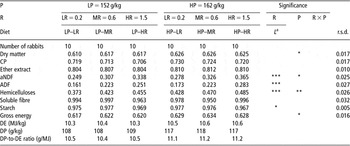
Increasing dietary CP significantly (0.001 < P < 0.05) improved digestive utilisation of DM (0.615 to 0.626 on average) and gross energy (0.620 to 0.630) as well as aNDF (0.298 to 0.323) and hemicelluloses (0.417 to 0.461; Table 3). Both DE concentration (10.3 v. 10.6 MJ/kg) and digestible protein (DP)-to-DE ratio (10.5 v. 11.2 g/MJ) were lower in LP diets than in HP diets.
Digestibility coefficients and nutritive value of experimental diets

P = protein level; LP = low protein; HP = high protein; R = soluble fibre-to-starch ratio; LR = low ratio; MR = medium ratio; HR = high ratio; DE = digestible energy; DP = digestible protein.
aL, probability of the linear component of variance.
*P < 0.05; **P < 0.01; ***P < 0.001.
Increasing soluble fibre-to-starch ratio did not change DM and gross energy digestibility, although it linearly decreased the digestibility of starch (from 0.976 to 0.968; P < 0.05) and linearly increased (P < 0.001) the digestibility of aNDF (0.264 to 0.352), ADF (0.167 to 0.267) and hemicelluloses (0.400 to 0.470). As for starch, soluble fibre was rather completely digested (0.95 to 1.00) in all diets. Both DE concentration (10.4 to 10.5 MJ/kg) and DP-to-DE ratio (10.8 to 10.9 g/MJ) were similar in diets with raising soluble fibre-to-starch ratio.
Health status and growth performance
During the trial, nine animals died of which six were fed the HP–LR diet, one the HP–MR diet, one the LP–LR diet and one the LP–HR diet. Increasing CP level tended (P = 0.10) to increase mortality, whereas raising soluble fibre-to-starch ratio significantly reduced mortality (10.0 to 1.4 and 1.4%; P < 0.05; Table 4). Rabbits fed HP–LR diet, with HP level and low-soluble fibre-to-starch ratio, showed the highest mortality rate (17.1%) compared with the other groups (1.7% on average; P < 0.001) as well as the highest sanitary risk (20.0% v. 8.1%; P = 0.04).
Rabbit mortality, morbidity and sanitary risk from weaning (33 days of age) to slaughter (75 days)

P = protein level; LP = low protein; HP = high protein; R = soluble fibre-to-starch ratio; LR = low ratio; MR = medium ratio; HR = high ratio.
aDiet HP–LR v. LP–LR + LP–MR + LP–HR + HP–MR + HP–HR; P < 0.001.
bNo statistical analysis was possible.
cSanitary risk = mortality + morbidity.
dDiet HP–LR v. LP–LR + LP–MR + LP–HR + HP–MR + HP–HR; P = 0.04.
*P < 0.05.
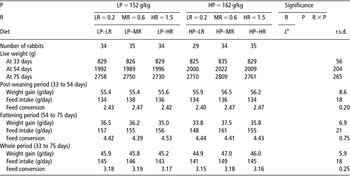
Growth performance was not affected by the feeding treatments either in the first (33 to 54 days) or in the second period (54 to 75 days) of growth (Table 5). From an initial average LW of 829 g at 33 days, rabbits weighed 2753 g at 75 days, showing in the whole trial a daily weight gain of 45.8 g/day, a daily feed intake of 145 g/day and a feed conversion equal to 3.17, in good accordance with the standard performance of the genetic type used.
Rabbit performance from weaning (33 days of age) until slaughter (75 days)

P = protein level; LP = low protein; HP = high protein; R = soluble fibre-to-starch ratio; LR = low ratio; MR = medium ratio; HR = high ratio.
aL, probability of the linear component of variance.
Caecal fermentative activity and gut mucosa traits
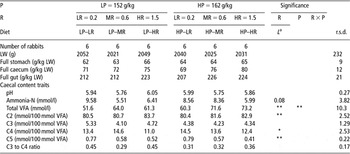
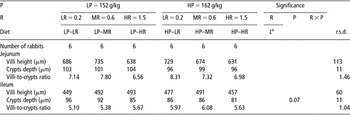
Increasing CP level increased total VFA in the caecal content from 59.0 to 68.4 mmol/l (P < 0.01) on average in rabbits fed LP and HP diets (Table 6), whereas it tended (P = 0.07) to reduce ileum crypt depth from 91 to 84 μm (Table 7).
Proportion of digestive organs and characteristics of caecal content at 55 days of age

P = protein level; LP = low protein; HP = high protein; R = soluble fibre-to-starch ratio; LR = low ratio; MR = medium ratio; HR = high ratio; LW = live weight; VFA = volatile fatty acids; C2 = acetate; C3 = propionate; C4 = butyrate; C5 = valerate.
aL, probability of the linear component of variance.
*P < 0.05; **P < 0.01.
Morphometry of ileum and jejunum mucosa at 55 days of age

P = protein level; LP = low protein; HP = high protein; R = soluble fibre-to-starch ratio; LR = low ratio; MR = medium ratio; HR = high ratio.
aL, probability of the linear component of variance.
Increasing soluble fibre-to-starch ratio significantly modified the main caecal traits (Table 6): N–ammonia tended to decrease linearly (9.07 to 6.20 mmol/l on average; P = 0.08), total VFA (56.0 to 67.3 mmol/l) and acetate proportion (80.4 to 83.3 mmol/100 mmol VFA) linearly increased (P < 0.01), whereas butyrate (14.0 to 11.7 mmol/100 mmol VFA; P < 0.05) and valerate proportions (0.78 to 0.47 mmol/100 mmol VFA; P < 0.01) decreased. Intestinal mucosa traits were not affected by soluble fibre-to-starch ratio (Table 7).
Slaughter results and carcass traits
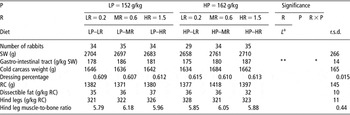
At final slaughter, carcass traits were not affected by the dietary treatment (Table 8), but a significant linear increase of the proportion of the gastrointestinal tract was observed (177 to 184 g/kg on average; P < 0.01) with increasing soluble fibre-to-starch ratio. The slaughter dressing percentage (0.611 on average) was consistent with the age of animals and the genetic type. Animals showed a satisfactory degree of fatness (dissectible fat: 35 g/kg reference carcass) and muscularity (hind legs: 324 g/kg reference carcass; hind leg muscle-to-bone ratio: 5.95).
Results of slaughter of rabbits at 75 days of age and main characteristics of 24-h chilled carcasses

P = protein level; LP = low protein; HP = high protein; R = soluble fibre-to-starch ratio; LR = low ratio; MR = medium ratio; HR = high ratio; SW = slaughter weight; RC = reference carcass.
aL, probability of the linear component of variance.
*P < 0.05; **P < 0.01.
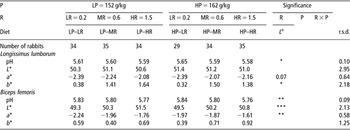
Meat pH and colour linearly changed with increasing soluble fibre-to-starch ratio, even if in a narrow range (Table 9). At L. lumborum, pH decreased (5.63 to 5.59; P < 0.05) and b* index increased (−2.39 to −2.12; P < 0.05). In the case of B. femoris, pH decreased (5.84 to 5.77; P < 0.01), whereas L* (49.4 to 51.2; P < 0.001) and a* values (−2.11 to −1.69; P < 0.01) increased.
Meat pH and colour indexes of 24-h chilled carcasses

P = protein level; LP = low protein; HP = high protein; R = soluble fibre-to-starch ratio; LR = low ratio; MR = medium ratio; HR = high ratio; L* = lightness; a* = redness; b* = yellowness.
aL, probability of the linear component of variance.
*P < 0.05; **P < 0.01; ***P < 0.001.
Discussion
Effect of CP level
Reducing dietary CP for fattening rabbits below the reference values of 160 to 165 g/kg as-fed without affecting growth performance and meat quality would be beneficial to reduce the feeding costs and to control nitrogen excretion (Maertens et al., Reference Maertens, Luzi and De Groote1997; Xiccato and Trocino, Reference Xiccato and Trocino2010).
In this trial, reducing dietary CP concentration from 162 to 152 g/kg as-fed did not affect growth performance. In fact, the latter value can be considered to be within the protein requirements for growing rabbits that are CP between 150 and 160 g/kg diet as-fed and DP-to-DE ratio ranges between 10.5 and 11.5 g/MJ (De Blas and Mateos, Reference De Blas and Mateos2010; Xiccato and Trocino, Reference Xiccato and Trocino2010). When the main limiting amino acids are supplied (lysine, methionine and threonine), dietary CP may be further reduced from 140 to 150 g/kg diet as-fed without negative consequences on performance (Trocino et al., Reference Trocino, Xiccato, Sartori and Queaque2000; García-Palomares et al., Reference García-Palomares, Carabaño, García-Rebollar, De Blas, Corujo and García-Ruiz2006). Only with CP below 138 g/kg diet as-fed, daily weight gain is impaired (−9%) in the entire fattening period (Maertens et al., Reference Maertens, Luzi and De Groote1997). In the post-weaning period, however, growth rate of rabbits weaned both at 25 days (Feugier et al., Reference Feugier, Smit, Fortun-Lamothe and Gidenne2006) or at 35 days (Trocino et al., Reference Trocino, Xiccato, Sartori and Queaque2000) was reduced with LP diets (150 and 144 g/kg, respectively).
At caecal level, dietary CP contributes to gut health equilibrium and its lack (<120 g/kg) or excess (>180 g/kg) may modify caecal fermentation activity and microflora composition (Carabaño et al., Reference Carabaño, Villamide, García, Nicodemus, Llorente, Chamorro, Menoyo, García-Rebollar, García-Ruiz and De Blas2009). All microbial populations benefit from the protein available at caecal level for their development and proliferation, but some pathogenic strains of Escherichia coli and Clostridia spp. seem to gain an advantage from protein unbalance and in particular from its excess. In fact, reducing protein level and increasing ileal protein digestibility significantly decreased mortality caused by epizootic rabbit enteropathy (Xiccato et al., Reference Xiccato, Trocino, Carraro and Fragkiadakis2006; Chamorro et al., Reference Chamorro, Gómez-Conde, Pérez de Rozas, Badiola, Carabaño and De Blas2007) and reduced the presence of Clostridium perfringens (Chamorro et al., Reference Chamorro, Gómez-Conde, Pérez de Rozas, Badiola, Carabaño and De Blas2007) and total anaerobic bacteria at ileum in growing rabbits (García-Palomares et al., Reference García-Palomares, Carabaño, García-Rebollar, De Blas, Corujo and García-Ruiz2006). Feugier et al. (Reference Feugier, Smit, Fortun-Lamothe and Gidenne2006), however, did not find differences in the health status of rabbits when reducing dietary CP from 210 to 150 g/kg.
In our trial, despite the number of animals was rather low to give definitive results on the effects of dietary treatments on health status, the highest mortality and sanitary risk (17.1% and 20.0%, respectively) were associated with the diet with high-protein concentration and the lowest soluble fibre-to-starch ratio in comparison with all other diets (1.5% and 8.1% on average). Similarly, rabbit mortality and morbidity increased as soluble fibre-to-starch ratio decreased in iso-ADF diets characterised by rather high-CP concentration (158 to 169 g/kg; Jehl and Gidenne, Reference Jehl and Gidenne1996; Perez et al., Reference Perez, Gidenne, Bouvarel, Arveaux, Bourdillon, Briens, La Naour, Messager and Mirabito2000; Soler et al., Reference Soler, Blas, Cano, Pascual, Cervera and Fernández-Carmona2004; Xiccato et al., Reference Xiccato, Trocino, Carraro, Fragkiadakis and Majolini2008). In contrast, there is no information about the effect of soluble fibre-to-starch ratio when feeding low-CP diets (<155 g/kg). Our finding is difficult to explain, however, as the small increase in CP level (152 to 162 g/kg) did not impair caecal fermentations, but rather improved them (e.g. increased caecal VFA concentration). Only the lower crypt depth in rabbits fed HP diets may be associated with a lower capacity of repairing mucosa damages and therefore, indirectly, could explain the higher susceptibility to digestive disorders of rabbits fed the same diets. Little and contradictory data are available concerning the effect of the protein level on the intestinal mucosa traits in rabbits. Nor the changes in dietary CP concentration (Chamorro et al., Reference Chamorro, Gómez-Conde, Pérez de Rozas, Badiola, Carabaño and De Blas2007) or the dietary supplementation with specific amino acids (glutamine and arginine; Chamorro et al., Reference Chamorro, De Blas, Grant, Badiola, Menoyo and Carabaño2010), which may directly promote gastrointestinal integrity, modified mucosal histology of early-weaned rabbits. On the basis of current knowledge, we could hypothesise that the CP level and the concentration and characteristics of dietary fibre interact and modify both the amount of undigested protein reaching the caecum and the contribution of the endogenous nitrogen to the total ileal flux (García et al., Reference García, De Blas, Carabaño and García1995; Carabaño et al., Reference Carabaño, Villamide, García, Nicodemus, Llorente, Chamorro, Menoyo, García-Rebollar, García-Ruiz and De Blas2009). However, the role of this interaction on rabbit health needs to be elucidated.
As what concerns slaughter results, this trial confirms that the protein level has almost no effect on carcass characteristics or meat traits, whereas possible effects may be expected with extreme CP concentrations (<130 g/kg or >180 g/kg; Xiccato and Trocino, Reference Xiccato and Trocino2010).
Effect of soluble fibre-to-starch ratio
In iso-ADF diets, the substitution of starch with soluble fibre, obtained by replacing cereals with beet pulp and wheat bran, does not usually change the DM and energy digestibility of diets, despite the fact that it often improves the digestive utilisation of fibre fractions (Gidenne and Jehl, Reference Gidenne and Jehl1996; Gidenne and Bellier, Reference Gidenne and Bellier2000; Gidenne and Perez, Reference Gidenne and Perez2000), as in our trial. The increased digestibility of fibre fractions depends mainly on the different nature and organisation of cell wall constituents in the diets containing less alfalfa meal and more beet pulp and which are, therefore, richer in rapidly fermentable fibre fractions (Carabaño et al., Reference Carabaño, Motta-Ferreira, De Blas and Fraga1997; Falcão-e-Cunha et al., Reference Falcão-e-Cunha, Peres, Freire and Castro-Solla2004).
The similarity in nutritive values and insoluble fibre (NDF and/or ADF) concentrations among the experimental diets also explains the absence of effects of the soluble fibre-to-starch ratio on feed intake and growth rate (Xiccato and Trocino, Reference Xiccato and Trocino2010). This successful substitution of starch with soluble fibre has positive implications on rabbit feeding, especially in the first period after weaning, when high-starch diets represent a potential risk for intestinal health.
On the contrary, reducing starch concentration (205 to 106 g/kg) and increasing the pectins’ level (29 to 79 g/kg), with simultaneous changes in NDF concentration (262 to 310 g/kg), increased feed intake and impaired feed conversion (Perez et al., Reference Perez, Gidenne, Bouvarel, Arveaux, Bourdillon, Briens, La Naour, Messager and Mirabito2000). In addition, a very high inclusion of beet pulp (>350 g/kg) replacing half of the barley amount decreased the nutritive value of the diet and provoked higher feed intake and reduced growth rate (García et al., Reference García, Galvez and De Blas1993).
As discussed above (Effect of CP level) previous studies also showed that increasing the soluble fibre-to-starch ratio decreased rabbit mortality and morbidity (Jehl and Gidenne, Reference Jehl and Gidenne1996; Perez et al., Reference Perez, Gidenne, Bouvarel, Arveaux, Bourdillon, Briens, La Naour, Messager and Mirabito2000; Soler et al., Reference Soler, Blas, Cano, Pascual, Cervera and Fernández-Carmona2004; Xiccato et al., Reference Xiccato, Trocino, Carraro, Fragkiadakis and Majolini2008) and improved caecal environment with lower pH, higher VFA and lower N–ammonia production (Jehl and Gidenne, Reference Jehl and Gidenne1996; Gidenne and Bellier, Reference Gidenne and Bellier2000; Xiccato et al., Reference Xiccato, Trocino, Carraro, Fragkiadakis and Majolini2008). The higher acetate proportion and lower butyrate rate were associated to a greater availability of substrate fermentable by fibrolytic bacteria (Falcão-e-Cunha et al., Reference Falcão-e-Cunha, Peres, Freire and Castro-Solla2004) and a lower activity of amylolytic microflora in the caecum (Parigi Bini et al., Reference Parigi Bini, Xiccato and Cinetto1990; Gidenne et al., Reference Gidenne, Pinheiro and Falcão-E-Cunha2000; Blas and Gidenne, Reference Blas and Gidenne2010).
Some authors (Álvarez et al., Reference Álvarez, Margüenda, García-Rebollar, Carabaño, De Blas, Corujo and García-Ruiz2007; Gómez-Conde et al., Reference Gómez-Conde, García, Chamorro, Eiras, García-Rebollar, Perez De Rozas, Badiola, De Blas and Carabaño2007) found an improved gut-barrier function in rabbits, which were fed more soluble fibre, although this trial, as well as previous studies of ours (Xiccato et al., Reference Xiccato, Trocino, Carraro, Fragkiadakis and Majolini2008; Trocino et al., Reference Trocino, Fragkiadakis, Radaelli and Xiccato2010 and Reference Trocino, Fragkiadakis, Majolini, Carabaño and Xiccato2011), did not detect relevant differences in villi length or crypt depth according to dietary soluble fibre concentration and its ratio with starch. These controversial results likely depend on differences in rabbit age at weaning or at sampling, besides differences in soluble fibre definition and its chemical determination (Van Soest et al., Reference Van Soest, Robertson and Lewis1991; Hall, Reference Hall2003).
At slaughter, a higher gut proportion was found by other authors in rabbits fed diets containing higher levels of soluble fibre from beet pulp and with contemporary wide changes in low-digestible fibre (NDF, ADF) and starch levels (García et al., Reference García, Galvez and De Blas1993; Carabaño et al., Reference Carabaño, Motta-Ferreira, De Blas and Fraga1997; Falcão-e-Cunha et al., Reference Falcão-e-Cunha, Peres, Freire and Castro-Solla2004; Trocino et al., Reference Trocino, Fragkiadakis, Majolini, Carabaño and Xiccato2011). On the contrary, when iso-ADF diets were compared, no real impact of beet pulp inclusion rate on the filling of digestive organs was found (Jehl and Gidenne, Reference Jehl and Gidenne1996; Gidenne and Perez, Reference Gidenne and Perez2000; Trocino et al., Reference Trocino, Fragkiadakis, Radaelli and Xiccato2010).
The interesting effects of increasing soluble fibre-to-starch ratio on meat quality, that is lower pH and lighter colour, could be associated with the longer energy uptake during transport and lairage before slaughter from the intestinal fermentation of soluble fibre. However, other previous studies of ours did not report relevant differences in meat traits according to soluble fibre concentration or its ratio with starch (Xiccato et al., Reference Xiccato, Trocino, Carraro and Fragkiadakis2006 and Reference Xiccato, Trocino, Carraro, Fragkiadakis and Majolini2008; Trocino et al., Reference Trocino, Fragkiadakis, Radaelli and Xiccato2010).
In conclusion, this paper describes that feeding growing rabbits with low protein and high-soluble fibre-to-starch ratio diets reduces mortality, improves digestive efficiency and intestinal environment without affecting growth performance.
Acknowledgements
This paper was funded by MIUR (PRIN 2005 – Prot. 2005070702). The authors thank Dr Andrea Zuffellato (Veronesi Verona S.p.A.) for his technical assistance during the trial.