Background
Simply asking people how they feel about their health has long been an important component of health status assessment. However, in clinical practice and in research, simple assessments of health have been overshadowed by more-technical questioning and diagnostic testing. This has led one senior researcher and clinician (Blazer, Reference Blazer2008) to lament the trend away from simply asking people how they feel:
Clinical medicine has moved away from listening to patients (their complaints) and toward seeing them, and what can be seen (a magnetic resonance image or a number on a symptoms screening scale). It has moved from a hear-and-feel discipline to a see-and-do discipline. Algorithms are increasingly replacing the art of listening to patients and assessing their views of their health. ‘‘How do you feel...?’’ is a question all too often ignored.
Self-rated health (SRH) is a simple, reliable (Lundberg & Manderbacka, Reference Lundberg and Manderbacka1996) question which may be useful in clinical practice, research, and general health surveys. The subjective assessment of one’s own health is associated with biomedical markers of disease (Jylhä, Volpato, & Guralnik, Reference Jylha, Volpato and Guralnik2006) and with objective measures of health. Gama et al. (Reference Gama, Damian, de Perez, Lopez, Lopez and Gavira Iglesias2000) found that SRH is strongly related to activities of daily living (ADLs), particularly mobility-related ADLs. However, SRH may be more than simply a reflection on one’s health – it may also reflect an individual’s efforts to achieve health-related goals (Bailis, Segall, & Chipperfield, Reference Bailis, Segall and Chipperfield2003), health beliefs and behaviours (Manderbacka, Reference Manderbacka1998), or sociocultural influences (Menec, Shooshtari, & Lambert, Reference Menec, Shooshtari and Lambert2007). SRH may predict mortality and contain information that is not entirely reflected in underlying medical conditions and risk factors, at least in middle-aged persons (Heidrich, Leise, Lowel, & Keil, Reference Heidrich, Liese, Lowel and Keil2002; Heistaro, Jousilahti, Lahelma, Vartiainen, & Puska, Reference Heistaro, Jousilahti, Lahelma, Vartiainen and Puska2001).
Since first reported, the association between SRH and mortality (Mossey & Shapiro, Reference Mossey and Shapiro1982) has been replicated in many studies in many countries and many settings (DeSalvo, Bloser, Reynolds, He, & Muntner, Reference DeSalvo, Bloser, Reynolds, He and Muntner2006; Idler & Benyamini, Reference Idler and Benyamini1997). In some populations, however, the question may not be an accurate predictor of death. The association between SRH and death may be weaker in African-Americans (Lee et al., Reference Lee, Moody-Ayers, Landefeld, Walter, Lindquist and Segal2007), women (Helmer, Barberger-Gateau, Letenneur, & Dartigues, Reference Helmer, Barberger-Gateau, Letenneur and Dartigues1999), those with lower social position (Dowd & Zajacova, Reference Dowd and Zajacova2007; Singh-Manoux et al., Reference Singh-Manoux, Dugravot, Shipley, Ferrie, Martikainen and Goldberg2007), and those with severe cognitive impairment (Walker, Maxwell, Hogan, & Ebly, Reference Walker, Maxwell, Hogan and Ebly2004). Importantly, Benjamins, Hummer, Eberstein, and Nam (Reference Benjamins, Hummer, Eberstein and Nam2004) have reported that SRH is predictive of most causes of death, except those most strongly associated with depression: suicide, homicide, and accidents. It is possible, therefore, that SRH may not accurately predict death in those with depressive symptoms. Depressive symptoms may result in a different assessment of subjective health. Han (Reference Han2002) found that depressive symptoms predicted a change in SRH over time; however, Han did not examine the effect of SRH or depressive symptoms on mortality.
The objectives of this study involving adults aged 65 and over residing in the community were twofold: (1) To determine if SRH predicts mortality in older adults with and without depressive symptoms; and (2) to determine if there is an interaction between SRH and depressive symptoms in influencing mortality over a five-year time frame.
Methods
Sample
Data used in this study are from the Manitoba Study of Health and Aging (MSHA), a longitudinal study of aging and cognition conducted in conjunction with the Canadian Study of Health and Aging (CSHA, 1994). Manitoba had, in 1991, a relatively stable population of 1,091,940 (Statistics Canada, 1992). Between February 1991 and November 1992, 1,751 individuals aged 65 and over living in the community were interviewed in person. These older persons were randomly selected according to health region and age group from a list provided by Manitoba Health, one of the most complete listings of residents available. There was an over-sampling of the oldest old.
In 1996 and 1997, attempts were made to re-interview the 1,751 individuals who had participated in the 1991–1992 interviews. By 1996–1997, 417 of these individuals had died. Telephone interviews were conducted with family members or friends for individuals who had died between 1991 and 1997. For those family and friends who consented, death certificates and administrative records were obtained for those who were deceased.
The study was approved by the Ethics Committee of the Faculty of Medicine of the University of Manitoba, and it was in compliance with the Declaration of Helsinki.
Measures
Time 1 Predictors. Depressive symptoms were measured using the CES-D scale (Radloff, Reference Radloff1977). A score of greater than or equal to 16 was considered abnormal. SRH was assessed using the question: “How would you say your health is these days? (very good; pretty good; not too good; poor; or very poor)” Since the number of observations in some cells was small, SRH was dichotomized into good (very good/good) versus poor (not too good/poor/very poor) for some analyses.
The Modified Mini-Mental State Examination (3MS) was used to assess cognition (Teng & Chui, Reference Teng and Chui1987). We analyzed the 3MS both as a continuous variable (100 points), and also by stratifying the sample into those with normal cognition (a score of 78 or above) or abnormal cognition (a score below 78). Functional status was based on self-report. It was assessed using the seven-item ADL and the seven-item Instrumental ADL (IADL) scales from the Older American Resources Utilization Survey (OARS; Fillenbaum, Reference Fillenbaum1988). For our analyses, we summed the scores of individual items and used the scale as a continuous variable, scored from 0 to 28. Education was measured as number of years of completed schooling; age is in years.
Outcome Measures. We considered the time to death as the primary outcome for these analyses. Death over the five-year interval was obtained by proxy report, death certificate, and administrative records. Mortality was coded as either 1 (deceased by the end of MSHA-2) or 0 (alive at the end of the study). Time to death was determined using the methodology of the Canadian Study of Health and Aging (Dubois & Hebert, Reference Dubois and Hebert2001). Briefly, if death certificate data were available (n = 247), we obtained the date of death from this. If death certificate data were not available, then we used the date of death from proxy report (n = 73) or administrative data (n = 97). The participants were considered to have been censored after the time-2 study period.
Statistical Analyses
The analyses (n = 1,751) included all participants for whom complete data were available. Associations between time-1 variables and mortality were sought using chi-square tests for categorical variables, and student’s t-tests (unequal variance) for continuous variables. We constructed Kaplan–Meier plots and used log rank tests. To adjust for the effect of confounding variables, we constructed Cox proportional hazards regression models with the outcome being the time to death. Covariates included CES-D score, age, gender, education, 3MS score, OARS score, and SRH. For these analyses, we dichotomized SRH into good versus poor since there were small numbers in some cells. Continuous variables were entered directly into the model, while categorical variables were entered as dummy variables. We sought interactions by stratifying analyses and by incorporating interaction terms into Cox proportional hazards models. We conducted analyses in SPSS version 9 (SPSS Inc., Chicago, IL) and Stata version 10 (Statacorp, college Station, TX).
Results
There were 1,751 participants. Depressive symptoms were present in 13.8 per cent of the total sample. There were 240 persons with depressive symptoms and 1,507 persons without depressive symptoms at time 1. Overall, 24.7 per cent had poor SRH; 63.8 per cent of those with depressive symptoms had poor SRH versus 18.5 per cent of those without (p < .0001, chi-square test). The mean age of the sample participants was 77.5 years (78.3 years in those with poor SRH versus 77.3 years in those with good SRH; p = 0.008, student’s t-test); 58.5 per cent were women (62.0 per cent of those with poor SRH versus 57.3 per cent of those with good SRH; p = 0.08, chi-square test). The mean education level was 9.3 years (8.2 years in those with poor SRH versus 9.7 in those with good SRH; p < .001, student’s test).
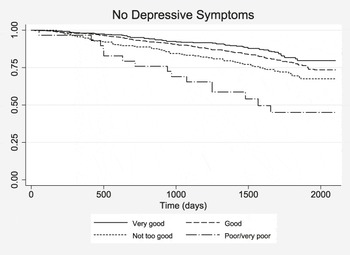
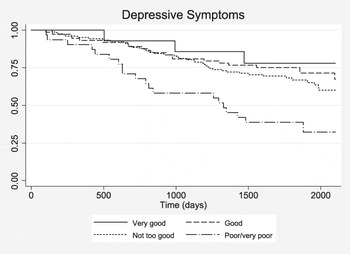
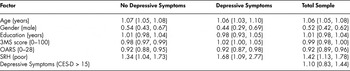
Over the five-year period, 417 participants died. Depressive symptoms and poor SRH both predicted death. Poor SRH predicted mortality over five years in those with depressive symptoms (41.2% of those with poor SRH vs. 26.4% of those with good SRH; p = .015, chi-square test), and in those without depressive symptoms (19.8% of those with good SRH vs. 31.2% of those with poor SRH; p < .001, chi-square test). The hazard ratio (HR, 95% confidence interval) of death over five years was 1.83 (1.50, 2.24) for those with poor SRH versus good SRH. In those with depressive symptoms, the HR was 1.63 (1.01, 2.63). In those without depressive symptoms, the HR was 1.68 (1.31, 2.14). There was a gradient in risk across SRH (see Figures 1 and 2).
Kaplan–Meier plot of five-year mortality in those without depressive symptoms. Self-rated health predicted mortality in those with no depressive symptoms, and there was a gradient in this effect.

Kaplan–Meier plot of five-year mortality in those with depressive symptoms. Self-rated health also predicted mortality in those with depressive symptoms, and there was a gradient in this effect.

We noted no interaction in the effect of depressive symptoms and SRH on mortality. When we constructed Cox regression models and included an interaction term SRH*CES-D, this term was not significant. We also conducted stratified analyses. The effect of SRH on mortality was similar in those with, and in those without, depressive symptoms in Cox regression models (see Table 1).
Results of Cox regression models. (Self-rated health predicts death in those with and in those without depressive symptoms)

3MS = Modified Mini-Mental State Examination; OARS = Older American Resource Survey; SRH = self-rated health; CES-D = Center for Epidemiological Studies-Depression. Note that education and the 3MS score are highly co-linear.
95% confidence intervals in parentheses.
In regression diagnostics, we also observed the previously documented effect of severe cognitive impairment (Walker et al., Reference Walker, Maxwell, Hogan and Ebly2004), where SRH predicted mortality in those with mild and moderate cognitive impairment but not severe cognitive impairment. As well, we noted that education and the 3MS score were highly correlated (data not shown; available on request). Since omitting either the 3MS or education from the models did not alter the associations between SRH, depression, and mortality, we chose to present the full model including both variables.
Discussion
Both SRH and depressive symptoms predicted death. There was no interaction: SRH predicted death in those with depressive symptoms and in those without depressive symptoms.
This study does have some limitations. First, we used the CES-D as a measure of depressive symptoms. Although this is a reliable, valid measure, it is not a measure of clinically diagnosed major depression. It is possible the results we obtained might have been different in those individuals with major depression. A second limitation is that our sample was racially homogeneous, reflecting the demographic make-up of older adults in Manitoba. Other researchers have shown that the association between SRH and mortality is not as strong in African-Americans as in non-African-Americans (Lee et al., Reference Lee, Moody-Ayers, Landefeld, Walter, Lindquist and Segal2007). More diverse samples from other studies could show different results. A third study limitation is that both health and depressive symptoms are not stable over time, and the relationship between these two factors and mortality can vary over time.
Our study also has a number of strengths. Reliable, valid measures were gathered by trained interviewers. As well, the study was population-based with representation from the entire province of Manitoba; this representation, however, may also be a limitation. The results we observed may not hold true in clinical samples with sicker individuals.
Our findings generally support the predictive validity of a simple question about general health. Previous studies considered depressive symptoms and depression a confounding factor (Bardage, Isacson, & Pedersen, Reference Bardage, Isacson and Pedersen2001; Blazer, Hybels, & Pieper, Reference Blazer, Hybels and Pieper2001). These studies found that after adjusting for the effect of depression, SRH predicts mortality. However, few of the previous studies considered an interaction between the two factors. Since older adults with depression may perceive their health differently than do those without depression, it is important to also consider interactions. Our study data support the view that SRH is an accurate predictor of death even in persons with depressive symptoms.
SRH has proved to be a remarkably accurate and potentially useful global measure of health. Its use has largely been limited to epidemiologic studies and health surveys. Further study into its usefulness in clinical settings and in populations seeking health care is warranted. Simple questions on health may prove extremely useful in clinical settings, and further research should be conducted in these populations. These simple questions may be a useful adjuvant to complex diagnostic medical tests. They might also be a useful alternative to complex diagnostic tests.