Implications
In horse breeding, fertility problems lead to profitability problems. The breeding animals are expensive, and if they do not produce foals regularly, their owners lose money. The possible negative effects of inbreeding on fertility would be easy to avoid, since the breeder can directly control inbreeding by choosing which animals to mate with each other. The heritability of fertility and predictions of breeding values for fertility are needed to select for more fertile horses in the future. But in addition to genetics, we have to account for environmental and management factors that play an important role as well.
Introduction
Equine fertility is a tangled complex with a great variety of influencing environmental and management issues, such as the time or method of insemination, making it difficult to detect the underlying factors directly linked to the animals themselves. Estimates of the animal-based factors are possible to attain by recognising the different sources of influence and dividing the total variance into its components. The additive and maternal genetic components, and the effect of inbreeding, are of special interest for this study.
Inbreeding coefficients of a mare and a stallion, as well as that of an expected foal, are based on pedigree data. The three coefficients are, in theory, not interrelated, and they all can have their own effects on the outcome of a mating. Highly inbred mares or stallions may have more fertility problems than on the average. On the other hand, a highly inbred foal might be aborted early, be born dead or be unfit for life. Evidence from some previous studies shows that high inbreeding may weaken the fertility of horses (Cothran et al., Reference Cothran, MacCluer, Weitkamp, Pfennig and Boyce1984; Klemetsdal and Johnson, Reference Klemetsdal and Johnson1989; Langlois and Blouin, Reference Langlois and Blouin2004).
In addition to inbreeding, additive genetic factors also affect fertility; although the proportion of total variance of fertility due to genetic components is admittedly small. Mahon and Cunningham (Reference Mahon and Cunningham1982) and Wilkens et al. (Reference Wilkens, Preisinger and Kalm1990) reported estimates of heritability for general equine fertility of well under 10%. The magnitude of heritability for fertility traits is similar in several species. In cattle, for example, despite the low heritability, breeding programs have improved fertility, as reviewed by Berglund (Reference Berglund2008). A similar progress should be possible in horses as well, but in practice, fertility traits of horses are often considered to be of less value than performance traits. However, fertility does have a major economic impact: if no foal is born for a broodmare, the mare produces nothing that year.
The goal of this study was to determine how inbreeding affects equine fertility, and to estimate the heritability of the foaling rate in Standardbred trotters (SB) and Finnhorses (FH) in Finland. Another goal was to produce tools – predictions of breeding values – that make it possible to predict which mares or stallions are prone to reproduction failures.
Material and methods
Data and editing
The original data consisted of all reported matings of SBs (n = 35 486) and FHs (n = 33 719) during the years 1991 to 2005 in Finland. A mating record consisted of all the matings of a mare with one stallion within a year. The outcome of the matings and a variety of background information were included. In addition, the pedigree database of all horses in the Finnish register and their ancestors was used in the analyses. The data were provided by Suomen Hippos, the Finnish Trotting and Breeding Association.
In this article, the term Standardbred is used to refer to the entire warmblood trotter stock in Finland, consisting mainly of Standardbreds of American descent, but also with some French and distant Orlov blood. The Finnhorse is a native horse breed, which since 1971 has been divided into four breeding sections: trotters, riding horses, draft horses and pony-sized horses. Trotters are by far the largest section. The section is determined when the mare or the stallion is offered for the studbook, but the broodmares do not have to be admitted there. It was therefore impossible to determine the breeding section of most horses in the mating database. It is also possible for the horse to be admitted to more than one section.
Before calculating the inbreeding coefficients, additions were made to the pedigree data, so that at least the most important lines were complete as far as the origin of the trotter breeds in the 19th century. Missing animals were added and errors were corrected, according to studbook data. The following three types of errors were most commonly encountered in the pedigree database: (1) One horse has multiple registration numbers. These may occur as a result of spelling errors or variations in different databases. This kind of error results in missing connections between relatives. (2) The same registration number refers to two or more individuals. Usually the horses have similar names, but are actually different individuals. This is a severe problem because it may lead to wrong family connections between totally unrelated horses. (3) Connections are missing between relatives. Sometimes one or both parents of a horse can be found in the database, but they have not been added as its parents. In conclusion, no pedigree data were deleted in the editing process; only corrections and additions were made. Even after the editions it is probable that some mistakes remain undetected.
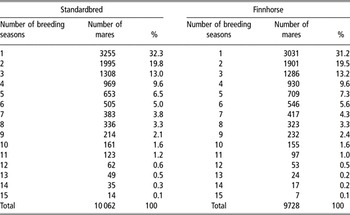
Most mares in both breeds had a rather low number of breeding seasons, that is, records from different years, in the database. Approximately one-third of all mares in the database had only one breeding season and one-half of the mares had one or two breeding seasons (Table 1). The low number of breeding seasons per mare is probably due, in part, to the database covering the entire trotter breeding field in Finland, which consists mostly of amateur breeders. Therefore, many mares are only bred a few times in their lifetime, not every year. Furthermore, the database does not always cover the entire breeding history of a mare. The mating years were restricted to the years between 1991 and 2005, and consequently, only the first matings of young mares and only the last matings of old mares can be found in the database.
Number of mares with different numbers of breeding seasons in Standardbred trotters and Finnhorses

A mating record was excluded from the analyses if the foal born had been registered in another country; if the mare was not in the Finnish register; or if the mare’s pedigree depth, that is, the average number of generations in an individual’s pedigree, was less than four. All mares registered in Finland have at least four complete ancestral generations in their pedigree, so checking the pedigree depth is an additional way to exclude mares that are not in Finnish register, because sometimes foreign mares do not show as foreign in the database. Furthermore, if there were two or more records per year for a mare, generally only the last one was considered. Normally all matings of a mare for a given year were included in one record, but it was possible for a mare to have several records in a year if it was covered by more than one stallion or, in rare cases, used as an embryo donor. If the result of one of several records was a foal, that record was chosen. If more than one of the records had produced a foal, all records were excluded because this meant that either embryo transfer had been used or there was an error in the database. If no foal was born out of multiple yearly records, the last record of the year was chosen. There were 732 cases of multiple yearly records in the SB and 957 in the FH.
There were some SB mares in the mating database that were not in the Finnish register, but had been mated with Finnish SB stallions. Their pedigree data is often inadequate, and the records of their foaling success are not always accurate. By manual checking, many cases were found where a foal had been born out of this kind of mating and registered in another country. However, there was no record of foaling in the Finnish database and the result of the mating was therefore marked as no pregnancy. It was impossible to check all the cases manually; thus, 838 foreign mares that still remained in the database after previous exclusions were left out.
Registration numbers of the foals were not in the mating database, so they had to be retrieved from the pedigree database based on the year of foaling and the registration numbers of the parents. However, there appeared to be some clerical errors in the mating years, which might have led to the wrong year’s foal being attached to a mating. Records with obvious errors in the dates were removed, such as different years in the first and last mating dates. Also, cases where a mare had more than one record per year were individually examined considering the possibility of an error in the dates.
Analysed datasets and studied trait
After editing, the data consisted of 33 679 and 32 731 mating records for SBs and FHs, respectively, meaning that 5.1% of the original SB and 2.9% of FH records had been deleted in the editing process. There were 10 062 SB mares and 9728 FH mares, and 1019 SB stallions and 1199 FH stallions left in the database for analyses.
The trait studied was the outcome of the mating, the individual level equivalent to the foaling rate, which is measured on population level. The value was 1, if a live or dead foal was born, and 0 in all other cases. Possible causes for the outcome 0 were that the mare did not become pregnant, abortion (i.e., the loss of an embryo) or the death of the mare during gestation. In the original data, the various causes had been separated. However, not all cases of abortion, for example, were duly reported, and therefore they could not be considered separately. Thus, instead of pregnancy rates, foaling rates were studied. The trait was studied as an outcome of the expected foal or alternatively as an outcome of the mare.
Since the foaling outcome, the trait studied, is dichotomous, it is not normally distributed. Although this violates the basic assumptions of the methodology used, previous studies have shown that the results should still be reasonably correct, although possibly biased downwards (e.g. Kadarmideen et al., Reference Kadarmideen, Thompson and Simm2000).
Methods, models and factors
In the preliminary analyses, a linear fixed effects model was fitted using the WSYS software (Vilva, Reference Vilva2008). The analysis of variance was used to study the statistical significance of the fixed effects. The mating year, the month of last mating class, the mating type, the age and type class of the mare, the age group of the stallion, and the inbreeding coefficient class of the foal were included simultaneously in the model.
In the next phase, a mixed model was built using the restricted maximum likelihood (REML)-based VCE6 program (Kovac et al., Reference Kovac, Groeneveld and Mielenz2008). In addition to the fixed factors used in the previous model, random factors were included as well. This made it possible to add the genetic components to the model and to estimate the heritabilities. In separate models, both the mated mare and the expected foal were used as a basic individual, that is, the result was considered to belong to either the mare (produced a foal or not), or to the foal (was born or was not born). By using the expected foal as the basic individual, it was possible get predictions of breeding values that were comparable among all individuals – mares, stallions and foals.
Using the PEST software (Groeneveld, Reference Groeneveld2006), Best Linear Unbiased Predictions (BLUPs) of breeding values were calculated for the foaling rate. In this case, the foal was the basic individual. Simultaneously, generalised least squares-estimates (Best Linear Unbiased Estimates, BLUEs) for estimable functions of fixed effect classes were also obtained using the PEST, and the statistical significance of the fixed factors was tested with the F-test.
The following model was assumed within the SB and FH breeds:

where recordijklmnop = outcome of the mating, 0 or 1; μ = overall mean.
The fixed effects are as follows: yeari = year of mating (i = 1,…,15); monthj = month of last mating class (j = 1,…,7); btypek = mating type (kSB = 1,…,4; kFH = 1,…,3); mtypeagel = age and type class of the mare (lSB = 1,…,19; lFH = 1,…,19); stallagem = age group of the stallion (m = 1,…,5); inbrclassn = inbreeding class of the expected foal (nSB = 1,…,8; nFH = 1,…,7).
The random effects are as follows: stallion = permanent environmental effect of the stallion N∼(0, Iσ2S), mare = permanent environmental effect of the mare, N∼(0, Iσ2M), maternal = maternal genetic effect (Model 1) N∼(0, Aσ2MG), animal = additive genetic effect of the expected foal (Model 1) or dam (Model 2) N∼(0, Aσ2AG), εijklmnop = residual N∼(0, Iσ2ε).
There were 33 665 SB and 32 674 FH matings in the VCE-runs, with a total of 57 353 SB and 51 315 FH animals in the additive relationship matrix A when the foal was the studied individual, and a total of 26 326 SB and 23 277 FH animals when the mare was the studied individual.
All mating years were regarded as separate classes in the analyses. The month of the last mating was the month when the mare had reportedly been covered for the last time that year. The months from April to August were each considered separately. The less common earlier months of the year (January to March) and later months (September to December) formed separate groups. Month of last mating was chosen rather than month of first mating, because the date of last mating is recorded to the database more reliably; often only the last mating is recorded if the mare is inseminated more than once during the mating season. The year and the month of mating are purely environmental factors. Based on the preliminary analyses, it was necessary to include them in the model, but their specific effects were not reported in this study.
Mating types were divided into four categories. Artificial insemination (AI) could be performed with fresh semen at the stallion’s home station (on-site AI) or with transported chilled semen at the mare’s home stable or some other station. Frozen semen is almost exclusively used for SB, and therefore studied here only for that breed. The fourth possible mating type was natural mating.
The age and type of the mare formed a combination factor. The combination was necessary, since it was assumed that the age of a mare might have a different impact on the foaling rate depending on a mare’s previous breeding use or history. The mare types were maiden, barren, rested and foaled. Maiden mares had no breeding history, barren mares had been covered the preceding year but had not produced a foal, rested mares had foaled previously but had not been covered the preceding year, and foaled mares had produced a foal earlier the same year as the new mating occurred. The four mare types were further divided according to the age of the mares during the mating year. Mares aged 1 to 2 years were practically all maiden and they were all grouped together (there were very few mares that had been mated as yearlings). Also, almost all mares aged 3 years were maiden, and they formed their own group. The 4-year-old mares formed two separate groups of maiden and non-maiden (barren, rested and foaled pooled together) mares. There were also groups for 5-year-old maiden mares, 6-year-old maiden mares, and separate groups of barren, rested and foaled mares aged 5 to 6 years. The mares aged from 7 to 9, 10 to 13, 14 to 16 and ⩾17 years were divided to the four mare types, except that since there were very few old maiden SB mares, the classification of the last age group had to be changed so that 14 to 25-year-old maiden mares were all grouped together. At the end, there were 24 groups for the SB and 25 for the FH.
The age of stallions was grouped similarly to the age of the mares, apart from the first group: the groups were 1 to 6, 7 to 9, 10 to 13, 14 to 16 and ⩾17 years.
Inbreeding coefficients were calculated for mares, stallions and expected foals, using PEDIG software (Boichard, Reference Boichard2002). In order to study the effects of different levels of inbreeding on fertility, inbreeding was considered a classified, fixed factor rather than a linear regression. The individuals and the matings were divided into groups based on their inbreeding coefficients. Inbreeding classes were different for the two breeds because the general levels of inbreeding were dissimilar. In some preliminary models, the inbreeding classes of the mare and the stallion were also used, in addition to that of the expected foal. With WSYS (Vilva, Reference Vilva2008), pedigree depth of an individual was calculated as the average number of generations contained in an individual’s pedigree: 1 + the average of the pedigree depth of its parents. For example, if no parents were known, pedigree depth = 1; or if only one parent was known, pedigree depth = 1.5. Therefore the animal itself is considered the first generation, and to get the average number of ancestral generations in a pedigree, 1 should be subtracted from the pedigree depth.
Results
Foaling rates
The average foaling rates in the data analysed were 72.6% for SBs and 66.3% for FHs.
Mating type
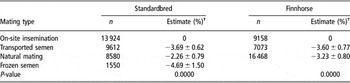
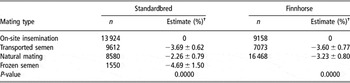
The most successful mating method was on-site AI (Table 2). Transported semen and natural mating both gave considerably lower foaling rates than on-site AI, but the results for frozen semen were the lowest. Frozen semen was only studied for the SB, but otherwise the results were similar in both breeds.
Distribution of mating records by mating type classes, and estimated effects of different classes on foaling rates
†Difference (in %-units) from the median (0) class, followed by s.e.
Age and type class of the mare
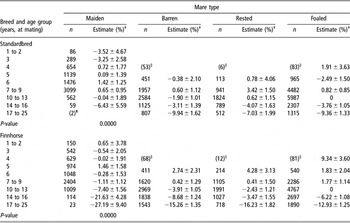
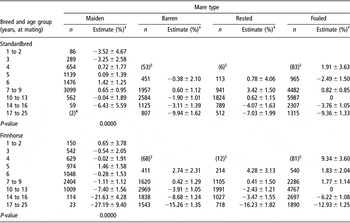
The general trend was that the older the mares were, the lower were their foaling rates (Table 3). The results were particularly low if the old mares were maiden. In the FH, maiden mares had the worst results in all age groups. Otherwise, the differences between mare types were not that clear. The results for mares that were mated when they were 1 to 3-years-old were lower in the SB than in the FH. For maiden mares, the best results were obtained when they were 5- (in the FH) or 6-years-old (in the SB). The non-maiden mares also tended to reach best results in the younger age groups: in the FH the non-maiden mares aged 4 to 6 years had especially good results. In general, SB mares appeared to achieve their peak in fertility later and maintain it better than FH mares.
Distribution of mating records by mare age and type classes, and estimated effects of different classes on foaling rates
†Difference (in %-units) from the median (0) class, followed by s.e.
‡Merged to 14–16-year-olds.
§Non-maiden (barren, rested or foaled) 4-year-olds were pooled together for the analysis.
Age group of the stallion
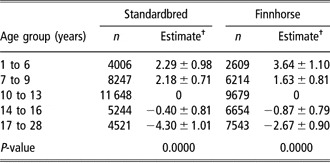
Old stallions tended to have lower foaling rates than the younger ones (Table 4), similar to the mares. There were no obvious differences between the two breeds in the magnitude of the effects between the age groups.
Distribution of mating records by stallion age groups, and estimated effects of different groups on foaling rates
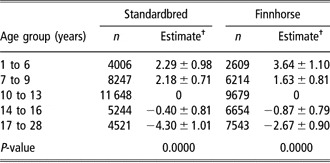
†Difference (in %-units) from the median (0) class, followed by s.e.
Inbreeding
The level of inbreeding was much higher in the SB than in the FH: the means were 9.9% and 3.6%, respectively, for expected foals during the mating years of 1991 to 2005. Fewer than 200 FH matings – 0.6% of the total – had inbreeding coefficients above 10%, whereas in the SB, 51% of matings produced inbreeding coefficients higher than 10%. Both breeds had some individuals with high inbreeding coefficients (over 30%), but hardly any with truly zero inbreeding. Mating closely related individuals with each other seemed to be rare. On the other hand, line breeding was used considerably, especially in the SB. The average pedigree depth in SB matings was 11.1 and in FH matings, 9.4.
The average coefficient of inbreeding of all recorded SB matings has slowly risen from 8.6% in 1991 to 10.6% in 2005, and from 3.0% to 4.2% in the FH matings. Parallel to the rise in inbreeding, the pedigree completeness has also been growing from 10.4 to 11.7 generations in the SB, and from 8.8 to 9.9 generations in the FH, at least partly explaining the rise in the level of inbreeding.
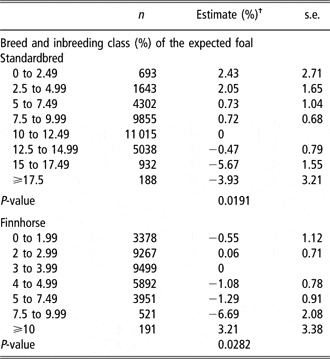
The general trend seemed to be declining foaling rates concurrent with an increase in the level of inbreeding (Table 5). Foaling rates for the SB stayed relatively constant if the inbreeding coefficient of the expected foal was between 0% and 15%. Groups with inbreeding coefficients higher than that had markedly lower foaling rates. Conversely, though, the most inbred animals did not have the worst results. In fact, for the small number of matings (16), with the inbreeding coefficient of the mating over 22.5%, the foaling rates were especially high (not shown).
Distribution of mating records by inbreeding classes, and estimated effects of different classes on foaling rates
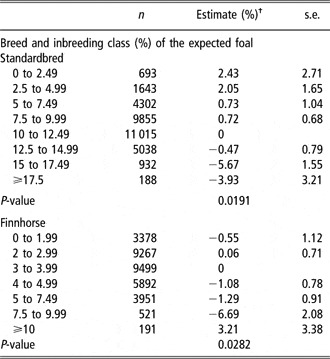
†Difference (in %-units) from the median (0) class.
For the FH, the foaling rates began to decline when the inbreeding coefficient exceeded 7.5%, at a lower level compared to the 15% turning point in the SB. However, the turning points relative to the average inbreeding coefficient were similar in both breeds: 6.1%-units in the SB, and 4.9%-units in the FH. The most highly inbred matings were not the worst in the FH, either; on the contrary, the most highly inbred group had the best results. The effect of inbreeding was statistically slightly less significant in the FH than in the SB (P-values of 0.028 and 0.019, respectively).
In addition to the inbreeding coefficient of the expected foal, the inbreeding coefficients of the mare and the stallion were found to be interconnected with the foaling rates as well (data not shown). In some cases all three were individually statistically significant (P < 0.05), depending on the breed (generally more significant in the SB) and how the groups were formed. However, there was a positive correlation between inbreeding coefficients of a foal and its parents, so they were not truly independent.
Genetic and permanent environmental effects
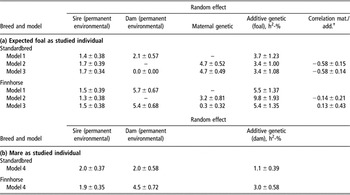
Additive genetic effects had some impact on equine fertility (Table 6). The estimates of heritability for the SB were between 3.4% and 3.7%, considerably lower than the 5.5% to 9.8% range in the FH. In addition, if the dam was the studied individual, the heritabilities were lower (1.1% for the SB and 3.0% for the FH) than with the expected foal being the studied individual.
Relative proportions (%) of total variance of foaling rates for random effects from different models
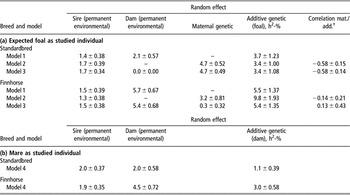
– = not included in the model.
†Correlation between additive genetic and maternal effects.
Fixed factors for all models: month, year, mating type, stallion age group, mare age and type, inbreeding class (of the expected foal).
In addition to additive genetic effects, the permanent environmental effects of sire and dam, and maternal effects were also included in the models in different combinations. The mare’s permanent environmental or maternal genetic effects comprised, at most, 4.7% (SB) and 5.7% (FH) of the total variation. The sire effects were not as sizeable, with 1.7% (SB) and 1.5% (FH), and were very similar for both breeds. Permanent environmental effects actually often explained more of the variation than additive genetic effects.
It proved difficult to separate the maternal genetic effect and the permanent environmental effect of the mare from each other. In fact, if they were simultaneously in the model (Model 3), one of them (the one with smaller value when alone in the model) was close to 0 and the other one was similar to its value in Model 1 or 2. There was negative correlation between maternal and additive genetic effects in the SB; the correlation coefficient was −0.58. No clear correlation was found in the FH.
The BLUP-values for foaling rate were also calculated. It was possible to identify some family clusters with particularly high or low BLUP-values.
Discussion
Non-genetic factors contributing to foaling rates
Comparing the mating types, transported semen may be the easiest choice for a mare owner in a lot of cases, but it involves several risk factors that reduce its efficiency compared to some other methods. The people involved may be less experienced compared to stud professionals, and the semen may deteriorate during the transport. The use of frozen semen is known to result in even lower pregnancy rates than transported semen (e.g. Samper, Reference Samper2001), but it may be the only practical choice if the desired stallion lives in another country.
Our observation that high stallion age and high mare age had a downward effect on fertility was parallel to the report of Langlois and Blouin (Reference Langlois and Blouin2004). Dowsett and Knott (Reference Dowsett and Knott1996) accordingly found lower semen quality in older than in younger stallions. Furthermore, we found that male fertility did not decrease with increasing age as rapidly as that of females, which is in accordance with Langlois and Blouin (Reference Langlois and Blouin2004). When considering differences among the stallion age groups, one must take into account the low number of individual stallions in some groups, as the same stallion may have hundreds of matings in the same age group. This means that the results are based on a relatively small sample of stallions. However, to make up for this, the same stallion often has results in more than one age group, because the data spans over a period of 15 years.
From a biological point of view the very youngest mares (mated as 1- or 2-year-olds), which have not yet reached full maturity, may be expected to obtain lower fertility results than mature mares. However, many matings of very young mares are not deliberately planned, and therefore might only be reported if a foal is actually born. In general, there were more matings of very young mares in the FH than in the SB. The FH matures later as a racehorse than the SB (the FH are allowed to start their racing careers a year later than the SB), which may direct breeders to get a foal out of a FH mare before its racing career in some cases. The FH is also used as a riding horse, which requires the animal to be even older before serious training can be started. The higher numbers of old maiden mares in the FH compared to the SB may be a sign of the longer careers of the FH before coming to breeding use (FH trotters are allowed to compete older than SB trotters), and more amateur breeding (FH is often used as a hobby horse).
In addition to the fixed non-genetic factors included in the model (the year of mating, the month of mating, the mating type, the age and type of the mare, the age of the stallion), there are still several other external sources of variance in foaling rates that were not accounted for in this study. Usually, there simply were no data available at all, but also some pieces of information that were available in the database were not chosen to be factors in the final models.
The stallion manager could have been used in the model instead of the stallion’s permanent environment. The stallion manager is the person who is responsible for the stallion’s use in stud for that particular mating. If one manager continually gets better or worse results than average with several stallions, this should have been accounted for. However, stallion managers were imperfectly recorded in the database: sometimes the owner of a mare seemed to be listed, even though the mare was inseminated at a station. Therefore the stallion itself was used in the models instead of the stallion manager.
The owner of the mare (herd factor) is not in the model because it was not available in the data. However, a great proportion of breeders only have one or two mares, and the effect of a mare’s permanent environment already was in the model. Therefore the situation is different from that in most other species, like cattle or sheep, in which the herd factor is essential. The mare’s permanent environment does not reflect the environment during the insemination, which is probably described better by the mating method (e.g. natural mating or transported semen).
There is a limit of 150 mated mares, and subsequently the maximum of 150 foals that can be registered for one stallion per year in Finland, following a recommendation of Union Européenne du Trot (UET), which is applied in most European trotter registries. For the managers of some of the most popular stallions, this limit may cause pressure not to report all matings, especially if a mare appears to be left barren. There are also several other reasons why a foal, and the mating it resulted from, is reported only after its birth, for example, poor record keeping and surprise foalings. This may make the foaling rates appear better than they actually are. However, after Finland joined the European Union (EU) in 1995, the EU-subsidy policy caused changes in bookkeeping practices. The owner of a mare could obtain financial income for duly registered unsuccessful matings also, as all mated mares were eligible for the broodmare subsidy, whether or not a foal was actually born. Because only part of the breeders draw subsidies, the record keeping problems still persist.
The FH population is almost completely restricted to Finland. Because of this, we have a database that covers essentially all matings and foalings that have occurred. The database keeps on growing, and the more generations of horses are born, the more accurate results can be achieved. A major limit to this study concerning the SB population is the inability to account for the flux of breeding material between countries. The previous fertility results of imported horses are not available, and certainly not those of their ancestors. Furthermore, when exported horses produce foals, the information does not reach this database.
It has to be noted that some mares excluded from the database as foreign may have been in the Finnish register while the foal in question was born, and therefore these mares should not have been excluded. On the other hand, some other mares that are currently in the Finnish register may have matings in the database from the time they were not yet registered in Finland, as only the current registration status of the mares was available. An additional problem with the imported mares is that when covered abroad, a mare does not show up in the mating database. This causes errors in the division of mares to maiden, barren, rested or foaled.
There were not many cases of multiple yearly records (usually involving a change of stallion during the mating season), so they did not constitute a major problem, but the practice of excluding all but the last mating from the analyses may have made the results for some stallions look better than they really are. In practice, a stallion might be replaced with another if it has problems getting mares pregnant. Still, this stallion would probably have achieved a higher foaling rate had it been given a chance to try to impregnate the mares throughout the season. However, excluding all but the last mating is always justifiable from a mare’s point of view, because it can only produce one successful foaling a year.
Pedigrees and inbreeding
The longest individual lines of descent could be found in the FH pedigrees. However, the average number of generations was higher for the SBs, which descend from a relatively small number of ancestors. A new imported horse often automatically gets a deep pedigree when it is added to the Finnish database, although only the first four ancestral generations are required to be entered in the register. Certain paternal, and also maternal, lines appear very frequently in the SB database.
It seems that the FH breed is based on a larger number of ancestors than the SB, due to its origin as a multi-purpose native breed. The SB, on the other hand, has always been selected for trotting and pacing speed (e.g. MacCluer et al., Reference MacCluer, Boyce, Dyke, Weitkamp, Pfennig and Parsons1983) and other traits important in harness racing.
The pedigree data used for completing the pedigree database is not totally reliable. To a great degree, it relies upon the honesty of the breeders, as reliable parentage testing by blood typing was not available until 1960s (Bowling, Reference Bowling2001), and adopted by all registration authorities even later. These errors in pedigrees might have an effect on the inbreeding coefficients of individual horses. It is impossible to determine whether this has an effect on the population level, and in which direction.
In general, the French and Orlov pedigrees were not as complete in the Finnish register as the ones of the pure American SBs. Even after the additions made during the data collection process, the situation still remains deficient. The inbreeding coefficients of horses from these origins are therefore not totally comparable with those of American SBs.
For the FH, all the available information from old studbooks has not been entered to the database. Many of the maternal lines have either not been entered, or documented information is not available about them at all. The inbreeding coefficients may therefore appear smaller than they truly would be, had all the existing family connections been complete in the database.
In the SB, the inbreeding coefficient of an individual may be surprisingly high even though its dam and sire do not seem to be closely related, or related at all, while looking at their four-generation pedigrees. This is due to the depth of the pedigree and cumulated inbreeding. The sire and dam may share a large number of common ancestors in distant generations.
Since the SB pedigrees were generally somewhat more complete than the FH pedigrees (average pedigree depths were 11.1 and 9.4), the cumulated inbreeding appears greater for them. This may make the difference in the level of inbreeding between the two breeds seem greater than it actually is. However, the level of inbreeding is still undeniably lower in the FH, and therefore it is problematic to compare the two breeds as to the effects of inbreeding because the distributions of inbreeding coefficients are so different.
The pedigree depth grows with time, because there is always more pedigree information available about the current generation than their ancestors. The mating cases of the earlier years become the parents of the mating cases of the later years. This can explain some or all of the growth of average inbreeding during the study period. There are methods to determine whether more inbred matings are actually increasing, and we intend to examine this in the future.
The interdependence between the inbreeding coefficients of a foal and its parents is due to the structure of inbreeding in horse breeding: the repeated individuals are often the same on both the maternal and paternal sides of the pedigree. There is no true crossbreeding between inbred animals of notably different lines. Therefore, using only the inbreeding coefficient of the foal was considered sufficient.
It is probable that many of the most inbred matings are not deliberately planned. They often involve closely related animals, such as a mare and her son. In such a case, the mating might not be properly reported unless it actually results in a birth of a viable foal. Since the zero-results of these highly inbred matings are seldom reported, the foaling rates appear to be higher than they really are. In the FH, an even greater part of the matings with high inbreeding coefficients is between close relatives, because the general level of inbreeding is low. There can actually be planned, ‘normal’ matings with high inbreeding coefficients in the SB, whereas in the FH there is a greater chance of the high inbreeding matings being accidents. This would explain the unexpectedly good fertility results for the most highly inbred groups.
The inbreeding class was slightly less-statistically significant in the FH than in the SB. The possible explanation for this difference could be the comparative lack of matings with over 10% inbreeding coefficients in the FH in contrast to the SB.
The effect of inbreeding on fertility in our study was in agreement with several previous studies: inbreeding has at least slightly detrimental effects (Cothran et al., Reference Cothran, MacCluer, Weitkamp, Pfennig and Boyce1984; Klemetsdal and Johnson, Reference Klemetsdal and Johnson1989; Langlois and Blouin, Reference Langlois and Blouin2004). Conversely, Cothran et al. (Reference Cothran, MacCluer, Weitkamp, Pfennig and Boyce1984) found a reverse result for SB trotters as opposed to pacers, but the data consisted of mating results of only three trotter stallions, so the results should be dealt with caution. In the study by Langlois and Blouin (Reference Langlois and Blouin2004), the effect of a higher inbreeding level of a stallion was slightly positive in some breeds, but not in trotters. Furthermore, Mahon and Cunningham (Reference Mahon and Cunningham1982) found no significant effect of inbreeding coefficients of mares on their fertility. However, the general level of inbreeding in that study was very low, under 1%, so the results are not really comparable with ours.
Instead of using linear regression to study the effect of inbreeding, as has been done in earlier studies on horses, the attempt here was to study the effects of different levels of inbreeding within a breed. In dairy cattle, there is evidence that effects of inbreeding on fertility are more pronounced on higher levels of inbreeding (Wall et al., Reference Wall, Brotherstone, Kearney, Woolliams and Coffey2005; Gonzáles-Recio et al., Reference Gonzáles-Recio, López de Maturana and Gutiérrez2007). Correspondingly, our results showed that the effect on fertility became more distinct after reaching a certain level of inbreeding. This does not necessarily imply a non-linear relationship between inbreeding and fertility. Because foaling rate is a binary trait, the lower levels of inbreeding may fail to have as big an observed effect as might be expected, because the effect is so small that the threshold between 1 and 0 is not exceeded. The inbreeding level in which the major drop in fertility occurred was different for the two breeds studied, but also the average levels of inbreeding were similarly different. The cut-off points were about 6%- and 5%-units above the average inbreeding coefficient in the populations of SB and FH. This roughly corresponds to the inbreeding coefficient for mating first cousins, if that is the only source of inbreeding.
Heritability and other measured variance components
The greater heritability in the FH, as opposed to the SB, implies more additive genetic variation in fertility in the FH, if the phenotypic variation in fertility is not bigger in the SB than in the FH, since h2 = σ2AG/σ2P. We do not have direct estimates for the variances of fertility on the underlying scale, but the phenotypic variance of foaling outcome is bigger in the FH than in the SB (this can be derived from the foaling rates and numbers of individuals). The difference in genetic variation would be understandable because FH is a far more heterogeneous breed with different purposes of use, compared to the SB that is only bred for harness racing. This also shows in the levels of inbreeding in the two breeds. The low estimates of heritability in the SB may also be explained, in part, by the deficiencies in the mating and foaling register due to imports and exports of the mares.
The estimates of heritability were larger if the foal was the studied individual instead of the mare, probably because we were then simultaneously accounting for all three sources of genetic variation on fertility (mare, stallion and foal). In the foal approach, the animal component does an approximate weighing of the paternal and maternal components. This may be problematic, because the paternal component may reflect the genetic part of the variation more than the maternal component, as the paternal component is less dependent on common environment. But a practical problem with the mare approach is that we get estimates not solely based on pedigree information only for stallions that have daughters in the database with mating information. These are likely to be old stallions probably not in active breeding use anymore. Furthermore, the estimates are only for mare fertility. But using the foal as the studied individual enables us to get offspring information faster, and estimate comparable breeding values for all individuals involved.
In this broad-spectrum approach, foaling rate as a general fertility measure fitted well as the studied trait. In the few earlier studies on the heritability of foaling rate or other general measures of horse fertility, the studied individual has not been the expected foal, but the mare. Mahon and Cunningham (Reference Mahon and Cunningham1982) got in Thoroughbreds a heritability estimate as high as 7.7% ± 3.0 for the fertility score, which was a general measure for mare fertility that accounted for the age of the mare. Moreover, this heritability estimate was based on the paternal half-sib correlation. The only REML-based study partially corresponding to ours is Wilkens et al. (Reference Wilkens, Preisinger and Kalm1990), reporting an estimated heritability of 3.8% for the foaling rate in Holsteiner warmblood riding horses. Our results with the mare as the studied individual were lower than these, especially in the SB.
The heritabilities of traits related to equine fertility, such as sperm production (van Eldik et al., Reference van Eldik, van der Waaij, Ducro, Kooper, Stout and Colenbrander2006) or twinning (Wolc et al., Reference Wolc, Bresińska and Szwaczkowski2006) have been studied using the REML, but they are not really comparable with the heritability of a more general trait such as the foaling rate.
In cattle, Jamrozik et al. (Reference Jamrozik, Fatehi, Kistemaker and Schaeffer2005) have estimated the proportions of maternal genetic variance of the total variance for fertility traits such as the interval from first service to conception, the non-return rate at 56 days, and stillbirth, using linear models. Even though these are not quite compatible with the foaling (or calving) rate, they offer some comparison to our results. With the maternal variance component of 2.9% to 3.5% for these traits, the values are actually rather close to ours, which were from 3.6% to 4.7% for the foaling rate.
In our maternal effect models it was not possible to separate between the maternal genetic effect and the permanent environmental effect of the mare when they were fitted in the model simultaneously. This could be caused by the limited number of observations per mare (as previously exhibited in Table 1): there was not enough information available to more specifically explore the effects of the mare. The models with only the permanent environmental effect of the mare might be more reliable than the maternal effects in our dataset.
Threshold models have been used in similar studies on bovine fertility (Kadarmideen et al., Reference Kadarmideen, Thompson and Simm2000; Guerra et al., Reference Guerra, Franke and Blouin2006) and in a twinning study for horses (Wolc et al., Reference Wolc, Bresińska and Szwaczkowski2006), but linear models are used as well (Jamrozik et al., Reference Jamrozik, Fatehi, Kistemaker and Schaeffer2005). For a dichotomous variable that is based on an underlying normally distributed trait such as the foaling rate, a threshold model would be theoretically correct. However, heritability estimates for binary bovine fertility traits from a linear model have been found to be close to the estimates from threshold models, but generally smaller (e.g. Kadarmideen et al., Reference Kadarmideen, Thompson and Simm2000; Guerra et al., Reference Guerra, Franke and Blouin2006).
Predictions of breeding values
The BLUP-values derived in this study may reflect the conscientiousness of stallion owners or managers to report all the matings to the registrar, in addition to the true genetic effects. In both breeds, it was possible to distinguish certain family lines that seemed to be associated with especially poor or especially good fertility. However, in some cases many of the family members have had the same owners, which could explain, in part, their similarly bad or good results.
Conclusions
According to our results SBs are on average notably more inbred than FHs. SBs can be seen similar to Holstein cattle: certain stallions are popular internationally (with help from modern breeding technologies), which makes populations around the world similar to each other. SB breeding is directed efficiently towards one purpose – faster trotting speed. FHs are more versatile and often used as hobby horses for different purposes.
The foaling rates for SBs were better than for FHs. Behind this seems to be the more professional attitude towards breeding SBs, which is reflected in many factors included in this study, such as mare age and mating types. Physiological differences between the breeds are not ruled out either. However, it would appear that SBs had better foaling rates than FHs despite their relatively high average inbreeding, not because of it. The results of our study clearly show that within both breeds, high inbreeding can lower fertility. Very inbred matings with inbreeding coefficients of over 15% in SBs and over 7.5% in FHs should be avoided. Avoiding inbreeding provides an easy way to prevent fertility problems.
Estimates of heritability for the foaling rate were dissimilar in SBs and FHs. The smaller amount of genetic variation in the SB could be, in part, due to its higher level of inbreeding. The heritability of foaling rate is not high, and therefore breeding for fertility is not the primary improvement option. This study pointed out differences between breeding practices and possibilities to improve the data collection process that can be utilised in practice to improve equine fertility in the future.
Acknowledgements
The authors acknowledge the important work done by Suomen Hippos to provide the data for this study.