La liste des rapports qui scandent l'histoire de l'action publique nationale ou internationale est probablement infinie. Dans cet océan flottent quelques totems, les rapports Beveridge, Ohlin, Khrouchtchev, Radcliffe, Rueff-Armand, Meadows, Delors, Maekawa, Stiglitz, etc. Chacun d'eux, à sa façon, a marqué son époque en posant un diagnostic et en dégageant des lignes d'action. Le rapport McCracken qui nous retient ici est souvent considéré comme le symptôme, le révélateur ou le déclencheur du tournant néolibéral de l'Organisation de coopération et de développement économiques (Ocde) et, par extension, de la coopération économique occidentaleFootnote 1 . Publié en 1977 dans une situation de stagflation (caractérisée par une croissance en berne et une inflation élevée) perçue comme inédite et déconcertante par son ampleur, le rapport McCracken témoignerait de l’émergence d'une nouvelle orthodoxie économique qui marque la fin ou l’étiolement du régime de Bretton Woods et préfigure la «grande modérationFootnote 2 » ouverte depuis le milieu des années 1980, aussi bien que certaines composantes de ce qui a été désigné, dans les années 1990 et au sein de cénacles proches, comme le «consensus de WashingtonFootnote 3 ». Il est nécessaire de s'arrêter sur ce réflexe de lecture dont les enjeux méthodologiques excèdent le tournant étudié, avant de proposer une alternative sociogénétique en mesure de saisir les dynamiques sociales (politiques, universitaires ou bureaucratiques) qui travaillent à la fois la rédaction de ce rapport et cette conjoncture économique et politique réputée critique.
L’«État disciplinaire», adossé à des «sciences économiques néo-orthodoxes», chasserait le Welfare State et ses politiques de gestion active de la demande en plaçant la lutte contre l'inflation en tête des objectifs macroéconomiques, au prix d'un niveau élevé et persistant de chômageFootnote 4 . En pleine ascension au sein de la discipline des relations internationales aux États-Unis, Robert Keohane propose cette analyse en 1978 dans une recension, exceptionnelle par sa longueur, qui fixe les lectures académiques du rapport en termes de «tournant néolibéral»Footnote 5 . Mais ces dernières précisent rarement ce qu'elles subsument sous le vocable «néolibéral». Le politiste britannique Stephen Gill a le mérite de signaler que ce rapport, à l'instar d'un autre publié en 1979 par la Commission trilatéraleFootnote 6 , préconise selon lui sans ambiguïté :
la nécessité d'un contrôle strict de l’émission monétaire nationale, des coupures ou des restrictions des dépenses publiques, et des tentatives visant à enrayer la croissance des salaires réels. Cela devait permettre d'inverser la tendance à la baisse des profits (et la tendance à la hausse des salaires réels) qui avait eu lieu entre 1968 et 1974, ainsi que d'attaquer l'inflation. [. . .] [Le] coût d'un tel programme d'action passerait par un niveau de chômage beaucoup plus élevé, et potentiellement permanent, et [. . .] les principaux États capitalistes (essentiellement en Europe) auraient à se délester de leur engagement d'assurer l'un des piliers centraux du consensus welfariste d'après-guerre. Les changements impliquent une attaque contre l'indexation des salaires et une offensive générale destinée à «libéraliser» les marchés du travail Footnote 7 .
Quintessence de l'orthodoxie néolibérale, ce rapport prend donc part à la «guerre contre l'inflation» des années 1970 et atteste le basculement durable des manières de voir et de faire à l'Ocde.
La participation du président du groupe d'experts, Paul Winston McCracken, à la Société du Mont-PèlerinFootnote 8 et son rôle de conseiller auprès du président Ronald Reagan quelques années plus tardFootnote 9 , ont fini de nouer le lien avec le néolibéralisme. Le rapport McCracken est très majoritairement lu à sens unique : certains éléments sont sélectionnés et ramenés à la victoire néolibérale quand d'autres, pourtant significatifs, s'en trouvent toujours écartés parce qu'ils cadrent mal avec ce scénario. Par exemple, un haut représentant de l’École de Chicago, tendance «nouveau classique», y voit une menace néokeynésienne pour sa doctrineFootnote 10 , à l’époque même où l'organisation était dénoncée par des monétaristes pour être un repère de keynésiensFootnote 11 . D'autres, aux antipodes théorico-politiques, y discernent une proclamation keynésienne sans lendemain ou un échec d'application, à l'image de l'Humphrey Hawkins Act pour le plein emploi voté par le Congrès états-unien en 1978Footnote 12 . Des passages du rapport réaffirment également la validité de l'analyse économique conventionnelleFootnote 13 , ou la possibilité d'une coopération économique keynésienne en matière d’équilibre des balances des paiements et de relance de la demande mondiale, qui détonne avec les stratégies de l'offre des années 1980Footnote 14 .
L'interprétation du rapport, dès sa publication, se révèle en réalité plurivoque, le tableau moins monochrome, le virage plus sinueuxFootnote 15 . Le succès néolibéral ultérieur a eu pour effet d’«unilatéraliser» l'interprétation du document et de la conjoncture dans laquelle il s’inscrit et qu’il contribue à dépeindre. Ce succès fait du même coup perdre de vue l'incertitude, parfois le désarroi, qui caractérisaient la situation pour certains acteurs, tout autant que les continuités, les compromis et les replis stratégiques, les positions d'attente ou celles plus offensives mais, in fine, perdantes. Les intégrer à l'analyse fait apparaître le rapport comme un temps suspendu, où l'histoire semble hésiter, dans une chronologie du tournant de plus longue durée. Mais ces remarques supposent de poser une question qui n'a guère taraudé les tenants du «tournant» : comment a-t-il eu lieu? Comment une organisation intergouvernementale, assise sur la neutralité revendiquée de son expertise économique et qui trouve dans les rapports qu'elle publie presque quotidiennement son expression bureaucratique la plus typiqueFootnote 16 , pourrait-elle opérer, en l'espace d'un seul d'entre eux, une mue politico-économique d'une telle ampleur? Les rares tentatives de réponse permettent d'identifier d'autres impasses et enjeux d'enquête.
Certains considèrent, à la façon de l’école (néo)réaliste en relations internationales, que le rapport signe sans conteste la domination des États-Unis au sein de l'Ocde et, réciproquement, l'hétéronomie congénitale de ce type d'organisation intergouvernementaleFootnote 17 . Ne précisant aucune des modalités concrètes de cette domination, cette première explication se soucie fort peu de l'attribution du label «néolibéral» à l'administration de Jimmy Carter, élue plus de six mois avant la publication du rapport. Cette dernière ne compte dans ses rangs aucun monétariste déclaré et, a fortiori, de reaganomist ou de partisan de l'offre. Elle défend dès son investiture et jusqu'en 1979 une stratégie keynésienne internationale, dite de la «locomotive». La campagne présidentielle de 1976 avait donné l'occasion au sénateur Carter de condamner l'utilisation par l'administration de Gerald Ford du «mal du chômage pour combattre l'inflationFootnote 18 ». Si ce rapport marque le tournant néolibéral et la domination états-unienne, ce décalage éventuel avec la nouvelle administration, et, du même coup, l'autonomie relative de l'Ocde, mériteraient attention.
La deuxième explication, de type cognitiviste, voisine avec l'histoire officielle et considère que «[p]eu à peu et non sans hésitation, [les économistes de l'Ocde] en vinrent à la conclusion que leurs hypothèses keynésiennes étaient, sinon fausses, du moins inadaptées au nouveau contexte économiqueFootnote 19 ». L'accumulation d'anomalies et de démentis empiriques sur le paradigme keynésien met celui-ci progressivement en doute, puis en déroute ; il succomberait à l’épreuve du réel. Cette explication intellectualiste entérine la revendication iconoclaste du monétarisme face au keynésianisme dans cette période. Elle se coule simultanément dans la stratégie de présentation de soi d'une organisation «experte» comme l'Ocde, bien plus préoccupée qu'une bureaucratie standard de se prévaloir d'un registre de légitimité scientifique dans lequel l'argument rationnel, la validation des hypothèses et l'administration de la preuve sont censés assurer le consensus. Cette explication converge avec des courants d’études qui réhabilitent le rôle des idées ou des phénomènes d'apprentissage dans l'analyse de l'action publique et qui n'enquêtent pas, ou trop peu, sur les bases sociales constituant cette «épreuve de réalité» ou ce «désaveu par les faits»Footnote 20 . La «réalité économique» et ses causalités ont besoin d'interprètes.
La troisième explication, de type néomarxiste, pointe la nouvelle alliance globale entre les gouvernements et les milieux d'affaires, dont le rapport McCracken serait l'expression éclatante. Cette recomposition se réaliserait au détriment de l'alliance social-démocrate antérieure (intégrant des New Deal industrialists aux États-Unis) ; elle aurait été préparée «par un effort collectif de révision idéologique entrepris au travers d'agences non officielles variées – comme la Commission trilatérale, les conférences Bilderberg, le Club de Rome et d'autres forums moins prestigieux – et approuvée ensuite par le biais d'agences plus officielles de construction de consensus comme l'Ocde Footnote 21 ». Cette explication intentionnaliste et «séquencialiste» manque d'appuis empiriques sur l'action et sur l'articulation des différentes agences, officielles ou non ; elle ne laisse que peu de place à la contingence, aux effets inattendus de l'action et à la convergence d'intérêts spécifiques et contradictoires.
Le point commun de ces explications est qu'elles restent entièrement placées sous la dépendance de la forme «rapport» qui produit l'institution ou le groupe comme un auteur homogène, et le document comme un produit fini, un opus operatum livré à l'interprétationFootnote 22 . Tout ce qui relève du work in progress, du modus operandi courant sur trois années, reste méconnu : rien ou presque n'a été écrit sur le commanditaire du rapport, sur la composition hétérogène du groupe d'experts, sur le rôle du secrétariat de l'Ocde, sur celui des délégués gouvernementaux ou des journalistes, etc.Footnote 23 . Ses propriétés organisationnelles les plus criantes ne sont pas plus connues. Rapport dit de «haut niveau» en interne, il engage des acteurs disposant d'un capital politique, bureaucratique ou universitaire élevé et cherche à faire événement sur les agendas politique et journalistique. Rapport dit aussi «horizontal», il œuvre à une approche transversale ou intersectorielle des problèmes en cause (le chômage, l'inflation, la croissance) en faisant collaborer différents secteurs de l'Ocde habituellement cloisonnés.
Interroger la dynamique de production revient à prendre au sérieux la prose administrative dans «la réalité des pratiques intellectuelles, des formes de pensée et de mise en ordre du monde, des routines bureaucratiquesFootnote 24 » qui la constituent. Cette stratégie de recherche appréhende plus encore le rapport comme une forme sociale liant ou excluant toute une série d'acteurs et d'univers dans sa fabrication, et à travers laquelle se déploie la coopération économique internationaleFootnote 25 . Jusqu'où cette approche sociogénétique autorise-t-elle à discuter sur pièces, c'est-à-dire aussi dans le cours de l'action, ces thèses sur la rupture du consensus social-démocrate antérieur, sur les faiblesses du keynésianisme ou sur l'hégémonie états-unienne? Jusqu'où permet-elle de sortir du schéma binaire postulé par la problématique du tournant, avec la victoire d'un camp sur un autre? N'est-ce pas aussi l'une des propriétés de la situation à étudier que de produire des luttes d’étiquetage qui polarisent les acteurs en camps homogènes autour d’«-ismes» censés fonctionner à la croyance partagée (monétarisme, keynésianisme, socialisme, néolibéralisme)Footnote 26 ?
Ce rapport, comme bien d'autres, n'est pas seulement un document à lire, il est un théâtre d'opérations politiques, bureaucratiques ou universitaires à reconstituer. En visée, cette proposition de travail s'apparente à une vivisection plutôt qu’à une autopsie. Elle met en sommeil l'imagerie causale du tournant, en contrôle les effets sur l'enquête et se montre attentive à l'une des caractéristiques de la situation : l'incertitude sur le devenir économique, doublée de celle de certains acteurs sur le cadre analytique et prescriptif keynésien et sa plasticité, ainsi que de celle sur le rôle même des organisations économiques internationales. Les repères habituels d'anticipation sont grippés, l'avenir politique, économique et social se laisse moins aisément déchiffrer, les solutions opératoires antérieures sont mises en doute, des formes de désobjectivation de l'institué sont à l’œuvre.
Dans l'ignorance du rapport finalisé, que les participants devaient produire, et de la fin de l'histoire néolibérale, que certains cherchaient à combattre, cette situation d'incertitude structurelle tranche avec la certitude rétrospective sur le virage néolibéral. La démarche d'enquête retenue ici donne une prise non téléologique pour étudier en acte le sens de l'acceptable, individuel et collectif, des acteurs impliqués dans la rédaction collective qui, «en incitant à prendre en compte dans la production la valeur probable du discours, détermine les corrections et toutes les formes d'autocensure ; concessions que l'on accorde à un univers social par le fait d'accepter de s'y rendre acceptableFootnote 27 ». La sociogénétique de ce rapport saisit les luttes et les bricolages interprétatifs et prescriptifs qui s'opèrent dans un travail différencié d'anticipation de l'acceptable, dans un balisage constant des soutiens sociaux dont pourraient bénéficier les idées-forces proposées, dans une détection des «structures de plausibilitéFootnote 28 ». La dynamique de production s'analyse comme une logique de situation à travers laquelle le secrétariat de l'Ocde se voit exposé à des enjeux et à des ressources externes polymorphes, qui s'entrechoquent et se jaugent dans cet espace. La forme rapport rend possible et objective aux yeux des participants les rapports de force internationaux de nature politique, bureaucratique ou universitaire. Les anticipations socialement structurées de ce qui est jouable, coûteux ou risqué – cette «causalité du probable» évanescente – sont pistées dans la composition collective autour de quatre temps forts : la commande, le cadrage, la constitution du groupe et la cristallisation du rapport.
Dans l’étau du champ du pouvoir états-unien
Les stratégies d'internationalisation des départements d’État et du Trésor face au choc pétrolier
Le rapport McCracken s'intitule initialement «Kissinger Growth Study». Alors secrétaire d’État de l'administration Ford (et avant Richard Nixon), Henry Kissinger passe commande d'une étude globale sur le ralentissement de la croissance économique en mai 1975 au Conseil de l'Ocde, l'organe exécutif de l'organisation, qui réunit les ministres des Affaires étrangères et des Finances des pays membres. Devant «la récession la plus sérieuse depuis la Grande Dépression», il fixe au rapport l’objectif d’étudier comment «retourner sur la voie d'une croissance durable» par des moyens coopératifs ; il ne fait là que reprendre le premier but assigné à l'Ocde dans sa convention constitutive du 14 décembre 1960. Kissinger prévient aussi que l’«inflation continue qui détruit la croissance sera l'arbitre des priorités sociales»Footnote 29 . Cette commande constitue le second pan de la stratégie d'enrôlement de l'Ocde par le département d’État. Le premier concerne la gestion de la crise pétrolière, avec la mise sur pied de l'Agence internationale de l’énergie (Aie) à l'Ocde en 1974. Le secrétariat de l'Ocde se distingue dès le début de l'année 1973 dans son rôle de prévisionniste, en particulier face au Fonds monétaire international (Fmi), en anticipant les effets d'une hausse brutale des prix des carburants sur les économies des pays membres.
En contrecoup des dévaluations du dollar depuis la suspension de sa convertibilité en or, décidée par Nixon en 1971, les exportateurs de pétrole, dont les contrats sont libellés en dollars, voudraient conserver leur marge en augmentant le prix du baril. Prétextant du soutien donné par le gouvernement états-unien à l'armée israélienne face à la coalition égypto-syrienne lors de la guerre du Kippour, les pays réunis au sein de l'Organisation des pays exportateurs de pétrole (Opep) décrètent en octobre 1973 un embargo sur les approvisionnements des États-Unis puis de l'Europe. Les prix quadruplent entre octobre 1973 et janvier 1974. En moyenne, dans la zone de l'Ocde, le taux d'inflation monte à 15 % au printemps 1974, et jusqu’à plus de 30 % au Japon ou au Royaume-Uni. Les taux d'intérêt s’élèvent à 12 % sur la même période, tandis que la production industrielle chute de 13 % et que le nombre de chômeurs atteint quinze millions en 1975, soit 5,5 % de la population active civile, le chiffre record de l'après-guerre. Toutes ces données d’époque, produites par l'Ocde elle-même, objectivent la «crise» et l’érigent en problème international.
En septembre 1974, pour préparer la visite à Washington du secrétaire général de l'Ocde, Emile van Lennep, le chef de la mission permanente des États-Unis à l'Ocde rapporte au cabinet de Kissinger leurs discussions sur la manière dont l'organisation «peut être la mieux utilisée et adaptée pour rejoindre les objectifs états-uniens dans la présente situation». Véritable «test à l'acide pour la coopération économique internationale entre les pays occidentaux industrialisés», la situation macroéconomique internationale se résume à trois composantes : la question énergétique, le couple inflation-récession, la question monétaire et financièreFootnote 30 . E. van Lennep se félicite de la future capacité des pays membres de l'Aie à déplacer des capitaux dans l'ensemble de la zone Ocde, ce qui leur permet de renforcer leur position de négociation face aux pays membres de l'Opep. À cet égard, le groupe de travail no 3 (WP3) du Comité de politique économique (Cpe) de l'Ocde, où se réunissent les ministères des Finances appartenant au Groupe des dix (G10)Footnote 31 , pourrait selon lui être davantage mobilisé pour lever des fonds sur les marchés financiers et auprès des pays producteurs de pétrole et les prêter, via la Banque des règlements internationaux (Bri), à ceux des pays de l'Ocde les plus affectés par la hausse des prix.
Ce projet international de recyclage public et négocié des pétrodollars pour juguler les tensions inflationnistes ressemble à celui opérant à travers les canaux du Fmi, imaginé en janvier 1974 par son nouveau directeur général, Johannes Witteveen, et soutenu par la Commission trilatérale, qui pourrait aussi être destiné aux pays en développement. Cette implication d'instances internationales dans la définition de diagnostics et de solutions financières coopératives signe, pour certains des hauts fonctionnaires internationaux concernés, l'acmé de leur actionFootnote 32 . Simultanément, pour les États-Unis, l'Aie permet de contourner la règle de l'unanimité ayant cours dans le groupe du comité sur le pétrole de l'Ocde et au Fmi, ce qui autorisait certains pays, en particulier la France, à conserver un droit de veto en matière de politique étrangère vis-à-vis des pays producteurs de pétroleFootnote 33 . Le fonds international de soutien de l'Aie reste pourtant largement inopérant, tandis que le fonds Witteveen est réduit en volume par le Trésor états-unien et son accès est limité aux pays qui n'introduisent pas de contrôles des capitaux ou qui ne les renforcent pasFootnote 34 .
L'accord final du Congrès états-unien pour de tels fonds de soutien dans une période de déficit budgétaire accentué semble inatteignable. Surtout, le but avoué du secrétaire du Trésor, William SimonFootnote 35 , est de garder la mainmise sur les pétrodollars, notamment saoudiens, autant que de rebattre les cartes du système financier international, depuis le système de contrôle public déjà fragilisé de Bretton Woods jusqu’à un système fondé sur des marchés financiers qui croulent sous les pétrodollars. Comme l'analyse Eric Helleiner, «[d]ans un système dérégulé, la taille relative de l’économie états-unienne, la proéminence continue du dollar et des institutions financières états-uniennes, et l'attractivité des marchés financiers états-uniens, tout donne aux États-Unis un pouvoir indirect via la pression du marché pour ‘changer la gamme de choix offerts aux autres’Footnote 36 ». Le gouvernement français notamment alimente cette croissance de l'industrie financière en finançant à bas coût une part croissante de son endettement public et des déséquilibres de sa balance des paiements sur les marchés de capitaux privés où les liquidités abondent. À la question de l'intentionnalité et, plus encore, de la maîtrise par les seuls décideurs états-uniens de la réémergence de la finance globale, il convient donc d'intégrer d'autres lignes d'action, gouvernementales ou non, qui sans avoir le dessein de mettre à bas l'ensemble du système de Bretton Woods, y concourent pourtant pour des raisons différentes et sans coordinationFootnote 37 .
Sur les questions énergétiques, monétaires et financières, le département d’État ne semble pas faire le poids face au Trésor, y compris dans les transactions bilatérales secrètes menées avec le gouvernement saoudien. E. van Lennep plaide pour revitaliser le travail du Cpe de l'Ocde, spécialement de son bureau informel et restreint aux Big Seven Footnote 38 , qui «serait bâti sur la pratique commencée durant le mandat de McCracken comme président du Council of Economic Advisers [Cea] [du président Nixon]», ou pour placer l'Ocde à l'appui du Groupe des cinq (G5)Footnote 39 – une réunion restreinte aux ministres des Finances puis, à partir de 1975, aux chefs d’État. Ce faisant, il évoque les cénacles internationaux des bureaucraties financières où sont relégués les diplomates, comme ceux du département d’État, qu'il connaît bien pour y avoir été précédemment représentant des Pays-Bas en tant que directeur du Trésor. Quand Kissinger soutient de son côté la proposition du chancelier de l’Échiquier travailliste, Dennis Healey, d'accroître les prérogatives et les ressources du Fmi au moment où le Royaume-Uni traverse la crise obligataire de 1976Footnote 40 , il s'oppose au Trésor qui défend des conditionnalités rigoristes des prêts du Fmi : une croissance monétaire sévèrement encadrée et une réduction drastique des dépenses publiquesFootnote 41 . Le brouillon du discours de Kissinger à l'Ocde sur la croissance, qui a fuité auprès des membres du Conseil de la politique économique états-unienne (Economic Policy Board), composé du Trésor, de la Réserve fédérale (Fed) et du Cea du président Ford, suscite leur irritationFootnote 42 . Le pôle économique et financier du champ bureaucratique états-unien, en particulier le Trésor, défend son pré carré international ou, mieux, ses stratégies d'internationalisationFootnote 43 .
L'instrument du déraillement de la Théorie générale
Kissinger quitte son poste en janvier 1977 avant de recevoir le rapport qu'il avait vraisemblablement commandé pour faire contrepoids aux initiatives internationales du Trésor. Le secrétariat de l'Ocde n'a pas pris l'initiative de réunir un groupe de réflexion sur les enjeux globaux de la croissance économique. Pour le bras droit du secrétaire général de l'Ocde pendant cette période, Stephen Marris, la raison en est simple : les économistes de l'Ocde ne savaient pas quoi proposer de neuf sur la situation macroéconomique internationale «stagflationniste». L'exposé qu'il délivre à ses collègues au cours d'un séminaire fermé organisé à l'Ocde en 1983, à l'occasion de son départ plus ou moins précipité, mérite d’être rapporté. La commande contraint le secrétariat à enfreindre pour la première fois ses propres règles :
la règle classique dans l'usage des groupes d'experts est d'avoir une idée claire de ce que vous souhaitez propager. Vous choisissez un groupe de gens que vous croyez capable de l'avaler. Vous produisez alors un rapport qui, avec un peu de chance, a un grand impact sur l'opinion. Or nous ne savions pas quelle idée nous voulions produireFootnote 44 .
À ce sens pratique organisationnel contrarié, qu'aucun des documents juridiques internes ne pourrait évoquer, S. Marris ajoute une clé de lecture rétrospective des forces en présence :
Il a été écrit à un point précis d'inflexion entre le consensus keynésien et le nouveau consensus néoclassique. Et avec un groupe hétérogène, il était absolument inévitable que nous essayions d'enjamber les deux écoles. Et bien sûr, dans une telle situation, il était pratiquement inévitable que nous tombions au milieu et que nous nous fassions vicieusement attaquer des deux côtésFootnote 45 .
L'opposition entre ces courants en voie de consolidation se fixe sur l'un des instruments centraux des politiques macroéconomiques d'après-guerre utilisé dans la plupart des pays membres de l'Ocde : la courbe de PhillipsFootnote 46 . Les économistes états-uniens Paul Samuelson – récipiendaire en 1970, pour ses travaux sur la théorie keynésienne du cycle, du prix de la Banque de Suède en sciences économiques en mémoire d'Alfred Nobel, surnommé «prix Nobel d’économie» – et Robert Solow, tous deux des figures tutélaires du keynésianisme de la synthèse néoclassique, lui ont donné ses lettres de noblesse académique et politique : si le chômage augmente, l'inflation ralentit ; si le chômage diminue, l'inflation augmenteFootnote 47 . Le compromis politique défendu aux États-Unis se situe entre un plein emploi défini aux environs de 4 % de chômage et une stabilité des prix définie autour de 2-3 % d'inflation. La politique budgétaire expansive menée par les administrations Kennedy et Johnson, notamment à partir de 1964, semble confirmer la possibilité d'un tel «réglage fin», selon le lexique alors en usage. Mais la croissance simultanée de l'inflation et du chômage, dès le milieu des années 1960 au Royaume-Uni, puis dans les années 1970 aux États-Unis, semble remettre en question ce jeu vertueux.
La stagflation précède le choc pétrolier et ce terme n’émane pas du champ universitaire, même si l'usage qu'en fait P. Samuelson dans la presse en 1973 le légitimeFootnote 48 . Il résulte d'une prise de position dans le champ politique anglais en 1965Footnote 49 , qui ne réussit ni ne cherche à mettre en cause les recettes désinflationnistes de contrôle sur les revenus, associées au keynésianisme, qui négligent alors délibérément la politique monétaireFootnote 50 . La stagflation ne discrédite pas mécaniquement le keynésianisme. Il faut des interprètes en mesure de lui imputer avec succès la responsabilité de la «crise». Portées par une nouvelle génération d’économistes formés dans la synthèse néoclassique, les attaques contre la courbe de Phillips redoublent dans le champ universitaire états-unien. L'instrument sert de levier de positionnement pour contester l'ensemble du modèle keynésien tel qu'il s’était américanisé en étant à la fois mathématisé, technocratisé et bordé par un anticommunisme et un antisocialisme farouches. R. Solow a reconnu post festum qu'il y avait pourtant «peu de chose qui soit spécifiquement keynésien à propos [de la courbe de Phillips] autant historiquement qu'analytiquementFootnote 51 ». L'un des paradoxes, qui a été peu relevé, de la consécration politique du keynésianisme états-unien des années 1960 est que celle-ci est presque contemporaine de la consécration académique de son principal concurrent, progressivement rassemblé sous le label «monétarisme», avec Milton Friedman en chef de fileFootnote 52 . Présidant l'American Economic Association en 1967, son allocution inaugurale incrimine la courbe de Phillips avant l'arrivée de la stagflation aux États-UnisFootnote 53 . En 1976, pendant la rédaction du rapport McCracken, il réédite l'opération au cours de la conférence qu'il tient pour la remise de son «prix Nobel» en critiquant le soutien de toute la profession des économistes à la courbe de PhillipsFootnote 54 .
En chaque occasion, M. Friedman s’érige en prophète et en iconoclaste, ridiculisant une orthodoxie keynésienne créée pour la circonstance. Il vise les politiques de lutte contre le chômage par stimulation budgétaire ou monétaire, qui produiraient chez les acteurs économiques des «anticipations adaptatives» et ramèneraient à moyen terme le chômage à son niveau «naturel», au-delà duquel il est considéré comme volontaire, et l'inflation à un niveau plus élevé. Les acteurs économiques, en particulier les salariés, ne sont victimes que temporairement de l’«illusion monétaire» suscitée par l'inflation : ils vont chercher à reconstituer leur épargne et donc réduire leur consommation, ce qui affecte en définitive le niveau d'activité économique. L'objectif de plein emploi devient trop coûteux à atteindre et conduit à une situation marquée par les deux maux de l'inflation et du chômage, ce qui met à mal le modèle keynésien tel qu'il est simplifié dans la courbe de Phillips. Ces critiques qui monopolisent les débats académiques sur les anticipationsFootnote 55 , même si elles sont rapidement dépassées en radicalité par les «nouveaux classiques» de l’École de Chicago et leurs «anticipations rationnelles» à court terme (la courbe de Phillips verticale)Footnote 56 , tendent à saper ab initio toute politique de gestion active de la demande par stimulation budgétaire et in fine monétaire ainsi que, plus largement, l'interventionnisme macroéconomique associé, à tort ou à raison, à l'œuvre de John Maynard KeynesFootnote 57 .
Pour régler la question du chômage, elles invitent, d'un côté, à neutraliser politiquement l'intervention en matière de politique monétaire en fixant des règles de croissance stable de la masse monétaire et, de l'autre, à ne plus se concentrer que sur les imperfections du marché du travail, son manque de flexibilité ou ses rigidités structurellesFootnote 58 . Ce dernier thème, qui est plus tard rangé sous le label «politique de l'offre», est abordé de manière marginale dans le rapport McCracken : quatre à six pages seulement sur près de 400 (à l'inverse de la Jobs Study de 1994, qui s'est focalisée sur ce point), mais qui suffisent pour s'attirer sur-le-champ les critiques du pôle social de l'Ocde et de R. Keohane dans sa recensionFootnote 59 . En matière monétaire, si le rôle de l'anticipation des prix dans la détermination des taux d'intérêt est davantage admis, le rapport se montre réservé sur l’établissement de règles fixes de la croissance monétaire, tout en considérant que cela pourrait être un moyen d'améliorer la régulation de la demande. Les économistes de l'Ocde entendent sophistiquer sur ce point leur stratégie keynésienne traditionnelle.
Le pari keynésien d'absorption du monétarisme
Ces savoirs sur l’économie sont presque simultanément des savoirs d’État et participent d'une «littérature de pouvoirFootnote 60 » qui met à distance le profane et qui est resserrée à un univers d'interconnaissance et de concurrence essentiellement états-unien. Dans une annexe technique du rapport intitulée «La courbe de Phillips incorporant les anticipations», les économistes du secrétariat de l'Ocde Footnote 61 contestent la critique friedmanienne et la politique restrictive déduite en postulant cette fois les anticipations des acteurs économiques devant «la mise en œuvre d'une politique économique restrictive». Celle-ci a pour effet de décourager «l'investissement et la production et finit de ce fait par diminuer l'emploi»Footnote 62 . Elle fait ainsi entrer l’économie dans un équilibre de sous-emploi des facteurs de production et justifie en retour une action contra-cycliqueFootnote 63 . Le corps du rapport signale à cet égard que «des dépenses publiques insuffisantes risquent aussi d'avoir des effets défavorables sur la croissance et le bien-être ainsi que, par le biais d'anticipations déçues, sur l'inflationFootnote 64 ».
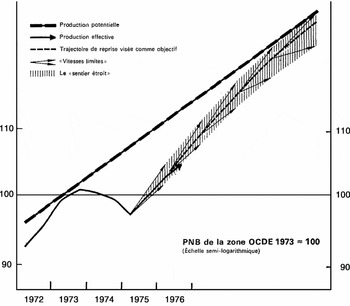
S. Marris résume alors ce qui, à ses yeux, représentait l'apport informationnel du secrétariat au rapport : «proposer une des versions les plus sophistiquées de réglage finFootnote 65 », qui tient au concept de «narrow path» (fig. 1), une voie étroite de reprise correspondant à un équilibre instable entre des anticipations inflationnistes et une demande hésitante.
Il ne fallait pas aller trop vite, mais ne pas ralentir trop non plus, sinon une spirale [inflationniste] se créait. [. . .] Il y avait toujours une bataille pour savoir si l'objectif était un déficit zéro, ou si, comme le disaient les keynésiens comme moi, dans les économies quand il y a un déficit de l’épargne privée, à ce moment-là, il peut y avoir une position d’équilibre, soit par un surplus ou soit par un déficit budgétaire qui balance le déficit structurel dans le secteur privé Footnote 66 .
Nous avions ainsi un modèle dans lequel nous disions : «si vous êtes en dessous du potentiel de production, vous ne devez pas essayer de revenir à la normale trop rapidement parce qu'il y a une sorte de vitesse limite à la reprise, mais vous ne devez pas rester trop longtemps en dessous parce qu'alors vous aurez des effets négatifs sur l'investissement, la motivation et la productivité et il sera de plus en plus dur de revenir à la normale»Footnote 67 .
Le «narrow path of growth»

Toute la difficulté de cette stratégie tient au paradoxe − énoncé par S. Marris dès 1970 dans un rapport plus confidentiel de l'Ocde − qui lie la croissance des anticipations inflationnistes à la réussite de la politique économique keynésienne : «les acteurs économiques commencent à anticiper correctement les conséquences macroéconomiques des actions gouvernementales et contribuent ainsi à rendre ces dernières incapables de produire le résultat désiréFootnote 68 ». Ce succès éloigne des esprits toute crainte de récession mondiale et alimente les comportements inflationnistes (surinvestissement, ententes sur les prix, demandes salariales, etc.)Footnote 69 . Pour restaurer la stabilité des prix et préserver l'emploi, l'Ocde recommande que les gouvernements éliminent la «demande excédentaire» et qu'ils se tiennent prêts «si nécessaire à accepter des réductions temporaires du taux d'activité jusqu’à ce que les signaux d'une meilleure stabilité des prix soit atteinte». Les risques électoraux d'une telle politique désinflationniste sont jugés trop élevésFootnote 70 . Pour casser les anticipations inflationnistes, tout l'enjeu revient à «convaincre les populations de se comporter comme si une récession sérieuse pouvait se produire sans en avoir vraiment uneFootnote 71 ». L'espoir était bien que les agents économiques «seraient tellement impressionnés par [la] détermination [des gouvernements] à adopter ces politiques [anti-inflationnistes] que leur comportement changerait sans avoir à en administrer la leçonFootnote 72 ».
Il s'agit d'une stratégie keynésienne délibérée pour infléchir les anticipations sans devoir passer à l'acte, à la différence des méthodes des monétaristes et des nouveaux classiques. Cette stratégie keynésienne orthodoxe, publiquement indicible si elle veut produire des effets, a été largement occultée avant d’être vaincue quelques années plus tard par ces outsiders. Comme l'observe S. Marris, elle a été «simplifiée dans la forme pure du monétarisme lorsque ces gens pitoyablesFootnote 73 tenant des anticipations rationnelles sont entrés dans le jeu» en ayant pour seul remède de réduire le taux de croissance monétaire et de laisser filer le chômage. Les politiques de gestion active de la demande sont désormais prises dans un étau – entre une position keynésienne risquée et indicible et une position monétariste adverse et affirmée – qui conforte la centralité de l'inflation et des anticipations comme un problème de politique économique.
Des keynésiens affichés partagent la stratégie du département économique de l'Ocde – recréer la crainte d'une récession réelle –, tels l'ancien président du Cea sous Lyndon Johnson, de 1968 à 1969, Arthur OkunFootnote 74 (auquel a succédé P. McCracken), ou encore le ministre des Affaires étrangères britannique, le travailliste Anthony Crosland, qui laisse planer le spectre de la récession et de la faillite de l'arbitrage entre inflation et chômage au congrès de son parti en 1976Footnote 75 . L’économiste suédois Gunnar Myrdal, «prix Nobel» en 1974 pour sa contribution à la théorie de la monnaie (la même année que Friedrich Hayek), partage aussi cette position mais il insiste sur les facteurs institutionnels ou sociétaux de l'inflation et défend l'internationalisation de l’État socialFootnote 76 . Toutefois, de l'intérieur de l'Ocde, des économistes proches de la social-démocratie européenne et du monde syndical, se réclamant d'une forme de keynésianisme, contestent cette stratégie. Gösta Rehn, le directeur du département de la Main-d’œuvre et des Affaires sociales (Msa) de l'Ocde de 1962 à 1973, figure tutélaire, avec Rudolph Meidner, du modèle suédois d'après-guerre (d'inspiration wicksellienne) articulant politiques fiscales, croissance des salaires réels, politiques de l'emploi et intervention étatique, estime que cette stratégie est trop risquée politiquement car elle peut être «interprétée par beaucoup comme une recommandation officielle pour accroître les niveaux de chômageFootnote 77 ». Les craintes de G. Rehn se sont confirmées par la suite : d'une stratégie de désinflation, on est passé à une politique antisociale.
Une lutte interne à l'Ocde entre le département économique et le département des Affaires sociales, incarnés respectivement par S. Marris et par G. Rehn, met en jeu la définition du keynésianisme international porté par l'organisation. Ces luttes se poursuivent avec la publication du rapport McCracken sept ans plus tard. À l'occasion d'un séminaire du pôle social et syndical de l'Ocde, G. Rehn, désormais responsable de l'Institut de recherches sociales de l'université de Stockholm, juge que le rapport signe l'abandon du plein emploi et qu'il dépolitise la question de l'inflation en n'examinant ni ses responsables (en particulier les firmes multinationales), ni les conflits redistributifs dont elle est l'expression monétaireFootnote 78 . G. Rehn défend, au contraire, des politiques désinflationnistes adossées à une politique active de l'emploi n'excluant ni la création d'emplois publics, ni une intervention publique dans les stratégies des entreprises. Quant au nouveau directeur du département des Affaires sociales, le britannique James Ronald Gass, convoqué pour s'expliquer devant les membres du groupe McCracken, il attaque le rapport pour sa «négligence totale des partenaires sociaux, des syndicats, etc.». Finissant d'attester le niveau d'asymétrie et l'impuissance du pôle social de l'Ocde, sa critique, comme pour d'autres rapports, se déploie «en vers, avec de la poésie» : «c’était un moyen de luttes, il y avait une telle dominance de la pensée macroéconomique»Footnote 79 .
S'il est hors de doute que le centre de gravité de la «commande» du rapport McCracken se situe aux États-Unis, la structuration d'ensemble du groupe d'experts ne saurait se résumer à une domination unifiée, unilatérale et incontestée. Elle s'inscrit au contraire au point de friction des champs politique, bureaucratique et universitaire, lesquels sont traversés de clivages plus ou moins saillants (républicains vs. démocrates, département d’État vs. département du Trésor, keynésiens de la synthèse vs. monétaristes). Les secteurs économiques dominants de l'Ocde (S. Marris et, à travers lui, le département économique de l'Ocde) se positionnent face aux débats états-uniens, contribuant ainsi à leur internationalisation. L'asymétrie d'une telle internationalisation se mesure dans la rénovation proposée du keynésianisme qui exclut ou minore d'autres courants keynésiens et institutionnalistes, suédois, britannique, français, etc. Certains de ces clivages s'incarnent dès les premiers marchandages sur le cadrage du rapport, d'autres font leur apparition par la suite. La forme rapport rend possible cette confrontation de capitaux informationnels, bureaucratiques et politiques ; elle en objective en quelque sorte la valeur différentielle ou le taux de change pour les participants.
Des marchandages sur le cadrage
Un secrétariat incontournable en décalage avec Paul McCracken
Pour mettre sur pied «le groupe d’économistes distingués traitant des problèmes de croissance», l'accord du bureau restreint du Cpe, où les «grands pays» de l'Ocde sont représentés par les ministères des Finances, est aussitôt recherché. La délégation allemande réagit fraîchement à l'initiative. Son représentant, Hans Tietmeyer, secrétaire d’État adjoint du ministère des Finances, chef de la délégation allemande au Cpe jusqu'en 1982 et futur président de la Bundesbank, insiste pour que l’étude se concentre sur le problème de l'inflation et sur des «problèmes pratiques plutôt qu'elle ne s'embarque sur des modèles théoriques et futuristes dans le sillage du Club de RomeFootnote 80 ». En tant que centre de réflexion porté sur la prospective, réunissant universitaires, hauts cadres d'entreprise et fonctionnaires nationaux et internationaux, le Club de Rome, créé en 1968 dans les couloirs de l'Ocde (principalement par le directeur du département de la Science et de la Technologie, Alexander King), avait attiré l'attention médiatique et politique, dans ses rapports retentissants de 1972Footnote 81 et de 1974Footnote 82 , sur les effets négatifs de l'industrialisation, sur les limites environnementales du productivisme ambiant, ainsi que sur la nécessité d'une coopération globale pour réduire les inégalités (inter)nationales de distribution de la richesse et de santé. Après avoir soutenu l'initiative à ses débuts, le secrétaire général de l'Ocde, sous le poids du département économique de l'Ocde et du Cpe, considère désormais officiellement qu'il n'y a pas de conflit entre la croissance économique et la protection du bien-être et de l'environnement, ce que laisse aussi entendre le rapport. La commande de Kissinger réinstalle, de ce point de vue, la croissance économique au cœur des objectifs politiques.
Lors de la première réunion de préparation au siège de l'Ocde quelques semaines plus tard, les directeurs des principaux départements sont présents, de même que P. McCracken. L'un des quatre secrétaires généraux adjoints, l'inspecteur général des finances mis en disponibilité Gérard EldinFootnote 83 , qui préside la séance, précise que le groupe souhaite proposer aux gouvernements des solutions «pour reconquérir le contrôle de l’économieFootnote 84 ». L'ensemble des cartes des politiques économiques est à rebattre : «Quel taux de croissance doit-on viser? [. . .] Quels nouveaux instruments sont nécessaires au niveau national et international? [. . .] Jusqu'où le système de marché fonctionne-t-il encore?» Le secrétariat de l'Ocde relaie les interrogations gouvernementales dans un cadre multilatéral où les divisions «verticales» de l'organisation en départements sectoriels (économie, industrie, social, science, etc.) semblent ponctuellement levées au profit d'une discussion «horizontale» mutualisant les ressources documentaires et les problématiquesFootnote 85 . Mais cette mise en commun ne saurait masquer la hiérarchie objective entre les départements, en termes d'effectifs, de budget et de capitaux informationnels, en particulier statistiques. L'ordre protocolaire le rappelle aussi, en plaçant le département économique et les questions qui lui sont associées au sommet, au détriment du reste, en particulier les questions «sociales» qui posent aux économistes de l'Ocde un problème de quantification et peinent à s'insérer dans les débats.
Sans surprise, tous les participants conçoivent le groupe comme une opportunité de dépasser les contraintes bureaucratiques qui pèsent habituellement sur les comités de travail de l'Ocde intégrant les délégations gouvernementales. Au reste, le travail du groupe ne doit pas conduire «à répéter [celui] du secrétariat qui est plus rigoureux [et] ne devra pas utiliser un modèle en particulier». Il pourrait être «à l'image du groupe ReyFootnote 86 , menant le réexamen de la politique économique dans une perspective de long terme mais sans un horizon précis»Footnote 87 . En dépit des engagements pris sur l'autonomie future du groupe et d'une enveloppe prévisionnelle confortableFootnote 88 , l’éventail des questionnements et la simple logistique rendent le secrétariat incontournable aux plans informationnel et rédactionnel. Le calendrier est en effet serré : un rapport intermédiaire doit être remis pour la réunion des ministres au sein du Conseil de l'Ocde en juin 1976 ; seulement cinq ou six réunions d'une semaine sont prévues, durant lesquelles le groupe peut se réunir seul, avec le secrétariat ou avec des personnes extérieures. S. Marris et ses collaborateurs sont les chevilles ouvrières du processus rédactionnel.
P. McCracken intervient peu au cours de la première réunion et uniquement pour préciser que le groupe ne doit pas se limiter à l'analyse «des facteurs économiques [mais doit] plutôt examiner un problème très difficile auquel font face les hommes politiques – à savoir que la confiance pour traiter de la situation économique s'est évaporée». Bref, il s'agit de traiter de facteurs qu'il semble lui-même juger extra-économiquesFootnote 89 . Deux jours plus tard, la lettre qu'il adresse au secrétaire général de l'Ocde tranche avec ces discussions éthérées et vise la nécessaire adaptation des outils d'analyse keynésiens. P. McCracken n'hésite plus à affirmer que la «sagesse conventionnelle de la tradition keynésienne apparaît inappropriée aux nouvelles forces économiques qui produisent des déséquilibres non anticipés, fondamentaux, persistants dans les économies du monde industriel». Ces déséquilibres ne se limitent ni au «bond discontinu des prix du pétrole [ni à] une faible production agricole»Footnote 90 . P. McCracken négocie alors la composition de son groupe : «j'assumerais le fait qu'ils devront avoir une inclination générale pour favoriser de façon prioritaire le système de marché afin d'organiser l'activité économique plutôt que les systèmes économiques gérés par l’État». L'espace des profils acceptables se restreint à un mode de pensée non interventionniste : la socialisation des marchés par le biais d'instances (para)étatiques est rejetée a priori Footnote 91 . Mettant en jeu, sur cette base, sa propre participation au groupe, P. McCracken négocie donc pied à pied avec E. van Lennep. Cette proximité et cette assurance trouvent leurs ressorts dans la trajectoire hors norme de l’économiste.
Un chairman de synthèses
Né en 1915 dans une famille républicaine de fermiers de l'Iowa, avec un oncle professeur d’économie, P. McCracken traverse dans sa jeunesse la Grande Dépression et considère que cette expérience l'a motivé à s'intéresser à l’économie : «Nous n'avions pas besoin de regarder les statistiques du Pnb qui, du reste, n'existaient pas encore, le problème était autour de nousFootnote 92 .» Après un diplôme obtenu au William Penn College d'Oskaloosa en 1937, il est admis à l'université Harvard et obtient son master en économie en 1942. Il est aussitôt recruté au département du Commerce, où il officie de 1942 à 1943 dans une économie de marché organisée pour la guerre. De 1943 à 1948, il intègre la banque régionale de Minneapolis de la Réserve fédérale américaine (Fed) comme économiste financier puis comme directeur de la recherche, tout en achevant son doctorat à Harvard. Il gagne ensuite la Ross School of Business de l'université du Michigan où il demeure jusqu’à sa retraite.
Cofondateur en 1952 de l'American Enterprise Institute (Aei) – un think tank conservateur à la légitimité alors fragile qui fournit des contingents aux administrations républicaines et que M. Friedman rejoint en 1956 –, P. McCracken fait partie de l’establishment intellectuel républicain en matière économique. En tant que président du Cea sous Nixon, de 1969 à 1971, il participe aux réunions du WP3 de l'Ocde Footnote 93 , où il fait la connaissance de E. van Lennep qui en est le président en tant que représentant du ministère des Finances néerlandais, avant d’être nommé secrétaire général de l'Ocde en octobre 1969. E. van Lennep consulte P. McCracken sur la question de l'inflation avant la demande de Kissinger. Rapporteur de la conférence sur ce thème conjoint au gouvernement et au Congrès états-uniens, P. McCracken prépare des parties de l'allocution du président Gerald Ford du 8 mai 1974Footnote 94 . En réponse à E. van Lennep, il précise que «ces effets de distorsion et de déplacement de l'inflation sont très spécifiques [aux configurations nationales]. Ce n'est pas, en somme, salaires contre profits, mais un salarié par rapport à un autreFootnote 95 .»
Au Cea, sous Nixon, P. McCracken dénonce le caractère inflationniste des augmentations de salaires accordées aux ouvriers de l'industrie automobile et se montre hostile aux programmes de création d'emplois dans la fonction publiqueFootnote 96 . Dans le même temps, il allonge l'indemnisation chômage et exempte les plus pauvres de l'impôt fédéral sur le revenu. Alors qu'il soutenait, en 1969, que dans «notre stratégie économique, il n'y a pas place pour un contrôle direct des prix et des salaires. L’économie de marché a sa moralité propre qui ne souffre pas d'atteinteFootnote 97 », il se résout en 1971 à une nouvelle politique économique de gel des salaires et de contrôle des prix, moins par doctrine que, comme il aime à (se) le (re)présenter, par «pragmatisme» ou «réalisme»Footnote 98 . C'est une «énorme déception» pour M. Friedman, car cela fausse selon lui la fixation «naturelle» des prix, nécessaire au bon fonctionnement du marchéFootnote 99 . Sur les questions monétaires, si P. McCracken ne pèse pas lourd face à la Fed d'Arthur Burns (le directeur de thèse de M. Friedman) qui pratique une politique monétaire expansionniste dès 1971, il souhaite, comme M. Friedman, en neutraliser les effets sur les anticipations en établissant une règle de croissance fixeFootnote 100 . Il se montre très réservé sur l'expérience du flottement généralisé des monnaies (spécialement du Deutsche Mark), qu'il juge «trop incertaine et risquéeFootnote 101 ».
Cette question des taux de change fixes ou flottants divise jusqu’à la Société du Mont-PèlerinFootnote 102 , à laquelle P. McCracken participe lors d'une rencontre en 1972 où se côtoient M. Friedman, Irving Kristol, Gordon Tullock, Karl Popper, Gary Becker («prix Nobel» en 1992), Gottfried Haberler ou Herbert Giersch. Ce dernier intègre le groupe McCracken et succède à James Buchanan («prix Nobel» en 1986) à la présidence de cette Société de réflexion internationale dans les années 1980Footnote 103 . P. McCracken ne semble plus avoir participé par la suite à ces rencontres, contrairement à celles de la Commission trilatérale, dont il est membre depuis sa création en 1972. Il y croise notamment l’économiste en chef de John Kennedy, le keynésien Walter Heller, le gouverneur démocrate de Géorgie, Carter, ou le président du Cea de Ford et, à ce titre, membre du WP3 de l'Ocde, Alan Greenspan, ainsi que, plus tard, vingt-six membres de l'administration Carter. À son départ du Cea, P. McCracken rejoint la cohorte d’économistes (dont M. Friedman) appointés par le Wall Street Journal pour assurer un éditorial mensuel, auquel il contribue pendant dix ans.
Sans voir dans son jury de thèse (en trigonométrie économique) un signe annonciateur de son parcours, force est de constater que s'y trouve miniaturisé le triptyque qui structure le champ de la science économique états-unienne d'après-guerre à Harvard. Le premier est un économiste keynésien dominant, démocrate, qui a formé P. McCracken, Alvin Hansen, principal importateur de Keynes aux États-Unis, qui lui a servi d'intercesseur auprès des autorités états-uniennes à Bretton Woods. Le deuxième, austro-hongrois ayant migré dans les années 1930 aux États-Unis, est un économiste élitiste et libéral, alors moins connu que le précédent, Joseph Schumpeter, l'archétype de l’«intellectuel conservateurFootnote 104 » en proie au pessimisme sur l'avenir du capitalisme face au socialisme. Le troisième, économiste de l’école autrichienne, G. Haberler, a suivi le séminaire privé de Ludwig von Mises à Vienne (le Mises-Kreis), a développé depuis 1934, à la Société des Nations, une théorie du cycle économique et du commerce international opposée à celle de Keynes et, enfin, a participé à la Société du Mont-Pèlerin ou au Cato Institute, avant de rejoindre l'Aei. L'originalité de P. McCracken tient à ce qu'il a pu être perçu, dans une forme d’allodoxia, comme appartenant aux trois pôles à la fois.
Des «politiques monétaires et fiscales non accomodantes», voilà la formule qu'il retient du rapport qui porte désormais son nom :
Si vous voulez limiter l'inflation, vous avez juste à vous y confronter frontalement. Je me rappelle la réunion à Paris avec les ministres des Affaires étrangères [. . .] ou plutôt des Finances, pour présenter le rapport. Et quelqu'un a dit : «Eh bien, c'est évident!» Il y avait comme un changement dans la manière de penser, vers plus de réalismeFootnote 105 .
Marqué par une forme de prudence, de «gradualisme» ou de centrisme, loin des éclats péremptoires d'un M. Friedman, P. McCracken n'a pas déchaîné les passions dans les sphères de la macroéconomie universitaire, du lobbying patronal au plan intellectuel et de la haute administration économique états-unienne. En 1975, il peut faire figure d'homme de la situation à l'Ocde en incarnant un point de convergence de forces opposéesFootnote 106 . Si ses interlocuteurs s'attachent à l'idée qu'ils se plaisent à s'en figurer («éclectique», «keynésien de droite», «friedmanien»), P. McCracken offre surtout suffisamment de capitaux bureaucratiques, politiques, universitaires et journalistiques à la structure d'ensemble exclusivement états-unienne pour être autorisé à élaborer une part du nouveau consensus macroéconomique mondial depuis l'Ocde.
L'extraversion contrainte du groupe d'experts
Congrès états-unien, Financial Times, G6 et Fmi en invités inattendus
Une fois les intentions de P. McCracken annoncées au secrétaire général, les invitations sont lancées. Dans l'activation de ce capital relationnel, les plus hauts gradés de l'Ocde sont mis à contribution : le secrétaire général ainsi que le directeur du département des Affaires économiques invitent H. Giersch, Guildo Carli ou Raymond Barre pendant l’été 1975. Prolongeant les asymétries antérieures, le département des Affaires sociales ou celui de la Science et de la Technologie sont exclus de cette intermédiation. Les courriers envoyés n’évoquent ni la commande de Kissinger, ni les desiderata politiques portés par P. McCracken sur la nécessaire «adaptation» du keynésianisme et l'obédience «market-oriented» des économistes recherchés. Aux relations épistolaires s'ajoutent des rencontres. Charles Wootton, le secrétaire général adjoint états-unien, organise un déjeuner destiné à «permettre au professeur McCracken et au secrétariat d'avoir un entretien avec un représentant senior du Congressional Joint Economic Committee, qui avait entendu parler de la mise en place du groupe et souhaitait être tenu informéFootnote 107 ». Ce type de rencontre informe de première main certains hauts responsables de l'Ocde sur les perceptions, les attentes et les conflits qui traversent les instances économiques états-uniennes. Les archives consultées laissent penser que seul le représentant du Congrès a reçu ce genre d'attention, au moment où a été réintroduit le projet de loi sur le plein emploi porté par l'aile gauche du parti démocrate.
Ce projet débouche, deux ans plus tard, sur le Humphrey Hawkins Act qui définit un nouveau mandat pour la Fed, désormais astreinte à justifier sa stratégie devant le Congrès, autour des mêmes objectifs que le futur rapport McCracken : plein emploi (défini à 4-4,5 % de chômage) et stabilité des prixFootnote 108 . C'est aussi dans cette période que le House Banking Committee de la Chambre des représentants, présidé par Henry Reuss, joue un rôle décisif de blocage sur les questions monétaires internationales en s'opposant à toute mesure d'ajustement multilatéral contraignante pour les États-Unis. Dans le système de taux de change flottant, où ces derniers bénéficient d'un privilège monétaire sans contrepartie, la distribution du coût des ajustements entre les pays avec une balance des paiements excédentaire et ceux avec une balance déficitaire se réalise au gré des fluctuations des marchés monétaires. Pour parer les attaques spéculatives sur le franc et l'instabilité financière, le Trésor français (représenté par Jacques de Larosière) milite face au Trésor états-unien (représenté par Edwin Yeo) pour un retour à un système de taux de change fixe (de type Bretton Woods) autorisant les ajustements monétaires multilatéraux (multilatéralisme des paiements) et dans lequel le WP3 de l'Ocde jouait jusqu'ici un rôle important.
Tous les champs politiques et bureaucratiques ne pèsent donc pas du même poids pour structurer les calculs et les anticipations du probable des agents de l'Ocde et de P. McCracken. Il en est de même des champs journalistiques. À partir du moment où la composition du groupe est presque stabilisée, la presse doit être contactée mais le titre du rapport – «Politiques pour une croissance économique non inflationniste» – reste trop terne et les alternatives sont peu convaincantesFootnote 109 . Une fuite précipite alors le programme prévu de «relations publiques». Alors que les membres pressentis n'ont pas tous donné leur accord et qu'aucun communiqué officiel n'a été publié, un article du Financial Times signé Samuel Brittan, éditorialiste en vue et futur soutien du thatchérisme, lève le voile sur la création et la composition du groupeFootnote 110 . À l'Ocde, les réactions sont ambivalentes. Si les objectifs assignés et le bon résultat promotionnel ne sont pas contestés, l'article évente tout effet de surpriseFootnote 111 . Plus grave, la confidentialité s'effrite en même temps que se fixe la composition du groupe : il devient désormais extrêmement coûteux pour le secrétariat d'exclure un des membres évoqués dans l'article. La fuite pèse dans les tractations internes.
L'article du Financial Times mentionne le lancement parallèle d'un groupe conduit par le secrétaire d’État du ministère des Finances allemand, Karl Otto Pöhl (futur président de la Bundesbank de 1980 à 1991), et où figure aussi R. Barre, chargé de préparer le premier sommet économique des chefs d’État du G5. À cette réunion, qui s'est tenue à Rambouillet en novembre 1975 (G6, car le gouvernement italien y est finalement invité), à laquelle l'Ocde n'est pas conviée malgré l'insistance de E. van Lennep, les chefs d’États préconisent des politiques de relance conjoncturelles plus prudentes au risque de taux de chômage plus élevés, suivant le principe de la «prudence dans l'expansion». Alors qu'une reprise économique se dessine depuis 1975, le Conseil de l'Ocde de juin 1976 reprend le même thème et le concept de «narrow path» développé par le secrétariat semble en être la traduction technique directe. Rambouillet signe également la concrétisation des négociations bilatérales entre la France et les États-Unis sur le système monétaire international, qui se manifeste la même année par un amendement des statuts du Fmi (art. IV) – avec la signature des accords de la Jamaïque – prévoyant non pas un retour à des taux de change fixe, mais le passage à un «système stable de taux de change flottant» voulu par le Trésor états-unien. D'un côté, les États sont autorisés à intervenir sur les marchés des changes pour prévenir des «situations de marché désordonnées», de l'autre, les dévaluations compétitives leur sont interdites. Le Fmi exerce désormais une «surveillance ferme» sur les politiques de change des États membres, les obligeant à lui fournir toutes les informations macroéconomiques nécessairesFootnote 112 .
Des attaches dans les bureaucraties économiques et les milieux d'affaires
Quelques semaines après l’épisode du Financial Times, P. McCracken est seul autorisé, «pour des motifs politiques», à rencontrer la presseFootnote 113 . Il s'agit d’ériger en principe l'inaccessibilité et l'homogénéité du groupe afin de prévenir les voix dissonantes. Masculins et multinationaux, ses membres apparaissent dans les dossiers de presse de l'Ocde comme des hommes d'expérience dont les titres universitaires, exclusivement en science économique, sont mis en avant pour camper tout à la fois les compétences intellectuelles et le désintéressement académique de leurs titulaires. Les principaux pays membres de l'Ocde sont représentés au sein du groupe et lorsque, en janvier 1976, R. Barre est nommé ministre du Commerce extérieur, il est remplacé au pied levé par un autre français, Robert MarjolinFootnote 114 . La même règle s'applique pour Miyohei Shinohara auquel succède Ryūtarō KomiyaFootnote 115 . À l'exception de Robin MatthewsFootnote 116 , les membres du groupe ont tous accumulé un capital social et bureaucratique international : six sur neuf à l'Ocde (ou à l'Oece), trois à la Communauté économique européenne (Cee), trois à la Banque mondiale, un à l'Onu, un autre au Fmi. Sur le plan national, les organismes gouvernementaux (sept sur neuf) liés à l'aide à la décision et aux études sont surreprésentés : le commissariat au Plan français, le Social Science Research Council britannique, le Comité du conseil économique allemand, le Cea états-unien, etc.
Ce capital bureaucratique «intellectuel» à base technique et politique (du type conseiller du prince) se révèle ici très éloigné du capital bureaucratique lié à l'ancienneté dans une administration et à l'exercice de fonctions de gestion. Les ministères économiques (commerce extérieur, industrie, économie) et les Banques centrales (Fed, Banque de Suède, Banque d'Italie, Banque de France) sont également surreprésentés. Par contraste, aucun membre du groupe n'a fait carrière, pour tout ou partie, dans un ministère «social» ou une organisation internationale dédiée au «social», comme l'Organisation internationale du travail (Oit) ou le Conseil économique et social de l'Onu (Ecosoc). Aucun d'entre eux n'a du reste brigué de mandats électifs parlementaires. À l'exception de R. Matthews et de R. Komiya, qui apparaissent comme les universitaires les plus «purs», et aussi les plus keynésiens, tous ont exercé des fonctions gouvernementales. Celles-ci sont rappelées dans les dossiers de presse sans considération de la couleur politique des gouvernements – majoritairement de droite –, ce qui dépolitise les wise men et fait primer l'officialité de la fonction. Les expériences professionnelles dans le secteur privé ou dans la représentation d'intérêts professionnels sont aussi écartées. Il n'est, par exemple, ni rappelé que P. McCracken est membre du conseil d'administration de l'Aei, ni que G. CarliFootnote 117 , l'ancien gouverneur de la Banque centrale d'Italie de 1960 à 1975, devient en 1976 le président de la principale confédération patronale italienne (Confindustria).
Les obédiences théoriques des économistes ne transparaissent pas davantage, unifiant du même coup, pour l'extérieur, les sciences économiques. En 1983, dans le séminaire fermé de l'Ocde mentionné plus haut, S. MarrisFootnote 118 décrit au contraire :
un groupe de gens extraordinairement hétérogènes qui se rangeaient depuis les keynésiens purs et durs comme Matthews, jusqu'aux partisans de l'offre non conformistes comme GierschFootnote 119 , en passant par les éclectiques comme LindbeckFootnote 120 et McCracken [. . .]. Alors inévitablement, nous avons eu avec ce rapport un résultat proche d'un document de comitéFootnote 121 .
Le titre universitaire et la fonction officielle exercée, associés à la multinationalité, insinuent l'indépendance et la hauteur de vue du groupe et participent à la construction d'attributs méta-partisans. L’énonciation experte, c'est-à-dire la mise en place d'une configuration asymétrique mettant aux prises un savant et un profane, un pédagogue et son élève, est à ce prixFootnote 122 . Ces trajectoires variées, mais homogènes, inscrivent le groupe et l'institution dans des formes d'interdépendance tacites et incorporées qui ne sont pas réductibles aux seules interactions. Et si, pour le directeur du département économique John Fay, les distances entre le groupe et les «partenaires sociauxFootnote 123 », représentés à l'Ocde par le Business and Industry Advisory Committee (Biac) et le Trade Union Advisory Committee (Tuac), doivent être tenues, les propriétés du groupe et ses premières prises de position suggèrent que l’écart se creuse en réalité beaucoup plus avec les syndicats qu'avec les milieux d'affaires.
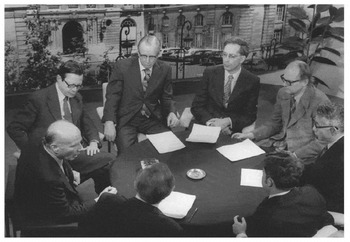
La scénographie d'un groupe à huis clos

La cristallisation conflictuelle du rapport : du probable au probant
Un écrivain public anxieux face à un groupe multiclivé
Dans sa note de cadrage sur la crise économique, le secrétariat embrasse un large spectre de facteurs : l'accès aux matières premières, l'affaiblissement de la propension à investir, la guerre du Viêtnam, mais aussi «la distribution du revenu de base entre travail et capital, les différences de revenu entre groupes de salariés, les revendications non salariales des ménages – comme la sécurité sociale, l'assurance santé, et même des aspirations comme la ‛participation’, la ‛qualité de vie’, etc.Footnote 124 .» S'il distingue «différentes écoles de pensée (qui ne sont pas nécessairement mutuellement exclusives)», aucun auteur ni aucun label académique (keynésianisme, monétarisme, etc.) ne sont cités. L'analyse ne se focalise pas sur la croissance de la masse monétaire, sur le choc pétrolier ou sur le manque de flexibilité du marché du travail. La note appelle à un «vaste renouvellement d'approche» afin de mettre davantage l'accent «sur les aspects qualitatifs que sur les aspects quantitatifs» : par exemple, l'assistance aux groupes marginalisés, les incitations au départ en retraite, la réduction du temps de travail. S'y devinent les recherches en cours sur les indicateurs sociauxFootnote 125 .
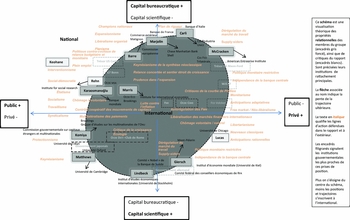
Schéma théorique de l'espace des positions dans le groupe McCracken

Invités à mettre en avant leurs propres opinions sur la situation, les membres du groupe n'approfondissent pas cette idée. Celui-ci apparaît bien plus fermé dans son champ de questionnement que le secrétariat. Certes, personne n'entend résumer la situation économique à l'inflation du prix des carburants, mais certains désignent sans détour les revendications en matière de partage des richesses, la puissance des syndicats et les mobilisations politiques post-68 comme les causes principales de la situation. H. Giersch et A. Lindbeck ont ainsi fait leur deuil du plein emploi et des politiques de demande «survendues». Ils ciblent la croissance de l’État social et préconisent d'emblée «la levée des garanties de groupes salariés qui entravent les négociations de salaire, les normes à fixer pour la politique monétaire, etc.Footnote 126 ». Ces jugements font directement écho aux thèmes de l’«ingouvernabilité» des sociétés occidentales et de l’«excès de démocratie», véhiculés la même année à la Commission trilatérale :
il est devenu difficile sinon impossible pour les gouvernements démocratiques de rogner sur les dépenses, l'augmentation des impôts, et de contrôler les prix et les salaires. En un sens, l'inflation est la maladie économique des démocraties. [. . .] [L]e fonctionnement efficace d'un système démocratique requiert en général un certain niveau d'apathie et de non-participation de la part de certains individus et groupesFootnote 127 .
S. Marris s'inquiète alors, dans son mémo interne au secrétaire général, de l’«orientation un peu trop traditionnelle et conservatrice» du groupe.
D'autres divisions surgissent en son sein, qui ne s'ajustent qu'en partie à l'opposition keynésianisme/nouveau classique évoquée rétrospectivement par S. Marris. Elles ont pour point commun de ne jamais mettre en discussion l'appareillage économétrique et statistique utilisé par le secrétariat de l'Ocde Footnote 128 – par exemple la comparabilité des taux d'inflation et de chômage –, le rendant une fois encore incontournable au plan informationnel. Atilla KaraosmanoğluFootnote 129 critique sévèrement le pré-rapport pour son manque d'attention aux pays en voie de développement, même s'il manque, semble-t-il, à «fournir lui-même des brouillonsFootnote 130 ». Il obtient néanmoins que sa critique soit annexée au rapport final. Il y affirme qu'il ne fait pas «confiance aux mécanismes du marché au même degré que la majorité des membres du groupe». Il pointe un aspect à ses yeux largement sous-estimé, surtout mis en regard de l'insistance sur les «revendications salariales inflationnistes des organisations syndicales», celui des «effets déstabilisants que peut avoir le comportement des grandes sociétés internationalesFootnote 131 ».
Sur ce point, le corps du rapport se félicite de l'adoption en 1976 par le Conseil de l’Ocde des «principes directeurs à l'intention des entreprises multinationales», préparés au sein du Comité de l'investissement international et des entreprises multinationales (Cime). Créé en 1975 à l'initiative des États-Unis, ce comité défend une autorégulation du secteur et cherche à contrer le projet de réglementation porté dès 1972 par le Groupe des 77 (G77) à l'Onu ou à l'Oit, à la suite du scandale de l'International Telephone and Telegraph (Itt) au Chili. Si le rapport reconnaît que «certaines sociétés ont abusé de leur pouvoir politique dans de petits pays», il oppose immédiatement les «expropriations injustifiables» de certains gouvernementsFootnote 132 . A. Karaosmanoğlu plaide pour une réglementation internationale contraignante du secteur, au même titre que bon nombre d’économistes sociodémocrates, socialistes et communistes, et de syndicalistesFootnote 133 . À mesure que leurs opérations financières s'internationalisent, les grandes firmes se soustraient à la réglementation héritée de Bretton Woods en recourant notamment à l'euromarché dérégulé de la place de Londres. Une alliance de fait pour la libéralisation financière internationale s’établit entre elles et les secteurs financiers.
Partagé aussi sur le degré d'indépendance à accorder aux Banques centrales, le groupe se clive plus encore sur l'ampleur de la relance souhaitée et, surtout, sur sa coordination internationale : les «expansionnistes», comme R. Marjolin appuyé en partie par R. Matthews, A. Karaosmanoğlu et R. Komiya, s'opposent aux partisans d'une relance modérée, P. McCracken, H. Giersch et A. LindbeckFootnote 134 . Alors que leurs pays respectifs ont chacun une balance des paiements excédentaire et qu'une relance domestique de leur part conduirait à leurs yeux à des tensions inflationnistes nouvelles, H. Giersch et R. Komiya s'opposent à la solution de relance coordonnée proposée dans le rapport, eux aussi dans une critique annexée qui vise entre les lignes la Rfa et le JaponFootnote 135 . R. Komiya précise par exemple que l'«on ne saurait demander à aucun [pays] de s’écarter de sa stratégie optimale, afin de prendre la tête d'un mouvement conjoncturel d'expansion ou de ralentissement de la demande mondialeFootnote 136 ». Donnant libre cours à son éthos de haut fonctionnaire international (qui précipite sa chute quelques années plus tard), S. Marris se plaint auprès du secrétaire général du conformisme général du groupe dû au manque de «compétence» et aux vues «incroyablement nationalistes» de ses membres «sur presque tous les problèmes discutésFootnote 137 ».
S. Marris fait aussi part d'une appréhension : le brouillon d'ensemble se tient, mais sa réception devient problématique à l'aune de l'alternance politique démocrate aux États-Unis, en particulier sur la question de la relance. Il n'exclut pas que le rapport soit «rejeté par la nouvelle administration» au Conseil des ministres de juin 1977. Le chef de l'unité de prévision et de l’évaluation du cabinet du secrétaire général de l'Ocde doute néanmoins de la nature politique du rejet états-unien et de la faculté de S. Marris à concilier les contraires dans les réécritures finales :
si Schultze et Blumenthal rejettent ce rapport et prennent [. . .] une position plus «expansionniste» à la Ministérielle (et étant donné la dissension dans les rangs du groupe McCracken lui-même, [. . .] ce ne serait pas très surprenant), je pense que ce sera à cause d'honnêtes différences dans leur compréhension du fonctionnement de l’économie moderne par rapport à celle du professeur McCracken. Ces différences [. . .] se centrent sur les déterminants de l'investissement et le rôle des anticipations [. . .]. Je souhaite juste tempérer votre optimisme sur la possibilité de rapprocher les deux camps avec un heureux compromis de langageFootnote 138 .
P. McCracken prend alors contact avec le nouveau président du Cea, Charles Schultze, et prévoit de rencontrer à Washington le sous-secrétaire d’État aux affaires économiques (Richard Cooper), celui aux affaires monétaires (Anthony Solomon), voire le secrétaire au Trésor (Michael Blumenthal). Ses dispositions de conciliateur peuvent désormais servir à ajuster in extremis le tir et à ménager l'institution. Ces rencontres rendent au contraire manifeste un écart de vue sur le plan de la relance mondiale que P. McCracken entend bien voir figurer dans le rapport. Ce décalage met en difficulté le secrétariat et pousse à de nouvelles corrections.
Les ultimes réécritures ou l'effet Bandwagon
E. van Lennep s'inquiète pour l'Ocde en raison de la «très grande sensibilité politique» du problème. Le secrétariat s'expose et tous les démentis de paternité n'y feront rien : le rapport sera lu comme un «rapport de l'Ocde» même sans sa signature officielleFootnote 139 . En conséquence, «les conclusions et les recommandations, mais même le développement, doivent être revus sous cet angleFootnote 140 ». Ce que certains récepteurs liront comme autant d'embarras stylistiques ou d'amphigouris trahit un déminage anticipé de la réception par un travail contraint de mise en formeFootnote 141 . En janvier 1977, la longue rencontre, à l'Ocde, du secrétaire général avec le nouveau vice-président états-unien, Walter Mondale, accompagné du sous-secrétaire d’État aux affaires économiques et de son assistant, Fred Bergsten, réitérée, en mars 1977, à Washington, n'a pu qu'accentuer l'enrôlement de l'Ocde dans la stratégie états-unienne visant à convaincre les gouvernements allemand et japonais de participer à un effort d'expansion conjointFootnote 142 . S'il a fallu initialement que le secrétariat s'associe au groupe, tout s'organise à l'approche de la livraison pour l'en distancer et le prémunir de retombées par un travail de réécriture. Cette inquiétude institutionnelle ramène à l'une des contradictions constitutives de l'Ocde quand elle est érigée en «expert» : diagnostiquer, innover et prescrire, mais dans une crainte à l’égard de ses principaux soutiens gouvernementaux, États-Unis en tête, sans quoi son «expertise» pourrait bien être réduite à une prise de position politique parmi d'autresFootnote 143 .
La question d'une «politique de régulation de la demande globale» n'est pas un thème réservé au groupe McCracken dans les années 1970. Les Perspectives économiques de l'Ocde de décembre 1976, une déclaration du Conseil européen pour un plan d'action concertée en mars 1977Footnote 144 , la documentation de préparation de la réunion ministérielle de l'Ocde de juin 1977Footnote 145 , un rapport triadique de la Brookings Institution publié la même année, et auquel P. McCracken a participé aux côtés d'A. Okun pour les États-UnisFootnote 146 , poussent dans le même sens les États-Unis, le Japon et l'Allemagne à agir comme les «locomotives» de l’économie mondiale par des politiques de relance concertée, selon le vœu de l'administration Carter. Mais celle-ci essuie un échec au sommet du G7 de Londres en mai 1977 face au chancelier allemand Helmut Schmidt et au Premier ministre japonais, Takeo Fukuda.
À la réception du rapport McCracken lors de la «Ministérielle» de l'Ocde en juin, le secrétaire au Trésor états-unien martèle encore en interne : «Nous pouvons réussir à atteindre une croissance non inflationniste soutenue [. . .] si les pays excédentaires comme les pays déficitaires permettent aux taux de change de jouer un rôle approprié dans le processus d'ajustementFootnote 147 .» Sa déclaration en conférence de presse est comprise, en France et en Allemagne, comme une annonce prochaine de dévaluation du dollarFootnote 148 . Une nouvelle dévaluation inciterait l'Opep à rehausser le prix du baril et donc à intensifier l'inflation à l’échelle mondiale, à l'heure où les États-Unis se préviennent d'un tel surcoût énergétique. Dans le sillage des administrations Nixon et Ford et en dépit de ses déclarations en faveur des droits de l'homme et de la coopération internationale, l'administration Carter sécurise en effet avec le roi Khaled ben Abdelaziz d'Arabie Saoudite ou avec le schah d'Iran (pour quelques mois encore) la stabilité des approvisionnements en pétrole des États-Unis et l'achat de bons du Trésor états-uniensFootnote 149 .
Les pressions états-uniennes sur le Japon pour des politiques expansionnistes se poursuivent en septembre 1977 au Fmi et en novembre au Cpe de l'Ocde. Le Japon s'engage finalement en décembre sur 7 % de croissance pour 1978. L'Allemagne devient alors le sujet de préoccupation des États-Unis. H. Schmidt souhaite organiser un sommet du G7 à Bonn en juillet 1978 et Carter conditionne sa participation à des engagements précis en matière de croissance et de politique énergétiqueFootnote 150 . Si, pour des raisons tactiques internes, H. Schmidt attend le sommet pour imposer sa politique de stimulation de la demande – en particulier face à la Bundesbank et à son ministère des Finances –, l'affaire est entendue avec le gouvernement états-unien dès avril 1978 : un accord sur un paquet de relance de 1 % du Pib allemand. En revanche, le sommet de Bonn, comme celui de Londres, ne touche pas aux questions monétaires censées être aux mains de Banques centrales, désormais plus autonomes, qui compensent cette décontraction budgétaire par une restriction monétaire.
Dans sa version finale, le rapport McCracken se prononce sans surprise «contre un retour à des taux de change fixés officiellement» et constate le «rôle plus important que sont désormais appelés à jouer les prêteurs privés dans les opérations de financement officielFootnote 151 ». Les limites à la création de réserves pour les États dépendent davantage «du jugement porté par le marché privé sur le crédit [. . .] que d'une évaluation officielle, multilatérale, des politiques mises en œuvre et des besoins de l'ensemble du système. Le système monétaire international présente désormais certaines des caractéristiques d'un système national de crédit sans Banque centrale.» À cet égard, le point le plus préoccupant n'est pas «l'accroissement des liquidités internationales en lui-même» mais «la répartition extrêmement inégale des dettes extérieures accumulées aussi bien au sein qu'en dehors de la zone de l'Ocde». Toutefois, rien n'est proposé pour restreindre, orienter ou rééquilibrer les activités des marchés de capitaux internationaux à l'expansion désormais quasi illimitée. Au contraire, «la compartimentation actuelle des marchés de capitaux devrait être démantelée», de même que «les obstacles institutionnels à l’émission d'obligations indexées» (obligations d’État incluses)Footnote 152 . Comme le regrette S. Marris, le rapport n'innove pas en ces domaines et «ne dit rien sur les aspects institutionnels et pratiques de la coopération économique internationaleFootnote 153 ». L'un des principaux rédacteurs du rapport en est donc le premier critique : la non-décision équivaut en ces circonstances à une réelle prise de position.
Suivant la position états-unienne, globalement transpartisane, entérinée par les accords de la Jamaïque en janvier 1976 concernant les taux de change flottant et le développement de l'industrie financière, le rapport McCracken soutient par défaut une coordination monétaire et financière internationale via le marché, éloignée de Bretton Woods. Rien n'est proposé sur une chambre de compensation internationale qui disposerait d'une monnaie indépendante des États (projet Bancor), toujours irrecevable par le Congrès états-unienFootnote 154 , pour reprendre l'idée de Keynes ou de Robert Triffin, ou celle de James Tobin d'une taxe sur les transactions financières à court terme (déjà évoquée par Keynes en 1930)Footnote 155 , qui suppléerait au contrôle des capitaux, jugé peu praticable, en particulier après la crise obligataire britannique de 1976Footnote 156 . Rien ne pousse non plus vers un fédéralisme fiscal et monétaire sur une échelle régionale, qui permettrait par exemple de réduire la dépendance des pays en voie de développementFootnote 157 , ou celle des pays européens face au dollar, comme le préconise au même moment le rapport McDougall de la Commission européenneFootnote 158 , ou le tandem franco-allemand avec le système monétaire européen après le sommet de Bonn en 1978, mais aussi le projet de Fonds monétaire européen, distinct du Fmi, tenté la même année par H. Schmidt avant d’être retiré devant l'opposition états-unienneFootnote 159 . Le dollar n'est, en définitive, jamais concurrencé.
La stratégie de la locomotive (bandwagon) produit ses effets sur la reprise de la demande mondiale mais alimente, bien involontairement, la dynamique inflationniste liée au deuxième choc pétrolier à la fin de l'année 1978. Pour casser l'inflation aux États-Unis, le nouveau président de la Fed (et ancien secrétaire adjoint au Trésor de Nixon), Paul Volcker, nommé à l’été 1979 par Carter, élève les taux directeurs de 11 % à 20 %, conduisant à une récession et à une montée du taux de chômage à 10 % aux États-Unis. L'inflation passe de près de 15 % en 1980 à 3 % en 1983. Ironie de l'histoire, cette réussite dans la lutte contre l'inflation au détriment du chômage signe, d'une certaine manière, l'actualité de la courbe de Phillips.
L'entrée a priori fort étroite par la rédaction collective de ce rapport permet de démêler un écheveau de relations sociales «macro» dans lequel les acteurs se meuvent pour donner du poids à leur objectivation de la réalité économique. Par l’étude d'une écriture que l'on peut qualifier de collusiveFootnote 160 , cette sociohistoire de l'expertise et des idées économiques met à mal tout déterminisme cognitiviste : la plausibilité et, a fortiori, la validation d'une idée, en particulier sur la politique économique, dépendent de bien d'autres choses, y compris dans un cadre réputé pour sa grande technicité, que de son rapport à une réalité univoque. Elles tiennent aux interprètes de cette réalité, à leur sélection ou à leur présence obligée, ainsi qu'aux soutiens sociaux (effectifs ou anticipés) dont eux, leurs idées et les causalités qu'ils reconnaissent comme valides, infirmées ou confirmées, et leurs projets, bénéficient. La domination états-unienne s'incarne dans la commande, la nomination du président du groupe, le marchandage sur le cadrage, l'organisation de réunions latérales, la fuite dans la presse, la réception anticipée ou la relecture finale. Contre les analyses (néo)réalistes et (néo)marxistes qui se complaisent dans la synecdoque étatique, il n'est pourtant pas question de la domination unilatérale d'un acteur stratège sur une organisation internationale homogène, mais bien de la domination socialement différenciée d'un champ du pouvoir spécifique sur un secteur institutionnalisé, lui-même différencié, de l'espace international.
L'emprise états-unienne sur les secteurs dominants de l'Ocde (le secrétaire général et son cabinet, le département des Affaires économiques) passe par une série d'anticipations et de rencontres informelles qui ne mettent jamais en question l'intégrité du rapport dans son ensemble. Pour le secrétariat de l'Ocde, ces transactions, si elles engagent des compromis et une veille stratégique, n'ont à aucun moment à être justifiées en interne : évidences pratiques, elles participent de l'ordre des choses et de la bonne marche du groupe d'experts et de l'organisation. Si elle ne les exclut pas a priori, cette emprise ne se réduit ni à des motifs idéologiques partagés, ni à des directives explicites de Washington au groupe ou au cabinet du secrétaire général. Connaître la «position des États-Unis», à savoir celle du Trésor, de la Fed, du Cea, voire de la Maison-Blanche, est un enjeu de première importance pour les hauts gradés de l'Ocde dans leur déchiffrement du probable et leur estimation du jouable ; l'hétéronomie institutionnelle passe par eux. Il y va de la vie du rapport et du crédit de l'institution qui le porte, elle qui dépend à titre principal dans son financement de l'administration états-unienne. Ce risque de marginalisation est d'autant plus élevé que ce type d'organisation se voit de plus en plus contournée par des réunions multilatérales ad hoc des chefs d’État (G7) et contestée dans ses prérogatives de régulation monétaire et financière par la réémergence des marchés de capitaux internationaux.
La structuration sociale complexe, mais saisissable, qui travaille dans leur production et leur circulation les savoirs de gouvernement de l’économie mis en rapport, est marquée par la confluence internationale asymétrique de champs bureaucratiques, politiques, universitaires, voire journalistiques et patronaux. La confluence est rendue possible et particulièrement observable par une forme de «désectorisationFootnote 161 » de l'espace organisationnel de l'Ocde qui se joue à travers ce rapport. Les réunions entre les diverses directions de l'Ocde ordinairement compartimentées et dont les relations n'en demeurent pas moins hiérarchisées au profit du pôle économique, l'usage de la fuite journalistique pour peser dans les marchandages sur la composition du groupe, le suivi par le secrétariat de ce qui s'opère sur d'autres théâtres d'opérations internationaux comme le Fmi ou le G7, mais aussi la surveillance de la commande par l'administration et le Congrès états-uniens, sont d'autres manifestations de cette désectorisation qui affecte l'action du secrétariat de l'Ocde et ses calculs sur le probable.
Les dynamiques (inter)organisationnelles ont interdit les transgressions et imposé une dramaturgie de réassurance symbolique assez terne. Avec des points de vue représentés qui s'opposent et semblent s'annuler, le rapport ne définit qu'une position moyenne, prudente, de continuité, en forme de pierre d'attente. Le rapport McCracken campe sur les positions du keynésianisme de la synthèse (néoclassique) sans lâcher son objectif central – le plein emploi –, mais en intégrant à un niveau sans précédent la lutte contre l'inflation. Le titre retenu in extremis – «Pour le plein emploi et la stabilité des prix» – traduit ce point d’équilibre argumentatif qui traverse le groupe, le groupe et le secrétariat, le gouvernement états-unien et ses homologues allemand et japonais. Avec les alternances politiques au Royaume-Uni, aux États-Unis et en Allemagne, contemporaines du deuxième choc pétrolier et de ses effets, le rapport McCracken est saisi comme l'une des pierres inaugurales de l’édifice néolibéral. Pourtant, rien n'autorise une appréciation exclusivement conservatrice des politiques budgétaires et monétaires, comme celle défendue par les partisans de l'offre (supply-siders) reaganiens. Les politiques de relance, a fortiori si elles sont concertées, restent promues mais seulement si elles se situent dans des marges plus étroites. Rien ne favorise non plus un nouveau Bretton Woods qui entraverait la montée en puissance des opérateurs industriels et financiers internationaux privés, ni rien ne pousse à redéfinir le bien-être des nations à la manière du Club de Rome, mais en a-t-il déjà été question à l'Ocde à ce niveau d'exposition?
Ce qui frappe, en creux, dans cette structuration rédactionnelle est la mise à distance des institutions de la démocratie représentative et sociale. Hormis le déjeuner avec un représentant du Congrès états-unien, aucun des participants n'a joui ou ne dispose d'un mandat parlementaire. Cette exclusion renvoie à l'internationalisation technocratique de l'après Seconde Guerre mondiale, dont l'Oece a été l'une des premières concrétisations face au Conseil de l'Europe ; ce dernier a d'ailleurs échoué à en contrôler les activités. De leur côté, les organisations syndicales apparaissent nettement minorées, sinon écartées, pour définir les voies de sortie de crise, de même que la direction de la main-d’œuvre et des affaires sociales de l'Ocde, réputée alors proche d'eux, mais aussi les ministères du Travail et les organisations internationales tripartites et dédiées au «social» comme l'Oit ou le Conseil économique et social de l'Onu. Rien n'indique que cette asymétrie structurelle entre «économique» et «social», qui se manifeste aussi dans la mobilisation asymétrique des savoirs de gouvernement entre la synthèse néoclassique et le reste (droit, science politique, sociologie, histoire, économie institutionnaliste), soit une nouveauté dans ces espaces.
La configuration keynésienne semble avoir été traversée par le même clivage, mais les secteurs économiques et financiers des États et des organisations internationales incorporaient, bon gré mal gré, les objectifs de développement des droits sociaux à leur politique économique, définissant une forme de ré-encastrement du libéralisme économiqueFootnote 162 . L'affrontement avec le bloc communiste, le discrédit des élites patronales et les mobilisations sociales et syndicales d'après-guerre, mais aussi la structure productive et financière de firmes encore largement cloisonnées nationalement, tout comme l'architecture financière de Bretton Woods, en ont sans doute formé les conditions de possibilité principales. Si le rapport McCracken agit finalement comme caisse de résonance internationale d'une politique économique keynésienne biaisée nationalement et aux lendemains difficiles (le plan de relance Carter accepté à Bonn est mis à mal par le deuxième choc pétrolier), c'est-à-dire comme instrument d'universalisation d'un particularisme, il ne saurait s'y réduire. Confiants dans leur position dominante face aux outsiders monétaristes et aux nouveaux classiques, les hauts fonctionnaires économistes de l'Ocde pensaient plutôt sophistiquer le keynésianisme international. Les déplacements opérés dans les marges peuvent se lire rétrospectivement comme autant de brèches ouvertes à ceux (parfois les mêmes) qui seront progressivement, dans les champs politiques, bureaucratiques et universitaires, nationaux ou internationaux, en situation de l'abattre.