


Introduction
Panic disorder (PD) is characterized by the presence of sudden, unexpected anxiety attacks, accompanied by physical and affective symptoms, fear of having additional attacks, and avoidance of places and situations where previous attacks have occurred (American Psychiatric Association, 2002). Although most patients report a precipitating factor related to the onset of disease (Lteif and Mavissakalian, Reference Lteif and Mavissakalian1995; Manfro et al., Reference Manfro, Otto, Mcardle, Worthington III, Rosenbaum and Pollack1996; Moitra et al., Reference Moitra, Dyck, Beard, Bjornsson, Sibrava and Weisberg2011), PD persists even after the disappearance of this stressor, suggesting a chronic course associated with high morbidity and negative impact on quality of life (QoL) (Kessler et al., Reference Kessler, Chiu, Jin, Ruscio, Shear and Walters2006).
Despite the evidence showing the efficacy of pharmacological treatment (Pollack, Reference Pollack2005) for PD, the mechanisms underlying the response to treatment are not fully understood and treatment resistance is not uncommon. In that context, cognitive-behavioural treatment (CBT) has proven useful to treat PD, both as adjunctive and main treatment strategy (Otto and Deckerbach, Reference Otto, Deckerbach, Rosenbaum and Pollack1998; Pollack, Reference Pollack2005).
The role of CBT in the treatment of PD relates to the hypothesis that maladaptive coping strategies to deal with stressful events may trigger both the appearance (Manfro et al., Reference Manfro, Otto, Mcardle, Worthington III, Rosenbaum and Pollack1996) and maintenance of symptoms (Moira et al., Reference Moitra, Dyck, Beard, Bjornsson, Sibrava and Weisberg2011) or relapse of PD (Hino, Takeuchi and Yamanouchi, Reference Hino, Takeuchi and Yamanouchi2002). A previous study showed that patients with PD use less adaptive and effective coping strategies compared to the control group with individuals without mental disease (Savoia and Bernik, Reference Savoia and Bernik2004).
Psychosocial interventions, and especially cognitive techniques, can be used to help patients learn coping strategies (Hyun, Nam and Kim, Reference Hyun, Nam and Kim2010; Songprakun and McCann, Reference Songprakun and McCann2012; Padesky and Mooney, Reference Padesky and Mooney2012), even though the changes and the use of coping strategies may also depend on previous experiences and personal resources (Taylor and Stanton, Reference Taylor and Stanton2007). For example, psychosocial intervention for stress management has a positive effect on depressive and anxiety symptoms, but a change in coping strategies does not always occur (Kennedy, Duff, Evans and Beedie, Reference Kennedy, Duff, Evans and Beedie2003; Kuper, Gallop and Greenfield, Reference Kuper, Gallop and Greenfield2010).
In our setting, the efficacy of cognitive-behavioural group therapy (CBGT) has been demonstrated in a 12-session CBGT protocol emphasizing information, cognitive restructuring, and exposure to feared sensations of anxiety and panic (interoceptive exposure), as well as stepwise exposure to agoraphobic situations. In that study, the effect size of CBGT was moderate to large for different outcomes after acute treatment (Heldt et al., Reference Heldt, Manfro, Kipper, Blaya, Maltz and Isolan2003) as measured one year after the intervention (Heldt et al., Reference Heldt, Manfro, Kipper, Blaya, Isolan and Otto2006). However, in the 2-year follow-up, residual symptoms of anxiety and occurrence of recent stressful life events were observed, so predicting PD relapse (Heldt et al., Reference Heldt, Kipper, Blaya, Salum, Hirakata and Otto2011).
Based on these findings, another study was conducted to identify the effect of a 12-session CBGT protocol on the coping strategies of patients with PD, comparing these individuals with control patients with no mental disorders (Wesner et al., Reference Wesner, Gomes, Detzel, Blaya, Manfro and Heldt2014). Patient assessments following CBGT revealed significant correlations between the use of adaptive coping strategies, decreased anticipatory anxiety and panic attacks. However, the use of coping strategies still differed significantly between patients and controls. We concluded that the acquisition of new cognitive strategies, such as problem-solving and resilience training – the development of the ability to adapt to and overcome stressful life events and adversities (Leopold and Greve, Reference Leopold and Greve2009) – could be implemented in standard CBGT protocols or subsequent booster sessions to change maladaptive coping styles and prevent PD relapse (Heldt et al., Reference Heldt, Kipper, Blaya, Salum, Hirakata and Otto2011; Wesner et al., Reference Wesner, Gomes, Detzel, Blaya, Manfro and Heldt2014).
The present study aims to evaluate the impact of cognitive booster sessions for coping and resilience training after standard CBGT for the treatment of PD.
Method
Participants
Forty-eight patients from the Anxiety Disorders Program (PROTAN) at Hospital de Clínicas de Porto Alegre (HCPA) who received 12 CBGT sessions for PD previously were invited to participate in the present trial. The inclusion criteria for the CBGT group as well as the measures of symptom severity and the assessment of the coping strategies used before and after the intervention have been described elsewhere (Wesner et al., Reference Wesner, Gomes, Detzel, Blaya, Manfro and Heldt2014). After the 12 CBGT sessions, participants were found to display significant improvements with large effect sizes (ES = 0.83 to 1.53) in anticipatory anxiety, agoraphobia, panic attacks, depressive symptoms and general anxiety. After treatment, 36 (75%) used antidepressants and 16 (33%) had been prescribed benzodiazepines.
For the present study, inclusion criteria were participation in the CBGT protocol between 2006 and 2009 and diagnosis of PD with or without agoraphobia based on the Mini International Neuropsychiatric Interview (MINI) (Amorin, Reference Amorin2000). Exclusion criteria included psychotic symptoms, significant clinical disease or disabling chronic disease in the last 6 months before the trial.
Patients were allocated to a booster group (4 booster sessions) or control group (2 educational sessions) using a draw system. Booster and educational sessions were carried out in September and October 2010. Follow-up assessments were conducted until October 2011. The study was approved by the Institutional Review Board and Research Ethics Committee (protocol no. 100136). All patients provided written informed consent.
Measures
Independent evaluators blinded to the patient group carried out the assessment of symptom severity. After that, patients in both groups answered the self-report assessments at baseline, 1, 6, and 12 months.
Assessment of PD severity and treatment response was based on the Panic Disorder Severity Scale (PDSS) (Shear et al., Reference Shear, Brown, Barlow, Money, Sholomskas and Woods1997), a 7-item instrument that takes into consideration the intensity and frequency of panic attacks, degree of anticipatory anxiety, anxiety sensitivity, level of phobic avoidance, and social and professional impairment. The Hamilton-anxiety (HAM-A) (Hamilton, Reference Hamilton1959) and Beck Depression Inventory (BDI) (Gorenstein, Andrade, Vieira-Filho, Tung, Artes, Reference Gorenstein, Andrade, Vieira-Filho, Tung and Artes1999) were used to assess anxiety and depressive symptoms respectively. The scales were applied at baseline, 1, 6, and 12 months in both groups, by independent interviewers blind to the intervention condition.
Coping strategies, resilience, and quality of life were measured by validated self-report scales as mentioned above. The Coping Strategies Inventory (CSI) (Savoia, Santana and Mejias, Reference Savoia, Santana and Mejias1996) was used to identify the thoughts and actions used by individuals to deal with internal or external demands of a specific stressful event. This 66-item scale covers eight different dimensions grouped into three types of strategy: 1) problem-focused strategy: confrontation (aggressiveness, hostility, and taking risk to change the situation), social support (information, support, and emotional basis), problem solving, and positive reappraisal (creating a positive meaning, focus on personal growth); 2) emotion-focused strategy: distancing (detachment and minimization of the situation), acceptance of responsibility (recognizing their role in the problem), escape and avoidance (efforts to escape or avoid the situation); and 3) both: self-control (regulation of one's own feelings and actions).
QoL was assessed by the World Health Organization Quality of Life Instrument – Short Version (WHOQOL-Bref) (Fleck et al., Reference Fleck, Louzada, Xavier, Chachamovich, Vieira and Santos2000), consisting of 26 questions, 2 about general QoL and the remaining 24 covering physical, psychological, social relations, and environment domains. The scale provides scores ranging from 1–100 in each domain, with higher scores associated with better QoL.
The Resilience Scale is used to measure levels of positive psychosocial adaptation to major life events (Pesce et al., Reference Pesce, Assis, Avanci, Santos, Malaquias and Carvalhaes2005). It has 25 positively worded Likert items with scores from 1 (strongly disagree) to 7 (strongly agree). The resulting scores range from 25 to 175 points, with higher values indicating a high resilience.
Intervention
In addition to the 12 CBGT sessions conducted previously (Wesner et al., Reference Wesner, Gomes, Detzel, Blaya, Manfro and Heldt2014), in which the focus was PD symptoms, in the present study the booster group participated in 4 weekly sessions lasting 90 minutes each, involving psychoeducation and coping techniques such as problem-solving and resilience training. Briefly, the first session was dedicated to recap PD psychoeducation and diaphragmatic breathing skills. In the second session, coping and problem-solving techniques were introduced (Saffi, Savoia and Lutufo Neto, Reference Saffi, Savoia, Lutufo Neto and Cordioli2008). The third session aimed to promote resilience strategies through causal analysis, emotional regulation, impulse control, optimism, empathy and self-efficacy (Pesce et al., Reference Pesce, Assis, Avanci, Santos, Malaquias and Carvalhaes2005). The fourth and final session focused on the identification of life stressors and their effects.
Patients in the control group participated in two sessions about healthy life habits, such as physical activities and its benefits; healthy eating and sleep hygiene; leisure and personal care. These 90 minute-sessions were held one month apart.
Statistical analysis
Categorical variables are expressed as absolute and relative frequency (percent). Quantitative variables with symmetric distribution are expressed as mean and standard deviation (SD) or standard error (SE). Group comparison of socio-demographic variables was performed using the t-test and Fisher's exact test. Generalized estimating equations (GEE) analysis (Liang and Zeger, Reference Liang and Zeger1986) was used for group comparison to verify the impact of booster sessions over 12 months. If significant, the factors were compared using Bonferroni post-hoc analysis. Adjusted GEE was again used with PDSS, HAM-A, and BDI to check if the significant changes were mediated by the symptoms. Effect size (ES) was measured using Cohen's d. Analyses were performed by SPSS version 18.0. Results were considered significant when p < .05.
Results
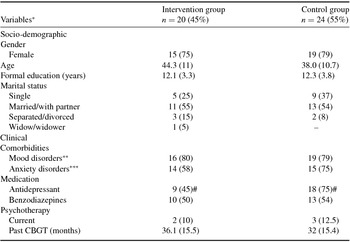
A group of 44 subjects was selected, with 20 (45%) allocated to the intervention group and 24 (55%) to the control group. Three individuals refused to participate, and one participant did not meet the inclusion criteria. The groups had similar socio-demographic characteristics. As for clinical characteristics, antidepressant use was significantly more common in the control group vs. the intervention group (p = .046). Time between CBGT and booster sessions varied from 1 to 4 years. There was no difference between the groups regarding past CBGT (p = .385) (see Table 1).
Socio-demographic and clinical characteristics: comparison between intervention and control groups

Notes: * Continuity variables were presented by means and standard deviation (SD). T test was used. Categorical variables were presented by frequency and percent. Fisher's Test was used;
**Mood disorders: current and past depression or dysthymia;
***Anxiety disorders: generalized anxiety disorder, social anxiety disorder or obsessive-compulsive disorder; # p<.05
CBGT = Cognitive behaviour group therapy
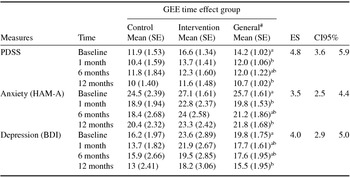
Data regarding initial symptom severity is presented in Table 2. The intervention group had more severe symptoms of PD, anxiety and depression. However, between-group differences at baseline were not statistically significant. This may be attributed to the observed variability estimated by the standard error [PDSS: intervention = 16.6(1.34) and control = 11.9(1.53); HAM-A: intervention = 27.1(1.61) and control = 24.5(2.39); BDI: intervention = 23.6(2.89) and control = 16.2(1.97)]. In relation to symptom severity after the booster sessions, significant improvement over time was found for the following variables: PD (PDSS) [(p time*group = .398; p group = .145; p time <.001)], anxiety (HAM-A) [(p time*group = .272; p group = .189; p time < .001)], and depression (BDI) [(p time*group = .488; p group = .057; p time < .018)], with a large effect size. No difference was found on interaction between the intervention and control groups.
Symptom severity outcome measures across the study period

Notes: Abbreviations: CI95%, 95% Confidence Interval; GEE, Generalized Estimating Equations; SE, Standard Error; PDSS, Panic Disorder Severity Scale; HAM-A, Hamilton Anxiety; BDI, Beck Depression Inventory.
Different letters (a,b) indicate statistical significant results at 0.05 level of significance in sequential Bonferroni multiple comparison adjustment; # Independent overall group mean over time.
ES – Effect size (Cohen's formula) between baseline and the 12-month assessment in the General mean score.
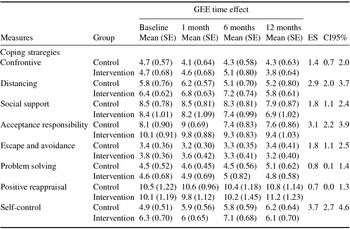
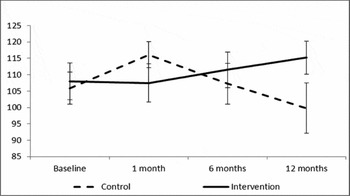
The impact of each intervention on resilience strategies and coping were measured over time. A significant increase in resilience was found at 1 month in the control group. The difference occurred on the interaction [control: baseline mean (SD) = 105.9 (4.91) vs. 1 month = 116.1 (3.96); intervention: baseline = 108 (5.67) vs. 1 month = 107.5 (5.86); p time*group = 0.039)]. However, a significant drop in control group resilience was observed again after 12 months of follow-up [control = 99.8(7.68)]; intervention = 115.2(5.08)]. In the booster group, a non-significant increase in resilience was observed after 12 months (see Figure 1). The effect size for resilience was 0.4 (IC95%: [-0.2; 1.0]). No significant changes on coping strategies were observed (Table 3).
Coping strategies results during the booster sessions and 12 months of follow-up

Notes: GEE – Generalized Estimating Equations; SE - Standard Error.
ES- Effect size (Cohen's formula) for the higher and lower mean observed between time and group
Different symbols (#*) indicate statistical significant results at .05 level of significance in sequential Bonferroni multiple comparison adjustment.
Resilience results during the booster sessions and after 12 months of follow-up

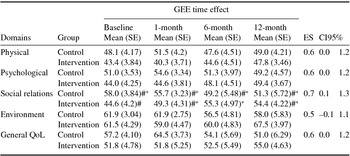
QoL assessed with WHOQOL-Bref was significantly higher in the social relations domain for the booster group after 6 months [(p time*group <.001)]. No significant association was found between any of the other QoL domains and the booster or control interventions (Table 4).
Quality of life results during the booster sessions and 12 months of follow-up

Notes: GEE- Generalized Estimating Equations; SE- Standard Error.
ES- Effect size (Cohen's formula) for the higher and lower mean observed between time and group
Different symbols (#*) indicate statistical significant results at 0.05 level of significant in sequential Bonferroni multiple comparison adjustment.
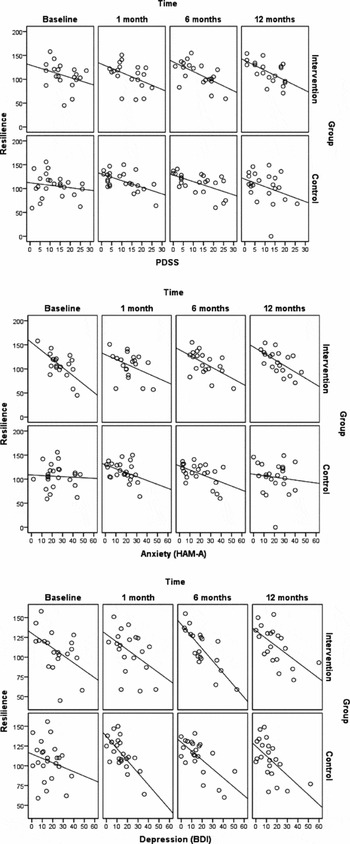
Considering the hypothesis that the change in resilience and QoL could be mediated by the severity of PD, anxiety, and depression symptoms, an adjusted analysis was performed for these aspects. It was found that resilience was not significant for HAM-A (p time*group = .194), BDI (p time*group = .134), and PDSS (p time*group = .099), confirming that the symptoms are mediators of resilience levels. In order to establish the direction of the effect, a correlation test was performed. A negative correlation was identified between higher levels of resilience and less intense symptoms (Figure 2).
Correlation between resilience and the booster or control intervention considering the severity of PD (PDSS), anxiety (HAM-A), and depression (BDI) symptoms

The social relations domain of QoL remained significant after adjustment for anxiety (p time*group<.001), depression (p time*group = .022), and PD symptoms (p time*group = .032), demonstrating that the change in QoL in this domain was not mediated by the presence of symptoms after the booster sessions.
Discussion
The results of this study demonstrate that the use of booster sessions after CBGT significantly improved PD, anxiety, and depression symptoms. In spite of random allocation, the participants in the intervention group were found to have more severe symptoms at baseline than control participants, and this difference was not statistically significant. However, participants in the intervention group also used fewer medications than control individuals. As such, it is possible that the lower symptom severity observed in the control group may be associated with the increased use of PD medication, which is effective in controlling symptoms such as panic attacks and anxiety (Pollack, Reference Pollack2005). The finding of an improvement in symptoms following booster sessions in the intervention group is in agreement with previous studies which show that, even in patients with severe and medication-resistant symptoms, cognitive and behavioural techniques can successfully improve symptoms of PD (Heldt et al., Reference Heldt, Manfro, Kipper, Blaya, Maltz and Isolan2003, Reference Heldt, Manfro, Kipper, Blaya, Isolan and Otto2006).
A non-significant increase in resilience was also observed in the booster group after 12 months, whereas the improvement in resilience observed after the first month in the control group did not last over time. Also, resilience was found to be dependent on symptoms. This is in line with a recent study that demonstrated a positive association between resilience and psychological wellbeing and a negative association with anxiety and depression symptoms (Haddadi and Besharat, Reference Haddadi and Besharat2010). Furthermore, the cognitive techniques used to promote resilience in the intervention group (and not in the control group) led to the improvement of individual skills and interpersonal relationships, which are developed throughout time.
Regarding coping strategies, significant changes were not found as a result of the booster sessions. A similar finding has been reported in studies using a brief intervention based on the coping theory (Kennedy et al., Reference Kennedy, Duff, Evans and Beedie2003). In another brief intervention study with HIV-positive patients, no changes in coping were observed at the end of the intervention; however, there was reduction in anxiety and depressive symptoms compared to control group. Also, patients who underwent maintenance sessions for one additional year experienced a significant increase in coping self-efficacy (Chesney, Chambers, Taylor, Johnson and Folkman, Reference Chesney, Chambers, Taylor, Johnson and Folkman2003). In our study, an increase in resilience levels was observed over time in the intervention group, unlikely given what happened to the control group, even if not significant. Indeed, resilience may be developed through new abilities to perceive, interpret, and overcome challenges and difficulties (Grotberg, Reference Grotberg and Melillo2005).
The social relations domain of QoL for the booster group was significantly higher at 6 months. After that, it remained stable until the 12th month of follow-up. However, the change recorded for the social relations domain was not associated with improvement in PD severity or anxiety and depression symptoms. Considering that improvement in symptoms occurred in both groups, our hypothesis is that the change in resilience in the intervention group, even if not significant, may have produced positive effects in terms of social relations during the follow-up period (Grotberg, Reference Grotberg and Melillo2005).
A significant improvement in PD and in anxiety and depressive symptoms in the control group, which received two sessions with lectures about healthy lifestyle, may be related to benefits of group therapy. Previous studies demonstrated that the group format is associated with clinically significant improvement for patients with anxiety and depression (Oei and Free, Reference Oei and Free1995; Oei, Llamas and Devilly, Reference Oei, Llamas and Devilly1999). Regardless of the intervention given to the control or booster groups, it is known that group therapies promote the exchange of experiences, generating a therapeutic environment of universality, altruism, and reduced stigma and isolation (Schmalisch, Bratiotis and Muroff, Reference Schmalisch, Bratiotis and Muroff2010).
Other non-specific factors in the CBGT technique, such as therapeutic alliance and cohesion, may also produce equivalent improvement in outcomes (Oei and Browne, Reference Oei and Browne2006; Yalom and Leszcz, Reference Yalom and Leszcz2006). Besides, the interventions applied to both groups were useful to stimulate positive psychological states, socialization, sharing of information, and catharsis (Woody and Adessky, Reference Woody and Adessky2002; Yalom and Leszcz, Reference Yalom and Leszcz2006). Additionally, all study participants had previously received CBGT (Wesner et al., Reference Wesner, Gomes, Detzel, Blaya, Manfro and Heldt2014), and their familiarity with the exposure techniques used may have increased their use by group participants.
It is also important to highlight the role of hope. Patients who agree to participate in research relating to their disorder are looking for help; therefore, even if allocated to control groups, they may express emotions and cognitions related to their hope for improvement, which may contribute to clinical improvement (Snyder et al., Reference Snyder, Ilardi, Cheavens, Michael, Yamhure and Sympson2000).
Some limitations of this study must be considered, such as the small sample size and the large number of statistical comparisons. Furthermore, results with large effect sizes, but not significant, might suggest the need for research with higher power. The use of self-administered instruments can also be considered a limitation, because patients may have interpreted some items differently. Moreover, applying these instruments repeatedly over a short period of time might have caused systematized answers. The fact that the intervention was brief could explain the lack of significance in changes such as that noted for resilience. Additional limitations were the different number of sessions in the control vs. booster groups and higher use of antidepressants by control group participants. Besides, we are unable to say how people fared between the end of CBGT and the start of boosters as we did not use the same measures. If we had used the same measures then we could have analyzed how the change between end of original treatment and start of boosters affects the impact of the boosters. This would be helpful in future studies.
In conclusion, in patients participating in CBGT for PD, the gains obtained may be maintained with group booster sessions, especially in terms of resilience, and quality of life. Further efficacy studies should focus on the combination of specific resilience techniques with standard CBGT.
Acknowledgements
This study was partially funded by Fundação de Incentivo a Pesquisa and Eventos do Hospital de Clínicas de Porto Alegre (FIPE-HCPA) and CAPES scholarship to Doctorate (JBG) and Master (ACW) degree.



Comments
No Comments have been published for this article.