Introduction
Potato (Solanum tuberosum L.) is the third most important food crop in the world after rice and wheat, and is a mainstay in the diet of most of the world's population (Raymundo et al., Reference Raymundo, Asseng and Prassad2017). In India, potato is being grown in around 2.15 million ha, with a production of 48.53 million tonnes, which accounts for 12% of the total world production (FAOSTAT, 2018). It has a potential role in improving human health due to the presence of several phytonutrients (anthocyanins, carotenoids, phenolics, flavonoids, etc.), vitamins (vitamin B1, B6, B9, C, E, etc.), minerals (potassium, magnesium, sodium, iron, copper, zinc, etc.), proteins, carbohydrates, dietary fibres, etc. Potato peel possesses higher antioxidant activity than a bell pepper, carrot and onion, and are, therefore, of great interest in human health. Hence, the potato is also called ‘wholesome food crop’ and ‘a nutritional depository’ (Mishra et al., Reference Mishra, Raigond, Thakur, Dutt and Singh2020).
Potato production is under the constant threat of numerous pest and diseases – among them, the potato tuber moth, Phthorimaea operculella (Zeller) (Lepidoptera: Gelechiidae) is one of the major pests of potatoes throughout the world including India and is reported to cause up to 100% of losses in storage conditions (Chandel et al., Reference Chandel, Vashisth, Soni, Kumar and Kumar2019). It is widely regarded as the most serious threat to potato and other solanaceous crops such as eggplant, pepper, tomato, and tobacco. Recently, it has gained the status of an emerging pest problem in the Nilgiri hills of Tamil Nadu, India, which is the oldest potato-growing region of the country.
Until now, the control of P. operculella mainly relied upon the use of chemical insecticides that have harmful effects on the soil biodiversity of the Nilgiri's Biosphere. The Nilgiri district is located in the Western Ghats, one of the eight biodiversity hottest hotspots of the world. Therefore, there is an urgent need for alternative control strategies for the management of this pest. The use of entomopathogenic nematodes (EPNs) as a biological control agent is one of the viable options (Kaya & Gaugler, Reference Kaya and Gaugler1993). Therefore, in the present study, we have tested the virulence of Steinernema cholashanense CPRSUS01 (Mhatre et al., Reference Mhatre, Patil, Vijaykumar, Venkatasalam, Divya, Jenifer, Pankaj and Chavan2017), originally isolated from potato rhizosphere, in those areas where the potato tuber moth is one of the major pests; thus, the biocontrol potential of this nematode was tested against the potato tuber moth. Moreover, S. cholashanense was originally described by Nguyen et al. (Reference Nguyen, Puza and Mracek2008), but, so far, the biocontrol potential of this nematode has not been studied on any insect-pest. The reproductive potential of any biological control agent is an important feature for their extended persistence and pathogenicity to the targeted insect-pests (Blanco-Pérez et al., Reference Blanco-Pérez, Bueno-Pallero, Neto and Campos–Herrera2017). Therefore, the reproductive potential of S. cholashanense was also assessed in P. operculella.
Material and methods
Insect culture
The infected tubers were collected from the potato field of Indian Council of Agricultural Research-Central Potato Research Station (ICAR-CPRS), research farm, Nilgiris, Tamil Nadu, India (11°23′N, 76°40′E) during September and October 2019. None of the sites were treated with either insecticides or EPNs during the previous crop season. The larvae were reared on potato tubers in a biological oxygen demand (BOD) growth chamber at 23 ± 2°C and a photoperiod of 14:10 (L:D) as per the procedures given by Arthurs et al. (Reference Arthurs, Lacey and de la Rosa2008), with some minor modifications. Infested tubers were placed in plastic containers (25 cm × 12 cm × 10 cm) filled with a thin layer of the autoclaved sterile sand for pupation of potato tuber moth larvae. The pupae were separated on daily basis using a 20-mesh (833 μm aperture) sieve. Then, the pupae were transferred to breeding containers (1000 ml) covered with a black muslin cloth, which can act as an oviposition site for the adult females; adults were fed with a 20% sugar solution. The deposited eggs were collected and placed in the other container for hatching and larval development in BOD at 23 ± 2°C and 14:10 (L:D). Based on the size of the larval head capsule (Broodryk, Reference Broodryk1971), the fourth-instar larvae (13.65 ± 2.96 mg) were identified and used for efficacy, penetration and reproduction assays. For the pupal bioassay, pupae were collected by sieving the sand.
Laboratory bioassays
Larval susceptibility in Petri dish assay
Initially, a range-finding bioassay was carried out using 2–1000 infective juveniles (IJs) larva−1 (data not shown) to determine the final IJs concentrations. To study the infectivity of S. cholashanense against fourth-instar larvae of P. operculella, IJs at concentrations 5, 10, 25, 40, 80 and 100 larva−1 were suspended in 150 μl of water and distributed evenly on the Petri dish (9 cm diameter) lined with filter paper previously moistened with 850 μl distilled water for each treatment. Each dish was added with single fourth-instar larvae (13.65 ± 0.55 mg) of P. operculella and 2–3 potato slices were provided to feed the larvae, then the dishes were sealed with parafilm to avoid moisture loss and incubated at 23 ± 2°C in BOD. Untreated control treatment dishes were maintained similar to the treatments except that no IJs were added; instead, 1 ml of distilled water was added. Larval mortality was observed at two and four days after IJs inoculation. To confirm larval death is due to nematode infection, the cadavers were dissected in Ringer's solution under a stereomicroscope to verify the presence of nematodes. There were 12 replicates for each treatment and the assay was repeated once.
Pupal susceptibility in plastic container assay
To study the infectivity of S. cholashanense to pupal stages of P. operculella, the different concentrations of IJs (80, 100, 200, 400 and 600 IJs pupa‒1) were suspended in 2.5 ml of distilled water and distributed evenly in the 100 ml plastic containers (diameter: 5.5 cm; height: 6.4 cm; soil capacity 100 cm3) containing the mixture of 90 cm3 autoclaved sand and soil (1:1 ratio; moisture 12% w/w). Control treatments received only distilled water without IJs. The single pupa was placed at 1 cm depth in each container. The containers were closed and incubated at 24 ± 2°C. Each treatment had ten replicates and the assay was repeated once. The observations on the emergence of adults were recorded on a daily basis for ten days. After this, the non-emerged pupae were collected and washed in distilled water and dissected in Ringer's solution under a stereomicroscope to verify the presence of nematodes.
Reproduction potential of S. cholashanense in P. operculella
Based on the results obtained in the larval susceptibility assay, three doses – viz. 40, 80 and 100 IJs larva−1 – were selected for penetration and reproduction assay. The nematode inoculation procedure was followed as mentioned in the larval bioassay. Single P. operculella larva was released into each Petri dish lined with tissue paper and provided with 2–3 potato slices. A total of 30 numbers of fourth-instar larvae (13.65 ± 0.55 mg) were used in the assay. To assess the IJs penetration, upon larval death, ten insect cadavers were randomly selected and transferred to separate Petri dish (9 cm diameter) containing dry filter paper and maintained in darkness for 24 h. After 24 h the cadavers were rinsed with distilled water to remove the nematodes from the surface of their bodies and then dissected in Ringer's solution under a stereomicroscope to count the number of IJs penetrated inside each cadaver.
Similarly, for reproduction assay, another ten cadavers were selected randomly, rinsed with distilled water to remove nematodes adhering to the body surface. Then, cadavers were transferred individually onto the white trap and incubated at 23 ± 2°C in the dark in BOD. The total number of IJs that emerged from each cadaver was counted. Each cadaver was considered as a replicate; the whole experiment was repeated once, and the results of the reproduction assays were expressed as the number of IJs mg−1 body weight.
Statistical analysis
Percentage data were normalized using arcsine transformation, and numerical data (progeny production) were square-root transformed before analysis. The analysis was undertaken on the transformed data, and only the back-transformed data is presented. The number of IJs required for killing 50% Lethal Concentration (LC50)) and 90% (LC90) of the P. operculella larvae after two and four days post inoculation was calculated using Probit analysis at 95% confidence intervals. Bioefficacy, penetration and progeny production data were pooled from repetitive experiments and subjected to analysis of variance (ANOVA) using PROC GLM of SAS software, version 9.3 (SAS Institute, 2011). When ANOVA was significant, comparisons of relevant means were made using the Tukey's significance test values at the 5% level of significance.
Results
Larval and pupal susceptibility
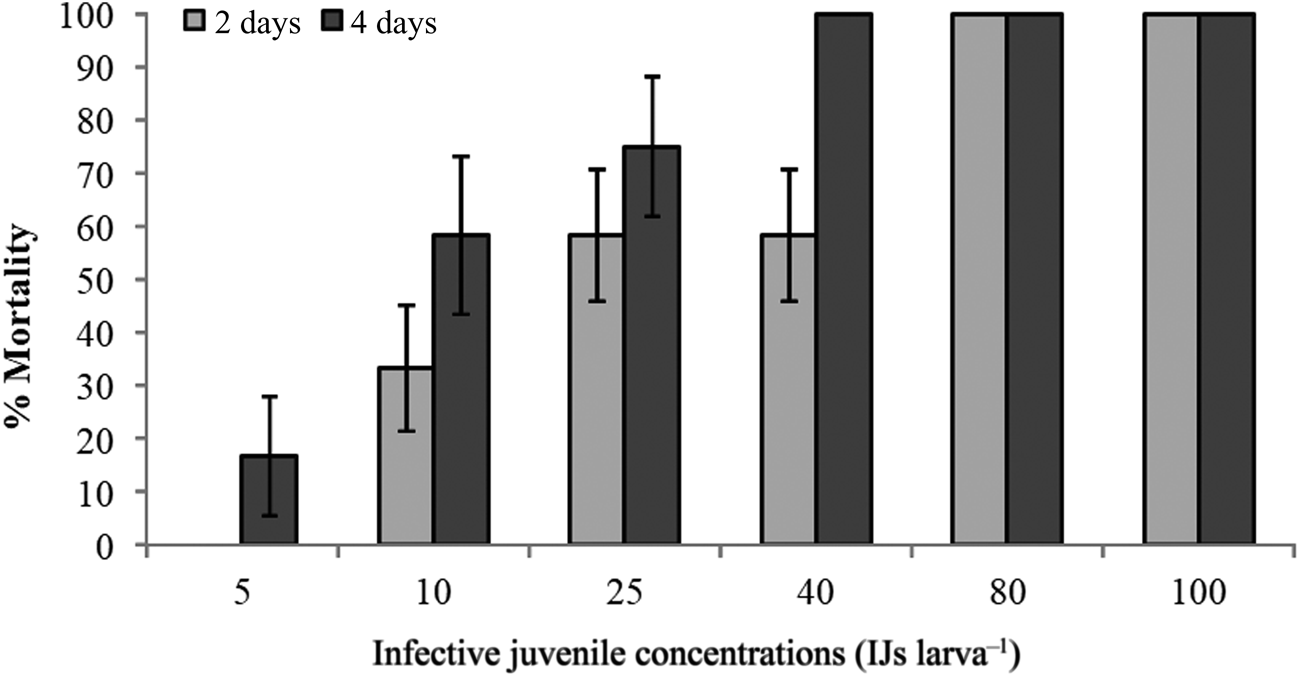
This study showed that S. cholashanense is capable of infecting the larval and pupal stages of P. operculella under laboratory conditions. In control treatments, no mortality was observed for both the bioassays. Larval mortality of P. operculella differed significantly among treatments after two (F = 18.87; df = 6, 77; P < 0.0001) and four (F = 23.39; df = 6, 77; P < 0.0001) days after treatment (fig. 1). Two days after treatment, the greatest mortality (100%) was observed with 80 and 100 IJs larva−1, but no mortality was observed with 5 IJs larva−1. However, four days after treatment, we recorded 16.67% mortality with 5 IJs larva−1. There was no significant interaction (P = 0.0992) between IJs concentrations and time. The bioassay results revealed that percentage mortality was increased significantly with an increase in IJs concentrations (F = 40.74; df = 6, 154; P < 0.0001) and time (F = 18.87; df = 1, 154; P < 0.0001) (fig. 1). The probit analysis indicated that the LC50 values at two and four days after treatment (table 1) for P. operculella were 20 and 10 IJs larva−1, respectively.
Percent mortality (mean ± standard error) of fourth-instar larvae of potato tuber moth, Phthorimaea operculella, at different concentrations of Steinernema cholashanense at two and four days after treatment (n = 12) in laboratory conditions.

Mean number of nematodes required to cause 50% (LC50) and 90% (LC90) mortality in fourth-instar larvae of the potato tuber moth, Phthorimaea operculella, at two and four days after treatment (DAT) (n = 12) in laboratory conditions.

SE, standard error; FLs, fiducial limits.
a LC values between DAT considered significantly different if the 95% FLs do not overlap.
b P-value for the χ 2 value. A non-significant χ 2 indicates a good fit of the line to the data.
When IJs were inoculated to the pupae of P. operculella, the higher concentrations (400 and 600 IJs pupa−1) showed 30% mortality followed by 20% for lower doses (80, 100 and 200 IJs pupa−1), but pupal mortality did not differ significantly (P = 0.6113) between the IJs concentrations.
Reproduction potential of S. cholashanense in P. operculella
The results of the reproduction assay revealed that S. cholashanense was able to penetrate and reproduce within the haemocoel of fourth-instar larvae of P. operculella. This is the first scientific study on the reproductive potential of S. cholashanense on P. operculella. When 100 IJs larva−1 were inoculated to fourth-instar larvae of P. operculella, 8.25% IJs penetration was recorded with a final IJs yield of 701.52 IJs mg−1 larval weight, with 80 IJs larva−1 it was 4.25% and 648.58 IJs mg−1 larval weight, respectively, whereas with 40 IJs larva−1 it was 6.6% and 592.37 IJs mg−1 larval weight. The percent IJs penetration into P. operculella was not significantly (P = 0.2229) different between the treatments. Similarly, the number of IJs multiplication in fourth-instar larvae of P. operculella was also not significantly (P = 0.7032) different among the treatments.
Discussion
The result of the pathogenicity study revealed that the Indian isolate of S. cholashanense CPRSUS01 is highly virulent to the fourth-instar larvae of P. operculella. The virulence of any EPN species is generally related to several factors, including the host insects, penetration, multiplication, etc. (Kaya & Gaugler, Reference Kaya and Gaugler1993). The S. cholashanense CPRSUS01 was isolated from potato rhizosphere of the Nilgiri hills of India, where potato is intensively cultivated throughout the year. Therefore, P. operculella might be a favourable host for this nematode. In our study, the LC50 values for S. cholashanense were 20 and 10 IJs larva−1 at two and four days after treatment, respectively. However, the results of the recent study by Yan et al. (Reference Yan, Sarkar, Meng, Reitz and Gao2020) demonstrated the LC50 of Steinernema carpocapsae against fourth-instar larvae of P. operculella was 181 IJs larva−1, which indicates the superiority of S. cholashanense in virulence over S. carpocapsae.
Several studies have shown that the larval stages of P. operculella are more susceptible to infection by different EPNs, whereas the pupal stages were found to be the most resistant ones (Hassani-Kakhki et al., Reference Hassani-Kakhki, Karimi and Hosseini2013; Kary et al., Reference Kary, Sanatipour, Mohammadi and Koppenhöfer2018; Yan et al., Reference Yan, Sarkar, Meng, Reitz and Gao2020). The results of the present study are in agreement with the earlier studies and indicated that S. cholashanense is highly virulent to the larval stages than pupal stages. Similar results of higher larval mortalities and lower pupal mortalities were recorded with other lepidopteran pests such as pink bollworm, Pectinophora gossypiella Saunders (Lepidoptera: Gelechiidae) (91.9% and 13%, respectively) (Henneberry et al., Reference Henneberry, Forlow and Burke1995, Reference Henneberry, Forlow and Burke1996) and tomato leaf miner, Tuta absulata Meyrick (Lepidoptera: Gelechiidae) (78.96–100% and below 10%, respectively) (Batalla-Carrera et al., Reference Batalla-Carrera, Morton and García del Pino2010). Moreover, Kary et al. (Reference Kary, Chahardoli, Mohammadi and Dillon2019) reported that EPNs failed to cause mortality in the pupal stages of the diamondback moth, Plutella xylostella Linnaeus (Lepidoptera: Plutellidae). In contrast to this, in some insects the pupal mortality was recorded – for example, Steinernema (Neoplactana) carpocapsae can cause 25–50% pupal mortality in Oriental armyworm, Pseudaletia unipuncta (=Mythimna seperata) Walker (Lepidoptera: Noctuidae) (Kaya & Hara, Reference Kaya and Hara1980). From the present study, it can be concluded that the fourth-instar larval stage of P. operculella is highly susceptible to S. cholashanense, suggesting that the soil application of this nematode can control fourth-instar larvae when they enter the soil for pupation, as well as to some extent the emerging adults from the pupae.
Several researchers studied the susceptibility of P. operculella larvae to EPNs, but data on EPN reproduction on P. operculella larvae is not available. Therefore, in this study, we have assessed the reproduction capacity of S. cholashanense on P. operculella larvae.
In earlier studies, the reproduction ability of different EPNs was assessed in lepidopteran larvae – among them, Helicoverpa virescens Fabricius (Lepidoptera: Noctuidae), Spodoptera exigua Hübner (Lepidoptera: Noctuidae), Spodoptera litura Fabricius (Lepidoptera: Noctuidae) and Trichopulsia ni Hübner (Lepidoptera: Noctuidae) were reported to produce a higher number of IJs mg−1 body weight of insect larvae and considered as a good host for EPNs (Elawad et al., Reference Elawad, Gowen and Hague2001; Khan et al., Reference Khan, Javed, Khan, Rajput, Atiq, Jabbar, Rehman, Moosa and Ali2020). Similarly, the reproduction capacity of S. cholashanense on P. operculella is 702 IJs mg−1 body weight, which is almost equal to S. exigua and T. ni (762 and 785 IJs mg−1 body weight, respectively) (Elawad et al., Reference Elawad, Gowen and Hague2001); therefore, P. operculella can be considered as a good host for S. cholashanense.
The multiplication of EPNs in the insect-pests plays a major role in their persistence in the field (Patil & Rangasamy, Reference Patil and Rangasamy2018); it would not only result in mortality of insect-pests but also the recycling ability of the EPN in tackling the succeeding generations of the insect-pests (Patil et al., Reference Patil, Rangasamy, Nagesh and Holajjer2019). Since the potato tuber moth can complete 7–13 generations in a year (Chandel et al., Reference Chandel, Vashisth, Soni, Kumar and Kumar2019), the higher multiplication rate of S. cholashanense recorded in this study may make enable it to tackle the succeeding generations of potato tuber moth in the field.
Conclusion
The results of the present study showed that S. cholashanense is a potential biocontrol agent against the potato tuber moth. But before including S. cholashanense CPRSUS01 in the integrated pest management program of P. operculella, further experiments are required to know the real potential of S. cholashanense CPRSUS01 in field conditions. Further, the compatibility of S. cholashanense CPRSUS01 should be evaluated with registered chemical insecticides available for the management of P. operculella.
Acknowledgement
The authors are grateful to the Director at the ICAR-Central Potato Research Institute, Shimla, India, and the Director at the ICAR-National Bureau of Agricultural Insect Resources, Bengaluru, India, for the facilities provided for conducting this study.
Financial support
This work was supported by the Indian Council of Agricultural Research, New Delhi, India.
Conflicts of interest
None.
Ethical standards
The authors assert that all procedures contributing to this work comply with the ethical standards of the relevant national and institutional guides on the care and use of laboratory animals.