Introduction
Family history of suicidal behavior (FHS) and childhood abuse are prevalent conditions closely associated with suicidal behaviors (Roy, Reference Roy2011). Moreover, they are inter-related and their combination has been shown to increase the severity of suicidal behavior (Roy, Reference Roy2011; Lopez-Castroman et al. Reference Lopez-Castroman, Jaussent, Beziat, Genty, Olié, de Leon-Martinez, Baca-García, Malafosse, Courtet and Guillaume2012). Indeed, these conditions have shown an additive effect on the age at onset of the first suicide attempt and the number of attempts in samples of bipolar patients (Carballo et al. Reference Carballo, Harkavy-Friedman, Burke, Sher, Baca-García, Sullivan, Grunebaum, Parsey, Mann and Oquendo2008) and suicide attempters (Lopez-Castroman et al. Reference Lopez-Castroman, Jaussent, Beziat, Genty, Olié, de Leon-Martinez, Baca-García, Malafosse, Courtet and Guillaume2012). Some authors have suggested that traits of impulsive aggression could mediate the effect of childhood abuse and FHS on suicidal behavior (Brent et al. Reference Brent, Oquendo, Birmaher, Greenhill, Kolko, Stanley, Zelazny, Brodsky, Firinciogullari, Ellis and Mann2003; Roy, Reference Roy2011). Two studies have investigated this possibility in family cohorts of depressed probands. Melhem et al. (Reference Melhem, Brent, Ziegler, Iyengar, Kolko, Oquendo, Birmaher, Burke, Zelazny, Stanley and Mann2007) found that more and earlier suicide events were observed in subjects with high impulsive aggression or with a parental history of suicide attempts or sexual abuse. Brodsky et al. (Reference Brodsky, Mann, Stanley, Tin, Oquendo, Birmaher, Greenhill, Kolko, Zelazny, Burke, Melhem and Brent2008) later confirmed the transmission of suicide risk along with sexual abuse and impulsivity across generations.
The construct of impulsive aggression describes the existence of psychological traits related to reactive aggression, as opposed to instrumental aggression. It is controversial whether impulsivity and aggression traits should be considered conjointly, but there is no doubt about their frequent overlap, particularly among suicide attempters (Gvion & Apter, Reference Gvion and Apter2011). In fact, impulsive aggression could explain the relationship between childhood abuse and FHS and suicidal behavior. FHS predicts impulsive aggressive behavior levels in psychiatric out-patients (Diaconu & Turecki, Reference Diaconu and Turecki2009) and early trauma increases impulsivity, reducing the capacity of the brain to modulate emotions (Braquehais et al. Reference Braquehais, Oquendo, Baca-García and Sher2010). Moreover, impulsive aggression meets most of the criteria for the definition of an endophenotype and could be potentially evaluated using neuropsychological tools (Courtet et al. Reference Courtet, Gottesman, Jollant and Gould2011). Suicidality and impulsivity have indeed been associated using different computerized tasks (Jollant et al. Reference Jollant, Bellivier, Leboyer, Astruc, Torres, Verdier, Castelnau, Malafosse and Courtet2005; Swann, Reference Swann2005). Although not always present in suicidal patients, impulsive aggression is linked to personality features relevant to the suicidal process (McGirr & Turecki, Reference McGirr and Turecki2007) and could be used as a clinical target to prevent suicidal acts in the future (Brent, Reference Brent2010; Gvion & Apter, Reference Gvion and Apter2011). However, both the heritability of impulsive aggression traits (Mann et al. Reference Mann, Arango, Avenevoli, Brent, Champagne, Clayton, Currier, Dougherty, Haghighi, Hodge, Kleinman, Lehner, McMahon, Mościcki, Oquendo, Pandey, Pearson, Stanley, Terwilliger and Wenzel2009) and the mediating role of these traits in the familial transmission of suicidal behavior have been demonstrated (Brent et al. Reference Brent, Oquendo, Birmaher, Greenhill, Kolko, Stanley, Zelazny, Brodsky, Firinciogullari, Ellis and Mann2003; McGirr et al. Reference McGirr, Alda, Séguin, Cabot, Lesage and Turecki2009). Of note, genetic studies of impulsive aggression have mostly reported associations with serotonergic genotypes, in parallel with genetic correlates of suicidal behavior and childhood abuse (Mann et al. Reference Mann, Arango, Avenevoli, Brent, Champagne, Clayton, Currier, Dougherty, Haghighi, Hodge, Kleinman, Lehner, McMahon, Mościcki, Oquendo, Pandey, Pearson, Stanley, Terwilliger and Wenzel2009; Miller et al. Reference Miller, Kinnally, Ogden, Oquendo, Mann and Parsey2009). Thus, serotonergic dysfunction could be an underlying link between these conditions.
In this study we investigated whether suicide attempters having FHS and/or childhood abuse showed greater scores for aggression and impulsivity. We hypothesized that subjects with FHS and childhood abuse would present higher levels of impulsive aggression than those with only one or none of these risk factors. In a second step, we compared some of the genetic polymorphisms that have been associated with impulsive aggression between the study groups.
Method
Participants
Patients were recruited as part of a suicide attempters study (n = 1050). They were consecutively hospitalized and survivors of a current suicide attempt in a specialist unit of Montpellier University Hospital. Suicide attempts were defined as self-injury behaviors with a non-zero level of suicidal intent (Silverman et al. Reference Silverman, Berman, Sanddal, O'Carroll and Joiner2007). Patients were between 18 and 84 years old, French speaking, and had all four biological grandparents originating from Western European countries (for genetic purposes). Trained psychiatrists or psychologists interviewed the patients. All participants completed and returned a consent form. The local research ethics committee of Lapeyronie Hospital, Montpellier, France approved this study.
The study sample included 696 patients with a full diagnostic evaluation, a fully completed questionnaire on childhood trauma, the scales on impulsive aggression and questions regarding the history of suicidal behavior in their family. Excluded subjects did not show any statistical difference regarding sociodemographic or clinical variables.
Assessment
Patients were evaluated after remission of a potential mood episode, that is with a current Hamilton Depression Rating Scale (HAMD; Hamilton, Reference Hamilton1960) score < 15. Either the French version of the Diagnostic Interview for Genetics Studies (DIGS; Preisig et al. Reference Preisig, Fenton, Matthey, Berney and Ferrero1999) or the Mini International Neuropsychiatric Interview (MINI; Sheehan et al. Reference Sheehan, Lecrubier, Sheehan, Amorim, Janavs, Weiller, Hergueta, Baker and Dunbar1998) were used to obtain Axis I DSM-IV diagnoses. Lifetime diagnoses were determined using a best-estimate procedure. The psychiatrist in charge of the patient's care assigned the diagnosis based on the MINI or DIGS, medical records and, when available, information from relatives.
Assessment of the history of childhood trauma was performed using the short version of the Childhood Trauma Questionnaire (CTQ; Bernstein & Fink, Reference Bernstein and Fink1998). The CTQ is a 28-item self-report questionnaire that investigates retrospectively five dimensions of child maltreatment: emotional abuse, emotional neglect, physical abuse, physical neglect and sexual abuse. Cut-off scores have been set for each type of trauma at four levels of maltreatment: none, low, moderate and severe. The different cut-offs have been shown to have good specificity and sensitivity (Bernstein & Fink, Reference Bernstein and Fink1998). Only childhood trauma with moderate or severe scores was considered. FHS included suicide completion and suicide attempts in first-, second- and third-degree relatives. Excluding records of suicidal behavior in third-degree relatives would have decreased the number of subjects with FHS by 14%.
The suicide assessment procedure was based on the Columbia Suicide History Form (Mann et al. Reference Mann, Waternaux, Haas and Malone1999) and Section O of the DIGS. The procedure is a semi-structured interview with validated questionnaires to collect information about sociodemographic features and characteristics of the suicide attempts. The violence of suicide attempts was categorized using the criteria of Asberg et al. (Reference Asberg, Träskman and Thorén1976). Those suicide attempts that required intensive care interventions were considered severe. Age at first attempt was defined as the age at which the patient first made a suicide attempt. Age at first attempt was assessed by the interviewer and then blindly rated by an independent psychiatrist according to medical case-notes and interviews. Cut-off for early age at first suicide attempt was set according to a previous study by our group (>26 or ⩽26 years of age) (Slama et al. Reference Slama, Courtet, Golmard, Mathieu, Guillaume, Yon, Jollant, Misson, Jaussent, Leboyer and Bellivier2009). The number of suicide attempts for the analyses were categorized using 1–2 and > 2 as cut-offs (Lopez-Castroman et al. Reference Lopez-Castroman, de las Mercedes Perez-Rodriguez, Jaussent, Alegria, Artes-Rodriguez, Freed, Guillaume, Jollant, Leiva-Murillo, Malafosse, Oquendo, de Prado-Cumplido, Saiz-Ruiz, Baca-Garcia and Courtet2011).
The construct of impulsive aggression was assessed using self-rated scales focused on three stable personality traits: impulsivity, hostility and anger expression. The concept of impulsivity comprises impaired self-regulation, premature reacting with little forethought, sensation seeking, and preference for immediate over delayed rewards (Gvion & Apter, Reference Gvion and Apter2011). The 10th version of the Barratt Impulsiveness Scale (BIS; Patton et al. Reference Patton, Stanford and Barratt1995) was used to evaluate impulsive personality traits. This widely used scale includes 34 items and is self-reported. The concept of hostility is frequently understood as equivalent to aggressive traits (Michaelis et al. Reference Michaelis, Goldberg, Davis, Singer, Garno and Wenze2004), that is the tendency to engage in physical or verbal aggression, although it might also be considered a mood state. In this study we used the Buss–Durkee Hostility Inventory (BDHI; Buss & Durkee, Reference Buss and Durkee1957), which comprises 75 items grouped in seven different subscales to evaluate aggressive traits in several dimensions. Finally, trait anger represents an overall inclination towards anger with more intense, frequent and longer feelings of anger than others (Deffenbacher et al. Reference Deffenbacher, Oetting, Thwaites, Lynch, Baker, Stark, Thacker and Eiswerth-Cox1996). The first version of the State–Trait Anger Expression Inventory (STAXI) was used to assess anger expression. This common Likert scale comprises 44 items and is self-reported (Forgays et al. Reference Forgays, Spielberger, Ottaway and Forgays1998). Only the trait anger subscale of STAXI (10 items), which is meant to reflect the existence of durable anger attributes, was used in this study to characterize impulsive aggressive patients.
Genetic analysis
Details on laboratory methods and genotyping are described elsewhere (Courtet et al. Reference Courtet, Baud, Abbar, Boulenger, Castelnau, Mouthon, Malafosse and Buresi2001). Four single nucleotide polymorphisms (SNPs) directly related to serotonergic neurotransmission and previously associated with impulsive aggression traits were tested: the serotonin 1B receptor promoter rs130058 polymorphism (5-HT1B A-161 T) (Zouk et al. Reference Zouk, McGirr, Lebel, Benkelfat, Rouleau and Turecki2007), the monoamine oxidase A variable number of tandem repeat polymorphisms in the promoter region (MAOA uVNTR) (Manuck et al. Reference Manuck, Flory, Ferrell, Mann and Muldoon2000; Jollant et al. Reference Jollant, Buresi, Guillaume, Jaussent, Bellivier, Leboyer, Castelnau, Malafosse and Courtet2007), the 44-base pair insertion/deletion polymorphism in the serotonin transporter gene (5-HTTLPR) (Gonda et al. Reference Gonda, Fountoulakis, Csukly, Bagdy, Pap, Molnár, Laszik, Lazary, Sarosi, Faludi, Sasvari-Szekely, Szekely and Rihmer2011) and the rs1 800 532 polymorphism in intron 7 of the tryptophan hydroxylase gene (TPH1 A218C) (Manuck et al. Reference Manuck, Flory, Ferrell, Dent, Mann and Muldoon1999).
Statistical analysis
We examined whether impulsive aggression measures, according to the total scores of the BIS, BDHI and STAXI scales, were associated with sociodemographic and clinical variables. Scale distributions were mostly skewed (Shapiro–Wilk statistics) and therefore we used the highest tertile as the cut-off (BIS ⩾69, BDHI ⩾42, STAXI trait anger ⩾27). Associations between impulsivity indexes and patient characteristics, exposition variables (FHS and CTQ dimensions), were quantified with odds ratios (ORs) and their 95% confidence intervals (CIs). Sociodemographic and clinical variables associated with impulsivity indexes (at p < 0.10) were included in logistic regression models to estimate ORs adjusted for exposure variables. When appropriate (for instance, when FHS and CTQ dimensions or genetic polymorphisms and CTQ dimensions were significantly associated with the outcome variables), the interaction terms were tested using the Wald χ 2 test given by the logistic regression model.
To study the severity of impulsivity, a composite index was created to regroup subjects with high impulsive aggression scores in different scales (BIS, BDHI and STAXI). The index included four levels according to the number of scores in the highest tertile of any of the scales measuring impulsive aggression: no scores (level 0), one score (level 1), two scores (level 2), or three scores (level 3). The FHS and the CTQ dimensions were compared between these levels using a multinomial logistic regression. The distribution of the different polymorphisms was tested by χ 2 for Hardy–Weinberg equilibrium. Given the exploratory nature of our epidemiological study, the significance level was set at p < 0.05. Multiple test adjustments are not required in this type of study because of the risk of type II errors (Rothman, Reference Rothman1990; Savitz & Olshan, Reference Savitz and Olshan1998; Bender & Lange, Reference Bender and Lange2001). All analyses were performed using SAS version 9.2 (SAS Inc., USA).
Results
Sample description
Most patients in the sample were female (71.7%), with a median age of 39.4 years (range 18.0–83.4). Regarding marital status, most patients were single (35.9%) or married (35.6%). A large part of them reported university studies (43.4%). Patients with high scores in the BIS, the BDHI and/or the STAXI anger trait subscale were younger and reported lower educational attainments and more frequent smoking than the rest of the sample (p < 0.05 for all comparisons). Those patients also attempted suicide for the first time at an earlier age (p < 0.001 for all comparisons). In particular, patients with high BIS and/or STAXI scores made more suicide attempts than the rest of the sample (p < 0.005 for both indexes). However, patients with high BDHI scores were significantly less likely to make severe suicide attempts and patients with high STAXI scores were less likely to make violent suicide attempts (p < 0.05 for both indexes).
To facilitate their presentation, only statistically significant differences are described after adjustment for variables significantly associated with the BIS, BDHI or STAXI anger trait subscale: sex, age, study level, alcohol or substance misuse, smoking, major depression, bipolar disorders, anxiety disorders, eating disorders, number of suicide attempts, and violent and/or severe attempt.
Impulsivity traits (BIS)
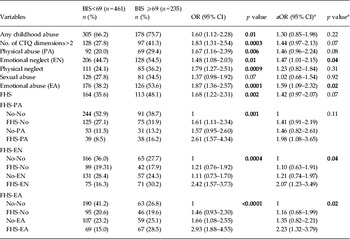
Adjusted results show that subjects with high impulsivity were more likely than the rest of the sample to have suffered emotional neglect and emotional abuse (Table 1). The other types of abuse and FHS were not significantly associated with high impulsivity scores. No interaction with regard to the BIS scores was found between FHS and different types of childhood abuse (data not shown). Therefore, we studied the effect on impulsivity measures of the combination of childhood abuse and FHS. Subjects who reported FHS and emotional neglect (OR 2.07, 95% CI 1.23–3.49) or FHD and emotional abuse (OR 2.23, 95% CI 1.32–3.79) were associated with high impulsivity scores when compared with the absence of those risk factors.
High and low total BIS scores by family history of suicidal behavior (FHS) and dimensions of the CTQ

CTQ, Childhood Trauma Questionnaire; BIS, Barratt Impulsiveness Scale; OR, odds ratio; CI, confidence interval; aOR, adjusted odds ratio.
Bold numbers indicate significant p values.
a The results were adjusted for sex, age, study level, alcohol or substance misuse, smoking, major depression, bipolar disorders, anxiety disorders, eating disorders, number of suicide attempts, and violent and/or severe attempt.
Hostility traits (BDHI)
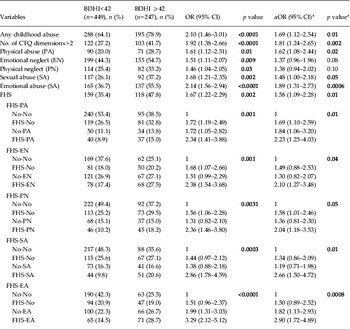
Subjects with high hostility scores reported at least one type of childhood abuse, and more often more than two different types of abuse, than the rest of the sample (Table 2). High hostility scores were also associated with emotional abuse, physical abuse, sexual abuse and FHS. As FHS and CTQ dimensions did not interact regarding hostility scores (data not shown), we examined whether a combination of those factors was associated with more hostility. We found that the combination of FHS and any type of childhood abuse was associated with increased hostility (p < 0.05 for all comparisons). The occurrence of physical abuse or emotional abuse alone (without FHS) was also significantly associated with higher hostility scores (OR 1.84, 95% CI 1.06–3.20 and OR 1.82, 95% CI 1.13–2.93 respectively). Patients in the highest tertile of hostility made less medically severe attempts than patients with low hostility [Risk Ratio Rating Scale (RRRS) risk score: OR 0.90, 95% CI 0.85–0.96, p = 0.001].
High and low total BDHI scores compared by family history of suicidal behavior (FHS) and dimensions of the CTQ

CTQ, Childhood Trauma Questionnaire; BDHI, Buss–Durkee Hostility Inventory; OR, odds ratio; CI, confidence interval; aOR, adjusted odds ratio.
Bold numbers indicate significant p values.
a The results were adjusted for sex, age, study level, alcohol or substance misuse, smoking, major depression, bipolar disorders, anxiety disorders, eating disorders, number of suicide attempts, and violent and/or severe attempt.
Anger traits (STAXI)
After adjustment, only one type of childhood abuse, emotional abuse, was significantly associated with high scores on anger traits (OR 1.60, 95% CI 1.12–2.28). Patients in the highest tertile of anger had more possibilities of being rescued (RRRS rescue score: OR 1.13, 95% CI 1.03–1.23, p = 0.008) than patients with low anger. FHS was not associated with measures of anger in the adjusted model and therefore the additive effect of the combination of FHS and childhood abuse on anger traits was not explored.
Impulsive aggression traits (composite index)
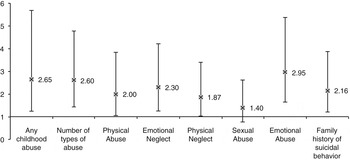
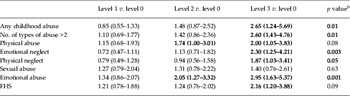
Detailed results of the adjusted comparisons between subjects with high scores in none, one, two or three of the assessment scales measuring impulsive aggression traits (BIS, BDHI and STAXI) are presented in Table 3. Patients with high impulsive aggression traits on all three scales (level 3) were more often abused as children (OR 2.65, 95% CI 1.24–5.69) and suffered more types of abuse (OR 2.60, 95% CI 1.43–4.76) than patients who did not score in the highest tertile in any of the scales (level 0). With the exception of sexual abuse (OR 1.40, 95% CI 0.76–2.61), level 3 patients also showed an increased risk in any other type of childhood abuse and FHS (OR 2.16, 95% CI 1.20–3.88) when compared to level 0 patients (Fig. 1). Patients with high impulsive aggression traits on all three scales (level 3) did not differ in the severity (RRRS scores) of their attempts from the rest of the sample.
Odds ratios and 95% confidence intervals for subjects with high versus low levels of impulsive aggression in all three dimensions [Barratt Impulsiveness Scale (BIS), Buss–Durkee Hostility Inventory (BDHI) and State–Trait Anger Expression Inventory (STAXI) trait anger]. The horizontal line represents the reference group, composed of subjects with low impulsive aggression.

Odds ratios and 95% confidence intervals associated with the different levels of impulsive aggression according to a composite index by features of childhood abuse and family history of suicidal behavior (FHS) a

Bold numbers indicate significant p values.
a The levels indicate the number of scales [Barratt Impulsiveness Scale (BIS), Buss–Durkee Hostility Inventory (BDHI) and State–Trait Anger Expression Inventory (STAXI)] in which the subjects scored in the highest tertile.
b The results were adjusted for sex, age, study level, alcohol or substance misuse, smoking, major depression, bipolar disorders, anxiety disorders, eating disorders, number of suicide attempts, and violent and/or severe attempt.
Genetic analyses
The distribution of 5-HTTLPR did not deviate from Hardy–Weinberg equilibrium for any of the SNPs studied (data not shown but provided on request). Regarding the 5-HTTPLPR genotype, subjects with high impulsivity scores were less likely to have an SS genotype than an LL or an SL genotype (OR 0.57, 95% CI 0.38–0.85). No other significant association was found between the different genotypes and higher scores on the BIS, STAXI or BDHI scales. Thus, we examined the interaction effects between the 5-HTTLPR genotypes and childhood abuse dimensions or FHS with regard to impulsivity scores after adjustment for sex, age, study level, alcohol or substance misuse, smoking, major depression, bipolar disorders, anxiety disorders, eating disorders, number of suicide attempts, and violent and/or severe attempt.
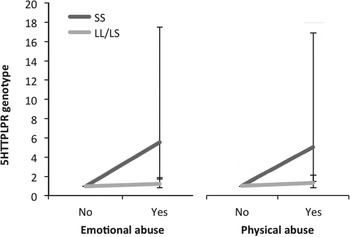
We found a significant interaction between the 5-HTTPLPR genotype (LL/LS v. SS) and two dimensions of childhood abuse, namely physical abuse (χ 2 = 2.61, df = 1, p = 0.10) and emotional abuse (χ 2 = 4.63, df = 1, p = 0.03), but not with FHS. We then stratified the sample between subjects with LL or LS genotypes and those with SS genotypes. Subjects with the SS genotype had a significant risk of higher impulsivity scores if they had reported emotional abuse (OR 5.55, 95% CI 1.75–17.5) or physical abuse (OR 5.03, 95% CI 1.50–16.9). Subjects with LL or LS genotypes showed no significant associations between childhood abuse dimensions and impulsivity (Fig. 2).
Odds ratios and 95% confidence intervals for high impulsivity among subjects with SS or LL/LS 5-HTTLPR genotypes who reported childhood emotional or physical abuse compared to those who did not.

Discussion
In our sample, high measures of impulsive aggression were associated with a greater number of suicide attempts and an earlier age at first attempt, but not with higher medical severity. Although impulsive aggression has been consistently associated with suicidal behavior, the role of these traits in the severity of the attempts is not yet clear (Jollant et al. Reference Jollant, Lawrence, Olié, Guillaume and Courtet2011). As expected, we also found that a majority of CTQ dimensions, which represent different types of childhood abuse, and FHS are associated with the measures of impulsive aggression. Moreover, subjects with a combination of childhood abuse dimensions and FHS seem to be more likely to present high impulsive aggression measures, particularly high hostility scores. Together with the findings of previous studies (Roy, Reference Roy2011; Lopez-Castroman et al. Reference Lopez-Castroman, Jaussent, Beziat, Genty, Olié, de Leon-Martinez, Baca-García, Malafosse, Courtet and Guillaume2012), these results support impulsive aggression traits as an intermediate factor that may link childhood abuse and FHS with severity of suicidal behavior.
The familial transmission of suicide risk is related to the transmission of sexual abuse and impulsivity (Brent et al. Reference Brent, Oquendo, Birmaher, Greenhill, Kolko, Stanley, Zelazny, Brodsky, Bridge, Ellis, Salazar and Mann2002; Brodsky et al. Reference Brodsky, Mann, Stanley, Tin, Oquendo, Birmaher, Greenhill, Kolko, Zelazny, Burke, Melhem and Brent2008). Roy (Reference Roy2011) described impulsive aggression as the mediating factor that could link childhood abuse, FHS and suicidal behaviors. Following these studies, we found that the combination of FHS and childhood abuse could be considered a phenotype with specific demographic, clinical and personality features that led to increased severity of suicidal behavior (Lopez-Castroman et al. Reference Lopez-Castroman, Jaussent, Beziat, Genty, Olié, de Leon-Martinez, Baca-García, Malafosse, Courtet and Guillaume2012). Impulsive aggression might be the missing link in a vicious circle that connects early trauma and FHS with a tendency to attempt suicide more frequently and more severely and consequently to the repetition of previous experiences in the familial milieu. This hypothesis is supported by previous evidence showing that impulsive children are particularly vulnerable to developing severe behavioral disorders when exposed to negative operant reinforcement in their family (Beauchaine & Gatzke-Kopp, Reference Beauchaine and Gatzke-Kopp2012). Among the possible neuropsychological effects of childhood abuse, an altered cortical arousal (Howells et al. Reference Howells, Stein and Russell2012), emotion dysregulation (Beauchaine et al. Reference Beauchaine, Klein, Crowell, Derbidge and Gatzke-Kopp2009) and an inability to inhibit responses have been indicated (Braquehais et al. Reference Braquehais, Oquendo, Baca-García and Sher2010). Childhood abuse has also been associated with cyclothymic and irritable temperaments (Rihmer et al. Reference Rihmer, Szilágyi, Rózsa, Gonda, Faludi and Rihmer2009). The experience of several types of abuse was associated in our study with higher scores of impulsive aggression, a finding that supports a graded effect of childhood abuse depending on its severity (Joiner et al. Reference Joiner, Sachs-Ericsson, Wingate, Brown, Anestis and Selby2007; Brezo et al. Reference Brezo, Paris, Vitaro, Hébert, Tremblay and Turecki2008).
To investigate how impulsive aggression traits are related to childhood abuse and FHS, we have examined a large and well-characterized sample of patients who had been hospitalized after a suicide attempt. However, several limitations of our study merit comment. We cannot generalize our findings to samples of non-attempters. The evaluation of impulsive aggression traits and childhood abuse was based on the recollection of the patients at the time of the assessment, and no other sources of information could be used to sustain the results of these assessments. However, the reports of the subjects seem to show an excellent concordance with proxy measures of impulsive aggression (An et al. Reference An, Phillips and Conner2010). The association of anger, aggression and impulsivity in the single phenotype of impulsive aggression is controversial, although current literature tends to consider this construct useful for clinical and research purposes (for review, see Gvion & Apter, Reference Gvion and Apter2011). Finally, patients in our sample were in remission of the affective episode that motivated their admission, but questionnaire-measured impulsivity seems to be relatively independent of mood state in unipolar and bipolar patients (Henna et al. Reference Henna, Hatch, Nicoletti, Swann, Zunta-Soares and Soares2013).
Impulsive aggression traits are at least partially determined by genetics, but the degree to which these traits are expressed also depends on environmental factors, such as childhood abuse (Stoltenberg et al. Reference Stoltenberg, Christ and Highland2012). Although the SS genotype was initially protective for impulsivity traits in our sample, we found that the interaction between this genotype and emotional or physical abuse in childhood was associated with higher impulsivity scores. These findings are in line with previous reports showing that childhood maltreatment mediates the relationship between the 5-HTTLPR genotype and higher impulsivity levels (Nishikawa et al. Reference Nishikawa, Nishitani, Fujisawa, Noborimoto, Kitahara, Takamura and Shinohara2012; Stoltenberg et al. Reference Stoltenberg, Christ and Highland2012). However, in our study we could not confirm previously reported associations between impulsive aggression traits and several SNPs (5-HT1B A161 T, MAOA uVNTR and TPH1 A218C) involved in the serotonergic pathway. These negative findings could reflect the complex transmission of the impulsive aggression phenotype. Studies of epistasia between the different genetic variants associated with this phenotype in suicidal patients could shed some light on this issue but are beyond the scope of this article. Furthermore, serotonin is not the only neurotransmitter modulating impulsive aggression. Several hormones of the hypothalamic–pituitary–adrenal–gonadotropic axis, such as vasopressin levels in cerebrospinal fluid (CSF) (Lee et al. Reference Lee, Ferris, Van de Kar and Coccaro2009) and blood concentrations of testosterone or cortisol (Barzman et al. Reference Barzman, Patel, Sonnier and Strawn2010), have been related to dimensional measures of lifetime aggression. More recently, neuropeptide Y-like immunoreactivity in CSF has also shown a correlation with impulsive aggression measures (Coccaro et al. Reference Coccaro, Lee, Liu and Mathé2012).
Therefore, the experience of childhood abuse or a suicidal act in a close family member are only two factors that should be regarded as part of a complex transactional model to explain the influence of biological and environmental influences on the developing brain (Turecki, Reference Turecki2005; Beauchaine & Gatzke-Kopp, Reference Beauchaine and Gatzke-Kopp2012). However, childhood abuse and FHS, together with impulsive aggression features, can be easily explored in clinical settings to improve the evaluation of suicidal risk. The combination of childhood abuse and FHS is likely to increase the severity of suicidal behavior (Lopez-Castroman et al. Reference Lopez-Castroman, Jaussent, Beziat, Genty, Olié, de Leon-Martinez, Baca-García, Malafosse, Courtet and Guillaume2012), but the particular effect of impulsive aggression on medical severity is less clear. Further studies are warranted to determine the association of these factors with the occurrence of suicidal behavior in graded levels of severity.
Acknowledgments
We thank R. Nunes for editorial support. J. Lopez-Castroman was supported by a FondaMental Foundation research grant. This study received financial support from CHU Montpellier (PHRC UF 7653) and the Agence Nationale de la Recherche (NEURO 2007 GENESIS).
Declaration of Interest
None.