INTRODUCTION
Echinococcus granulosus sensu stricto (s.s.) is present in Australia occurring in both sylvatic and domestic transmission cycles. The parasite is believed to first have arrived in Australia in one of the many consignments of sheep that contributed to the settlement of the British colony shortly after the arrival of the First Fleet in 1788. A large consignment of Merinos raised in North Africa arrived in Sydney in 1803. The origin of these sheep suggests that one of the main sources of E. granulosus in Australia could have been North Africa and/or Spain (Gemmell, Reference Gemmell1990). Sheep spread rapidly across Australia, by 1860 there were around 20 million sheep (Jenkins, Reference Jenkins2005). Other domestic animals arrived to the Colony in the First Fleet and subsequent ships, including cattle that originated in Cape Town. The founding stock of cattle had risen to about 54 000 by 1820 and to 371 699 by 1840 (Parsonson, Reference Parsonson1998). However, since the most common variant of E. granulosus s.s. produces mostly infertile cysts in cattle, the role of this and other livestock species in the establishment of the parasite in Australia seems to be secondary.
A wildlife transmission cycle of E. granulosus s.s. in Australia involves dingoes and dingo/domestic dog hybrids as definitive hosts, and macropod marsupials such as wallabies and kangaroos as intermediate hosts. Currently, the wildlife cycle contributes to maintaining a domestic cycle through E. granulosus-infected wild dogs defecating on pasture, transmitting infection to livestock (Grainger and Jenkins, Reference Grainger and Jenkins1996). The cycle is also maintained due to behaviour of some farmers and hunters feeding hydatid-infected offal of macropods or feral pigs to domestic dogs (Jenkins, Reference Jenkins2006).
In the 1980s, it was considered that three variants of E. granulosus were found in Australia, two in sheep (mainland and Tasmania), while a third strain was thought to be present amongst macropods on the mainland. The differentiation of these strains was based on biological features, for example, the differences in the rate of development of secondary hydatid cysts of E. granulosus (Kumaratilake and Thompson, Reference Kumaratilake and Thompson1983). Subsequently, Kumaratilake et al. (Reference Kumaratilake, Thompson and Dunsmore1983) described consistent differences in the growth, segmentation and maturation of E. granulosus in dogs between the parasite of Tasmanian sheep origin and the one of Eastern and Western Australian sheep origin. They also found that Tasmanian E. granulosus produced eggs approximately 7 days earlier than the parasite of Eastern and Western Australian origin (Kumaratilake et al. Reference Kumaratilake, Thompson and Dunsmore1983). Different allelic frequencies were described at two enzyme loci between Australian strains (Lymbery and Thompson, Reference Lymbery and Thompson1988). An attempt to differentiate the Tasmanian and mainland domestic strains present in Australia based on the rostellar hook morphology failed, since they were found to be indistinguishable raising doubts in the previously accepted existence of two strains in Australia (Hobbs et al. Reference Hobbs, Lymbery and Thompson1990). Subsequently, Lymbery et al. (Reference Lymbery, Thompson and Hobbs1990) found substantial genetic diversity within all populations of E. granulosus from domestic and sylvatic hosts in Western and Eastern Australia; however, there was no evidence of genetic differentiation between populations. Finally, similar doubts about the existence of different strains in Australia were raised by Hope et al. (Reference Hope, Bowles and McManus1991) based on restriction fragment length polymorphism analysis that could not discriminate between E. granulosus originating from central Queensland macropod marsupials and Australian mainland sheep.
Seminal work was undertaken on genetic diversity in E. granulosus by Bowles et al. (Reference Bowles, Blair and McManus1992). This study allowed the differentiation of ‘strains’ and species of the genus Echinococcus based on the sequence of a 366 bp section of the cox1 gene (Mitochondrially encoded cytochrome C oxidase I) from the parasite. The study included samples from Australia: Queensland (human, kangaroo, dingo) and Tasmania (sheep), all the samples were genotyped as G1 (‘common sheep strain’) except for the Tasmanian sample, that was actually a pool from cysts of two sheep from the same farm which were classified as G2 (‘Tasmania sheep’ strain), based on three nucleotide differences in the cox1 sequence compared with G1 (Bowles et al. Reference Bowles, Blair and McManus1992). Subsequently, a similar study using a 471 bp section of the nadh1 gene of E. granulosus confirmed the differentiation of genotypes previously described using the 366 bp section of the cox1 gene (Bowles and McManus, Reference Bowles and McManus1993). A large number of studies from different parts of the world have been published over the past 23 years since the publication by Bowles et al. (Reference Bowles, Blair and McManus1992) based on amplifying and sequencing the same 366 bp fragment of the cox1 gene from E. granulosus isolates [reviewed by Carmena and Cardona (Reference Carmena and Cardona2013) and Alvarez Rojas et al. (Reference Alvarez Rojas, Romig and Lightowlers2014)]. Several authors have identified substantially greater variability in the cox1 sequence than that described by Bowles et al. (Reference Bowles, Blair and McManus1992); for example, Vural et al. (Reference Vural, Baca, Gauci, Bagci, Gicik and Lightowlers2008) found that none of 107 E. granulosus isolates analysed from Turkey and characterized as G1 had complete identity with the 366 base pair cox1 fragment described for the G1 genotype by Bowles et al. (Reference Bowles, Blair and McManus1992). Casulli et al. (Reference Casulli, Interisano, Sreter, Chitimia, Kirkova, La Rosa and Pozio2012), identified 21 ‘new’ haplotypes, as well as the three known genotypes (G1, G2 and G3) in East European and Italian isolates of E. granulosus based on the amplification of the same section of the cox1 gene (366 bp).
Different investigators have used various sections of the cox1 gene of different length to describe variability within E. granulosus s.s. and constructed haplotype networks of this parasite as a way to highlight its microdiversity (Moro et al. Reference Moro, Nakao, Ito, Schantz, Cavero and Cabrera2009; Nakao et al. Reference Nakao, Li, Han, Ma, Xiao, Qiu, Wang, Yanagida, Mamuti, Wen, Moro, Giraudoux, Craig and Ito2010; Hailemariam et al. Reference Hailemariam, Nakao, Menkir, Lavikainen, Yanagida, Okamoto and Ito2012; Ma et al. Reference Ma, Wang, Lin, Craig, Ito, Cai, Zhang, Han, Ma, Zhang, Liu, Zhao and Wang2012; Boufana et al. Reference Boufana, Lahmar, Rebai, Ben Safta, Jebabli, Ammar, Kachti, Aouadi and Craig2014, Reference Boufana, Lett, Lahmar, Buishi, Bodell, Varcasia, Casulli, Beeching, Campbell, Terlizzo, McManus and Craig2015; Zhong et al. Reference Zhong, Wang, Hu, Wang, Liu, Gu, Wang, Peng and Yang2014; Chaligiannis et al. Reference Chaligiannis, Maillard, Boubaker, Spiliotis, Saratsis, Gottstein and Sotiraki2015). In a number of recent studies, the full length of the cox1 gene had been used to assess the microdiversity of E. granulosus. For example, in Russia, Konyaev et al. (Reference Konyaev, Yanagida, Ingovatova, Shoikhet, Nakao, Sako, Bondarev and Ito2012, Reference Konyaev, Yanagida, Nakao, Ingovatova, Shoykhet, Bondarev, Odnokurtsev, Loskutova, Lukmanova, Dokuchaev, Spiridonov, Alshinecky, Sivkova, Andreyanov, Abramov, Krivopalov, Karpenko, Lopatina, Dupal, Sako and Ito2013) described a total of 12 cox1 haplotypes from 14 isolates of E. granulosus s.s., while Yanagida et al. (Reference Yanagida, Mohammadzadeh, Kamhawi, Nakao, Sadjjadi, Hijjawi, Abdel-Hafez, Sako, Okamoto and Ito2012) described 44 haplotypes in 120 isolates from Iran, Jordan, China and Peru. The most common haplotype found by Yanagida et al. (Reference Yanagida, Mohammadzadeh, Kamhawi, Nakao, Sadjjadi, Hijjawi, Abdel-Hafez, Sako, Okamoto and Ito2012) was named as EG01, and this was the major haplotype in all the geographic populations they studied as well as being constantly placed in the centre of the haplotype networks. These results suggest an evolutionary history of E. granulosus s.s. in which a genetic subgroup including EG01 might have been selected at the dawn of livestock domestication, and then it was dispersed worldwide through the diffusion of stock raising.
The importance of the understanding of the microdiversity of E. granulosus s.s. lies in the possibility that different haplotypes may differ in attributes such as host specificity and also parameters relating to diagnosis and responses to vaccines. Genetic variability also has the potential to influence the effectiveness of clinical management practices, due to differences in pathogenicity or response to drugs as suggested by Romig et al. (Reference Romig, Ebi and Wassermann2015). Another useful outcome of investigation of haplotype diversity in E. granulosus is to contribute to our understanding of how the parasite spread worldwide. There have been few investigations of genetic variability in E. granulosus in Australia since the 1980s, and none involving analyses of the full cox1 gene sequence. In this study, we provide new information regarding the microdiversity of E. granulosus s.s. haplotypes in Australia analysing the full length of the cox1 gene sequence in 37 isolates from different hosts and geographic areas of the country.
MATERIAL AND METHODS
Parasite material
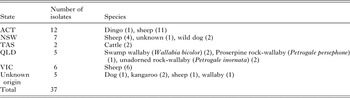
Echinococcus granulosus protoscoleces or germinal membrane extracted from individual cysts from livestock or wildlife animals and adult specimens from dingoes and wild dogs were individually stored in ethanol 70% at −20 °C. Information on the number, origin and hosts from which the isolates were obtained that were analysed in this study are detailed in Table 1. An isolate was defined as material derived from a single cyst (protoscoleces or germinal membrane) or a single adult worm.
Number of isolates of Echinococcus granulosus s.s. analysed showing the origin were samples were taken in Australia and species affected

DNA extraction
Protoscoleces or germinal membrane from a single cyst or individual adult worms were washed three times in PBS prior to lysis with solution containing 100 mm Tris–HCl (pH 8·0), 50 mm EDTA (ethylenediaminetetraacetic acid) and 1% (w/v) SDS (sodium dodecyl sulphate). DNA extraction was performed with phenol:chloroform as previously described (Sambrook, Reference Sambrook1989). Total nucleic acids were precipitated with isopropanol and resuspended in nuclease-free distilled water and quantified using Nanodrop (Thermo Scientific) and stored at −20 °C until further use.
Amplification of the cox1 gene
The full-length sequence of the cox1 gene of E. granulosus s.s. was amplified in two sections for each sample. The 5′ part of the gene (1132 bp) was amplified using forward primer 5′-TTACTGCTAATAATTTTGTGTCAT-3′ previously used by Huttner et al. (Reference Huttner, Nakao, Wassermann, Siefert, Boomker, Dinkel, Sako, Mackenstedt, Romig and Ito2008) and reverse primer: 5′-TGGATCACTAACATTAACACTAGA-3′. PCR conditions included: 94 °C × 2 min, 40 cycles of 94 °C × 15 s, 52 °C × 30 s and 68 °C for 1 min, followed by 5 min at 68 °C. In a 50 µL reaction with 200 µ m dNTPs, 0·2 µ m of each primer, 1·25 units Taq DNA Polymerase (NEB) and ~100 ng of DNA. If a PCR product was not amplified, 0·5–1 µL from the first PCR reaction was used in a nested PCR using forward primer 5′-GTTAGTTTTGACTGTACGTTTTCA-3′ and reverse prime 5′-ATCAACACATAAACCTCAGG-3′ to amplify an 800 bp product. The 3′ part of the cox1 gene (1323 bp) including a sequence overlapping with the 5′ PCR product, was amplified using primer forward 5′-GTTGTCCTCGTCGTATTTTTCTAG-3′ and reverse primer used by Huttner et al. (Reference Huttner, Nakao, Wassermann, Siefert, Boomker, Dinkel, Sako, Mackenstedt, Romig and Ito2008) 5′-GCATGATGCAAAAGGCAAATAAAC-3′. PCR conditions were similar to the previous PCR, except that 55 °C was used as the annealing temperature. If a PCR product was not amplified, 0·5–1 µL from the first PCR reaction was used in a nested PCR using forward primer 5′-CTGTTTTGTTATTGGTTACGTTGC-3′ and reverse primer 5′-CACAATTAAACAACCAGGTCAATG-3′, aiming to obtain a PCR product of 1104 bp.
Sequence analysis and haplotype network construction
Sanger sequencing of the cox1 gene fragments was undertaken, using the primers for the nested PCR, at the Australian Genomic Research Facilities (Melbourne, Australia) and at the GATC Biotech (Konstanz, Germany). Full-length sequences of the cox1 gene were built with the EG01 sequence (accession number: JQ250806) as reference using the software Geneious (Kearse et al. Reference Kearse, Moir, Wilson, Stones-Havas, Cheung, Sturrock, Buxton, Cooper, Markowitz, Duran, Thierer, Ashton, Meintjes and Drummond2012). Only electropherograms with single peaks were accepted; in the case of ambiguities or double peaks, the PCR fragments were sequenced in both directions. The identification of haplotypes and the networks analyses were computed by TCS 1·21 software with 95% connection limit (Clement et al. Reference Clement, Posada and Crandall2000). Amino acid sequences were inferred from the nucleotide sequences by flatworm mitochondrial genetic code (Nakao et al. Reference Nakao, Sako, Yokoyama, Fukunaga and Ito2000). Indices for diversity (haplotype diversity Hd and nucleotide diversity π) and neutrality (Tajima's D and Fu's Fs) were computed using DnaSp 5·10·1 (Librado and Rozas, Reference Librado and Rozas2009).
RESULTS
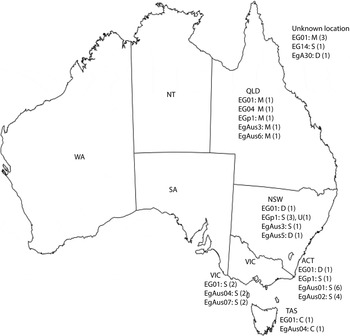
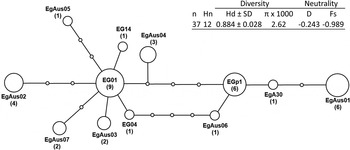
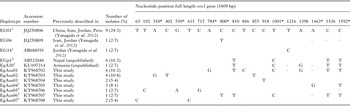
Full-length sequence of the cox1 gene was obtained for 37 isolates. All sequences were clearly associated with the species E. granulosus s.s. Nine samples corresponded to the previously described haplotypes EG01, six to EGp1 (accession number: AB522646), while EG04 (JQ250809), EG14 (AB688591) and EgA30 (KU697314) were found in one sample each. Nineteen samples comprise sequences of seven haplotypes that had not been previously described named EgAus01–EgAus07 (Accession numbers: KT968702–KT968708). Table 2 shows the nucleotide substitution for each position compared with the EG01 haplotype, some of these substitutions represent non-synonymous amino acid substitutions in the predicted COX1 protein. With reference to the conventionally used list of genotypes (G1–3), 16 of our isolates conform to G1 (‘common sheep strain’), one to G2 (‘Tasmanian sheep strain’), seven to G3 (‘buffalo strain’), while the other 13 do not show 100% identity to the 366 bp reference sequences of Bowles et al. (Reference Bowles, Blair and McManus1992). Figure 1 shows the geographic distribution of the haplotypes found in Australian territory, the haplotype EG01 was found at least once in all the states: Australian Capital Territory (ACT), New South Wales (NSW), Queensland (QLD), Tasmania (TAS) and Victoria (VIC). Five samples analysed from Queensland (QLD) were isolated from wildlife animals and they correspond to five different haplotypes. The haplotype network constructed with the sequence of cox1 gene for the 37 isolates and values for diversity and neutrality indices are shown in Fig. 2.
Distribution of the haplotypes of E. granulosus s.s. found in different states of Australia, ACT: Australian Capital Territory, NSW: New South Wales, QLD: Queensland, TAS: Tasmania, VIC: Victoria and samples of unknown location. Number in brackets denotes the number of isolates corresponding to each haplotype for each species as follows: D (dingo, wild dog), S (sheep), C (cattle), M (macropod marsupial), U (unknown species).

Haplotype network and Diversity and Neutrality indices for the 37 sequences of the full length of the cox1 gene from E. granulosus s.s. analysed in this study. Size of the circles shows the frequency of the haplotypes, number in brackets indicates isolates belonging to each haplotype.

Nucleotide substitutions found in the sequence of the cox1 gene (1609 bp) in the twelve haplotypes described in Australia from the 37 isolates analysed in this study. Superscript indicates the genotype described by Bowles et al. (Reference Bowles, Blair and McManus1992) to which haplotype described here belong: E. granulosus s.s. haplotypes described in Australia from 37 isolates analysed in this study. Superscript indicates identity with a genotype described by Bowles et al.: genotype G11, genotype G22 and the genotype G33. Asterisk denotes a non-synonymous amino acid substitution

DISCUSSION
The analysis of the sequences showed a considerable microdiversity among our panel of samples, 12 haplotypes, of which seven were not previously described designated as EgAus01–07. The globally most common and widespread haplotype EG01, originally described by Yanagida et al. (Reference Yanagida, Mohammadzadeh, Kamhawi, Nakao, Sadjjadi, Hijjawi, Abdel-Hafez, Sako, Okamoto and Ito2012), was the most frequent, but not the dominating haplotype present in the isolates from Australia (9/39 samples) (Table 2 and Figs 1 and 2). Other previously described haplotypes found within the Australian samples are EG04 also known from Iran and Jordan; EG14 previously described from China (Yanagida et al. Reference Yanagida, Mohammadzadeh, Kamhawi, Nakao, Sadjjadi, Hijjawi, Abdel-Hafez, Sako, Okamoto and Ito2012), EGp1 previously described from Nepal (unpublished), and EgA30, found in Armenia (unpublished). No clear correlation between haplotype and host species is apparent (Figs 1 and 2).
Within our samples the cox1 section (366 bp) for the G1 genotype described by Bowles et al. (Reference Bowles, Blair and McManus1992) is present in haplotypes EG01, EG14 and also in the newly described EgAus04 and EgAus05. The haplotype EgAus6, found in a single isolate from a Queensland unadorned rock-wallaby (Petrogale inornata) contained the G2 sequence (‘Tasmanian sheep strain’) from Bowles et al. (Reference Bowles, Blair and McManus1992). The G3 sequence is present in haplotypes EGp1 and EgA30, this is the ‘buffalo strain’ (Bowles et al. Reference Bowles, Blair and McManus1992), which was frequent in our samples (7/37 isolates) but has not been reported previously from Australia. If we were to use similar criteria in assignment of ‘strain’ status to the E. granulosus samples examined in our study as that used by Bowles et al. (Reference Bowles, Blair and McManus1992), we would have described seven different ‘strains’, all from Australian samples. The nomenclature used by Bowles and colleagues during the 1990s was valuable at the time as a way of differentiating the genetic variants of E. granulosus that were understood then. However, these designations are now insufficient to describe the intraspecific variability of E. granulosus s.s., which is now known to be substantially greater than previously thought (Nakao et al. Reference Nakao, Yanagida, Konyaev, Lavikainen, Odnokurtsev, Zaikov and Ito2013; Romig et al. Reference Romig, Ebi and Wassermann2015). For example, Romig et al. (Reference Romig, Ebi and Wassermann2015) identified 137 haplotypes based on 304 E. granulosus s.s. isolates of the G1–3 cluster from Western, Eastern and Southern Asia, Europe, Africa and South America. Had the original strain definition of Bowles et al. (Reference Bowles, Blair and McManus1992) been used, a large proportion of these haplotypes were not homologous with either G1, 2 or 3, although they clearly belong to the same cluster. A similar situation was previously described by Busi et al. (Reference Busi, Snabel, Varcasia, Garippa, Perrone, Liberato and D'Amelio2007), Vural et al. (Reference Vural, Baca, Gauci, Bagci, Gicik and Lightowlers2008), Snabel et al. (Reference Snabel, Altintas, D'Amelio, Nakao, Romig, Yolasigmaz, Gunes, Turk, Busi, Huttner, Sevcova, Ito, Altintas and Dubinsky2009) and Casulli et al. (Reference Casulli, Interisano, Sreter, Chitimia, Kirkova, La Rosa and Pozio2012).
Nucleotide substitutions in the samples analysed here predict amino acid variability in the COX1 protein as shown in Table 2. Four of the seven ‘new’ haplotypes described here present one or more amino acid substitutions compared with the predicted amino acid sequence encoded by the cox1 gene from the common EG01 haplotype. It has been proposed that similar levels of genetic variability have the potential to impact a variety of aspects of the host/parasite interaction, or responses to chemotherapeutic agents or vaccines. For example, genetic variability in the gene encoding the EG95 vaccine between E. granulosus s.s. and Echinococcus canadensis (G6) has already been shown to affect the antigenicity of the protein (Alvarez Rojas et al. Reference Alvarez Rojas, Gauci and Lightowlers2013). Echinococcus granulosus s.s. is the main genotype complex responsible for cystic echinococcosis in humans (Alvarez Rojas et al. Reference Alvarez Rojas, Romig and Lightowlers2014); therefore it is important to know if there is any preference of haplotypes infecting humans and/or if haplotypes infecting livestock are less susceptible to vaccination or chemotherapeutic treatment.
Regional differences in haplotype diversity have been used to infer the origin of E. granulosus s.s., with the hypothesis emerging that the parasite's origin was a wildlife cycle in western Asia which switched to domestic animals and subsequently spread to other regions in the wake of livestock domestication (Yanagida et al. Reference Yanagida, Mohammadzadeh, Kamhawi, Nakao, Sadjjadi, Hijjawi, Abdel-Hafez, Sako, Okamoto and Ito2012). Genetic diversity, being high in western Asia and the Middle East appears to decrease toward Europe and Eastern Asia and was reported to be particularly low in a part of South America (Casulli et al. Reference Casulli, Interisano, Sreter, Chitimia, Kirkova, La Rosa and Pozio2012; Yanagida et al. Reference Yanagida, Mohammadzadeh, Kamhawi, Nakao, Sadjjadi, Hijjawi, Abdel-Hafez, Sako, Okamoto and Ito2012). The haplotype diversity value of 0·884 described in this study (Fig. 2) is comparable with networks which were described from the Middle East and China, while the value of the nucleotide diversity (π) of 0·0026 (Fig. 2) is slightly higher (Yanagida et al. Reference Yanagida, Mohammadzadeh, Kamhawi, Nakao, Sadjjadi, Hijjawi, Abdel-Hafez, Sako, Okamoto and Ito2012). In this study, the Tajima's D and Fu's Fs values are both negative (Fig. 2), which could be interpreted as a population increase after an unknown bottleneck event that may have happened in the past.
Echinococcus granulosus is believed to have been introduced into Australia through the rather recent importation of sheep, which has led to our original hypothesis that, due to this bottleneck event, the microdiversity in Australia would be low and/or the haplotypes closely related. Our results are in strong contradiction to this, as shown by a high diversity and a sprawling network without a central dominating haplotype. This finding warrants a reconsideration of the effect of such introduction events. Diversity indices and structure of the haplotype network do not indicate a strong recent founder effect, as it has been shown, e.g. for China, where most of the numerous haplotypes were grouped at 1-bp distance in a star-like fashion around the numerically dominating central haplotype EG01 (Yanagida et al. Reference Yanagida, Mohammadzadeh, Kamhawi, Nakao, Sadjjadi, Hijjawi, Abdel-Hafez, Sako, Okamoto and Ito2012). In our panel, EG01 was only found in nine out of 37 isolates, and the branches to some of the other haplotypes are rather long. This is more suggestive of an ancient polymorphism, imported into Australia from various countries over the past 200 years. Alternatively, it could represent diversity that evolved from importation of the parasite prior to European settlement, for example, with the introduction of dingoes, believed to have been around 6000 years ago (Corbett, Reference Corbett1995). Investigation of microdiversity and the presence of specific haplotypes in South-Western Europe and North Africa, where most of the early Australian sheep stock are thought to have originated, may reveal whether the substantial genetic variability demonstrated here in Australian E. granulosus isolates was mainly imported.
ACKNOWLEDGEMENTS
Professor Ian Beveridge kindly supplied material from wildlife from Queensland. Nucleotide sequence data reported in this paper are available in the GenBank database under the accession numbers: KT968702, KT968703, KT968704, KT968705, KT968706, KT968707, KT968708 and KU697314.
FINANCIAL SUPPORT
Cristian A. Alvarez Rojas and Dennis Ebi are recipients of the Go8 (Group of eight Australia)-DAAD (German Academic Exchange Service) Joint Research Scheme 2015. Funding is acknowledged from NHMRC grants 1003546 and 1043327 (to M.L.).