Introduction
Widowhood is considered to be one of most stressful life events in old age. The resulting elevated stress is a significant risk factor for disability, morbidity and mortality (Stroebe, Schut and Stroebe Reference Stroebe, Schut and Stroebe2007). Previous research demonstrated a higher level of depression among widowed older adults compared to married individuals (Kessler Reference Kessler1997). Extensive research has investigated possible intervening factors in the association between widowhood and depressive symptoms. Two primary conceptualisations of the intervening factors have been proposed. The first is a mediation model that considers which consequences of widowhood affect depressive symptoms (Umberson, Wortman and Kessler Reference Umberson, Wortman and Kessler1992; Van der Houwen et al. Reference Van der Houwen, Stroebe, Schut, Stroebe and Van den Bout2010). The second conceptualisation reflects a moderator model outlining resources that buffer (or worsen) the association between widowhood and depressive symptoms (Chou and Chi Reference Chou and Chi2001; Lindström and Rosvall Reference Lindström and Rosvall2012).
Stroebe et al. (Reference Stroebe, Folkman, Hansson and Schut2006) pointed out that bereavement is a cumulative model-building process, suggesting widowhood may change one's socio-economic resources and the changes that occur during the process may serve as coping resources for the widowed. It is suggested that financial strain and the availability of social recourses, such as social engagement, can be both moderators (i.e. risk factors) and mediators (i.e. consequences of the bereavement process). For instance, economic insecurity may be a risk factor that impedes adjustment to spousal loss, but it can also be a consequence of bereavement (e.g. economic hardship; Lopata Reference Lopata1996; Umberson, Wortman and Kessler Reference Umberson, Wortman and Kessler1992). Likewise, social support can serve as a protective factor in the bereavement process (Schut Reference Schut1999), but it may also be negatively affected as a consequence (e.g. social isolation, loneliness, losing a reliable care provider) of spousal loss (Fried et al. Reference Fried, Bockting, Arjadi, Borsboom, Amshoff, Cramer, Epskamp, Tuerlinckx, Carr and Stroebe2015; Hong, Hasche and Bowland Reference Hong, Hasche and Bowland2009; Janke, Nimrod and Kleiber Reference Janke, Nimrod and Kleiber2008a).
Previous research found that available social and financial resources serve as moderating factors that insulate against depression (Carr Reference Carr2004; Miller, Smerglia and Bouchet Reference Miller, Smerglia and Bouchet2004; Schaan Reference Schaan2013). Similarly, availability of social and financial resources has been tested as a mediating factor of widowhood and depression; that is, widowhood changes the availability of social and financial resources, which in turn leads to increased depressive symptoms (Janke, Nimrod and Kleiber Reference Janke, Nimrod and Kleiber2008b; Lee, Willetts and Seccombe Reference Lee, Willetts and Seccombe1998; Momtaz et al. Reference Momtaz, Ibrahim, Hamid and Yahaya2010). Despite extensive research, only a few studies have investigated whether social resources act as moderators to buffer the negative effects of widowhood on depression among Chinese older adults (Li et al. Reference Li, Liang, Toler and Gu2005; Zhang and Li Reference Zhang and Li2011). To the best of our knowledge, no study has evaluated factors that may mediate the association between widowhood and depression among Chinese older adults, leaving the pathway from widowhood to depression unclear.
This research examined intervening variables in the relationship between widowhood and depressive symptoms through two alternative models – mediation and moderation – using nationally representative data from the Sample Survey on Aged Population in China 2006. This study focused on three key factors that have important policy and practice implications for Chinese older adults: financial strain, worry about having no care-giver and social engagement.
This study is significant in three aspects. First, unlike those in Western countries, Chinese older adults are more likely to experience financial strain due to a less-developed social security system that provides minimal financial protection to widowed older adults (Phillips and Feng Reference Phillips and Feng2015). Higher financial strain may worsen the effect of widowhood on depression. Second, after the implementation of the one-child policy and reduced family size, the availability of familial care resources in old age has become a major concern for many older Chinese adults. Research has shown that one of the top worries Chinese older adults express is having no children available to take care of them in old age (Zhang and Goza Reference Zhang and Goza2006). The scarcity of care resources, particularly those provided by older adults’ children, may compound worries about having no care-giver after losing a spouse. Finally, although research has noted the beneficial effect of social engagement on depressive symptoms among older adults in Western countries, this issue has not been examined among Chinese older adults. Compared to those in Western cultures, Chinese older adults have less diverse social venues such as religious and social organisations for social participation because family relationships take centre stage in Chinese social relationships (Cheng et al. Reference Cheng, Li, Leung and Chan2011). Thus, understanding the role of social engagement in the dynamics of widowhood and depressive symptoms among Chinese older adults will add valuable knowledge to the existing literature.
Mediating effects
Widowhood has significant implications for older adults’ financial, social and psychological wellbeing. Previous research has shown that financial strain is higher among widowed adults than their married counterparts (McGarry and Schoeni Reference McGarry and Schoeni2005; Utz Reference Utz, Carr, Nesse and Wortman2006; Zick and Smith Reference Zick and Smith1991). Given that financial strain and poverty are closely related to depression (Heflin and Iceland Reference Heflin and Iceland2009), studies have suggested financial strain is a prominent mediation mechanism linking widowhood to depression (Umberson, Wortman and Kessler Reference Umberson, Wortman and Kessler1992).
Previous research also demonstrated that social engagement is related to better mental health (Glass et al. Reference Glass, De Leon, Bassuk and Berkman2006; Min, Ailshire and Crimmins Reference Min, Ailshire and Crimmins2016) and social engagement can change as a result of widowhood (Bennett Reference Bennett1998; Utz et al. Reference Utz, Carr, Nesse and Wortman2002). However, the direction of such change, either increased or decreased social engagement, has varied. Because social activities are multi-dimensional, the measurement of social engagement may contribute to this variation, among other reasons such as study size, data type or statistical methodology. For instance, studies (Donnelly and Hinterlong Reference Donnelly and Hinterlong2010; Utz et al. Reference Utz, Carr, Nesse and Wortman2002) found that widowed older adults show a higher level of informal social engagement (i.e. contact and interaction with friends and neighbours), particularly immediately following the onset of widowhood, but tend to report less formal engagement (i.e. formal volunteer activities, meeting attendance and religious service attendance) than non-widowed older adults. Given our interest in the long-term effect of widowhood, the current study examined formal social engagement specifically in terms of the link between widowhood and depressive symptoms.
Worry has also been linked to depression among older adults (Golden et al. Reference Golden, Conroy, Bruce, Denihan, Greene, Kirby and Lawlor2011; Hopko et al. Reference Hopko, Reas, Beck, Stanley, Wetherell, Novy and Averill2003), with increased worry being significantly related to greater severity of depressive symptoms (Lee and Dunkle Reference Lee and Dunkle2010; Skarborn and Nicki Reference Skarborn and Nicki1996). Previous research focused mostly on worry and depression, therefore little is known about how widowhood leads to worry about having no care-giver and how that is related to depression.
Moderating effects
A stress and coping model (Lazarus and Folkman Reference Lazarus and Folkman1984) suggests that socio-economic resources and social integration such as social support and active engagement can buffer individuals’ mental health adjustment and their ability to cope with stressful life circumstances such as spousal loss.
Prior research has shown that activities such as volunteering, participating in clubs and attending meetings have significant positive effects on depressive symptoms. Given findings regarding the positive association between social engagement and depression (Adams, Leibbrandt and Moon Reference Adams, Leibbrandt and Moon2011), engaging in different social activities could be beneficial to the wellbeing of older adults as they experience difficult or stressful life events such as widowhood (Ha Reference Ha2008; Ha and Ingersoll-Dayton Reference Ha and Ingersoll-Dayton2011; Janke, Nimrod and Kleiber Reference Janke, Nimrod and Kleiber2008a). Studies have indicated that social engagement after the loss of a spouse is associated with higher levels of morale (Litwin Reference Litwin2006), fewer depressive symptoms (Hong, Hasche and Bowland Reference Hong, Hasche and Bowland2009) and less functional decline (Janke, Davey and Kleiber Reference Janke, Davey and Kleiber2006).
Regarding worry about lacking a care-giver, prior studies showed that social support from family members, friends and neighbours can ameliorate the adverse effects of widowhood (Li et al. Reference Li, Liang, Toler and Gu2005; Silverstein and Bengtson Reference Silverstein and Bengtson1994). Given the value of social support in sustaining older adults’ wellbeing, lack of social support or even worry about the availability of social support may worsen the impact of widowhood on psychological wellbeing. A recent study showed that worrying about having no care-giver among widowed older adults is indeed related to depressive symptoms (Xu et al. Reference Xu, Li, Min and Chi2017).
Studies have explored the role of financial strain as a consequence of widowhood (McGarry and Schoeni Reference McGarry and Schoeni2005; Utz Reference Utz, Carr, Nesse and Wortman2006) in influencing depressive symptoms. However, financial resources are also important coping resources according to the stress and coping model. Studies have shown financial strain is a source of psychological distress among older people (Ferraro and Su Reference Ferraro and Su1999; Kahn and Pearlin Reference Kahn and Pearlin2006) and that widowed older adults with higher income report higher life satisfaction (Fry Reference Fry2001).
Based on the above-mentioned literature review, we tested the following six hypotheses.
• Hypothesis 1: Financial strain, social engagement and worry about having no care-giver will mediate the association between widowhood and depressive symptoms.
(a) Widowed older adults, compared to their married counterparts, will have higher financial strain, which will be related to higher levels of depressive symptoms.
(b) Widowed older adults, compared to their married counterparts, will have lower social engagement, which will be related to higher levels of depressive symptoms.
(c) Widowed older adults, compared to their married counterparts, will have higher worry about having no care-giver, which will be related to higher levels of depressive symptoms.
• Hypothesis 2: Financial strain, social engagement and worry about having no care-giver will moderate the association between widowhood and depressive symptoms.
(a) Higher level of financial strain will exacerbate the negative effect of widowhood on depressive symptoms.
(b) Higher level of social engagement will buffer the negative effect of widowhood on depressive symptoms.
(c) Higher level of worry about having no care-giver will exacerbate the negative effect of widowhood on depressive symptoms.
Methods
Data source and study sample
The data used in the current study came from the Sample Survey on Aged Population in Urban/Rural China conducted in 2006 by the China Research Center on Aging (CRCA). The survey was based on a stratified multi-stage and probability proportional to size sampling method. First, 20 divisions were selected. Second, in each division, four cities (urban areas) and four counties (rural areas) were selected using the probability proportional to population size. Third, 16 blocks and 16 rural townships were selected in each division. All urban residential communities in the 16 blocks and all villages in the 16 townships were listed together. Fourth, 50 urban residential communities were selected with equal probability proportional to population size in each province. Fifth, 50 urban residential communities and 50 rural villages were selected at random from the list. In the case of households with more than one person aged 60 years or older, one individual was selected at random. This resulted in a sample of approximately 500 urban and 500 rural older adults in each province. The sampling method and data collection have been described in more detail elsewhere (e.g. He et al. Reference He, Sengupta, Zhang and Guo2007). Potential participants were contacted and asked for informed consent. Unavailable subjects (declined to participate, illness, dementia, absence from home or relocation) were replaced by older adults in the households next to those originally chosen based on the Kish table (CRCA 2007).
Provincial or county committees on ageing recruited individuals to conduct interviews using a structured questionnaire after receiving intensive standardised training from CRCA officials. Before interviews, irrelevant people were asked to leave the site. A proxy (usually a family member) was used if individuals had difficulty answering interview questions. For subjective questions, however, regarding their thoughts, plans and feelings (e.g. depressive symptoms), if interviewees could not respond, no other people answered on their behalf. To ensure the quality of interviews, CRCA researchers and personnel from the Bureau of Statistics and the Bureau of Civil Affairs supervised the interview process. Upon completion, questionnaires were examined on-site by interviewers and off-site by their supervisors to ensure completion and minimise missing data. All valid questionnaires were returned to the CRCA for further review and data entry (CRCA 2007). The response rate was 97.1 per cent (CRCA 2007). In this study, we excluded individuals who had missing values for major variables (N = 300). The final sample for this study was 15,588 individuals aged 60 years or older from 16 provinces.
Widowhood
Widowhood status was measured by asking: ‘What is your marital status?’ We coded widowhood status into three categories: married, widowed and other (i.e. never married, divorced, separated or other). Then we created two dummy variables: widowed and other.
Financial strain
Self-rated financial strain was measured by a single question: ‘How do you assess your economic condition?’ This item was measured using a five-point Likert scale: 1 = have a surplus, 2 = enough, 3 = so-so, 4 = difficult and 5 = very difficult.
Social engagement
Social engagement was measured as a composite score calculated based on two questions: (a) ‘Do you go to the following three facilities for activities: senior activity centre, senior college, and playgrounds or parks?’ Answers regarding these facilities were measured on a four-point Likert scale (1 = no facility available, 2 = never, 3 = occasionally and 4 = often). We recalibrated the score to 0 = no participation and 1 = participation (combining responses 3 and 4) in the composite score calculation. (b) ‘Do you participate in the following five activities: neighbourhood watch, voluntary work, mutual aid group, mentoring youth and other volunteer activities?’ Each answer was measured as 1 = yes and 0 = no. A composite score for these two questions was used for final analysis, with a range from 0 to 8. Higher scores indicated a higher level of social engagement.
Worry about having no care-giver
Worry about not having a care-giver was measured by asking: ‘Do you worry about having no care-giver when needed?’ This item was measured using a five-point Likert scale: 1 = never to 5 = very much.
Depressive symptoms
Depressive symptoms were measured using the 15-item Geriatric Depression Scale Short Form (Yesavage et al. Reference Yesavage, Brink, Rose, Lum, Huang, Adey and Leirer1983). This scale has been extensively used with Chinese populations in mainland China, Hong Kong and the United States, and has been confirmed as cross-culturally reliable and valid (Boey Reference Boey2000). Participants were asked whether they experienced depressive symptoms, such as restless sleep and feeling helpless, during the week before the interview. Responses were measured as 1 = yes and 0 = no. After four positive items were reverse recoded, summed scores were created. Overall scores ranged from 0 to 15 and Cronbach's alpha in the present sample was 0.78.
Control variables
Socio-demographic and health variables including age, gender (0 = male, 1 = female), education, residence (0 = urban, 1 = rural), self-rated health, functional health, number of children, living arrangement (0 = not living with a child, 1 = living with a child) and years of widowhood were included as control variables in this study. Age, number of children and years of widowhood were measured as interval-level variables and entered as continuous variables in the models. Education was measured with four categories (1 = illiterate, 2 = old-style private school but no formal education, 3 = primary school, 4 = junior high school, 5 = senior high school, 6 = college or above) and treated as an interval-level variable in the regression models. Self-rated health was measured using a five-point Likert scale ranging from 1 = very bad to 5 = very good. Functional health was measured using activities of daily living (ADLs) and instrumental activities of daily living (IADLs). ADLs refer to the ability to perform basic activities such as eating, dressing, using the restroom, getting in and out of bed, locomotion at home and bathing. Similarly, IADLs include meal preparation, laundry and sweeping. ADL and IADL scores were the sum of six ADL and three IADL items. All ADL and IADL items were rated on a three-point Likert scale: 1 = not difficult at all, 2 = a little bit difficult and 3 = unable to perform the task. The internal consistencies of the ADL and IADL measures were 0.87 and 0.88, respectively. Higher scores indicated more limited function.
Analysis
The analysis included descriptive statistics of socio-demographic characteristics of participants and main study variables (social engagement, financial strain, worry about having no care-giver and depressive symptoms).
Structural equation modelling was implemented to test the meditating model using Mplus 7.0 (Muthén and Muthén Reference Muthén and Muthén2012). To evaluate overall model fit, we used chi-square, Comparative Fit Index (CFI), Tucker–Lewis Index (TLI), Root Mean Square Error of Approximation (RMSEA) and Standardised Root Mean Square Residual (SRMR) tests. The mediating effects of social engagement, financial strain and worry about having no care-giver on the path from widowhood to depressive symptoms were tested with bootstrapping procedures. A nested model comparison using chi-square difference tests was conducted to examine whether not considering the direct path from widowhood and depressive symptoms worsened the fit of the model.
We also conducted ordinary least squares regressions (with mean-centring of the three moderating variables) to test the moderating effects of financial strain, social engagement and worry about having no care-giver on the association between widowhood on depressive symptoms. The variance inflation factor was less than 2.5 across all regressions, indicating no multicollinearity concerns. All analyses were performed using SPSS 24.0.
Results
Sample descriptive
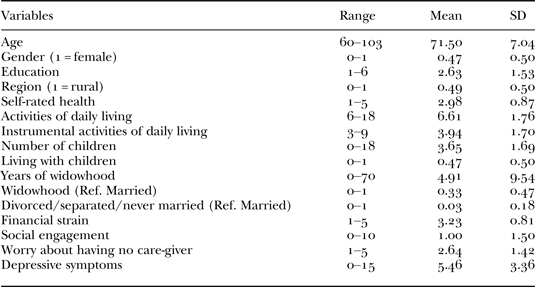
Table 1 displays the demographic characteristics of older adults. Among the 15,115 participants surveyed, about 33 per cent were widowed (N = 5,288), 3 per cent had other marital status and 64 per cent were married (N = 9,827). About 47 per cent were men and 53 per cent were women. The average age of participants was 71.50 (standard deviation (SD) = 7.04), with a range of 60–103 years old. About 26.8 and 30.5 per cent of participants had completed high school or above and primary school, respectively. Around 49 per cent of participants came from rural areas of China. In terms of health status, participants reported an average self-rated health score of 2.98 (SD = 0.87). The mean scores of ADLs and IADLs were 6.61 and 3.94, respectively. The average number of children was 3.65 and 47 per cent of participants reported living with their children. The average years of widowhood among participants was 4.91 (SD = 0.47), with a range of 0–70 years. Participants reported an average financial strain score of 3.23 (SD = 0.81), social engagement score of 1.00 (SD = 1.50) and worry about having no care-giver score of 2.64 (SD = 1.42). The mean score regarding depressive symptoms was 5.46 (SD = 3.36).
Descriptive statistics of analytic variables

Notes: N = 15,588. SD: standard deviation. Ref.: reference category.
Mediating effects
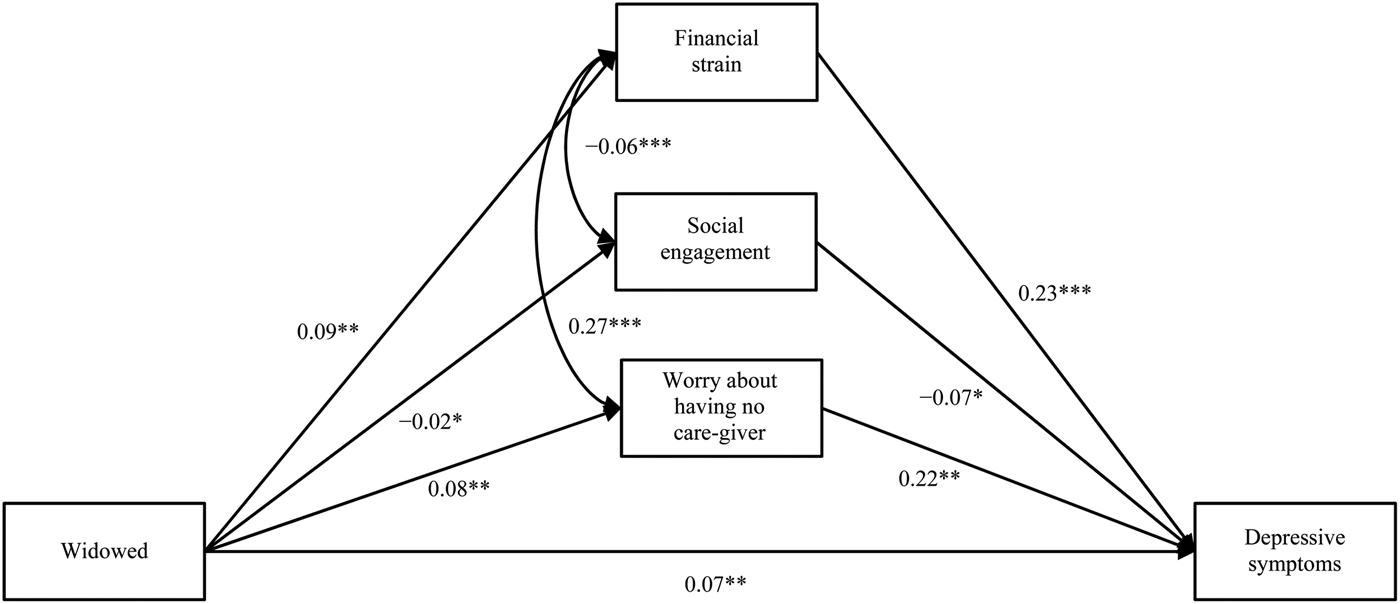
Figure 1 shows the standardised results of the structural equation modelling analysis of the mediating effects of financial strain, social engagement and worry about having no care-giver on depressive symptoms. The control variables (i.e. age, gender, education, region, self-rated health, ADLs, IADLs, number of children, living with children and years of widowhood) were regressed on all the variables in the model. The final model fit indices indicated a good fit, χ2(1) = 36.776; RMSEA = 0.048 (95% confidence interval (CI) = 0.035, 0.062); CFI = 0.999; TLI = 0.903; SRMR = 0.004.
Mediating effects of financial strain, social engagement and worry about having no care-giver in the association between widowhood and depressive symptoms.

Being widowed was related to higher levels of depressive symptoms (β = 0.07, p < 0.001), financial strain (β = 0.09, p < 0.01), social engagement (β = −0.02, p < 0.05) and worry about having no care-giver (β = 0.08, p < 0.001). In addition, financial strain (β = 0.23, p < 0.001), social engagement (β = −0.07, p < 0.001) and worry about having no care-giver (β = 0.22, p < 0.001) were significantly associated with depressive symptoms.
We tested three indirect effects from being widowed to depressive symptoms with 1,000 bootstraps and 95 per cent CI values. First, the indirect path from being widowed to financial strain to depressive symptoms was significant (β = 0.140, p < 0.001, CI = 0.107, 0.172). Second, the indirect effect from being widowed to social engagement to depressive symptoms was also significant (β = 0.001, p = 0.025, CI = 0.003, 0.020). The indirect effect via worry about having no care-giver was significant (β = 0.106, p < 0.001, CI = 0.075, 0.138) as well. The results indicate that financial strain, social engagement and worry about having no care-giver significantly mediated the association between widowhood and depressive symptoms.
Finally, we compared our suggested model to the model that did not consider the direct effect from being widowed to depressive symptoms (full mediation model). The chi-square difference test indicated omitting the direct effect from widowhood and depressive symptoms resulted in worse model fit, χ2diff(1) = 55.643, p < 0.001, supporting the proposed partial mediation model.
Moderating effects
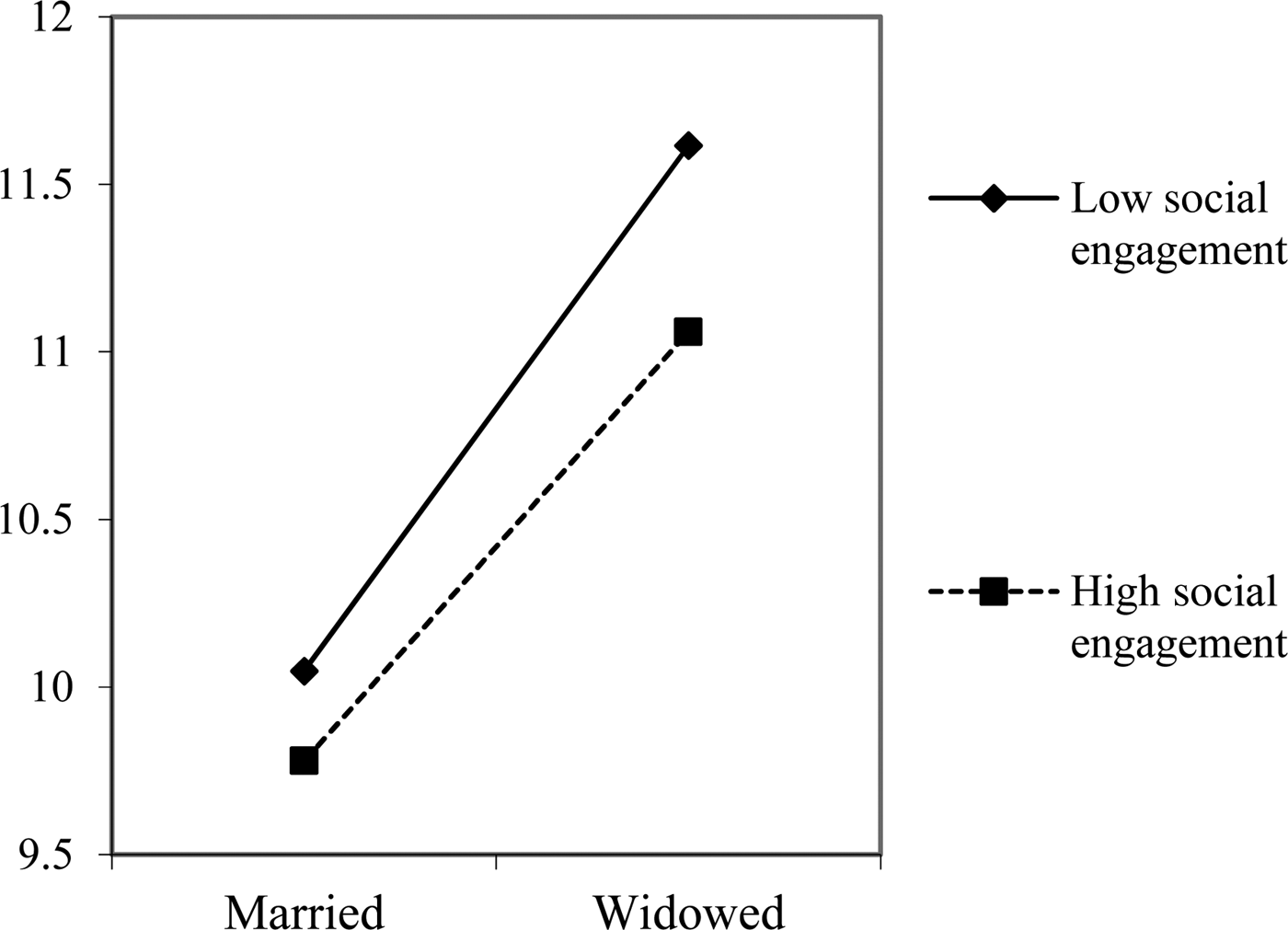
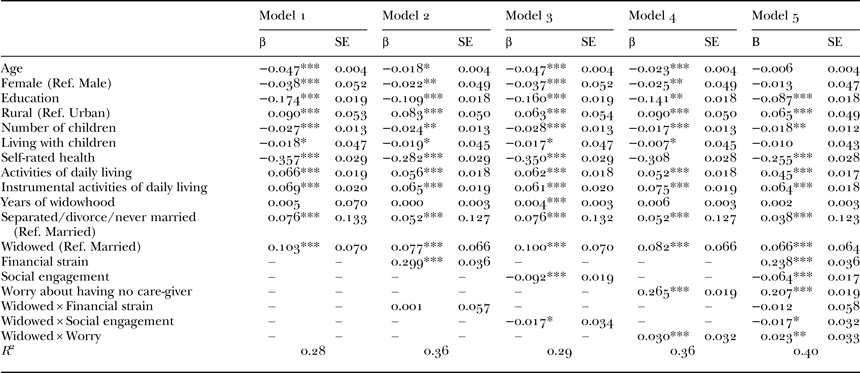
Table 2 shows the regression coefficients for estimated effects of widowhood on depressive symptoms and the moderating effects of financial strain, worry about having no care-giver and social engagement. As shown in Model 1, compared to married participants, being widowed was significantly associated with depressive symptoms (β = 0.10, p < 0.001). In Model 2, we introduced interaction terms of financial strain (widowed × financial strain). Financial strain was significantly related to higher levels of depressive symptoms (β = 0.30, p < 0.001). However, no moderating effect of financial strain was found in the association between widowhood and depressive symptoms. Results from Model 3 show the moderating effect of social engagement. Social engagement was related to lower levels of depressive symptoms (β = −0.92, p < 0.001). Social engagement also moderated the association between widowhood and depressive symptoms (β = −0.02, p < 0.05). Figure 2 visualises the moderating effect of social engagement. In general, participants with higher social engagement had lower depressive symptoms; however, the difference in depressive symptoms between groups with low and high social engagement was bigger among those who were widowed compared to those who were married.
Depressive symptoms among older adults who are married and widowed by social engagement.

Moderating effect of financial strain and social engagement in the relationships between widowhood and depressive symptoms

Notes: N = 15,588. SE: standard error. Ref.: reference category.
Significance levels: *p < 0.05, **p < 0.01, ***p < 0.001.
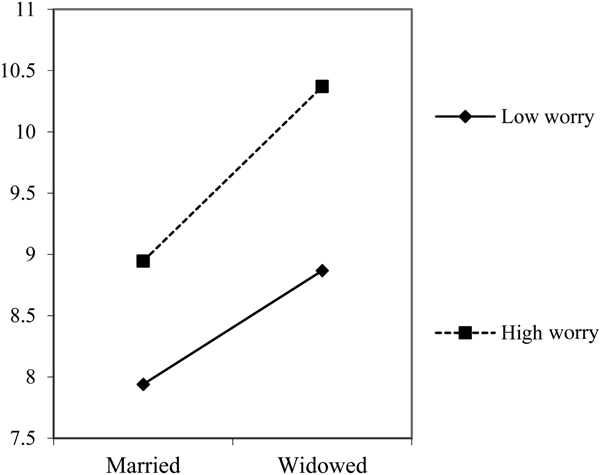
Results from Model 4 show worry about having no care-giver was associated with higher levels of depressive symptoms (β = 0.27, p < 0.001). A moderating effect of worry about having no care-giver was also found in the association between widowhood and depressive symptoms (β = 0.30, p < 0.001). Figure 3 shows that a higher level of worry about having no care-giver was related to higher depressive symptoms and the difference in depressive symptoms scores due to level of worry was bigger among widowed participants than married older adults. In Model 5, we tested the moderating effects of financial strain, social engagement and worry about having no care-giver in one model. We found consistent results that social engagement and worry about having no care-giver moderated the association between widowhood and depressive symptoms.
Depressive symptoms among older adults who are married and widowed by worry about having no care-giver.

Discussion
Using nationally representative data from a sample of older adults in China, this study examined the mediating and moderating effects of three culturally relevant factors (financial strain, social engagement and worry about having no care-giver) on the association between widowhood and depressive symptoms. This study found that widowed older adults were more financially strained, less engaged in formal social activities and had more worry about their care-giver availability than married older adults, resulting in higher depressive symptoms (supporting Hypotheses 1a, 1b and 1c). This indicates that widowed Chinese older adults are vulnerable both financially and socially, which contributes to a higher risk of depression. This study also found significant moderating effects of social engagement and worry about having no care-giver in the association between widowhood and depressive symptoms. In general, widowed older adults tend to have higher levels of depressive symptoms than married older adults. However, when widowed older adults are more socially engaged and less worried about having no care-giver, this observed gap in depressive symptoms between married and widowed persons narrows, mostly through increased social engagement (supporting Hypotheses 2b and 2c).
Regarding meditating effects, our finding of higher financial strain among widowed older adults is consistent with previous research that found a lower standard of living among widowed older adults compared to those who were married (Dreze and Srinivasan Reference Dreze and Srinivasan1997; Hungerford Reference Hungerford2001). Previous studies showed that spouses are one of the main sources of social networking among older adults, including in-law family relationships and friends (Bott and Spillius Reference Bott and Spillius2014), and the potential primary care-giver (Marks Reference Marks1996). Our findings add to the literature by highlighting the financial and social challenges that Chinese older adults face during widowhood and related pathways that make them psychologically vulnerable. Future studies examining other potential mechanisms linking widowhood and psychological wellbeing, such as informal social engagement, social support or other psychological coping resources such as personality, will provide valuable information to explicate the pathways from spousal loss to higher depressive symptoms.
Regarding moderating effects, we found social engagement and worry about having no care-giver moderated the association between widowhood and depression, but not financial strain. Our finding is consistent with studies conducted among Western populations (Ha and Ingersoll-Dayton Reference Ha and Ingersoll-Dayton2011) that suggested that engaging in social activities can be beneficial for older adults when they experience stressful life events. Social activities offer widowed adults a way to cope with their loss, insulate against the impact of negative life events, and provide opportunities to remain socially connected and physically active. We found that individuals who live in an urban area and have a higher level of education reported higher levels of social engagement. Studies on external factors that hamper or facilitate engagement in activities, such as availability, geographic distribution and accessibility, would provide insight and inform the planning of social engagement programmes for Chinese older adults. It is also important to note that our measure of social engagement focused on formal social engagement. Social activities are multi-dimensional and include formal and informal activities (closely related to possible social support from families and friends). Thus, examining variations in effects across different types of social engagement would provide more detailed information to develop more targeted intervention programmes and policy.
Next, the previous literature has mostly examined financial strain as a mediator (McGarry and Schoeni Reference McGarry and Schoeni2005; Utz Reference Utz, Carr, Nesse and Wortman2006) rather than a coping resource, whereas the conceptual framework of the stress and coping model suggests financial factors can be both buffers and mediators (Elwell and Maltbie-Crannell Reference Elwell and Maltbie-Crannell1981). Our study used two conceptualisations (mediators as a consequence of bereavement and moderators as coping resources) to examine how financial factors influence the dynamic between bereavement and psychological wellbeing. Our study participants reported a mean score of 3.24 on financial strain, which is between ‘so-so’ and ‘somewhat difficult’, suggesting financial strain is common among Chinese older adults but varies by marital status. Widowed older adults in our sample were more financially strained than married older adults. Nonetheless, our finding of no significant moderating effect of financial strain shows that these gaps in depressive symptoms between married and widowed do not necessarily narrow or widen with the level of financial strain.
Our study provided unique contributions to the literature by examining intervening factors related to the association between widowhood and depression among Chinese older adults. Extensive research has tested the bereavement effect on older adults’ psychological wellbeing. Such studies suggested how and when certain factors may contribute to the link between these associations. However, previous studies did not investigate the intervening factors in this link among Chinese older adults using nationally representative data. We found that not only do the availability of or resources related to the three variables (i.e. financial strain, social engagement and worry about having no care-giver) vary among Chinese older adults, but also the buffering or reinforcing effects of these factors can differ in relation to bereavement and psychological wellbeing. Current Chinese older adults are influenced by the one-child policy, the consequence of which is less availability of informal social support or potential care from their adult children in later life. Our study confirmed that examining the role of financial strain, social engagement and care-related concerns among widowed older adults is important given the cultural and social context of China, such as low benefit levels of pensions, and limited and diverse social venues for social participation among older adults. Since 2006, the Chinese government has initiated various pension policies. For example, the New Rural Pension Scheme and Urban Residents’ Pension Scheme were created in 2009 and 2011, respectively. In 2014, the State Council merged and provided the Residents’ Pension Scheme, which covers more than half a billion Chinese individuals. A recent policy analysis study (Liu and Sun Reference Liu and Sun2016), however, found that although the pension reform has achieved a degree of universal benefits, the benefit level remains low. Further studies on the effects of newly enacted polices related to Chinese older adults and whether those policies narrow the gaps among older adults based on marital status will be beneficial.
Our study used cross-sectional data; however, longitudinal data will provide more opportunities to capture the transition from married status to widowhood and explore dynamic long-term changes in financial hardship, social engagement and care-related concerns in relation to spousal loss and its psychological consequences. It is also important to note that the variables used to assess financial strain and worry about having no care-giver were subjective self-reported measures in the present study. It is possible that more depressed individuals were more likely to report more negatively regarding their financial and future care situation. Further study examining the gaps between subjective measures of financial strain and other objective financial hardship indicators such as household income or assets, and how such discrepancy mediates the relationship between widowhood and psychological outcomes, may shed light on points of intervention. It will be of interest to understand how strongly worry about having no care-giver is related to actual care received later in life.
In summary, this study added knowledge to the current literature by investigating how financial and social factors affect the association between widowhood and depressive symptoms among Chinese older adults through two alternative models: mediation and moderation. Our results provide valuable information for both practice and policy.
Acknowledgement
The authors thank Ping Guo (deceased) at the China Research Center on Aging for statistical support.