Introduction
Predators often vary their predatory tactics depending on the characteristics of their prey, because their prey also opposes them using various anti-predator defences, such as morphological and behavioural traits. A predator may thus select a suitable predatory tactic based on the traits of the targeted prey, to maximize their predation success (Davies et al., Reference Davies, Krebs and West2012).
Naticid and muricid gastropods are well-known marine carnivorous snails that attack by penetrating the shells of various prey species, including crustaceans (Huelsken, Reference Huelsken2011), gastropods (Berry, Reference Berry1982; Yamamoto, Reference Yamamoto2004; Pahari et al., Reference Pahari, Mondal, Bardhan, Sarkar, Saha and Buragohain2016) and bivalves (Tanaka, Reference Tanaka1954; Ansell, Reference Ansell1960, Reference Ansell1982a, Reference Ansell1982b; Ansell & Morton, Reference Ansell, Morton, Morton and Dudgeon1985, Reference Ansell and Morton1987; Rodrigues et al., Reference Rodrigues, Nojima and Kikuchi1987; Brown, Reference Brown1997; Kingsley-Smith et al., Reference Kingsley-Smith, Richardson and Seed2003; Dietl et al., Reference Dietl, Herbert and Vermeij2004; Ishida, Reference Ishida2004; Yamamoto, Reference Yamamoto2004; Dietl & Herbert, Reference Dietl and Herbert2005; Peharda & Morton, Reference Peharda and Morton2006; Morton, Reference Morton2008; Hasegawa & Sato, Reference Hasegawa and Sato2009; Chiba & Sato, Reference Chiba and Sato2012; Chiba & Sato, Reference Chiba and Sato2013; Hutchings & Herbert, Reference Hutchings and Herbert2013; Visaggi et al., Reference Visaggi, Dietl and Kelley2013; Chiba & Sato, Reference Chiba and Sato2014; Mondal et al., Reference Mondal, Hutchings and Herbert2014; Paul et al., Reference Paul, Herbert and Dietl2014; Pahari et al., Reference Pahari, Mondal, Bardhan, Sarkar, Saha and Buragohain2016; Morton, Reference Morton2017; Tomiyama, Reference Tomiyama2018). Naticid gastropods employ three major predatory tactics against bivalve prey: wall-drilling, edge-drilling and suffocation (Ansell & Morton, Reference Ansell and Morton1987; Visaggi et al., Reference Visaggi, Dietl and Kelley2013; Mondal et al., Reference Mondal, Hutchings and Herbert2014; Paul et al., Reference Paul, Herbert and Dietl2014). Wall-drilling is the typical predatory behaviour in naticid and muricid gastropods, wherein predators drill near the thicker centre of the prey's valve (Mondal et al., Reference Mondal, Hutchings and Herbert2014). In edge-drilling, a borehole is made at the valve margin. This tactic is considered to be more advantageous than wall-drilling, because it reduces drilling time (Dietl & Herbert, Reference Dietl and Herbert2005; Mondal et al., Reference Mondal, Hutchings and Herbert2014). Suffocation is employed before drilling or without making any drill hole, in which the predator envelops the prey with their foot to suffocate it (Visaggi et al., Reference Visaggi, Dietl and Kelley2013). The use of these different predatory tactics has been shown to vary with sediment depth (Hasegawa & Sato, Reference Hasegawa and Sato2009; but see Visaggi et al., Reference Visaggi, Dietl and Kelley2013), competition (Dietl et al., Reference Dietl, Herbert and Vermeij2004; Hutchings & Herbert, Reference Hutchings and Herbert2013) and shell thickness in bivalves (Ansell & Morton, Reference Ansell, Morton, Morton and Dudgeon1985, Reference Ansell and Morton1987).
In gastropod–bivalve predator–prey systems, predatory tactics may often vary among prey species. For example, the predatory gastropods Polinices mammilla (Linnaeus, 1758) and Neverita didyma (Röding, 1798) employ two or three predatory tactics with different frequencies depending on the species of the bivalve prey (Ansell & Morton, Reference Ansell and Morton1987). In addition, size differences between predator and prey could also be an important factor in determining the predatory tactics (Ansell, Reference Ansell1960; Brown, Reference Brown1997; Kingsley-Smith et al., Reference Kingsley-Smith, Richardson and Seed2003; Peharda & Morton, Reference Peharda and Morton2006; Huelsken, Reference Huelsken2011; Chiba & Sato, Reference Chiba and Sato2012; Morton, Reference Morton2017; Tomiyama, Reference Tomiyama2018). For example, large individuals of Euspira nitida (Donovan, 1804) consume a larger and wider size range of the bivalve, Cerastoderma edule than small individuals, and the position of the drill hole varies with the size of the prey individual (Kingsley-Smith et al., Reference Kingsley-Smith, Richardson and Seed2003). Thus, predatory tactics could vary based on the prey species and the relative size of the prey.
In this study, we describe predator and prey interactions between the marine gastropod Paratectonatica tigrina (Röding, 1798) (Figure 1A), that employs three predatory tactics (i.e. wall-drilling, edge-drilling and suffocation), and two species of its bivalve prey, Meretrix lusoria (Röding, 1798) and Ruditapes philippinarum (Adams & Reeve, 1850). We particularly focused on investigating the factors that determine predatory tactics and the consequences of each predatory behaviour. It is known that P. tigrina feed by perforating the shells of bivalves (Tanaka, Reference Tanaka1954; Figure 1B–E), as well as other species of Naticidae, such as N. didyma (Ansell & Morton, Reference Ansell and Morton1987; Rodrigues et al., Reference Rodrigues, Nojima and Kikuchi1987), E. nitida (Ansell Reference Ansell1960, Reference Ansell1982a, Reference Ansell1982b; Kingsley-Smith et al., Reference Kingsley-Smith, Richardson and Seed2003), Conuber incei (Philippi, 1853) (Morton, Reference Morton2008, Reference Morton2017) and Laguncula pulchella Benson, 1842 (Hasegawa & Sato, Reference Hasegawa and Sato2009; Chiba & Sato, Reference Chiba and Sato2012, Reference Chiba and Sato2013, Reference Chiba and Sato2014; Tomiyama, Reference Tomiyama2018). However, no quantitative assessment of predatory tactics by this species has yet been conducted. Our aim was to demonstrate how P. tigrina applies its three predatory tactics on both bivalve prey species.
Predation by Paratectonatica tigrina and the drill holes they make in the shells of two bivalve species. (A) Predation of P. tigrina on Meretrix lusoria. (B) Drill hole (arrow) on the Ruditapes philippinarum shell wall and (C) on the edge of the shell. (D) Drill hole (arrow) on the M. lusoria shell wall and (E) on the edge of the shell.

Materials and methods
Sampling
We collected P. tigrina from the estuarine mudflat of the Kumagawa River, Yatsushiro, Kumamoto, Japan, on 13 and 27 April 2018. Ruditapes philippinarum individuals were collected from Matsushima Island, Kamiamakusa, Kumamoto, Japan, on 18 April 2018. Meretrix lusoria were collected from Kafuri, Itoshima, Fukuoka, Japan, on 15 and 26 April 2018. After collecting these animals, we temporarily maintained individuals of each species separately in an aquarium with a flow-through seawater supply until the initiation of the experiment. The animals were not fed during this period.
Experimental setup
Gastropod predators and bivalve prey were randomly assigned to and placed one-by-one into plastic containers (15 × 10 × 8 cm) that served as experimental arenas. Sand (200 ml) was placed into each of these containers as substrate. Into each side of the containers, we bored two holes (5 mm in diameter) at 5 cm from the bottom to permit the exchange of seawater. The containers were covered with a metal net to prevent P. tigrina from escaping from them. Five experimental containers were arranged within a larger plastic container (50 × 33 × 12 cm) with a flow-through seawater supply. We initiated the experiments on 18 April 2018 for R. philippinarum and 27 April 2018 for R. philippinarum and M. lusoria. The total sample size was 28 and 29 for R. philippinarum and M. lusoria, respectively.
We checked for predation events (i.e. whether P. tigrina had caught a bivalve) once or twice each day during the experimental period (30 days). When a bivalve was released from P. tigrina, we confirmed whether it was dead and determined the feeding duration. The feeding duration was defined as the number of days on which we continuously observed predation events until the end of predation. When predation did not occur for 30 days, we terminated the trials.
Measurements
After the experiments, all the predators, remaining bivalve shells and surviving bivalves were temporarily frozen in a freezer. We then removed the soft body parts of each animal after thawing. All shells of the predator and prey were dried for 4 h at 70°C in a convection oven (NDO-510W, EYELA Tokyo Rikakikai Co., Ltd, Japan). Then, the shell lengths of P. tigrina, R. philippinarum and M. lusoria were measured using a calliper to the nearest 0.05 mm. The shell thickness of the two bivalve species was also measured with a dial thickness calliper to the nearest 0.05 mm. We measured the dry shell weight of P. tigrina, R. philippinarum and M. lusoria with an electronic scale (SA-120, ViBRA Shinko Denshi Co., Ltd, Japan) to the nearest 0.001 g. We also recorded the presence of drill holes and their position on the shells of bivalves (i.e. wall-drilling or edge-drilling, Figure 1B–E). The mean ± SD shell lengths of P. tigrina with respect to R. philippinarum and M. lusoria were 21.15 ± 1.35 mm and 20.44 ± 2.10 mm, respectively. The mean shell lengths of R. philippinarum and M. lusoria were 26.65 ± 3.56 mm and 24.58 ± 4.77 mm, respectively.
Statistical analysis
We conducted the following analyses to compare the predation behaviours of P. tigrina with respect to the two prey species. First, we applied a generalized linear mixed model (GLMM) with a binomial distribution and a logit link function to compare predation success between the two prey species. The response variable was predation success, while the explanatory variables were the prey species and shell weight ratio. The ID number of the large containers was included as a random intercept. Although the interaction between the prey species and shell weight ratio was included, we subsequently excluded the interaction from the model because it was not significant (Z = −0.26, P = 0.80). Second, we applied Fisher's exact test to compare the frequencies of the three predatory tactics between the two prey species. Third, we compared the shell weight ratio among predatory tactics within each species with either a one-way analysis of variance (ANOVA) for R. philippinarum or Welch's t-test for M. lusoria. Fourth, the feeding duration was analysed using a GLMM with a Poisson distribution and a log link function. In this case, the response variable was the predation duration (days), while the explanatory variables were the prey species and shell weight ratio. The ID number of the large containers was included as a random intercept. We removed the interaction from this model because it was not significant (Z = 0.40, P = 0.69). These data were further analysed by limiting the response variable to cases where the following two predatory tactics were used: wall-drilling and edge-drilling. In these cases, since there was also no significant interaction (wall-drilling: Z = −0.33, P = 0.74; edge-drilling: Z = −0.051, P = 0.96), the interaction was removed from the models. We also compared the feeding durations of all tactics and each specific predatory tactic between R. philippinarum and M. lusoria using a Wilcoxon rank-sum test. Furthermore, we compared feeding durations among tactics within each species with a Kruskal–Wallis test (R. philippinarum) and Wilcoxon rank-sum test (M. lusoria). Lastly, the shell thickness was compared between the two bivalve species using an analysis of covariance (ANCOVA, with a type III sum-of-squares). The response variable was the shell thickness, while the explanatory variables were the prey species and the shell length of the bivalve prey. The interaction between prey species and shell length was excluded because it was not significant (F(1, 53) = 3.29, P = 0.08). In all analyses, if a significant difference was found for categorical variables composed of three groups, Tukey's honestly significant difference (HSD) test was applied.
All analyses were conducted using R 3.5.1 software (R Core Team, 2018). The R packages ‘lme4’ and ‘car’ were used for analyses with GLMM and ANCOVA, respectively.
Results
Predation success
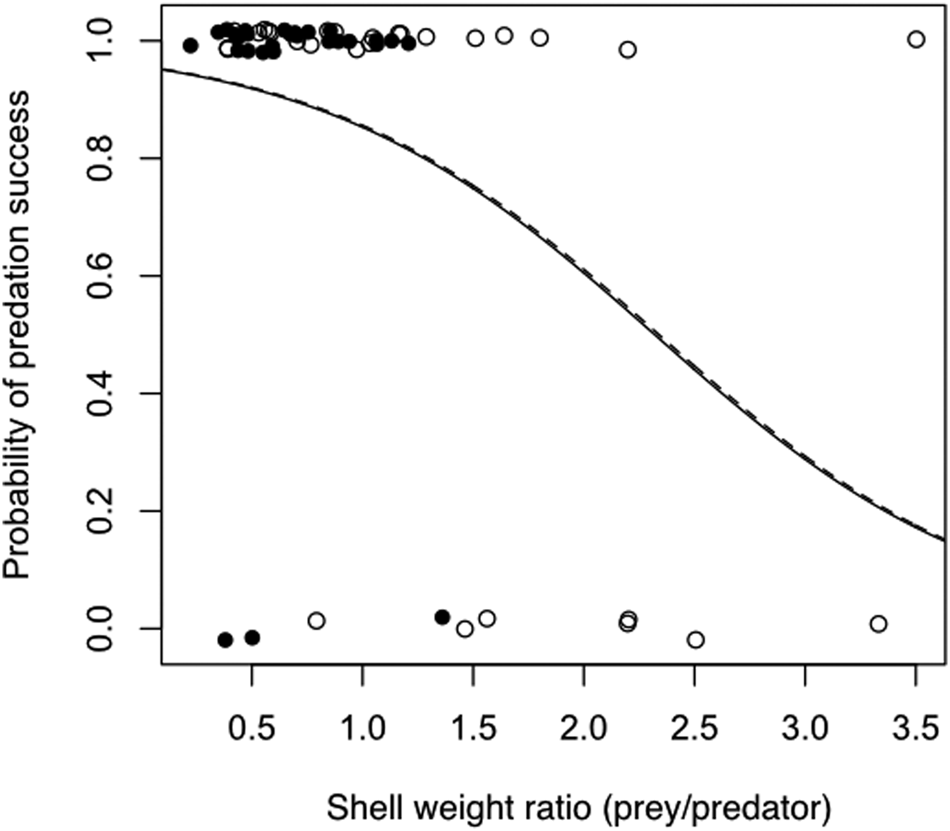
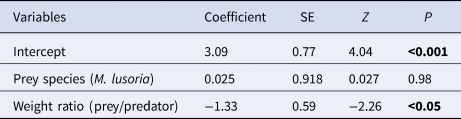
Predation occurred in 89.3% (25/28) and 75.9% (22/29) of the trials using R. philippinarum and M. lusoria, respectively. The probability of predation success increased with the shell weight ratio (prey shell weight/predator shell weight) (Figure 2; Table 1). However, predation success did not significantly differ between the two prey species (Figure 2; Table 1).
Relationship between predation success and the ratio of shell weights between predator and prey (prey/predator). Black and white circles indicate Ruditapes philippinarum and Meretrix lusoria, respectively. Solid and dashed lines indicate curves estimated by GLMM for R. philippinarum and M. lusoria, respectively.

The results of the GLMM analysis of predation success

Bold font indicates statistical significances.
Predatory tactics
The proportions of attacks that occurred via wall-drilling, edge-drilling and with no drill hole predatory tactics for R. philippinarum were 44.0% (11/25), 32.0% (8/25) and 24.0% (6/25), respectively. For M. lusoria, these proportions were 63.6% (14/22), 36.4% (8/22) and 0.0% (0/22), respectively. The frequency with which these predatory tactics were used was significantly different between the two prey species (Fisher's exact test, P < 0.05).
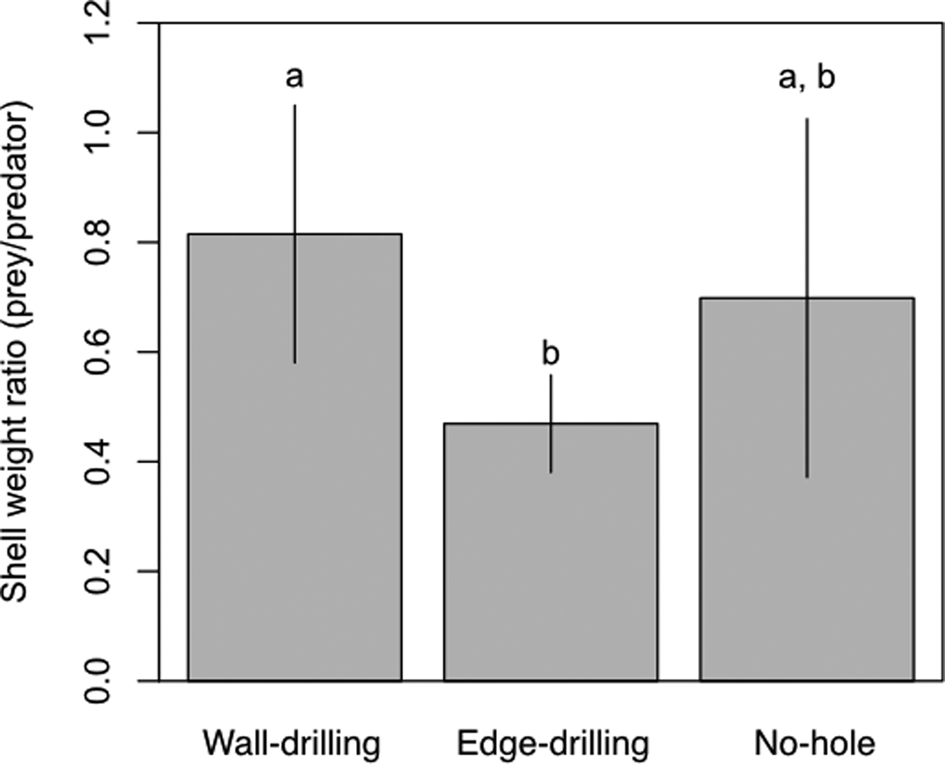
Shell weight ratios differed significantly among predatory tactics employed by P. tigrina against R. philippinarum (one-way ANOVA, F(2,22) = 5.38, P < 0.05, Figure 3), whereas shell weight ratios did not differ for those used against M. lusoria (Welch's t-test, t(17.73) = 0.45, P = 0.66). Multiple comparison post-hoc tests detected a significant difference between wall- and edge-drilling in R. philippinarum (Tukey's HSD test, P < 0.01). However, there were no significant differences between any other combinations of tactics (Tukey's HSD test, wall-drilling vs no hole: P = 0.58; edge-drilling vs no hole: P = 0.17).
Shell weight ratio (prey/predator) for each predatory tactic. Different letters above the bars indicate those that were significantly different according to Tukey's HSD test.

Feeding duration
The total feeding duration was 2.68 ± 1.14 days (N = 25) and 3.18 ± 0.80 days (N = 22) on R. philippinarum and M. lusoria, respectively. The feeding duration was not influenced by either the prey species or the shell weight ratio (GLMM, prey species: Z = 0.46, P = 0.65, shell weight ratio: Z = 1.34, P = 0.18). When the data included in the analyses were limited to those from trials in which wall-drilling was observed, there was no significant difference in the duration between the two prey species (R. philippinarum: 2.82 ± 0.98 days, N = 11; M. lusoria: 3.29 ± 0.83 days, N = 14; Wilcoxon rank-sum test, W = 58, P = 0.28). Similarly, in edge-drilling, there was no significant difference in the duration of this predatory tactic between prey species (R. philippinarum: 2.50 ± 1.41 days, N = 8; M. lusoria: 3.00 ± 0.76 days, N = 8; Wilcoxon rank-sum test, W = 27, P = 0.62). In both wall- and edge-drilling, the feeding durations were also not significantly influenced by either prey species or shell weight ratio (GLMM for wall-drilling, prey species: Z = 0.42, P = 0.67, shell weight ratio: Z = 1.15, P = 0.25; GLMM for edge-drilling, prey species: Z = −0.24, P = 0.81, shell weight ratio: Z = 1.09, P = 0.28). The duration of feeding without generating a drill hole was 2.67 ± 1.21 days (N = 6) on R. philippinarum. When feeding durations were compared among tactics within a species, there was no significant difference among tactics in trials with both prey species (Kruskal–Wallis test for R. philippinarum: χ2(2) = 0.15, P = 0.93; Wilcoxon rank-sum test for M. lusoria: W = 46, P = 0.48).
Shell thickness of the two bivalve prey species
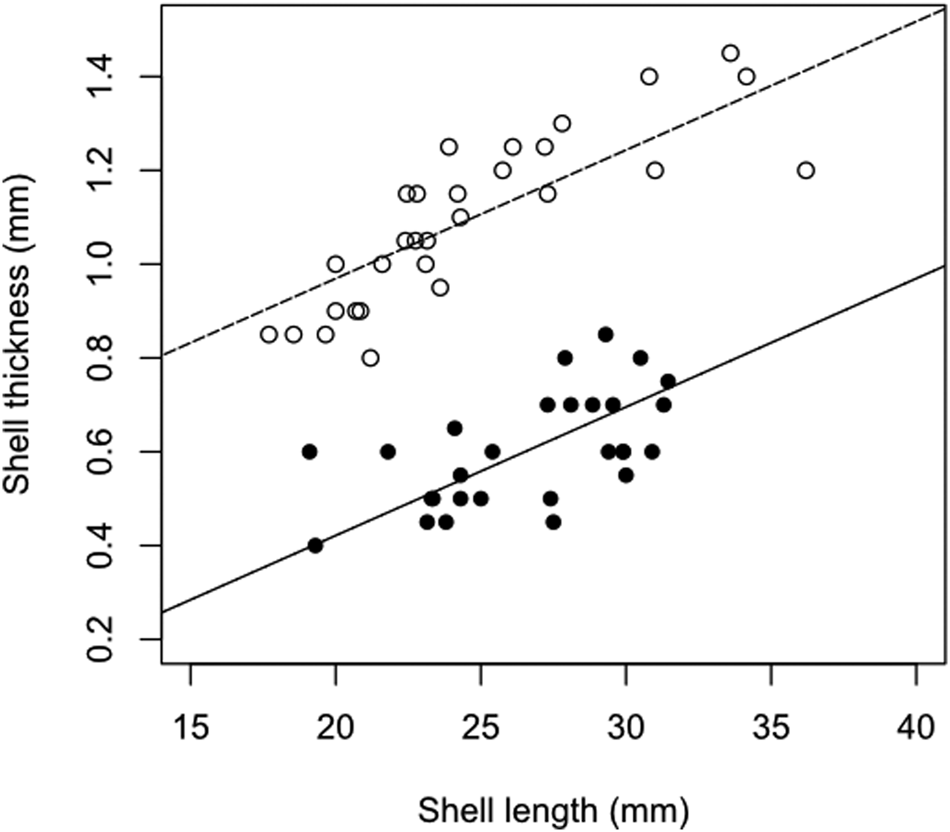
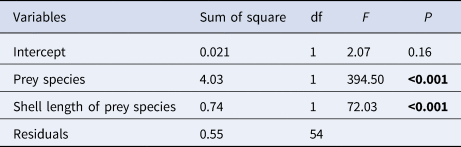
Shell thicknesses differed between R. philippinarum and M. lusoria. The average shell thickness was 0.60 ± 0.12 mm (N = 28) and 1.09 ± 0.18 mm (N = 29) in R. philippinarum and M. lusoria, respectively. Although the shell thickness correlated with the shell length in both prey species, the intercepts differed between these species (Figure 4; Table 2).
The relationship between shell thickness and shell length in two bivalve species. Black and white circles indicate Ruditapes philippinarum and Meretrix lusoria, respectively. Solid and dashed lines indicate estimated regression lines for R. philippinarum and M. lusoria, respectively.

ANCOVA table for the comparison of shell thickness between the two bivalve prey species

Bold font indicates statistical significances.
Discussion
Predation success increased when the predator's shell weight was relatively larger than that of the prey (Figure 2). Similar patterns have been reported in many naticid gastropods (e.g. E. nitida vs C. edule, Kingsley-Smith et al., Reference Kingsley-Smith, Richardson and Seed2003; L. pulchella vs R. philippinarum, Chiba & Sato, Reference Chiba and Sato2012; N. didyma vs R. philippinarum, Rodrigues et al., Reference Rodrigues, Nojima and Kikuchi1987). This may be a general pattern for predatory interactions between carnivorous naticids and their prey. However, in the present study, the difference between the prey species did not affect predation success. Perhaps the size of the foot of predatory snails may simply determine the size of bivalve prey (Rodrigues et al., Reference Rodrigues, Nojima and Kikuchi1987), resulting in similar predation success against bivalve prey of different species having similar shell morphology.
Paratectonatica tigrina used three predation tactics with frequencies that differed between the two bivalve prey species. Paratectonatica tigrina attacked R. philippinarum using all three tactics. However, only two tactics were employed against M. lusoria, excluding the non-drilling tactics. The use of different tactics for different prey species has been reported in some other naticid species. For example, N. didyma used side-boring (i.e. wall-boring) and non-boring predatory tactics with different frequencies against different bivalve species (Ansell & Morton, Reference Ansell and Morton1987). However, Notocochlis gualtieriana (Récluz, 1844) utilized only side-boring against all species of bivalve prey (Ansell & Morton, Reference Ansell and Morton1987). Collectively these findings, including ours, demonstrate that naticid gastropods use different tactics at different frequencies for different prey species, which is further dependent on the predator species.
In general, edge-drilling may not consume much energy and time to bore the shell edge, since the edge is thinner than the middle of the shell wall (Dietl & Herbert, Reference Dietl and Herbert2005; Dietl et al., Reference Dietl, Herbert and Vermeij2004). In fact, Dietl & Herbert (Reference Dietl and Herbert2005) showed that the carnivorous muricid, Chicoreus florifer (Reeve, 1846), takes a longer time for wall-drilling than edge-drilling. However, this study has shown that the feeding duration did not differ among tactics both within each prey species and between the prey species. Perhaps the different predation tactics of the species in this study did not correlate with the feeding duration, and thus all tactics seemed to be equally efficient with respect to feeding, even if predatory snails selected suitable tactics against each prey. The inconsistency between the results of our study and those of the previous study may be derived from differences in the mode of feeding by the predator; muricid gastropods usually feed on prey on the surface of the substrate, while naticids carry prey animals underground after capturing them (Hasegawa & Sato, Reference Hasegawa and Sato2009). Muricid gastropods may thus be exposed to a high predation pressure during feeding, while naticid gastropods are not. Consequently, selection may strongly favour tactics that shorten the feeding duration in muricids, but not in naticids.
The predation tactics used toward R. philippinarum may have been partly determined by the shell weight ratio, since wall-drilling was employed when the shell weight of the predator was relatively heavier than that of the prey, while edge-drilling was utilized when the predator was relatively lighter than the prey (Figure 3). When they attack the large R. philippinarum, the wall of the shell may be wide and relatively flat, and thus they can easily attach to it with their foot. Thus, P. tigrina would consequently utilize the wall-drilling tactic against large R. philippinarum. Edge-drilling against small R. philippinarum may also be efficient because it would allow them to envelope the aperture of the bivalve prey, thereby preventing them from using their foot to escape. However, such a relationship was not detected for M. lusoria. In addition, predation without the drilling of a hole (i.e. suffocation) did not occur against M. lusoria, as the latter do not frequently escape like the R. philippinarum (Takeshita & Maekawa, personal observation); thus enabling P. tigrina to mount the valve of M. lusoria stably once attached. Therefore, these findings suggest that P. tigrina would select suitable predatory tactics based on the characteristics of prey species.
Anti-predator defences may differ between the two bivalve species. The shell of R. philippinarum is relatively thinner than that of M. lusoria (Figure 4), suggesting that the investment in morphological defensive traits is small in R. philippinarum. Instead, they frequently showed escape behaviours when P. tigrina had attached to them (Supplementary Material). On the other hand, when M. lusoria were attacked, they firmly closed the thicker valves and barely showed any escape behaviours (Takeshita & Maekawa, personal observation). Therefore, R. philippinarum may invest relatively more in behavioural defences than morphological ones, while M. lusoria appear to invest more in morphological defences than behavioural ones. These differences in anti-predator traits between prey species may have, at least partly, led to the different frequencies with which different predatory tactics were used on them by P. tigrina.
Supplementary material
The supplementary material for this article can be found at https://doi.org/10.1017/S0025315420000831
Acknowledgements
We are grateful to Y. Henmi and A. Maenaka for their assistance during sampling and experiments.
Financial support
This research received no specific grant from any funding agency, commercial or not-for-profit sectors.