1. Introduction
copy raising is a syntactic phenomenon in which the subject from an embedded clause is raised to the subject position of the matrix clause, leaving a copy pronoun in its place. An example of a copy-raised sentence and its unraised counterpart in English is given in 1a and 1b, respectively.
-
(1)


Copy raising has been shown to exist in a number of Germanic languages: English (for example, Potsdam & Runner Reference Potsdam, Runner, Mary, Ball, Elston and Neuvel2001, Landau Reference Landau2009, Asudeh & Toivonen Reference Asudeh2012, Asudeh Reference Asudeh2012, Rett & Hyams Reference Rett and Hyams2014); Dutch (Van Egmond Reference van Egmond2004, Asudeh & Toivonen Reference Asudeh and Toivonen2007, Poortvliet Reference Poortvliet2014); Swedish (Asudeh & Toivonen Reference Asudeh2012), and German (Asudeh & Toivonen Reference Asudeh and Toivonen2007). However, the exact purpose of copy raising in the Germanic languages and the way in which it is used in these languages remains somewhat unclear. This is not surprising, as research into copy raising is relatively young, and most of this research—and especially all early research in this field—has focused only on English (Postal Reference Postal1974; Rogers Reference Rogers, Douglas, Ann Campbell, Cohen, Lovins, Maxwell, Nygren and Reighard1971, Reference Rogers, Levi, Peranteau and Phares1972, Reference Rogers1973, Reference Rogers and Michael1974; Gisborne Reference Gisborne1996, Reference Gisborne2010; Potsdam & Runner Reference Potsdam, Runner, Mary, Ball, Elston and Neuvel2001; Asudeh Reference Asudeh, Mary, Debenport, Pycha and Yoshimura2002, Reference Asudeh2004, Reference Asudeh2012; Fujii Reference Fujii, Sylvia, Vicente and Schoorlemmer2005, Reference Fujii, Corver and Nunes2007; Landau Reference Landau2009, Reference Landau2011).
The focus of the current study is therefore on German and Dutch copy raising, which has not yet received much attention in the literature, except for the work by Van Egmond (Reference van Egmond2004) and Poortvliet (Reference Poortvliet2014) on Dutch, and by Asudeh & Toivonen (Reference Asudeh and Toivonen2007) on German and Dutch. These few studies provide data on copy raising in Dutch and German that are inconsistent or incomplete, and therefore demand further research. First of all, it is unclear which verbs allow copy raising in these languages. The verbs that undergo copy raising in English can be split into two sets, namely, the ‘seem’-verbs (for example, seem) and the descriptive perception verbs (that is, look, sound, feel, taste, smell), as shown in 2a. However, the literature has shown that German speakers dislike the use of copy raising with the ‘seem’-verb scheinen (Asudeh & Toivonen Reference Asudeh and Toivonen2007), with no clear indication of their attitude toward copy-raised descriptive perception verbs, as in 2b. Dutch has been shown to use copy raising for the descriptive perception verbs, but claims for the ‘seem’-verb lijken diverge: Van Egmond (Reference van Egmond2004) states that lijken allows copy raising in Dutch, as in 2c, but this result is not found in the acceptability judgment tasks carried out by Poortvliet (Reference Poortvliet2014).
-
(2)
Second, the purpose of copy raising in the Germanic languages other than English has not been established. As first shown by Asudeh & Toivonen (Reference Asudeh2012) and later experimentally tested by Rett & Hyams (Reference Rett and Hyams2014), English copy raising is used to mark direct evidence (that is, the speaker has witnessed the event expressed in the embedded clause), but not for indirect evidence (that is, the speaker has learned about the event expressed in the embedded clause through hearsay or deduction). A similar claim is made by Poortvliet (Reference Poortvliet2014) about Dutch, but no such information exists about German.
The main questions that are therefore posed in this study are as follows: First, is copy raising used in German and Dutch, and if so, how? Second, what is the purpose of copy raising in German and Dutch? These questions are synchronic in nature and are answered by use of acceptability judgment tasks, which are based on an acceptability judgment task for English (Rett & Hyams Reference Rett and Hyams2014). A third question is, how do the various Germanic languages differ in their use of copy raising, and how can one account for these differences? This question is approached from a diachronic perspective and is posed with Van Haeringen's (Reference van Haeringen1956) pattern in mind. Following this pattern, English is hypothesized to behave differently from German, and Dutch is hypothesized to behave at times like English and at times like German. The motivation behind this hypothesis is that copy raising is seen as a far advanced stage along a grammaticalization cline, one that appears to be similar in German (Diewald & Smirnova Reference Diewald and Smirnova2010, Whitt Reference Whitt2015, Reference Whitt2016) and English (De Haan Reference de Haan2007, Gisborne & Holmes Reference Gisborne and Holmes2007, Whitt Reference Whitt2016). Since, according to Van Haeringen's theory, English should be the most progressive and German the most conservative of the three languages, with Dutch appearing in between, it is hypothesized that English is further on this grammaticalization cline than Dutch, and both are further than German.
This paper is structured as follows: Section 2 briefly summarizes the literature on copy raising in English, German, and Dutch. Section 3 presents synchronic data from acceptability judgment tasks in Dutch and German, based on the acceptability judgment task used by Rett & Hyams (Reference Rett and Hyams2014). Section 4 provides a discussion of these results and analyzes them from a diachronic perspective. Section 5 is a conclusion.
2. Copy Raising in English, German, and Dutch
2.1. Background
Copy raising is a syntactic phenomenon found in many typologically unrelated languages, such as Modern Greek (Joseph Reference Joseph, Hankamer and Aissen1976), Samoan (Chung Reference Chung1978), Hebrew (Lappin Reference Lappin, Jones and Sells1984), Irish (McCloskey & Sells Reference McCloskey and Sells1988), Haitian Creole (Déprez Reference Déprez1992), Igbo (Ura Reference Ura1998), Persian (Darzi Reference Darzi1996), and Turkish (Moore Reference Moore1998). Even though a common phenomenon, copy raising has received much less attention in the literature than standard subject-to-subject raising. Copy raising differs from standard subject-to-subject raising in that in a copy-raised construction, the subject of the embedded clause is raised to the subject position of the matrix clause, leaving a copy pronoun in its place, as in 3a. The standard subject-to-subject raising construction takes an infinitival complement, as in 3b.
-
(3)
A reason for the difference in interest between copy raising and standard raising could be that copy raising has “a more marked status” (Asudeh & Toivonen Reference Asudeh2012:324) than standard raising, in the sense that fewer copy raising constructions are found in corpora than standard raising constructions, and that copy raising is often judged by speakers as being more colloquial. Furthermore, copy raising appears to be more restricted than standard raising: The subject of a copy raising construction has to be the source of perception, that is, the PSource (Asudeh & Toivonen Reference Asudeh2012). Finally, copy raising appears to be less productive than raising in the number of verbs that actually allow copy raising. In English, standard raising verbs include seem, appear, tend, fail, happen, start, turn out, happen, be likely, be apt, be bound, be sure, be certain, prove, begin, continue, cease, look, and sound. The copy raising verbs in English consist of seem, appear, look, sound, feel, taste, and smell.
English copy raising verbs can be split into two sets of verbs: the ‘seem’-verbs such as seem and appear, and the descriptive perception verbs, such as look, sound, feel, taste, and smell. These two sets of verbs are often grouped together based on the more general sense of putting on a certain appearance (Kim Reference Kim2014:198) or giving a certain impression. Hence, they have been referred to as the “verbs of appearance” (Gisborne & Holmes Reference Gisborne and Holmes2007). Asudeh & Toivonen (Reference Asudeh2012), however, argue that these two sets of verbs should be distinguished from each other, as they behave differently with respect to copy raising: The ‘seem’-verbs are said to be the “true copy raising verbs” in that they always require a copy pronoun in constructions such as 4a. In contrast, the descriptive perception verbs are not true copy raising verbs as they can appear in a copy-raised construction without a copy pronoun, as in 4b.
-
(4)
Only a few experimental studies have been conducted to test the presence and behavior of copy raising in Dutch (Van Egmond Reference van Egmond2004, Asudeh & Toivonen Reference Asudeh and Toivonen2007, Poortvliet Reference Poortvliet2014). These studies unanimously show that Dutch speakers accept copy raising with descriptive perception verbs. However, in case of copy raising with the ‘seem’-verb lijken, these studies show less agreement. This disagreement is also found in the theoretical literature on Dutch copy raising: Van Riemsdijk (see Van Egmond Reference van Egmond2004:25) states that copy raising is not present in Dutch, and Zwart rates the example in 5a (from Zwart Reference Zwart2011:166) as ungrammatical. However, Donaldson and Broekhuis consider examples 5b (from Donaldson Reference Donaldson2008:373) and 5c (from Broekhuis Reference Broekhuis2014:563), acceptable.
-
(5)
The experimental literature on Dutch copy raising does not provide much more clarity. Van Egmond (Reference van Egmond2004) claims that 44% of the Dutch participants in her acceptability judgment tasks find copy-raised lijken in present tense with animate subjects acceptable. This number is even higher for copy-raised constructions with lijken in present tense with inanimate subjects, that is, 75%. Asudeh & Toivonen (Reference Asudeh and Toivonen2007), even though they could not find any copy raising examples in the grammar books they checked (that is, Klooster Reference Klooster2001, Houët Reference Houët1996), report from their study that 47% of Dutch participants in an acceptability judgment task accepted copy-raised constructions. However, these findings are contradicted by Poortvliet (Reference Poortvliet2014), who finds that none of the participants in her acceptability judgment task allow for lijken in copy-raised constructions.
German copy raising with descriptive perception verbs has not yet been discussed in any study, and the only material on copy raising with ‘seem’-verbs appears to be Asudeh & Toivonen Reference Asudeh and Toivonen2007. The authors state that the consulted grammars (that is, Helbig & Buscha Reference Helbig and Buscha2001, Klosa Reference Klosa2001) do not provide any examples of copy raising, and that only 12% of their German participants allowed copy raising.
2.2. Copy Raising and Evidentiality
Rett & Hyams (Reference Rett and Hyams2014) present the first study that experimentally tests what has already been discussed in the literature elsewhere (for example, Landau Reference Landau2009, Asudeh & Toivonen Reference Asudeh2012), namely, that copy raising has a pragmatic purpose. Their findings show that seem, look, and sound in copy-raised constructions in English are used to mark how the speaker obtained the information or evidence expressed by the embedded clause. This marking of evidence is referred to as evidentiality, the linguistic encoding of the source of information. As Aikhenvald (Reference Aikhenvald, Alexandra and Dixon2003) states, every language has some way of referring to the source of information, be it lexically or through morphological means. Aikhenvald (Reference Aikhenvald2004) discusses Tariana, whose speakers always specify the source of information by using evidential morphological markers fused with tense. Tariana encodes five types of source of information: visual evidence, nonvisual evidence, inferred evidence, assumed evidence, and reported evidence. These types of information are exemplified in 6 (from Aikhenvald Reference Aikhenvald2004:2–3), in which the morphological marker for evidentiality is added as a suffix at the end of the verb: The suffix -ka is used to mark visual evidence, the suffix -mahka is used to mark nonvisual evidence, the suffix -nihka expresses inferred evidentiality, the suffix -sika is used for assumptions, and -pidaka is used for reported evidence.
-
(6)
Aikhenvald shows that, like Tariana, many languages that have grammatical evidentiality (“morphological evidentiality” in Aikhenvald's terms, but, as shown below, also languages with syntactically marked evidentiality) encode various subtypes of evidence, specifying exactly the type of the source of evidence. The simplest evidential system distinguishes between two terms, that is, eyewitness versus noneyewitness (for example, Jarawara, Godoberi, and Kalasha), while the most complex systems can have up to five distinctions (for example, Tariana and the Papuan language Fasu).
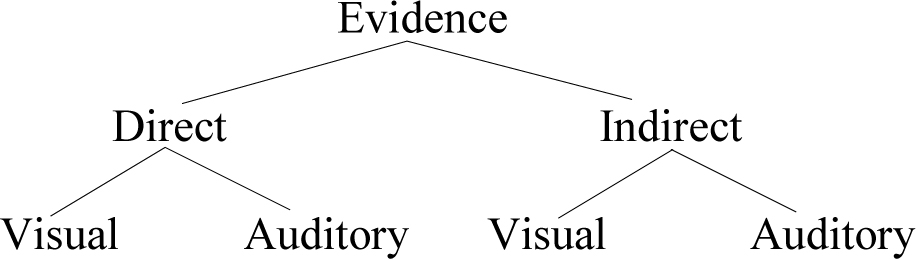
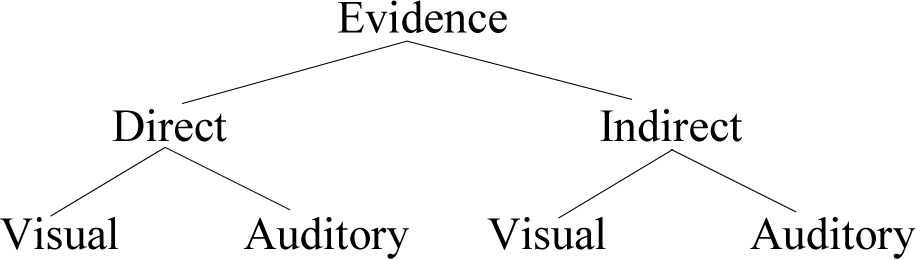
In their study, Rett & Hyams (Reference Rett and Hyams2014) distinguish between four evidential types: direct visual evidence, indirect visual evidence, direct auditory evidence, and indirect auditory evidence (see figure 1). Evidence is direct when the speaker can directly perceive the described event. Direct evidence is usually of a perceptual nature and is divided into visual and auditory by Rett & Hyams.Footnote 1 Indirect evidence implies that the speaker does not have direct access to the event: “The speaker has not perceived P directly, being separated from P in space and time. However s/he has had access to other kinds of information about P” (Plungian Reference Plungian2001:351–352). Indirect evidence is also split into visual and auditory evidence.
Evidential subtypes from Rett & Hyams Reference Rett and Hyams2014.
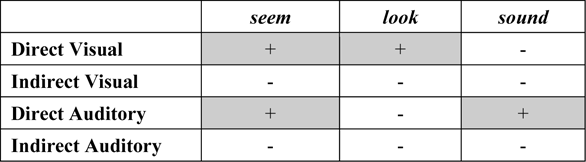
Based on acceptability judgment tasks, Rett & Hyams (Reference Rett and Hyams2014) show that copy-raised constructions are used in English to mark direct evidence: Seem, when used in a copy-raised construction, denotes direct visual or direct auditory evidence; look, when used in a copy-raised construction, marks direct visual evidence; and sound, when used in a copy-raised construction, marks direct auditory evidence. These verbs, when they appear in copy-raised constructions, cannot be used to mark indirect evidence. An overview of these results is given in table 1.
Mean ratings (+, ?, −) from Rett & Hyams Reference Rett and Hyams2014.

In conclusion, the literature has shown that English allows copy raising with both the ‘seem’-verbs and the descriptive perception verbs; Dutch allows copy raising with descriptive perception verbs, but no conclusions can yet be drawn about the acceptability of copy raising with lijken; German appears to dislike copy raising with scheinen (no data are available on the acceptability of copy raising with descriptive perception verbs). Furthermore, it is claimed that copy raising is used to mark direct evidence in English. However, no such claims have been made about Dutch and German. The next section discusses two acceptability judgment tasks conducted in Dutch and German in order to find out which verbs allow copy raising and whether copy raising serves the same purpose as it does in English, that is, to mark direct evidence.
3. Synchronic Data for ‘Seem’-, ‘Look’-, and ‘Sound’-Verbs
3.1. Dutch
This experiment was based on Rett & Hyams’ (Reference Rett and Hyams2014) experiment conducted in English, and had two aims: i) to test whether copy-raised constructions can be used with the ‘seem’-verb lijken, and the two descriptive perception verbs eruitzien and klinken; and ii) if so, to determine the type of evidential meaning of these verbs when used in a copy-raised construction. To be more precise: Does Dutch have syntactically encoded evidentiality like English (that is, do copy-raised constructions in Dutch mark direct evidence)?
As the results of the experiment show, Dutch employs the same technique to mark direct evidence as English does, namely, it marks direct evidence by using a copy-raised construction. As in English, copy-raised eruitzien ‘to look’ is used for direct visual evidence, and copy-raised klinken ‘to sound’ is used for direct auditory evidence. However, unlike English seem, Dutch lijken cannot be used to mark evidentiality syntactically: It appears not to be allowed in copy-raised constructions. The following section discusses the results from the experiment and the statistics verb-by-verb.
Participants: In total, 21 Dutch participants completed the acceptability judgment task. All were native speakers of Dutch. No information on their age and gender is available.
Stimuli: The questionnaire consisted of 30 items, of which 12 were experimental items and 18 were filler items. The experimental items consisted of four evidential types (direct visual, indirect visual, direct auditory, indirect auditory) and three verbs (lijken ‘to seem’, eruitzien ‘to look’, klinken ‘to sound’). All items were based on Rett & Hyams’ (Reference Rett and Hyams2014) questionnaire. An example of a Dutch item is given in 7. All items from the acceptability judgment task (in English) are given in the appendix.
-
(7)
Design: The acceptability judgment task was created with Google Forms and was strictly anonymous. In the task, the participants were given a context followed by a sentence. The participants were asked to rate the acceptability of each sentence within the given context on a Likert scale from 1 (lowest) to 5 (highest). The 5-point Likert scale differs from the 3-point scale used in Rett & Hyams’ study, but it was chosen to allow for a finer grained picture of the acceptability of the sentences. The acceptability judgment task was administered online and completed by participants at home.
Results: The scores were normalized into z-scores according to a by-participant z-score transformation prior to further analysis in order to eliminate forms of bias such as scale compression (that is, using only points 2 to 4 on a 1-5 scale) or scale skew (that is, using only the upper or lower end of the scale). The normalized values range from roughly −1.5 to 1.5, with 0 as the normalized mean. As Featherstone (Reference Featherstone2005:1533) states, “[Normalization] effectively unifies the different scales that the individual subjects adopted for themselves, and allows us to inspect the results visually.”
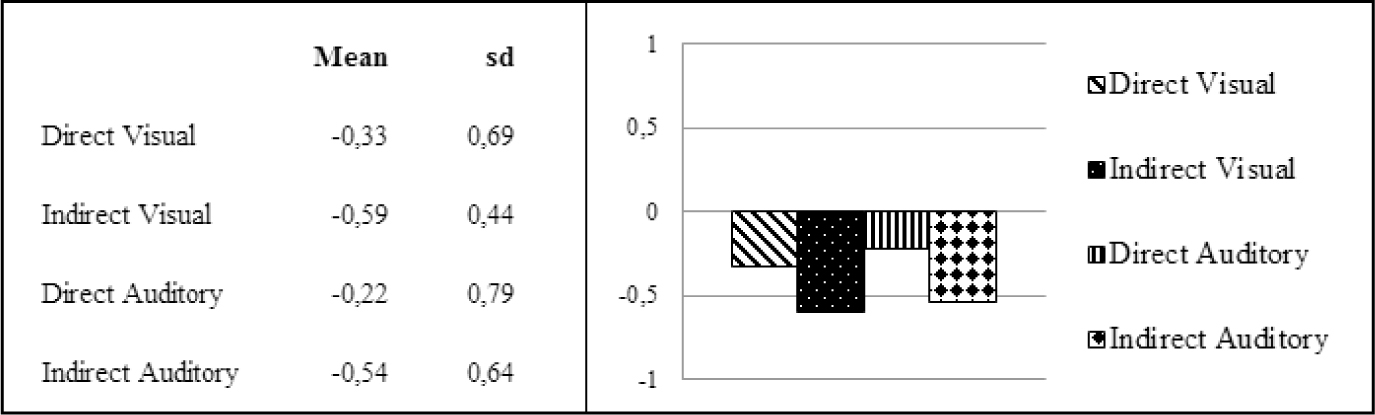
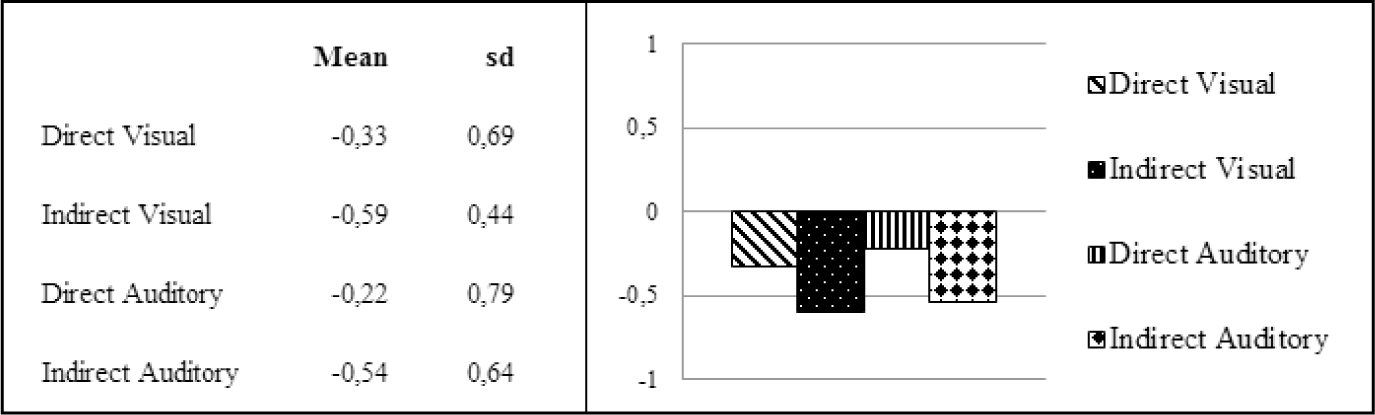
Lijken The mean z-scores and the corresponding standard deviations for the verb lijken ‘to seem’ for each evidential type are presented in figure 2. These results show that the construction X lijkt alsof hij/zij… ‘X seems like he/she…’ was not rated highly for any of the evidential types, and all have negative means: direct visual (μ=−.33), indirect visual (μ=−.59), direct auditory (μ=−.22), and indirect auditory (μ=−.54) evidence all received comparably low ratings. The difference between the various evidence types was further explored by means of a one-way ANOVA, which showed that the means for these groups are not significantly different (F(3, 80)=1.489, p=.224).
Means and standard deviations for lijken.
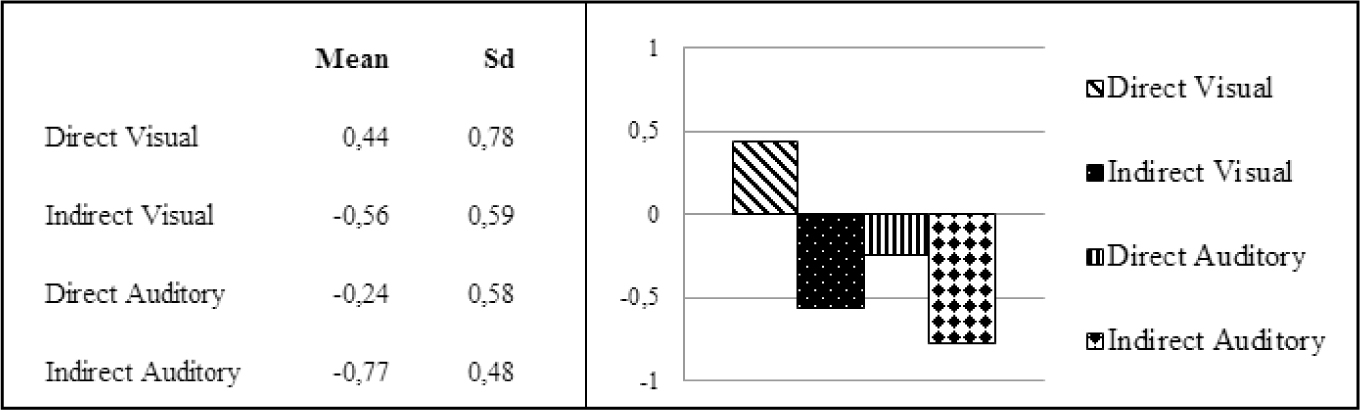
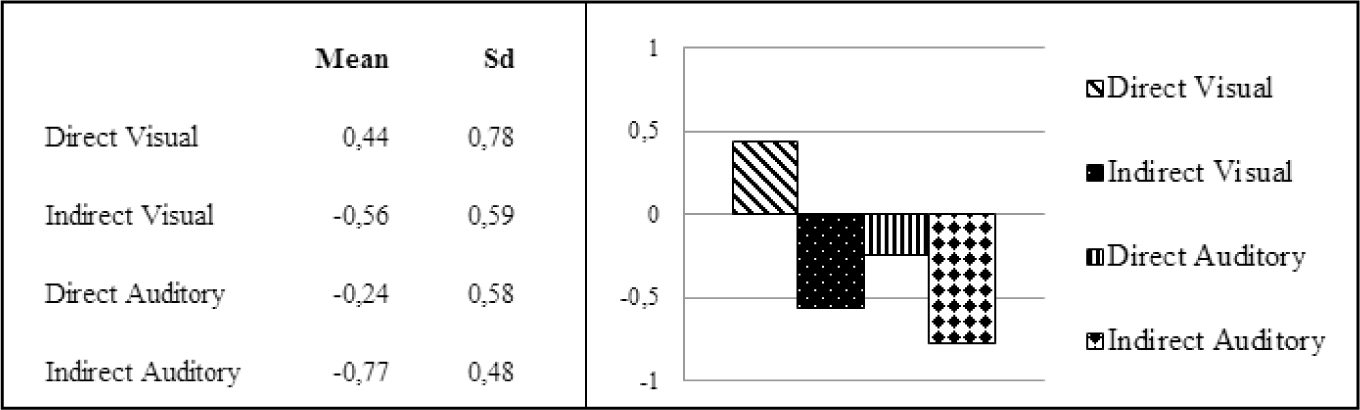
Eruitzien The mean z-scores and the corresponding standard deviations for the verb eruitzien ‘to look’ for each evidential type are presented in figure 3. These results show that the construction X ziet eruit alsof hij/zij… ‘X looks like he/she…’ was rated highly only when the context provided direct visual evidence (μ=.44). In the context of direct visual, direct auditory, and indirect auditory evidence, the construction received comparably low ratings: Indirect visual (μ=−.56), direct auditory (μ=−.24), and indirect auditory (μ=−.77) evidence all received comparably low ratings. The difference between the various evidence types was further explored by means of a one-way ANOVA, which showed that the means for these groups are significantly different (F(3, 80)=15.33, p=<.001). A follow-up pairwise comparison was conducted to compare the effect of evidence type in the context on the acceptability of copy-raised constructions with eruitzien. The evidential type direct visual was rated significantly higher than indirect visual (p<.001), direct auditory (p<.001), and indirect auditory (p<.001).
Means and standard deviations for eruitzien.
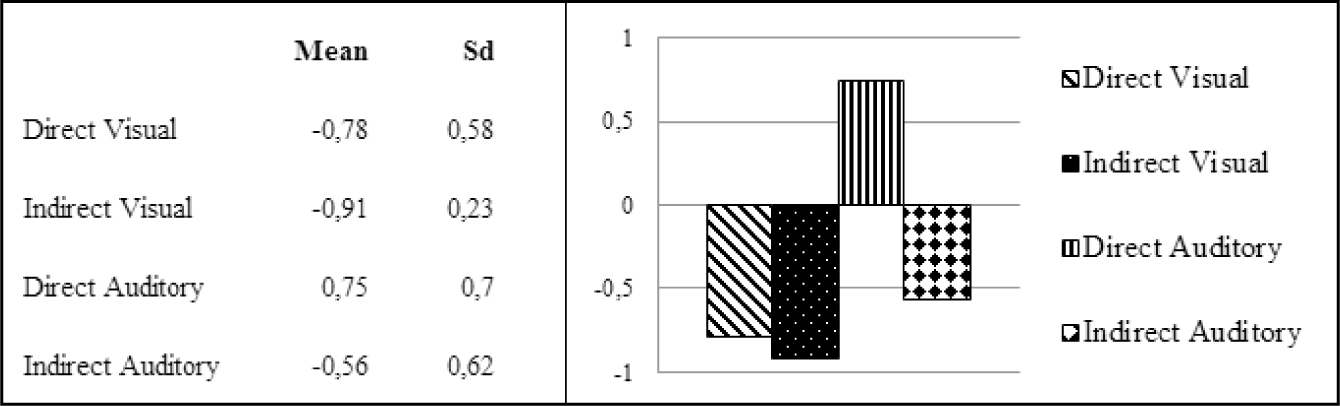
Klinken The mean z-scores and the corresponding standard deviations for the verb klinken ‘to sound’ for each evidential type are presented in figure 4.
Means and standard deviations for klinken.
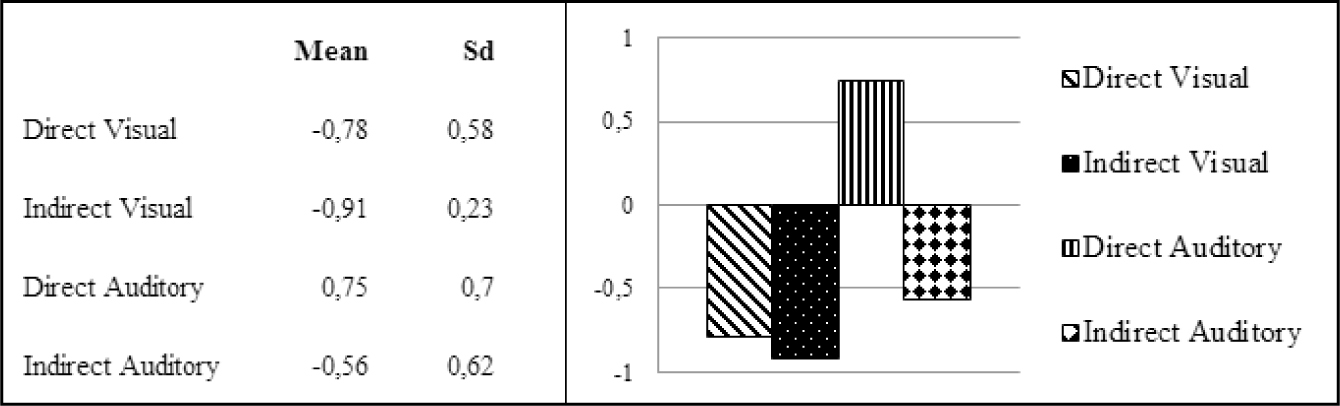
These results show that the construction X klinkt alsof hij/zij… ‘X sounds like he/she…’ was rated highly only when the context gave direct auditory evidence (μ=.75). Indirect auditory (μ=−.56), direct visual (μ=−.78), and indirect visual (μ=−.91) evidence all received comparably low ratings. A one-way ANOVA showed that the means for these groups are not significantly different (F(3, 80)=38.77, p=<.001). A follow-up pairwise comparison was conducted to compare the effect of evidence type in the context on the acceptability of copy-raised constructions with klinken. The evidential type direct auditory was rated significantly higher than indirect auditory (p<.001), direct visual (p<.001), and indirect visual (p<.001).
3.2. German
This experiment tested i) whether copy-raised constructions can be used with the ‘seem’-verb scheinen ‘to seem’, and the two descriptive perception verbs aussehen ‘to look’ and klingen ‘to sound’; and ii) if so, what the evidential meaning is of these verbs when used in a copy-raised construction. As the results of the experiment show, German employs the same technique to mark direct evidence with the descriptive perception verbs as English and Dutch do, namely, it uses a copy-raised construction: Copy-raised aussehen ‘to look’ is used for direct visual evidence, copy-raised klingen ‘to sound’ is used for direct auditory evidence. However, unlike English seem and like Dutch lijken, German scheinen ‘to seem’ cannot be used to mark evidentiality syntactically: This verb appears not to be allowed in copy-raised constructions. The following section discusses the results from the experiment and the statistics verb-by-verb.
Participants: In total, 55 German participants completed the acceptability judgment task. All were native speakers of German. No information on their age and gender is available.
Stimuli: The questionnaire consisted of 30 items, of which 12 were experimental items and 18 were filler items. Again, the experimental items consisted of four evidential types (direct visual, indirect visual, direct auditory, indirect auditory) and three verbs (scheinen ‘to seem’, aussehen ‘to look’, klingen ‘to sound’). An example is given in 8 (all items in the acceptability judgment task are from Rett & Hyams Reference Rett and Hyams2014 and appear in the appendix in English).
-
(8)
Design: The design was exactly the same as for the Dutch task (see section 3.1).
Results: The scores were normalized into z-scores according to a by-participant z-score transformation prior to further analysis.
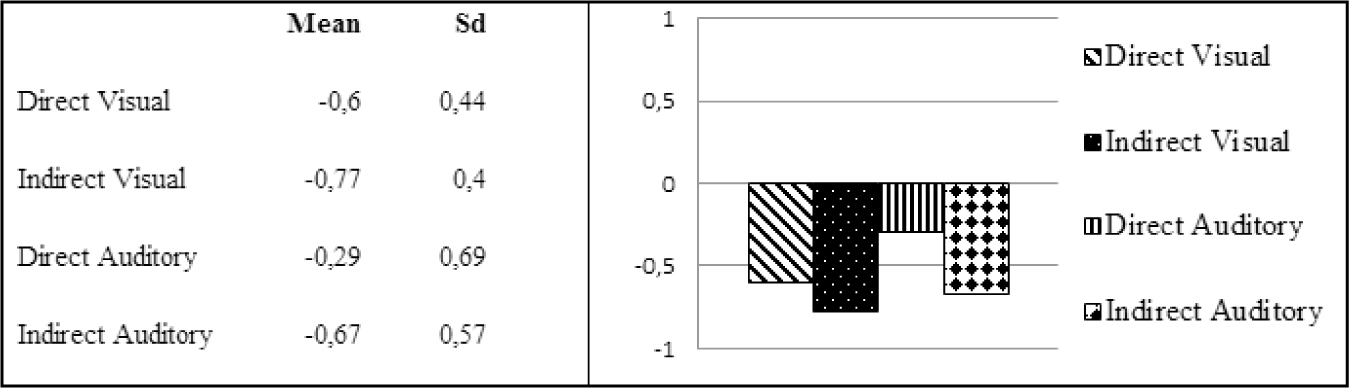
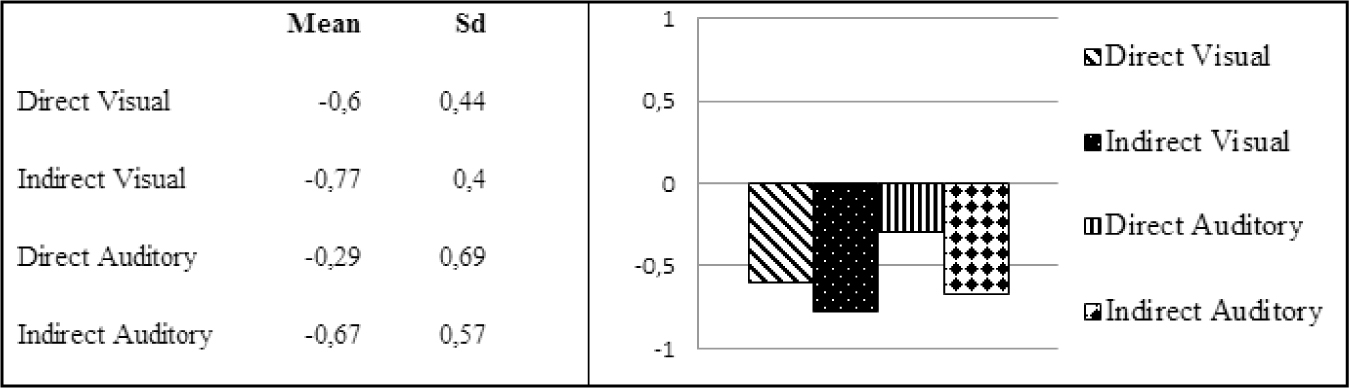
Scheinen The mean z-scores and the corresponding standard deviations for the verb scheinen ‘to seem’ for each evidential type are presented in figure 5. These results show that the construction X scheint, als ob er/sie… ‘X seems like he/she…’ was not rated highly for any of the evidential types, and all have negative means: Direct visual (μ=−.60), indirect visual (μ=−.77), direct auditory (μ=−.29), and indirect auditory (μ=−.67) evidence all received comparably low ratings. The difference between the various evidence types was further explored by means of a one-way ANOVA, which showed that there are significant differences in some of the means (F(3, 216)=7.904, p<.001): The evidential type direct auditory was rated significantly higher than direct visual (p=.003), indirect auditory (p<.001) and indirect visual (p<.001).
Means and standard deviations for scheinen.
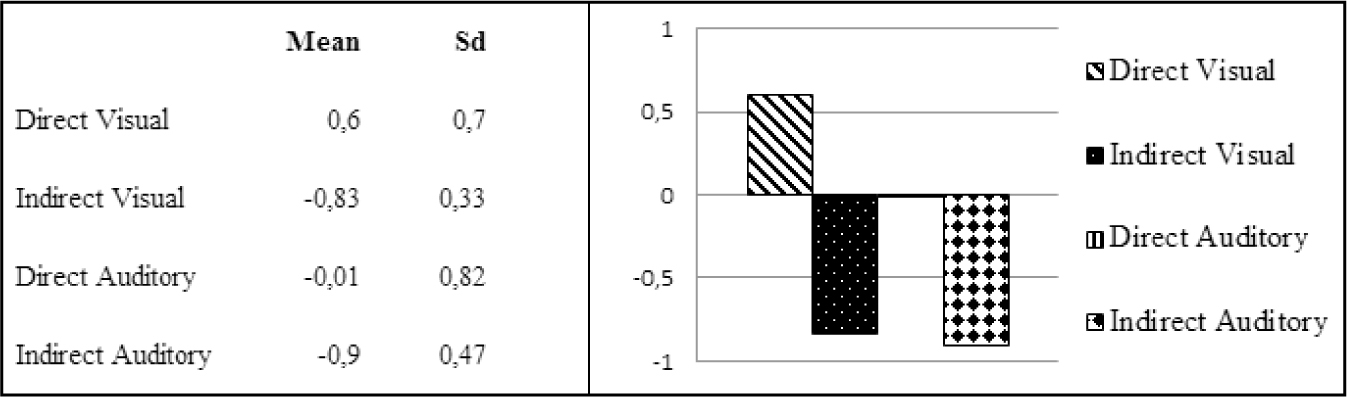
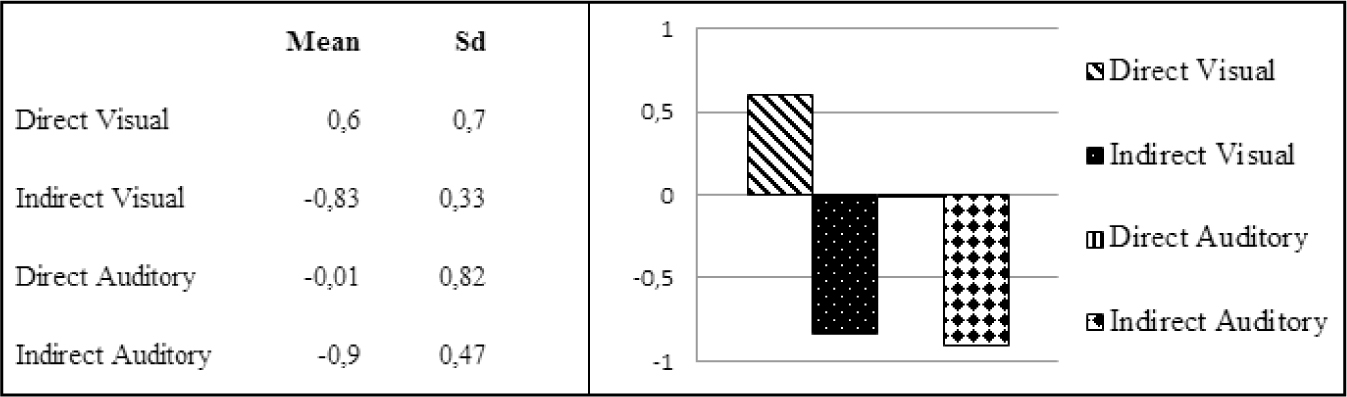
Aussehen The mean z-scores and the corresponding standard deviations for the verb aussehen ‘to look’ for each evidential type are presented in figure 6. These results show that the construction X sieht aus, als ob er/sie… ‘X looks like he/she…’ was rated highly only when the context gave direct visual evidence (μ=.60), but in the context of indirect visual (μ=−.83) and indirect auditory (μ=−.0.90) evidence it received comparably low ratings. The only surprising result is that of direct auditory evidence (μ=−.0.01), which indicates that aussehen received only marginally negative scores when used for direct auditory evidence. A one-way ANOVA showed that the means for these groups are significantly different (F(3, 216)=74.99, p=<.001). A follow-up pairwise comparison was conducted to compare the effect of evidence type in the context on the acceptability of copy-raised constructions with aussehen. The evidential type direct visual was rated significantly higher than indirect visual (p<.001), direct auditory (p<.001), and indirect auditory (p<.001). Direct auditory was also rated significantly higher than indirect visual (p<.001) and indirect auditory (p<.001).
Means and standard deviations for aussehen.
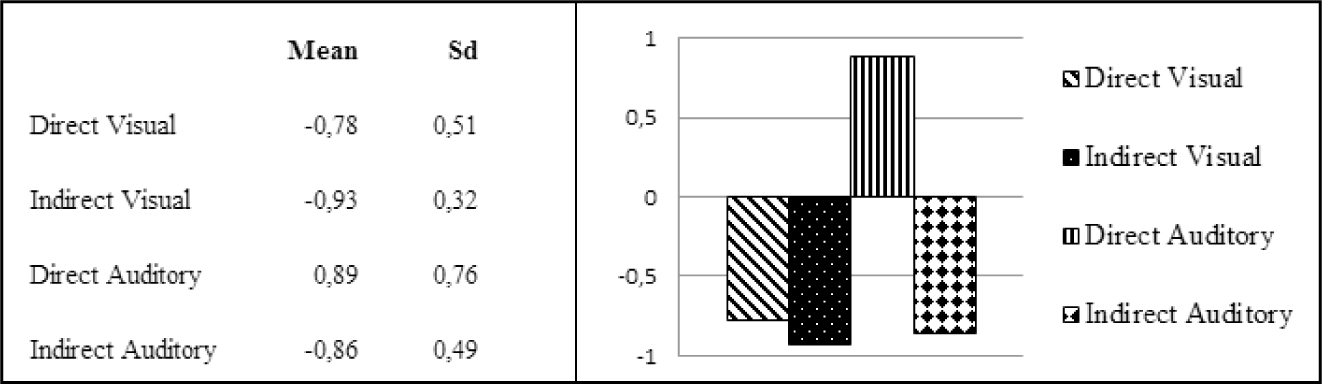
Klingen The mean z-scores and the corresponding standard deviations for the verb klingen ‘to sound’ for each evidential type are presented in figure 7.
Means and standard deviations for klingen.
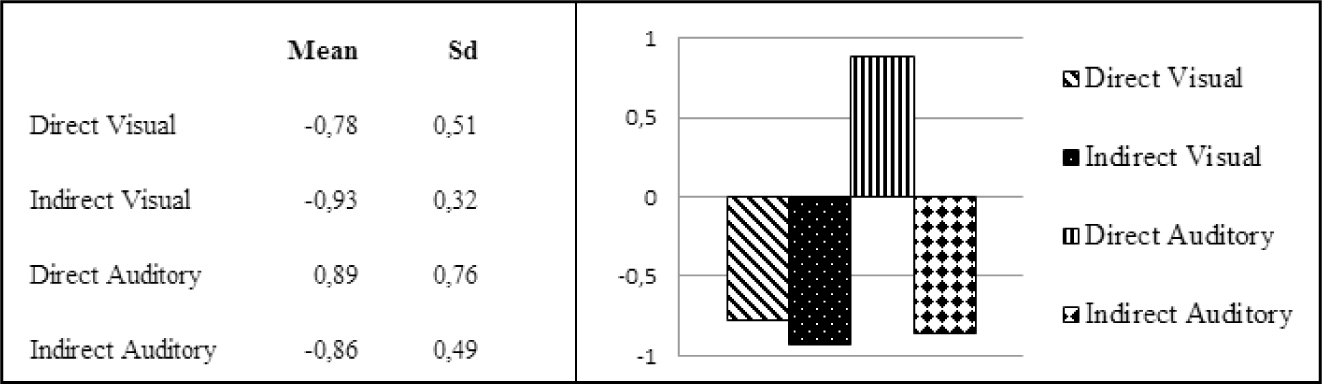
These results show that the construction X klingt, als ob er/sie… ‘X sounds like he/she…’ was rated highly only when the context gave direct auditory evidence (μ=.89), whereas in the context of indirect auditory (μ=−.86), direct visual (μ=−.78), and indirect visual (μ=−.93) evidence it received comparably low ratings. A one-way ANOVA showed that the means for these groups are not significantly different (F(3, 216)=143.1, p=<.001): The evidential type direct auditory was rated significantly higher than indirect auditory (p<.001), direct visual (p<.001) and indirect visual (p<.001).
3.3. Dutch versus German
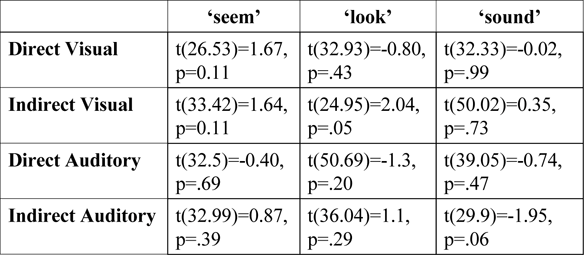
The difference between the Dutch and German ratings was further explored by means of a number of Welch two-sample t-tests. The p-values of these comparisons of the means are given in table 2. They show that no significant differences were found between Dutch and German data.
Results of the two-sample Welch t-tests.

These p-values are all equal or above .05, which indicates that there are no significant differences between the Dutch and German data.
3.4. Discussion
The previous sections have discussed two acceptability judgment tasks carried out for Dutch and German, using the material from Rett & Hyams Reference Rett and Hyams2014. The results from these tasks show that unlike English, German and Dutch do not allow copy raising with the ‘seem’-verbs scheinen and lijken. However, Dutch and German are like English in that the descriptive perception verbs eruitzien/aussehen and klinken/klingen allow copy raising. When copy raising is used with these verbs, it is to mark direct evidence, just as found for English copy raising by Rett & Hyams (Reference Rett and Hyams2014). A point I want to make here, but which is not pursued further for now, is the fact that in both Dutch and German, the ‘look’-verbs eruitzien and aussehen receive remarkably high scores in the context of direct auditory evidence (−0.24 and −0.01, respectively). In contrast, the scores for the ‘sound’-verbs klinken and klingen in the context of direct visual evidence are very low (−0.78 for both). A similar finding is reported in Poortvliet Reference Poortvliet2014. A possible explanation is that the ‘look’-verbs are undergoing semantic bleaching, and as a result they no longer mean ‘to look’, but are extended to mean ‘to seem’. Furthermore, this tendency for the ‘look’-verbs in Dutch and German to receive relatively high scores in the context of direct auditory evidence confirms that copy raising is indeed used to mark direct evidence.
The synchronic data suggest a few things. First of all, in section 2 I briefly mentioned the discussion whether or not ‘seem’-verbs and descriptive perception verbs belong to the same set. The data from German and Dutch indicate that even though ‘seem’-verbs and descriptive perception verbs in these languages may share semantic traits, they differ syntactically and should not be analyzed as one set of verbs. Furthermore, the Dutch data support the claim that lijken does not allow copy raising, and they do not support the claim that copy raising can occur with lijken. A possible explanation for the varying claims regarding copy-raised lijken could be that perhaps gender, dialectal variation, age, or social class are influencing the data. These are factors that neither this study nor Van Egmond Reference van Egmond2004 and Asudeh & Toivonen Reference Asudeh and Toivonen2007 have controlled for. A recent study on Canadian English usage of copy raising in Toronto (Brook Reference Brook2015) suggests that copy raising is used more by younger speakers than by older speakers, and that the like-construction is an incoming variant. Perhaps a similar change is occurring in Dutch at the moment, which could explain the variation in findings as to whether lijken allows copy raising or not.
The question that arises, then, is this: How can one account for this synchronic difference in the use of the ‘seem’-verbs between German and Dutch on the one hand and English on the other? This question is posed in the next section. The hypothesis is, following Van Haeringen Reference van Haeringen1956, that there are differences in the diachronic development of English, Dutch, and German that can explain the synchronic difference.
4. Diachronic Data for ‘Seem’-Verbs
The previous section has looked at the synchronic status of copy raising in German and Dutch. I have shown that the verbs that allow copy raising (that is, descriptive perception verbs but not the ‘seem’-verbs) and the purpose of copy raising (that is, to mark direct evidence) are the same in these two languages. This means that English, German, and Dutch all use copy raising to mark direct evidence, and that all allow copy raising with descriptive perception verbs. However, the languages differ in that only English seem allows copy raising, but not German scheinen and Dutch lijken. This raises the question: Why do German scheinen and Dutch lijken not allow copy raising even though English seem does?
Van Haeringen (Reference van Haeringen1956) claims that synchronic differences between English, Dutch, and German can be explained in terms of different diachronic development of these languages. Based on this claim, this section discusses the grammaticalization of the English, Dutch, and German ‘seem’-verbs over time. I show that English seem grammaticalized much earlier and faster that German scheinen. Furthermore, Dutch lijken started to grammaticalize much later than English, but it is catching up to English much more quickly than German. Whether this means that one can speak of a Van Haeringen pattern (that is, English being the most progressive, German the least, and Dutch being in the middle) is too early to say now, as Dutch and German behave synchronically very similarly. However, the differences in these diachronic patterns do highlight the importance of diachronic explanations for synchronic variation.
4.1. The Grammaticalization Pattern of ‘Seem’-Verbs
De Haan (Reference de Haan2007), Diewald & Smirnova (Reference Diewald and Smirnova2010), and Whitt (Reference Whitt2015, Reference Whitt2016) propose similar grammaticalization patterns for German and English ‘seem’-verbs. They show that German scheinen and English seem started off as main verbs, that is, verbs with a full lexical meaning and no grammatical function. The use of the verb seem as a full verb, meaning ‘to befit’, is exemplified in 9a (from De Haan Reference de Haan2007:138). The next step is for the ‘seem’-verb to grammaticalize into a copular verb, in which case it requires a predicative complement, such as an adjective, as shown in 9b. This is followed by the development of the ‘seem’-verb into a verb that allows a to-infinitive, as shown in 9c. As the next step, the ‘seem’-verb allows the presence of a complement clause, headed by a complementizer (for example, that) or by prepositions (for example, like, as if, as though), as shown in 9d and 9e. The last step in the grammaticalization process as proposed by De Haan (Reference de Haan2007), Diewald & Smirnova (Reference Diewald and Smirnova2010), and Whitt (Reference Whitt2015, Reference Whitt2016) is the usage of the verb in a parenthetical construction, as shown in 9f (all remaining examples are from De Haan Reference de Haan2007:136).
-
(9)
There are two side notes to this grammaticalization pattern as proposed by De Haan (Reference de Haan2007), Diewald & Smirnova (Reference Diewald and Smirnova2010) and Whitt (Reference Whitt2015, Reference Whitt2016). First, absent from these discussions is the copy-raised construction. Bender & Flickinger (Reference Bender, Flickinger, Gosse, Hinrichs, Kruijff and Oehrle1999) claim that the copy-raised construction was introduced later than its expletive counterpart, as shown in 9e, and can thus be expected to have developed between 9e and 9f. Second, De Haan (Reference de Haan2007) and Diewald & Smirnova (Reference Diewald and Smirnova2010) group the use of ‘seem’-verbs in combination with a complement clause together with the use of ‘seem’-verbs in combination with a prepositional phrase. However, as is shown below, for a more exact picture these two complement types need to be separated.
Even though the grammaticalization continuum is similar in English and German, the exact timeline of the grammaticalization of ‘seem’-verbs appears to be quite different in the two languages. Based on Bender & Flickinger Reference Bender, Flickinger, Gosse, Hinrichs, Kruijff and Oehrle1999, De Haan Reference de Haan2007, Gisborne & Holmes Reference Gisborne and Holmes2007, and Whitt Reference Whitt2015 for English, and Diewald & Smirnova 2007, De Haan Reference de Haan2007, and Whitt Reference Whitt2015, Reference Whitt2016 for German, I have tried to reconstruct the timelines for these two languages.
4.2. Grammaticalization of English Seem
Gisborne & Holmes (Reference Gisborne and Holmes2007) claim that the grammaticalized use of seem (that is, as a copular verb in combination with a predicative complement) started to occur in the 12th century. Gisborne & Holmes (Reference Gisborne and Holmes2007:10) provide the following example, from the period 1150 and 1250:
-
(10)
Both De Haan (Reference de Haan2007) and Gisborne & Holmes (Reference Gisborne and Holmes2007) date the first occurrence of seem in combination with an infinitival complement (as in 11a) and that-complement (as in 11b) back to between 1300 and 1400 (both examples are from De Haan Reference de Haan2007:138).
-
(11)
As the biclausal complements are often grouped together and most literature discusses the first attestations of the that-complement instead of the as if-complement, no conclusions can be drawn as to when the as if-complement first occurred. The only discussion of this construction is by Bender & Flickinger (Reference Bender, Flickinger, Gosse, Hinrichs, Kruijff and Oehrle1999), who state that there are no examples of seem taking an as if-complement in the Helsinki Corpus. Google Books, however, provides an attestation of seem with a prepositional phrase headed by as if from 1652, as in 12, and Google Books Ngrams suggests that the usage of this construction only picks up after that.
-
(12)
Similarly, the copy raising construction has been overlooked in discussion of the grammaticalization pattern of English seem. As Bender & Flickinger (Reference Bender, Flickinger, Gosse, Hinrichs, Kruijff and Oehrle1999) show, the Oxford English Dictionary has an example of the copy-raised construction that dates back to 1673, as shown in 13 (from Bender & Flickinger Reference Bender, Flickinger, Gosse, Hinrichs, Kruijff and Oehrle1999:13). However, not many more attestations of copy-raised seem are found in the OED or Google Books Ngrams until the mid-18th century, unlike its expletive counterpart, whose usage grows steadily from the mid-17th century onwards.
-
(13)
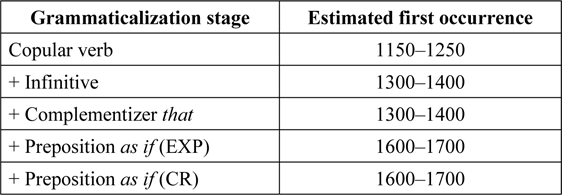
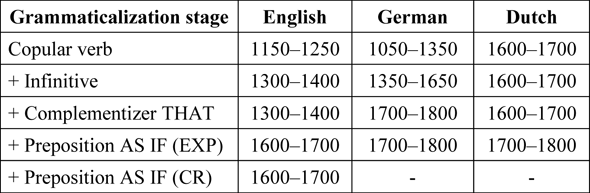
For now, the parenthetical construction is left out of the discussion, as I am mainly interested in the syntactic development of seem until its use in copy-raised constructions. Table 3 provides an overview of the various grammaticalization stages of seem and the estimated years of introduction of these stages in English.
Grammaticalization stages of seem.

This table shows that the first use of seem as a copular verb is estimated to have occurred between 1150 and 1250; as an infinitival verb between 1300 and 1400; in combination with the complementizer that between 1300 and 1400 as well; in combination with the preposition as if (both copy-raised and with an expletive subject) between 1600 and 1700.
4.3. Grammaticalization of German Scheinen
Diewald & Smirnova (Reference Diewald and Smirnova2010) and Whitt (Reference Whitt2016) discuss the grammaticalization of scheinen and provide rough estimations of when scheinen entered the various grammaticalization stages, as discussed above. Diewald & Smirnova (Reference Diewald and Smirnova2010:252) claim that scheinen as a copular verb started to occur in German between 1050 and 1350, of which they provide the following example:
-
(14)
The first usage of scheinen in combination with an infinitival complement, as in 15a (from Diewald & Smirnova Reference Diewald and Smirnova2010:253), is said to have occurred between 1350 and 1650. The subsequent change to scheinen taking a clausal complement is estimated to have occurred between 1700 and 1800 (De Haan Reference de Haan2007).Footnote 3 Diewald & Smirnova (Reference Diewald and Smirnova2010) and Whitt (Reference Whitt2016) do not separate the complements headed by dass from those headed by als ob and focus on examples with dass, as in 15b (from Diewald & Smirnova Reference Diewald and Smirnova2010:253). De Haan (Reference de Haan2007) lists as earliest examples of complements headed by als ob those found in Goethe's work, i.e. in the 18th century. However, no examples are given.
-
(15)
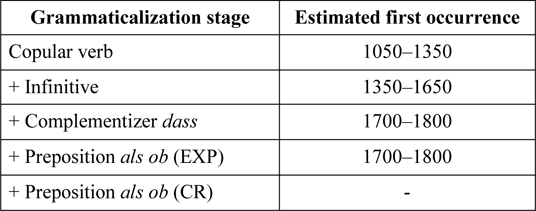
Table 4 provides an overview of the various grammaticalization stages of scheinen and the estimated years of introduction of these stages in German.
Grammaticalization stages of scheinen.

This table shows that the first use of scheinen as a copular verb is estimated to have occurred between 1050 and 1350; as an infinitival verb between 1350 and 1650; in combination with the complementizer dass between 1700 and 1800; in combination with the preposition als ob (with an expletive subject) between 1700 and 1800. No occurrences of copy-raised scheinen have been attested.
4.4. Grammaticalization of Dutch Lijken
The only work that discusses the grammaticalization of Dutch lijken is Vliegen Reference Vliegen2011, which unfortunately focuses mostly on the other evidential raising verbs blijken ‘to turn out’ and schijnen ‘to seem’.Footnote 4 Vliegen, following Van der Horst Reference van der Horst2008, claims that lijken as a copular verb first occurred in the 17th century, as in 16 (from Van der Horst Reference van der Horst2008:1206), and as such grammaticalized much later than blijken and schijnen.
-
(16)
‘I have heard many people talk, who seemed decent and sincere.’
However, further information as to when the infinitival complement or the clausal complement were introduced in Dutch is not provided in the literature. A corpus search in the Corpus Gysseling (Early Middle Dutch, 1200–1300), the Chancellery and Narrative Subcorpora from the Compilation Corpus Historical Dutch by Coussé (Reference Coussé2010) (1250–1800 and 1575–2000, respectively), and Brieven als Buit (Letters from 1600–1700) shows that the first instance of lijken with an infinitival complement occurred in the 17th century, as in 17a; that the first instance of lijken with a clausal complement headed by dat also occurred in the 17th century, as in 17b; and that the first instance of lijken with a clausal complement headed by alsof occurred at the end of the 18th century, as in 17c.
-
(17)
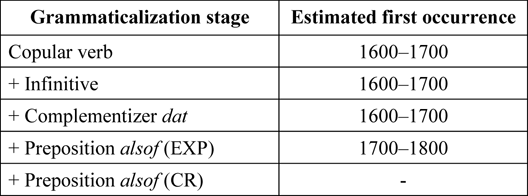
The following table provides an overview of the various grammaticalization stages of lijken and the estimated years of introduction of these stages in Dutch.
Grammaticalization stages of lijken.

This table shows that the first use of lijken as a copular verb is estimated to have occurred between 1600 and 1700; as an infinitival verb between 1600 and 1700; in combination with the complementizer dat between 1700 and 1800; in combination with the preposition alsof (with an expletive subject) between 1700 and 1800. No occurrences of copy-raised lijken have been attested.
4.5. Comparison
I have outlined the grammaticalization paths of English seem, German scheinen, and Dutch lijken. A comparison of these three paths shows that English seem has evolved the fastest of the three languages and has developed the furthest: Not only can English seem be used in copy raising constructions, but also in parenthetical constructions (see 9f).
The timeline for German scheinen shows that it has developed much slower than English seem. Even though scheinen and seem appear to have started to copularize roughly around the same time (between 1050 and 1350, and 1150 and 1250, respectively), all the subsequent grammaticalization stages were entered much later in German.Footnote 5 The results of the German acceptability judgment tasks have shown that the copy-raised constructions are not allowed even in present-day German.
Dutch lijken has developed quite differently from English and German: The shift from being a main verb to being used in combination with a prepositional phrase and an expletive subject (and all the intermediary stages) spans a timeframe of only two centuries, whereas this shift spans around four centuries in English and five centuries in German. A possible explanation is that most of the grammaticalization was first completed by another Dutch verb, whose usage Dutch speakers started to extend to lijken. As Vliegen (Reference Asudeh and Toivonen2007) states, the meaning of lijken and its constructions seem to be modeled after this other verb, which is the Dutch cognate of German scheinen, namely, the verb schijnen ‘seem’. Vliegen provides a grammaticalization timeline for schijnen, following Van der Horst Reference van der Horst2008:451, and claims that schijnen has probably started to grammaticalize between 1400 and 1600. However, the exact link between schijnen and lijken remains to be established.
An overview of the estimated centuries during which the ‘seem’-verbs in English, German, and Dutch entered each of the grammaticalization stages are given in table 6 and figure 8 below.
Overview of the grammaticalization patterns of the English, German, and Dutch ‘seem’-verbs.

Overview of the grammaticalization patterns of the English, German and Dutch ‘seem’-verbs.

These overviews show that English seem has progressed the most and the fastest, and German scheinen the slowest. Dutch lijken has progressed quite fast, but appears to have come to a standstill together with German, as the next step—that is, copy raising—is not yet occurring. Based on the synchronic findings and the previous claims in the literature, it appears as if German is not nearly ready to use scheinen in copy-raised constructions, but that Dutch lijken might be changing toward allowing copy raising. It is, however, too early to make any claims about this.
5. Conclusion
This study has discussed copy raising in three Germanic languages from both a synchronic and diachronic perspective. The synchronic data confirm a number of claims made in the literature and offer some new insights: German scheinen does not allow copy raising, Dutch lijken prefers to avoid copy raising, and descriptive perception verbs allow copy raising in both languages. Furthermore, the purpose of copy raising is the same in these languages as it is in English: to mark direct evidence. The diachronic data show that the ‘seem’-verbs in the three languages have undergone the same grammaticalization pattern, even though English seem is further in its development than scheinen and lijken. These data suggest a Van Haeringen-like pattern: English seem has developed the furthest, German scheinen is the most conservative in its development, and Dutch lijken is not yet fully acceptable in copy raising constructions, but speakers have been found to be using it. However, more time is needed to tell whether this is indeed the case.
The next steps identified based on this study apply to both the synchronic and the diachronic sections. With regard to the synchronic data, larger studies (in terms of participants and experimental items) would preferably be conducted in order to confirm the findings reported here. Furthermore, such studies would need to control for sociolinguistic factors such as age, place of birth, and gender, as these factors might explain the variation found for Dutch lijken. Furthermore, it appears that there are some contextual factors that allow a copy raising construction to be used for indirect auditory evidence.Footnote 6 As Heycock (Reference Heycock1994) discusses, a construction such as Your car sounds like it needs a new clutch is completely acceptable when uttered over the phone as a response to a story about a broken car. Further research is needed to establish to which contexts this usage is limited. In terms of the diachronic data, more in-depth corpus research is needed in order to create a more detailed timeline for the ‘seem’-verbs, especially for German and Dutch. I have only focused on the history of the ‘seem’-verbs, but it would also be interesting to see whether the descriptive perception verbs have undergone a similar pattern of grammaticalization toward allowing copy raising.
APPENDIX
English questions as taken from Rett & Hyams Reference Rett and Hyams2014. The sentences below were translated into Dutch for the Dutch study and into German for the German study. The experimental items are given in boldface.
Direct Visual
Fola is babysitting little Timmie when she notices spots on his skin. When Timmie's mom picks up him up, Fola says: Timmie {seems/looks/sounds} like he has a rash.
Indirect Visual
Fola's son Milo is grounded and not allowed to leave his room. When Fola goes upstairs to check on him, she finds his room empty and the window wide open, so she says: Milo {seems/looks/sounds} like he snuck out of the house.
Direct Auditory
Fola tried out for a role in Macbeth and is now jealous because she is only the understudy for Carol. From behind the curtain, Fola hears Carol coughing and sneezing. Excited, Fola says: Carol{seems/looks/sounds} like she is sick.
Indirect Auditory
Fola has a next door neighbor, Mrs. Noisy, who often travels on the weekend without turning off her loud alarm clock. This Saturday, Fola wakes up to Mrs. Noisy's alarm ring for 10 minutes straight, and she says: Mrs. Noisy{seems/looks/sounds} like Mrs. Noisy is on vacation.