

Over the last two decades, a growing body of literature has examined democratic reforms that increase citizen participation (Cain et al. Reference Cain, Dalton and Scarrow2003; Dalton Reference Dalton2004; Newton and Geissel Reference Newton and Geissel2012; Smith Reference Smith2009). Democratic innovations, such as referendums, citizens’ forums, participatory budgeting or mini-publics have burgeoned in different forms across established democracies (Bedock Reference Bedock2017; Morel and Qvortrup Reference Morel and Qvortrup2017; Newton and Geissel Reference Newton and Geissel2012; Smith Reference Smith2009; Zittel and Fuchs Reference Zittel and Fuchs2006).
In this article, we are interested in citizens’ support for one specific form of democratic innovation: assemblies composed of citizens selected by lot. The first experiments started in the 1970s with citizen juries and planning cells, followed in the 1980s by the development of consensus conferences (Grönlund et al. Reference Grönlund, Bächtinger and Setälä2014). Assemblies gained a broader audience within academia in the mid-2000s when two Canadian provinces (British Columbia and Ontario) and the Netherlands organized citizens’ assemblies on electoral reforms (Fournier et al. Reference Fournier2011). Another landmark was the Irish Constitutional Convention installed in 2012 (Suiter et al. Reference Suiter, Farrell and O'Malley2016b). Since then, many other bodies composed at least partly of citizens selected by lot have been created (Reuchamps and Suiter Reference Reuchamps and Suiter2016). Across Europe, since 2000, there have been over 100 cases of assemblies composed wholly or in part of citizens selected by lot instituted by national or regional public authorities.Footnote 1
Yet scholarly research on attitudes towards citizens’ assemblies remains scarce. The few existing studies present assemblies composed by lot merely as consultative bodies associated with representative institutions. In this article, using the 2017 French Election Study, we take a different approach by studying support for citizens selected by lot presented as a clear alternative to replace elected politicians to take the most important political decisions.
This alternative is radical in at least two respects: it would replace elected politicians by citizens, and these citizens would be chosen not through election, but sortition. Such use of sortition goes beyond most previous instances of citizens’ assemblies composed by lot, which have remained consultative and managed by elected politicians. What makes this topic particularly relevant is that public support for giving real decision-making power to citizens would reveal a strong desire to move away from the traditional representative logic based upon election. To understand the specificities of the support for this form of democratic innovation, we contrast it with two mechanisms giving a greater role for citizens in policymaking: support for the generic idea that citizens should make the main political decisions, and support for citizen-initiated referendums.
After briefly presenting the literature on support for increased citizen participation, we review the drivers that may influence the support for selection by lot to replace current decision-makers and discuss the specificities of mini-publics compared with other forms of citizen participation. We then present the French Election Study and the operationalization. We follow this by a discussion of our empirical results, before proceeding to the theoretical discussion and conclusion.
Support for increased citizen participation and for specific democratic innovations
Over recent years, several studies across Europe have underlined growing support among the population for a greater role of citizens in policymaking, without always being specific about the instruments of citizen participation that would be introduced. For instance, Sergiu Gherghina and Brigitte Geissel (Reference Gherghina and Geissel2017) have shown that a quarter of the German population would like citizens to be the core policymakers, the same proportion as those who prefer elected politicians. Multiple other studies focus on citizens’ preferences about who should govern, and on demands for a greater involvement of citizens in general (Bengtsson and Christensen Reference Bengtsson and Christensen2016; Cain et al. Reference Cain, Dalton and Scarrow2003; Dalton Reference Dalton2004; del Río et al. Reference del Río, Navarro and Font2016; Font et al. Reference Font, Wojcieszak and Navarro2015; Webb Reference Webb2013).
Next to this first strand of literature, other scholars have examined support for specific ways of involving citizens in political decision-making. The most consolidated body of research focuses on referendums (Bengtsson and Mattila Reference Bengtsson and Mattila2009; Bowler et al. Reference Bowler, Donovan and Karp2007; Coffé and Michels Reference Coffé and Michels2014; Schuck and de Vreese Reference Schuck and de Vreese2015). A few other scholars have examined citizens’ preferences for mechanisms of deliberative or participatory democracy, most often in relation to broader preferences on who should make decisions in democracies and how (Caluwaerts et al. Reference Caluwaerts and Deschouwer2018; Coffé and Michels Reference Coffé and Michels2014; Neblo et al. Reference Neblo2010; Webb Reference Webb2013).
Two elements are still missing from the existing literature. First, support for the inclusion of citizens selected by lot as alternative policymakers has not been studied directly. This democratic innovation is very specific, as the political socialization of citizens revolves around voting. Replacing voting by random selection would be a radical paradigm shift for most citizens. Secondly, the few existing studies that try to capture support for citizens selected by lot all consider this form of democratic innovation as a mere complement to representative institutions. Indeed, so far, all citizens’ assemblies have been consultative. They have never been granted the capacity to have the final say in passing new laws and regulations.
However, it would be misleading to conclude that citizens’ assemblies are inconsequential. In several cases, the recommendations that were formulated had major political consequences (Reuchamps and Suiter Reference Reuchamps and Suiter2016). For example, elected authorities decided to submit the recommendations provided by citizens’ assemblies organized in Ireland, British Columbia and Ontario to referendums (Fournier et al. Reference Fournier2011; Suiter et al. Reference Suiter, Farrell and Harris2016a). Some scholars are debating about the opportunity to introduce legislatures – most often second chambers – composed by lot, juxtaposed with elected and non-elected bodies (Gastil and Wright Reference Gastil and Wright2019).
In this article, we go further by studying public support for citizens’ assemblies composed by lot replacing elected politicians. Although such a radical reform goes way beyond the prerogatives of former and current citizens’ assemblies, and the experiments discussed by academics, it is a very relevant question to draw comparisons with support for other consequential instruments of citizen participation such as referendums. To quote Stephen Craig (Reference Craig1980), these two instruments are ‘elite-challenging’, because they contest elected politicians’ dominance over policymaking. Comparing a non-challenging instrument such as consultative citizens’ assemblies with an elite-challenging instrument such as citizen-initiated referendums would probably have produced different findings. We have chosen to focus on reforms that truly limit the power of elected politicians.
Factors driving support for citizens selected by lot
In order to build our hypotheses on support for citizens selected by lot, we proceed in two steps. First, we rely upon the literature on support for a greater involvement of citizens in policymaking and for specific mechanisms of direct and deliberative democracy. These explanations focus on three dimensions of trust: trust in oneself, political trust and trust in other citizens. In the next section, we elaborate on the specific features of support for citizens selected by lot.
Trust in oneself: the cognitive mobilization hypothesis
Andreas Schuck and Claes de Vreese (Reference Schuck and de Vreese2015) identify two main hypotheses explaining which citizens are in favour of direct democracy: cognitive mobilization and political dissatisfaction. The earlier hypothesis is anchored in a traditional explanation of political participation: citizens with more resources and more (perceived) ability to participate support more opportunities to have a say in politics (Almond and Verba Reference Almond and Verba1963; Brady et al. Reference Brady, Verba and Scholzman1995). These citizens have been labelled ‘post-materialists’ (Inglehart and Welzel Reference Inglehart and Welzel2005), ‘critical citizens’ (Norris Reference Norris1999, Reference Norris2011) or ‘assertive citizens’ (Dalton and Welzel Reference Dalton and Welzel2014).
The opposite could be true. For instance, studying Canada, Cameron Anderson and Elizabeth Goodyear-Grant (Reference Anderson and Goodyear-Grant2010) have shown that highly informed citizens are more sceptical of referendums because they are more concerned about minority rights. Similarly, for assemblies composed via sortition, one may expect that resourceful citizens would not want to leave decision-making in the hands of others, as the chance to be part of the assembly would be very limited indeed.
Yet, even if the odds of being selected are very low, the prize at stake is substantial. When someone is selected, not only would he/she have a much greater impact on policymaking than via election or referendums, but he/she would also take part in a much richer form of political participation with intense deliberation among participants. This idea is central to the argument made by Russell Dalton and Christian Welzel (Reference Dalton and Welzel2014), who argue that assertive citizens are calling not only for more opportunities to participate but also for richer modes of participation. Overall, we tend to believe that the second interpretation is more convincing and formulate our hypotheses accordingly.
In concrete terms, this general expectation about the role of political resources can be interpreted in two ways. First, it states that objective resources such as education, money or age (Brady et al. Reference Brady, Verba and Scholzman1995) foster demands for more citizen participation. Participatory democrats tend to be found among people with a higher level of education (Bengtsson and Mattila Reference Bengtsson and Mattila2009; Coffé and Michels Reference Coffé and Michels2014; Dalton Reference Dalton2017; Webb Reference Webb2013). Several studies show that older citizens are more attached to the representative model (Dalton and Welzel Reference Dalton and Welzel2014; del Río et al. Reference del Río, Navarro and Font2016; Tiberj Reference Tiberj2017; Webb Reference Webb2013) as they have been socialized in a political environment characterized by elite-directed participation (Dalton and Welzel Reference Dalton and Welzel2014; Norris Reference Norris1999; Tiberj Reference Tiberj2017). In their study of sortition within a bicameral system, Pierre-Étienne Vandamme et al. (Reference Vandamme2018) found that younger respondents are more supportive of sortition.
Hypothesis 1.1: The more an individual has objective resources encouraging political participation, the more likely he/she is to support decision-making by citizens selected by lot.
The second dimension of the ‘cognitive mobilization hypothesis’ is that those in favour of a greater role for citizens in policymaking are generally more politically interested (Schuck and de Vreese Reference Schuck and de Vreese2015) and efficacious (Kahne and Westheimer Reference Kahne and Westheimer2006). Michael Neblo and colleagues (Reference Neblo2010) showed that political interest is the strongest predictor of citizens’ willingness to take part in democratic innovations involving deliberation. Citizens’ trust in their own competence can also be captured via the concept of internal political efficacy, defined as the idea that one feels ‘competent to avail himself of the opportunity to use institutional channels’ (Craig Reference Craig1979: 229). For instance, Paul Webb (Reference Webb2013) found that political efficacy had a strong positive effect on support for more citizen participation.
Hypothesis 1.2: The more an individual believes he/she is competent politically, the more likely he/she is to support decision-making by citizens selected by lot.
Political trust: the dissatisfaction hypothesis
Going back to Schuck and de Vreese (Reference Schuck and de Vreese2015), the second main line of explanation to understand public support for referendums is the ‘dissatisfaction hypothesis’. Citizens are increasingly dissatisfied with representative democracy, and their trust in the core actors, institutions and procedures of representative democracy is shrinking (Cain et al. Reference Cain, Dalton and Scarrow2003; Dalton Reference Dalton2004; Webb Reference Webb2013). As a consequence, they want representative democracy to be reformed. Some authors rely on the generic ‘satisfaction with democracy’ item (Bengtsson and Mattila Reference Bengtsson and Mattila2009; del Río et al. Reference del Río, Navarro and Font2016; Schuck and de Vreese Reference Schuck and de Vreese2015); others use a battery of items measuring trust for the main actors and institutions of representative democracy (Bertsou and Pastorella Reference Bertsou and Pastorella2017; Coffé and Michels Reference Coffé and Michels2014; del Río et al. Reference del Río, Navarro and Font2016; Jacquet et al. Reference Jacquet, Deschouwer and Delwit2015).
Hypothesis 2.1: The more an individual is dissatisfied with representative democracy, the more likely he/she is to support decision-making by citizens selected by lot.
To test for this second hypothesis, it is important to disentangle the different dimensions of dissatisfaction with democracy. Political trust may be expressed towards different objects: the political community, regime principles, regime performance, political institutions and political actors (Norris Reference Norris1999; Thomassen Reference Thomassen and Poguntke2015). Citizens may express strong distrust towards one object – for instance political actors – while remaining very supportive of the principles of representative democracy (Dalton Reference Dalton and Norris1999).
Consequently, in line with Gherghina and Geissel's (Reference Gherghina and Geissel2018) study on support for increased citizen participation in policymaking, we propose to go back to David Easton (Reference Easton1965) and to distinguish between diffuse support for the principles of the political system and support for specific actors. For specific support, we examine two dimensions: satisfaction with the incumbents and the evaluation of elected politicians in general. For diffuse support, we examine support for the general principle of election on which representative democracy relies. Selection by lot of ordinary citizens goes very strongly against the elective logic. Moreover, previous findings on France have shown that individuals who endorse a minimal definition of democracy mostly based on the centrality of elections are less likely to criticize the level of ‘democraticness’ of their political system (Bedock and Panel Reference Bedock and Panel2017). We therefore formulate a second sub-hypothesis:
Hypothesis 2.2: The more an individual is dissatisfied with the general principle of election, the more likely he/she is to support decision-making by citizens selected by lot.
Trust in others: the evaluation of citizens’ competence hypothesis
Beyond the hypotheses outlined above, we argue that there is a third dimension of trust that should be taken into consideration. Participatory instruments imply that (at least some) traditional prerogatives of professional politicians are transferred to lay citizens. A question that could be easily raised is whether those citizens are up to the job. As Bernard Manin (Reference Manin1997) argues, election and representation rest upon the idea that election selects the best and more motivated individuals. Participatory and direct democracy instruments go against this logic. A few studies, in particular those using qualitative methods, show that individuals are often sceptical about the abilities of their fellow citizens to get involved in politics (García-Espín and Ganuza Reference García-Espín and Ganuza2017; Hibbing and Theiss-Morse Reference Hibbing and Theiss-Morse2002). Citizens especially tend to consider that citizens on the other side of the political spectrum lack political competence (Achen and Bartels Reference Achen and Bartels2017; Cramer Reference Cramer2016). Adrián del Río and his colleagues (Reference del Río, Navarro and Font2016) have shown that support for greater involvement of citizens was linked to a positive evaluation of the capacity of other citizens to play a role in politics.
Hypothesis 3: The more an individual thinks that other citizens are politically competent, the more likely he/she is to support decision-making by citizens selected by lot.
The specificities of support for citizens selected by lot
So far, we have built our hypotheses using studies on support for a greater role of citizens in policymaking in general and direct democracy. We believe that support for citizens selected by lot as main policymakers involves four fundamental differences compared with other instruments of citizen participation.
First, replacing elected politicians by citizens selected by lot would position lay citizens as the new centre of democratic politics. This is particularly disrupting in France, a very centralized political system that does not have a solid culture of interest-group participation. We expect that only a relatively low number of citizens who express strong political distrust in general and in elected politicians in particular would support such a radical move.
Second, this reform replaces the principle of election by the principle of sortition. The two models rest upon very different premises. The contemporary representative model is based on distinction and selection through competence (Manin Reference Manin1997). The premises of selection by lot are similarity (Courant Reference Courant, Wright E and Gastil2019) and radical egalitarianism (Vandamme Reference Vandamme2018). The legitimacy of this procedure relies on the idea that the decisions taken by citizens selected by lot would be similar to the ones that citizens would make themselves. Therefore, we expect that support for this mechanism is to be found among citizens who disagree with the core principle of representative democracy, namely election.
Third, citizen juries composed by lot are more demanding than most other forms of citizen involvement in policymaking. Citizens are asked not only to cast a vote in a referendum, but also to attend meetings for several days or weeks and to deliberate in public on complex policy issues. As a consequence, one might expect that only the more politically motivated citizens, with objective and subjective political resources, would support this reform. Christopher Achen and Larry Bartels (Reference Achen and Bartels2017) actually criticized deliberative forums composed of lay citizens as they would increase even further the political dominance of competent citizens.
Fourth, we expect that trust in the political competence of other citizens is more important for the support of sortition than for other forms of citizen participation, because key political decisions are handed over to a very limited proportion of citizens – especially in a large country such as France – whereas in referendums and elections, everyone has the potential to have a say by voting.
Data and operationalization
The French National Election Study
France offers a fertile ground to investigate our research question and test our hypotheses for three reasons. First, France is one of the West European countries where political distrust has been among the highest over the last decades (Bedock Reference Bedock2017: 15). Second, this high level of dissatisfaction has translated into demands for democratic reforms altering representative democracy at the national level. In the ‘Yellow Vests’ mobilization, demands concerning citizen-initiated referendums and citizens’ assemblies have been central (Collectif d'enquête sur les Gilets jaunes 2019). During the last presidential elections in 2017, several candidates, including Emmanuel Macron (En marche), Benoît Hamon (Socialist Party) and Jean-Luc Mélenchon (France insoumise), proposed introducing citizen juries in various forms, from an annual audit of the president to the introduction of citizens drawn by lot in the French Senate. In the autumn of 2019, a convention composed of 150 citizens drawn by lot was put in place to make proposals about climate change, in the aftermath of the ‘Great Debate’ organized after the Yellow Vests crisis. President Macron declared that some of the proposals from the convention would be put to a referendum and that citizens’ assemblies should become institutionalized. Third, France is an interesting case because these demands fundamentally clash with the current organization of political power at the national level which is characterized by its centralization, its verticality and the power of the president of the Republic (Grossman and Sauger Reference Grossman and Sauger2009).
Our study takes advantage of the 2017 French Election Study (Gougou and Sauger Reference Gougou and Sauger2017), a post-election survey conducted a few days after the second round of the presidential election in May 2017 and undertaken by Kantar-TNS-Sofres, with 1,830 respondents (face to face interviews).
Dependent variables
The core dependent variable for our study is support for citizens selected by lot. It is captured via a question asking respondents to select what types of actors should be given the central role in deciding what is best for the country. Five options were offered: MPs, the president, citizens selected by lot, experts, and successful businessmen. We built a dummy variable opposing respondents in favour of citizens selected by lot to respondents who have chosen another alternative.
One could argue that citizens do not have well-formed preferences on this issue or on democratic processes in general. However, Saskia Goldberg et al. (Reference Goldberg, Wyss and Bächtiger2019), who tested whether the preferences of German citizens on democratic procedures change when they are exposed to a deliberative treatment, show that these attitudes are much more stable and coherent than initially assumed, even though this is more true when respondents are exposed to mechanisms they are more familiar with (Bengtsson Reference Bengtsson2012). The formulation of the question has two consequences for the findings. First, only citizens familiar with this form of democratic innovation can be expected to tick this option as their preferred one. Those who are unfamiliar or unsure about this idea had the opportunity to choose another political actor or to refuse to answer.Footnote 2 Second, the question does not explicitly refer to the replacement of elected politicians. However, we assume that respondents know that the current baseline model in France is representative democracy and that empowering citizens selected by lot would radically question this logic. Therefore, we argue that this variable identifies radical supporters of citizens selected by lot.
One of the core goals of this article is to discuss support for citizens selected by lot as the main policymakers, in contrast with other instruments giving citizens a greater weight in policymaking. The 2017 French Election Study asks respondents whether they agree with the idea that ‘the people, and not politicians, should make our most important policy decisions’. We recoded this question into a dummy variable. Comparing a specific instrument with this generic question should be done with caution. Åsa Bengtsson shows that this item captures ‘positive attitudes towards more citizen involvement, but without implying attitudes in favour of a democratic system where citizens should be responsible of all political decisions’ (Reference Bengtsson2012: 58). It is interesting to compare our results on this item with several studies using the same type of generic question to measure support for increased citizen participation (del Río et al. Reference del Río, Navarro and Font2016; Font et al. Reference Font, Wojcieszak and Navarro2015; Gherghina and Geissel Reference Gherghina and Geissel2017; Webb Reference Webb2013).
Finally, we compare selection by lot with support for direct democracy, taking advantage of a question asking respondents whether they agree with the idea that ‘we should be able to organize a referendum if a high number of people ask for it’.Footnote 3 We have recoded this question into a dummy variable.
Selection by lot is the most ‘extreme’ option as it replaces politicians with citizens’ rule. The idea that citizens rather than politicians should decide is a less explicit form of citizens’ rule, in which citizens deserve the final say without necessarily being responsible for all political decisions. Finally, the citizen-initiated referendum is a more conventional political institution and the least radical option of the three.
17.7% of respondents choose citizens selected by lot over other alternatives to make the most important political decisions. By contrast, more than half (53%) consider that citizens, not politicians, should take the most important decisions, and 86% agree with citizen-initiated referendums. As expected, citizens selected by lot are clearly seen as the most ‘radical’ alternative. One could argue that few citizens support citizens’ assemblies selected by lot. Rather, we insist on the fact that full sortition to replace elected politicians is more radical than any existing political experiment or than most reform proposals discussed by academics. Therefore, one could reasonably argue that support for citizens’ assemblies selected by lot would be significantly higher if these were consultative, or if they took the form of a second chamber deliberating alongside the elected assembly. A survey of Belgian citizens showed that 39% of respondents were in favour of a second chamber composed exclusively of citizens selected by lot, and 47% of a second chamber mixing elected politicians and citizens selected by lot (Vandamme et al. Reference Vandamme2018: 127).
Independent variables: trust in one's own competences
The objective political resources included in our study are age, education and income. We differentiate between three levels of education: lower secondary or less, vocational and upper secondary, and tertiary. Age and income are continuous variables.
The cognitive mobilization approach also expects that one's subjective perceived political competence affects support for citizen participation in policymaking. We use a question measuring internal political efficacy, asking respondents whether they felt that ‘politics is too complicated for people like me’.
Independent variables: political trust
To test for the political trust hypothesis, we include a series of indicators capturing French citizens’ evaluation of representative democracy, distinguishing between specific and diffuse support (Easton Reference Easton1965; Gherghina and Geissel Reference Gherghina and Geissel2018).
In terms of specific support, we use one question asking respondents how satisfied they were with the actions of President François Hollande during the preceding term (recoded into three categories: ‘Satisfied’, ‘Not satisfied’ and ‘Not satisfied at all’).Footnote 4 The second dimension of specific support relates to how French citizens evaluate elected politicians in general. We use five questions: ‘How widespread is corruption such as bribe taking among politicians in France’, ‘Most politicians are trustworthy’, ‘Most politicians do not care about the people’, ‘The politicians are the main problem in France’ and finally, ‘The majority of politicians are only interested in the rich and the powerful’. A factor analysis shows that all five items are loading on the same dimension (see Table 5 in the online appendix). We built an additive scale ranging from 0 to 8 capturing citizens’ evaluation of elected politicians (Cronbach's alpha = 0.76). The higher the score on this scale, the more distrustful respondents are about elected politicians.
To measure diffuse support for the principles of representative democracy, the French Election Study offers two relevant questions capturing whether French citizens still believe in elections as a principle of government. The first one asked respondents whether ‘who is in power can make a big difference and really change things’, the second whether ‘who people vote for can make a big difference to what happens’. The two indicators encompass some classical elements of external political efficacy (Davis and Hitt Reference Davis and Hitt2017; Finkel Reference Finkel1985; Karp and Banducci Reference Karp and Banducci2008) and also measure the perception of current procedures. We built an additive scale aggregating the answers to the two questions (Cronbach's alpha = 0.81). The scale also ranges from 0, when the respondent strongly agreed with both statements, to 8, when he/she strongly disagreed with both.Footnote 5
Finally, we ran a principal component analysis which confirmed that the three dimensions are distinct in the eyes of the respondents (see Table 6 in the online appendix).
Independent variables: trust in the competence of others
To measure the perceived political competence of other citizens, we use a question asking respondents whether they agree with the idea that ‘in general, people know what is good for France’.
Finally, in line with several previous studies on support for democratic innovations (Bengtsson and Mattila Reference Bengtsson and Mattila2009; Bertsou and Pastorella Reference Bertsou and Pastorella2017; Jacquet et al. Reference Jacquet, Deschouwer and Delwit2015; Schuck and de Vreese Reference Schuck and de Vreese2015; Webb Reference Webb2013), our analyses include two control variables: gender and left–right orientation.
Empirical results
In this section, we test the three sets of hypotheses for the three dependent variables.
We hypothesized that support for a greater involvement of citizens in policymaking is found among citizens with more political resources (H1.1) and more trust in their own political skills (H1.2). Overall, support for this line of explanation is rather mixed.
For all three dependent variables (and in particular for citizen-initiated referendums), older citizens are less supportive of citizen participation. For the other objective resource variables, findings go in the opposite direction to that hypothesized. Income has a negative effect on support for citizens selected by lot and for the idea that citizens should take the most important decisions, but not on the support for citizen-initiated referendums. Education has a negative effect on support for referendums and citizen participation in general. For instance, individuals who do not have university education are almost twice as likely to support citizen-initiated referendums. However, education has no statistically significant effect on support for citizens selected by lot. Overall, objective political resources such as income and education tend to limit support for citizen participation.
For the effect of subjective political resources (H1.2), the direction of the effect is in line with our expectation – individuals who disagree with the idea that politics is too complicated for people like them are more likely to support sortition – but the effect is just above the threshold of statistical significance. For the other two mechanisms, H1.2 is not confirmed. Overall, internal political efficacy does not appear to be a key driver of support for increased citizen participation.
To better understand which of our three lines of explanation has the greatest impact on the support for each mechanism, we ran models in which the variables were introduced separately (see Tables 3, 4 and 5 in the online appendix). They show that the contribution of objective resources and internal political efficacy to McFadden's R2 is stronger for support for citizen-initiated referendums. Using the average probability for each of the dependent variables as a set-off point to evaluate the number of correctly classified cases, models including only cognitive mobilization variables and controls correctly classify between 60.6% and 72.9% of the cases.
Determinants of the Preference for the Mode of Political Decision

Notes: * P < 0.05; ** P < 0.01. Coefficients in odds ratios, 95% confidence intervals in parentheses. The correctly classified cases are measured using the average probability at the cut-off point.
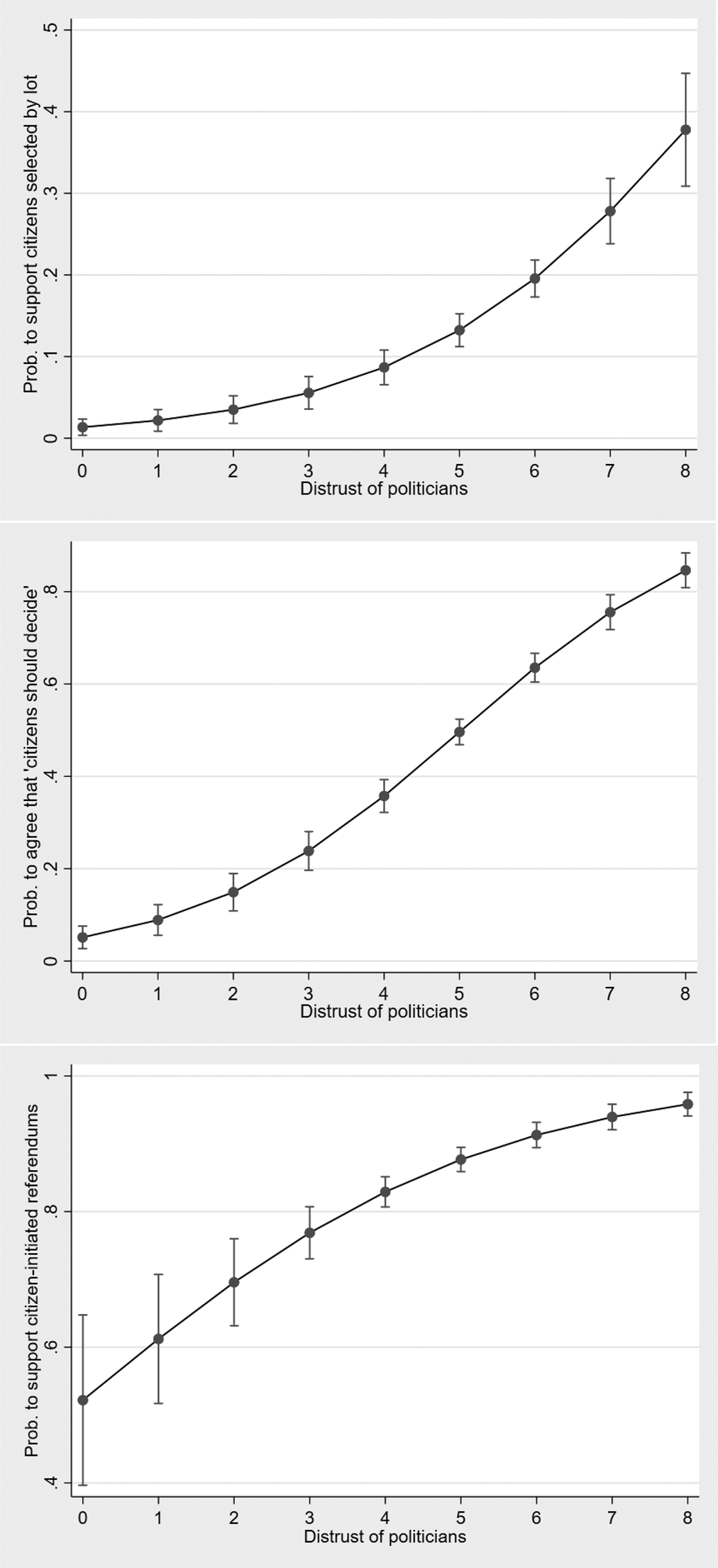
Next to the role of political resources, our second line of expectation was about the role of political (dis)satisfaction. Three findings can be underlined. First, distrust of elected politicians plays a significant role in explaining support for all three dependent variables (see Figure 1). For citizen-initiated referendums, the effect of distrust of politicians is rather linear and rises from 52% for respondents who fully trust politicians to 96% for respondents who are the most distrustful of elected representatives. A moderate level of distrust already increases support for this reform. By contrast, for support for citizens selected by lot and for the idea that citizens should take the most important decisions, the effect is exponential. Respondents who trust politicians the most only have a 1% probability of supporting citizens selected by lot to take the most important decisions, whereas this proportion rises to 38% for the most distrustful (respectively 5% to 85% for the idea that ‘citizens should decide’). The effect of distrust of politicians on support for these reforms becomes only significantly higher among respondents deeply dissatisfied with elected politicians. Support for the replacement of politicians by ordinary citizens or the notion that citizens should decide is fostered by a radical discontent with current policymakers.
Predicted Probabilities of the Preference for Different Modes of Political Decisions According to the Level of Distrust in Politicians
The second finding is in line with this conclusion. As we expected, the effect of trust in the principle of elections differentiates support for citizens selected by lot and the two other dependent variables (H2.2.). When respondents are the most confident about the ability of elections to bring about change, only 13% of them support citizens selected by lot as their preferred alternative to take political decisions. This proportion rises to 25% for individuals who are the least convinced about the ability of elections to bring about change. The effect is linear, which means that as soon as individuals start to express doubts about the election mechanism, it fosters support for sortition. These results confirm our expectation that this mechanism is different from other forms of citizen participation as it is linked with the rejection of the core principle of representative democracy: representation via election.
Third, we observe that support for the incumbent President Hollande has no substantial effect on any of the three dependent variables. At best we can see that the effect is statistically significant for the idea that citizens should have the final say for individuals who are ‘not satisfied at all’ with Hollande's performance. Dissatisfaction with the incumbent authorities is not sufficient to trigger support for a radical move from representative democracy such as sortition. This could be explained by the fact that Hollande and more generally all presidents since 2002 have experienced steep declines in their levels of popularity (Grossman and Sauger Reference Grossman and Sauger2014).
Overall, the models including political trust variables (see Tables 2 to 4 in the online appendix) appear to contribute the most to the variations in support for our three dependent variables. McFadden's R2 increases strongly with the addition of this block of variables, in particular when it comes to support for citizens selected by lot, and for citizen participation in general. The number of correctly classified cases also rises (between 69.3% and 73.5%).
Our third hypothesis stated that support for citizens selected by lot is driven by how much confidence one has in the political capacities of other citizens. That hypothesis is confirmed by the data, although the effect of this variable should not be overstated. Indeed, McFadden's R2 and the proportion of correctly classified cases only marginally increases by adding this variable (see Tables 2 to 4 in the online appendix). However, the role of trust in other citizens is crucial to differentiate support for citizens selected by lot from the other two dependent variables. This variable has a positive and statistically significant effect on the support for sortition. Respondents who disagree with the idea that other citizens are incompetent are 55% more likely to support citizens selected by lot to replace elected politicians. By contrast, it has no statistically significant effect on support for referendums or on support for the idea that citizens should take the most important decisions.
Next, examining the control variables, plotted probabilities show that female respondents have a 15% probability of supporting citizens selected by lot (19% for men). They are also less likely to support the idea that citizens should take the most important decisions. This result is puzzling insofar as we control for objective and subjective measures of political competence. It may be due to the strong internalization of gendered norms limiting the direct involvement of women in the political sphere (Bargel Reference Bargel2005; Verba et al. Reference Verba, Burns and Schlozman1997). The more left-wing respondents have a 24% probability of supporting sortition, as opposed to only 11% of the more right-wing respondents. The effect of political orientation does not hold when it comes to the two other dependent variables.
We should also stress that the explanatory power of our models remains modest for all three dependent variables. For the sake of comparability, we operationalized our dependent variables as dummy variables (in favour or against the three forms of democratic innovations), leaving other preferences merged into one broad and heterogeneous group. For example, for support for citizens selected by lot, we separated French citizens in favour of this form of democratic innovation from citizens supporting four other very different alternatives: MPs, the president of the Republic, businessmen and experts. In future studies, more fine-grained data would allow deeper digging into the logics of support for different alternatives.
Conclusion and discussion
The goal of this article was twofold: first, to examine who supports citizens selected by lot to replace elected politicians; second, to evaluate whether these advocates differ from those who support an enhanced role of citizens in political decisions more generically and direct democracy. There are three take-away messages at the end of this study.
First, citizens with more objective political resources are less supportive of increased citizen participation, contrary to our expectation, whereas subjective political competence does not appear to be a central driver. These results open space for discussion. The negative impact of objective political resources (age, income, education) on support for the three forms of citizen participation gives credit to the findings of Besir Ceka and Pedro Magalhaes (Reference Ceka and Magalhaes2019), who explain that individuals who have acquired a privileged position in society have an interest in defending the institutional status quo. The Yellow Vests crisis provides additional evidence, as the more mobilized individuals belonged to the working class and the lower middle class (Collectif d'enquête sur les Gilets jaunes 2019). Regarding subjective political competence, the very limited effect of internal political efficacy on support for citizens selected by lot tends to contradict the idea of authors such as Dalton and Welzel (Reference Dalton and Welzel2014) or Norris (Reference Norris2011) who argued that citizens who want more opportunities to participate also demand ‘richer’ ways of participating.
Second, the main driver of support for all forms of empowerment of citizens is trust in elected politicians. The principle of delegation in representative democracies is built on the division of labour between elected representatives and the rest of society (Manin Reference Manin1997). Elected politicians are supposed to embody the general interest, to connect citizens’ demands to the political system to produce decisions, and to be more competent than lay citizens. Distrust for politicians undermines the very principles on which politicians build their legitimacy and fosters support for enhanced citizen participation.
The third and final key message is that one cannot simply generalize findings from the literature on public support for more citizen participation in general, or specific instruments such as referendums to understand support for citizens selected by lot. This last form of democratic innovation has some specific drivers. The role of political distrust is very important: supporting sortition requires citizens to consider not only that politicians cannot be trusted, but also that election as an institutional mechanism is unable to produce meaningful change. The other characteristic of support for sortition is the role of one's trust in the political skills of fellow citizens. Respondents are more likely to endorse this preference if they disagree with the idea that other citizens are politically incompetent. One of the key conditions to be able to trust other citizens is the belief that they are sufficiently ‘equipped’ to take political decisions for other people.
This study allows us to advance our knowledge of public support for deliberative mini-publics composed of citizens selected by lot, a form of democratic innovation that has been gaining ground across democracies in recent times. It is important to discuss to what extent insights from the French case may be applicable to other countries. Across Europe, several democracies have or are introducing bodies composed at least partly of citizens selected by lot. It has been the case at the national or regional level in Austria, Belgium, Denmark, Germany, Ireland, Italy, Luxembourg, the Netherlands, Portugal, Spain and the UK. The data collected in 2017 in France remain very relevant; since then, mini-publics have remained high on the agenda following the Yellow Vests crisis to which President Macron responded by launching a public ‘Great Debate’, followed, in the autumn of 2019, by a citizens’ assembly on climate change.
The French case appears to be intrinsically important for an understanding of support for democratic innovations in general, and for citizens’ assemblies composed via sortition in particular, in a context of deep distrust in elected representatives. This context can be compared with the ones leading to the launch of citizens’ assemblies in the UK, or a few years earlier in Ireland, Iceland, Belgium, the Netherlands and Canada. Another element that increases our confidence in the validity of our findings in other West European countries is that the characteristics of French respondents are not fundamentally different from those of citizens in other countries where citizens’ assemblies are also discussed or implemented at the national level, or with countries where such democratic innovations have been tested at a smaller scale such as Spain, Italy, Portugal or Austria. Our findings are more likely to make sense in these countries than in other settings such as Central and Eastern Europe where citizens’ relationship to politics is very different and where the very concept of sortition remains absent from the political agenda.
Nevertheless, we must also acknowledge that some elements may limit the exportability of our findings. The obvious one is that France has a very peculiar political regime compared with most other European democracies. In particular, the centrality of the president of the Republic is very different from what is observed in most other European countries, even taking into consideration the process of presidentialization of parliamentary systems over recent years.
Finally, and probably most importantly, our study focuses on radical supporters of citizens selected by lot – that is, on those who would be willing not only to involve lay citizens in assemblies deliberating alongside elected representatives, but who would also be ready to do without politicians. In other words, our findings are applicable to individuals who want to alter the current organization of political power fundamentally. These citizens appear to be particularly distrustful of elected politicians and of the elective mechanism, while at the same time being confident in other people's political competence. Supporters of less disruptive mechanisms involving citizens selected by lot (consultative assemblies, citizens’ assemblies associated with parliament, citizens’ assemblies followed by referendums, and so on) ought to be more numerous and less fundamentally dissatisfied with the current representative model. Following recent studies (Rojon et al. Reference Rojon, Rijken and Klandermans2019), future works should investigate to what extent the profile of the supporters of various forms of citizens’ assemblies drawn by lot is affected by the design and function of these innovations, and with their link with existing representative institutions.
Supplementary information
To view the supplementary information for this article, please go to https://doi.org/10.1017/gov.2020.1
Acknowledgements
The study has been made possible thanks to two research grants obtained by Jean-Benoit Pilet. First, Jean-Benoit Pilet has received funding from the European Research Council (ERC) under the European Union's Horizon 2020 research and innovation programme (grant agreement No. 772695). The second is the FNRS research grant for the project Reforming Representative Democracy (project T.0182.18).



