One aspect of the dramatic increase in the use of experiments within political science (Druckman et al. Reference Druckman, Green, Kuklinski and Lupia2006; Mutz Reference Mutz2011) is the establishment of conjoint experimental designs as a prominent methodological tool. While survey experiments have traditionally examined just one or two factors that might shape outcomes (see, for reviews, Gaines, Kuklinski, and Quirk Reference Gaines, Kuklinski and Quirk2007; Sniderman Reference Sniderman, Druckman, Green, Kuklinski and Lupia2011), conjoint designs allow researchers to study the independent effects on preferences of many features of complex, multidimensional objects. These include many different types of phenomena, such as political candidates (Campbell et al. Reference Campbell, Cowley, Vivyan and Wagner2019; Teele, Kalla, and Rosenbluth Reference Teele, Kalla and Rosenbluth2018), immigrant admissions (Hainmueller and Hopkins Reference Hainmueller and Hopkins2015; Bansak, Hainmueller, and Hangartner Reference Bansak, Hainmueller and Hangartner2016; Wright, Levy, and Citrin Reference Wright, Levy and Citrin2016), and public policies (Gallego and Marx Reference Gallego and Marx2017; Hankinson Reference Hankinson2018). Factorial designs of this sort have a long history, but the driving force behind this use of conjoint analysis has been the introduction by Hainmueller, Hopkins, and Yamamoto (Reference Hainmueller, Hopkins and Yamamoto2014) of a small-sample, fully randomized conjoint design. The associated analytic approach emphasizes a single quantity of interest: the average marginal component effect (AMCE). By capturing the multidimensionality of target objects, the randomized conjoint design breaks any explicit, or implicit, confounding between features of these objects. This gives the AMCE a clear causal interpretation: the degree to which a given value of a feature increases, or decreases, respondents’ favorability toward a packaged conjoint profile relative to a baseline.
While randomization of profile features gives the AMCE a causal interpretation, most published conjoint analyses in political science use AMCEs not only for causal purposes (interpreting AMCEs as effect sizes) but also for descriptive purposes. The aim is to map levels of favorability toward a multidimensional object across its various features.Footnote 1 In this sense, conjoints are often applied like list experiments, using randomization to measure a sample’s preferences over something difficult to measure with direct questioning. A positive AMCE for a given feature can be read as a descriptive measure of high favorability toward profiles with that feature. The quantity is causal, but it is often read descriptively.
This is particularly the case for subgroup analyses of conjoint experiments. Such exercises are an increasingly common feature of experimental analysis (Green and Kern Reference Green and Kern2012; Grimmer, Messing, and Westwood Reference Grimmer, Messing and Westwood2017; Ratkovic and Tingley Reference Ratkovic and Tingley2017; Egami and Imai Reference Egami and Imai2018). For example, the Hainmueller, Hopkins, and Yamamoto (Reference Hainmueller, Hopkins and Yamamoto2014) study of immigration attitudes splits the sample into two using a measure of ethnocentrism and then compares AMCEs for the two subgroups. Similarly, Bansak, Hainmueller, and Hangartner (Reference Bansak, Hainmueller and Hangartner2016) compare preferences toward immigrants across a number of binary respondent characteristics: age, education, left–right ideology, and income. Other examples abound. Ballard-Rosa, Martin, and Scheve (Reference Ballard-Rosa, Martin and Scheve2016) compare preferences over tax policies across a number of subgroups defined by demographics and political orientations; Bechtel and Scheve (Reference Bechtel and Scheve2013) compare AMCEs on climate agreements across four different countries and across subgroups of respondents; and Teele, Kalla, and Rosenbluth (Reference Teele, Kalla and Rosenbluth2018) compare AMCEs for features of male and female political candidates among male and female respondents. Most of these comparisons are visual or informal. But some involve explicit estimation of the subgroup difference, such as when Kirkland and Coppock (Reference Kirkland and Coppock2017) compare conditional AMCEs across hypothetical partisan and nonpartisan elections. Interpretation of subgroup AMCEs thus involves an implied quantity of interest: the difference between two conditional AMCEs.
What is not necessarily obvious in such analyses is that differences in preferences (that is to say, the difference in degree of favorability toward profiles containing a given feature) are not directly reflected in subgroup differences-in-AMCEs. A difference in effect sizes is distinct from a difference in preferences. We show that a difference in two (or more) subgroups’ favorability toward a conjoint feature—like a difference in willingness to support a particular type of immigrant between high- and low-ethnocentrism respondents—is only rarely reflected in the difference-in-AMCEs. In fact, no information about the similarity of the subgroups’ preferences is provided by comparisons of subgroup AMCEs, yet such comparisons are commonly made in practice.
As we will show, where preferences in subgroups toward the experimental reference category are similar, the difference-in-AMCEs conveys preferences reasonably well. The problem occurs when preferences between subgroups diverge in the reference category. Here, the difference-in-AMCEs is a misleading representation of underlying patterns of favorability. Given most published conjoint studies report results based on reference categories chosen for substantive reasons about the nature or meaning of the levels rather than the configuration of preferences revealed in the experiment, difference-in-AMCEs should not be assumed to be interpretable as differences in subgroup preferences. The root of this error is likely familiar to many researchers: it is simply a matter of regression specification for models involving interactions between categorical regressors. Egami and Imai (Reference Egami and Imai2018), for example, provide an extensive discussion of the implications of this property for interpreting causal interactions between randomized features of conjoint profiles. The state of the published literature, however, would suggest the problem remains nonobvious when applied to descriptive analysis of subgroups in conjoint designs.Footnote 2
In what follows, we demonstrate the challenges of conjoint analysis and remind readers of how reference category choice for profile features creates problems for comparing conditional AMCEs across respondent subgroups. We show how the use of an arbitrary reference category means the size, direction, and statistical significance of differences-in-AMCEs have little relationship to the underlying degree of favorability of the subgroups toward profiles with particular features. Reference category choices can make similar preferences look dissimilar and dissimilar preferences look similar. We demonstrate this with examples drawn from the published political science literature (namely experiments by Bechtel and Scheve Reference Bechtel and Scheve2013, Hainmueller, Hopkins, and Yamamoto Reference Hainmueller, Hopkins and Yamamoto2014, Teele, Kalla, and Rosenbluth Reference Teele, Kalla and Rosenbluth2018). We then provide suggestions for improved conjoint reporting and interpretation based around two quantities of interest drawn from the factorial experimentation literature: (a) unadjusted marginal means, a quantity measuring favorability toward a given feature and (b) an omnibus F-test, measuring differences therein. The software for the R programming language to support our findings—and that can be used to examine sensitivity of conjoint analysis to reference category selection, calculate AMCEs and marginal means, perform subgroup analyses, and test for subgroup differences in any conjoint experiment (Leeper Reference Leeper2018)—is demonstrated throughout using example data (Leeper, Hobolt, and Tilley Reference Leeper, Hobolt and Tilley2019). We conclude with advice for best practices in the analysis and presentation of conjoint results.
1 Quantities of Interest in Conjoint Experiments
Conjoint analysis serves two purposes. One is to assess causal effects. Another is preference description.Footnote 3 In causal inference, fully randomized conjoints provide a design and analytic approach that allows researchers to understand the causal effect of a given feature on overall support for a multidimensional object, averaging across other features of the object included in the design. Such inferences can be thought of as statements of the form: “shifting an immigrant’s country of origin from India to Poland increases favorability by X percentage points.” In descriptive inference, conjoints provide information about both (a) the absolute favorability of respondents toward objects with particular features or combinations of features and (b) the relative favorability of respondents toward an object with alternative combinations of features. Such inferences can be thought of as statements of the form “Polish immigrants are preferred by X% of respondents” or “Polish immigrants are more supported than Mexican immigrants, by X percentage points.” Thus, both causal and descriptive interpretations of conjoints are based on the distribution of preferences across profile features and differences in preferences across alternative feature combinations.
Analytically, a fully randomized conjoint design without constraints between profile features is simply a full-factorial experiment (with some cells possibly, albeit randomly, left unobserved). All quantities of interest relevant to the analysis of conjoint designs therefore derive from combinations of cell means, marginal means, and the grand mean, as in the traditional analysis of factorial experiments. In a forced-choice conjoint design, the grand mean is by definition 0.5 (i.e., 50% of all profiles shown are chosen and 50% are not chosen). Cell means are the mean outcome for each particular combination of feature levels. In the full-factorial design discussed by Hainmueller, Hopkins, and Yamamoto (Reference Hainmueller, Hopkins and Yamamoto2014) and now widely used in political science, many or perhaps most cell means are unobserved. For example, in their candidate choice experiment, there are  $2\ast 6\ast 6\ast 6\ast 2\ast 6\ast 6\ast 6=\text{186,624}$ cell means but only 3,466 observations. About 98% of cell means are unobserved. While this would be problematic for attempting to infer pairwise comparisons between cells, conjoint analysts mostly focus on the marginal effects of each feature rather than more complex interactions. Supplementary Information Section A provides detailed notation and elaborations of the definitions of quantities of interest.
In fully randomized designs, the AMCEs are simply marginal effects of changing one feature level to another, all else constant. AMCEs therefore depend only upon marginal means: that is the column and row mean outcomes for each feature level averaging across all other features. A marginal mean describes the level of favorability toward profiles that have a particular feature level, ignoring all other features. For example, in the common forced-choice design with two alternatives, marginal means have a direct interpretation as probabilities. A marginal mean of 0 indicates that respondents select profiles with that feature level with probability  $P(Y=1|X=x)=0$. While a marginal mean of 1 indicates that respondents select profiles with that feature level with probability
 $P(Y=1|X=x)=1$, where
 $Y$ is a binary outcome and
 $X$ is a vector of profile features.Footnote 4 With rating scale outcomes, marginal means can vary arbitrarily along the outcome scale used.
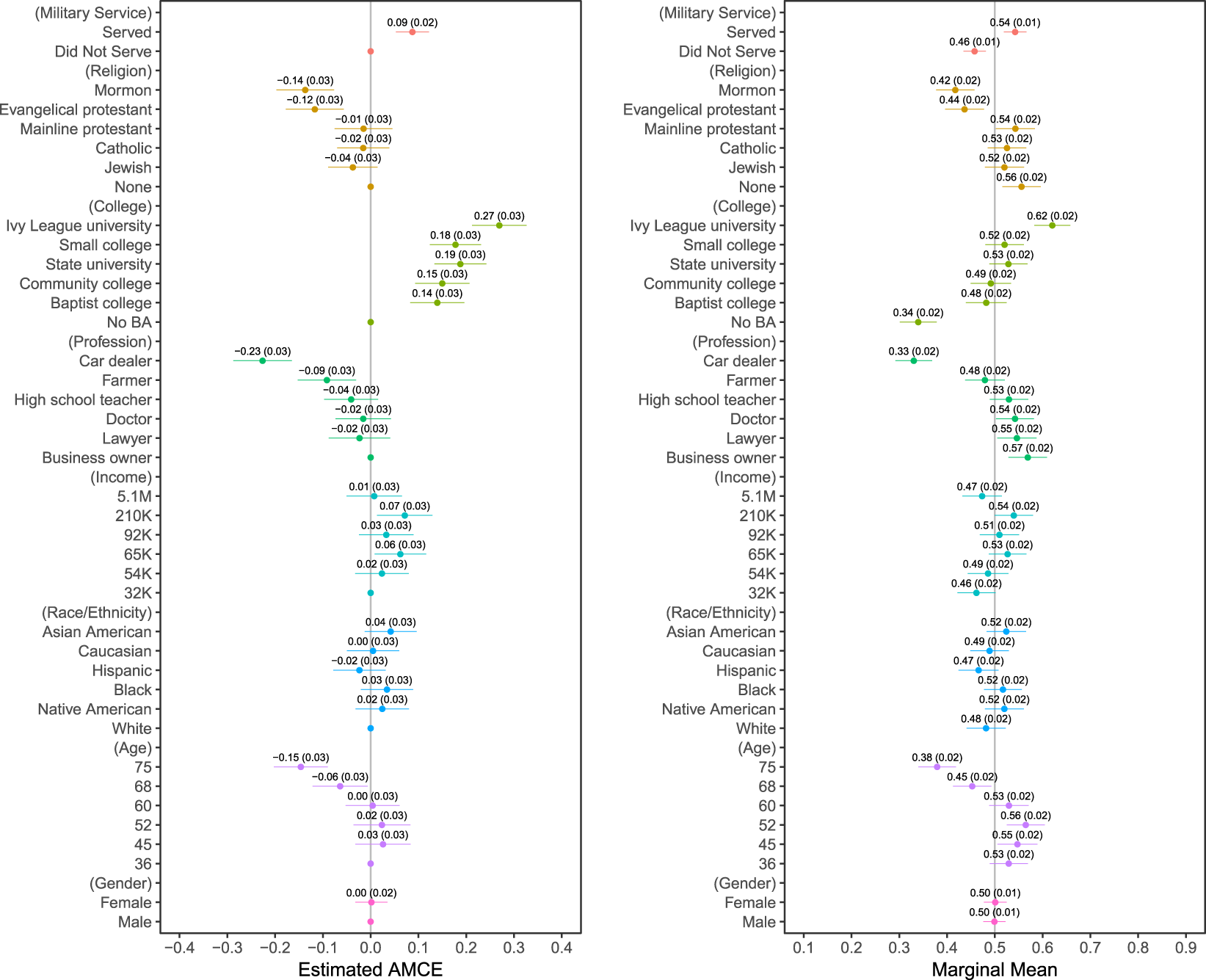
Because levels of features are randomly assigned, pairwise differences between two marginal means for a given feature (e.g., between candidates who are male versus female) have a direct causal interpretation. For fully randomized designs, the AMCE proposed by Hainmueller, Hopkins, and Yamamoto (Reference Hainmueller, Hopkins and Yamamoto2014) is equivalent to the average marginal effect of each feature level for a model where each feature is converted into a matrix of indicator variables with one level left out as a reference category. This is no different from any other regression context wherein one level of any categorical variable must be omitted from the design matrix in order to avoid perfect multicollinearity.Footnote 5 This close relationship between AMCEs and marginal means is visible in Figure 1 which presents a replication of the AMCE-based analysis of the Hainmueller et al. candidate experiment (left panel) and an analogous examination of the results using marginal means (right panel). Note, in particular, how marginal means convey information about the preferences of respondents for all feature levels while AMCEs definitionally restrict the AMCE for the reference category to zero (or undefined). For example, the AMCE for a candidate serving in the military is 0.09 (or 9 percentage points) increase in favorability, reflecting marginal means for serving and nonserving candidates of 0.46 and 0.54, respectively. Similarly, the zero effect size for candidate gender reflects identical marginal means for male and female candidates (0.50 in each case). AMCEs in fully randomized designs are simply differences between marginal means at each feature level and the marginal mean in the reference category, ignoring other features.
Replication of the Hainmueller, Hopkins, and Yamamoto (Reference Hainmueller, Hopkins and Yamamoto2014) candidate experiment using AMCEs and MMs.

The AMCE is often described as an estimate of the relative favorability of profiles with counterfactual levels of a feature. For example, Teele, Kalla, and Rosenbluth (Reference Teele, Kalla and Rosenbluth2018) summarize their conjoint on public support “female candidates are favored [over men] by 7.3 percentage points” (6). Similarly, Hainmueller, Hopkins, and Yamamoto (Reference Hainmueller, Hopkins and Yamamoto2014) describe some of the results of a conjoint on preferences toward political candidates:
We also see a bias against Mormon candidates, whose estimated level of support is 0.06 (SE  $=$ 0.03) lower when compared to a baseline candidate with no stated religion. Support for Evangelical Protestants is also 0.04 percentage points lower (SE
 $=$ 0.02) than the baseline. (19)
These examples make clear that despite the causal inference potentially provided by the AMCE, the quantity of interest is frequently used to provide a characterization of a preference that has a distinctly descriptive flavor about the relative levels of support across profiles and also across subgroups of respondents. Indeed, this style of description is widespread in conjoint analyses. This use of conjoints to provide descriptive inferences about patterns of preferences is important because AMCEs are defined as relative quantities, requiring that patterns of preferences are expressed against a baseline, reference category for each conjoint feature. A positive AMCE is read as higher favorability, but it is only higher relative to whatever category that serves as the baseline. For example, in the Hainmueller, Hopkins, and Yamamoto candidate example, choosing a nonreligious candidate as a baseline and interpreting the resulting AMCEs means that the differences between other pairs of marginal means (e.g., evaluations of Mormon and Evangelical candidates) are not obvious. The negative direction, and the size, of the AMCEs for Mormon and Evangelical candidates would be different if the least-liked category of Mormons were the reference group. More trivially, Teele, Kalla, and Rosenbluth (Reference Teele, Kalla and Rosenbluth2018) describe their comparisons about public preferences for female candidates relative to male candidates, but could have also described patterns of equal size but opposite sign comparing preferences over male relative to female candidates. Supplementary Information Section B includes some additional illustrations of this point for interested readers.
2 Consequences of Arbitrary Reference Category Choice
How do researchers decide which of tens of thousands of possible experimental cells should be selected as the reference category? Examining recently published conjoint analyses, it appears that the choice of reference category is either arbitrary or based on substantive intuition about the meaning of feature levels. For example, Hainmueller, Hopkins, and Yamamoto (Reference Hainmueller, Hopkins and Yamamoto2014) choose female immigrants as a baseline in their immigration experiment, thus providing an estimate of the AMCE of being male, while Teele, Kalla, and Rosenbluth (Reference Teele, Kalla and Rosenbluth2018) choose male candidates as a baseline in their conjoint, thus providing an estimate of the AMCE of being female. The choice is seemingly innocuous. Sometimes, choices of reference category appear to be driven by substantive knowledge: on language skills of immigrants in their immigration experiment, Hainmueller, Hopkins, and Yamamoto (Reference Hainmueller, Hopkins and Yamamoto2014) choose fluency as a baseline; on the prior trips to the US feature, “never” is chosen as the baseline.
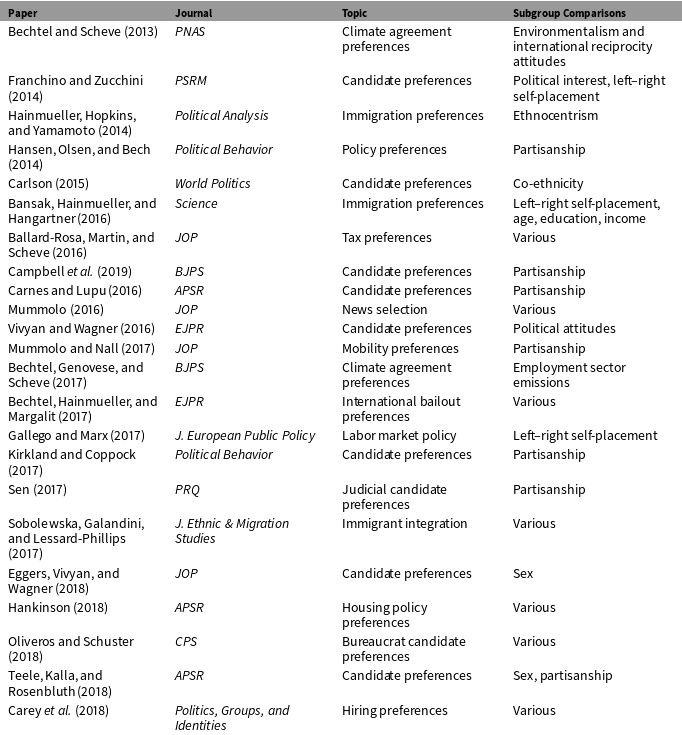
Uses of subgroup analysis published in political science journals.

All articles in this table use subgroup conditional AMCEs to make inferences about differences in preferences between subgroups.
While seemingly arbitrary and innocuous, the choice of reference category can provide highly distorted descriptive interpretations of preferences among subgroups of respondents. This occurs when researchers examine conditional AMCEs, wherein AMCEs are calculated separately for subgroups of respondents and those conditional estimates are directly compared (Hainmueller, Hopkins, and Yamamoto Reference Hainmueller, Hopkins and Yamamoto2014, 13). Conditional AMCEs convey the causal effect of an experimental factor on overall favorability among the subgroup of interest. Consider, for example, a two-condition candidate choice experiment in which Democratic and Republican respondents are exposed to either a male or female candidate and opinions toward the candidate serve as the outcome. It is reasonable to imagine that effects of candidate sex might differ for the two groups and to therefore compare the size of treatment between the two groups. Perhaps Democrats are more responsive to candidate sex than are Republicans, making the causal effect larger for Democrats than Republicans. When conjoint analysts engage in subgroup comparisons, they are engaging in this kind of search for heterogeneous treatment effects across subgroups, but across a much larger number of experimental factors.
As Table 1 shows, discussions of conditional AMCEs in conjoint analyses often compare the size, and direction, of subgroup causal effects. Given the common practice of descriptively interpreting conjoint experimental results, such subgroup analyses seem perfectly intuitive. The set of subgroups listed in the last column of Table 1 contains some unsurprising covariates, such as partisanship, that are of obvious theoretical interest in almost any study of individual preferences. If interpreted as a difference in the size of the causal effect for two groups, such comparisons are perfectly consistent with more traditional experimental analysis and a perfectly acceptable interpretation of the conjoint results.
Yet, just as the analysis of full sample conjoint data is often descriptive in nature, it is also the case that conjoint analysts frequently interpret differences in conditional AMCEs descriptively rather than causally. For example, in one analysis, Hainmueller, Hopkins, and Yamamoto (Reference Hainmueller, Hopkins and Yamamoto2014) visually compare the pattern of AMCEs among high- and low-ethnocentrism respondents and interpret that “the patterns of support are generally similar for respondents irrespective of their level of ethnocentrism” (22). Ballard-Rosa, Martin, and Scheve (Reference Ballard-Rosa, Martin and Scheve2016) make similar comparisons in their tax policy conjoint: “While there are few strong differences in preferences for taxing the lower three income groups (the ‘hard work’ group has slightly lower elasticities for taxing the poor), there are strong differences in preferences for taxing the rich” (12). In the Bechtel and Scheve (Reference Bechtel and Scheve2013) conjoint on support for international climate change agreements in the United States, United Kingdom, Germany, and France, they summarize their results as “We find that individuals in all four countries largely agree on which dimensions are important and to what extent” (13765). In these examples, the differences between conditional AMCEs are used as a way of descriptively characterizing differences in preferences (i.e., levels of support) between the groups rather than differences in causal effects on preferences in the groups.
The selection of a reference category, while earlier an innocuous analytic decision, becomes substantially consequential for a descriptive reading of conditional AMCEs. Most obviously, using AMCEs descriptively prevents any description of the levels of favorability in the reference category. It can also lead to misinterpretations of patterns in preferences. AMCEs are relative, not absolute, statements about preferences. As such, there is simply no predictable connection between subgroup causal effects and the levels of underlying subgroup preferences. Yet, analysts and their readers frequently interpret differences in conditional AMCEs as differences in underlying preferences. AMCEs do provide insight into the descriptive variation in preferences within groups and across features, and conditional AMCEs do estimate the size of causal effects of features within groups. But AMCEs cannot provide direct insight into the pattern of preferences between groups because they do not provide information about absolute levels of favorability toward profiles with each feature (or combination of features).
This additional information matters. Consider again the simple two-condition experiment in which the effect of a male as opposed to female candidate,  $x\in 0,1$, is compared across a single two-category covariate,
 $z\in 0,1$ such as Democratic or Republican self-identification. Subgroup regression equations to estimate effects for each group are
 $$\begin{eqnarray}\displaystyle {\hat{y}} & = & \displaystyle \unicode[STIX]{x1D6FD}_{0}+\unicode[STIX]{x1D6FD}_{1}x+\unicode[STIX]{x1D716},\quad \forall z=0\nonumber\\ \displaystyle {\hat{y}} & = & \displaystyle \unicode[STIX]{x1D6FD}_{2}+\unicode[STIX]{x1D6FD}_{3}x+\unicode[STIX]{x1D716},\quad \forall z=1.\nonumber\end{eqnarray}$$
The effect of  $x$ when
 $z=0$ is given by
 $\unicode[STIX]{x1D6FD}_{1}$. The effect of
 $x$ when
 $z=1$ is given by
 $\unicode[STIX]{x1D6FD}_{3}$. These are, in essence, the conditional AMCEs in a conjoint analysis. Yet, the difference in AMCEs (
 $\unicode[STIX]{x1D6FD}_{3}-\unicode[STIX]{x1D6FD}_{1}$) is not equal to the difference in preferences between the two groups, which is
 $\bar{y}_{z=1|x=1}-\bar{y}_{z=0|x=1}$ (estimated by
 $(\unicode[STIX]{x1D6FD}_{2}+\unicode[STIX]{x1D6FD}_{3})-(\unicode[STIX]{x1D6FD}_{0}+\unicode[STIX]{x1D6FD}_{1})$). The difference-in-AMCEs only equals the difference in preferences when
 $\unicode[STIX]{x1D6FD}_{2}\equiv \unicode[STIX]{x1D6FD}_{0}$. Yet, the standard AMCE-centric conjoint analysis does not present absolute favorability in the reference category. Similarity of conditional AMCEs only means similarity of the causal effect of the feature across groups and not similarity of preferences, unless preferences toward profiles with the reference category are equivalent in both groups. Given the reference category choice is typically arbitrary or driven by substantive knowledge of the levels, there is never any reason to expect that the reference category satisfies this equality requirement. When using a difference-in-AMCEs comparison to estimate a difference in preferences, the size and direction of the bias is determined by the size of the difference in preferences toward the reference category within each subgroup.
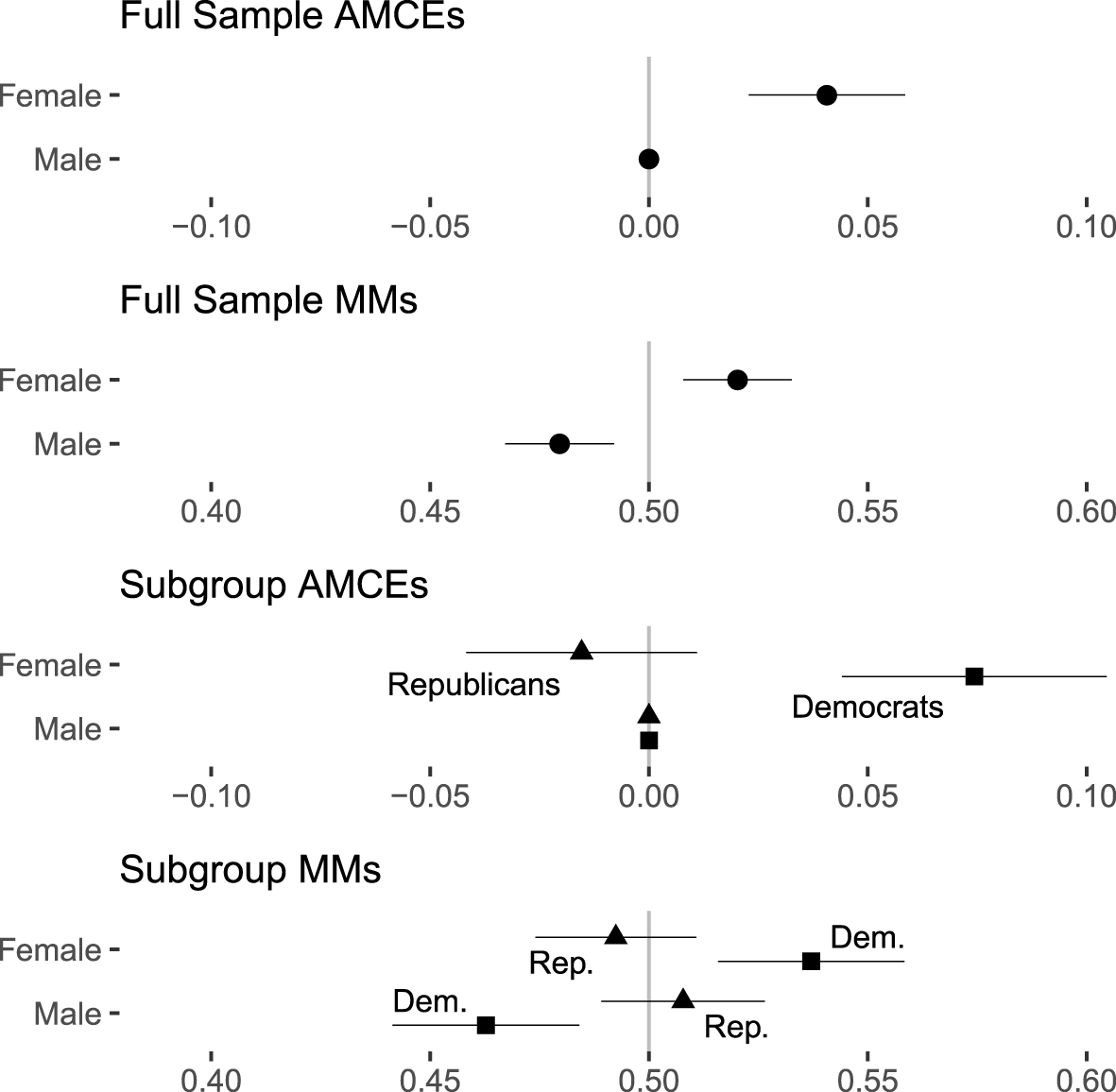
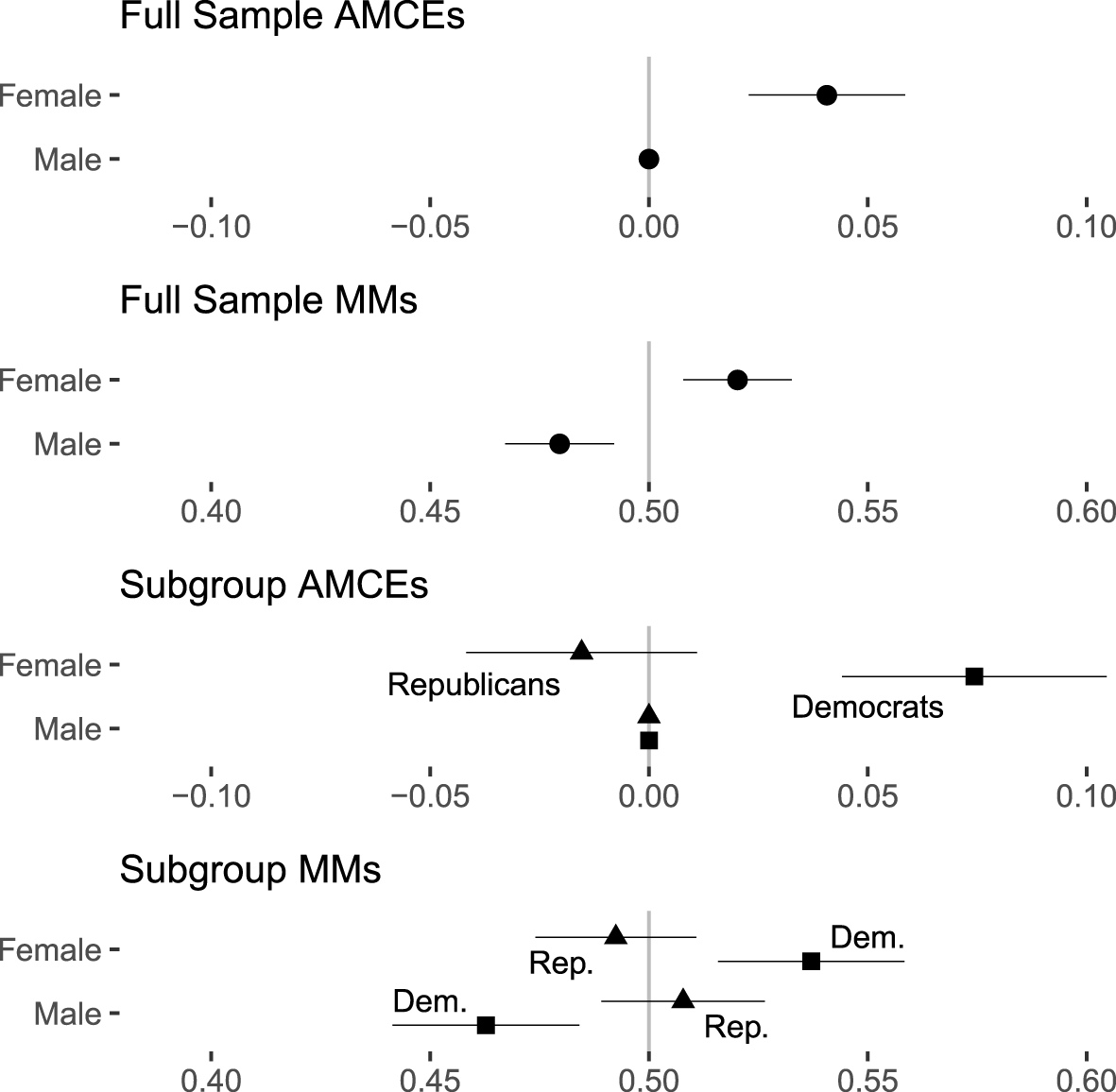
To draw this example out more fully, the upper panel of Figure 2 shows AMCEs for Teele, Kalla, and Rosenbluth’s candidate choice experiment for the full sample of respondents. The second panel shows full sample marginal means. Respondents’ preference for female candidates is very apparent in both forms of analysis in the upper two panels because the AMCE definitionally equals the difference in marginal means. But how do Republicans and Democrats differ in their preferences over male and female candidates? The third panel shows conditional AMCEs separately for Democratic and Republican voters, as provided in the original paper, and the lower panel shows the results using conditional marginal means for Democratic and Republican voters.Footnote 6 By requiring a reference category fixed to zero, the conditional AMCE results in the third panel suggest that there is a very large difference in favorability toward female candidates between Republican and Democratic respondents. In reality, however, the difference in these conditional AMCEs (0.089) reflects the true difference in favorability toward female candidates (difference: 0.045; Democrats: 0.537, Republicans: 0.492) plus the difference in favorability toward male candidates (difference: 0.045; Democrats: 0.463, Republicans: 0.508). Because Democrats and Republicans actually differ in their views of profiles containing the reference (male) category, AMCEs sum the true differences in preferences for a given feature level with the difference in preferences toward the reference category.Footnote 7
Replication of results for “candidate sex” feature from the Teele, Kalla, and Rosenbluth (Reference Teele, Kalla and Rosenbluth2018) candidate experiment using full sample AMCEs and marginal means (MMs) and subgroup AMCEs and MMs for Democrats and Republicans.
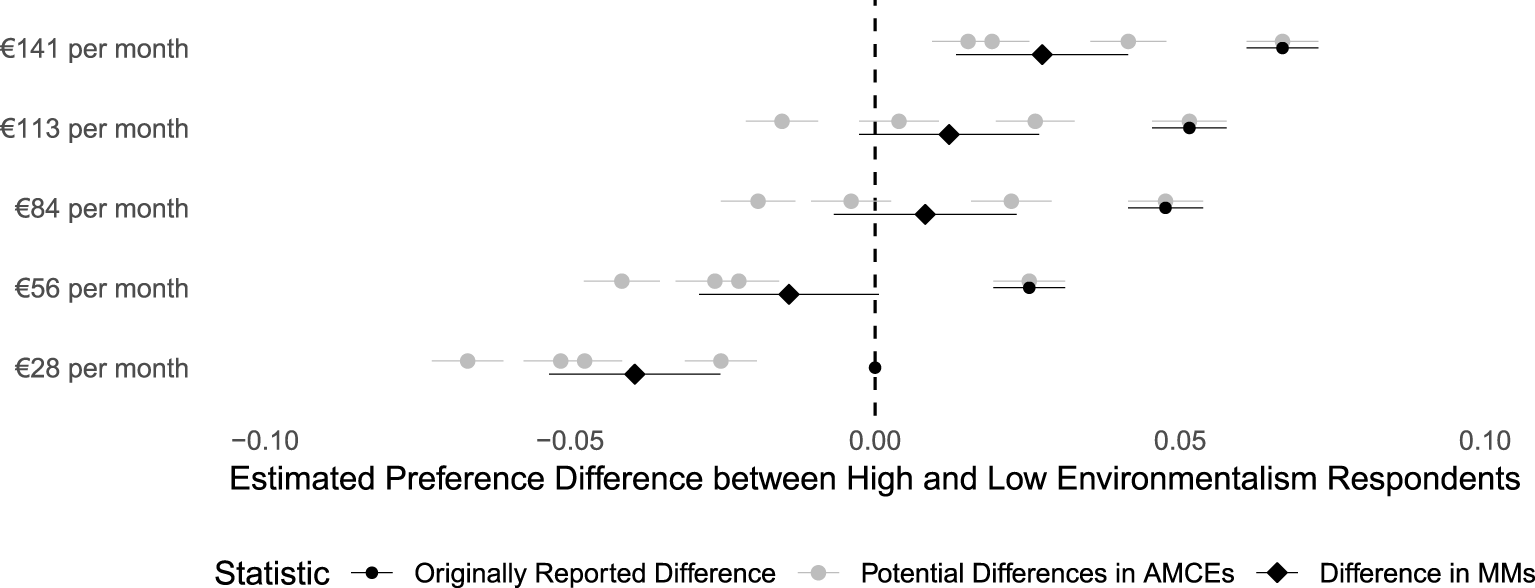
Visual or numerical similarity of subgroup AMCEs is therefore an analytical artifact, not an accurate statement of the similarity of patterns of preferences. We can see this bias in a reanalysis of Bechtel and Scheve’s four-country climate change agreement experiment. Figure 3 shows an analysis for the feature capturing the monthly household cost for a potential international climate agreement. This replicates a portion of their results which compare high- and low-environmentalism respondents pooled across countries (Bechtel and Scheve Reference Bechtel and Scheve2013, 13767 figure 4). The original analysis has conditional AMCEs for the two subgroups with 28 Euro per month as the reference category. Conditional AMCEs for both groups are presented as negative with conditional AMCEs for low-environmentalism respondents being more negative than the conditional AMCEs for high-environmentalism respondents at every feature level. This implies positive differences in favorability toward each monthly cost between high- and low-environmentalism respondents. Figure 3 presents the implied difference-in-AMCEs from the original analysis as black circles, demonstrating the substantial and positive apparent differences between the two groups. For example, the difference-in-AMCEs for the 56 Euro per month level (incorrectly) implies that high-environmentalism respondents are more favorable toward a 56 Euro per month household cost of an agreement than are low-environmentalism respondents. Yet, the opposite is actually true: high-environmentalism respondents are less favorable toward this option than low-environmentalism respondents. By using the 28 Euro per month level as the reference category, the original analysis implies that preferences are identical between the two groups when in reality, high-environmentalism respondents are much less favorable toward a 28 Euro per month cost than low-environmentalism respondents. The black diamonds in Figure 3 show these true differences in favorability as marginal means for the two groups.
True difference in favorability and implied preference differences between high- and low-environmentalism respondents for “monthly cost” feature from the Bechtel and Scheve (Reference Bechtel and Scheve2013) climate agreement experiment for each possible reference category.

Furthermore, the gray dots in Figure 3 represent the alternative differences-in-AMCEs that could have been generated from alternative choices of reference category using the same data. Not only is it possible for reference category choice to significantly color the apparent size of differences between subgroup, that choice can also impact the direction and statistical significance of subgroup differences. An analyst could easily choose a reference category that presents the differences between these two groups as large and positive, small and positive, small and negative, large and negative, or negligible. The original analysis (again, black circles) happens to show large and positive differences between the groups.
It is worth highlighting two further features in Figure 3. First, the alternative differences-in-AMCEs estimates vary mechanically around the difference in marginal means, as the reference category varies. The difference between marginal means for two groups are always fixed in the data, so the differencing of subgroup AMCEs is merely an exercise that is centering those differences at arbitrary points along the range of observed differences in marginal means. Second, and more practically, because there is no category for which the preferences of the two subgroups in this example are identical, no choice of reference category would have led to inferences from differences-in-AMCEs that accurately reflect the underlying difference in preferences. Even in the 84 Euro per month level, the difference between the two groups is slightly positive. Were there a category for which subgroup preferences were exactly equal, then we could choose that as the reference category and interpret differences-in-AMCEs as differences in preferences. But there is never any guarantee that such a reference category exists. Thus, there is no way to use conditional AMCEs or differences between those conditional AMCEs to convey the underlying similarity or differences in preferences across sample subgroups.
3 Improved Subgroup Analyses in Conjoint Designs
Researchers and consumers of conjoints interested in describing levels of respondent favorability toward profiles with varying features can avoid the inferential errors that accompany conditional AMCEs by focusing attention on (subgroup) marginal means, differences between subgroup marginal means to infer subgroup differences in preferences toward particular features, and omnibus nested model comparisons to infer subgroup differences across many features. To demonstrate each of these three techniques, we provide a complete example based on Hainmueller, Hopkins, and Yamamoto’s analysis of their immigration conjoint by respondent ethnocentrism, which finds that “the patterns of support are generally similar for respondents irrespective of their level of ethnocentrism” (Hainmueller, Hopkins, and Yamamoto Reference Hainmueller, Hopkins and Yamamoto2014, 22). First, we show how different reference categories could have led to distinctly different conditional AMCEs and, therefore, interpretations of subgroup preference similarity. Second, we show how differences in marginal means clearly convey the similarity of these two subgroups without any sensitivity to reference category. Finally, we show how tested model comparisons would have provided Hainmueller, Hopkins, and Yamamoto with a statistic test of the claimed similarity in levels of support between these two respondent subgroups.
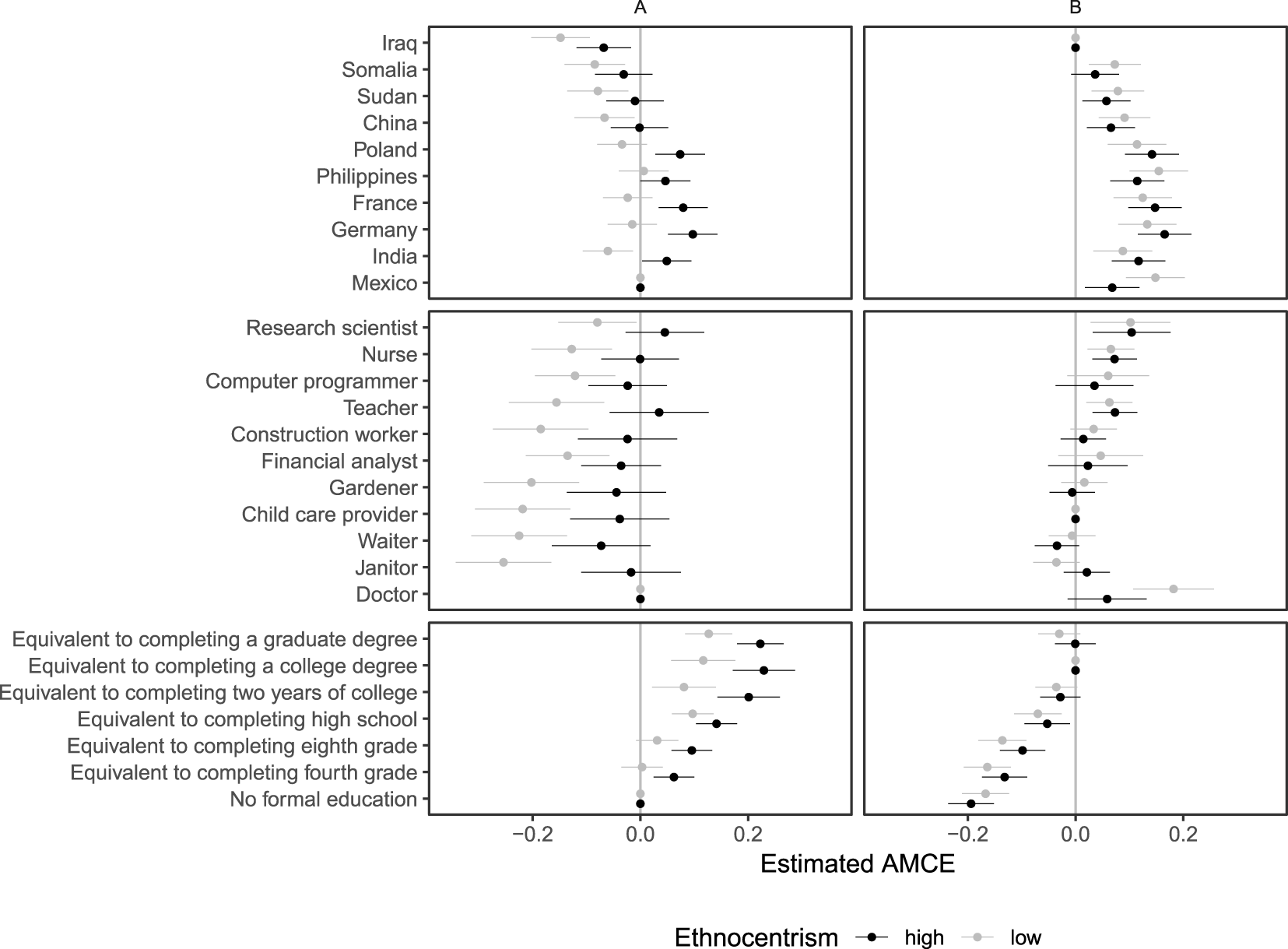
Comparison of AMCEs for low- and high-ethnocentrism respondents using two alternative reference category choices for three features from Hainmueller et al.’s (Reference Hainmueller, Hopkins and Yamamoto2014) immigration experiment.

To begin with, consider the left and right facets of Figure 4, which shows estimated subgroup AMCEs for three features from the immigration study. In panel A (left), all features are configured so that the reference category is the one with the largest difference in levels of support between the two subgroups, thus distorting the size of differences at all other levels. In panel B (right), all features are configured so that the reference category is the one with the smallest difference in preferences between the two subgroups.
Panel A gives the impression that there are significant differences in preferences between high- and low-ethnocentrism respondents toward immigrants from different countries of origin, with different careers, and with different educational attainments because the reference category choice cascades the difference in reference category favorability into AMCEs for all other feature levels. By contrast, Panel B gives the impression that these differences are negligible. The experimental data and analytic approach in the two portrayals is identical; the only difference is the choice of reference category. Given what we have shown about the relationship between differences in conditional AMCEs and differences in conditional marginal means, Panel B is a more “truthful” visualization, which Cairo (Reference Cairo2016) uses to mean avoidance of self-deception in the presentation of data, and a more “functional” visualization, by which Cairo means choosing graphics based on how they will be interpreted by the visualization’s consumers. The differences between subgroup AMCEs there more accurately convey differences in underlying preferences because the reference categories used in Panel B are the most similar between the two groups.
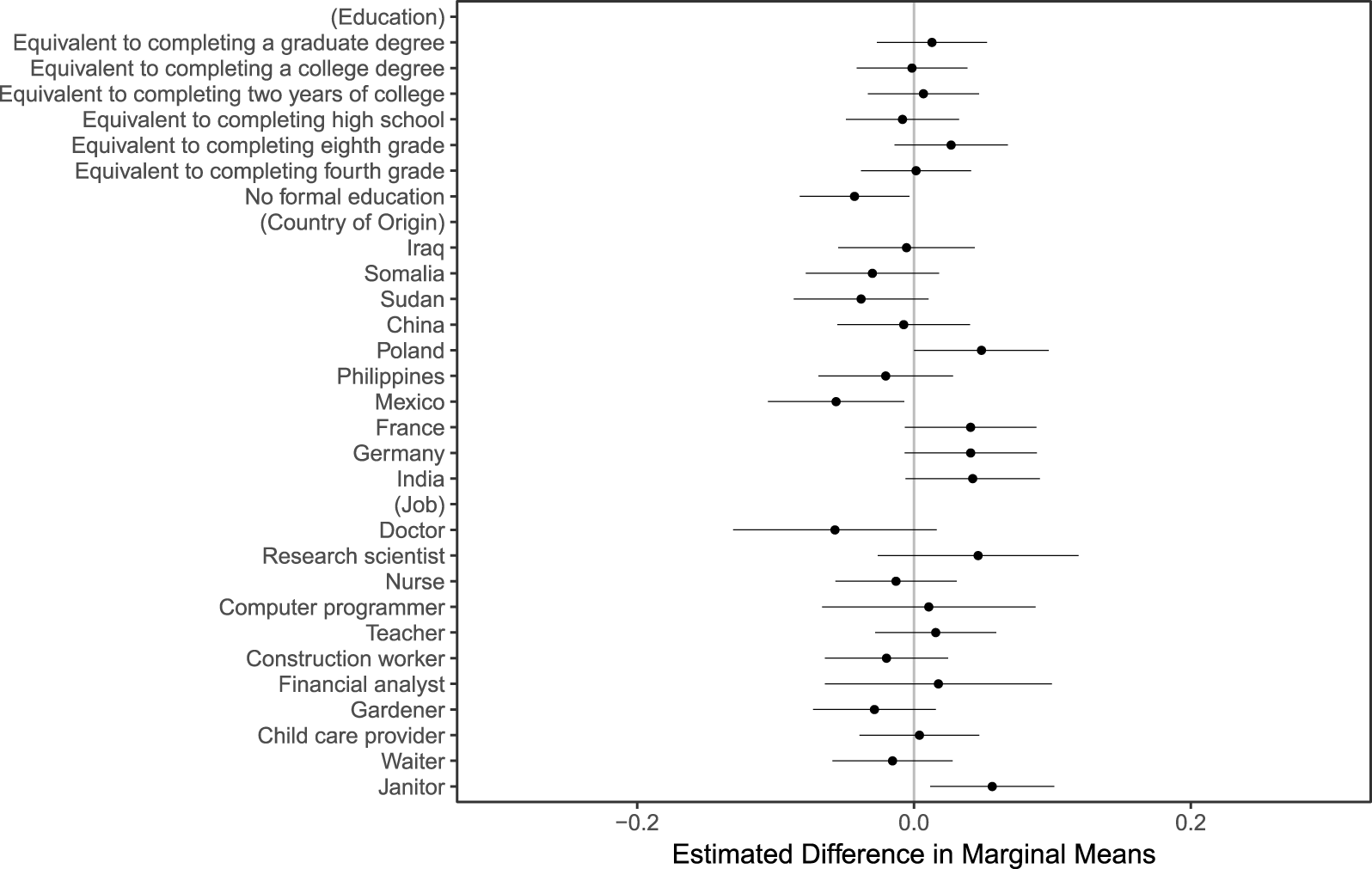
Differences in conditional marginal means, by ethnocentrism, for three features from Hainmueller et al.’s (Reference Hainmueller, Hopkins and Yamamoto2014) immigration experiment.

Next, making a comparison of levels of favorability toward different types of immigrants without using AMCEs would have been even more truthful. Figure 5 directly shows the comparison of preferences as differences in subgroup marginal means between the two groups for these three features, with 95% confidence intervals for the difference.Footnote 8 The two groups indeed have similar preferences, something that would have happened to be clear had the conditional AMCEs in the right panel of Figure 4 been presented but that would have been far less obvious were the conditional AMCEs in the left panel of that figure were presented. The pairwise difference in means tests would provide formal procedures for testing the statistical significance of these differences.
Yet, finally, the similarity of subgroup preferences in conjoints is often characterized in an omnibus fashion, as in the quote from Hainmueller, Hopkins, and Yamamoto (Reference Hainmueller, Hopkins and Yamamoto2014) describing “patterns of support.” An appropriate test in such cases is one that evaluates whether a model of support that accounts for group differences better fits the data than a model of support with only conjoint features as predictors. This type of test is known as a “nested model comparison” which compares the fit of a “restricted” regression (the restriction being that interactions between features and a subgroup identifier are held to be zero) nested within an “unrestricted” regression that allows for arbitrary interactions between conjoint features and the subgroup identifier. Formally, a nested model comparison provides an F-test of the null hypothesis that all interaction terms are equal to zero.Footnote 9
To make this concrete, for a feature with four levels (one treated as a reference category), the first (restricted) equation would be the following:
 $$\begin{eqnarray}Y=\unicode[STIX]{x1D6FD}_{0}+\unicode[STIX]{x1D6FD}_{1}\mathit{Level}_{2}+\unicode[STIX]{x1D6FD}_{2}\mathit{Level}_{3}+\unicode[STIX]{x1D6FD}_{3}\mathit{Level}_{4}+u.\end{eqnarray}$$
The second (unrestricted) equation would allow for interactions between feature levels and the subgroup identifier:
 $$\begin{eqnarray}\displaystyle Y & = & \displaystyle \unicode[STIX]{x1D6FD}_{0}+\unicode[STIX]{x1D6FD}_{1}\mathit{Level}_{2}+\unicode[STIX]{x1D6FD}_{2}\mathit{Level}_{3}+\unicode[STIX]{x1D6FD}_{3}\mathit{Level}_{4}+\unicode[STIX]{x1D6FD}_{4}\mathit{Group}\nonumber\\ \displaystyle & & \displaystyle +\,\unicode[STIX]{x1D6FD}_{5}\mathit{Level}_{2}\ast \mathit{Group}+\unicode[STIX]{x1D6FD}_{6}\mathit{Level}_{3}\ast \mathit{Group}+\unicode[STIX]{x1D6FD}_{7}\mathit{Level}_{4}\ast \mathit{Group}+u.\end{eqnarray}$$
While Equation (1) imposes the constraint that  $\unicode[STIX]{x1D6FD}_{4}=\unicode[STIX]{x1D6FD}_{5}=\unicode[STIX]{x1D6FD}_{6}=\unicode[STIX]{x1D6FD}_{7}=0$, Equation (2) allows for subgroup differences in favorability. Testing this null entails computing an F-statistic comparing the fit of each equation:
 $$\begin{eqnarray}F={\displaystyle \frac{\frac{\mathit{SSR}_{\mathit{Restricted}}-\mathit{SSR}_{\mathit{Unrestricted}}}{r}}{\frac{\mathit{SSR}_{\mathit{Unrestricted}}}{n-k-1}}},\end{eqnarray}$$
where  $\mathit{SSR}_{\mathit{Restricted}}$ is the sum of squared residuals for Equation (1),
 $\mathit{SSR}_{\mathit{Unrestricted}}$ is the sum of squared residuals for Equation (2),
 $r$ is the number of restrictions (in the above example, 4),
 $n$ is the number of cases, and
 $k$ is the number of feature levels in the unrestricted model.Footnote 10
For the education feature, the resulting F-test for the model comparison in this case again gives us little reason to believe that there are subgroup differences:  $\text{F}(7,\text{11,493})=0.68$,
 $p\leqslant 0.69$. We could repeat such pairwise comparisons or omnibus comparisons for each feature in the design—for country of origin (
 $\text{F}(10,\text{11,490})=1.56$,
 $p\leqslant 0.11$) or job (
 $\text{F}(11,\text{11,489})=0.87$,
 $p\leqslant 0.56$)— or for all features as a whole (
 $\text{F}(98,\text{11,402})=1.16$,
 $p\leqslant 0.14$).
This visual display in Figure 5 and these statistical tests make clear what could not be directly inferred from conditional AMCEs alone; there are indeed no sizeable and only a few statistically apparent differences in preferences between the two groups.
This kind of nested model comparison test can also be used to assess heterogeneity across conjoint features (see also Egami and Imai Reference Egami and Imai2018). For example, Teele, Kalla, and Rosenbluth (Reference Teele, Kalla and Rosenbluth2018) report just such a test for how effects of features other than candidate sex may differ between male and female candidates, finding no such heterogeneity (8–9). Fortunately, the original analysis accurately detected an absence of subgroup differences; yet, a subtly different set of analytic decisions about reference categories (as shown in Figure 4) could have led to quite different inferences. As an example, Bechtel and Scheve (Reference Bechtel and Scheve2013) argue that their conjoint results show that “individuals in all four countries [Germany, France, United States, United Kingdom] largely agree on which dimensions are important and to what extent” (Bechtel and Scheve Reference Bechtel and Scheve2013, 13765), but a nested model comparison shows that the countries do differ in their preferences  $\text{F}(54,\text{67,982})=3.72$,
 $p\leqslant 0.00$. This cross-country variation is largely driven by differences in sensitivity to monthly household costs feature,
 $\text{F}(15,\text{67,995})=3.80$,
 $p\leqslant 0.00$, with the United Kingdom and United States being more cost sensitive than Germany and France. Visual comparisons of conditional AMCEs can sometimes provide accurate insights into subgroup differences in preferences (as in the Hainmueller, Hopkins, and Yamamoto case), but ultimately there is no guarantee that they do in any particular analysis.
4 Conclusion
This article has identified several challenges related to the analysis and reporting of conjoint experimental designs, particularly analyses of subgroup differences. We suggest that conjoint analyses should report not only AMCEs but also descriptive quantities about levels of favorability that better convey underlying preferences over profile features and better convey subgroup differences in those preferences. Marginal means contain all of the information provided by AMCEs and more. Consequently, our intention here is not to substantively undermine any previous set of results but, instead, to urge researchers moving forward to demonstrate considerable caution in how they design, analyze, and present the results of these types of descriptive experiments and how they test for differences in preferences between subgroups.
We have relatively straightforward and hopefully uncontroversial advice for how analysts of conjoint experiments should proceed:
1. Always report unadjusted marginal means when attempting to provide a descriptive summary of respondent preferences in addition to, or instead of, AMCEs.
2. Exercise caution when explicitly, or implicitly, interpreting differences-in-AMCEs across subgroups. Differences-in-AMCEs are differences in effect sizes for subgroups, not statements about the relative favorability of the subgroups toward profiles with a given feature. Heterogeneous effects do not necessarily mean different underlying preferences. If differences in AMCEs are reported, the choice of reference categories should be discussed explicitly and diagnostics should be provided to justify it.
3. When descriptively characterizing differences in preference level between subgroups, directly estimate the subgroup difference using conditional marginal means and differences between conditional marginal means, rather than relying on the difference-in-AMCEs.
4. To formally test for group differences in preferences, regression with interaction terms between the subgrouping covariate and all feature levels will generate estimates of level-specific differences in preferences via the coefficients on the interaction terms. A nested model comparison between this equation against one without such interactions provides an omnibus test of subgroup differences, which should be reported when characterizing the overall patterns of subgroup differences.
Following this advice, we hope, will allow researchers to more clearly and more accurately represent descriptive results of conjoint experiments.
The popularity of conjoint analyses in recent years highlights the power of the design and the important contribution made by Hainmueller, Hopkins, and Yamamoto (Reference Hainmueller, Hopkins and Yamamoto2014) in providing a novel causal interpretation of these fully randomized factorial designs. Yet, with new tools always come new challenges. The now-common practice of descriptively interpreting conjoints requires more caution than is immediately obvious. To facilitate improved analysis and, especially, to provide easy-to-use tools for calculating marginal means and performing reference category selection diagnostics, we provide software called cregg (Leeper Reference Leeper2018) available from the Comprehensive R Archive Network. Additionally, this manuscript is written as a reproducible knitr document (Xie Reference Xie2015) that contains complete code examples that will perform all analyses and visualization used throughout this article. With these resources in hand, researchers should be well equipped to analyze subgroup preferences in conjoint designs without running into the analytic challenges discussed here.
Supplementary material
For supplementary material accompanying this paper, please visit https://doi.org/10.1017/pan.2019.30.