

Do the retirement patterns of public-sector workers in America differ from those in the private sector? Many private-sector workers today face a retirement income landscape characterized by exposure to market forces through defined-contribution pension plans and private saving, and the risk of financial insecurity later in life. These conditions stem from fundamental changes in the traditional three pillars of retirement income and from other changes in the retirement environment. As a result, the relative attractiveness of work and leisure later in life has been altered, predominantly in favor of additional work. Older Americans have responded to this new retirement environment and a century-long trend toward earlier and earlier retirement among American men ceased in the mid-1980s and has since reversed. The labor force participation rates of older American women have increased even more dramatically.
Not only are older Americans continuing to work later in life, but they are also doing so in many creative ways. Gradual retirement – including phased retirement (fewer hours with one's current employer), bridge employment (continued work but with a different employer), and labor market reentry after departure – is now more common among older career workers than the stereotypical one-time, permanent exit from the labor force. All are well documented in the literature, with bridge employment being by far the most common, followed by reentry (unretirement!) and phased retirement. The reasons for the popularity of bridge employment are many, including preferences for hours flexibility, a new line of work or a new location and, in some cases, inadequate financial resources. Involuntary transitions from career employment also are important, as some older workers face physical limitations, layoffs, or other barriers to continued work on a career job. Some have no choice but to seek work with another employer if they desire to stay in the labor force.
The impact of continued work on later financial security can be profound, as each year of additional work can both increase assets available for retirement and reduce the number of years of leisure that need to be financed (Bronshtein et al., Reference Bronshtein, Scott, Shoven and Slavov2018). Continued work is also one option that many older workers – those in good health and with employment skills still in demand – can control. In contrast, by the time they approach traditional retirement ages, individuals can do little to increase their Social Security wealth, their expected pension income, or their savings. Nor are they likely to have any impact on their employers’ decisions concerning pensions or post-retirement health care plans or on Social Security, Medicare or Medicaid reform, all of which might have major impacts on their economic well-being. For many older individuals, the most realistic option for improving one's standard of living in retirement is to work more.
Much of the discussion about continued work later in life might be of less importance for career public-sector employees, who are typically covered by defined-benefit pension plans that both encourage retirement at relatively young ages and offer financial security at older ages. We might therefore expect public-sector employees’ retirement dates to be earlier than those with defined-contribution plans, ceteris paribus, with the timing of retirement influenced by the age-specific incentives in their defined-benefit plans.
Despite the important differences between the incentives and circumstances faced by public- and private-sector workers, this distinction has received relatively little attention in the retirement literature. This paper aims to address this gap by examining how public- and private-sector workers transition from career employment to complete labor force withdrawal, with a focus on the roles of bridge employment, phased retirement, and reentry. We use data on four cohorts of older Americans from the Health and Retirement Study (HRS), a nationally-representative longitudinal survey of older Americans, and concentrate in this paper on the results from the first and longest cohort, the HRS Core, which began in 1992.Footnote 1
We are interested in not only when older public- and private-sector workers leave their career jobs but also in how they do so. Do they leave the labor force or move to another job – or both, and in what order? To address these topics, we construct individual work histories using the longitudinal HRS data. We focus on respondents who were on a full-time career (FTC) job at the time of their first HRS interview.Footnote 2 We find that public-sector employees generally follow the same diverse retirement paths as do private-sector workers, albeit with some important distinctions, such as a higher prevalence of part-time bridge employment, and, among women, a higher prevalence of phased retirement.
The next section describes our data and methods, followed by our empirical results, a policy discussion and our conclusions. A brief literature review is available from the authors.Footnote 3
1. Data and methods
In this project, we use 13 biennial waves of data from the longitudinal HRS to compare retirement transitions from career employment among public- and private-sector workers, but concentrate in this paper on the first and oldest cohort, the HRS Core, respondents who were aged 51–61 when first interviewed in 1992 (n = 12,652). We identify those who, at the time of this first survey, were wage-and-salary workers on a FTC job, and then disaggregate this sample by sector. The HRS survey asks whether the respondent had ever been employed by a unit of a state, county, or local government or by the federal government. Respondents who said yes were then asked about the dates of their government employment, from which we can identify the public- or private-sector status of the respondent's job at the time of the first interview. For each FTC respondent, we then examine the work history from this career job through complete labor force withdrawal and beyond (to check for unretirements), or until the time of the last completed survey for those who remain employed or who drop out of the HRS because of death or other sample attrition.
We observe three categories of gradual retirement. A bridge job is any job with a new employer that takes place after the last FTC employment of these older workers. Phased retirement is defined as a 20% or more reduction in hours with one's career employer. Reentry is defined as a return to paid work following two survey waves of non-work following an exit from FTC employment or from a bridge job (Figure 1).
A model of the various paths to retirement.

We first conduct a series of cross-sectional analyses of labor force status in each survey year (i.e., still working in career employment, transitioned to another employer, or not working) for each of the four cohorts in each survey year, for public- and private-sector workers separately. This provides the first glimpse at possible differences in retirement patterns by sector. We then examine retirement transitions in a longitudinal context, and examine the prevalence of bridge employment, phased retirement, and job market reentry for public- and private-sector workers.
Our analysis begins with a series of bivariate comparisons, for public- and private-sector workers separately, using known determinants of retirement and our outcomes of interest: bridge employment, phased retirement, and post-retirement reentry. Time-varying attributes are measured as of the wave prior to the respondent's transition from career employment.
We then control for other factors using a multinomial logistic regression model with a three-way outcome variable: (1) still on or last observed on the FTC job; (2) moved to a bridge job; and (3) exited the labor force directly from the FTC job. The model is as follows:
 $$R_{{\rm it}}^{\rm {^\ast}} = \alpha \; + {\rm \;} \beta _1X_{\rm i} + \beta _2X_{{\rm it}-1} + \beta _3{\rm Publi}{\rm c}_{\rm i} + {\rm \;} \varepsilon _{\rm i t}$$
where i represents individual and t the wave in which the transition from career employment is made.  $R_{it}^{\rm *} $ is a latent variable that determines the observed choice, R it, which denotes whether the individual moved to a bridge job or exited directly from the labor force by time t. εi is a white noise error term. Time invariant and time varying characteristics are represented by X i and X it−1, respectively, with all time varying variables measured as of the wave prior to the transition from career employment. These characteristics include demographic and economic traits known to be significant determinants of the retirement process, such as age, health status, pension status, spouse's employment status, and wage rate. The specification shown in Model 1 includes a control for the sector (private or public), and is estimated separately for men and for women. Coefficients are transformed into relative risk ratios (RRR) with those remaining in FTC employment as the base category.
We then estimate a logistic regression model of part-time work in bridge employment for those who moved to a bridge job. The right-hand side variables in this model resemble those in Model 1, with both time invariant and time-varying determinants of part-time status, along with a dichotomous indicator for career public employees. The dependent variable,  $H_{{\rm it}}^{\rm *} $, is a latent variable that determines the observed choice, H it – a zero-one indicator of whether the respondent is working part-time (less than 1,600 hours/year) in bridge employment.
We also estimate logistic regression models of phased retirement and reentry. For phased retirement, the dependent variable is equal to one if the respondent reduced hours worked on the career job by 20% or more, and zero otherwise. For reentry, the dependent variable is equal to one if the respondent reentered the labor force after having been out for at least two consecutive survey waves. Like the bridge employment and part-time employment models, the phased retirement and reentry models are estimated for men and women separately, with the explanatory variables measured as of the wave the respondent left paid work or, for those who reenter, as of the wave prior to reentry.
2. Results
Our sample includes all HRS Core men and women in Wave I with wage-and-salary work experience since age 50 who were working on a FTC job at the time of their first interview in 1992. About one-quarter of the HRS Core career workers (22% of men and 25% of women) held jobs in the public sector at the time of their first interview, a total of 853 respondents, of whom 454 were men (53%) and 399 were women (47%).Footnote 4
2.1 Cross-sectional analysis of labor force participation among public- and private-sector older workers
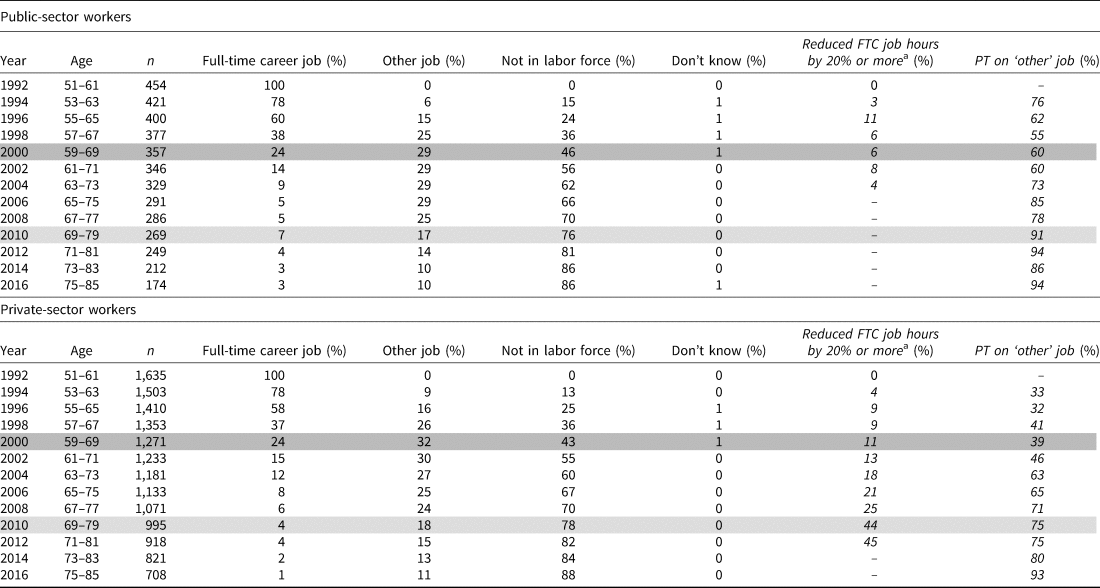
A cross-sectional examination of labor force status of the initial HRS sample shows that public- and private-sector men differed only slightly with respect to their transitions from career employment. For example, the percentage of public-sector and private-sector men who remained on their full-time career job 8 years later, in 2000 (see the darker shading in Tables 1 and 2), was 24% for both groups; a decade later, in 2010, these numbers are 7% and 4%. By 2000, 29% of these public sector men were in another (bridge) job, compared with 32% of the private sector workers. The bridge job numbers in 2010 (see lighter shading) were 17% and 18%.
Labor force status by survey participation year, HRS Core men on a FTC job as of the first interview

a Results not reported for cells with fewer than 30 respondents.
Source: Authors’ calculations based on the Health and Retirement Study.
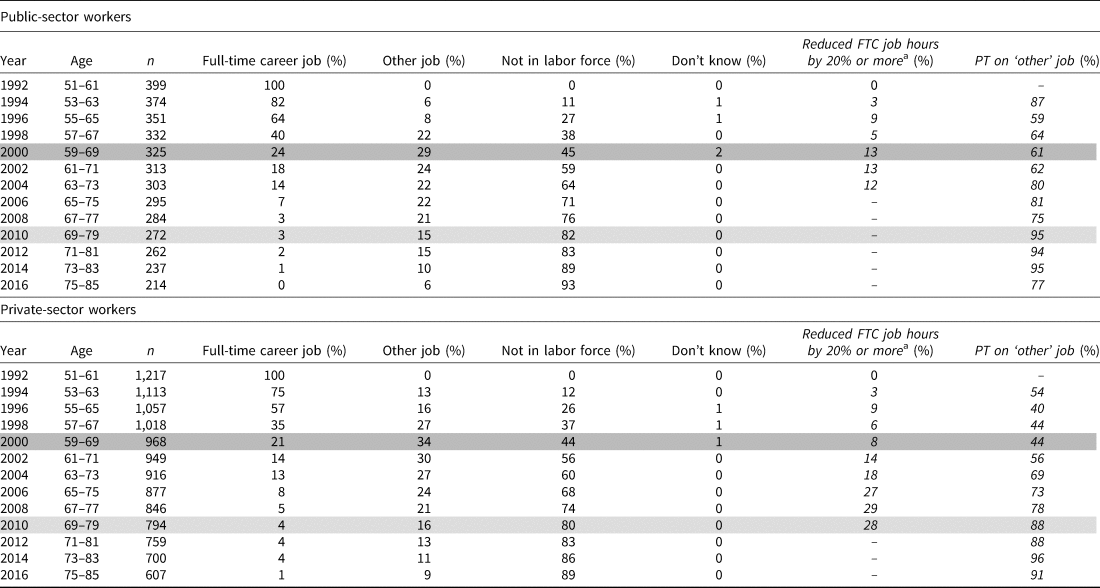
Labor force status by survey participation year, HRS Core women on a FTC job as of the first interview

a Results not reported for cells with fewer than 30 respondents.
Source: Authors’ calculations based on the Health and Retirement Study.
The analogous numbers for women in the two sectors are also very similar: 24% and 21% still on their full-time career job in 2000 and 3% and 4% 10 years later. The bridge job numbers for the two sectors of women are also similar, though often slightly lower in the public sector: 29% and 34% by 2000 and 15% and 16% in 2010.
One important finding from this cross-sectional view that persists throughout our analyses is that for those respondents who did move to another job, public-sector workers were much more likely than private-sector ones to be working part-time; for example, 60% vs. 39% of the men in a bridge job in 2000; 91% vs. 75% of those men in 2010. Among women in bridge jobs in 2000, 61% of the public sector women were working part-time compared with only 44% of those in the private sector; in 2010, 95% vs. 88%.
The takeaway from the cross-sectional analysis is that public-sector and private-sector men and women had remarkably similar transition patterns from FTC work, although public-sector career workers were more likely than their private-sector counterparts to be working part-time in these positions. We next examine bridge job prevalence based on individual work histories using the longitudinal nature of the HRS.
2.2 Longitudinal analysis of gradual retirement among public- and private-sector older workers
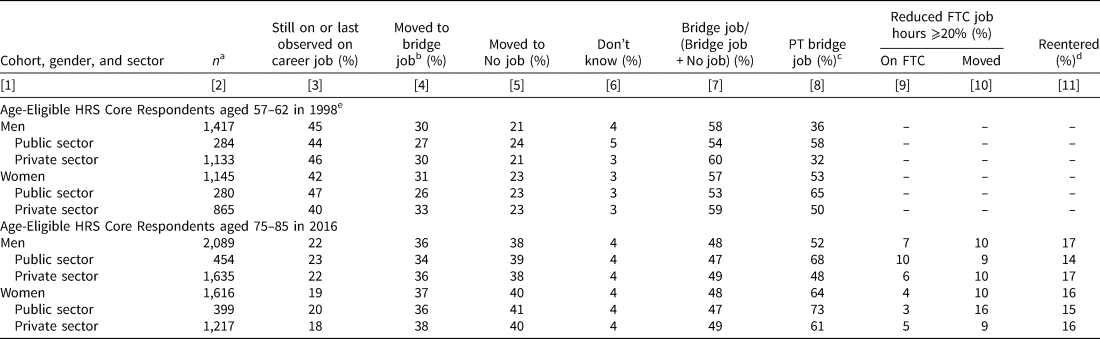
Roughly one half or more of the HRS Core respondents who left career employment moved to a bridge job rather than out of the labor force (Table 3 column 7). This was true in 1998, 6 years after the initial interview and in 2016, another 8 years later.Footnote 5 It is also true for the other three cohorts of younger HRS respondents (not shown) – about one-half of the FTC job leavers who moved to a bridge job rather than out of the labor force. This is consistent with considerable literature on the tremendous importance of bridge job employment in the retirement process (Quinn, Reference Quinn1999; Cahill et al., Reference Cahill, Giandrea and Quinn2006, Reference Cahill, Giandrea, Quinn and Wang2013, Reference Cahill, Giandrea, Quinn, George and Ferraro2015a, Reference Cahill, Giandrea and Quinn2015b, Reference Cahill, Giandrea and Quinn2018; Alcover et al., Reference Alcover, Topa, Parry, Fraccaroli and Depolo2014; Wang et al., Reference Wang, Penn, Bertone, Stefanova, Alcover, Topa, Parry, Fraccaroli and Depolo2014). As with the cross-sectional findings above, bridge job prevalence among public-sector workers was somewhat lower than that among private-sector workers and public-sector men and women on bridge jobs were more likely to be working part-time.
Transitions from FTC employment through 1998 and 2016, HRS Core respondents on a FTC job at the time of the first interview, by gender, and sector (horizontal percentages)

a Includes respondents on a wage-and-salary FTC job at the time of the first interview. Transitions are measured as of 2016.
b Does not include respondents who were not working for two consecutive waves following FTC employment and who later reentered.
c Percentage of respondents working part-time in bridge employment as a percentage of all individuals who transitioned to a bridge job; part-time employment is defined as working fewer than 1,600 hours per year.
d Percentage of respondents who returned to paid work after not having worked for at least two consecutive waves at some point following career employment.
e Percentages are based on Core respondents aged 51–56 at the time of the first interview to allow for comparisons across cohorts.
Source: Authors’ calculations based on the Health and Retirement Study.
Consistent with prior research on the prevalence of phased retirement (a reduction in career job hours of 20% or more – Table 3, column 9) and reentry (a return to the labor force after being out for at least two HRS waves – Table 3, column 11), we find that both of these forms of gradual retirement are considerably less common than bridge employment among both public- and private-sector workers. We also find that public-sector men are slightly more likely than those in the private sector to have reduced hours on a career job later in life; the differential is smaller and in the other direction among women.
To summarize, bridge job prevalence is modestly lower among public-sector workers compared with private-sector ones. The most notable difference by sector is with respect to hours worked in bridge employment. In both sectors, phased retirement and labor market reentry are less important in the gradual retirements of public- and private-sector workers than are bridge jobs with new employers.
2.3 Determinants of gradual retirement among public- and private-sector older workers
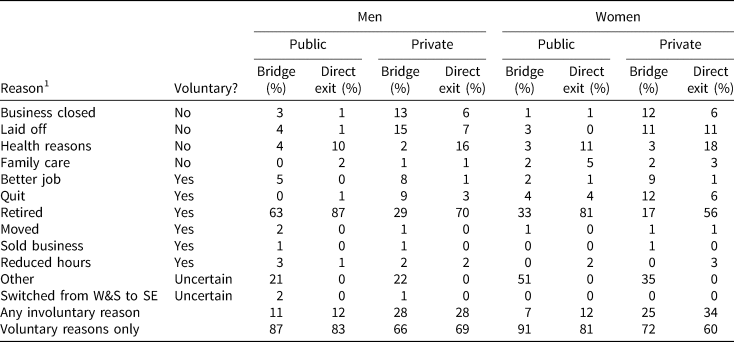
The next step of the analysis focuses on the determinants of these retirement decisions. First, do public workers’ explanations of why they left their career job differ from those of private-sector workers? A higher percentage of public-sector workers than private-sector ones who moved to bridge employment report ‘retired’ as their reason for leaving their career jobs (63% vs. 29% among HRS Core men; 33% vs. 17% among Core women – see Table 4). As might be expected, public-sector career workers are much less likely than private-sector ones to report ‘business closed’ or ‘laid off’ as their reason for leaving career employment for a bridge job (less than 7% among public-sector men and women vs. about a quarter of private-sector men and women). More generally, public-sector workers were more likely to report voluntary reasons only for leaving career employment (80%–90% of public-sector career workers compared with 60%–70% of private-sector career workers – Table 4). In short, public- and private-sector workers do differ in their stated reasons for leaving career employment.
Reasons for transitioning from FTC employment, HRS Core respondents who transitioned from FTC employment, by sector and type of transition

[1] Categories are not mutually exclusive.
Source: Authors’ calculations based on the Health and Retirement Study.
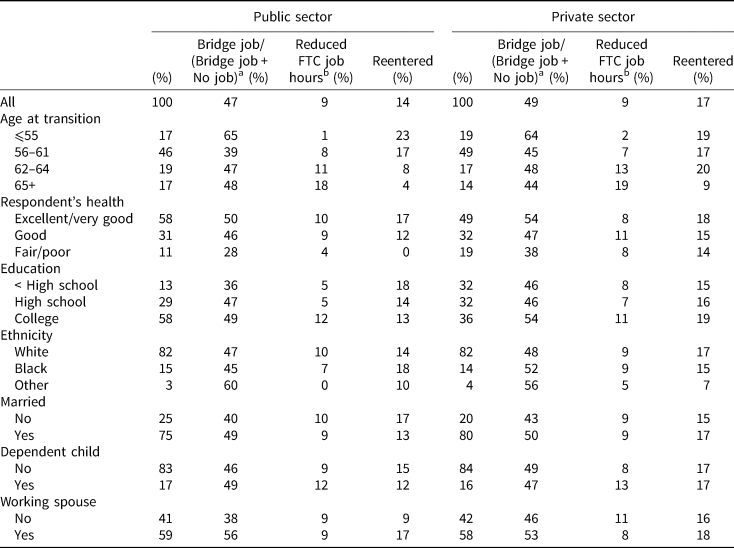
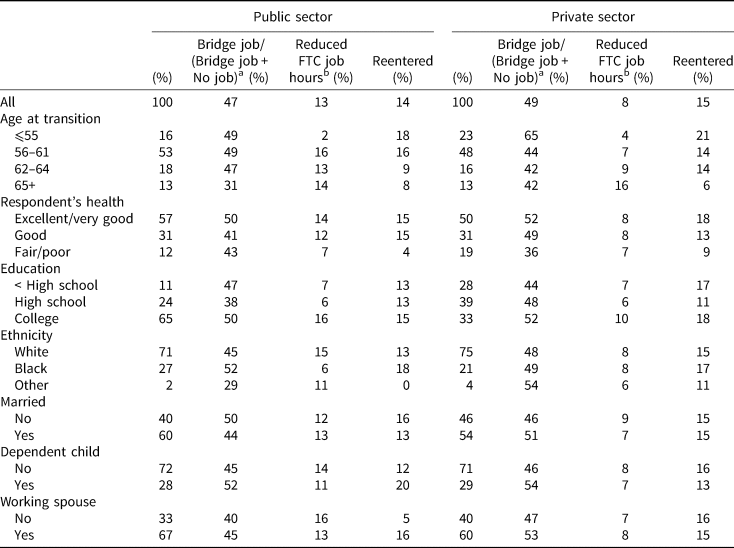
We next examine the extent to which public- and private-sector transitions differ with respect to known determinants of gradual retirement. Not surprisingly, bridge job prevalence generally declines with the age at transition from the FTC job (although not always monotonically), and generally increases with better self-reported health status and higher educational attainment (Tables 5 for men; 6 for women). Bridge job prevalence is also higher among those who are married compared with those who are not, and higher among the married with a working spouse than those married without one. The prevalence of labor market reentry also declines with age, increases with self-reported health status, and is higher among those with a working spouse – all reasonable results. In contrast to bridge job activity, the prevalence of reentry is higher among those with less formal education and those not married, perhaps those less prepared to handle negative post-retirement shocks. Phased retirement increases with educational attainment and, among public-sector workers, increases with higher rated self-reported health status, but, in contrast to both bridge employment and reentry, increases with age. One explanation for the latter result is that older workers who remain in career employment might be more likely than their younger counterparts to request phased retirement.
Transitions from FTC employment by worker characteristics, HRS Core men on a FTC job at the time of the first interview

a Does not include respondents who were not working for two consecutive waves following FTC employment and who later reentered.
b Percentage of respondents who experienced a reduction in career job hours of 20% or more.
Source: Authors' calculations based on the Health and Retirement Study.
Transitions from FTC employment by worker characteristics, HRS Core women on a FTC job at the time of the first interview

a Does not include respondents who were not working for two consecutive waves following FTC employment and who later reentered.
b Percentage of respondents who experienced a reduction in career job hours of 20% or more.
Source: Authors' calculations based on the Health and Retirement Study.
Regarding differences by sector, public-sector workers were slightly older than private-sector workers at the time of their transition from career employment. The percentage of public-sector men and women who left career employment prior to age 56 was about 16% compared to 19% and 23% for private-sector men and women. Public-sector career workers were in better self-described health and less likely to report their health as fair or poor – 11% compared to 19%. Finally, public-sector workers were almost twice as likely as private-sector workers to have a college degree (58% vs. 36% for the men; 65% vs. 33% for the women).
Regarding phased retirement and reentry, the general patterns by age, health status, educational attainment, and other demographic characteristics among public-sector workers resemble those of private-sector ones.
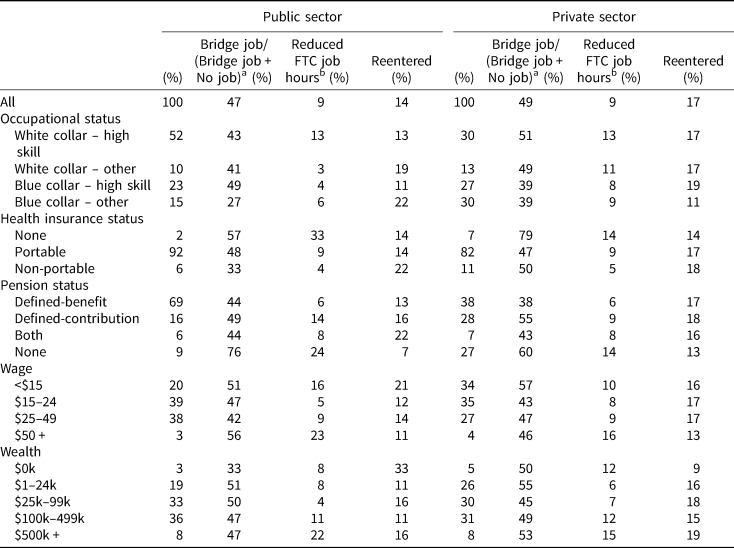
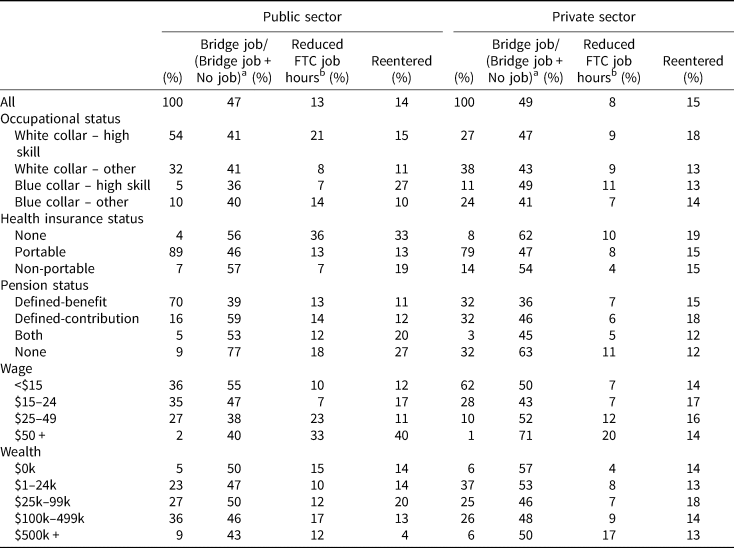
There are important differences by sector in several job and economic characteristics known to influence gradual retirement decisions. Public-sector career workers are considerably more likely to be white collar and have health insurance that is portable (i.e., after leaving career employment), a defined-benefit pension plan, higher wages, and, to a lesser extent, higher levels of wealth (Tables 7 for men; 8 for women). Specifically, 62% and 86% of the public-sector career men and women were white collar compared to 43% and 65% in the private sector. Access to portable health insurance – either employer-provided retiree health insurance or health insurance not tied to career employment (e.g., private or through a spouse's health insurance) – is 10 percentage points higher for public sector career workers than for those in the private sector – 92% vs. 82% among the men and 89% vs. 79% among the women.
Transitions from FTC employment by job and economic characteristics, HRS Core men on a FTC job at the time of the first interview

a Does not include respondents who were not working for two consecutive waves following FTC employment and who later reentered.
b Percentage of respondents who experienced a reduction in career job hours of 20% or more.
Source: Authors' calculations based on the Health and Retirement Study.
Transitions from FTC employment by job and economic characteristics, HRS Core women on a FTC job at the time of the first interview

a Does not include respondents who were not working for two consecutive waves following FTC employment and who later reentered.
b Percentage of respondents who experienced a reduction in career job hours of 20% or more.
Source: Authors' calculations based on the Health and Retirement Study.
Access to defined-benefit (DB) pension plans has been declining over time but the prevalence of DB plans is considerably higher among public-sector workers – 75% of the public sector men had a defined-benefit pension plan (alone or in combination with a defined contribution plan) compared to only 45% of the private sector men; among women, the difference is even larger – 75% vs. 35%. And pension status and type matters. Among those men and women who left a FTC job, those who did so with a defined-contribution (DC) pension were more likely to move to a bridge job than those with a DB one, and those with no pension at all on their career job were more likely than those with a pension of either type to do so.
Finally, public-sector men and women are considerably less likely (by 14–26 percentage points) to be earning a low wage of $15/hour or less – 20% vs. 34% of the men and 36% vs. 62% of the women.Footnote 6 These differences in job and economic characteristics have an ambiguous effect on the prevalence of gradual retirement for public-sector workers. Those with unattractive characteristics on the career job, like low wages, no pension or no portable health coverable, might transition to a bridge job out of financial necessity. On the other hand, those with more favorable career job characteristics might have a more attractive set of options in the bridge job world, and do so out of interest rather than necessity.
An examination of phased retirement and labor market reentry within economic subgroups is limited by the relatively small sample sizes of important subgroups (e.g., public-sector workers with no health insurance). For subgroups where comparisons can be made, public- and private-sector men do not appear to differ systematically with respect to the prevalence of phased retirement and reentry within economic characteristic subgroups. Among women, however, phased retirement is notably higher for public-sector women than private-sector ones for those with white-collar, highly-skilled jobs (18%–21% vs. 7%–11%, respectively, across cohorts), portable health insurance (13%–19% vs. 7%–8%, respectively, across cohorts), defined-benefit pensions (11%–20% vs. 5%–8%, respectively, across cohorts), defined-contribution pensions (10%–41% vs. 4%–11%, respectively, across cohorts), and higher wages ($25–$49/hour) (23%–32% vs. 7%–12%, respectively, across cohorts). These differences by sector among women pertain only to phased retirement as similar patterns are not seen with respect to reentry.
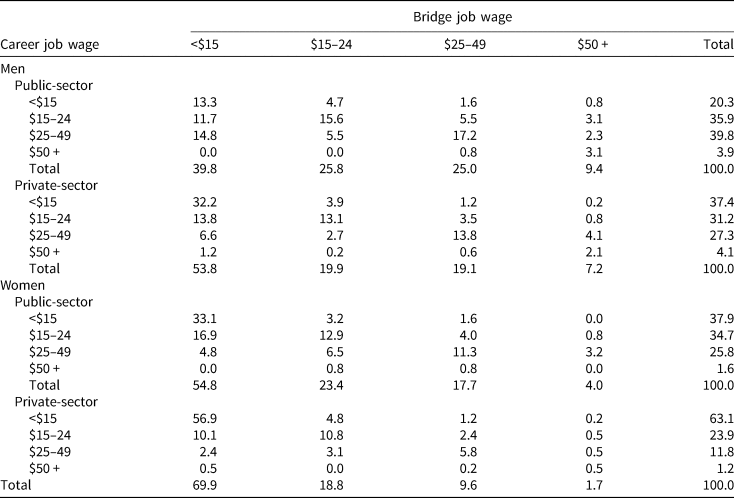
Prior to examining retirement determinants in a multivariate context, we note that the outcomes of gradual retirement (e.g., wages on the new job) might differ by the original public- and private-sector status. As seen in Table 9, both career public- and private-sector HRS Core men and women experienced a general decline in their wages when taking a bridge job. For example, among public-sector men who transitioned to a bridge job, 20% had wages below $15/hour (inflation adjusted) on their career job whereas about 40% did so on their bridge job. Among private-sector men, about one-third (37%) had wages below $15/hour whereas more than one half (54%) did on the bridge job. Similar increases in the percentage of low-wage workers in the bridge jobs are seen among women. More detailed analyses of wage and other job attribute differences between career and bridge employment are warranted in future research.
Hourly wages in career and bridge employment, by gender, and sector, HRS Core respondents on a FTC job at the time of the first interview

Source: Authors’ calculations based on the Health and Retirement Study.
2.4 Multivariate analysis of gradual retirement among public- and private-sector older workers
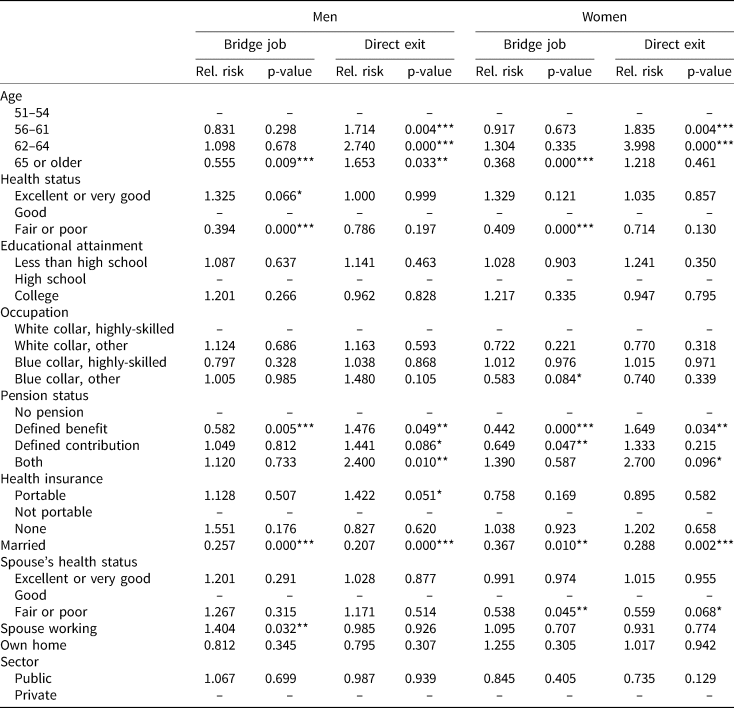
The differences in important demographic and economic characteristics by sector, with some suggesting a higher prevalence of gradual retirement among the public-sector workers (e.g., more likely to be college educated and white-collar) and others suggesting a lower prevalence (e.g., older at transition and more likely to have a defined-benefit pension), suggest a multivariate approach that simultaneously takes many characteristics into account. Using the multinomial logistic regression model specified in Equation (1), with separate equations for men and women, we find that many of variables included are statistically significant explanators of the decision to take a bridge job (Table 10).Footnote 7 For example, other things equal, men are less likely to take a bridge job the older they are at the time of the first transition, if they are in fair or poor health, or if they have a defined-benefit pension. They are also less likely, other things equal, to take a bridge job if they are married, and this effect is diminished if the spouse is working. For women, the age, health, and defined-benefit pension impacts are similar to the men, although the pension impacts for women apply to those with defined-contribution plans as well. The labor force status of the spouse does not appear to be important for the bridge job decisions of women, but the health status of the spouse is – but for women only, who are less likely to take a bridge job if their spouse is in fair or poor health, perhaps for care-giving reasons. Older men do not seem to be similarly constrained! The public-sector coefficient is nowhere near significant, which is consistent with our general finding that the career job exit patterns of public- and private-sector workers are very similar, even though the two groups differ with respect to known determinants of retirement.
Relative risk ratios from multinomial logistic regression, dependent variable: first transition from FTC job, HRS Core respondents on a FTC job at the time of the first interview1, 2

[1] The following controls (not shown) are also included in the regression: ethnicity, presence of dependent child, wage, wealth, and region.
[2] Based on all bridge jobs if multiple bridge jobs are observed.
*Statistically significant at the 10% level; **statistically significant at the 5% level; ***statistically significant at the 1% level.
Source: Authors’ calculations based on data from the Health and Retirement Study.
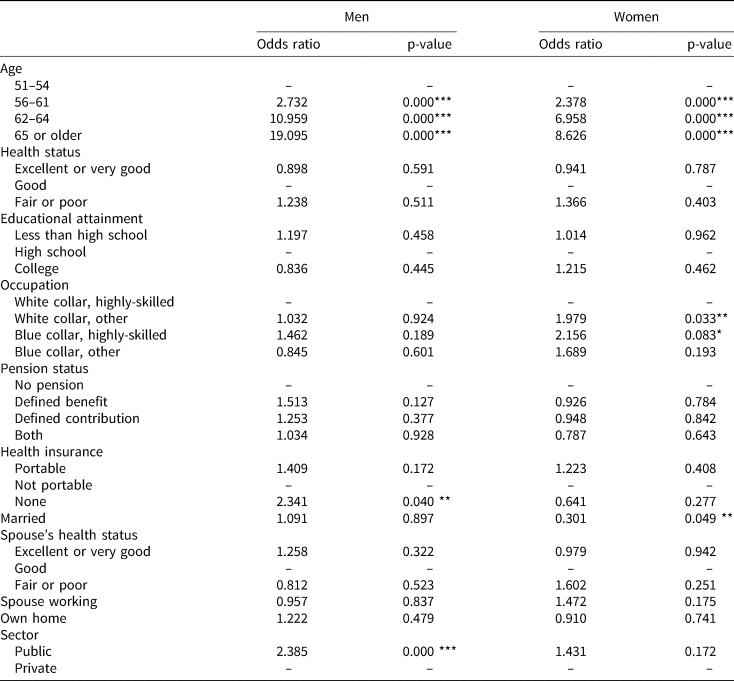
The descriptive analysis above revealed that public- and private-sector workers differed with respect to the number of hours worked in bridge employment, with part-time bridge employment appearing to be much more prevalent among public-sector workers. This result is confirmed in the multivariate analysis (Table 11). After adjusting for other factors, public-sector men are well more than twice as likely as private-sector men (and public-sector women also more likely than private-sector women, although the result for women is not statistically significant) to be working part-time in bridge employment. Age at the time of transition, not surprisingly, is a strong determinant of part-time bridge employment, but the majority of demographic and economic characteristics included in the model, measured at the time of transition, are not significant. This suggests that the determinants of working part-time in bridge employment differ from those that influence the choice of gradual retirement compared with direct exit.
Odds ratios from logistic regressions, dependent variable: part-time bridge employment, HRS Core respondents who transitioned to bridge employment1, 2

[1] The following controls (not shown) are also included in the regression: ethnicity, presence of dependent child, wage, wealth, and region.
[2] Based on all bridge jobs if multiple bridge jobs are observed.
*Statistically significant at the 10% level; **statistically significant at the 5% level; ***statistically significant at the 1% level.
Source: Authors’ calculations based on data from the Health and Retirement Study.
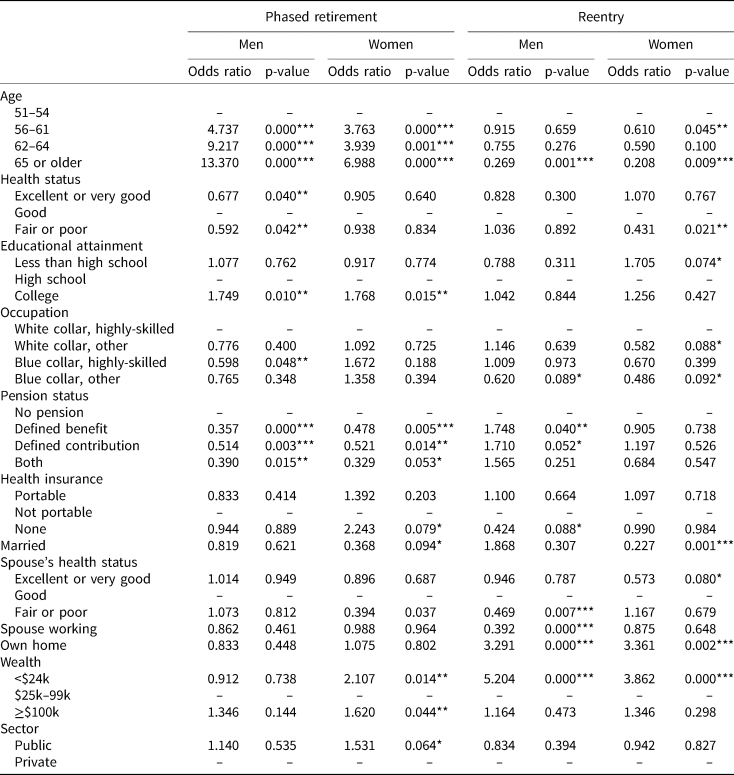
Another area where public- and private-sector workers differed in the descriptive analysis is with respect to phased retirement – reduced hours on the career job. These differences hold in a multivariate context for women only. All else equal, career public-sector women are significantly more likely than those in the private sector to lower the number of hours worked in career employment by 20% or more (Table 12). As with the bridge job models, age at the time of transition, health status, and pension status are significant determinants of both phased retirement and reentry. The fact that public-sector status is a statistically significant predictor of phased retirement among women, but not men, is noteworthy. Assuming that demand-side barriers to reducing hours in public-sector career employment do not differ by gender, this finding suggests that supply-side factors could be driving the result, and the extent to which such factors are voluntary (i.e., desire for more leisure time) or involuntary (i.e., elder care responsibilities) for women warrants further exploration in future research.
Odds ratios from logistic regressions, dependent variable: reduced FTC job hours and reentry, HRS Core respondents on a FTC job at the time of the first interview1, 2

[1] The following controls (not shown) are also included in the regression: ethnicity, presence of dependent child, wage, and region.
[2] Health, spouse's health, marital status, presence of a dependent child, home ownership, wealth, and region are measured in the wave prior to reentry for those who reenter.
*Statistically significant at the 10% level; **statistically significant at the 5% level; ***statistically significant at the 1% level.
Source: Authors' calculations based on data from the Health and Retirement Study.
3. Policy relevance
The exit patterns of career public-sector workers are diverse, just as in the private sector. About one-half of FTC public-sector workers move to a bridge job prior to leaving the labor force, which is similar to their private-sector counterparts. Career public- and private-sector workers are also similar with respect to labor force reentry (unretirement) after an initial departure. Of the three components of gradual retirement, phased retirement is the one in which public- and private-sector career workers appear to differ. In particular, among women, the prevalence of phased retirement is higher among career public-sector workers although the overall prevalence of phased retirement among both groups is low relative to that of bridge employment. The prevalence of phased retirement among men does not differ significantly by sector.
Where public- and private-sector workers differ most is with respect to the hours worked upon leaving career employment, with part-time bridge employment being more common among public-sector workers. This has important policy implications. Public-sector workers, on average, have characteristics that would suggest a higher degree of financial security in retirement, not only with the availability of defined-benefit pensions, but also because of their self-reported health status, educational attainment, wages, and wealth. These characteristics, along with public-sector workers’ subjective responses about why they left career employment (Table 4), suggest that the gradual retirement decisions of public-sector workers are largely voluntary. Public-sector workers appear to remain in the labor force on a part-time basis because they want to, not because they have to for financial reasons.
Public-sector workers’ preferences for gradual retirement highlight a potential opportunity for public employers, as policies that facilitate phased retirement may help reduce abrupt retirements and the workflow disruptions they might cause, especially in this era of rapid workforce aging. The key to capitalizing on this opportunity is to properly incentivize continued employment in the public sector. For some public workers such incentives will not matter, as bridge employment provides an opportunity to try a new line of work, perhaps in a new part of the country. For others, however, the choice between continued but part-time work in the public sector and part-time employment elsewhere could be marginal, and the right incentives could shift the decision in favor of continued public-sector work.
In 2014, the Office of Personnel Management (OPM) offered a formal phased retirement option to some federal workers, which is an important development (U.S. Office of Personnel Management, 2018).Footnote 8 A key feature of this policy is that federal workers who qualify can receive a prorated pension while reducing their hours. Perhaps more importantly, the size of workers’ pension benefits, when they do retire completely, are not negatively impacted by reducing their work hours later in life, as would be the case under final-average-salary formulas. Employees also continue to receive service credits (adjusted for hours) while working.Footnote 9
More broadly, however, typical benefit formulas within defined-benefit plans present challenges for phased retirement options and highlight a key tradeoff relevant to the current retirement income landscape. On one side, the financial security that DB plans provide to public employees is a strong positive attribute and can help public employers attract new workers through deferred compensation and also encourage the departure of older workers through early retirement incentives. But these same incentives can limit the gradual retirement options of older workers, however, thus prompting the need for policies such as OPM's new policy. How this barrier to phased retirement compares with the net benefits of DB plans (net of the financial burden that such plans have imposed on local and state governments) could inform policy decisions about the attractiveness of DB plans in the public sector going forward.
Another important consideration is the balance between attributes of public- and private-sector employment generally. The relative job stability, generous defined-benefit plans, and regular work hours in the public-sector can counterbalance higher salaries in the private sector. As such, the well-documented shift toward DC plans and away from DB plans in the private sector may have increased the relative attractiveness of public-sector employment.
One aspect of this shift is that private-sector workers now bear more market risk in saving for retirement. They are responsible for asset allocation decisions and for determining when and how to withdraw the money from their retirement accounts so that they do not outlive their assets. One way to address the latter issue is to purchase annuities. Retirees currently have this option but relatively few do so (Brown, Reference Brown2007). Research has also shown that DC plan participation increases when participation is the default and employees must opt-out if they do not want to participate (Beshears et al., Reference Beshears, Choi, Laibson, Madrian and Wise2010; Butrica and Karamcheva, Reference Butrica and Karamcheva2015). It is possible that an opt-out provision for annuities could have a similar effect on the number of retirees that choose to annuitize all or part of their retirement account.
Whether this type of arrangement is feasible will depend on the ability of companies to negotiate the fees for setting up the annuity and to ensure that the insurance companies managing the annuity payments are financially secure. It would also be necessary to determine the fraction of the retirement account that is annuitized and whether the annuity payments are tied to inflation. Early research on opt-out DC plans was conducted by getting a few companies to change the default (Holden and VanDerhei, Reference Holden and VanDerhei2005). Employees could easily reverse this decision at any time, but it is more complicated to get out of an annuity after payments have started. Fortunately, most workers will receive Social Security, which provides risk-free fully-indexed annuity payments.
Many older Americans face financial challenges later in life, especially those without a defined-benefit employer pension. One very important option for reducing financial insecurity later in life, for those physically able to do so and with demand for their skills, is to continue working (Munnell and Sass, Reference Munnell and Sass2008; Quinn and Cahill, Reference Quinn and Cahill2016; Reference Quinn, Cahill, Clark, Maurer and Mitchell2018).Footnote 10 Should a DB-to-DC shift take place in the public sector, the retirement patterns of today's public-sector workers suggest that continued work later in life could help secure their financial well-being after retirement.
Several topics related to the retirement patterns of public-sector career workers are worth exploring in future research. First, this paper focuses on transitions from public-sector career jobs later in life. Transitions from public-sector career jobs earlier in an individual's work history (e.g., in one's early- to middle-40s) could impact retirement transitions later in life. Second, the HRS provides information on the desirability and ability to reduce career job hours, and this information could be used to further understand the mechanisms behind the retirement transitions of public- and private-sector workers. In a similar vein, a more detailed examination of occupational status, beyond the 4-way characterization used in this paper, might also shed light on the determinants of retirement, as well as any impacts due to differences in occupation by gender. Third, tax policies related to public-sector pension benefits might also affect retirement behavior, and the impact of any increases in disposable income might be worth exploring. Finally, transitions into public-sector employment might be worth some attention as well, especially in the context of encore jobs – those that serve a social purpose in addition to providing compensation. Such arrangements might benefit both career private-sector workers as well as public employers, as they tap into a highly experienced workforce. Some policies may help facilitate these arrangements. One option is to help reduce barriers to hiring older workers in the public-sector, perhaps by streamlining the hiring and training process for more experienced applicants, or by offering part-time positions with a set tenure commitment. Such a structure could be appealing to older private-sector workers looking for meaningful work that contributes to the broader community.
4. Conclusion
This paper explores work after departure from career employment in the public and private sectors, with a focus on bridge jobs, phased retirement, and labor market reentry. We find that the diverse retirement patterns that have been well documented in the private-sector literature apply also to career public-sector workers. Bridge employment is most common, with about one-half of workers transitioning to a bridge job following FTC employment, followed by labor market reentry and phased retirement, which are much less prevalent. Differences by sector exist with respect to hours worked in bridge employment, with public-sector career workers being more likely to work part-time. Among women, public-sector career workers are also more likely than those in the private sector to experience phased retirement – defined here as a reduction in hours on the career job by 20% or more.
From a policy standpoint, what is most notable about the gradual retirements of public-sector career workers is that they are so similar to those in the private sector. To our surprise, public-sector workers are not more likely than private-sector workers to choose one-time, permanent exits from the labor force (‘traditional’ retirements). Instead, workers in both sectors exhibit remarkable flexibility when it comes to continued work later in life, which is a bright spot among the many challenges our aging society is confronting. The diverse retirement patterns of public- and private-sector workers expand options for continued work later in life, helping to strengthen families’ financial well-being and meet employers’ needs for a talented and experienced workforce and society's goals for the production of more goods and services to support our aging population.
Acknowledgements
This paper was prepared for the NBER conference, ‘Incentives and Limitations of Employment Policies on Retirement Transitions: Comparisons of Public and Private Sectors,’ held in Jackson Hole, WY on August 9–11, 2018. All views expressed in this paper are those of the authors and do not necessarily reflect the views or policies of the U.S. Bureau of Labor Statistics. We thank (and so should the readers!) Kathleen McGarry, our discussant, and others in attendance for excellent comments on an earlier draft of this paper which led to the much more succinct version here.