1 Introduction
Huddleston & Pullum (Reference Huddleston and Pullum2002: 561–2) briefly note the existence of two intensifying adjectival constructions in Present-day English: intensificatory tautology (the syntactic juxtaposition of two cognitively synonymous adjectives, e.g. massive great mountains, whole complete thing) and intensificatory repetition (the iteration of one and the same adjective, e.g. long long way, old old story). This case study focuses on the former of these intensificatory options, i.e. the intensificatory tautology construction.
Probably because of its (relatively) low frequency in the language, the attention that intensificatory tautology has traditionally received is relatively scarce. Insightful remarks on either specific tautological clusters or on the register(s) where tautological intensification is often attested are found in previous literature (see the comments on tiny little, great big, big fat in Matthews Reference Matthews2009, Reference Mathews2014; Coffey Reference Coffey, Hasselgård, Ebeling and Ebeling2013; also section 2 below). However, no in-depth study of intensificatory tautology as a ‘type’ of intensificatory strategy in English (understood, in line with Traugott & Trousdale Reference Traugott and Trousdale2013: 14ff., as a (sub)schematic construction) has been carried out so far, either synchronically or diachronically.
It is the aim of this article to (begin to) fill the gaps in previous literature by (a) exploring the nature and distribution of tautological intensification in Present-day English (henceforth PDE) and, on the basis of the latter analysis, (b) assessing the significance of tautological intensification for synchronic descriptions of the English Noun Phrase (henceforth NP). The investigation concentrates on the most frequent tautological cluster combination (see Huddleston & Pullum Reference Huddleston and Pullum2002: 562), i.e. that created by the juxtaposition of two size-adjectives (e.g. big fat, great huge, tiny little, etc. On this restriction, see also section 2 below).
The article is structured as follows: section 2 briefly summarises previous literature on tautological intensification. Section 3 outlines the methodology. Sections 4–6 are devoted to the formal and functional analysis of selected tautological clusters in PDE, whereas section 7 summarises the main findings of the article and their significance for NP research.
2 Tautological intensification: previous literature
It has often been pointed out in previous literature that tautology is cross-linguistically associated with the conveyance of intensity/emphasis (Rubino Reference Rubino and Hurch2005: 19; Benczes Reference Benczes2014: 440). The tautological clusters examined here are no exception to this: for instance, tiny little in a tiny little bird is used to point to a bird of an ‘exceptionally small size’; great big in a great big hole, his great big party highlights the magnitude (physical or otherwise) of an entity/event. As indicated in the Introduction, this article focuses on combinations of size-adjectives only (e.g. great big, tiny little, big huge). Similar clusters with other (non-dimensional) adjectives are of course attested in PDE (e.g. basic fundamental, complete whole, remote rural). The overall frequency of these other synonymic adjective clusters is (among other considerations) too low to make robust claims regarding their syn-semantic distribution and therefore they have not been included in the study. In order to make this restriction clear, the article adopts the term size-adjective cluster to refer to the phenomenon that occupies us here.
Tautological size-adjective clusters are briefly discussed in Huddleston & Pullum (Reference Huddleston and Pullum2002: 562). They categorise them as ‘intensificatory tautology’ constructions and observe that they are frequently found with adjectives of ‘very large’ or ‘very small’ size (e.g. great big, tiny little), often in informal styles and oral domains. Structurally, they see them as standard cases of ‘stacked modification’, i.e. in a tiny little bird, little first creates a nominal with bird (little bird ‘bird of small size’) which is subsequently modified by tiny ([tiny [little bird]) to express, as noted above, ‘a bird of an extremely small size’.
Recent work, however, challenges Huddleston & Pullum's (Reference Huddleston and Pullum2002) claims. Coffey (Reference Coffey, Hasselgård, Ebeling and Ebeling2013: 64ff.) queries a too-lineal correlation between tautological clusters and the notion of intensification. He singles out the cluster tiny little and suggests that this combination may sometimes be semantically less intensive than the use of tiny by itself (he compares tiny little grocers with tiny grocers) because of the association of little with affective meanings. Like Coffey (Reference Coffey, Hasselgård, Ebeling and Ebeling2013), Matthews (Reference Mathews2014: 99) notes the difficulty of teasing apart affection and degree emphasis in clusters where little is involved. Nevertheless, the emphatic nature of the tautological construction seems for him – as for Huddleston & Pullum (Reference Huddleston and Pullum2002) – to be an essential property of the cluster (Matthews Reference Matthews2009: 365). Furthermore, Matthews (Reference Matthews2009, Reference Mathews2014: 100) takes issue with Huddleston & Pullum's (Reference Huddleston and Pullum2002) view on the stacked nature of adjective clusters, suggesting instead that both adjectives jointly modify the head noun as a single unit. Matthews (Reference Mathews2014: 99; see also Reference Matthews2009: 364) also briefly comments on the fact that size-adjective clusters are not only restricted to ‘specific adjectives’ (i.e. large/small size adjectives) but also to adjectives ‘in specific orders’ (e.g. great big and tiny little are preferred over big great or little tiny). Coffey's (Reference Coffey, Hasselgård, Ebeling and Ebeling2013: 59) corpus data, however, reveal diverging ordering preferences for some of the clusters discussed by Matthews (Reference Matthews2009; see section 4.2 below).
As may be obvious from the Introduction and the brief summary above, previous accounts on size-adjective clusters, while very insightful, leave room for further investigation. On the one hand, the more theory-oriented investigations (Huddleston & Pullum's Reference Huddleston and Pullum2002; Matthews Reference Mathews2014) are based on the scholars’ perceptive insights rather than on an analysis of large-scale data. On the other hand, the recent corpus-based work (Coffey Reference Coffey, Hasselgård, Ebeling and Ebeling2013) aims at providing greater descriptive adequacy of specific patterns without engaging with wider questions on the structure of the NP. The present case study bridges the two approaches by using corpus-based methods to not only uncover general patterns of use across size-adjective clusters but also test the validity of previous theory-oriented claims regarding size-clusters and explore the clusters’ overall significance for the formal and functional make-up of the English NP.
3 Method
Three readily available compilations were used for the analysis, i.e. the British National Corpus (henceforth BNC1990), the Collins WordBanks Online and the newly compiled Spoken BNC2014 (henceforth BNC2014). The three corpora offer a variety of written and spoken texts and their combination provides adequate chronological coverage of the present-day English period (1960–2014).Footnote 1 Only the British English data within each compilation were used for the study.
The tool Phrases in English Footnote 2 was used to retrieve all [ADJ ADJ] 2-gram clusters in the BNC1990 with a minimum of 5 tokens of frequency. A similar POS-tag search was carried out in the Collins WordBanks corpus. From the initial list of adjective clusters, all pairs featuring two size-adjectives were selected (24 clusters).Footnote 3 However, as n-gram clusters are based on raw frequencies only, statistical tests of collocational strength (MI scores and T-scores) were carried out to ensure the robustness of the pairs.Footnote 4 Only those pairs with an MI- and T-score value of 3.5 or above were selected for the analysis (see (1) below).Footnote 5
(1) big fat, great big, big huge, tiny little, great massive
For each cluster, all tokens were retrieved across the three corpora and manually checked. Discarded examples included:
• Cases where one of the adjectives (often the rightmost one) is part of either another collocation or a fixed expression with a noun. See the case of big brother and Great Dane in examples (2)–(3) below:
(2) ‘In a way, I maybe asked for it,’ Cynthia said. ‘I know I go on a bit. It's just that he's such a great big brother.’ (Collins, BB-gF022241)
(3) Recently, until his untimely death, equally well-attired, he walked his massive Great Dane on the Ardrossan beach. (Collins, NB5-010509)
• Instances where the noun modified by the adjective cluster either has been omitted or is unclear (this only applies to tokens attested in the spoken part of the corpora):
(4) It's not a great big [unclear]. (BNC, HE9628)
(5) a big graph like and and I only need a little tiny . . . (BNC, FME706)
In addition, cases where the selected size-adjectives appear in three-adjective clusters (see examples in (6)–(7) below) were discarded from the main dataset but saved in order to investigate them separately at a later stage (see section 5 below):
(6) And it's a huge great big muscle but it can get a little bit er inflamed, as it passes over the front edge of the kneecap there (BNC, G5U99)
(7) Oh dear. I never forgot that woman as long as I live. Ooh great big fat horrible woman she was (Collins, SB3-00118)
4 size-adjective clusters: analysis of their behaviour
4.1 General remarks
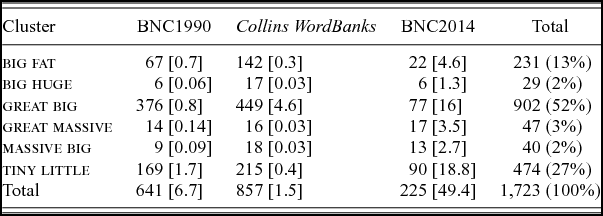
Table 1 summarises the overall frequency of the selected size-adjective clusters in the corpora. Capitalisation represents cluster lemmas; e.g. huge big stands for both huge big and big huge patterns (see section 4.2 below on the order of these clusters). Figures in square brackets record normalised figures per million words.
size-adjective clusters across corpora

A close look at the table shows that all adjectives included in the size-clusters are gradable (all of them denote a particular point on a scale) and relatively schematic (they can map meanings onto different types of scales). Whether the scale they map onto is a physical dimension (e.g. massive hole), a non-physical dimension (e.g. big voice), a temporal (e.g. little minute) or a metaphorical one (e.g. fat lie), depends primarily on the nominal referent they combine with and the context of use (Lorenz Reference Lorenz1999: 56; Murphy Reference Murphy2003: 39).
Furthermore, the adjectives in these clusters can be subdivided into two different groups depending on their mode of gradability (Paradis Reference Paradis1997: 47–8). Adjectives such as big, great and little are scalar, i.e. they map a given property onto different points of a scale range. By contrast, adjectives such as tiny, huge and massive are extreme (Paradis Reference Paradis1997: 54), i.e. they are conceptualised as always occupying either the uppermost (huge, massive) or the lowermost (tiny) point of a scale. Without going into too much detail, this difference can be easily captured by looking at the type of degree modifiers that they tend to combine with: scalar adjectives often accept degree modification by boosters such as very or really (e.g. really big, very little), whereas extreme adjectives usually combine with maximisers such as totally or absolutely (e.g. compare totally massive, absolutely huge with ?very huge/massive). These modification patterns are of course tendencies rather than hard-and-fast-rules: pragmatic factors need to be considered when selecting a particular intensifier–adjective combination (see Paradis’ Reference Paradis1997: 59 concept of ‘contextual modulation’).
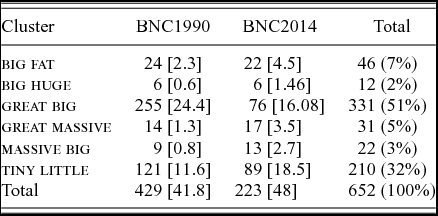
Focusing now on the size-adjective clusters as wholes, stark frequency differences are observed, with big fat, great big and tiny little accounting for over 90 per cent of the attested tokens. Note, however, that size-adjective clusters are infrequent overall: great big, the most frequent cluster on the list, amounts to fewer than 20 tokens per million words in any given corpus. A diachronic, cross-corpora look at the data suggests a noticeable increase of all size-clusters in PDE. Admittedly, this figure is based on the distributional frequencies of the clusters in both spoken and written domains rather than on spoken language only (where previous literature suggests that size-adjective clusters are most frequently attested). When only the spoken subcorpora are considered, usage frequencies still increase – although less noticeably (from 46 to 48 tokens per million words; see table 2).Footnote 6
size-adjective clusters: spoken data

A detailed analysis of the behaviour of the clusters is provided in sections 4.2 and 4.3 below.
4.2 Formal behaviour
This section focuses on two mains aspects, i.e. the syntactic behaviour of size-adjective clusters and their cluster-internal ordering preferences.
As regards syntactic behaviour, previous researchers have classed size-adjective clusters as attributive-only constructions (Huddleston & Pullum Reference Huddleston and Pullum2002: 561). The corpus data considered here support the claim, with over 99 per cent of the tokens scrutinised featuring attributive uses. Some examples where size-clusters occur in predicative ((8)–(9)) and postpositive positions ((10)–(11)) are, however, found. In most cases, the examples feature great big, although some tokens of other size-adjective clusters are also attested ((10)–(11)):
(8)

(9)
(10) I've got a bump. . .twenty-seven on my left knee. All huge big and red and puffy and very squidgy and like because I'd been sunbathing the actual (Collins, SB3-001406)
(11) [flies] that had been attracted to the corpse. Perhaps a dozen of them, big fat and black, took to the air and buzzed lazily. (Collins, BB-M022179)


Moving on to linearity issues, previous scholarship has commented on the organisational preferences of specific size clusters. As regards ‘large size’ adjective combinations, the order great big (e.g. a great big hole) is ‘normal’ for the cluster great big. Speaker preference is noted as the main factor motivating the choice (see Matthews Reference Mathews2014: 99; also Coffey Reference Coffey, Hasselgård, Ebeling and Ebeling2013: 56). For small-size clusters (tiny little), both Matthews (Reference Matthews2009: 364) and Coffey (Reference Coffey, Hasselgård, Ebeling and Ebeling2013) favour the order tiny little over little tiny. Matthews (p.c.) relates the variation to prosodic differences (intonation and rhythm). Coffey's (Reference Coffey, Hasselgård, Ebeling and Ebeling2013) corpus-based study explores a number of possible motivating factors, i.e. domainFootnote 7 (spoken vs written texts), register (formal vs informal communication), type of nominal head and modification preferences (i.e. presence/absence of intensifiers) of the cluster, as well as speaker's sex and age. However, only the first factor appears to have a noticeable impact on the ordering of the cluster, in that ‘little tiny is almost twice as frequent as tiny little in the spoken data, and tiny little is by far the more frequent phrase in the written language’ (Coffey Reference Coffey, Hasselgård, Ebeling and Ebeling2013: 59).
Table 3 records the order preferences of the size-adjective clusters considered here.
Frequency distribution across size-clusters and patterns

Overall, the results align with previous scholars’ suggestions. Great big is indeed the most frequent order of the great big cluster in the data (cf. Matthews Reference Mathews2014). Also, in line with Coffey's (Reference Coffey, Hasselgård, Ebeling and Ebeling2013) claims, tiny little shows itself as a reversible cluster, either pattern being amply attested (but note that no prosodic tests were carried out in order to explore the rhythmic difference between little tiny and tiny little).Footnote 8 Furthermore, the figures provide a relatively straightforward cline of reversibility across clusters. At the irreversible end of the continuum stand great big and big fat. massive great, tiny little, massive big and big huge feature (in that order) more reversible options.
The reasons behind the preferences for one or another pattern within a cluster are however more difficult to ascertain. Focusing first on the claims put forward by previous scholarship, speaker preference cannot be usefully measured when readily available, large-scale corpora are taken as the methodological basis of the investigation. Medium (i.e. spoken vs written), register and modification preferences do not seem to have a noticeable effect on cluster order in the corpora either. Note, in this respect, that Coffey's (Reference Coffey, Hasselgård, Ebeling and Ebeling2013) suggestions about the differences in the order of tiny little across speech and writing may be less significant than expected, as the tiny little tokens attested in written texts in the corpora frequently come from stretches of spoken language in novels and/or magazines (e.g. fictional dialogue, indirect representation of speech, interviews, etc.; see example (12) below).
(12) ‘Do you remember the Polanski movie Repulsion, where all you see of the city is a tiny little street outside Catherine Deneuve's flat? (BNC, CK41843, New Musical Express [arts periodical])
The possible impact of other cluster-internal and contextual determinants was also checked in the data. For intra-cluster motivations, the adjectives’ gradability type (scalar vs extreme) was considered (the four reversible size-adjective clusters in the corpus data feature a combination of one scalar and one extreme adjective). However, no systematic lineal preferences were observed across clusters: massive great and tiny little seem to prefer the pattern where the extreme adjective precedes the scalar one whereas in massive big and big huge, the scalar + extreme adjective option is more frequent (see table 3).
Moving now on to contextual factors, it was briefly noted above that size-adjectives map onto different (physical and non-physical) dimensional scales in a flexible manner, i.e. depending on the semantics of the noun with which they combine (compare a tiny little house, a massive great bungalow with a tiny little detail, massive great bureaucracies). The preference for one or another adjective order may therefore be influenced by the particular combination of size-adjective cluster and nominal referent. This type of analysis, however, moves away from formal criteria and into functional considerations, and therefore it will be considered in more detail once the functional behaviour of size-clusters is explored (section 4.3 below).
All in all – and in spite of the inconclusive results obtained – the analysis carried out in this section suggests that size-adjective clusters are, formally, linearly flexible constructions with a very strong preference for attributive uses.
4.3 Functional behaviour
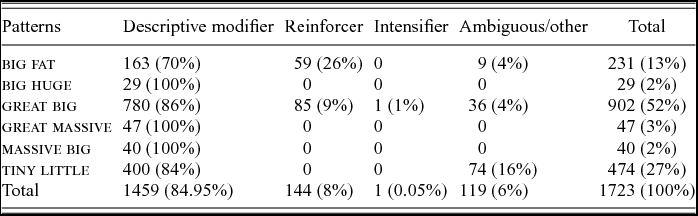
size-adjective clusters have been associated with standard adjectival functions in previous literature, i.e. as property-assigning or ‘descriptive’ modifiers of a head noun (see Matthews Reference Mathews2014 or Coffey Reference Coffey, Hasselgård, Ebeling and Ebeling2013). The corpus analysis carried out here not only provides support for the association (see table 4 in section 4.3.5, where descriptive modifier uses amount to over 80 per cent of the tokens) but also expands on previous accounts by exploring (a) the range of descriptive modifier senses that size-clusters can convey and (b) their on-going development as reinforcers and adverbial intensifiers.
size-adjective clusters across functions

4.3.1 size-adjective clusters as descriptive modifiers
It is the nature of the nominal head (and the context of use) which determines the type of scale upon which size-adjective clusters prompt meaning. In general terms, spatial scales and, more specifically, ‘physical dimension’ is the meaning they convey most frequently (60 per cent of the tokens across clusters overall). Consider, in this respect, examples (9)–(10) above, where great big and huge big are used to describe the large physical size of different objects and individuals.
Examples where the nominal heads elicit non-physical or metaphorical dimensional readings of the size-adjective clusters are also recorded in the corpus (20 per cent of the instances). Illustrative examples are provided in (13)–(14). In (13), massive big denotes the ‘large size’ of a wedding reception, measured in terms of number of guests and entertainment (rather than the actual physical dimension of the venue). In the same example, massive great floods expresses largeness – in terms of amount of water. Big huge in (14) conveys metaphorical dimension (‘significance’):
(13) [A] massive big party and go on a long honeymoon in Florida because it is warm and they have lots erm years that there was a continuous series of these massive great floods . . . until the ice age finally retreated well back. (Collins, NBA-990906)
(14) ‘It's been a big huge help for us trying to get started over here. This is our way of saying thank you. . .’ (Collins, MB3-031125)
All the examples noted above qualify as descriptive modifying uses of the size-adjective clusters in that they attribute a particular property to the nominal referent. Further semantic–pragmatic differences among these senses can nevertheless be observed. Examples where the size-adjective cluster conveys physical dimension are more objective (in the sense they can be externally validated, e.g. massive great house), whereas uses prompting metaphorical scalar readings of the clusters are more subjective, i.e. their property-ascription is grounded in the speaker's point of view.Footnote 9 These differences are captured in recent functional literature in a distinction between ‘objective’ (in our case, physical dimension meanings of size-adjective clusters) and ‘subjective’ descriptive modifiers (in our case, non-physical and metaphorical senses; cf. Ghesquière Reference Ghesquière2010, Reference Ghesquière2014; Ghesquière et al. Reference Ghesquière, Davidse and linden2013). It is also important to emphasise here that the distinction between ‘objective’ and ‘subjective’ descriptive modifying uses has to be conceptualised as a continuum where senses may overlap. Consider for instance (15) below where both amount (non-physical dimension) and significance (metaphorical dimension) are prompted.
(15) this chap from erm was it Tesco's who had the big huge pay rise earns four yes Ian McLauren (Collins, SB1-0106)
4.3.2 size-adjective clusters: ambiguous examples
Overlaps are not only attested within particular functional domains (e.g. different types of descriptive modification; see section 4.3.1 above) but also across functions. For example, previous literature has commented on the fact that that little, teeny or wee may convey non-descriptive, affective meanings when mapped onto metaphorical scales (see Mathews Reference Matthews2009; also González-Díaz Reference González-Díaz, Conradie, Ronél, Beukes, Fischer and Ljunberg2010). size-adjective clusters where little conveys affection are indeed attested in the data. In these cases, however, the affective senses overlap with physical dimension denotations. Consider in this respect (16) below. The head noun thing conveys an affective meaningFootnote 10 which is matched by the semantics of the size-adjective cluster and the presence of the deictic demonstrative this (which promotes the construction of an involved narrative by bringing the described event ‘metaphorically close’ to the speech event). However, the size-adjective cluster in this context also specifies that the individual being talked about is not only positively regarded by the speaker but also ‘of a reduced physical size’.
(16) Amusement bubbled up in him at this tiny little thing with her hands planted firmly on her hips presuming to tell him what he was going to do. (BNC, JY64047)
4.3.3 size-adjective clusters as reinforcers
Unlike descriptive modifiers, reinforcersFootnote 11 do not normally ascribe a property to their nominal referent, but are instead ‘specifiers of degree at the same time as they convey an evaluation of the reliability of the proposition, i.e. they are epistemic markers’ (Paradis Reference Paradis, Bermúdez-Otero, Denison, Hogg and McCully2000: 233). Consider, for instance, the use of real in ‘a real help’ (see Huddleston & Pullum Reference Huddleston and Pullum2002: 555): in this example, real does not attribute a quality (‘having an objective existence’) to its nominal reference; it signals the speaker's appreciation of the support by emphasising the degree to which the property expressed by the head noun applies. Syntactically, reinforcers are attributive-only elements and, unlike descriptive modifiers, do not accept degree modification (as they themselves act as specifiers of degree, see the comment above). Examples (17)–(19) below illustrate size-adjective clusters in reinforcing function.
(17) She pushed me over and said, ‘I knew it wasn't nobody, yow great big baby!’ (BNC, CMD 2453)
(18) the latest incarnation of Star Wars ultra-baddie Darth Vader is just a great big softie. (Collins, NBA-020506)
(19) ‘And?’ ‘And nothing, guy. Big fat zero. The place was deserted and I looked like an asshole, going in ready for Christ’ (Collins, BB-M012098)
Note that, in all cases, the clusters do not specify an intrinsic property of their head noun. The ‘baby’ in example (17) does not refer either to a very young child or necessarily a ‘large-size’ (great big) human entity. On the contrary, it refers to an adult whom the speaker is not very sympathetic towards because of his/her immaturity. In this context, great big works with the noun to convey both negative affection and degree emphasis. A similar explanation applies to (18). The text evaluates the performance of an actor in his role as Darth Vader. Again, great big does not describe the size of the actor and/or that of his filmic impersonation but instead highlights the reviewer's displeasure with his performance (he is a ‘softie’ rather than a ‘proper baddie’). Along the same lines, big fat in (19) expresses the disappointing ‘nothingness’ of the speaker's findings.
It should also be noted here that the standard grammatical tests to prove the non-descriptive nature of reinforcing adjectives (i.e. syntactic position and intensification) work in size-clusters only partially. Syntactically, size-clusters are normally attributive-only constructions (see section 4.1 above) and therefore their predicative use will sound awkward regardless of its (descriptive/reinforcing) function (e.g. the big huge car ~ *the car is big huge [descriptive] / a great big softie ~ *the softie is great big [reinforcing]). The second criterion (intensification) seems however to be operative: whereas size-adjective clusters in descriptive modification functions combine with degree intensifiers in the corpus (see (20)–(21) below), no tokens of intensified reinforcers were found in the data:
(20) ‘Very big fat cheque,’ he added as a wry afterthought. (BNC, JXU3460)
(21) I'd imagined these huge things that were going to suck me to death, but they're actually little, like, just very very tiny little worms, about erm an inch long and very thin (BNC, FYP175)
4.3.4 size-adjective clusters as intensifiers
The last function of size-adjective clusters recorded in the corpus is that of intensifier. This function is, at the time of writing, rather limited: only one example is attested in the corpus data (see (22) below), although an advanced WebCorp search of UK sites reveals some more examples (e.g. great big little West End show, great big small world). Focusing on the corpus data example proper, great big in (22) has to be interpreted as a (sub)modifier of the following lexeme (little). Stacked modification does not seem to be a semantically viable option, as a lump of ice cannot simultaneously be large (great big) and small (little) in size. The function of great big in this instance seems to be that of booster (i.e. meaning ‘very’).
(22) Erm how about erm when it's great big little lumps of ice falling down what do you call that ends in ail? (BNC, FMG299)
4.3.5 Summary of findings
The distribution of the different functions across clusters is summarised in table 4.
The table shows that only great big and big fat feature unambiguous examples of reinforcer and intensifier uses. great big and big fat are also different from the other size-adjective clusters analysed here in three other respects, namely, both clusters have high token frequencies, are non-reversible (see tables 2–3 above) and feature most of the examples of scattered predicative and postpositive uses of size-adjective clusters. This has not gone unnoticed in previous sources: great big and big fat feature individual (sub)entries in some modern lexicographical works (e.g. see OED, great, adj.). Along the same lines, Coffey (Reference Coffey, Hasselgård, Ebeling and Ebeling2013: 56), for instance, notes that ‘[f]requency and irreversibility would suggest that “great big” may be best considered as a fully lexicalized phrase’. Furthermore, and although diachronic considerations fall outside the scope of this article, it is worth noting here that the development of reinforcer and degree intensifier functions of great big and big fat tallies with well-established historical pathways of lexical change; namely, the grammaticalisation of scalar adjectives into adverbs of degree (i.e. adjective > adverb cline; see among others Peters Reference Peters and Kastovsky1994; Adamson Reference Adamson, Fischer, Rosenbach and Stein2000; Méndez-Naya Reference Méndez-Naya2008).
(23)

The cline in (23) also highlights an aspect that so far has been only partially touched upon in the discussion; namely, the extent to which subjectivity operates across the functional distributions mapped out above. In a now classical paper, De Smet & Verstraete (Reference De Smet and Verstraete2006) expand on Traugott's notion of subjectivity by providing a typology that differentiates between ideational and interpersonal subjective notions. In a nutshell, ideational subjective cases include instances where a linguistic expression encodes the speaker's viewpoint and conveys an ideational meaning. Conversely, interpersonal subjectivity subsumes those cases where a linguistic expression ‘merely involves positioning of the speaker with respect to a content’, without propositional meaning (De Smet & Verstraete Reference De Smet and Verstraete2006: 385). Applying this distinction to the functionality of the clusters explored here (see (23)), one may argue that size-adjective clusters in descriptive subjective modifying functions are ideationally subjective (they ascribe a property to the referent of the noun and speaker-based emphasis due to the iteration of the same adjective). size-adjective clusters in intensifier and reinforcer functions are, in different ways, interpersonally subjective. In the case of the intensifier functions, the schematic (scalar) configuration of the size-adjective cluster has been foregrounded at the expense of its lexical content (Paradis Reference Paradis1997, Reference Paradis, Bermúdez-Otero, Denison, Hogg and McCully2000), with the result that the cluster can only convey degree meanings (which are, again, speaker-based). The interpersonal subjective meanings of reinforcers derive from the mapping of the size-adjective cluster onto a scale of evaluation. In either case, the speaker-based grounding is coded semantically and has syntactic consequences (note the syntactic restrictions of reinforcers mentioned above, and the fact that size-clusters in intensifying functions belong to a different grammatical category from that of descriptive modifier uses).
Subjectivity is, in Traugott's (Reference Traugott2010) view, a basic requirement for intersubjectivity (understood as the semantic codification of ‘the speaker's attention to the addressee self-image’, Traugott Reference Traugott2010: 32). While the data do not clearly show any cases of semantically coded intersubjectivity, they record clear examples where size-clusters are pragmatically intersubjective. The most frequent cases are those where deictic demonstratives co-occur with size-clusters in descriptive modifying functions (i.e. physical dimension; 62 examples). The context is often informal story-telling situations where the speaker introduces characters or objects important to the core of the narrative (see (24)–(25) below). Deictics are subjective indexes in that they ground the centre of the linguistic event in the speaker (Lyons Reference Lyons, Jarvella and Klein1982: 106; Davidse et al. Reference Davidse, Vandelanotte and Cuyckens2010a: 12; Traugott & Dasher Reference Traugott and Dasher2005: 23). However, in these particular examples, they are intersubjective in orientation as they are clearly used for stylistic effect, i.e. to portray a sense of immediacy that intends to involve the addressee in the narration (see Wu Reference Wu2004: 240; Carlier & De Mulder Reference Carlier and Mulder2010: 243).
(24) 0022 the next thing you knew she was up to there in this great big puddle weren't she 0012 That was so funny (BNC2014, BSCTR022)
(25) She's this massive big coat on, and I said to her, sh— I said, she said, I said you alright, Kerry (BNC, KPV6536)
Finally, the discussion in section 4.2 above considered the possibility that the lineal organisation of the size-adjective clusters may be influenced by functional factors (i.e. the particular combination of the size-adjective cluster and its nominal referent). The data reveal some suggestive differences. In the case of big huge, it is the pattern huge big (as opposed to big huge) that tends to combine with nouns that elicit non-physical and metaphorical readings of the cluster. Similar distinctions are found with tiny little, i.e. it is the tiny little pattern (not little tiny) which is most frequently found when the cluster conveys descriptive-cum-affective readings. As noted above, however, these differences are suggestive of possible developmental pathways rather than robust synchronic trends.
5 Three size-adjective clusters
The discussion in section 4 concentrated on the clustering of two size-adjectives immediately preceding a nominal referent. In this section, a consideration of cases where three size-adjectives co-occur is carried out to test the robustness of the patterns identified so far.
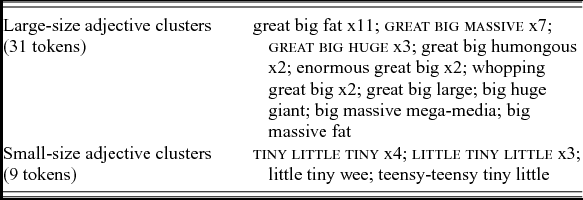
As noted above, size-adjectives vary in their schematicity; i.e. adjectives such as great or massive are more schematic (i.e. they can therefore map meanings onto a wider range of dimensional scales) than others such as long or tall. On the basis of this distinction, two different patterns can be observed in the three size-adjective cluster data: cases where three (more) schematic adjectives co-occur (e.g. a massive great big flask of coffee) and cases where we have a combination of more and less schematic adjectives (e.g. great big tall ceilings) (see table 5).
Schematic three size-adjective clusters

As regards the latter combination (clusters of more- and less- schematic size-adjectives), all examples in the data (13 tokens) feature size-clusters already examined, i.e. great big (10 tokens), tiny little (2 instances) and great massive (1 token), normally occurring on the left of a less schematic adjective (99 per cent of the cases). In other words, the lineal order of the cluster seems to be [great big/tiny little, etc. + less schematic adjective]. The most frequent adjective in the rightmost position is long (6 examples), always in combination with great big (i.e. great big long X). Other examples of rightmost adjectives in these combinations include broad, hefty, slim, skinny and tall.
(26) No such a thing as bales of straw, it was loose hay stacked, and you used to cut it with a big hay knife. <event: ‘bell ring’>Oh, great big hefty thing it was, it was an art to cut hay, with these big knives. (BNC, FX139)
(27) <ZF0>let's say something about Edmund Street library . . .
<M02/> Great massive tall rooms and it was scattered er er the original library er of course (Collins, SB1-0839)
The reading most frequently associated with these three size-adjective clusters is physical dimension (i.e. descriptive modifying functions). In example (26), for instance, the denotational vagueness of great big hefty thing is later specified in the utterance: the thing refers to a knife or tool for cutting hay, which happens to be large in size (big, great big). Similar physical dimension readings are obtained in (27). Cases featuring the combination great big long X are somewhat different, as in these instances, the size-cluster great big is often ambiguous between a degree intensifying (‘very’) and a descriptive modifying interpretation (i.e. ‘large size’, either physical or metaphorical) regardless of the noun it co-occurs with (see (28) below).
(28) you wrote a biography of John Major which was described as being well a great big long cuddle with the man it was so complimentary (COLLINS, SB1-0960)
The corpus data also record 40 examples where three (or more) schematic size-adjectives co-occur. In general, the large-size three-adjective cluster combinations either include the cluster great big (27 out of the 31 examples) or the adjectives great and big independently. The small-size clusters are, paradigmatically, less varied, i.e. they always feature tiny and little, and often one of these two is iterated. Consider table 5 for specific patterns – clusters in capitals represent, as in previous sections, lemmas.
The main difference between these three size-adjective clusters and the two size-adjective options explored in section 4 is pragmatic: the three size-adjective clusters above are more emphatic than the two-adjective ones. In functional terms, however, these three-adjective clusters still behave most frequently as descriptive modifiers. Consider (29)–(30) below, where the clusters highlight the excessively large/small size of a nunnery and a torch.
(29) Right keep going until you come to a great big massive place and that is the nunnery. He said Knock on that door and (COLLINS, SB3-000761)
(30) Just a little pocket, a little tiny, tiny torch with a very strong beam (BNC, KDR1120)
Reinforcer uses are also found, in all cases featuring the pattern great big fat (4 examples; see (31)–(32) below). In (31), the negative affective semantics of the nominal head toad is matched by that of the premodifying adjective ugly and further emphasised by great big fat. A similar reinforcer function of great big fat is recorded in (32). One may suggest that it is the semantics of the adjective fat what prompts the combination of the adjective string with evaluative nominal heads, great big being added to highlight further the speaker's viewpoint. A quick look at the BNC shows, for instance, that fat and slob have a MI- and T-scores of 9.1 and 2.4, respectively – values that are above the thresholds of interesting co-occurrences (see fn. 5 above). Example (32) also features the use of deictic this, which renders the combination as (pragmatically) intersubjective.
(31) . . . have to scream at you about MX sometime because I'm so pissed off with the stupid great big fat ugly toad. (COLLINS, SB1-1091)
(32) Oh it was very funny. They were in Istanbul and there was this great big fat slob of a sailor <ZGY/> they have ridiculous names I forget what he was called (COLLINS, SB3-001386)
In addition, ambiguous examples (between descriptive modifiers/reinforcer functions) are attested, often featuring small size-adjective combinations. In (33) tiny little conveys non-physical, temporal dimension (‘limited time’) scale, while at the same time projecting the speaker's own judgement, i.e. positive affection towards the work to be carried out:
(33)

All in all, the functional distribution of three size-adjective clusters closely mirrors that of their two adjective counterparts, therefore supporting the analysis of the semantic–pragmatic patterns discussed in previous sections. The lineal organisation of three size-adjective clusters also suggests that two size-adjective clusters are stable combinations: when they enter three (or sometimes four) size-adjective clusters, it is always another lexical item that ‘moves around’ to their left or right, possibly as a way of increasing their emphatic load. Potential cases of ambiguity as regards the clusters’ internal organization often tend to be resolved either orthographically or prosodically. Note the comma in (30) above or in (34) below, which indicates that here the bracketing is [[little tiny] tiny] and [great [big fat]] rather than [little [tiny tiny]] and [[great big] fat], respectively). In (35), the intra-cluster division is marked by a pause after massive (here we have a four size-adjective cluster, with humongous as the rightmost element).
(34) M&S and Sainsbury's pestos got the thumbs down while Carluccio's own genovese version got a great, big fat tick. Funny that. (COLLINS, MB9-040908)
(35) Wendy They came in massive <-|-> great big humongous boxes packed with polystyrene actually. (BNC, F8U1120)
The reflections above on the functional and formal organisation of size-adjective clusters open up a more general question, namely, that of their status within the PDE lexico-syntax continuum. This is, a priori, a difficult question to tackle. Lexicon and syntax are, in any language, overlapping rather discrete modules (Giegerich Reference Giegerich2005: 571ff.). Furthermore, in the case of English, the establishment of lexico-syntactic boundaries is, as experts have previously noted, a ‘notorious crux’ due to the (comparatively) limited system of inflections of the language (Matthews Reference Matthews1974: 184; Wälchli Reference Wälchli2005: 12). The issue is discussed in more detail in section 6 below.
6 The status of size-adjective clusters in PDE
The size-adjective combinations studied in this article can be considered ‘chunks’ or ‘multi-word items’ (Bybee Reference Bybee, Givón and Malle2002; Arnaud et al. Reference Arnaud, Ferragne, Lewis, Maniez, Granger and Meunier2008: 111), i.e. phraseological units formed by two frequently co-occurring lexical items (as shown by the MI and T-score tests described in section 3 above). The syntactic relationship between the two adjectives within the cluster has, however, been the subject of debate in previous literature. Three main options were put forward in previous accounts; namely, (a) the two adjectives are in a relation of submodification; (b) the two adjectives are stacked; (c) they are asyndetically co-ordinated.
Bache (Reference Bache1978: 75) advocates for submodification relations within particular size-clusters, suggesting that great big and tiny little are ‘fixed collocations where the adverbial value of the first adjective is especially clear’. Note, however, that unlike the submodifying constructions suggested by Bache (Reference Bache1978) (i.e. [ADV ADJ]; e.g. very happy, really sweet), size-adjective clusters cannot normally Footnote 12 be attested in predicative uses (e.g. the lorry is very big but ?the lorry is great big). In addition, as schematic, lexically bleached elements, intensifiers tend not to restrict the range of the items that they intensify.Footnote 13 By contrast, the range of adjectives entering size-adjective constructions is rather limited (e.g. tiny little and huge great sound fine, but tiny small or huge large are odd; see Matthews Reference Matthews2009: 364; Reference Mathews2014: 98ff.). The data analysis above provide further evidence against submodification: namely, the fact that half of the size-adjective clusters explored above are, to a greater or lesser degree, reversible, a possibility which is not available to any [ADV + ADJ] combination.
Huddleston & Pullum (Reference Huddleston and Pullum2002) consider size-adjective clusters ‘stacked’ patterns, i.e. cases where the rightmost adjective creates a unit with the noun which is recursively modified by the second, leftmost adjective (e.g. [a[tiny[little bird]]]; see also Klein Reference Klein1998: 137 or Méndez-Naya Reference Méndez-Naya2015 for a similar syntactic analysis of co-occurring degree adverbs). Matthews (Reference Mathews2014) refutes this suggestion and points out that size-adjective clusters are semantically non-compositional units ‘that, as a whole. . .modify the head noun’ (Matthews Reference Mathews2014: 100). The data analysis in sections 4 and 5 above tallies with Matthews’ suggestions. size-adjective clusters are, as shown by the examples provided throughout the article, continuous units: other adjectives can appear before or after the selected clusters, but no material can be inserted in-between the two cluster-elements (see also comments in section 5). As regards semantic non-compositionality, note that, in general, the overall emphatic meaning of the cluster is only achieved when the two size-adjective lexemes are combined. For instance, in (36)–(38) below, the reformulation introduced by the speaker(s) introduces a size-adjective cluster – probably with the aim of enhancing the interpersonal import of the speakers’ initial qualification:
(36) When we went there were a little carrier bag with only. . . a tiny little carrier bag (BNC, KSS1390)
(37) But he had worked with a big er in a great big firm and he then he branched out on his own you know. (BNC, K6L82)
(38) people will buy it you see. I mean in Spain they have a huge lottery which is got a huge big prize (COLLINS, SB1-0630)
The unitary semantic import of size-clusters is also shown by their syntagmatic variability. Consider, in this connection, the examples below, where size-adjective clusters in descriptive modifier functions are coordinated with other adjectives in order to either provide greater descriptive adequacy to the nominal referent (see (39)) or introduce stylistic variation to a written description (see (40)):
(39) that had been attracted to the corpse. Perhaps a dozen of them, big fat and black, took to the air and buzzed lazily. One of them smacked drunkenly into (COLLINS, BB-M022179)
(40) It had tall dark trees on each side, with rhododendron bushes behind, then at the end of the drive some great big steps and a massive oak front door. (COLLINS, BB-Ym022021)
All in all, the results from the data analysis support the claim that the syntactic structure of size-clusters is one where we have ‘an adjective plus an adjective’ (Matthews Reference Mathews2014: 100–1, 117; Reference Matthews2009: 364) in an asyndetic coordinative relation (this allows for the cluster's (partial) lineal reversibility and emphatic semantic–pragmatic import due to iteration). This structural make-up aligns size-adjective clusters with another iterative strategy that has only recently (re)gained attention in morphological literature, i.e. tautological synonymic compounds (e.g. pathway, subject matter, teensy-tiny, teeny-weeny; see Benczes Reference Benczes2014; Renner Reference Renner2008). Tautological synonymic compounds (henceforth TSCs) are a subtype of dvanda compounds, defined as units ‘composed of two elements which belong to the same lexical category and are co-hyponyms’ (Renner Reference Renner2008: 610). Like size-adjective clusters, TSCs are (relatively) infrequent structures, often deployed for emphatic epistemic functions in English. They are also dispreferred in non-attributive functions (e.g. a teeny-weeny bird but ?the bird is teeny-weeny; see Matthews Reference Matthews2009). However, unlike the size-clusters analysed here, the TSC examples provided in the literature on English do not seem to feature reversible cases. In this connection, Benczes (Reference Benczes2014: 441, fn. 7) cautiously notes, however, that there is ‘no exhaustive list of synonymous compounds in contemporary language use’.Footnote 14
One may therefore wonder whether the size-adjective clusters analysed here could be classed as particular instantiations of TSCs. A close look at the data analysis and a consideration of well-attested trends of language change seem, however, to suggest that size-adjective clusters are the product of lexicalisation processes through the ‘freezing’ of syntactic collocational patterns (see Brinton & Traugott Reference Brinton and Traugott2005: 47ff.; Miller Reference Miller2014). Firstly, the analyses in sections 4 and 5 above show that particular size-adjectives (i.e. great and big for the large-size clusters; little for the small-size ones) tend to feature across the clusters analysed. Great, big and little could therefore be considered the central element of a partially schematic size-cluster to which another, semantically related lexical item (i.e. another size-adjective sharing dimensional mappings), is added.Footnote 15 This syn-semantic distribution of the clusters fits in well with what Moon (Reference Moon1998: 145-6) describes as lexico-grammatical frames, i.e. phraseological structures with a fixed and a variable slot where ‘the variable element is lexical. . . and the variations found tend to belong to the same semantic set’. In turn, the semantically determined variability of the cluster allows for certain productivity of the frame: consider not only the different clusters analysed in this article but also those size-adjective combinations that were discarded due to their low scores in the MI and Z- significance tests (enormous great, puny little, little weeny, whacking great; see fn. 5 above). Finally, as previous literature has consistently shown, frequent co-occurrence of lexemes sharing core semantic meanings may lead to (co-)lexicalisation (see Lorenz Reference Lorenz, Wischer and Diewald2002: 149 or Arnaud et al. Reference Arnaud, Ferragne, Lewis, Maniez, Granger and Meunier2008: 111ff.). In this respect, Wälchli (Reference Wälchli2005:115ff.) further observes that when language structures lexicalise (or, in his own words, become part of the ‘permanent’ lexicon of the language), they characteristically undergo an increase in their token frequency and a gradual loss ‘of context sensitivity’ (what in diachronic linguistics would be classed as ‘grammaticalisation’) that leads to an expansion of their functionality. As noted in section 4.3 above, great big and big fat seem to have undergone such a process of lexicalisation: while the other size-adjective units explored here are (relatively) less frequent and have a more restricted functionality (descriptive modification), great big and big fat are noticeably more frequent across the PDE corpora and feature new intensifier/reinforcing functions.
7 Conclusion
The aims of this article were twofold: at the local linguistic level, to provide an in-depth analysis of the formal and functional characteristics of size-adjective clusters in PDE; at the more general level, to show that intensificatory tautology is a well-established intensificatory strategy in PDE whose impact on current functional–structural descriptions of the English NP has only been partially acknowledged.
Considering first the results of the local linguistic analysis, the corpus investigation revealed that size-adjective clusters have a wider semantic and functional distribution than previously observed. Semantically, previous literature associates size-adjective clusters with descriptive modifier functions where they often convey ‘physical dimension’ meanings. The sections above show, however, that in descriptive modifier functions, size-adjective clusters feature a variety of (non-physical and metaphorical) dimensional senses. As regards functional distribution, the results demonstrate that size-adjective clusters are developing new reinforcer and adverbial intensifying functions alongside the more ‘standard’ descriptive modifier uses. This functional expansion has a formal correlate: reinforcer and intensifier functions are, at present, mainly limited to non-reversible size-adjective types (especially great big) – which in turn indicates the operation of well-established diachronic patterns of lexicalisation.
The article also makes a number of theoretical contributions. Modern linguistic theory standardly assumes that adjectives in NP complex modifying strings are ‘stacked’, i.e. they enter a layered modification pattern where the first (rightmost) adjective creates a unit with the noun that can be successively enlarged by the addition of adjectives placed on the left of the string (Huddleston & Pullum Reference Huddleston and Pullum2002: 446; Matthews Reference Matthews2007: 132; Reference Matthews2009: 361; Reference Mathews2014: 87). The syntactic make-up of constructions such as the size-adjective clusters explored here not only challenges the view that stacking should be seen as the default organising principle of adjectives in the NP modifyng slot, but also reveals the need for a detailed investigation of how co-ordinative relations operate within the NP premodifying string (in this connection, see Méndez-Naya Reference Méndez-Naya2015; Vandelanotte Reference Vandelanotte2002).
Moving from syntagmatic to paradigmatic considerations, the article shows that size-adjective clusters are legitimate functional competitors to a range of well-established (and relatively more studied) intensificatory strategies in English. At the word-formation level, for instance, consider the syn-semantic concomitances between size-adjective clusters and the TSC structures discussed in section 5 above. Furthermore, and also within the realm of morphology, the interpersonally subjective meanings of size-adjective clusters mirror the range of semantic functions typically conveyed by suffixes in English (e.g. tiny little vs diminutives such as -let or -ling, for instance) and in other European languages (note the similarities between the reinforcing uses of large size-adjective clusters and the functional import of augmentative suffixes in some Romance languages such as Spanish: a great big plan vs un plan azo; a great big problem vs un problem ón). size-adjective clusters create further functional competitions with a number of phraseological structures in the NP. A case in point is the ‘standard’ NP pattern of adverbial intensification [ADV ADJ] (compare a very big lorry with a big huge lorry). Another potential site of functional competition is that established between the size-adjective clusters explored here and the tautological iterations [ADJ ADJ] (e.g. long-long N, old-old N) briefly described in the Introduction above. The sharing of (and overlaps within) the intensificatory functional space between size-clusters and these other strategies is in need of careful consideration.
Finally, size-clusters are a particular manifestation of ‘accretion’ (i.e. the iteration of linguistic material within a structure; see, for instance, double comparative structures such as more friendlier). Functionally, linguistic accretion has often been associated with the conveyance of emphasis at the synchronic level, and conceptualised as remedial mechanism on the diachronic axis. More importantly for the purposes of this article, accretion is, paradigmatically, an innovative mechanism: it leads to the development of new constructions, especially at points in time in which linguistic (sub)systems are in transition (López-Couso Reference López-Couso2013; Méndez-Naya Reference Méndez-Naya2015). In the particular case of the Present-day English NP structure, previous literature has provided robust evidence of a significant increase in the number and variety of the structures that fill the NP premodifying slot (see Biber & Clark Reference Biber, Clark, Fanego, José López-Couso and Pérez-Guerra2002; Arnaud et al. Reference Arnaud, Ferragne, Lewis, Maniez, Granger and Meunier2008). The on-going lexicalisation of size-adjective clusters examined in this article constitutes another such manifestation of change in (or at least, increasing variability of) the NP premodifying string and, therefore, at the wider level, it constitutes a particular instantiation of the innovative (or, perhaps better, re-novative) impact of accretion on the English NP.
Overall, the present study shows that ‘minor’ strategies such as the size-clusters analysed here are ‘less minor’ when one considers that they create pockets of interpersonal meanings whose impact on the formal and functional make-up of the NP deserves further exploration.