Introduction
Life-threatening chronic diseases can affect not only the patients but also all of their family members. Since chronic diseases are considered important life crises, their effect on family life is still being researched and discussed (Fridriksdottir et al., Reference Fridriksdottir, Sigurdardottir and Gunnarsdottir2006, Reference Fridriksdottir, Sævarsdottir and Halfdanardottir2011; Schur et al., Reference Schur, Neubauer and Amering2014; Buzgova et al., Reference Buzgova, Spatenkova and Fukasova-Hajnova2016; Areia et al., Reference Areia, Major and Relvas2017). Family members are expected to participate in patient care during the diagnosis and treatment process of chronic diseases through monitoring and managing the symptoms of the patient and providing economic and emotional support to the patient (Areia et al., Reference Areia, Major and Relvas2017). The psychological and physical health statuses, work lives, and personal and social relations of family members can be affected by the care and treatment process of patients (Kristjanson and Aoun, Reference Kristjanson and Aoun2004; Girgis et al., Reference Girgis, Lambert and Johnson2013; Lund et al., Reference Lund, Ross and Petersen2014; Hashemi et al., Reference Hashemi, Irajpour and Taleghani2018; Preisler et al., Reference Preisler, Rohrmoser and Goerling2019). Especially the symptoms experienced by the patients and the prognoses of their diseases can negatively affect the well-being and quality of life of family members (Fridriksdottir et al., Reference Fridriksdottir, Sigurdardottir and Gunnarsdottir2006, Reference Fridriksdottir, Sævarsdottir and Halfdanardottir2011; Schur et al., Reference Schur, Neubauer and Amering2014; Rha et al., Reference Rha, Park and Song2015; Buzgova et al., Reference Buzgova, Spatenkova and Fukasova-Hajnova2016; Areia et al., Reference Areia, Major and Relvas2017). Since the care process causes high levels of stress among family members (Areia et al., Reference Areia, Major and Relvas2017), comprehensive care involves not only the treatment of the disease but also supporting family members (Fridriksdottir et al., Reference Fridriksdottir, Sævarsdottir and Halfdanardottir2011).
Background
Supporting family members involves helping family members cope with the illness of the patient, informing family members sufficiently, providing emotional support, meeting the needs of family members, and motivating and appreciating their participation in patient care (Nelson et al., Reference Nelson, Puntillo and Pronovost2010). Not meeting the needs of family members may negatively affect their communication and cooperation with healthcare professionals (Buzgova et al., Reference Buzgova, Spatenkova and Fukasova-Hajnova2016). It is thus important to determine what family members need to provide high quality and effective care to patients as well as on what level those needs are met. During the disease process, psychologically vulnerable families with insufficient resources and health problems and concerns need to be provided with careful protective family care (Kristjanson and Aoun, Reference Kristjanson and Aoun2004).
Despite these facts, the literature on the subject shows a limited amount of information on the needs of the family members of patients and how much those needs are met by health professionals (Fridriksdottir et al., Reference Fridriksdottir, Sigurdardottir and Gunnarsdottir2006). Family members who need help and the support amount and type they require can be best evaluated by healthcare professionals (Kristjanson and Aoun, Reference Kristjanson and Aoun2004). Thus, studies developing and utilizing reliable measurement tools to evaluate and meet the needs of family members undertaking the care of chronic patients have been recommended, as well as the development of novel supportive care interventions (Hudson et al., Reference Hudson, Aranda and Kristjanson2004, Reference Hudson, Zordan and Trauer2011; Obringer et al., Reference Obringer, Hilgenberg and Booker2012; Wang et al., Reference Wang, Molassiotis and Chung2018; Preisler et al., Reference Preisler, Rohrmoser and Goerling2019).
There are no instruments that can be used to determine the needs of family members of inpatients in Turkey or the level to which those needs are met. The Family Inventory of Needs is a measurement tool measuring the needs of the family members of such patients and evaluating the level to which those needs have been met. Additionally, the Family Inventory of Needs has been reported to help health professionals correctly identify many needs of the family members of chronic patients and assist health professionals in providing sufficient support to such family members (Kristjanson et al., Reference Kristjanson, Atwood and Degner1995; Buzgova et al., Reference Buzgova, Spatenkova and Fukasova-Hajnova2016). It was thus thought that through the Turkish adaptation of the Family Inventory of Needs, the needs of family members regarding the care and treatment process of the patients could be identified and met, and that family members could be made a part of patient care, strengthening family-oriented holistic care.
Study aim
The aim of this methodological study was to test the validity and reliability of the Turkish version of the Family Inventory of Needs and determine its psychometric characteristics.
Methods
Study design and sampling method
This study was conducted between April 12, 2019 and December 30, 2019 with the participation of the family members of inpatients hospitalized in the palliative care units of four hospitals. The family members were selected using the “Simple Random Probability Sampling” method, where individuals can be selected from the universe in equal probabilities (Polit and Beck, Reference Polit and Beck2010). In sample size determination, the formula for finding sample size within a known universe was used. When determining the universe size of the study, 1,187 inpatients that were treated in the palliative care units of the hospitals in the city, where the study would be conducted between January 1, 2017 and December 31, 2017, were taken as a reference. The sample size within a known universe was calculated to be 291 with a 95% confidence interval and 4% margin of error. Considering possible data losses, data collection was completed when 300 family members were reached. On the other hand, while determining sample sizes for scale studies, the sample size is generally suggested to be between 5 and 10 times the number of items in the scale. In this context, special attention was given to reach a sample size of at least 10 times the number of items in the inventory in this study (O'Rourke and Hatcher, Reference O'Rourke and Hatcher2013).
Participants who were 18 years of age or above, literate, male or female, and primarily responsible for the care of the patient who had no communication problems in answering scale items and who volunteered willingly to participate in the study were included in the study. Participants who were under 18 years of age, illiterate, or not primarily responsible for the care of the patient were excluded, as well as those who provided care to the patients for a fee and those who were not willing to participate in the study. In this context, 14 people who provided care to the patients for a fee, 10 people who did not agree to participate in the study, 7 people who did not completely fill out the questionnaires, and 5 family members who could not be reached since they were not by the side of the patient during the data collection process were excluded from the study. The rate of answering the questionnaires was 88.0%.
Data collection
Quantitative data for this study were collected using an identification form including the sociodemographic and care provision characteristics of the participants and the “Family Inventory of Needs,” which would be tested for validity and reliability in Turkish. Before the application of the questionnaires, family members participating in the study were given explanations regarding the aim of the study, and informed consent was taken.
After the language and content validity efforts of the Family Inventory of Needs were completed, a pretest application of the questionnaire and scale was performed with a group of 50 family members. After the pretest, items that could not be understood were determined and revised. Family members who were included in the pretest application were excluded from the sample. The principles of scientific ethics were upheld during data collection, and data were collected on a voluntary basis. Family members were notified that the decision to participate in the study was completely theirs, that their names would not be written on the questionnaires, and that data to be collected from this study would only be used within the context of this study. Data were collected by the researchers through face-to-face interviews. To help the relatives of patients fill out the data collection forms more easily, a well-lit, spacious room at an appropriate temperature was prepared in the palliative care unit through the support of the service head nurse. During data collection, special consideration was given to ensure that the relatives of patients were alone in this quiet room. Data collection took approximately 12–15 min per participant.
Data collection tools
The Family Member Identification Form
The Family Member Identification Form consisted of 11 items concerning sociodemographic information (age, sex, marital status, education level, monthly income, employment status, occupation, social security status, unit of residence, and presence of chronic diseases) and 9 items concerning care provision characteristics (relationship to the patient, status regarding cohabitation with the patient, duration of care provision, status regarding receiving support in the care process, how providing care to the patient affected the participant's health, work life, or social life).
The Family Inventory of Needs
The Family Inventory of Needs was developed by Kristjanson et al. (Reference Kristjanson, Atwood and Degner1995). The first validity and reliability study of the scale was performed with the families of late-stage oncology patients registered in a hospice program, and the scale was reported to be a valid and reliable tool to measure the needs of the families of adult oncology patients and the level to which those needs were met. The 20-item scale has two subdimensions, namely “Importance” and “Fulfillment.” All of the items in the scale belong to both subdimensions. The importance subdimension of any item in the scale is answered as “not important (1),” “somewhat important (2),” “moderately important (3),” “very important (4),” or “of utmost importance (5).” The fulfillment subdimension is answered as “not fulfilled (1),” “partially fulfilled (2),” or “fulfilled (3).”
The lowest score that can be taken from the importance subdimension is 20, while the highest is 100. The lowest score that can be taken from the fulfillment subdimension is 20, while the highest is 60. Higher scores indicate higher levels of importance with regard to the needs of the family members and higher levels of fulfillment with regard to those needs. The scale was tested for validity and reliability in various countries (Schur et al., Reference Schur, Neubauer and Amering2014; Areia et al., Reference Areia, Major and Relvas2017), and the Cronbach α reliability coefficient of the original scale was found to be 0.83 (Kristjanson et al., Reference Kristjanson, Atwood and Degner1995). In this study, the Cronbach α reliability coefficient of the scale was found to be 0.91 for the importance subdimension and 0.92 for the fulfillment subdimension.
Data analysis
In this study, the quantitative data for categorical variables was given as frequencies, while numerical variables were given as mean values and standard deviation. The Davis method was used for the content validity of the Family Inventory of Needs. Explanatory factor analyses were applied to examine the factor structure formed by the scores obtained from family members and the construct validity of the scale. Intraclass correlation coefficients (ICCs) were used to determine the compliance between measurements during the test–retest examination, and the dependent sample t-test was used in intergroup comparisons. To determine the types of analyses to be used in the study, the “Kolmogorov Smirnov” test of normalcy was used on scale scores, and as a result, scale scores were found to exhibit normal distribution. For this reason, parametric tests were used to compare scale scores. The reliability of the scale was examined using the Cronbach α internal consistency coefficient. The level of statistical significance was taken as p < 0.05.
Ethical considerations
The study was started after taking approval from the Ondokuz Mayıs University Ethical Board for Clinical Studies (September 3, 2018/No.: B.30.2.0DM.0.20.08/1855). Written permission from the Samsun Provincial Directorate of Health was taken for data collection (April 12, 2019/No.: 61646299-604.02).
Results
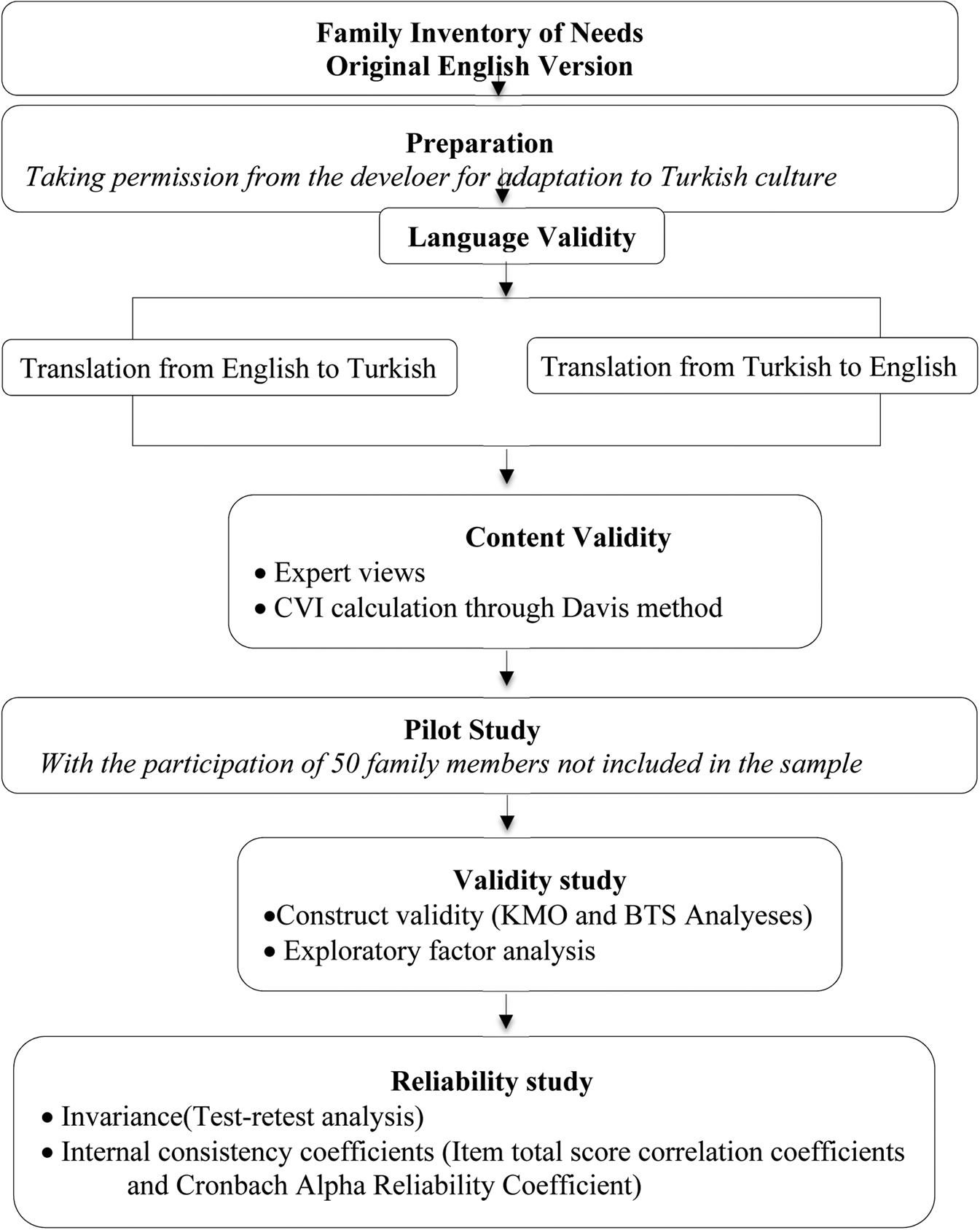
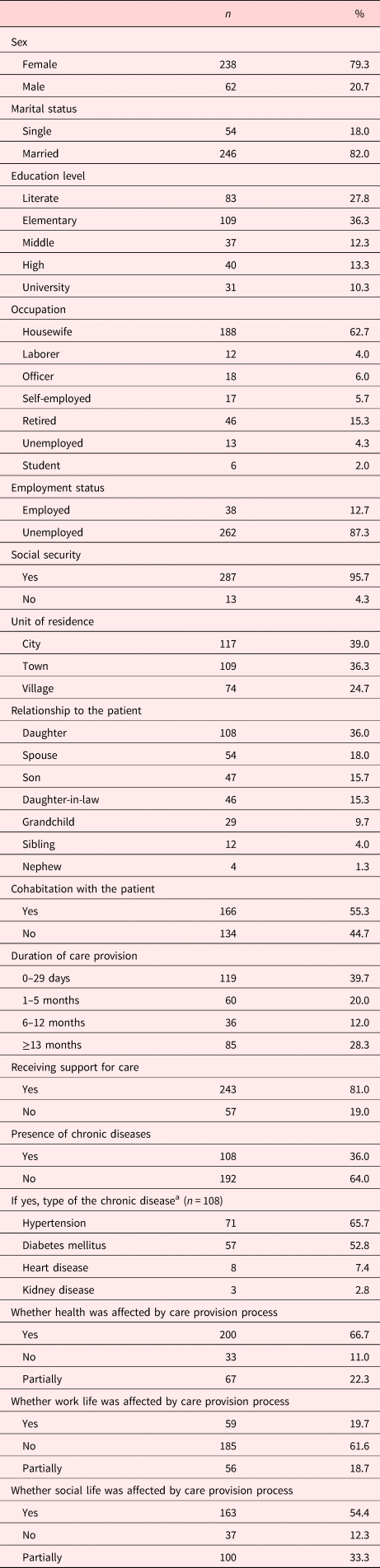
A total of 300 family members participated in the study. 79.3% of the participants were female, 82.0% were married, 36.3% were elementary school graduates, 62.7% were housewives, 87.3% were unemployed, 95.7% had social security, and 39.0% lived in the centrum (Table 1). 36.0% of the family members were daughters of the patients, 55.3% lived in the same house with the patient, 39.7% had been accompanying the patients for 0–29 days, 81.0% received support from other family members in patient care, 36.0% had a chronic disease themselves, and 65.7% were diagnosed with hypertension. It was further found that the health of 66.7% of the family members, the employment status of 19.7% of the family members, and the social lives of 54.4% of the family members were affected by the care provision process (Table 1). The Turkish validity and reliability process of the Family Inventory of Needs is given in Figure 1.
The scale adaptation process.

The distribution of the sociodemographic and care provision characteristics of the family members (n = 300)

a More than one answer.
Language validity
Before the study, permission was taken from the developer of the Family Inventory of Needs. The translation process was performed in multiple stages using the forward–backward translation model (Beaton et al., Reference Beaton, Bombardier and Guillemin2000). First, the scale was translated from English into Turkish by four professionals with good knowledge of English into Turkish translation. Then, the backward translation of the scale was performed by four linguistics experts fluent in both English and Turkish. The original English, Turkish, and back-translated forms of the scale were then examined with regard to clarity, inconsistencies, differences in terms, and differences in meaning. The scale items were found to comply with their counterparts in the other forms, providing the same meaning.
Content validity
The views of seven experts (five nursing lecturers and two psychology lecturers) were taken to evaluate the content validity of the Family Inventory of Needs (Polit and Beck, Reference Polit and Beck2010). An expert view form was prepared to determine the level of compliance between the original form of the scale and its Turkish version and to evaluate the understandability of the scale items. The experts examined the scale items with regard to understandability, serving their purpose, distinguishability, and cultural appropriateness. According to expert views, the Davis method was used to calculate Content Validity Index values. The results showed the content validity indices to be between 0.86 and 1. According to these results, the Family Inventory of Needs was found to have content validity and be appropriate for Turkish culture and representative of the field it tries to measure.
Pilot study
To evaluate whether the Family Inventory of Needs could be understood by the family members of the patients, a preliminary application with a group of 50 family members representing the characteristics of the sample was performed after language and content validity efforts were completed. The group participating in the preliminary application was not included in the sample. After preliminary application, no revisions were made to the identification form or scale items.
Construct validity
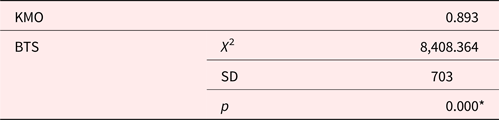
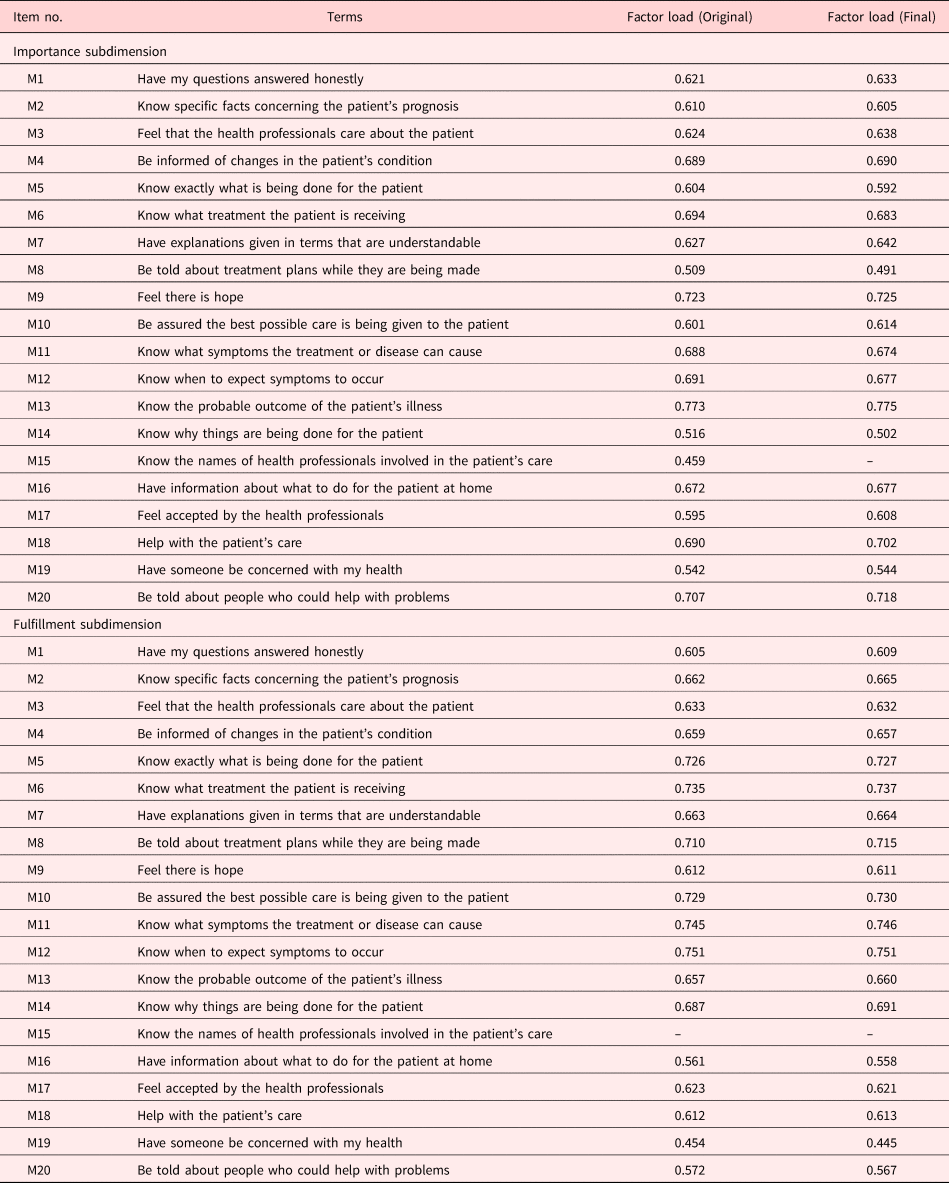
The Kaiser–Meyer–Olkin (KMO) value of the Family Inventory of Needs was found to be 0.893 (Table 2). When a scree plot was formed to determine the subdimensions of the scale, two subdimensions with an eigenvalue over 1 could be found (Figure 2). One item with poor correlation to other scale items and a low primary factor load were removed from the scale (Item 15). The items of the Family Inventory of Needs were found to explain 45.23% of the total variance in scores. The 13th item was found to be the strongest indicator in the importance subdimension with a value of 0.77, while the 12th item was found to be the strongest indicator in the fulfillment subdimension with a value of 0.75 (Table 3).
The Eigenvalue Scree Plot.

The KMO value and BTS results of the family inventory of needs

* p < 0.001 indicates significant level.
The item factor load values of the Family Inventory of Needs

Reliability
Test–retest invariance reliability
The Family Inventory of Needs, which was applied to 300 relatives of patients in this study, was applied again to 34 individuals selected from among this sample through simple random probability sampling with a two-week interval. The scores obtained from the importance and fulfillment subdimensions of the scale in the test–retest application were examined using the ICC, and the answers were found to show good fit (p < 0.01). This fit suggested that the scale had good test–retest reliability. In addition to the ICC calculation, test–retest scores were also examined using the dependent sample t-test. As a result of the dependent sample t-test, no statistically significant difference between the mean scores of the test and retest applications could be found (p > 0.05) (Table 4).
The ICCs between the test–retest scores of the Family Inventory of Needs and their level of significance

MV, Arithmetic mean; ICC, intraclass correlation coefficient; t, dependent sample t-test; p, level of significance.
* p<0.01.
** p<0.001.
Internal consistency
The internal consistency of the Family Inventory of Needs was evaluated using the Cronbach α reliability coefficient and item-total score correlations.
Item-total score correlation coefficients
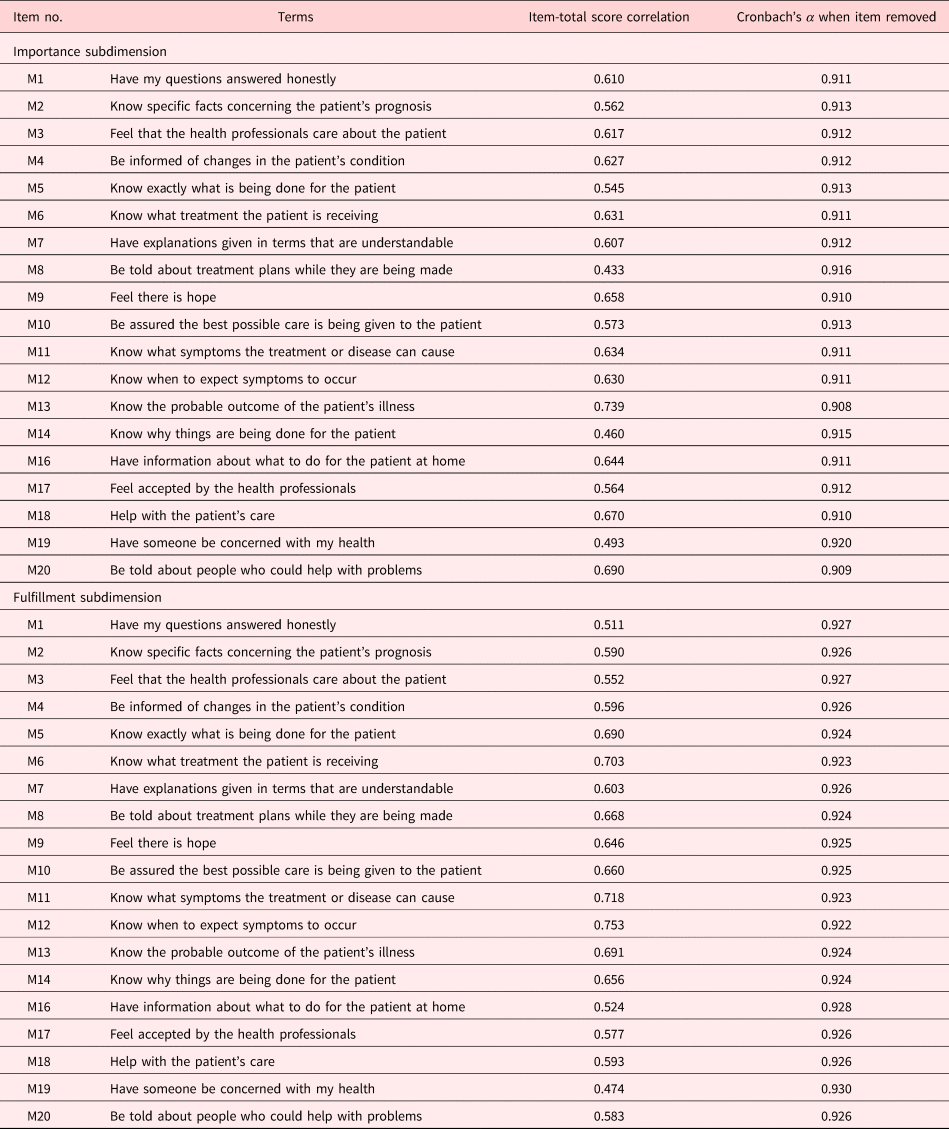
The item-total score correlation coefficients of the scale were found to vary between 0.433 and 0.739 in the importance subdimension, and between 0.474 and 0.753 in the fulfillment subdimension. In this study, it was found that the Cronbach α reliability coefficient values of the scale could not be increased by removing any of the 19 items in the scale (Table 5). The Family Inventory of Needs was found to have high internal consistency with 19 items (α > 0.700).
The item-total score correlations of the Family Inventory of Needs

The Cronbach α reliability coefficient
When the internal consistency of the Family Inventory of Needs was examined using the Cronbach α reliability coefficient, the reliability levels of the importance (α = 0.916) and fulfillment (α = 0.929) subdimensions were found to be very high. A positive significant relationship between the subdimensions of the scale was also found (r = 0.366, p = 0.000).
Discussion
It is very important to determine the needs of caregivers during the care and treatment process of patients and the level to which those needs can be met. This requires the use of an appropriate measurement tool developed for this purpose. In this study, the psychometric characteristics of the Turkish version of the Family Inventory of Needs were evaluated.
In scale development efforts, structure validity studies are performed to evaluate how well the measurement tool measures the relevant concept. The most widely used method to test structure validity is factor analysis. Factor analysis aims to find new variables (factors and dimensions) in smaller numbers by combining related variables (Izquierdo et al., Reference Izquierdo, Olea and Abad2014). In this study, the KMO Measure of Sampling Adequacy test was used before determining the factor structure of the scale to determine whether the data obtained from the study were appropriate for factor analysis. Then, the BTS was used to determine whether the relationships between the variables to be analyzed were significant.
The KMO value of the Family Inventory of Needs was found to be 0.893. This result showed that the sample size was sufficient for factor analysis. The fact that the chi-squared value of the scale in the Bartlett test had advanced significance (p < 0.001) in this study showed that there was a significant relationship between the variables and that study data were appropriate for factor analysis.
One item with poor correlation to other scale items and a low primary factor load were removed from the scale in this study (Item 15). In the studies performed by Fridriksdottir et al. (Reference Fridriksdottir, Sigurdardottir and Gunnarsdottir2006), Buzgova et al. (Reference Buzgova, Spatenkova and Fukasova-Hajnova2016), and Areia et al. (Reference Areia, Major and Relvas2017), no items were removed from the scale, and the studies were completed with 20 items. However, Schur et al. (Reference Schur, Neubauer and Amering2014) and Márquez García et al. (Reference Márquez García, Grau Abalo and Infante Pedreira2015) removed six items each in their studies after factor analyses.
The scale was found to have two subdimensions after statistical analyses. In compliance with our findings, other studies with the scale had found two subdimensions in the scale, namely the importance of needs and the level to which they are fulfilled (Fridriksdottir et al., Reference Fridriksdottir, Sigurdardottir and Gunnarsdottir2006; Schur et al., Reference Schur, Neubauer and Amering2014; Márquez García et al., Reference Márquez García, Grau Abalo and Infante Pedreira2015; Buzgova et al., Reference Buzgova, Spatenkova and Fukasova-Hajnova2016; Areia et al., Reference Areia, Major and Relvas2017). Alongside this, Buzgova et al. (Reference Buzgova, Spatenkova and Fukasova-Hajnova2016) and Areia et al. (Reference Areia, Major and Relvas2017) found four domains under each subdimension as a result of the factor analyses they performed, namely basic information, care- and treatment-related information, support, and patient comfort. This is thought to stem from the sociodemographic and cultural differences in the samples in different studies.
The Cronbach α reliability coefficient method is widely used in determining the internal consistency of Likert-type measurement tools. The Cronbach α coefficient varies between 0 and 1. The Cronbach α coefficients closer to 1 indicate higher scale reliability (Karagöz, Reference Karagöz2017; Özdamar, Reference Özdamar2017). In this study, the validity of the scale was tested with exploratory factor analysis, and the reliability of the 19-item scale with two subdimensions was evaluated using the Cronbach α reliability coefficient. In this study, the reliability levels of the importance (α = 0.916) and fulfillment (α = 0.929) subdimensions of the Family Inventory of Needs were found to be very high.
In a manner supporting our findings, the Cronbach α coefficients of the importance and fulfillment subdimensions of the Family Inventory of Needs were found to be, respectively, 0.92 and 0.93 in a study by Areia et al. (Reference Areia, Major and Relvas2017), 0.92 and 0.91 in a study by Buzgova et al. (Reference Buzgova, Spatenkova and Fukasova-Hajnova2016), 0.93 and 0.93 in a study by Márquez García et al. (Reference Márquez García, Grau Abalo and Infante Pedreira2015), 0.94 and 0.96 in a study by Schur et al. (Reference Schur, Neubauer and Amering2014), and 0.92 and 0.96 in a study by Fridriksdottir et al. (Reference Fridriksdottir, Sigurdardottir and Gunnarsdottir2006). All these results show very high internal consistency in the scale.
According to those results, the Turkish version of the Family Inventory of Needs was found to be a valid and reliable measurement tool for the Turkish society that can be used to discover the needs of patients’ families and the extent to which those needs have been met.
Limitations of the study
This study has certain limitations. The study being conducted in a single city is one such limitation. Until comparable studies can be performed using the Turkish version of the Family Inventory of Needs with the family members of palliative care patients in different cities and regions of Turkey, the findings of this study can not be generalized for the family members of all Turkish palliative care patients.
Conclusion
The Turkish version of the Family Inventory of Needs with 19 items and two factors was found to be a valid and reliable measurement tool for the Turkish society that can be used to discover the needs of patients’ families and the extent to which those needs have been met. According to our findings, the Family Inventory of Needs is recommended for use in our country.
Clinical implication
The Family Inventory of Needs can be applied not only to the family members of palliative care patients but also to the family members of all inpatients in healthcare institutions. Alongside this, this scale can be used in evaluating the effectiveness of family-oriented care applications.
Funding
This study was supported by the Ondokuz Mayıs University Scientific Research Project Office (Grant No. PYO.SBF.1904.19.005).
Conflict of interests
There are no conflicts of interest.