Introduction
Childhood vaccination is important to protect children from various diseases and illnesses. Adequate levels of vaccination coverage mitigate the mortality and morbidity burden among children in both developed and developing countries (Andre et al., Reference Andre, Booy, Bock, Clemens, Datta, John and Santosham2008). Vaccines stimulate the body’s immune system and protect individuals from subsequent infection and disease (Pasquale et al., Reference Pasquale, Preiss, Silva and Garçon2015). Vaccination not only has a significant life-saving potential, but also contributes to economic growth and well-being. For instance Ozawa et al. (Reference Ozawa, Clark, Portnoy, Grewal, Stack and Sinha2017) estimated the benefits of vaccination for 72 low-income countries and concluded that a vaccination programme would save 6.4 million lives and avert 426 million cases of illness, US$6.2 billion in treatment costs and US$145 billion in productivity losses during 2011 to 2020. Similarly, Largeron et al. (Reference Largeron, Lévy, Wasem and Bresse2015) concluded that vaccination against infectious disease in children, adults and elderly people decreases health care costs by reducing the need for medical care, diagnostic tests, treatment and hospitalization. Quilici et al. (Reference Quilici, Smith and Signorelli2015) also found that childhood vaccination could protect individuals from fifteen crucial infectious diseases and also increase school attendance in European countries.
While most studies of childhood vaccination have assessed its association with morbidity, mortality and the cost-benefits of child health, in recent years attempts have been made to examine its association with school attainment and cognitive development. Anekwe et al. (Reference Anekwe, Newell, Tanser, Pillay and Bärnighausen2015), in their study in South Africa, found that timely receipt of measles vaccination was associated with better school grades at ages 6–11 years. Similarly, Bloom and colleagues (Reference Bloom, Canning and Shenoy2011) concluded that vaccination against measles, polio, tuberculosis, diphtheria, pertussis and tetanus was associated with increased cognitive test scores in childhood. Children who were vaccinated in childhood against hepatitis B and diphtheria-tetanus-pertussis (DTP) using a formulation with or without thimerosal showed better scores on the Wechsler intelligence scale for children (WISC-R) (Mrozek-Budzyn et al., Reference Mrozek-Budzyn, Majewska and Kiełtyka2015). What’s more, the effects were long-lasting. In the context of China, Oskorouchi et al. (Reference Oskorouchi, Sousa-Poza and Bloom2020) found that adults aged 45 years and above who were fully vaccinated before the age of 15 scored more highly on numeracy and episodic memory tests. Nandi et al. (Reference Nandi, Kumar, Shet, Bloom and Laxminarayan2020), in their study in India, showed that adults who were born during or after the implementation of the 1978 Universal Immunization Programme (UIP) had better school grades than those born prior to the UIP. A longitudinal study in India (Nandi et al., Reference Nandi, Deolalikar, Bloom and Laxminarayan2019a) revealed that Haemophilus Influenza type b (Hib) vaccinated children under the 6 years scored higher in English and maths at age 11–12 years. At age 14–15 years they had higher scores in reading and maths than unvaccinated children. A longitudinal cohort study from Ethiopia, India and Vietnam concluded that children who were vaccinated for measles at age 6–18 months had better cognition and school performance at age 7–12 years than measles-unvaccinated children (Nandi et al., Reference Nandi, Shet, Behrman, Black, Bloom and Laxminarayan2019b). Clearly, experimental and observational studies have demonstrated the many benefits of childhood vaccination, including improved physical development, better educational outcomes and equity in the distribution of health gains (Jit et al., Reference Jit, Hutubessy, Png, Sundaram, Audimulam, Salim and Yoong2015).
Previous studies have revealed an association between certain vaccines and cognitive development in particular regions of India. However, few studies have evaluated the association between childhood vaccination and cognitive development using nationally representative surveys in the country. The present study analysed panel data from the 2004–05 and 2011–12 Indian Human Development Surveys to examine the association between child vaccination status and cognitive and learning ability among children at age 8–10 years. The IHDS 2004–05 provides information on childhood vaccination for under-5 children and this was matched with performance scores in reading, writing and maths for children aged 8–11 years, available in IHDS 2011–12.
Methods
Data
Data were taken from the India Human Development Surveys (IHDS). This is a nationally representative household survey jointly carried out by the National Council of Applied Economic Research (NCAER) and the University of Maryland, USA. The first round of IHDS interviews were completed in 2004–05, and covered 41,554 households in 1503 villages and 971 urban neighbourhoods across India. The IHDS survey is a multi-topic panel survey, and the IHDS 2011–12 survey included 42,152 households in 384 districts, 1420 villages, and 1042 urban neighbourhoods across the country. However, the IHDS 2011–12 re-interviewed 83% of these households, as well as split households (those located within the same village or town and an additional sample of 2134 households), to trace changes in people’s lives.
The IHDS 2011–12 gathered information on school knowledge among children who were 8–11 years old. Reading, writing and arithmetic knowledge tests were administered to all available children in these age groups in surveyed household. The tests were developed in collaboration with Pratham NGO New Delhi, India, and were pre-tested to ensure comparability across languages. The IHDS 2004–05 round provides childhood vaccination information on 11,781 eligible households. Childhood vaccination information was canvased in the household data file of IHDS 2004–05 and information about children’s maths, writing and reading tests was recorded in an individual data file in IHDS 2011–12. Furthermore, the matched household data set was merged with the IHDS 2011–12 individual data file through the link file of the survey. Of the total eligible cases, 9781 children aged 8–11 from IHDS–II were matched, and the rest of the cases were deleted because of data unavailability on account of household migration, death etc. between 2004–05 and 2011–12. The Stata software program zanthro was used to measure the anthropometric status of children, which provides anthropometric indicators based on the WHO reference for child growth standards 2007 (Vidmar et al., Reference Vidmar, Cole and Pan2013). As per the referred norms, zanthro calculates weight-for-age information for children aged 0–10 years, so children above the age of 10 years were excluded. Accordingly, the study was based on a final analytical sample of 6183 cases.
Bivariate analysis was used to examine the association between the acquisition of basic skills by children and their immunization status. A multivariate logistic regression model was used to examine the effect of childhood vaccination on cognitive development among school-age children, which was measured by different skill tests.
Outcome variable
The outcome variable was the ‘cognitive and learning ability of 8- to 10-year-old children measured by their level of skill in maths, reading and writing’. For maths, children were grouped into four categories, 1) cannot identify any numbers between 10 and 99, 2) can identify numbers only, 3) can subtract two-digit numbers with borrowing but cannot divide numbers and 4) can divide as well as subtract. For the reading task, children were classified into five categories: 1) cannot recognize any letters, 2) can recognize letters but cannot read words, 3) can read words but not connect them into sentences, 4) can read simple two-to-three sentence paragraphs but not a one-page story and 5) can read a one-page story. For the writing task children were divided into three categories: 1) cannot write a simple sentence, 2) can write a simple sentence with two or fewer mistakes and 3) can write a simple sentence without making a mistake.
For the multivariate analysis, the maths task was coded into two categories: 0=can’t recognize any numbers; 1=can read numbers and/or subtract a two-digit number from another two-digit number and/or divide a three-digit number with a one-digit number. The reading task was coded into two categories: 0=cannot read at all; 1=can read letters and/or words and/or a short paragraph and/or a short story. The writing task was coded into two levels: 0=can’t write at all; 1=can write with two or fewer mistakes and/or no mistakes.
Key explanatory variable
The vaccination status of children was the key explanatory variable. Information on vaccination was collected for the last two children of eligible women in the IHDS 2004–05, and was categorized into three: full vaccination, partial vaccination and no vaccination. ‘Full vaccination’ meant having three doses of the polio vaccine, three doses of DPT (diphtheria-pertussis-tetanus), one dose of BCG (Bacillus Calmette-Guérin) against tuberculosis and one dose of the measles vaccine before the age of 12 months. Partial vaccination meant that the child missed one or more vaccine whereas no vaccination meant the child did not receive any vaccine.
Other variables
Socioeconomic and other background variables included in the analysis were child’s age, sex, size at birth, type of school, religion, caste, anthropometric indicators (stunting, underweight); and maternal education, wealth index tertiles, place of residence, source of drinking water and whether there was a toilet facility in the household.
Results
Results of bivariate analyses
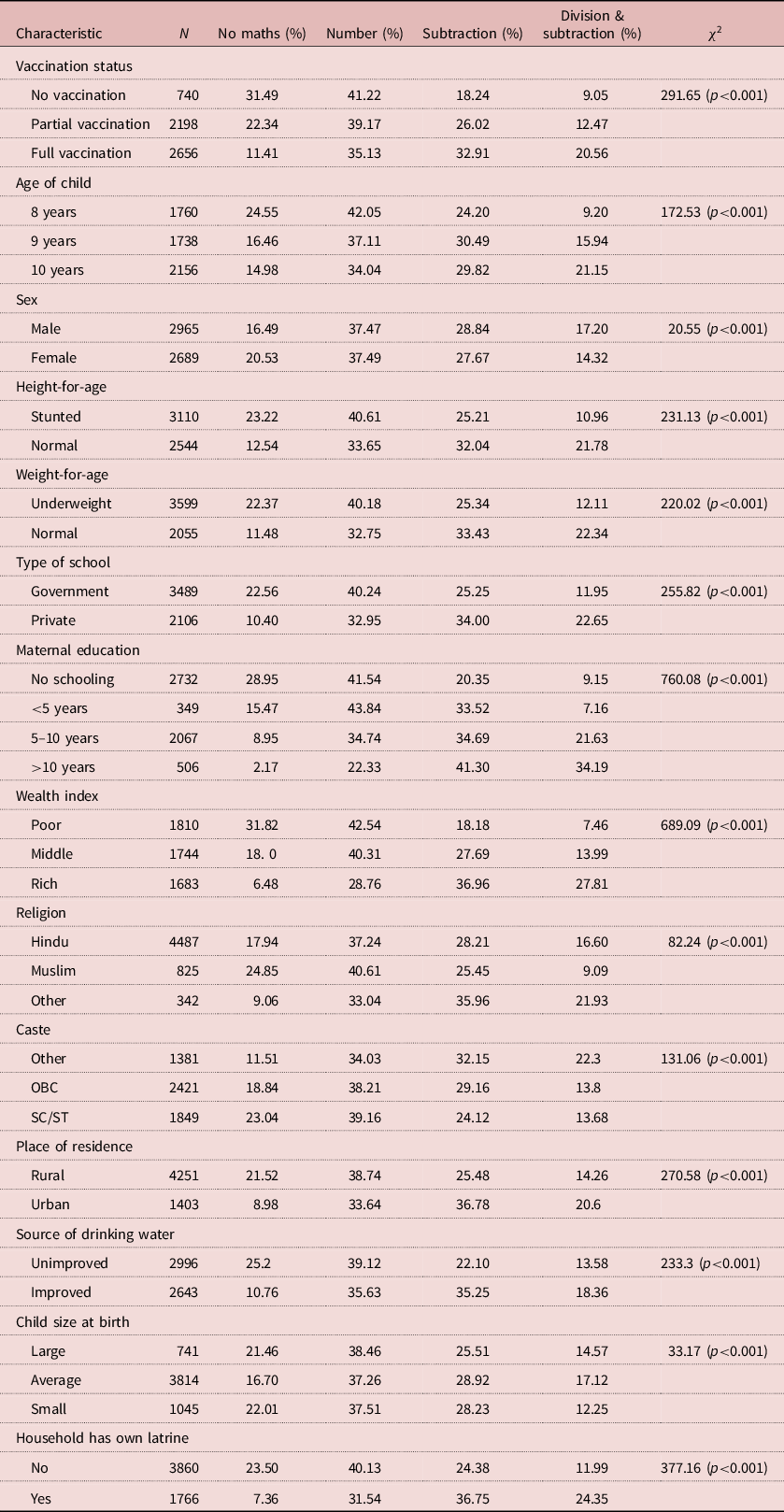
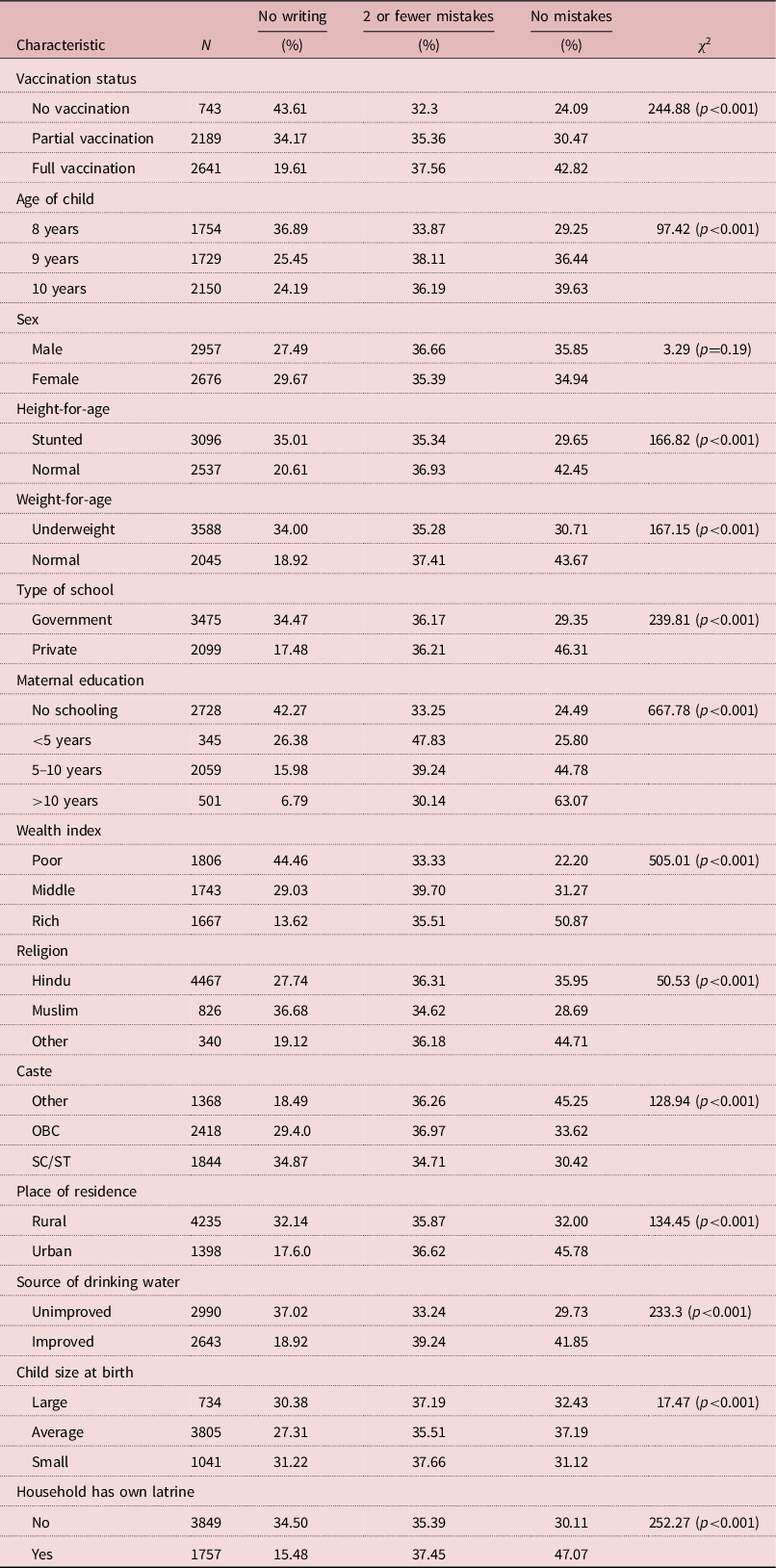
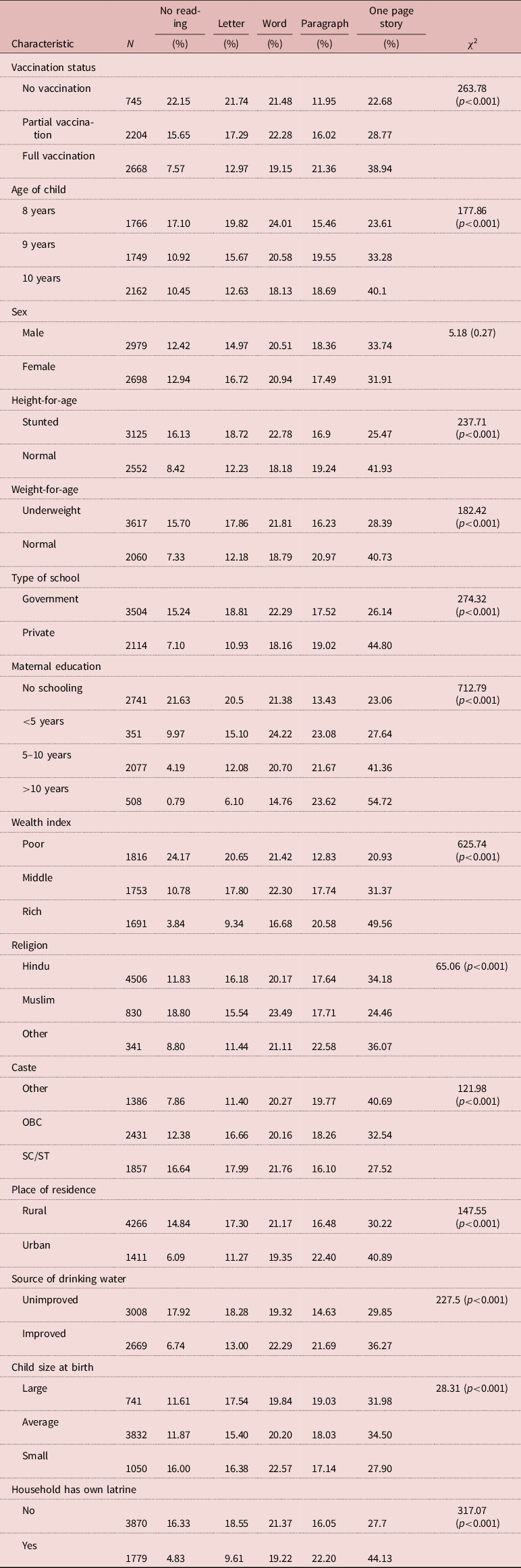
Tables 1, 2 and 3 show the results of the bivariate analysis of the sample children’s mathematical, writing and reading abilities, respectively, by their vaccination status and other explanatory variables. Overall, vaccinated children had better mathematical ability than unvaccinated children (Table 1). Of those with full vaccination, 11.4% could not identify numbers at all between 10 and 99, but 35.2% could; 33.0% could do two-digit subtraction; and 20.6% could divide a three-digit number by a single-digit number and also perform two-digit subtraction. On the other hand, only 9.0% of unvaccinated children could perform numerical division and only 18.3% could subtract.
Bivariate analysis of association of children’s mathematical ability with explanatory variables

Bivariate analysis of association of children’s writing ability with explanatory variables

Bivariate analysis of association of children’s reading ability with explanatory variables

As for writing ability, of the fully vaccinated children, 42.8% were able to write a simple sentence without making a mistake, whereas only 24.1% of the unvaccinated ones could do so (Table 2). While 19.6% of fully vaccinated children could not write a simple sentence, more than twice as many (43.6%) were unable to do so among the unvaccinated children. Significant differences were also found in the reading ability of fully vaccinated and unvaccinated children (Table 3). Of the fully vaccinated children, 7.6% were unable to identify words, but three times as many among unvaccinated children (22.2%) were unable to do so. Rates of paragraph and story-reading ability among the fully vaccinated children were 21.4% and 39.0%, respectively, while among those that were unvaccinated the respective rates were 12.0% and 22.7%.
Results of multivariate logistic regression analyses
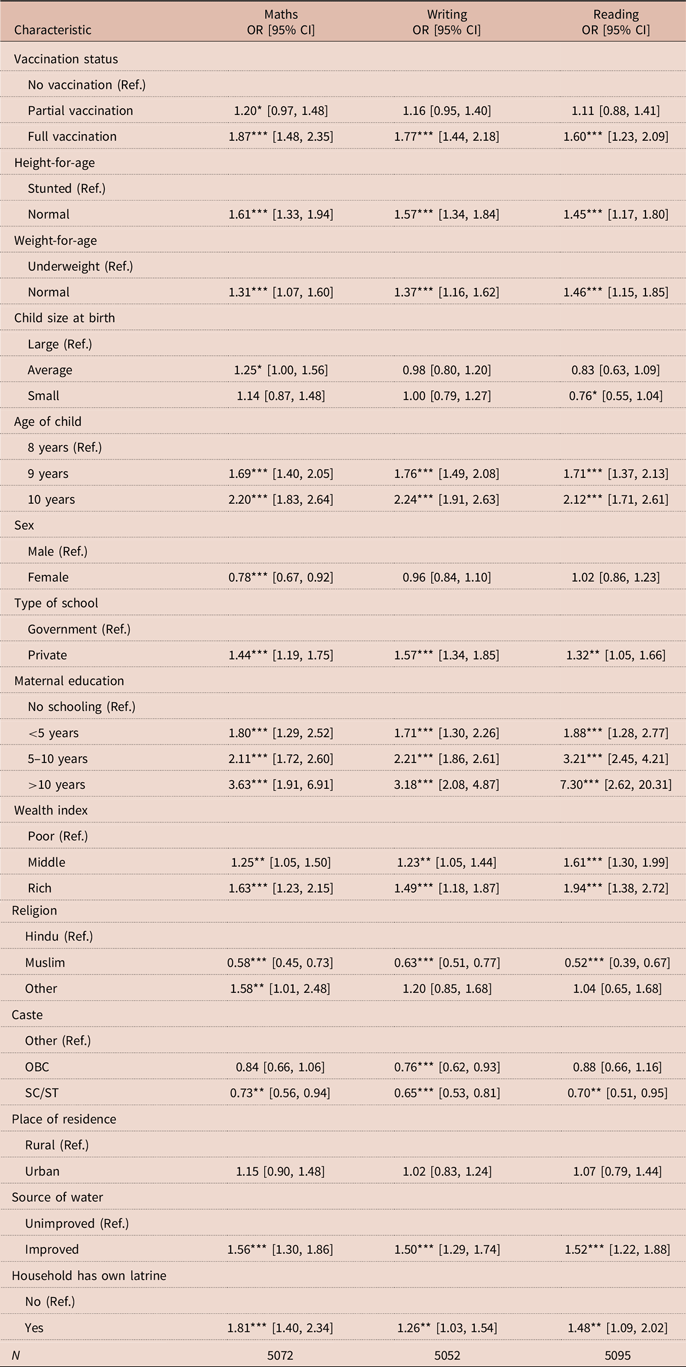
The multivariate regression analyses indicated significant associations between childhood vaccination and the mathematical, writing and reading abilities of the 8- to 10-year-old children (Table 4). Children who were fully vaccinated by the age of 12 months were more likely to be able to do simple mathematical tasks (OR: 1.87, 95% CI: 1.48, 2.35), write sentences (OR: 1.77, 95% CI: 1.44, 2.18) and read words, paragraphs and stories (OR: 1.60, 95% CI: 1.23, 2.09) than unvaccinated children.
Multivariate regression of the mathematical, writing and reading abilities of 8- to 10-year-old children

Ref.=reference category
*p<0.10; **p<0.05; ***p<0.01.
Among the other explanatory factors, maternal education, social or caste background and household socioeconomic status all had significant effects on the mathematical, writing and reading abilities of the children. Those with mothers with more than 10 years of schooling were more likely to be able to do simple maths (OR: 3.63, 95% CI: 1.91, 6.91), write (OR: 3.18, 95% CI: 2.08, 4.87) and read (OR: 7.3, 95% CI: 2.62, 20.31) than those with illiterate mothers. Compared with poor children, those from economically advantaged households had better odds of doing simple maths (OR: 1.63, 95% CI: 1.23, 2.15), writing sentences (OR: 1.49, 95% CI: 1.18, 1.87) and reading (OR: 1.94, 95% CI: 1.38, 2.72). Children from scheduled caste and scheduled tribe (SC/ST) households were less likely to be able to perform well in maths (OR: 1.94, 95% CI: 1.38, 2.72), writing (OR: 1.94, 95% CI: 1.38, 2.72) and reading (OR: 1.94, 95% CI: 1.38, 2.72) than other social groups.
Age of the child, nutritional status and type of school were all found to be associated with mathematical, writing and reading abilities. Children at the age 10 years had a higher chance being able to do simple maths (OR: 2.2, 95% CI: 1.83, 2.64), write a sentence (OR: 2.24, 95% CI: 1.91, 2.63) and read (OR: 2.12, 95% CI: 1.71, 2.61) than younger children (8 years). Children of 10 years of age had relatively higher odds ratio for writing compared with reading and mathematical solving abilities. As expected, older children were better as mathematics, writing and reading than younger children. Girls were less likely to be able to do simple maths than boys (OR: 0.78, 95% CI: 0.67, 0.92). However, there was no significant gender difference in writing and reading skills. Children with normal height-for-age (not stunted) had better odds of being able to do maths (OR: 1.61, 95% CI: 1.33, 1.57), write (OR: 1.57 95% CI: 1.34, 1.84) and read (OR: 1.45, 95% CI: 1.17, 1.80) compared with stunted children. Children with normal weight-for-age (not underweight) were more likely to be able to do maths (OR: 1.31, 95% CI: 1.07, 1.6), write (OR: 1.37, 95% CI: 1.16, 1.62) or read (OR: 1.46, 95% CI: 1.15, 1.85) compared with underweight children. Children who were of average size at birth were more likely to be able to do maths (OR: 1.25, 95% CI: 1.1, 1.56), whereas those who were of small birth size had poor odds of scoring better in reading tests (OR: 0.76, 95% CI: 0.55, 1.04).
Children attending private schools had better mathematical (OR: 1.44, 95% CI: 1.19, 1.75), writing (OR: 1.57, 95% CI: 1.34, 1.85) and reading skills (OR: 1.32, 95% CI: 1.05, 1.66) than those attending government schools. Finally, household environmental factors, including source of drinking water and household having a toilet facility, were also found to be associated with cognitive and learning ability. However, urban–rural place of residence had no significant association with test performances in maths, writing or reading. Children from households with an improved source of drinking water had higher odds of scoring well in maths (OR: 1.56, 95% CI: 1.3, 1.86), writing (OR: 1.5, 95% CI: 1.29, 1.74) and reading (OR: 1.52, 95% CI: 1.22, 1.88) compared with those with unimproved drinking water facilities. Similarly, children from households with their own toilet facility had higher scores in maths (OR: 1.81, 95% CI: 1.4, 2.34), writing (OR: 1.26, 95% CI: 1.03, 1.56) and reading (OR: 1.48, 95% CI: 1.09, 2.02) than households with shared sanitation or those resorting to open defecation.
Discussion
This study examined the association between childhood vaccination and cognitive and learning ability among school children aged 8–10 years in India. The four salient findings of the study were as follows. First, children who received all basic vaccinations by the age 12 months were more likely to perform mathematical tasks, write a sentence and read than those with none or only partial vaccination. In particular, fully vaccinated children performed better in mathematics. Second, maternal education is an important covariate, and was found to be significantly associated with children’s mathematical, writing and reading abilities. Third, the mathematical skills of girls were poorer than those of boys, but there were no significant gender differences in writing and reading skills. Fourth, the nutritional status of children was found to be significantly associated with children’s mathematical, writing and reading skills.
Before discussing these findings, it is worth mentioning the key limitations of the study. Vaccination information was collected with a reference period of the last two births since January 2000 in survey households and was for children under the age of 5 years in IHDS-I (2004–05); and around 75% of the vaccination data were self-reported by survey respondents (mothers). The mathematical, reading and writing tasks were the same for all children at age 8–10 years, irrespective of their age/grade or schooling status. Apart from quality of school, teachers’ levels of education and parental efforts in child’s education can also influence the performance of children. The IHDS did not cover all children in the follow-up survey. Hence, it was not possible to claim causal associations, but the study offers important insights for the further analysis of associations.
The multivariate regression analysis showed a positive and statistically significant association between children receiving all basic vaccinations by 12 months of age and their mathematical, writing and reading abilities at age 8–10 years. Previous studies have revealed that infectious disease can affect the cognitive ability of children. Berger and colleagues (Reference Berger, Villalobos, Clark, Holubkov, Pollack, Berg and Newth2018) found that infants with critical pertussis scored poorly in visual reception, receptive language and expressive language. Goetghebuer et al. (Reference Goetghebuer, West, Wermenbol, Cadbury, Milligan, Lloyd-Evans and Weber2000) found that Pneumonia, Haemophilus and Influenza type b (Hib) were associated with hearing loss, mental retardation, motor abnormalities and seizures. Moreover, studies have demonstrated a long-term effect of tuberculous meningitis (TBM) on neurocognition, resulting in cognitive impairment in adults and children (Chen et al., Reference Chen, Lu, Chang, Chen, Chen, Hsu and Lin2015; Davis et al., Reference Davis, Nightingale, Springer, Solomons, Arenivas and Wilkinson2019). Hamborsky et al. (Reference Hamborsky, Kroger and Wolfe2015) suggested measles could lead to intellectual disability and increase neurologic complications. Childhood vaccination protects them from infectious disease such as polio, measles, diphtheria, pertussis (whooping cough), rubella (German measles), mumps, tetanus, rotavirus and Haemophilus Influenza type b (Hib) (CDC, 2014). Mina et al. (Reference Mina, Metcalf, De Swart, Osterhaus and Grenfell2015) suggested that measles vaccines may also offer protection from non-measles infections and in the long-term increase immunologic memory.
The findings of this study suggest that basic childhood vaccination influences children’s cognitive and learning ability at school-going age. A study from Philippines (Bloom et al., Reference Bloom, Canning and Shenoy2011) had similar results, finding that receiving six childhood vaccines was associated with children’s better cognitive development. The percentage of children in India aged 12–23 months receiving all basic vaccinations during 2015–16 was only 62%, and this varied considerably across states (from 35% to 91%) and districts (from 7% to 100%) (IIPS, 2017). India launched the initiative Transformation of Aspirational Districts in 2018, with a focus on improving health, nutrition and educational outcomes in order to achieve the Sustainable Development Goals (SDGs), and also to improve rankings and performance in the Human Development Index (HDI). Clearly, achieving universal coverage of all childhood vaccinations could be a cost-effective strategy to improve health and educational outcomes in India.
Higher maternal education had a positive association with the children’s mathematical, reading skills and writing skills at age 8–10 years. Vikram et al. (Reference Vikram, Vanneman and Desai2012) also found a positive relationship between maternal education and health knowledge and complete childhood immunization in India. Thus, maternal education seems to have a dual impact – on both child immunization and education. Fernald et al. (Reference Fernald, Kariger, Hidrobo and Gertler2012) also found a significant association between maternal education and children’s maths, reading and writing test scores. In addition, the present study found a gender difference in mathematical ability, but not writing and reading. This is a critical theme in education as there is no specific reason why the sex of children should play a role in educational performance across disciplines. The observed gender difference in maths and reading ability may be due to excessive engagement of girls in activities beyond schooling and learning, with parents having a son preference in matters of learning and education. White et al. (Reference White, Ruther and Kahn2016) found that the impact of adverse time allocation on girls can increase in the presence of siblings as they may have to devote time to household chores.
The study found a strong association between child nutritional status and their cognition and learning ability. Children of normal nutritional status (normal height-for-age and weight-for-age) did better in mathematical, writing and reading tests than stunted or underweight children. Similar findings have been made in previous studies (Spears, Reference Spears2012; Acharya et al., Reference Acharya, Luke, Haro, Rose, Russell, Oommen and Minz2019). Another study found that childhood immunization was associated with better nutritional status (Kim et al., Reference Kim, Rajpal, Joe, Corsi, Sankar, Kumar and Subramanian2019). Anekwe and Kumar (Reference Anekwe and Kumar2012) found that childhood vaccination was a predictor of infant growth and development, as the universal immunization programme in India was found to have a favourable impact on child anthropometric outcomes. Childhood vaccination against DTP, polio and measles also improves the nutritional status of children (Bhargava et al., Reference Bhargava, Guntupalli and Lokshin2011), and has direct and indirect benefits for schooling and child educational outcomes.
Finally, access to an improved source of drinking water was also found to be associated with improved maths, reading and writing skills among children. Clean and safe (free from fecal contamination) drinking water improves the nutritional status of children (Johri et al., Reference Johri, Sylvestre, Koné, Chandra and Subramanian2019). The benefits even appear to be felt during gestation, as mothers who have access to safe drinking water during pregnancy are likely to give birth to children with better Word List Memory scores (Wulan et al., Reference Wulan, Smith, Prado, Apriatni, Muadz and Shankar2015). Similarly, the present study found a significant association between having a toilet facility and children’s mathematical, reading and writing skills. A systematic review by Sclar (Reference Sclar, Garn, Penakalapati, Alexander, Krauss and Freeman2017) suggested that household access to sanitation was associated with improved cognitive ability of children. Orgill and Pattanayak (Reference Orgill-Meyer and Pattanayak2020) also revealed a significant association of village latrine coverage in early childhood with better cognitive scores 10 years later. Unimproved sanitation spreads diseases such as cholera, diarrhoea, dysentery, hepatitis A, typhoid and polio and exacerbates stunting (WHO, 2019). Hence, improved sanitation protects children from infectious disease and improves their educational performance. Nevertheless, there is limited research on the association of drinking water and sanitation with cognitive and learning ability among children. There is a need for more research on the association of water, sanitation and hygiene (WASH) indicators with child cognitive development.
In conclusion, this study suggests that full childhood vaccination might be a potential factor affecting the educational attainment of children in India. There is therefore an urgent need to scale-up public spending on health care in the country.
Funding
This research received no specific grant from any funding agency, commercial entity or not-for-profit organization.
Conflicts of Interest
The authors have no conflicts of interest to declare.
Ethical Approval
This study was based on a secondary data set with no identifiable information on the survey participants. This dataset is available in the public domain for research use so no approval was required from any institutional review board.