I. Introduction
Some labor advocates have helped institute labor inspectorates and specialized labor courts in Latin America since the beginning of the twentieth century (e.g., Clagett Reference Clagett1952, 81–98; Schrank and Piore Reference Schrank and Piore2007). Labor inspectorates generally enforce labor laws through street-level bureaucrats who visit workplaces, record infractions, fine employers, and/or create compliance programs (Schrank and Piore Reference Schrank and Piore2007). Labor courts generally enforce employment contracts and labor-protective legislation through adjudication (Summers Reference Summers1972, 1120). However, scholars and advocates have criticized labor inspectorates and labor courts for not having sufficient resources to perform their jobs, for being corrupt, for being politically captured, and for otherwise being mired in bureaucratic trappings that make them ineffective actors (see, e.g., Schrank Reference Schrank2009; International Labor Office [ILO] 2011). Scholars and advocates concerned with power and labor organizing as the main source of workers' rights, such as Marxists, social democrats, labor law scholars, and legal mobilization scholars, would also be all but surprised by the fact that many labor rights that hinge on state enforcement remain ineffective in Latin America (e.g., Dukes Reference Dukes2016).
The critiques made against inspectorates and labor courts in Latin America are also similar to those made generally against the legal systems of the region, spurring what is now a decades-old “rule of law” (ROL) reform movement (e.g., Esquirol Reference Esquirol2008). At the administrative level, reformers have supported labor inspectorate modernization and professionalization. Some of those reforms have met their intended goals at the administrative levels, even in countries where patronage and corruption are rampant (see, e.g., Schrank and Piore Reference Schrank and Piore2007; Schrank Reference Schrank2009). As to the courts, the ROL movement has called for more resources for judiciaries and to professionalize courts (Esquirol Reference Esquirol2008). It has also called for making courts more accountable by, among other things, instituting oral court proceedings, similar to those in the United States and other Anglo-American jurisdictions (e.g., Merryman Reference Merryman1969, 113–14).
But, critics of the ROL movement abound. In addition to those critics who argue that civil society organizations are more important than state institutions for the rights of the subaltern (Hirschl Reference Hirschl2004), others argue that ROL programs are mired in divergent interests and ideologies (Carothers Reference Carothers, Domingo and Sieder2001; Santos Reference Santos, Santos and Trubek2006). In other words, ROL programs are incoherent. These critics note that while some ROL reformers aim to improve investment environments for powerful actors, others are more interested in advancing the rights of the subaltern. In light of such a seemingly disjointed policy context, and given the skepticism of power theorists toward a judicialized system of labor rights in a contemporary “neoliberal” context devoid of strong unions and collective bargaining, can reformed labor courts effectively protect workers?
This article uses the Chilean case of ROL-reformed labor courts to explore whether labor courts can protect the rights of workers at the point of dismissal, when workers need these protections the most, despite neoliberalism or divergent policy goals. It uses secondary sources to describe the organizational conditions of the Chilean working class, political context, formal termination rules, and procedural rules in place for workers to bring dismissal complaints. It also reports on primary evidence I collected through ethnography describing how dismissal cases were handled in 2009–2010, after the ROL reforms, but in a neoliberal context where workers were relatively disorganized, bargained at the plant level or atomistically, were politically weak, and where the market played a fundamental role in organizing economic life. In the manner of an “ethnographic revisit” (Burawoy Reference Burawoy2009, 75–76), I compare my contemporary (2009–2010) observations with those made by a prior ethnographer, Heleen Ietswaart, in 1970–1972 (Ietswaart Reference Ietswaart1977, Reference Ietswaart1982). Ietswaart observed how courts handled dismissal cases in Chile in a time of “socialism,” defined here as a time when workers were much better organized, unions bargained at the national level, shared political power, and government policy purposely narrowed the role that the market could play in organizing the economy.
Perhaps counterintuitively, the ethnographic revisit shows that labor courts are more protective in the contemporary, neoliberal era than during the socialist period. ROL reforms explain the more protective labor courts. ROL reforms increased the number of labor judges from about twenty to almost ninety, instituted oral procedures, and, very importantly, eliminated actuarios, court officers of the old written process who faced the parties and organized case files for the labor judges. During the process of putting case files together, actuarios, pressured to reduce overwhelmed court dockets, coaxed and compelled many workers to settle their claims for a small fraction of what workers originally requested (Ietswaart Reference Ietswaart1977, Reference Ietswaart1982). After the 2006 ROL reforms, judges oversaw dismissal cases in open court and many times attempted to lead settlements in a labor-protective direction. The article thus concludes that socialist and neoliberal contexts are not necessarily conducive to more or fewer labor-protective judiciaries. Even if labor-protective legislation exists, and despite surrounding organizational and economic conditions, the judiciary as an institution itself, including the procedure available for workers to pursue their claims, matters for effective, labor-protective courts.
A. Why Settlement?
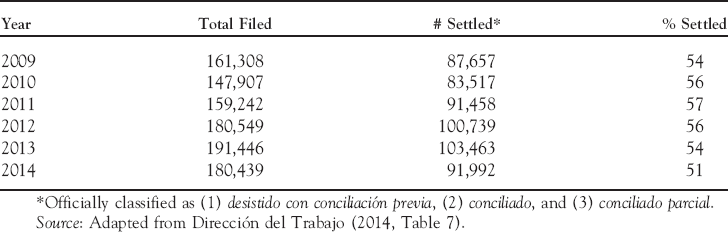
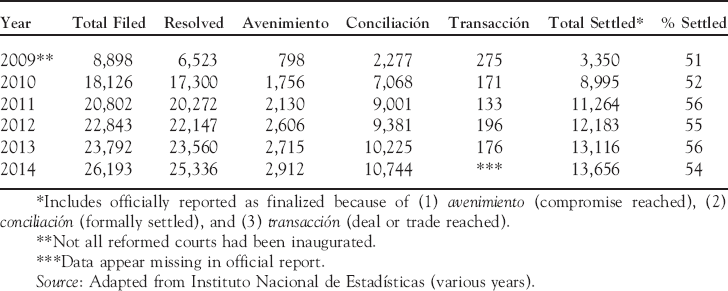
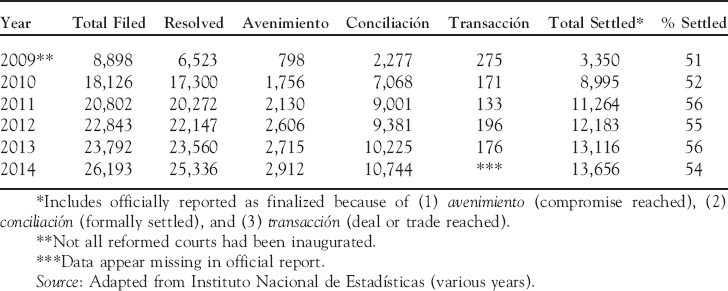
This study focuses on settlement rather than on court opinions because most cases regarding employee terminations settle in Chile. From 2009–2014, dismissal cases settled at the labor inspectorate, the administrative agency that handles most dismissal cases, 51–57 percent of the time (see Table 1). Over half of dismissal cases resolved by the labor courts also settled during the same period (see Table 2). Workers thus experience labor justice, to a great extent, as a transaction. Settlement is also pervasive in many other jurisdictions, including the United States, where most causes of action, labor law related or otherwise, regularly settle (see, e.g., Landes Reference Landes1971; Galanter and Cahill Reference Galanter and Cahill1994; Eisenberg and Hill Reference Eisenberg and Hill2003; Clermont Reference Clermont2009; Weatherspoon Reference Weatherspoon2011). Understanding settlement is thus important to understand law “in practice.”
Dismissal Cases Resolved at Chilean DT, 2009–2014

| Year | Total Filed | # Settled* | % Settled |
|---|---|---|---|
| 2009 | 161,308 | 87,657 | 54 |
| 2010 | 147,907 | 83,517 | 56 |
| 2011 | 159,242 | 91,458 | 57 |
| 2012 | 180,549 | 100,739 | 56 |
| 2013 | 191,446 | 103,463 | 54 |
| 2014 | 180,439 | 91,992 | 51 |
* Officially classified as (1) desistido con conciliación previa, (2) conciliado, and (3) conciliado parcial.
Source: Adapted from Dirección del Trabajo (2014, Table 7).
Dismissal Claims Filed, Resolved, and Settled at the Chilean Reformed Labor Courts, 2009–2014
| Year | Total Filed | Resolved | Avenimiento | Conciliación | Transacción | Total Settled * | % Settled |
|---|---|---|---|---|---|---|---|
| 2009 ** | 8,898 | 6,523 | 798 | 2,277 | 275 | 3,350 | 51 |
| 2010 | 18,126 | 17,300 | 1,756 | 7,068 | 171 | 8,995 | 52 |
| 2011 | 20,802 | 20,272 | 2,130 | 9,001 | 133 | 11,264 | 56 |
| 2012 | 22,843 | 22,147 | 2,606 | 9,381 | 196 | 12,183 | 55 |
| 2013 | 23,792 | 23,560 | 2,715 | 10,225 | 176 | 13,116 | 56 |
| 2014 | 26,193 | 25,336 | 2,912 | 10,744 | *** | 13,656 | 54 |
* Includes officially reported as finalized because of (1) avenimiento (compromise reached), (2) conciliación (formally settled), and (3) transacción (deal or trade reached).
** Not all reformed courts had been inaugurated.
*** Data appear missing in official report.
Source: Adapted from Instituto Nacional de Estadísticas (various years).
Finally, settlement also helps us understand the day-to-day practice of trial-level courts in Latin America. Sociolegal scholarship of Latin American courts has mostly concentrated on high courts (Ingram Reference Ingram2015). This article helps close the high court–trial-level court gap in the literature (but see Brinks Reference Brinks2008; Huneeus Reference Huneeus2010; Couso and Hilbink Reference Couso, Hilbink, Helmke and Rios-Figueroa2011; Ingram Reference Ingram2016).
B. Organization of the Article
Section II summarizes the literature on the factors that are said to provide workers with stronger rights in capitalist society. Section III summarizes the research methods. Section IV reports the historical, legal, and ethnographic evidence. Section V discusses the findings. Section VI concludes. A methodological appendix provides more detail on how I collected my data through ethnography.
II. Organizations, their Environments, and the Promise of ROL Reforms for Workers' Rights
Students of labor and labor movements, perhaps since Karl Marx, have argued that labor rights are chimerical under capitalism (see Markovits Reference Markovits2007). Therefore, nineteenth- and early twentieth-century socialists, social democrats, and labor reformers, while not always seeing eye to eye, agreed that if workers were to have any rights at all, they needed to be self-organized and to build their own source of social power (Lichtenstein and Harris Reference Lichtenstein and Harris1993, 4; see, e.g., Webb and Webb [1847] Reference Webb and Webb1965). Self-organized workers should contribute to an “autonomous” system of law separate from that of the then-existing common or civil law, which kept workers subordinated (Bogg et al. Reference Bogg, Costello, Davies and Prassl2015, 2). Empirical evidence supported these reformers' views for an autonomous labor law. Marx, for example, documented the way English judges, many of whom came from bourgeois backgrounds, would readily decide matters in favor of employers, even when labor inspectors brought cases to these judges documenting clear violations of labor-protective laws (Marx [1867] Reference Marx1992, 398–405). In the US context, turn-of-the-century and early twentieth-century common law courts would also readily place injunctions on labor unions and ordinary workers who acted collectively (Forbath Reference Forbath2009, Ch. 3). American reformers such as Felix Frankfurter thus spoke sharply against “government by injunction” and called for judicial abstention from industrial disputes (Frankfurter and Greene Reference Frankfurter and Greene1930, 1).
Post–World War II scholar-reformers such as Hugo Sinzheimer and Otto Kahn-Freund also focused on working-class organization for effective labor rights (Kahn-Freund Reference Kahn-Freund, Davies and Freedland1983; Dukes Reference Dukes2016, Chs. 2, 4). Their perspective continued to have empirical support. In the United States, for example, scholars documented how judges, who were trained in the common law and had little understanding of unequal relations of power in capitalist employment relations, interpreted labor-protective statutes narrowly. They gave primacy to property right protections over those of workers when they decided cases and controversies, eroding workers' rights (see, e.g., Klare Reference Klare1977; Atleson Reference Atleson1983).
The traditional labor law view on how organization and social power matters for effective and autonomous labor law is echoed today by the law and social movements literature. Under this perspective, movements need to diffuse social norms and exert political power to protect the rights of subaltern groups. Gerald N. Rosenberg (Reference Rosenberg2008), for example, aptly showed that the civil rights movement was much more important for effective civil rights in the United States than Supreme Court opinions. According to Lauren Edelman (Reference Edelman1990), the civil rights movement was also important for diffusing employment equality norms in many US workplaces, even prior to the enactment of employment discrimination law.
Another strand of the social movements literature has shown that effective law requires organizations and social movements to “mobilize” law (McCann Reference McCann1994; Albiston Reference Albiston2010, 11–17). From that perspective, while law on the books does not enforce itself, it provides opportunities for movement actors to intercede effectively in the sociopolitical landscape. In a similar vein, political scientists and industrial relations experts have shown that labor protections are more effective when worker organizations collaborate with state enforcers to implement the laws (Fine and Gordon Reference Fine and Gordon2010; Fine Reference Fine2014; Amengual Reference Amengual2016; see also Ayres and Braithwaite Reference Ayres and Braithwaite1995, 54). Some case studies also show that individual employees, if provided with whistleblower protections, can also collaborate with state institutions to enforce existing labor rights (Estlund Reference Estlund2010, 110–28).
Movements may also transform the legal meaning of workers' rights. Pedriana and Stryker (Reference Pedriana and Stryker2004), for example, showed that the civil rights movement helped the early Equal Employment Opportunity Office, a weak agency, to interpret employment discrimination law broadly. On the other hand, once the civil rights movement splintered and demobilized, employer agents, that is, human resource management professionals, diffused a much narrower interpretation of discrimination laws (Dobbin Reference Dobbin2009; Edelman Reference Edelman2016). In this light, labor rights can be endogenous—determined by organized social actors, and not just by the state actors who are supposed to be in charge of interpreting and enforcing the law (Edelman, Uggen, and Erlanger Reference Edelman, Uggen and Erlanger1999; Edelman Reference Edelman2016).
Organizations, however, function in environments where “rational myths,” professionalized knowledge, and other beliefs shape organizations and their capacity to act (Albiston Reference Albiston2010, 17; Zucker Reference Zucker1977; Meyer and Rowan Reference Meyer, Rowan, Powell and DiMaggio1991; Scott and Meyer Reference Scott and Meyer1994). US labor unions, for example, managed to expand and effectively to bargain collectively on behalf of workers in the corporatist contexts created by the New Deal (Wachter Reference Wachter2007, 588–90). In that environment, groups such as labor unions were enfranchised to act as political actors. Their legitimacy was less questioned than in the prior Lochner era or the current neoliberal market context (Wachter Reference Wachter2007, 588–90). After World War II, US law and policy returned to favoring individual over collective actors, such as the corporate shareholder. Other policies that eroded American corporatism included deregulation of key, unionized industries such as communications and transportation. Antitrust law, which limited the capacity of corporate actors to act in concert to set prices and output quotas, also sounded the death knell of American corporatism (Wachter Reference Wachter2007, 628).
But the story about the development of workers' rights does not end with unions and corporatism. Some countries started to legislate specific rules for factory work, which required state administrators, labor inspectors, to enforce the laws (Ramm Reference Ramm and Hepple1986, 107–08). At first, labor activists were suspicious of these inspectors because they were drawn from the same social class as the industrialists (Ramm Reference Ramm and Hepple1986, 108). The activists advocated for professional inspectors who would not be biased in favor of capitalists (Ramm Reference Ramm and Hepple1986, 108).
The growth of labor unions and corporatism during the earlier part of the twentieth century, at least in the West, both in Europe and the Americas, also led to the institutionalization of labor tribunals of various sorts, mostly to mediate conflicts between incipient labor organizations and capitalists (Ramm Reference Ramm and Hepple1986, 270). These tribunals started as mostly lay institutions that represented labor, management, and the state (Ramm Reference Ramm and Hepple1986, 270–74). By the second half of the twentieth century, however, many countries folded their lay labor tribunals into their formal judiciaries, “juridifying” and professionalizing the tribunals as formal labor courts (Malmberg Reference Malmberg, Hepple and Veneziani2009, 273–75; see, e.g., Clagett Reference Clagett1952).
In recent years, some Latin American inspectorates appear to be have improved through professionalization and institutional modernization (Schrank and Piore Reference Schrank and Piore2007; Schrank Reference Schrank2009), and because of the pressures by labor unions in developed countries with free trade agreements with Latin American countries (Murillo and Schrank Reference Murillo and Schrank2005). However, labor courts in the Latin American region have been criticized for being too slow and expensive, and hardly capable of covering most workers who seek their aid (ILO 2011, 33). Reformers advocate for, among other things, replacing written legal processes, prevalent in the civil law court systems where many of these labor courts are embedded, with oral procedures; oral procedures are understood, rightly or wrongly, to increase the speed of the judicial process and the public accountability of courts. ROL reformers also advocate for simpler, more cost-effective legal processes (ILO 2011, 33).
The critiques made of existing labor courts, at least those in developing countries, are similar to those made of the judicial systems of countries with poor ROL records (Prillaman Reference Prillaman2000, 15; Carothers Reference Carothers, Domingo and Sieder2001, 15). In light of those criticisms, some Latin American court systems have lately been reformed to provide a better trained, more independent, better resourced, and more professional judiciary, alongside oral, speedier, simpler, and more economic procedures (see, e.g., Prillaman Reference Prillaman2000).
However, some Latin American countries have been more effective than others in instituting ROL reforms (Prillaman Reference Prillaman2000). Observers have noted that Chile, for example, effectively reformed its criminal court system in the 1990s, while many other Latin American countries could not do so (Prillaman Reference Prillaman2000, Ch. 6). While other countries attempted ROL reforms piecemeal, a problem according to Prillaman (Reference Prillaman2000), Chile focused on holistic reform, attacking inefficiency and lack of judicial independence and accountability, and on making courts more accessible to the public, all at the same time (Prillaman Reference Prillaman2000, 142–44).
In his cross-national study of killings by police in Latin America, Daniel Brinks (Reference Brinks2008) underscored the importance of expanding access to justice to reduce the obstacles that subaltern actors face when using the legal system. Such obstacles may include relatively expensive court fees and the cost of hiring lawyers, as well as informal practices, such as bribes. According to Brinks, however, access is not sufficient to guarantee justice for the subaltern. An active government watching out for the interests of the subaltern, such as by maintaining the physical integrity of witnesses in criminal trials and locking up police suspects who may terrorize witnesses, matter for effective justice. As we will see further in this article, that proactive, tutelary state role also appears to matter in labor courts.
However, ROL reforms, even if holistic, encounter another roadblock: policy incoherence. While progressive and left-leaning political actors who may favor workers promote some ROL reforms (Ingram Reference Ingram2016), more conservative ROL reformers, who may not favor workers, promote different kinds of ROL reforms. More conservative ROL reformers have promoted property rights, investments, and markets (Carothers Reference Carothers, Domingo and Sieder2001, 10; Santos Reference Santos, Santos and Trubek2006, 253). Institutions such as the International Monetary Fund, the World Bank, and the Interamerican Development Bank have promoted ROL reforms to develop Latin American economic performance (Buscaglia and Dakolias Reference Buscaglia and Dakolias1996; Prillaman Reference Prillaman2000, 3–4; Haggard, MacIntyre, and Tiede Reference Haggard, MacIntyre and Tiede2008; Rodriguez-Garavito Reference Rodriguez-Garavito, Dezalay and Garth2011, 162–63). Other reformers, more on the left, have focused on expanding democracy, fragmenting power, and strengthening human rights (Carothers Reference Carothers, Domingo and Sieder2001, 12–13). An incoherent policy context could thus derail labor court reforms, especially in times when markets reign as hegemonic.
Finally, despite the good intentions of some left reformers, ROL reforms may judicialize politics and demobilize subaltern political actors, constricting democracy (Hirschl Reference Hirschl2004). ROL reforms could thus further disorganize the working class and create a policy context in which labor rights become even more ephemeral. Therefore, a priori, the general organizational and policy context for workers' rights in contemporary times, and especially in light of market hegemony, seems hostile at worst and indeterminate at best. Can ROL reforms buttress labor rights in such a context?
III. Methods
To understand how ROL reforms can strengthen workers' rights despite an institutional environment that seems to favor capital over labor, or that is, at best, incoherent, this article analyzes the handling of employee dismissal cases filed by workers in Chile in two historical periods: a socialist and a neoliberal one. By a socialist period, this article refers to a context in which working-class organization is relatively high, labor organizations are enfranchised to bargain centrally (cf. Western Reference Western1997, Ch. 3), unions have political power, and government policy reduces the role of the market. Other labels could be used for contexts such as this one, such as corporatism (cf. Wachter Reference Wachter2007), but here I use the term socialist because that was the label that the then Unidad Popular (UP) government (1970–1973) of Chile used to define itself. This article looks, in part, at the handling of dismissal cases by labor courts in that socialist period.
By a neoliberal context, I refer to a context in which collective organization by workers is dim, their political power scant, and markets play a more fundamental role in ordering economic activity. Since democracy was restored in Chile in the early 1990s, the country has instituted some social and poverty alleviation programs, but the country remains one of the most marketized in the world (Frank Reference Frank2002, 36–37; Sandbrook et al. Reference Sandbrook, Edelman, Heller and Teichman2007, Ch. 6). In fact, it is one of the countries most derided by critics of neoliberalism (Harvey Reference Harvey2005) and loved by the friends of market reform (Edwards Reference Edwards2010, Ch. 5).
The neoliberal period under study here comes, however, with a twist because ROL reforms had already been instituted in the labor courts. As such, Chile serves as an “instrumental” case study (Stake Reference Stake1995, 3–4) of how ROL reforms may impact labor protection in light, or in spite, of working-class disorganization and pro-market, or hostile and/or incoherent, policy contexts for workers' rights.
Below, the article reports on (1) how we can understand the periods under study as socialist and neoliberal, (2) how formal, legal rules regarding worker dismissals were similar in both periods, (3) the general competence of the two government authorities that enforce labor law in Chile, the labor inspectorate and the labor courts, and (4) how ROL reforms changed the litigious process in the labor courts, both de jure and de facto, including during settlement. This latter part of the article on how courts actually handle dismissal cases is based on ethnographic evidence that I collected in 2009–2010, and by a prior ethnographer in 1970–1972.Footnote 1
IV. Chilean Labor Justice
This section first describes the contours of socialism and neoliberalism in Chile during the periods studied. It then describes how substantive dismissal rules during the 1970–1972 and 2009–2010 periods were in important ways commensurate. Third, the section describes the state institutions that enforced dismissal rules in Chile in 1970–1972 and 2009–2010, the labor inspectorate and the labor courts. Finally, the section describes how the procedural rules of the labor courts are markedly different today after the ROL reforms of 2006 and how, in practice, settlements are made in a more protective fashion.
A. Chilean Socialism and Neoliberalism
It is hardly disputable that the organizational conditions of the Chilean working class were different in the 1970–1972 period and in the 2009–2010 period. In 1970, a socialist government, the UP, was democratically elected. The UP was an alliance of the Chilean left, including communists and socialists (Winn Reference Winn and Winn2004, 16). Although Chile has historically been a country with a relatively small labor movement with little political power, many labor leaders rose to power through the UP government. Labor's higher profile increased working-class organization and militancy (Cook Reference Cook2007, 110–11). Labor union density, or the percentage of the workforce who were members of unions, thus increased from 30 percent in 1969 to 41 percent in 1972 (Remmer Reference Remmer1980, 277–78).
The UP also started to narrow the role that the market played in organizing the economy. It promised to bring socialism respecting the rules of the constitutional order (Compa Reference Compa1973, 10). One of the legal ways for socialism was the more aggressive use of tripartite commissions for national wage setting (Compa Reference Compa1973; Winn Reference Winn and Winn2004, 17–18). These commissions acted as “central bargaining organism[s] where representatives of employers, employees and the government negotiated a single labor agreement for the nation's entire private sector” (Compa Reference Compa1973, 1).
The government also started to create an “Area of Social Property”—the core of the future socialist economy (Compa Reference Compa1973, 10; Ietswaart Reference Ietswaart1982, 630–31; Winn Reference Winn and Winn2004, 16). The UP used mostly two preexisting legal procedures to take over or run private businesses for the Area of Social Property: intervention and requisition (Compa Reference Compa1973, 39; Ietswaart Reference Ietswaart1982, 629–30).Footnote 2
Other socialist policies included the nationalization of copper in 1970, which accounted for two-thirds of all of Chile's exports, the nationalization of almost all the banks, expansion of the agrarian reform, and policies that included guaranteeing milk for every child, a job to every worker, and enlargements in public health, housing, and education, among other programs (Winn Reference Winn and Winn2004, 16).
The UP also aggressively enforced labor laws. Prior to the UP government, at least one important historian described labor inspectors as “ill-paid” and “venal,” administrators who “turned a blind eye to [the employer's] violations of the labor laws and repression of union democracy” (Winn Reference Winn1989, 53). That venality ended with the UP. In her ethnography, Heleen Ietswaart detailed how the labor inspectorate forcefully tried to protect workers who were dismissed by their employers. They were emboldened by the UP's electoral victory (Ietswaart Reference Ietswaart1982, 641). They frightened the employer to settle these cases in favor of workers or face, albeit in uncertain words, the wrath of the UP government (Ietswaart Reference Ietswaart1982, 654).
However, the Chilean road to socialism took a 180-degree and violent turn on September 11, 1973, when General Augusto Pinochet led a bloody coup against the constitutional government of the UP. The military junta banned political parties, banned most street mobilizations, and brutally repressed labor unions and the Chilean political left (Winn Reference Winn and Winn2004, 19–20). In the late 1970s, the junta also enacted pro-market reforms through a group of mostly US-trained Chilean economists known as the “Chicago Boys” (Winn Reference Winn and Winn2004, 31–37). The military dictatorship drafted a new constitution in 1980 that protected private property rights while keeping itself firmly in control of the government (Winn Reference Winn and Winn2004, 30). The Chicago Boys also promoted new labor laws, known collectively as the Plan Laboral, which, among other things, eviscerated collective bargaining rights and the right to strike (Winn Reference Winn and Winn2004, 19–31).
In 1989, elections were held after almost two decades of brutal dictatorship and heroic resistance by pro-democracy forces, including, very importantly, organized labor (Barrera and Valenzuela Reference Barrera, Samuel Valenzuela, Samuel Valenzuela and Valenzuela1986; Winn Reference Winn and Winn2004, 45–48). A center-left coalition called the Concertación, which included the Socialist Party, won those elections and remained in power until 2010, when a center-right coalition won those elections. Since 2014, the center left has retaken power. However, despite the end of the Pinochet dictatorship and the demise of the Chicago Boys, almost all policy observers have noted that core market policies that began with Pinochet have remained in place (Frank Reference Frank and Winn2004, 72; Winn Reference Winn and Winn2004, 49–59). Among those central neoliberal policies that remained is the Plan Laboral (Frank Reference Frank2002, Reference Frank and Winn2004; Cook Reference Cook2007, 118–20; Rosado Marzán Reference Rosado Marzán, Jensen and Lichtenstein2016, 118–223).
Under the Plan Laboral, labor unions are limited to plant-level bargaining; memberships must also be purely voluntary (Winn Reference Winn and Winn2004, 31–36; Cook Reference Cook2007, 118; Rosado Marzán Reference Rosado Marzán, Jensen and Lichtenstein2016, 219–23). Scholars have noted that the Plan Laboral has contributed to working-class disorganization. From 2009–2015, between 13 and 15 percent of Chilean workers were members of a labor union (Dirección del Trabajo 2014, 14), which contrasts with highs of over 40 percent in 1972. Although student and youth organizations have played a significant role in recent years, compelling the government of President Bachelet to promote educational reforms to increase access to quality, affordable education (Moss Wilson Reference Moss Wilson2012), and precarious, subcontracted workers have been at the forefront of protests demanding an expansion of labor rights (Figueroa Valenzuela Reference Figueroa Valenzuela2008), working-class organization continues to decline, inequality remains rampant, and core, Pinochet-era policies still remain strong (Winn Reference Winn and Winn2004).
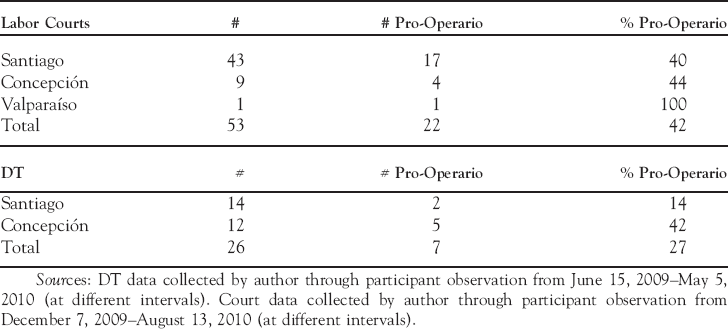
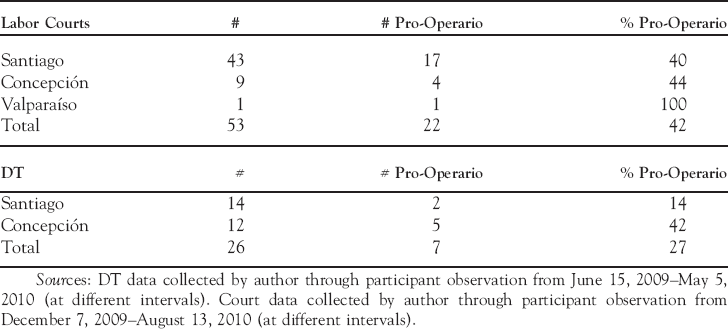
At the administrative level, the labor inspectorate is also less assertively pro-worker in contemporary times than during the UP era. In my observations at the Directorate of Labor (DT), the government agency in which the labor inspectorate of Chile is housed, labor inspectors, who had the authority to serve as mediators in settlement claims, very rarely tried assertively to persuade employers to settle dismissal claims in a way favorable to the worker (see Table 3 and Section III.C) (Rosado Marzán Reference Rosado Marzán2012).
Number of Hearings Observed by Author at DT and Labor Courts and Impressions of Pro-Operario Orientation
| Labor Courts | # | # Pro-Operario | % Pro-Operario |
|---|---|---|---|
| Santiago | 43 | 17 | 40 |
| Concepción | 9 | 4 | 44 |
| Valparaíso | 1 | 1 | 100 |
| Total | 53 | 22 | 42 |
| DT | # | # Pro-Operario | % Pro-Operario |
| Santiago | 14 | 2 | 14 |
| Concepción | 12 | 5 | 42 |
| Total | 26 | 7 | 27 |
Sources: DT data collected by author through participant observation from June 15, 2009–May 5, 2010 (at different intervals). Court data collected by author through participant observation from December 7, 2009–August 13, 2010 (at different intervals).
Hence, under the UP government, union membership was higher than in the post-Pinochet era. Unions played a much more active role in running the country and setting terms and conditions of employment for workers in the country as a whole. The government also created an Area of Social Property—the core for the UP's socialist economy. There was also a much more assertive labor inspectorate. There are, thus, stark differences in the organizational conditions of workers then and now, and in the general institutional environment. Today, Chile is much more marketized, or neoliberal.
B. Substantive Similarities in Chilean Dismissal Law in the Periods Under Study
Despite the stark differences between the socialist and neoliberal periods, it is crucial to recognize that the rules protecting employees from dismissal were in important respects similar during the UP government and in more contemporary times. The Immobility Law of 1966,Footnote 3 the dismissal law in place during the UP government, stated that the employer could not terminate employees without cause (see Thayer Ojeda and Novoa Reference Thayer Ojeda and Novoa1980, 419). Employees who were terminated without cause and not reinstated by the employer were entitled to receive one month of severance pay per year worked (Sehnbruch Reference Sehnbruch2006, 53–54). The law did not provide for a cap on employer liability; the number of actual years worked by the employee would determine the severance liability.
The Pinochet regime, being no friend of labor, rescinded the Immobility Law and replaced it with a law that provided for at-will dismissal and a small severance payment equaling to (at most) five months of pay (Frank Reference Frank2002, 40). However, in the 1990s, the democratically elected government of Chile reestablished for-cause dismissal (Frank Reference Frank2002, 40; 2004, 77; Carnes Reference Carnes2014, 125–26). Since then, the labor code has stated that employees can be legally terminated only for cause.Footnote 4 If employers fail to show cause, they must pay severance and certain penalties (see Frank Reference Frank2002, 49). In fact, even if employers show cause, they may have to pay some severance to the employee.Footnote 5 Only in a limited number of cases, such as when workers fail to meet their contractual duties or if the employer suffers from unforeseen circumstances or force majeure, may the employer terminate the employment contract without incurring any severance liabilities.Footnote 6 Unlike the Immobility Law, however, employer severance liability today is generally limited to eleven months of employee pay (Frank Reference Frank2002, 40).Footnote 7 However, also unlike the Immobility Law, after the 2006 ROL reforms, employers may be liable for an additional six- to eleven-month severance penalty if the termination was discriminatory and lacerated the employee's “fundamental rights.”Footnote 8 Hence, while the political context for workers was different under socialism and neoliberalism, dismissal protections were similar in important ways.
C. The Labor Inspectorate and the Labor Courts
The two government entities in charge of enforcing labor law in Chile, and particularly dismissal protections, briefly described above, are the labor inspectorate and the labor courts. Ietswaart mentioned that labor courts during the 1970–1972 period had exclusive competence, or jurisdiction, over dismissal claims (Ietswaart Reference Ietswaart1977, 161; 1982, 645). The same is true today.Footnote 9 This means that only labor courts can formally adjudicate dismissal cases.
However, in the early 1970s, as is the case today, employees could request that the labor inspectorate mediate an out-of-court settlement before the courts heard the case (Ietswaart Reference Ietswaart1982, 638, 652). If the worker so requested it, the labor inspectorate would typically summon the employer to appear in a settlement hearing and bring to the hearing the employment contract, the assistance record of the employee, and evidence that the employer made all wage payments and other legal deductions and contributions on behalf of the employee, among other evidence pertinent to settle an employee claim against the employer (Ietswaart Reference Ietswaart1982, 638, 645, 652).Footnote 10
Official statistics showed that in the 1970–1972 period, workers would seek the aid of the labor inspectorate much more frequently than that of the courts, even though the inspectorate only had power to subpoena the employer for a voluntary settlement (Ietswaart Reference Ietswaart1982, 663–65). In Santiago, for example, workers filed an average of 710 dismissal requests for mediation in the three-month period of April–June of 1970 (the lowest number of filings during the time that Ietswaart did her fieldwork) and 1,173 in January–March of 1970 (the highest number of filings during the time that Ietswaart did her fieldwork) (Ietswaart Reference Ietswaart1982, 644). In Ietswaart's reported data, such filings in the Santiago courts never exceeded 453 in a three-month period, and mainly stayed in the high two hundreds and three hundreds, generally, during similar three-month intervals (Ietswaart Reference Ietswaart1982, 661).
In the 2009–2010 period, the caseload of the labor inspectorate continued to exceed that of the courts. The DT resolved one-hundred-sixty thousand to one-hundred-ninety thousand dismissal cases nationally each year between 2009 and 2014 (see Table 1). Dismissal cases filed in the courts roughly fluctuated somewhere between eighteen thousand and twenty-six thousand from 2010–2014, or once all the reformed labor courts were operating (see Table 2). As when Ietswaart did her study, the more contemporary courts' docket was only a fraction of the labor inspectorate's.Footnote 11
D. Procedural Rules Differ After the ROL Reforms
While the formal dismissal rules and the state institutions that handled dismissal cases were essentially the same in the socialist and neoliberal periods under study, the judicial procedure available to workers who filed dismissal claims was markedly different. Since the ROL reforms of 2006, procedures have become more oral, labor judges have become much more active in handling dismissal grievances (including settlements), and workers are represented by counsel.
Chile has had a labor court system since 1924 (Ietswaart Reference Ietswaart1982, 656). It was created with the intention of compensating for the “economic inferiority” of workers with “legal superiority” (Ietswaart Reference Ietswaart1982, 656), a phrase that attests to the importance of the so-called protective principle and pro-operario—or pro-worker—orientation of labor law in South America. The protective principle presumes that workers are subordinated to and dependent on capitalists. Therefore, they require special legal protections, that is, labor law (Plá Rodriguez Reference Plá Rodriguez1978, 61; Gamonal and Rosado Marzán Reference Gamonal and Rosado Marzán2014, 616; Gamonal Reference Gamonal2015; see also Brinks and Forbath Reference Brinks, Forbath, Peerenboom and Ginsburg2013, 238). The way that South America, including Chile, comprehends the employment relationship is that if society leaves workers subject to individual freedom of contract and the market, employers can treat workers as if they were commodities, compromising workers' humanity and society's moral interests. Law must temper the power imbalance between workers and their employers as a moral imperative (see Ermida Reference Ermida2011, 11).
However, the Chilean labor justice procedure appears to have caught up with its protective principle only in recent years. In the 1970s, during the years of the UP, actuarios, or officers of the courts whose job was to compose case dossiers for judges, would handle settlements (Ietswaart Reference Ietswaart1977, 309–10; 1982, 655–56). Judges rarely met the parties, given that the process of litigation was based on presenting written evidence to the judge, not oral testimony (Ietswaart Reference Ietswaart1982, 655–56). There were no real trials (Ietswaart Reference Ietswaart1982, 656). Parties faced actuarios to present testimony and documentary evidence that became part of the case file presented to the judge (Ietswaart Reference Ietswaart1977, 309–10). Actuarios would take down testimonies and type them up for inclusion in the case file for the judge to read (Ietswaart Reference Ietswaart1982, 655–56). It was at that point that the actuarios would ask parties whether a settlement could be reached (Ietswaart Reference Ietswaart1977, 309–10).
Ietswaart observed a total of sixty-three dismissal hearings during her fieldwork. To lighten the court's docket, the actuarios would pressure parties (most often the workers) to settle (Ietswaart Reference Ietswaart1977, 326–29). Out of those sixty-three cases, actuarios pressured workers to settle 38.1 percent of the time, while employers were pushed to settle only in 11.1 percent of the cases. Neither party was pushed in 33.3 percent of the cases. Both parties were pushed in 17.5 percent of the cases (Ietswaart Reference Ietswaart1977, 320).
However, Ietswaart reported that the pressure to settle a case was much stronger in cases where there were no lawyers representing any of the parties, or 58 percent of the cases that Ietswaart observed (thirty-seven out of sixty-three). In eleven of the sixty-three cases that she observed, only one party had a lawyer, most likely the employer, and in those cases the actuario also attempted very strongly to settle the case (Ietswaart Reference Ietswaart1977, 327). When both parties had lawyers, lawyers would insist on sending the matter to the judge, and the actuario would generally acquiesce (Ietswaart Reference Ietswaart1977, 324–25). Administrative convenience and lack of representation, not merit, therefore determined who had their cases decided by a judge.
We must underline, however, that even though the actuario-centered process was procedurally favorable to employers, the dynamics between the labor courts, employers, workers, and the Supreme Court, which exercised supervisory control of the lower labor courts, was contentious and complicated. Chilean labor courts, which were lower-level trial courts, had been embattled institutions since their incipience (Hilbink Reference Hilbink2007, 64). Then, labor courts were tripartite, lay tribunals that could summon the police to enforce their orders without further judicial oversight (Hilbink Reference Hilbink2007, 64). In 1931, the government professionalized the labor courts, but those professional judges' decisions could be reviewed only by the Ministry of Social Welfare, an executive agency independent of the judiciary (Hilbink Reference Hilbink2007, 64). Employers and newspapers still disapproved of the political character of labor courts, compelling the government in 1933 to put the labor courts under the “directive, correctional, and economic” control of the country's Supreme Court, known for being extremely conservative and hostile to workers' rights (Hilbink Reference Hilbink2007, 65; Novoa Monreal Reference Novoa Monreal1970).
Even after the Supreme Court obtained supervisory control over the labor courts, it could not overturn labor court opinions on substantive legal grounds. The recurso de casación, the ordinary appellate procedure, was unavailable for labor matters going to the Supreme Court (Hilbink Reference Hilbink2007, 64). However, despite its lack of competence to reverse labor cases on substantive grounds, the Supreme Court would commonly reverse labor courts through its capacity to discipline judges (Novoa Monreal Reference Novoa Monreal1970; Hilbink Reference Hilbink2007, 64). Parties could file a recurso de queja, or a complaint appeal, at the Supreme Court (Hilbink Reference Hilbink2007, 64). In those complaint appeals, parties typically alleged that lower court judges had committed judicial misbehavior and, therefore, they requested that the Supreme Court reverse the judges. The Supreme Court readily sanctioned reversals through this roundabout way. While in 1930 only 10 percent of the Supreme Court docket was composed of such complaint appeals, by the 1960s that rate increased to over half of all cases on the court's docket (Hilbink Reference Hilbink2007, 65).
According to Ietswaart, the Supreme Court's hierarchical control over the lower courts significantly tamed the labor courts, compelling lower court judges and actuarios to orient their activity “toward pleasing the Supreme Court, and that meant avoiding trouble”; for example, showing productivity by moving their cases (1982, 656). Other critics had condemned the judiciary in harsher terms, lambasting the “inconfessable and ignoble instincts” of Supreme Court superiors, which cultivated underlings characterized by “ego massaging and obsequiousness” (Hilbink Reference Hilbink2007, 62, internal citations omitted).
But, as stated before, dynamics between the courts, employers, and employees, and between hierarchical levels in the courts, were complicated. Even despite disciplinary control, some labor jurisprudence remained committed to the pro-operario, or worker-protective principle, of Chilean labor law (see Sehnbruch Reference Sehnbruch2006, 53–54). Very importantly, the labor courts narrowed employer causes for terminating workers. On its face, the Immobility Law established that “economic reasons” were just cause for termination (Sehnbruch Reference Sehnbruch2006, 53–54). However, labor courts narrowed that termination cause so that employers could not use “economic reasons” willy-nilly to justify any and all terminationsFootnote 12 (Sehnbruch Reference Sehnbruch2006, 53–54). To no surprise, workers perceived the Immobility Law as providing “job security and insurance against unemployment and thus [it] came to be seen as their most important acquired right” (Sehnbruch Reference Sehnbruch2006, 53–54). On the other hand, employers viewed the law as a “nightmare” (Sehnbruch Reference Sehnbruch2006, 53).
During the Pinochet dictatorship, the labor courts were hesitant to apply the labor-protective, pro-operario interpretation of the law in their opinions (Sehnbruch Reference Sehnbruch2006, 55). Thereafter, the Plan Laboral totally eliminated the requirement that workers could be fired only for cause (Sehnbruch Reference Sehnbruch2006, 56). In 1981, Pinochet abolished the labor courts and labor courts of appeals (Macchiavello Reference Macchiavello1997, 46; Ortúzar and Vegara forthcoming). But the absence of labor courts was short. The Supreme Court advised the dictatorship to reinstate the labor courts in 1986; the dictatorship conceded (Macchiavello Reference Macchiavello1997, 46). Labor cases were likely clogging the civil court dockets and administrative convenience required the labor courts' return. Some scholars have argued, however, that Pinochet's labor courts were palliated; the dictatorship did not let former labor judges sit in these labor courts, arguing that the former judges had “bad habits” (Ortúzar and Vegara forthcoming). Moreover, labor courts of appeal, crucial in developing a labor-protective jurisprudence in the former era, were never reestablished, not even after the 2006 ROL reforms.
The actuario-centered process continued in Chile until about the end of the 2000s, when the 2006 Labor Justice ROL reforms came to fruition. These reforms followed at the heels of ROL reforms in the criminal tribunals (see, e.g., Prillaman Reference Prillaman2000; Palacios Muñoz Reference Palacios Muñoz, Dezalay and Garth2011). The Chilean Congress stated that the purpose of the labor justice ROL reforms was to introduce faster, simpler, and more transparent court proceedings, including oral trials in open court (Biblioteca de Congreso Nacional de Chile 2006, 4–8, 239). ROL reforms in the labor courts were thus an extension of prior ROL reforms, which analysts had viewed as effective in Chile, unlike other Latin American countries (Prillaman Reference Prillaman2000, Ch. 6). As prior ROL reforms, the labor justice reforms focused on truly transforming the trial courts by increasing the number of judges, making the procedures more oral, and providing legal representation to low-income litigants (Rosado Marzán Reference Rosado Marzán2010, 512). The actuario was eliminated in the labor courts, as it was similarly eliminated in the criminal courts. Actuarios were considered ineffective, if not corrupt, institutional actors (see Hersant Reference Hersant2014). In fact, in the pre-ROL reformed criminal courts, the actuarios were known for “disappearing” case files if bribed (Matus Reference Matus1999, 21, 179, 304, 305, 416, 418).
Moreover, today the procedural rules require that lawyers represent all parties. If plaintiffs are indigent, they will receive free legal representation. In 2006, the state hired 137 legal aid lawyers to represent indigent labor court plaintiffs free of charge. These lawyers formed the rank-and-file of the new Defensoría Laboral (Labor Defense) created to represent workers in the labor courts (Rosado Marzán Reference Rosado Marzán2010, 512).
Today, after the ROL reforms, judges, not actuarios, settle cases. They do so during pretrial hearings or during the trial itself. They also settle the cases differently than the actuarios. In my observations at the labor courts, where I observed fifty-three hearings, judges never tried to pressure workers to accept a settlement for any price, as actuarios did when Ietswaart performed her study. Most of the time, they did not try to settle cases aggressively; rather, they handled cases in a bureaucratic, ceremonial, or routine way, without attempting to side with either party. However, in about 42 percent of the hearings I observed, or twenty-two of fifty-three, judges tried to settle the cases in ways that appeared labor protective, meaning that judges discussed the merits of the cases, factually and legally, during pretrial hearings and during the trial, pointed out the apparent weaknesses of the employer's case, and tried to persuade the employer to settle.
The Supreme Court also appears not to be policing the judges through the recurso de queja as a roundabout way to reverse judicial opinions, or at least not to the extent experienced in earlier decades. I did not perceive judges to be paying too much attention to what Supreme Court superiors would think of them, or of the recurso de queja. Official statistics show that in recent days, 6–7 percent of all cases filed in the Supreme Court were recurso de queja, while, as stated earlier, in the 1960s the ratio was 30 percent (Poder Judicial de Chile 2017).Footnote 13
Very importantly, despite procedural reforms, judges retain inquisitorial powers that provide them with authority to question witnesses directly and to call on the witnesses who they want to hear in court.Footnote 14 They have authority to discover evidence that can compel parties to settle cases. The vignettes below provide some examples of how current-day judges, unleashed by the ROL reforms, exercise their newly found authority in Chile.
E. Judges Provide Benchmarks for Settlement
After the ROL reforms, the Chilean Labor Code explicitly requested that, for ordinary trials, the judge attempt to settle the case at the “preparatory” hearing, or the first of two hearings in ordinary trials.Footnote 15 In practice, the judge attempts to settle cases throughout the preparatory and trial hearings.
One strategy that judges use today to nudge if not push employers into settling a case is to provide an amount that they believe the case should settle for based on the pleaded facts. Judges sometimes state that they have heard similar cases before, with similar facts, where the plaintiff settled for a particular amount. If the parties did not settle, the judge normally proceeded with the hearing. When evidence started to hurt the employer's case, judges made note in open court that perhaps the settlement amount should be higher than what the judges had indicated at the beginning of the hearing.
For example, in one case regarding the termination of a call center worker, the worker requested a total of Chile $1,929,740 as compensation for an allegedly unjustified termination.Footnote 16 The judge, who was forceful and stern, reminded the employer at the beginning of the trial that if the worker prevailed, the employer would be liable for all the accrued severance in addition to an 80 percent penalty, among other fees and plaintiff court costs. The employer offered less than half the amount requested by the worker, or Chile $850,000, to settle the claim, which the worker rejected.
During the hearing, the worker's witnesses—coworkers—alleged that the worker had been classified by the employer as “non-apt” during the employment relationship, which meant that customers of the employer, all of whom were in Spain, had complained that they could not understand the accent of the Chilean worker. Non-apt employees were ordered to sit in the lunchroom for the entire workday. While paid for sitting in the lunchroom, the workers had no other duties until they could be put to work for a different corporate client.
The employer fired the non-apt worker in this case for allegedly being absent from work. However, the worker alleged that she was in the lunchroom, as ordered, when the employer alleged that she had been absent. Noting the rather bizarre non-apt policy, which struck the judge as psychologically abusive, the judge immediately declared in court that the suit should settle for more than the Chile $850,000 initially offered by the employer, signaling that the case was not going well for the employer. The employer, however, offered no other sum.
Thereafter, more testimony surfaced, suggesting that there were more than twenty-two non-apt employees in the call center of almost four hundred employees. The non-apt employees were ordered to wait entire days, unsupervised, in the lunchroom. Therefore, it was not possible, so declared some witnesses, for the employer to know if the non-apt employees were in the lunchroom during working hours. Moreover, testimony by a union shop steward suggested that many non-apts, tired of the boredom and humiliation of sitting in the lunchroom, voluntarily resigned from the workplace. Employees who voluntarily resign in Chile are not qualified to receive severance pay. The policy thus appeared to serve as a means for the employer to get rid of unwanted workers without paying severance. “Very interesting!” snapped the judge, further signaling to the employer his displeasure with the non-apt policy.
Despite the judge's efforts to settle the case, the employer was not willing to settle. At the end, the employer ended up paying for this stubbornness. The judge found the employer liable for about Chile $2,288,741, including the 80 percent penalty for losing the case in court and the plaintiff's court costs, plus interest, which exceeded the total amount initially pleaded by the worker.Footnote 17 Thus, the process and its outcome appeared pro-operario.
F. Settlement Must Be Voluntary
Judges frown on strained settlements, which, according to Ietswaart, actuarios used to compel regularly. In one pretrial hearing that I observed, the plaintiff had requested in his complaint a total of Chile $1.9 million, including Chile $340,000 for lack of termination notice, Chile $687,000 for severance, Chile $550,000 for the 80 percent penalty, and other sums for court costs and other fees. At the beginning of the hearing, the judge asked if the parties were willing to settle. The employer said it was willing to offer 70 percent of the employee's claim without any penalties or fees (which can be imposed by the court only if the plaintiff prevails), or Chile $700,000. The plaintiff appeared troubled by the offer and went outside with his lawyer to discuss the matter. Ten minutes later, the worker and his lawyer returned. The worker's lawyer requested Chile $1 million to settle, which was the full amount of severance owed by the employer excluding penalties and other fees. The employer's attorney immediately refused the offer. The judge reminded the worker's lawyer that 70 percent settlements were considered acceptable, but then asked the employer's attorney if he could increase the amount. The lawyer said that he had instructions to go only up to Chile $700,000, but after some discussion, increased the amount to Chile $750,000. After some haggling, the employee said, almost reluctantly, that he would accept Chile $750,000. Not being entirely convinced by what appeared to be a rather lukewarm acceptance, the judge asked the plaintiff if he really wanted the deal. The plaintiff told the judge that he felt “forced” to accept the deal. The judge told the worker that the settlement must be voluntary and decided to close settlement discussions. Visibly torn and upset that negotiations had apparently come to a close, the worker tried to explain to the judge that he still wanted to settle for Chile $750,000. However, by then, the plaintiff had shown himself to be too unsure. The judge decided to end negotiations and proceeded with the preliminary hearing.Footnote 18
This much more careful manner of settlement, where judges were sensitive about workers' consent in the process, contrasts with Ietswaart's account of the ways workers were coaxed into accepting settlement offers by the old actuarios. Even workers who said they wanted a certain deal appeared to be protected by the judge so that workers made voluntary decisions during settlement.
G. The Powerful Combination of the Pro-Operario Mandate, the Inquisitorial Judge, and the Oral Process
Moreover, on more than one occasion I observed judges using their inquisitorial powers, inherited from the old, written process, to question witnesses directly, clarify the evidence, and push the case forward, sometimes into settlement. In one case, for example, while the trial hearing was taking place, the judge called on a court officer working in another courtroom of the courthouse to serve as a witness in his courtroom. The case concerned an employee of a law firm who was terminated while she was on maternity leave, shortly after the death of the law firm's only lawyer. The son of the deceased employer closed the law firm and fired the worker, the employer's secretary. The secretary sued in the labor court demanding back pay and reinstatement. In the event she could not be reinstated, the worker requested back pay, severance, and all penalties and fines. This meant that if she could not be reinstated, she was owed, at a minimum, three months of back pay (June through August 2010), five months of severance, and one additional month for lack of notice of termination, which the law mandates in Chile. Given that her base pay was Chile $600,000, the employer potentially owed her Chile $5,400,000 plus the 80 percent penalty, other fines, and court costs.
The employer's estate argued, among other things, that the estate could not owe five months of severance to the worker because the worker did not work for five consecutive years for the employer. She had taken time off throughout the five-year tenure. Since she must work for five consecutive years to accumulate the five months of severance, she could not claim the severance benefit. Indeed, there appeared to be missing or contradictory documentary evidence about her tenure. Moreover, the employer argued that there was not enough money in the estate to pay the worker.
Exasperated by lack of documentary evidence to substantiate the employee's employment history, and visibly concerned about the possible poverty of the estate, the judge subpoenaed a court officer who worked at the labor court to testify. The judge realized that the court officer had worked for the law firm in the past. The court officer could at least certify whether or not the plaintiff had worked for five consecutive years. When he showed up in court, the officer testified that, in fact, the worker had worked for five uninterrupted years for the employer. With the new evidence, a settlement was imminent. The parties eventually settled for Chile $4 million, to be paid in eight installments.
The judge told me in a short interview after the settlement that while he could have written a favorable decision for the worker, with a much larger award, the estate did not appear to have enough money to pay. The worker might have had to sue in bankruptcy proceedings, and may have ended up receiving much less than the Chile $4 million—and at a much later date. He also told me that this settlement was made possible thanks to the “clockwork” (relojería) of the new system. That clockwork combines the pro-operario mandate, judges' inquisitorial authority inherited from the old system, and a new oral process. The combination of these provides formidable authority and presence to the new labor judges.
H. A Dramatic Pro-Operario Orientation
As stated above, in about 42 percent of the hearings that I observed, the judges showed a pro-operario orientation, meaning that they tried to discover facts useful to the worker and pursued lines of argument in open court that helped the worker's case. While most cases were handled in some sort of bureaucratic, rote fashion, pro-operario actions by judges, some of which have been explained above, contrast with the almost absolute aloofness if not abject contempt shown by the actuarios toward workers during settlement proceedings, as described by Ietswaart. Moreover, as some of the vignettes above showed, judges could sometimes be quite dramatic in outwardly showing their pro-operario orientation. Snapping at the employer's attorney during the hearing—“Very interesting!”—when the evidence suggested that the employer may have been humiliating the so-called non-apt employees at the call center, stopping settlement when it appeared that the worker was not making a voluntary choice, and calling a court officer in a different room of the labor court to testify were all dramatic instances that I experienced in the labor courts.
Such courtroom drama is common in the US context, as attested and perhaps highlighted in popular culture, where parties face each other in an adversarial proceeding. But given the active participation of the inquisitorial judge, who in the case of the labor courts must also be perceived to comply with his or her role to protect workers, the courtroom drama takes a more official tone that puts defendant-employers on high alert.
For example, in another case I observed, a judge, displeased with certain evidence regarding the manner in which the employer paid its workers, decided to visit, right during the trial, one of the employer's facilities and to discover the evidence himself. The employer's business was a drugstore chain found on almost every other city block of downtown Santiago, where the labor courts are located. The judge wanted to see if the employer in fact provided all employees with a list of all their sales and commissions, as required by law; the employer's lack of provision of the list of sales and commissions was the subject of the lawsuit. When the evidence appeared inconclusive, the judge simply announced that he was going out to look for the evidence himself. He stood up, and so did his clerk, the parties, and their lawyers, who then walked out of the courtroom, into the streets of Santiago, and from there to one of the employer's drugstores several city blocks from the court. The judge entered the drugstore with his entourage, presented himself to the cashier, and asked that she please provide him with her sales and commission information. The cashier accessed the drugstore's computer system and provided the requested information to the judge, clearing up that evidentiary matter immediately. The evidence pointed against the case of the workers because the employer appeared to be in compliance. The judge decided in his opinion and order that the employer provided adequate documentation.Footnote 19 Hence, the inquisitorial, pro-operario orientation does not mean that the employee always wins. It does provide, however, proceedings where judges show that the labor courts are on the employees' side, sometimes even dramatically.
V. Discussion
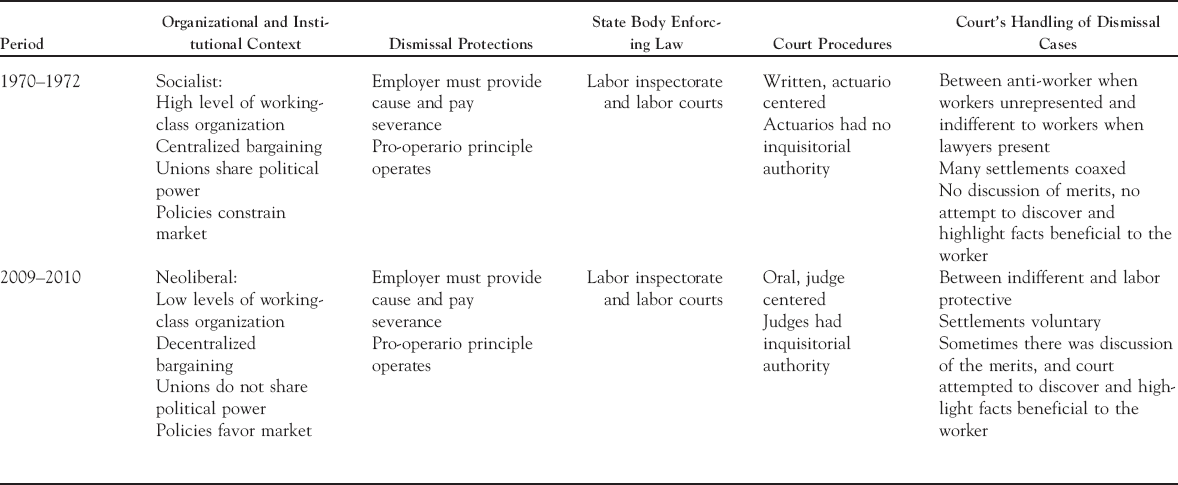
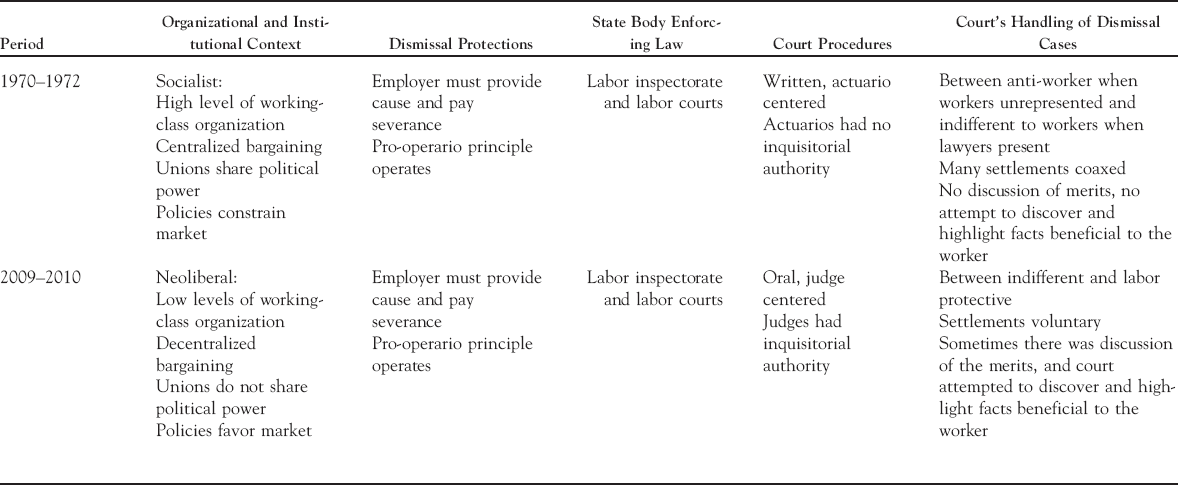
The Chile of 1970–1972 was very different from that of the post-Pinochet era. Workers were much better organized, their organizations represented workers in centralized bargaining institutions, and they shared in political power. The UP's policy for the Area of Social Property, copper nationalization, and its many social programs also narrowed the role of the market in organizing the Chilean economy. This article has called that era socialist given those particularities of the political economy. The article has referred to the current, post-Pinochet era, which is almost the opposite of the socialist era, as a neoliberal era. By labeling the current era neoliberal, I do not mean that there has been no space for nonmarket economic activities in post-Pinochet Chile, or that the state has retired from the economy. In fact, the article has provided evidence showing that Chile had similar laws regarding employee dismissals in the two eras. In both periods, employers could not fire employees without cause and had to pay severance when they terminated employees, except in particular circumstances. In both periods, the labor inspectorate mediated most dismissal cases filed by workers. Courts, which had ultimate jurisdiction to adjudicate these dismissal claims, would also settle many of these cases. But distinctly, and perhaps most interestingly, ROL reforms have made labor courts more protective despite working-class disorganization, decentralized bargaining and lack of political power, and the more prominent place that the market has played in organizing the Chilean economy (see Table 4).
Summary of Findings
| Period | Organizational and Institutional Context | Dismissal Protections | State Body Enforcing Law | Court Procedures | Court's Handling of Dismissal Cases |
|---|---|---|---|---|---|
| 1970–1972 | Socialist: High level of working-class organization Centralized bargaining Unions share political power Policies constrain market |
Employer must provide cause and pay severance Pro-operario principle operates |
Labor inspectorate and labor courts | Written, actuario centered Actuarios had no inquisitorial authority |
Between anti-worker when workers unrepresented and indifferent to workers when lawyers present Many settlements coaxed No discussion of merits, no attempt to discover and highlight facts beneficial to the worker |
| 2009–2010 | Neoliberal: Low levels of working-class organization Decentralized bargaining Unions do not share political power Policies favor market |
Employer must provide cause and pay severance Pro-operario principle operates |
Labor inspectorate and labor courts | Oral, judge centered Judges had inquisitorial authority |
Between indifferent and labor protective Settlements voluntary Sometimes there was discussion of the merits, and court attempted to discover and highlight facts beneficial to the worker |
The reason labor courts are more labor-protective today seems to have no direct relationship to working-class organization or the prominent role of the market; it has to do with ROL reforms. Actuarios settled cases before the ROL reforms. They would do so at any price to the worker to reduce overburdened court dockets and to appease Supreme Court supervisors. Since the ROL reforms, actuarios no longer exist in the labor courts. There are more judges. Labor judges, institutional actors with a duty to protect workers, have been unleashed throughout the process of litigation. As a result, courts have become more labor protective despite the neoliberal context.
One could argue that legal representation played a role in increasing the protective profile of labor courts. However, free legal representation for poor parties cannot explain the pro-operario orientation entirely. Under the old, actuario-centered system, Ietswaart noted that actuarios were tamed when lawyers were present. They would not try to cajole workers to accept meager settlements, but neither did they try to settle cases assertively in favor of workers even when represented by counsel. They would not provide settlement benchmarks that could increase when the evidence more favored workers. They had no inquisitorial authority to call witnesses or perform in-person investigations, as labor judges now do. In essence, actuarios just put files together and coaxed and pressured unrepresented parties, namely, workers, to drop their cases for a pittance. In 2009–2010, judges not only tended to conform to the pro-operario criterion, but also could direct testimony and other evidence in labor-favorable ways. Hence, the traditional inquisitorial labor judge, unleashed and blended into a new oral process, transformed Chilean labor justice despite neoliberalism.
VI. Conclusion
Can ROL reforms help protect workers' rights in an era where workers are relatively disorganized and markets play a more central role in organizing economic life? Can workers' rights survive in an incoherent policy environment or, worse, in one that is downright hostile? Chile answers that question with a “yes.” ROL reforms have delivered on their promise for labor protection despite the otherwise apparently incoherent or hostile context.
However, Chile is in some ways unique. Duplicating its successes may not be that easy. First, as detailed in this article, Chile is one of the few countries in the world well regarded for its ROL reforms (Prillaman Reference Prillaman2000). Its holistic focus on increasing judicial resources, improving judicial independence and professionalism, and providing counsel to indigent parties have created conditions that have made such reforms effective there, but have been more difficult to replicate elsewhere.
Second, the Chilean judiciary has been historically autonomous, if not downright isolated, from other political branches of government. In fact, Chilean judicial apoliticism coupled with formalistic jurisprudence has been severely critiqued for decades (Hilbink Reference Hilbink2007). Judges inhibited themselves from deciding human rights cases during Pinochet's dictatorship by formally adhering to rules that enabled courts to duck politically controversial cases (Hilbink Reference Hilbink2007). That relative isolation from politics, however, may have provided the labor courts with sufficient autonomy to act in labor-protective ways once the actuario was removed and the labor-protective labor judge was unleashed throughout the process of litigation.
Third, the labor-protective judge, while embattled and with a complex history, has a long history in Chile, where the 2006 reforms are but a chapter. The judge was not created from whole cloth in 2006; rather, the labor-protective judge was de-shackled from the old, written system that kept him or her in an office reading paper files and writing opinions. Replicating a protective labor judge may be more difficult in jurisdictions without a similar institutional actor in their history.
Finally, we should underscore that this study did not address the role of judges' personal beliefs, commitments, and ideology in structuring their behavior during the process of litigation. Ideas play a role in this study, in the form of institutional ideas, those stemming from the protective principle that informs the pro-operario orientation. Future research could explore how labor judges' personal ideas and convictions interact with institutional, pro-operario norms.
To conclude, while workers' rights may hinge on working-class organization, political power, and the role of the market, courts matter for quality labor justice. This is not to say that labor courts have generally improved the life of workers in Chile. Chile remains one of the most unequal countries in the world. Critics of its economic model abound. However, workers who seek the aid of Chilean labor courts today, in more neoliberal times, are more apt to meet a responsive institution than during socialism. Rule of law and procedural rules matter for labor justice.
Methodological Appendix
I structured this study as an “extended case” (Burawoy Reference Burawoy2009). It included an “ethnographic revisit” (Burawoy Reference Burawoy2009, Ch. 2) that compared observations with those of Heleen Ietswaart (Reference Ietswaart1977, Reference Ietswaart1982), who performed a study almost identical to mine but in 1970–1972, two of the almost three years of the UP's government in Chile.
My fieldwork included participant observation, triangulated through key informant interviews, and legal texts. My participant observation lasted for about seven months in 2009–2010. During my seven months in Chile, I had an office in downtown Santiago at the national headquarters of the DT, where the labor inspectorate is housed. The director of the DT granted me the office space after I requested it, via letter, to study the institution. The DT helped me obtain permission to attend settlement hearings. As to labor courts, I attended hearings there as simply a member of the public; labor court hearings are open to the public.
At the DT, I observed twenty-six hearings in which parties were present and, therefore, a settlement hearing could be had. Fourteen of the hearings were in Santiago and twelve were in Concepción. I observed DT hearings in Santiago and Concepción, the two largest Chilean cities, to arrive at a “sufficient” (Seidman Reference Seidman2013, 58) understanding of what prevails during such hearings in major urban centers, where most dismissal claims are filed. The twenty-six observations do not provide empirical evidence of what prevails in smaller cities, or in rural areas of the country. Further research could provide us with a picture of labor justice outside Chile's main cities. Despite their limitation to urban centers, the twenty-six hearings, which lasted anywhere between thirty minutes and about two hours, provided me with “saturation” of data (Seidman Reference Seidman2013, 58–59).
I also observed labor trials at the labor courts of Santiago, as well as the country's second largest city of Concepción and the port city of Valparaíso. I spent about three months at the labor courts and observed a total of fifty-three hearings related to employee dismissals. Forty-three hearings were in Santiago, nine were in Concepción, and one was in Valparaíso. The fifty-three court hearings in three different cities provided me with sufficient data about what happens in labor court hearings in major urban centers, as well as data saturation. The one marked difference in my observations was that the courts had a significant backlog in Valparaíso and Concepción. Despite the backlog, however, the settlement proceedings operated pretty much in the same fashion as in Santiago.
The fieldwork at the DT and the courts helped me to establish relationships with three inspectors and two labor court judges. These three inspectors and two judges served as key informants. I interviewed these key informants formally and informally throughout this fieldwork to triangulate observations. I also engaged in document collection and review, including studying the Labor Code, the Decreto con Fuerza de Ley (DFL) No. 2, and other legal documents, some cited herein.
I recorded my observations as daily jottings during the day (Emerson, Fretz, and Shaw Reference Emerson, Fretz and Shaw1995, 19–20). I then transcribed the jottings into more formal notes. At certain times during my fieldwork, I also wrote short memos to myself. These memos served as preliminary analyses of my data.
I then compared my observations with those of Ietswaart (Reference Ietswaart1977, Reference Ietswaart1982). Finally, I presented preliminary results in a workshop in October 2012 in Chile. Present at the workshop were other informants, including the president of the labor court where I did my research, the head of the settlement department of the DT in Santiago, the research chief of the DT, the former head of the legal division of the DT, and four Chilean law professors. They assessed that my preliminary empirical results appeared accurate. Since 2010, I have also regularly consulted informally with key informants to update and fact-check aspects of this report.