Introduction
Reproductive success in parasitoid wasps depends largely on the decisions made by females during their foraging activities (Outreman and Pierre, Reference Outreman and Pierre2005). The acceptance of a host for oviposition becomes the most important step once the host has been found, and this is mainly dependent upon the quality of the host (Visser et al., Reference Visser, Luyckx, Nell and Boskamp1992). In solitary parasitoids, where only one individual can complete its development in a given host, a determining factor for host acceptance is its condition of being previously parasitized or not (Ueno, Reference Ueno1994), since an already parasitized host will be, in general, of lower quality for the foraging female (Bakker et al., Reference Bakker, van Alphen, van Batenburg, van der Hoeven, Nell, van Strien-van Liempt and Turlings1985; Nelson and Roitberg, Reference Nelson and Roitberg1995). Sympatric wasp parasitoids using the same resources may compete for hosts both at the adult stage (when females forage in the same patch) and at the larval stage, when hosts are superparasitized or multiparasitized (within-host competition) (Harvey et al., Reference Harvey, Poelman and Tanaka2013; Cusumano et al., Reference Cusumano, Peri and Colazza2016).
Superparasitism is a reproductive strategy that occurs when a female parasitoid parasitizes a host that has been previously parasitized, either by herself or by another female of the same species (van Alphen and Visser, Reference van Alphen and Visser1990). However, many species of solitary parasitoids are able to distinguish between parasitized and non-parasitized hosts, which is known as discrimination ability (van Lenteren, Reference van Lenteren, Nordlund, Jones and Lewis1981; Mackauer, Reference Mackauer, Mackauer, Ehler and Roland1990). This depends on the capacity of female parasitoids for identifying external or internal cues on the hosts (Vinson, Reference Vinson1976; Roitberg and Mangel, Reference Roitberg and Mangel1988). In solitary parasitoids, supernumerary individuals are eliminated through direct, physical combat or through physiological suppression (Bakker et al., Reference Bakker, van Alphen, van Batenburg, van der Hoeven, Nell, van Strien-van Liempt and Turlings1985; Hubbard et al., Reference Hubbard, Marris, Reynolds and Rowe1987; Mackauer et al., Reference Mackauer, Bai, Chow and Danyk1992).
Superparasitism occurs at different levels: (1) self-superparasitism, when a female solitary parasitoid oviposits more than once on or in the same host; (2) conspecific superparasitism, when two or more females of the same species parasitize one host (van Dijken and Waage, Reference van Dijken and Waage1987); and (3) multiparasitism, when two or more females of different species parasitize the same host (Vinson and Ables, Reference Vinson and Ables1980; Pschorn-Walcher, Reference Pschorn-Walcher1987; Pijls et al., Reference Pijls, Hofker, van Staalduinen and van Alphen1995). Multiparasitism events may lead either to interspecific competition among parasitoids, or to a facilitation process in those situations in which a given species may benefit from the presence of the other species (Poelman et al., Reference Poelman, Gols, Gumovsky, Cortesero, Dicke and Harvey2014; Cusumano et al., Reference Cusumano, Peri and Colazza2016).
Under both mass rearing and field conditions, superparasitism has been reported in Diachasmimorpha longicaudata (Ashmead) (Hymenoptera: Braconidae), which was introduced into Mexico to control fruit flies of the genus Anastrepha Schiner (Diptera: Tephritidae) (González et al., Reference González, Montoya, Pérez-Lachaud, Cancino and Liedo2007, Reference González, Montoya, Pérez-Lachaud, Cancino and Liedo2010; Montoya et al., Reference Montoya, Cancino, Pérez-Lachaud and Liedo2011, Reference Montoya, Ruiz, Pérez-Lachaud, Cancino and Liedo2013). Such reproductive strategy has been related to a female-biased sex ratio without adversely affecting other fitness parameters of the offspring (González et al., Reference González, Montoya, Pérez-Lachaud, Cancino and Liedo2007; Montoya et al., Reference Montoya, Cancino, Pérez-Lachaud and Liedo2011). On the contrary, little is known of the effect of superparasitism and multiparasitism in the guild of native Anastrepha parasitoids.
In the Neotropics, the guild of native parasitoids associated with fruit flies of this genus comprises mainly members of the family Braconidae (Hymenoptera), for the most part, Opiinae solitary, larval–pupal endoparasitoids (Ovruski et al., Reference Ovruski, Aluja, Sivinski and Wharton2000). Among the most important species are Doryctobracon crawfordi Viereck, Utetes anastrephae Viereck, and Opius hirtus Fischer (López et al., Reference López, Aluja and Sivinski1999; Ovruski et al., Reference Ovruski, Aluja, Sivinski and Wharton2000), which are polyphagous and associated with several species of the genus Anastrepha. Doryctobracon crawfordi is distributed from central Mexico to Argentina (Ovruski et al., Reference Ovruski, Wharton, Schliserman and Aluja2005) and is associated mainly with larvae of Anastrepha ludens Loew, A. fraterculus Wiedemann, A. striata Schiner, A. serpentina Wiedemann, and A. obliqua Macquart (López et al., Reference López, Aluja and Sivinski1999). The distribution of U. anastrephae extends from northern Florida to northern Argentina (Sivinski et al., Reference Sivinski, Aluja and López1997; Ovruski et al., Reference Ovruski, Aluja, Sivinski and Wharton2000), while O. hirtus is distributed mainly in Mexico, Costa Rica, and the Dominican Republic (Ovruski et al., Reference Ovruski, Aluja, Sivinski and Wharton2000). Opius hirtus has been related to Anastrepha species not attacked by the other parasitoid species in the region (López et al., Reference López, Aluja and Sivinski1999; Sivinski et al., Reference Sivinski, Piñero and Aluja2000), such as Anastrepha cordata Aldrich, which develops in Tabernaemontana alba Mill (Apocynaceae) and other small-sized fruits (Hernández-Ortíz et al., Reference Hernández-Ortíz, Perez-Alonso and Wharton1994). Opius hirtus has the narrowest host range of these three species and has a great capacity to forage for rare, low-density hosts (García-Medel et al., Reference García-Medel, Sivinski, Díaz-Fleischer, Ramírez-Romero and Aluja2007).
The purpose of this study was to determine, under laboratory conditions, the presence and level of superparasitism in the three native parasitoid species of Anastrepha flies, and its possible effects on fitness parameters such as offspring sex ratio, survival, and fecundity. This basic knowledge could contribute to deciding on the use of these species in augmentative biocontrol programs.
Materials and methods
Biological material
The experiments were carried out at the Biological Control Laboratory of the Methods Development Unit of the Moscafrut Program (SENASICA-SADER), located in Metapa de Domínguez, Chiapas, Mexico. Environmental conditions were: temperature of 25 ± 1 °C, relative humidity of 75 ± 5%, and photoperiod of 12:12 h (light: darkness). Eight-day-old A. ludens host larvae were provided by the Moscafrut facility where this species is mass reared at a rate of 75 million per week (Orozco-Dávila et al., Reference Orozco-Dávila, Quintero, Hernández, Solís, Artiaga, Hernández and Montoya2017). Doryctobracon crawfordi, U. anastrephae, and O. hirtus adults were provided by the Biological Control laboratory where they are currently maintained at the colony level using the methods described by Aluja et al. (Reference Aluja, Sivinski, Ovruski, Guillen, Lopez, Cancino, Torres Anaya, Gallegos-Chan and Ruiz2009).
Determination of superparasitism
Self-superparasitism
Individual 5-day-old mated females were individually placed in 30 × 30 × 30 cm Plexiglass cages and 20 A. ludens larvae introduced into each cage as hosts. Females were sexually mature (see Lawrence et al., Reference Lawrence, Greany, Nation and Baranowski1978; Ovruski et al., Reference Ovruski, Colin, Soria, Oroño and Schliserman2003) and naive (i.e., had no previous experience of oviposition). The three parasitoid species in this study are known to be synovigenic, i.e. they emerge with few or no eggs, but egg-load significantly increases after 24 h (Cicero et al., Reference Cicero, Sivinski, Rull and Aluja2011). The host larvae were mixed with artificial larval diet (see Orozco-Dávila et al., Reference Orozco-Dávila, Quintero, Hernández, Solís, Artiaga, Hernández and Montoya2017) and exposed to each female parasitoid in the oviposition units, which consisted of a Petri dish (8.5 × 1.5 cm) covered with fine organza mesh secured in place by an elastic band to prevent escape of the larvae. After 2 h of exposure, the larvae were removed and placed in plastic containers (~ 100 ml) to continue their development to the pupal stage. After 24 h, the diet was removed by washing with water and replaced with moist coconut fiber as substrate for pupation. After 72 h, the exposed hosts were observed under a Discovery V8 Karl Zeiss stereomicroscope (Göttingen, Germany) in order to quantify the number of oviposition scars present on the fly puparium as an indicator of superparasitism (as in Montoya et al., Reference Montoya, Liedo, Benrey, Cancino, Barrera, Sivinski and Aluja2000, Reference Montoya, Benrey, Barrera, Zenil, Ruiz and Liedo2003). A 10% subsample of the hosts was dissected to corroborate and correlate the presence of immature parasitoid stages with the number of oviposition scars observed on the puparium. The non-dissected hosts were placed in plastic containers (~100 ml) labeled according to the number of scars, and held till adult parasitoid or fly emergence to determine the relationship between offspring sex ratio and number of scars. Fifteen replicates were conducted per parasitoid species.
Conspecific superparasitism and offspring fitness
Groups of five mated females of the same species and age (5-day-old), with no oviposition experience, were placed in Plexiglass cages of the type described above, and provided with 20 larvae in an oviposition unit. The same methods described in the previous section were followed for these tests.
In order to determine the effect of superparasitism on the longevity and fecundity of the progeny of each species, we formed pairs with the adult parasitoids that emerged from hosts with different number of scars (1 scar, 2–3 scars, and >3 scars). Survival was evaluated under two conditions: (a) without food or water, and (b) with food (honey) and water (as in FAO/IAEA/USDA, 2019). For the first condition, only mortality of both sexes was recorded every day, while for the second condition, mortality and fecundity were recorded daily. For fecundity, twenty 8-day-old A. ludens larvae were exposed to each adult pair for 2 h a day, starting from the fifth day until the female parasitoid died. There were 15 replicates per species.
Multiparasitism
Groups of three females (one female of each species) were introduced into the Plexiglass cages described above, where 20 A. ludens larvae were exposed to them in a Petri dish oviposition unit for 2 h. The Petri dishes with larvae were then removed and the larvae placed in recycled diet in a plastic container (~100 ml) with a lid, in order to continue their development to the pupal stage. The diet was removed after 24 h of exposure and replaced with a moist substrate of coconut fiber. The puparia were maintained under laboratory conditions until adult emergence. The percentage of emergence (observed level of parasitism) and sex ratio of each species was recorded. To corroborate the presence of immature stages of the parasitoid species in competition, a subsample of 10% of the parasitized hosts was dissected three days after exposure. The larvae were identified by morphological differences among species according to Murillo et al. (Reference Murillo, Liedo, Nieto-López, Cabrera-Mireles, Barrera and Montoya2016). A total of 15 replicates were conducted.
Statistical analyses
The relationship between number of oviposition scars per puparium and number of immature stages found within each host was analyzed by a simple linear regression in the self-superparasitism experiment, and by a binary logistic regression in the case of the conspecific superparasitism experiment, according to the nature of the data. The possible influence of superparasitism (number of scars per host) on the sex of the emerging adult was analyzed with a logistic regression using a logit link function. Survival curves were compared using the log-rank test and a Cox proportional hazards model (Lee and Wang, Reference Lee and Wang2003). Fecundity was estimated from the number of daughters produced daily by each female for each species of parasitoid, and the data analyzed using a one-way ANOVA with a Tukey test. Multiparasitism data were analyzed using a one-way ANOVA with a Tukey test. The logistic regression was conducted using Statgraphics Centurion ver. XV (2008). For the one-way ANOVA analysis, linear regression and log rank test we used JMP version 7.0.1 (SAS, 2007). Data were checked for the assumption of normality with Kolmogorov–Smirnov test.
Results
Self-superparasitism
A total of 87 (29%) of the hosts exposed to D. crawfordi (n = 300) exhibited oviposition scars, of which 33 (38%) had more than one scar. There was no relationship between the number of scars present per host and the number of immature stages found within the host (0–1 parasitoid larva/host) (logistic regression, χ2 = 1.04, d.f. = 1, P = 0.31, fig. 1a). The percentage of observed emergence of D. crawfordi was 33%. For the hosts parasitized by U. anastrephae, 147 puparia (49%) had scars, of which 73 (50%) had more than one scar. No relationship was observed between number of scars and quantity of immature stages (χ2 = 1.22, d.f. = 1, P = 0.26, fig. 1b). The percentage of observed emergence in this species was 34%. A similar tendency was observed for O. hirtus, where the relationship between number of immature stages and number of scars on the host puparia was also not significant (χ2 = 1.53, d.f. = 1, P = 0.21, fig. 1c), with 81 (27%) of the hosts exhibiting scars, of which 34 (42%) had more than one scar. Observed adult emergence was 23%. The sex of the resulting adults was not influenced by the number of scars per host in any of the three species: D. crawfordi (logistic regression, χ2 = 0.16, d.f. = 1, P = 0.68), U. anastrephae (χ2 = 0.05, d.f. = 1, P = 0.82), and O. hirtus (χ2 = 0.01, d.f. = 1, P = 0.93).
Relationship between number of oviposition scars per host and number of immature stages in self-superparasitism and conspecific superparasitism conditions in Doryctobracon crawfordi (a, d), Utetes anastrephae (b, e), and Opius hirtus (c, f). Logistic regression (a, b, c and f) and linear regression (d, e).

Conspecific superparasitism and offspring fitness
Of the larvae exposed to D. crawfordi, 73% (219/300) exhibited oviposition scars, of which 79% (173/219) had more than one scar. The relationship between number of oviposition scars on the puparia and number of immature stages within them was at the limit of significance (R 2 = 0.25; F = 4.3, d.f. = 1,13; P = 0.05, fig. 1d). The number of immature stages was never greater than four and the percentage of adults that emerged was 27%. In U. anastrephae, 58% (174/300) of the hosts exhibited oviposition scars, of which 84% (146/174) exhibited more than one scar. In this species, a strong positive and significant relationship was observed between number of scars and number of immature stages (R 2 = 0.72; F = 56.13, d.f. = 1,21; P < 0.0001, fig. 1e). Adult emergence was 36%. In O. hirtus, 57% of hosts (170/300) exhibited oviposition scars, of which 80% exhibited more than one scar (135 hosts). However, most of the dissected hosts contained only one larva and the relationship between number of scars per host and number of immature stages was not significant (R 2 = 0.059, F = 1.84, d.f. = 1,29, P = 0.18, fig. 1f). The percentage of adult emergence in this species was 13%.
Under conspecific superparasitism conditions, the probability of an emerging parasitoid being a female was not related to the number of scars present on the host for any of the species evaluated: D. crawfordi (logistic regression, χ2 = 1.97, d.f. = 1, P = 0.16), U. anastrephae (logistic regression χ2 = 0.96, d.f. = 1, P = 0.32), and O. hirtus (logistic regression χ2 = 0.035, d.f. = 1, P = 0.85).
Survival
In the test without food and water, the number of oviposition events per host (1 scar, 2–3 scars, and >3 scars) had no effect on female and male survival for any of the three species [D. crawfordi (log-rank test, χ2 = 9.20, d.f. = 2, P = 0.32; χ2 = 0.67, d.f. = 2, P = 0.71), U. anastrephae (log-rank test, χ2 = 17.95, d.f. = 1, P≤0.05; χ2 = 1.98, d.f. = 2, P = 0.36), and O. hirtus (log-rank test, χ2 = 7.24, d.f. = 2, P = 0.29; χ2 = 2.93, d.f. = 2, P = 0.23)] for females and males, respectively. However, when comparing among species, O. hirtus was the species with the longest survival (5.26 ± 0.24 days) (mean ± SE; n = 43) (log-rank test χ2 = 12.81, d.f. = 2, P = 0.0001). Doryctobracon crawfordi and U. anastrephae lived for shorter times, 4.43 ± 0.25 days (±SE, n = 24) and 4.38 ± 0.17 days (±SE, n = 28), respectively.
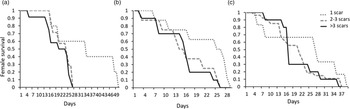
When food and water were provided, survival was not significantly different among females of each species reared from hosts with different number of scars: D. crawfordi (log-rank test χ2 = 5.78, d.f. = 2, P = 0.06), U. anastrephae (log-rank test χ2 = 4.64, d.f. = 2, P = 0.09), and O. hirtus (log-rank test χ2 = 0.71, d.f. = 2, P = 0.7) (fig. 2a–c). The number of scars present on the puparium had no effect on the survival of the emerged females and males, D. crawfordi (log-rank test χ2 = 5.01, d.f. = 1, P = 0.08), U. anastrephae (log-rank test χ2 = 1.98, d.f. = 1, P = 0.36), and O. hirtus (log-rank test χ2 = 2.93, d.f. = 1, P = 0.23).
Survival of fed females of Doryctobracon crawfordi (a), Utetes anastrephae (b), and Opius hirtus (c) that emerged from host larvae with different numbers of oviposition scars.

Fecundity
Females of D. crawfordi and O. hirtus that emerged from hosts with a low number of scars (1–3 scars) produced a significantly higher number of daughters (F = 1.66, d.f. = 2,70, P = 0.01 and F = 5.05, d.f. = 2,66, P = 0.001, respectively), compared with those emerged from hosts with more than three scars (Table 1). In contrast, the number of daughters in the progeny of U. anastrephae females was unaffected by the number of scars present on the host from which they emerged (F = 1.48, d.f. = 2,69, P = 0.23) (Table 1). The observed sex ratio in the three species of native parasitoids studied was 1:1.
Mean daily daughters per female (mean ± SE). Females emerged from host puparia with a different number of scars under the condition of conspecific superparasitism.

Different letters in a single column indicate a statistically significant difference. One-way ANOVA and Tukey test, P < 0.05.
Multiparasitism
A greater number of U. anastrephae immature stages was observed in the dissected puparia (1 ± 0.06) (±SE) (one-way ANOVA, F = 22.7, d.f. = 2,87, P < 0.01), followed by D. crawfordi and O. hirtus. Only one host was found concurrently parasitized by the three species of parasitoids. The combination of immature stages most frequently observed per host was D. crawfordi and U. anastrephae (n = 4 hosts) (fig. 3). Of the non-dissected hosts, there were no significant differences in observed adult emergence between U. anastrephae and D. crawfordi (F = 2.15, d.f. = 1,33, P = 0.13). However, the number of observed O. hirtus adults that emerged (0.58 ± 0.22) (±SE) was significantly lower than that of D. crawfordi and U. anastrephae (3.08 ± 0.86 and 2.83 ± 0.78, respectively) (±SE) (F = 4.01, d.f. = 2,42, P = 0.03).
Number of dissected hosts (n = 30) that contained immature stages of one, two, and three wasp species under multiparasitism conditions. Species: (a) Opius hirtus, (b) Doryctobracon crawfordi, (c) Utetes anastrephae, (d) U. anastrephae/O. hirtus, (e) D. crawfordi/O. hirtus, (f) D. crawfordi/U. anastrephae, and (g) D. crawfordi/U. anastrephae/O. hirtus.

Discussion
Our results show that, in the three native parasitoid species studied, superparasitism does not appear to be a commonly adopted strategy, since this phenomenon was practically non-existent when females foraged in solitary. Under intraspecific competition conditions, it occurred only infrequently. Furthermore, multiparasitism of the host was observed only in nine instances (n = 300). Avoidance of superparasitism in native parasitoid females foraging in solitary was suggested in a previous study by Ayala et al. (Reference Ayala, Pérez-Lachaud, Toledo, Liedo and Montoya2018) and is confirmed here.
Interestingly, when the females of any of the three parasitoid species foraged alone, more than 40% of the hosts exposed exhibited more than one scar, even though unparasitized hosts were still available. This high percentage of hosts with more than one scar can be attributed to the probing activity of females during host discrimination and not to an act of self-superparasitism, since no correlation was observed between number of scars per puparium and number of immature stages found within them. This contrasts with what has been reported in the exotic species Di. longicaudata (Montoya et al., Reference Montoya, Liedo, Benrey, Cancino, Barrera, Sivinski and Aluja2000; González et al., Reference González, Montoya, Pérez-Lachaud, Cancino and Liedo2007) and D. tryoni (Cameron) (Ayala et al., Reference Ayala, Martinez, Figueroa, Pineda, Miranda, Liedo and Montoya2014), which tend to superparasitize hosts even when foraging alone.
The findings described above lend particular importance since we can infer that females of these native species have an intrinsic capacity for host discrimination that makes them very selective, so they do not appear to be influenced by external factors such as the number of non-parasitized hosts available. According to Godfray (Reference Godfray1994), egg load in female parasitoids is a factor that normally correlates with discrimination capacity, where a limitation in the production of eggs makes females more selective. However, the females of the species in this study are synovigenic, and are categorized by Cicero et al. (Reference Cicero, Sivinski, Rull and Aluja2011) as species limited by time. Such species often produce a high number of eggs or have the ability to replace them quickly, thereby making their reproductive success proportional to the number of hosts they can attack during their life-time (Stephens and Krebs, Reference Stephens and Krebs1986; Charnov and Stephens, Reference Charnov and Stephens1988). This type of species can use the strategy of superparasitizing their hosts or reabsorb their eggs, which increases their life expectancy (Rivero-Lynch and Godfray, Reference Rivero-Lynch and Godfray1997).
Chemical signals, such as marking pheromones, or different chemical secretions that accompany the process of oviposition can actively influence the process of host selection and facilitate the recognition of previously parasitized hosts (Vet and Dicke, Reference Vet and Dicke1992). The female selection process observed in these three species could be related to the detection of marking pheromones or substances injected during the process of oviposition (e.g., venoms and associated viruses), which seemingly altered or even diminished the quality of the host by causing internal changes (Mackauer, Reference Mackauer, Mackauer, Ehler and Roland1990; Gauthier and Monge, Reference Gauthier and Monge1999; Outreman et al., Reference Outreman, Le Ralec, Plantegenest, Chaubet and Pierre2001). This contrasts with an interspecific facilitation effect of superparasitism suggested in some studies (Cusumano et al., Reference Cusumano, Peri and Colazza2016). The substances introduced into the hosts during oviposition play roles in conditioning the physiology of the host in order to facilitate the development of the parasitoids (Moreau and Asgari, Reference Moreau and Asgari2015). Another effect of these substances is the permanent or temporary paralysis of the hosts (Vinson and Iwantsch, Reference Vinson and Iwantsch1980), as is the case of the three studied species, which produced mean transient paralysis from 13 to 24 min in stung hosts (Ayala et al., Reference Ayala, Pérez-Lachaud, Toledo, Liedo and Montoya2018). This facilitates oviposition without the parasitoid wasps being subjected to the defensive behavior of the hosts (Vinson and Iwantsch, Reference Vinson and Iwantsch1980), although it could also be a strategy to avoid competition by delaying the moment at which a host can be detected and attacked again (Ayala et al., Reference Ayala, Pérez-Lachaud, Toledo, Liedo and Montoya2018). It is also possible that the experience of first oviposition contact with a non-parasitized larva, and subsequently with a previously parasitized larva, is another factor that favored the capacity for discrimination observed in the females, since it was demonstrated that Di. longicaudata females with oviposition experience tended to superparasitize hosts less frequently than naive ones (Montoya et al., Reference Montoya, Benrey, Barrera, Zenil, Ruiz and Liedo2003).
Competition for hosts in the presence of conspecifics seems to promote superparasitism in some cases. Females of Di. longicaudata and D. tryoni increase their superparasitic activity when faced with competition (Montoya et al., Reference Montoya, Liedo, Benrey, Cancino, Barrera, Sivinski and Aluja2000; Ayala et al., Reference Ayala, Martinez, Figueroa, Pineda, Miranda, Liedo and Montoya2014), with no adverse effects on the longevity and fecundity of their progeny (González et al., Reference González, Montoya, Pérez-Lachaud, Cancino and Liedo2010; Ayala et al., Reference Ayala, Martinez, Figueroa, Pineda, Miranda, Liedo and Montoya2014). In the case of the native species in this study, no direct physical interaction between females was observed during the experiments, and the presence of conspecific females foraging in the same patch had no effect on superparasitism in O. hirtus. However, in D. crawfordi and U. anastrephae, a direct relationship was observed between number of scars and number of immature stages within the puparia of A. ludens, which suggests an increase in the propensity to superparasitize hosts in these two species when conspecifics are present in the same patch. Two non-exclusive alternative strategies that may favor superparasitism are infanticide (including ovicide) and the fact that the host' immune response may be compromised by the presence of multiple eggs (van Alphen and Visser, Reference van Alphen and Visser1990; Godfray, Reference Godfray1994). In addition to discriminating a previously parasitized host, females of some species have the capacity to identify the sex of the previously oviposited egg and assign the sex of her progeny accordingly, as is the case of the species Anisopteromalus calandrae Howard (Hymenoptera: Pteromalidae) (Lebreton et al., Reference Lebreton, Chevrier and Darrouzet2010).
According to King (Reference King, Wrensch and Ebbert1993), sex ratio in parasitoid wasps can vary depending on three conditions: (a) size and quality of host, (b) superparasitism, and (c) incidence of various females foraging in the same site. In some instances, superparasitism may favor the proportion of females. This is explained by the better ability of female larvae to compete, as in the case of Eupelmus vuilleti (Hymenoptera: Eupelmidae) (Darrouzet et al., Reference Darrouzet, Imbert and Chevrier2003). Van Baaren et al. (Reference van Baaren, Landry and Boivin1999) reported similar results in Anaphes victus Huber (Hymenoptera: Mymaridae), where females were better competitors than males in superparasitism conditions.
For the exotic species Di. longicaudata and D. tryoni, superparasitism has been positively related to the production of females, with a resulting female-biased sex ratio at the population level (González et al., Reference González, Montoya, Pérez-Lachaud, Cancino and Liedo2007; Montoya et al., Reference Montoya, Cancino, Pérez-Lachaud and Liedo2011), whereas in our study with three native species, the observed superparasitism had no effect on the production of females. Our results also show that, in the cases of O. hirtus and U. anastrephae, the number of oviposition scars per host had no effect on the longevity and fecundity of the progeny, unlike in D. crawfordi, where lower longevity and lower fecundity were reported in females emerging from puparia with more than one scar (Ayala et al., Reference Ayala, Martinez, Figueroa, Pineda, Miranda, Liedo and Montoya2014).
Interspecific competition in parasitoids can arise as a result of exploitation of a common resource (May and Hassell, Reference May and Hassell1981; Schoener, Reference Schoener1983; Bográn et al., Reference Bográn, Heinz and Ciomperlik2002; Wang et al., Reference Wang, Yang, Wu and Gould2008), and may occur while both females forage for hosts and later while larvae develop within the host (Harvey et al., Reference Harvey, Poelman and Tanaka2013, Cusumano et al., Reference Cusumano, Peri and Colazza2016). The greater the similarities existing among foraging habits, the higher the probability of competition caused by oviposition and feeding of closely related parasitoid species. According to the results of our multiparasitism experiment, the species with apparently higher competitive abilities under intrinsic conditions was U. anastrephae, since most of the dissected hosts contained a single immature stage corresponding to that species, although similar percentages of subsequent emergence of adults of U. anastrephae and D. crawfordi were observed. Traits indirectly related to competition of adult females (host discovery efficiency, attack rate, egg load) might have also affected the observed results. The more frequent presence of U. anastrephae larvae in the dissected hosts could be attributed to higher female competitive abilities. For instance, the instantaneous rate of discovery and handling time reported by Poncio et al. (Reference Poncio, Montoya, Cancino and Nava2016) for this species were greater than those reported by Montoya et al. (Reference Montoya, Liedo, Benrey, Cancino, Barrera, Sivinski and Aluja2000) for Di. longicaudata. Ayala et al. (Reference Ayala, Pérez-Lachaud, Toledo, Liedo and Montoya2018) also noted that U. anastrephae attacked more hosts than D. crawfordi and O. hirtus under similar experimental conditions. Moreover, the first larval instar of U. anastrephae exhibits larger mandibles than the other two species, a trait that could allow this species to outcompete better the others (Murillo et al., Reference Murillo, Liedo, Nieto-López, Cabrera-Mireles, Barrera and Montoya2016). Extrinsic competition depends mainly on adult density and female wasp: host larvae ratio (Poncio et al., Reference Poncio, Montoya, Cancino and Nava2016). We did not observe consistent interactions among foraging females of the different species, possibly due to the low female density in our experiments (three females, one female per parasitoid species) and a higher number of available hosts in the experimental arena. According to Harvey et al. (Reference Harvey, Poelman and Tanaka2013), multiparasitism conditions are more advantageous for species with a rapid development, or species that attack their hosts during earlier stages of development.
Even when superparasitism in parasitoid wasps is common in nature and can be adaptive under specific conditions, the native species studied here tended to avoid superparasitizing hosts, probably because of the close relationship they maintain with hosts of the genus Anastrepha. The tendency to superparasitize has also been observed in species such as Trichogramma spp. under mass rearing conditions, where a high proportion of females leads to superparasitism, and the sexual proportion of the progeny favors the production of males (Smith, Reference Smith1996). Parasitoid: host ratios and superparasitism have been related as key factors influencing sex ratio when insects are reared under laboratory conditions (Waage et al., Reference Waage, Carl, Mills, Greathead, Singh and Moore1985; King, Reference King, Wrensch and Ebbert1993; Montoya et al., Reference Montoya, Cancino, Pérez-Lachaud and Liedo2011). Thus, this kind of studies are relevant when natural enemies are evaluated as biocontrol agents. Our study also provides sound data on the potential and limitations of mass rearing of each species.
Acknowledgements
We wish to thank the Biological Control Laboratory group of the Moscafrut Program SENASICA-SADER for providing technical support. We thank Javier Valle Mora for advice regarding the statistical analyses, and the Consejo Nacional de Ciencia y Tecnología (CONACyT) for the doctoral studies scholarship awarded to AA (CVU 350406). Thanks are also due to Maxwell K. Billah and an anonymous reviewer for their helpful comments. This study was partially funded by the Programa Nacional de Moscas de la Fruta DGSV-SENASICA-SADER.