Introduction
Legal and ethical principles rightly prevent treatment from being forced upon a patient without his informed consent (Haberstroh, Reference Haberstroh2015). The assessment of capacity to consent is therefore a very important issue when planning medical treatments, especially in people with dementia, as their capacity to consent to complex medical treatment may already be questionable in mild stages of the disease (Marson et al., Reference Marson, Schmitt, Frederick, Ingram and Harrel1994; Karlawish et al., Reference Karlawish, Casarett, James, Xie and Kim2005; Gurrera et al., Reference Gurrera, Moye, Karel, Azar and Armesto2006; Moye et al., Reference Moye, Karel, Edelstein, Hicken, Armesto and Gurrera2007; Lui et al., Reference Lui2009). According to Appelbaum and colleagues, capacity to consent requires the ability to “understand,” “appreciate,” “reason,” and “express a choice” (Grisso and Appelbaum, Reference Grisso and Appelbaum1998a,Reference Grisso and Appelbaumb; Moye et al., Reference Moye, Gurrera, Karel, Edelstein and O'Connell2006; Appelbaum, Reference Appelbaum2007; Reference Appelbaum2010; Kim, Reference Kim2010; Moye et al., Reference Moye, Marson and Edelstein2013). This definition is widely accepted (Grisso and Appelbaum, Reference Grisso and Appelbaum1998a,Reference Grisso and Appelbaumb) and complies with German law (Vollmann et al., Reference Vollmann, Bauer, Danker-Hopfe and Helmchen2003; Vollmann, Reference Vollmann2008). As capacity to consent is situation specific, the assessment must be individualized depending on the treatment situation (Moye et al., Reference Moye, Gurrera, Karel, Edelstein and O'Connell2006; Reference Moye, Karel, Edelstein, Hicken, Armesto and Gurrera2007). In a clinical setting, after providing information on the diagnosis, as well as the planned treatment and the benefits and risks associated with it, the attending physician must decide whether or not the patient has the necessary decision-making capacity (Appelbaum, Reference Appelbaum2007; Reference Appelbaum2010). Many studies have described reduced decision-making capacity in people with dementia (Vollmann et al., Reference Vollmann, Bauer, Danker-Hopfe and Helmchen2003; Karlawish et al., Reference Karlawish, Casarett, James, Xie and Kim2005; Moye et al., Reference Moye, Gurrera, Karel, Edelstein and O'Connell2006; Moye et al., Reference Moye, Karel, Edelstein, Hicken, Armesto and Gurrera2007; Vollmann, Reference Vollmann2008; Lui et al., Reference Lui2009; Appelbaum, Reference Appelbaum2010). One possible explanation for this is that people with dementia have deficits in several cognitive functions, such as memory, attention, expressive, and receptive language and executive functioning, which are associated with decision-making capacity (Marson et al., Reference Marson, Chatterjee, Ingram and Harell1996; Reference Marson, Hawkins, McInturff and Harrell1997a; Moye et al., Reference Moye, Gurrera, Karel, Edelstein and O'Connell2006; Mullaly et al., Reference Mullaly2007; Palmer and Savla, Reference Palmer and Savla2007; Lui et al., Reference Lui2012; Felnhofer et al., Reference Felnhofer, Kothgassner and Kryspin-Exner2013; Moye et al., Reference Moye, Marson and Edelstein2013).
Capacity assessments using structured interviews are not currently routine clinical practice (Hermann et al., Reference Hermann, Trachsel, Mitchell and Biller-Andorno2014). Nevertheless, the number of structured interviews for the assessment of capacity to consent has increased in recent years (Lamont et al., Reference Lamont, Jeon and Chiarella2013). Most interviews were developed with the aim of improving the reliability and quality of clinical assessments, as the reliability of physician capacity assessments is questionable, especially in the case of people with mild dementia (Marson et al., Reference Marson, Hawkins, McInturff and Harrell1997b). The MacArthur Competence Assessment Tool for Treatment (MacCAT-T), developed by Grisso and Appelbaum (Reference Grisso and Appelbaum1998b), is one of the most popular of these structured interviews (Appelbaum, Reference Appelbaum2010). The MacCAT-T is a semi-structured interview that must be adapted to the specific treatment situation. It allows the user to make an assessment of the participants ability to “understand” (13 items), “appreciate” (2 items), “reason” (4 items), and “express a choice” (1 item) (Grisso et al., Reference Grisso, Appelbaum and Hill-Fotouhi1997, Grisso and Appelbaum, Reference Grisso and Appelbaum1998b). The interviewer begins by providing relevant information concerning the disorder and the planned treatment and goes on to explain the benefits and risks of the treatment. This information is relevant for the evaluation of the patient's ability to “understand” and “appreciate.” Grisso and Appelbaum (Reference Grisso and Appelbaum1998b) describe in their manual that a selection of the most important benefits and risks is required for the MacCAT-T assessment. A decision made by the Supreme Court in the UK (Montgomery vs. Lanarkshire, 2015) highlights the fact that this selection is not trivial. The decision of the Supreme Court contains important guidance on how duty of disclosure should be interpreted. In this particular case, a relevant risk that might have led to another treatment decision was not mentioned to the patient. The Supreme Court decided that this was a clear failure on the part of the treating physician, as he did not disclose all necessary information. This example demonstrates the importance of the selection of relevant risks in an informed consent process. As stated in the Mental Capacity Act (2005), a patient requires all relevant information, or they cannot be considered to be making an informed decision. If there are other important risks in addition to the risks named in the MacCAT-T, it is the task of the treating physician to describe them. Nevertheless, the responses on the MacCAT-T items may be representative and enable a patient's functional status to be assessed (Grisso and Appelbaum, Reference Grisso and Appelbaum1998a,Reference Grisso and Appelbaumb). Since the disclosed information depends on the specifics of the health condition, as well as the individual selection of information by the physician, comparisons of results obtained using the MacCAT-T are challenging, not least because treatment options vary in their complexity. To achieve standardized assessment procedures, most studies use hypothetical vignettes to assess decision-making capacity in people with dementia (Moye et al., Reference Moye, Gurrera, Karel, Edelstein and O'Connell2006; Reference Moye, Karel, Edelstein, Hicken, Armesto and Gurrera2007; Lui et al., Reference Lui2012; Felnhofer et al., Reference Felnhofer, Kothgassner and Kryspin-Exner2013). As Haberstroh and colleagues (Reference Haberstroh, Mueller, Knebel, Kaspar, Oswald and Pantel2014) point out, people with dementia suffer from impaired abstraction capabilities. Immersion in a hypothetical scenario may therefore exceed the capacities of a person with dementia, making it difficult to draw a conclusion about capacity to consent in a real informed consent situation. In addition, such a vignette may frighten or confuse people with dementia, as they might imagine themselves to be genuinely afflicted with the disease it describes (Haberstroh et al., Reference Haberstroh, Mueller, Knebel, Kaspar, Oswald and Pantel2014). Hence, the use of hypothetical vignettes may represent an additional burden that actually has a negative influence on performance and reduces the external validity of any findings (Palmer, Reference Palmer2007; Felnhofer et al., Reference Felnhofer, Kothgassner and Kryspin-Exner2013). For this reason, studies are needed that assess performance in real consent situations. This procedure is both externally valid and ethically justifiable.
Up to now, the majority of studies have only reported sum-scores to indicate capacity assessments in hypothetical treatment situations. The use of a standardized instrument in a real informed consent situation additionally allows the results of a capacity assessment to be reported on an item level and, as the items do not vary, to be independent of the individual selection of one physician. By finding out what kind of information people with dementia are able to comprehend, it will be possible to develop informed consent procedures for people with dementia. Additionally, use of a standardized assessment tool will allow item statistics for the instrument to be investigated.
Objective of the study
The aim of the following investigation was to adapt the existing German version of the MacCAT-T (Vollmann, Reference Vollmann2008) for use in a specific real consent procedure. Like Karlawish et al. (Reference Karlawish, Casarett, James, Xie and Kim2005), we decided to use consent to treatment with cholinesterase inhibitors in our study, as this question is often asked in the early stages of Alzheimer's Disease, especially in memory clinic settings. By adapting the MacCAT-T, it should be possible to detect dementia-specific resources and deficits, i.e. detailed information on what kind of information was comprehensible to the patient and what was not. In particular, we were interested in item statistics, inter-rater reliability, criterion-related validity, and correlations with neuropsychological variables (CERAD-NP) in people with dementia involved in real informed consent procedures.
Methods
Participants
Participants in the dementia group were recruited in two hospitals in Germany. We included outpatients from memory clinics at the Heidelberg University Hospital and the Psychiatric Hospital in Schluechtern. The diagnosis of Alzheimer's Disease (F0.00) or Alzheimer's Disease – mixed type (F00.2) were provided by the attending physician using the standard ICD-10 and NINCDS/ADRDA criteria. Criteria for the diagnosis of dementia were deficits in at least two or more areas of cognition, as well as a progressive worsening of memory, or other cognitive functions sufficient to interfere with everyday activities.
An indication for treatment with cholinesterase inhibitors was the inclusion criteria. An additional psychiatric diagnosis, or severe dementia, were exclusion criteria. The physician used all available information (i.e. neuropsychological testing and clinical interview), to decide whether a patient's dementia was mild, moderate, or severe. The clinical decision was based on the Global Deterioration Scale (Reisberg et al., Reference Reisberg, Ferris, de Leon and Crook1988).
Cognitively unimpaired persons were recruited from meeting places for elderly adult citizens, and from a university program for elderly adults. The study reported here is part of the comprehensive research project EmMa (Haberstroh et al., Reference Haberstroh, Mueller, Knebel, Kaspar, Oswald and Pantel2014; Mueller et al., Reference Mueller2015), which aims to enable people with dementia to benefit from their right to self-determination as far as possible. The main focus of the project is the enhancement of capacity to consent to treatment among persons with dementia by means of resource-oriented communication and supported decision making. The EmMa Research Group works interdisciplinarily by combining expertise from the fields of geriatric medicine, gerontology, medical ethics, psychology, law, and psychiatry. The project aims to develop enhanced consent procedures, and to evaluate competence assessment tools.
A total of 53 participants with dementia and 133 cognitively unimpaired persons were included in this study. Demographic characteristics are presented in Table 1. The cognitively unimpaired group was younger and better educated than the dementia group. The main focus of this paper is on the performance of people with dementia.
Demographic characteristics of included cases

Note: MMSE = Mini-Mental-State-Examination; SD = Standard deviation.
aMann–Whitney U and Fisher's exact tests used to identify group differences.
Methods
Measures
MacCAT-T
Decision-making capacity is assessed using the MacCAT-T (Grisso et al., Reference Grisso, Appelbaum and Hill-Fotouhi1997; Grisso and Appelbaum, Reference Grisso and Appelbaum1998a,Reference Grisso and Appelbaumb; Vollmann, Reference Vollmann2008). The MacCAT-T provides a semi-structured interview that can be used to assess the participants’ ability to “understand,” “appreciate,” “reason,” and “express a choice.” “Understanding” is measured by means of 13 items and includes the subscales “disorder” (5 items), “treatment” (4 items), and “risks” and “benefits” (4 items). 2 items assess “appreciation,” 4 assess “reasoning,” and 1 assesses “expressing a choice.” Scores range from 0 to 2 (2 adequate, 1 partial, and 0 inadequate). The MacCAT-T takes 25–30 minutes to administer.
The interviewer always begins the process by providing relevant information concerning the disorder (diagnosis, features of disorder, and course of disorder), the treatment (name and features of the treatment) as well as benefits and risks of the treatment.
Afterwards, the patient is asked to repeat in his own words what he or she has comprehended. Two items, on the appreciation of disorder and treatment, assess “appreciation.” They are considered positive if the patient shows awareness of the disorder and its symptoms (appreciation-disorder), or acknowledges at least some of the benefits that are expected to result from treatment (appreciation-treatment). To evaluate different aspects of “reasoning,” the explanations of the patient's final choice are evaluated. Is the patient able to name consequences of the treatment (consequential thinking), is he able to compare alternatives (comparative thinking), is he able to anticipate consequences on his everyday life, besides those described by the interviewer (generating consequences)? The reasoning component “logical consistency” requires that the cognitive process of arriving at a conclusion is coherent, while “expressing a choice” requires that the patient makes a clear statement of preference. After the interview, the results are documented in the MacCAT-T record form (Grisso et al., Reference Grisso, Appelbaum and Hill-Fotouhi1997; Grisso and Appelbaum, 1998; Vollmann, Reference Vollmann2008).
Modification of the MacCAT-T
We used Vollmann's German translation of the MacCAT-T and adapted it for our purposes. The provided information was standardized for the choice between medical treatment with cholinesterase inhibitors versus no treatment for people with mild or moderate dementia. With the exception of two items concerning the patient's individual symptoms, all items were standardized, based on the benefits and risks of the treatment provided in the German S3 dementia guideline (2009). It was necessary to make a selection from all the possible risks of the treatment, as these would have been too numerous. We chose the risks that occur most frequently, rather than the most dangerous ones. Other risks of the treatment, such as cardiovascular risks, were disclosed by the attending physician on an individual basis, depending on the cardiovascular risk profile of the patient. It should be noted that assessment with the MacCAT-T requires the disclosure of less information than would be needed for complete informed consent.
Table 2 shows the standardized items provided for the assessment of “understanding,” as well as the items of “appreciation,” “reasoning,” and “expressing a choice.” The number of items measuring the different abilities was not increased. Information on individual symptoms was provided by the attending physician. Like Owen et al. (Reference Owen2009), we decided not to offer an alternative treatment in order to reduce the complexity of the decision. Patients were therefore asked to decide for or against treatment with cholinesterase inhibitors.
Items of the MacCAT-T

We used a corresponding hypothetical vignette for people without cognitive impairment, whereby the provided information was standardized for a typical patient with Alzheimer's dementia.
cerad-np
The CERAD-NP test battery (Welsh et al., Reference Welsh1994; Barth et al., Reference Barth, Schönknecht, Pantel and Schroeder2005) was developed to measure cognitive function in patients with Alzheimer's Disease. It has good psychometric properties (Dos Santos et al., Reference Dos Santos, Thomann, Wüstenberg, Seidl, Essig and Schroeder2011) and consists of the subtests: Verbal Fluency, Confrontational Naming (Boston Naming Test), Mini-Mental State Examination (MMSE), Measures of Verbal Learning (Word List Memory and Word List Recognition), and Constructional Praxis Performance and Recall. The MMSE (Folstein et al., Reference Folstein, Folstein and McHugh1975) is a screening examination for dementia. It consists of short measures of orientation, registration, recall, attention, reading aloud, and visual construction. Moreover, Trail Making Tests A (attention) and B (task shifting) are included in the assessment (Tombaugh, Reference Tombaugh2004). The CERAD-NP battery takes approximately 30 minutes to administer.
Procedure
Patients underwent standard psychiatric procedure for a memory clinic setting, i.e. clinical interview, neuropsychological testing, neuroimaging, hematology, and other biochemistry tests. The attending physician provided information on the disorder, examined the indication for anti-dementia drugs, recommended suitable medical treatment and explained it, along with its attendant benefits and risks, to the patient on an individual basis. The MacCAT-T assessment took place after the regular appointment of the patient with the physician. The MacCAT-T interview was administered by a trained psychologist who was previously provided with relevant information on the patient by the attending physician. The MacCAT-T therefore repeats elements of the physician's examination but as a standardized procedure, consisting of the diagnos as and type of medical treatment with anti-dementia drugs, along with expected benefits and known risks. Inter-rater reliability was assessed with the help of a second trained rater, who was also present during the MacCAT-T assessment.
Statistical analyses
We used the Statistical Package for the Social Sciences (SPSS 21.0) for all data analyses. Data analysis was conducted, and ICC (two-way mixed and single measure) were used to estimate inter-rater reliability. Eighteen people from the cognitively unimpaired group and six from the dementia group were assessed by two raters. Item characteristics (means and standard deviations) were calculated separately for the dementia, and the cognitively unimpaired groups. Skewness and kurtosis were measured for the dementia group, along with corrected item-total correlations for the multi-item scales “understanding,” “reasoning,” and the MacCAT-T as a whole. Criterion-related validity was estimated by testing for group differences in MacCAT-T scores between the mild and the moderate dementia groups (known-groups validity). This was performed using Mann–Whitney's U-test and the χ 2-test at a conventional α level of 0.05. For the total sample, we investigated whether the MacCAT-T scores were associated with any neuropsychological variables (i.e. memory and attention), as measured using subscales of the CERAD-Plus Test battery. Correlation analyses were conducted with corrections for covariance due to age and education. We expected positive associations, especially between the abilities “understanding” and “reasoning’ (Lui et al., Reference Lui2009; Felnhofer et al., Reference Felnhofer, Kothgassner and Kryspin-Exner2013).
Informed consent to research
The study was approved by the local ethics committees of the Medical Faculties (University of Frankfurt and University of Heidelberg) at both research sites as well as the State Medical Association (Landesärztekammer Hessen). Written informed consent was obtained from the patient and – if applicable – from the healthcare proxy as well.
Results
Inter-rater reliability
Very high inter-rater reliability (two raters) was found for all MacCAT-T abilities. ICCs were 0.990 on “understanding” 0.951 on “appreciation,” and “reasoning” and 0.958 on expressing a choice.
Item statistics
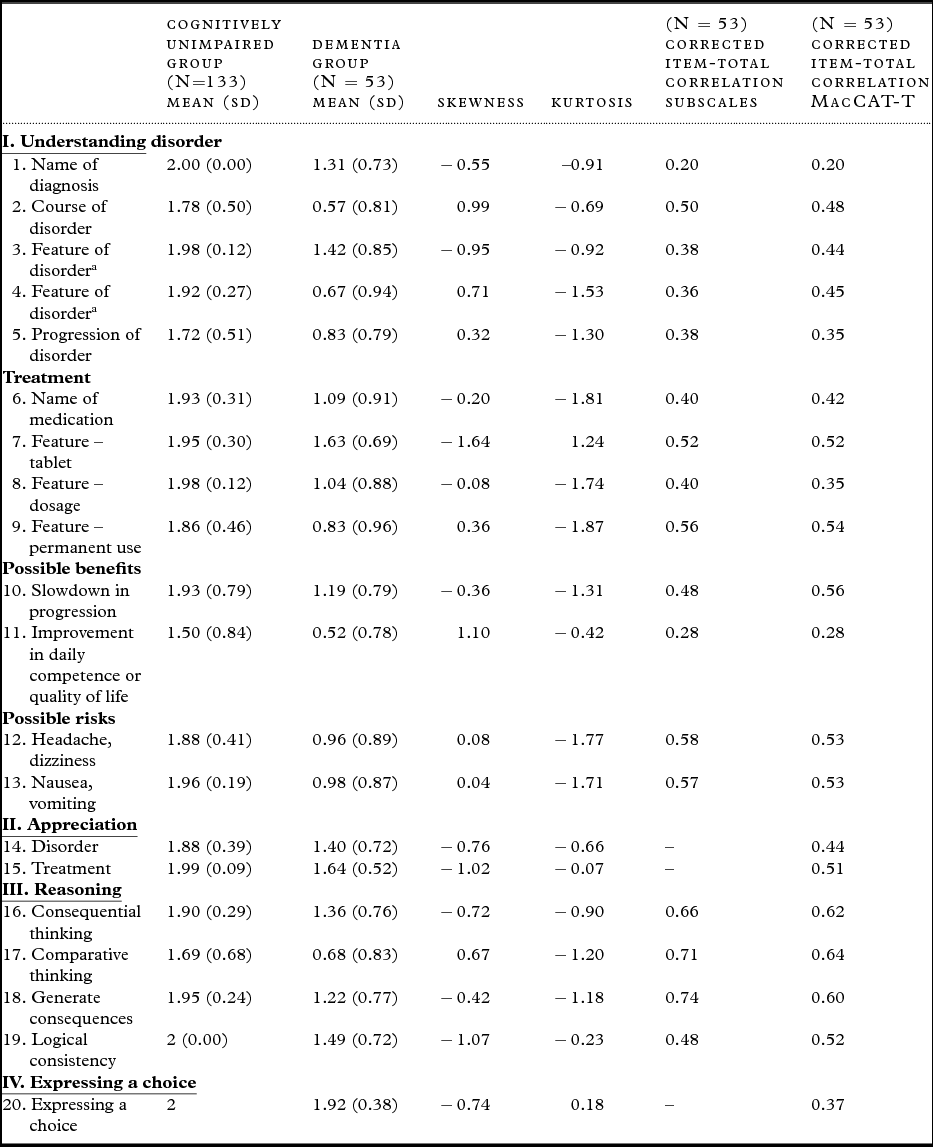
Means, standard deviations, and corrected item total correlations for the dementia group, and means and standard deviations for the cognitively unimpaired group, are presented in Table 3. It should be borne in mind that the two groups differ significantly in terms of age and education, and a vignette had to be used rather than a genuine treatment decision for the cognitively unimpaired group.
Performance of dementia and cognitively unimpaired group on standardized MacCAT-T items

Note: MacCAT-T mean scores range from 0 to 2 (with 0 = inadequate, 1 = partial, 2 = adequate).
aThese two items were individualized for people with dementia depending on the patient's individual symptoms; SD = Standard deviation.
While means in the cognitively unimpaired group ranged from 1.5 to 2.0 with an overall mean of 1.9, they varied between 0.68 (“comparative thinking”) and 1.92 (“choice”) in the dementia group, with an overall mean of 1.1. In the cognitively unimpaired group, all participants received a top score on the items “name of diagnosis,” “logical consistency,” and “expressing a choice.” The standard deviations in the cognitively unimpaired group ranged from 0.0 to 0.84 (mean: 0.3), indicating a ceiling effect in the cognitively unimpaired group. Standard deviations in the dementia group ranged from 0.38 to 0.96 (mean: 0.78). The item “comparative thinking” was relatively difficult for both the dementia group and the cognitively unimpaired group. In addition, a considerable number of people with dementia were not able to comprehend the “course of the disorder” and did not understand the concept “progression of disorder.” Most people with dementia were also unable to report a second individual symptom of their disorder. Almost all people with dementia were able to state a clear treatment choice, showed “appreciation of disorder and treatment” and were able to repeat the name of their disorder. The items “name of diagnosis (1)” and the benefit “improvement in daily competences (11)” had a corrected item total correlation of <0.30.
Known-groups validity
To assess known-groups validity, we divided the people with dementia into two groups (mild or moderate dementia). Results are shown in Table 4. We found differences between the two groups in “understanding” and “reasoning.” No differences were found in “appreciation” and “expressing a choice.”
Performance of people with mild and moderate dementia in different categories of the MacCAT-T

Note: SD = Standard deviation.
Associations with neuropsychological variables
Correlations between abilities as measured using the MacCAT-T, and neuropsychological variables, are given as validation criteria in Table 5. Correlations are corrected for covariance of age and education.
Correlations between the ability to understand, appreciate and reason measured using the MacCAT-T and neuropsychological variables

Note: 95% confidence intervals in brackets, all correlations are controlled for age and education (N = 186).
The strongest correlations were found between the ability “understanding” and the neuropsychological variables of the CERAD-NP Test Battery, and especially with verbal retrieval and word list recognition (see Table 5). Weaker correlations with verbal retrieval were found on “reasoning,” but associations were seen with Trail Making Tests A and B. The weakest correlations were found on “appreciation.” Overall, the results revealed that the relevant abilities of the MacCAT-T show generally expected correlations with neuropsychological variables.
Discussion
The aim of this study was to provide a standardized real informed consent paradigm that allows externally valid and ethically justifiable capacity research in people with dementia. With this in mind, we attempted to discover the dementia-specific properties of capacity to consent to treatment in a real informed consent process that would allow us to develop enhanced consent procedures for this specific treatment. Unlike other studies, we focused our analysis on items rather than sum-scores in order to be able to specify the characteristics defining dementia more precisely and in greater detail.
Our results show that the standardized MacCAT-T has very high inter-rater reliability. Significant group differences in the subscales understanding and reasoning of the MacCAT-T between people with mild versus moderate dementia suggest criterion-related validity. The generally expected correlations between the relevant abilities of the MacCAT-T, and neuropsychological variables suggest construct validity. The dementia group showed greater variance in all aspects of capacity to consent than the cognitively unimpaired group. On a subscale level, the greatest deficits were found in items that measured “understanding” and “reasoning.” In agreement with previous studies, performance in these two abilities was associated with memory, attention and other verbal factors (Gurrera et al., Reference Gurrera, Moye, Karel, Azar and Armesto2006; Felnhofer et al., Reference Felnhofer, Kothgassner and Kryspin-Exner2013). It can be concluded from the results of item analysis that people with dementia are less handicapped when items and tasks are less dependent on memory and attention. This finding has led to the development of treatment-specific enhanced consent procedures for this patient group (see below).
Two items (“name of disorder” and “improvement in daily competence”) had very low corrected item-total correlations. As these items are necessary for reasons of content validity, it will be necessary to investigate how their assessment could be improved. We found the strongest associations between “understanding” and neuropsychological variables like verbal retrieval, recognition, attention, and verbal fluency. In comparison, “appreciation” was less strongly associated with verbal retrieval. For the assessment of “understanding,” the MacCAT-T confronts the patient with new information, and this may be a reason for the strength of its association with verbal retrieval. The weak correlation of cognitive assessment subtest scores with “appreciation” probably reflects the stronger association of “appreciation” with general attitudes. For example, “appreciation-treatment” is assessed by asking the patient whether the proposed treatment might be of some benefit (Grisso and Appelbaum, 1998). A patient who trusts his physician is more likely to answer the question positively, regardless of whether he understands the treatment.
However, we did not assess attitudes or trust in this study. “Reasoning” is the ability to process treatment information (Grisso and Appelbaum, 1998). Accordingly, we found associations with attention, as measured using Trail Making Tests A and B, and, moreover, with subtests that measure verbal retrieval. To decide whether to undergo a specific treatment, the patient requires information on the expected benefits and risks that will result from it, as this will enable him to imagine its consequences in his everyday life. Such processing requires at least a minimum of attention and verbal recall. Moreover, different values are also important during this process.
Finally, we would like to give some examples of how the results of this study might be used to improve the provision of information on possible treatments and their consequences. The task “comparison of different consequences of the treatment” was one of the most difficult tasks for people with dementia. It might be possible to make this easier for patients by providing written information describing specific consequences, with the aim of reducing memory and attention demands during the task. Most people with dementia were also unable to report changes in the brain as a possible reason for their disease. Simplified pictures of the brain may help them understand the changes that occur. Comprehension of an anti-dementia treatment might also be enhanced by putting the drug package on the table, as this would enable the patient to read the name and planned dose of the medical treatment. The use of bullet points containing key information and corresponding pictograms may also help (Haberstroh et al., Reference Haberstroh, Mueller, Knebel, Kaspar, Oswald and Pantel2014). Additionally, it is necessary to choose adequate communication strategies (Moye et al., Reference Moye, Gurrera, Karel, Edelstein and O'Connell2006) for people with dementia. Future research should investigate whether such enhanced consent procedures are helpful. Furthermore, physicians, relatives, and guardians should be trained in ways to support or translate for people with dementia, especially when information is difficult for them to understand (Haberstroh et al., Reference Haberstroh, Mueller, Knebel, Kaspar, Oswald and Pantel2014). The aim thereby is to enhance comprehension and the reasoning process as much as possible. This procedure differs from other psychological assessments, as these often require a standardized protocol to ensure objectivity. In case of capacity assessments, the maximum possible support is permissible, with the consequence that the result also depends on the ability of the assessor to support capacity to consent. Capacity assessments may also be improved through documentation of the kind of support that was used during the assessment, and how much the patient benefited from it. On the other hand, it is also necessary to discuss the extent to which provided information can be simplified, i.e. how much information a person with dementia really needs to gain an adequate understanding of diagnosis, treatment, benefits, and risks (Kim, Reference Kim2010). To check whether support was successful, we would recommend a second assessment. For this purpose, a 5 or 7 point Likert scale would be helpful, as such a scale is more sensitive to changes.
Limitations of the study
Participants without dementia were better educated and younger than participants with dementia. This should be kept in mind when interpreting the performance differences in the categories reflecting capacity to consent to treatment. The main focus of this paper was on the performance of people with dementia. Nevertheless, future research should assess larger subsamples that are more similar in terms of age and education. As educational level and age are expected to have an influence on the relationship between neuropsychological factors and decision-making capacity, we controlled the bivariate correlations to take account of these effects. Although we used a real consent situation for dementia patients, we had to use a hypothetical vignette for the cognitively unimpaired, since there was no comparable real consent situation for them. In view of these limitations, it was not possible to use the cognitively unimpaired group as a classical control group. Nevertheless, the results are of value, as they indicate small but existing variances in healthy, well-educated persons.
As mentioned above, the information that is provided on treatment with cholinesterase inhibitors for the MacCAT-T assessment cannot be regarded as comprehensive. We decided to select the risks most commonly associated with the treatment, although we could also have chosen to disclose the most serious risks i.e. cardiovascular risks. In a real-life informed consent process, all relevant information would have to be disclosed to the patient. Future studies should investigate the consequences of choosing other risks.
We had insufficient data (i.e. sample size in the dementia group and number of items of subcales were too low) to compute principal component analysis. It was therefore not possible to precisely evaluate construct validity, which is a clear limitation to our study. Furthermore, it should be noted that we were only able to investigate the validity of known groups due to a lack of further external criteria. As Moye et al. (Reference Moye, Gurrera, Karel, Edelstein and O'Connell2006) point out, convincing criteria that prove the validity of capacity assessments are hard to define and rarely at hand. Comparisons with expert judgments are one of the most clinically relevant external criteria, but validation using a “routine physician assessment” has its own pitfalls and limitations (Mueller et al., Reference Mueller2015).
The small sample size of the group of people with dementia made it difficult to accurately gauge inter-rater reliability and limits the generalizability of our results.
Conclusion
The item-based evaluation of the MacCAT-T offers a valuable supplement to reporting sum-scores, as the latter may mask vital clinical details on the kind of information that is comprehended and the kind that is not. Clinicians would welcome an instrument that generates a binary indication of decisional capacity. However, this is not what the MacCAT-T has been developed for. The results obtained from this study on resources and deficits may help to support people with dementia in real consent situations. In accordance with the literature, our own data also indicate that one useful strategy would be to reduce attention and memory demands as far as possible (Haberstroh et al., Reference Haberstroh, Mueller, Knebel, Kaspar, Oswald and Pantel2014).
Conflicts of interest
None.
Description of authors’ role
J. Haberstroh, T. Mueller, and M. Knebel designed the study and collected the data. T. Mueller wrote the paper and made the statistical analysis. J. Haberstroh, M. Knebel, R. Kaspar, P. Halder-Sinn, and C.J. Kemper assisted writing the paper and were involved on the interpretation of the data. C.J. Kemper and R. Kaspar advised on the statistical design of the study. F. Oswald, J. Schroeder, and J. Pantel substantially revised the manuscript.
Acknowledgments
This work was funded by the Volkswagen Foundation. The authors would like to thank Phillip Elliott for proofreading the document.