INTRODUCTION
Attention-deficit/hyperactivity disorder (ADHD) is a complex developmental disorder with a high prevalence (Spronk, Vogel, & Jonkman, Reference Spronk, Vogel and Jonkman2013). It is characterized by inattention, impulsivity, and distractibility, with or without accompanying hyperactivity (Barkley, Reference Barkley2014). Adults with ADHD typically demonstrate impairments in a variety of cognitive abilities, such as sustained attention, executive functioning, and response inhibition (Asherson, Reference Asherson2005). Long-term memory problems mainly in the verbal memory domain (the focus of the current study) are a frequently reported symptom in adult ADHD (Fuermaier et al., Reference Fuermaier, Tucha, Koerts, Weisbrod, Lange, Aschenbrenner and Tucha2017; for meta-analysis, see Skodzik, Holling, & Pedersen, Reference Skodzik, Holling and Pedersen2017).
The cause of the long-term memory deficits in adults with ADHD is still not clear. Some researchers suggest that learning problems (i.e., difficulties at the stage of encoding) underlie the long-term memory difficulties (e.g., Cahn & Marcotte, Reference Cahn and Marcotte1995), while others hypothesize that (additionally) retrieval processes might be impaired in ADHD (e.g., Pollak, Kahana-Vax, & Hoofien, Reference Pollak, Kahana-Vax and Hoofien2008). Reviewing the pertinent literature, Skodzik et al. (Reference Skodzik, Holling and Pedersen2017) concluded that the impaired long-term memory performance shown by adults with ADHD results from problems in the initial learning of new material, and not from deficient retrieval of information.
The memory impairments adversely affect academic performance, social functioning, and overall quality-of-life. Seeking for a way to overcome such problems, a wide range of treatment approaches has emerged, pharmacologic (e.g., MPH; brand name, Ritalin, which is the most commonly prescribed drug for the treatment of ADHD; Chamberlain et al., Reference Chamberlain, Del Campo, Dowson, Müller, Clark, Robbins and Sahakian2007) as well as non-pharmacologic. One of the non-pharmacologic approaches involves using mnemonic strategies. These memory devices help individuals remember larger pieces of important information. Studies that examined the effect of mnemonic strategies training, e.g., rehearsal and imagery, on adults with ADHD are relatively scarce.
In a study among ADHD children, Douglas and Benezra (Reference Douglas and Benezra1990) asked their participants to report how they tried to learn paired associates. The participants with ADHD tended to report relying on rote repetition, whereas controls, typically developed (TD) peers, reported using strategies involving imagery and elaboration (i.e., optimal strategies for such tasks, which form links between the items). Individuals with ADHD were found to use effortful learning strategies (e.g., semantic clustering) less spontaneously (Egeland, Nordby Johansen, & Ueland, Reference Egeland, Nordby Johansen and Ueland2010).
The literature suggests that using mnemonic strategies plays a significant role in learning and memory (e.g., Verhaeghen, Marcoen, & Goossens, Reference Verhaeghen, Marcoen and Goossens1992), and may be successfully used in educational settings as well as in therapy and rehabilitation programs. In the current study, we assessed the effectiveness of a simple mnemonic device – vocal production – on verbal learning of young adults with ADHD.
The Production Effect: Vocalization as a Mnemonic Device
The production effect (PE) refers to an improvement in long-term memory for items read aloud (vocalized) relative to items read silently at encoding (Forrin, MacLeod, & Ozubko, Reference Forrin, MacLeod and Ozubko2012; MacLeod, Gopie, Hourihan, Neary, & Ozubko, Reference MacLeod, Gopie, Hourihan, Neary and Ozubko2010; Mama & Icht, Reference Mama and Icht2016a; Reference Mama and Icht2016b; Ozubko, Hourihan, & MacLeod, Reference Ozubko, Hourihan and MacLeod2012). The effect has been found with several types of study items (e.g., pictures, Icht & Mama, Reference Icht and Mama2015; non-words, MacLeod et al., Reference MacLeod, Gopie, Hourihan, Neary and Ozubko2010; text, Ozubko et al., Reference Ozubko, Hourihan and MacLeod2012), and with many kinds of specific productions other than saying aloud (e.g., spelling, writing, typing, mouthing, whispering, Forrin et al., Reference Forrin, MacLeod and Ozubko2012), yet vocalization was found to result with the most prominent memory benefit. The PE is typically found in mixed study lists, in which some of the study items are vocally produced and the remaining items are silently read (MacLeod et al., Reference MacLeod, Gopie, Hourihan, Neary and Ozubko2010), although there is evidence for a between-subject PE, studying “pure” lists (see meta-analysis by Fawcett, Reference Fawcett2013).
In line with this finding, a key idea driving much of the pertinent PE research has been that of distinctiveness: saying a word aloud provides for another process of encoding, making the word distinct against the backdrop of the other, silently read words (i.e., the encoding distinctiveness account, MacLeod et al., Reference MacLeod, Gopie, Hourihan, Neary and Ozubko2010). This meaning of relative distinctiveness thus refers to unique productions (or depth of processing) afforded to some of the items at study. Indeed, MacLeod and his colleagues (Forrin et al., Reference Forrin, MacLeod and Ozubko2012; Ozubko et al., Reference Ozubko, Hourihan and MacLeod2012) posited that the main mechanism underlying the PE is the execution of distinct, item-specific responses (vocal as well as non-vocal). Producing items at study increases their distinctiveness in memory relative to unproduced items. At test, this distinctiveness facilitates access to aloud items, increasing their memory rates (recall, recognition) relative to silent items.
Attempting to further explain the underlying mechanism of the PE, MacDonald and MacLeod (Reference MacDonald and MacLeod1998) suggested that production has an attentional component. At study, participants pay more attention to words that are read aloud (relative to silent words), resulting in better memory performance (see also, Mama, Fostick, & Icht, Reference Mama, Fostick and Icht2018; Ozubko et al., Reference Ozubko, Hourihan and MacLeod2012).
As reading aloud is such a simple and easy act to perform, it was suggested as a mnemonic device (Ozubko et al., Reference Ozubko, Hourihan and MacLeod2012). Indeed, the PE has been documented across various populations (dysarthric adults, Icht, Bergerzon-Biton, & Mama, Reference Icht, Bergerzon-Biton and Mama2016; individuals with hearing impairments, Taitelbaum-Swead, Icht, & Mama, Reference Taitelbaum-Swead, Icht and Mama2017; Taitelbaum-Swead, Mama, & Icht, Reference Taitelbaum-Swead, Mama and Icht2018). The current study tested the PE in a group of young adults with ADHD, with and without MPH, and compared their memory performance to a control group. At study, the participants were presented with a list of words, and were required to read them aloud or silently. A final recall test followed the study phase, in which we compared memory performance (number of words recalled) between no-production (silent words) and vocal production (aloud words). Since vocalization allocates more attention to the aloud items, we assumed that a PE would be documented in both groups (ADHD and controls), and that for the ADHD group, the PE size would be larger with (than without) MPH (which improves attention).
METHOD
Participants
ADHD group
Twenty undergraduate students (6 females; age range: 19–32 years; mean age: 25 years; SD=2.9) from Ariel University. Recruitment was achieved through advertisement within the university facilities. All participants in the ADHD group provided a diagnostic assessment for ADHD in adulthood. The diagnostic procedure in Israel is performed by a certified neurologist or psychiatrist. It includes an interview with the patient confirming the DSM-V (Diagnostic and Statistical Manual of Mental Disorders, Fifth Edition) criteria. In addition, a computerized continuous performance test is administered (e.g., TOVA, Greenberg & Waldman, Reference Greenberg and Waldman1993; MOXO, Neuro-Tech Solutions Ltd). Participants confirmed that they have been treated with MPH in their adult life (based on self-report) and have been using it regularly. Regarding comorbid disorders, two participants had a comorbid diagnosis of ADHD and depression, and three participants were diagnosed with ADHD and anxiety.
Control group
Twenty-one undergraduate non-ADHD students (10 females; age range: 20–32 years; mean age: 25 years; SD=2.7) from Ariel University. None of these individuals reported a history of neurological or psychiatric diseases and none was taking any medication known to affect mood or cognitive performance.
Participants were native Hebrew speakers. They were screened for ADHD using a standard self-report rating scale designed to quantify ADHD symptoms (ASRS-v1.1). Exclusion criteria were: (a) first language not Hebrew; (b) age below 18 or above 35; (c) individuals suffering from a disorder other than ADHD which might affect the studied parameters (e.g., vision or hearing disabilities, learning disability); and (d) people who cannot be given MPH due to medical reasons. The study was approved by the local ethics committee (the research was completed in accordance with the Helsinki Declaration), and all participants volunteered to participate in the experiment and signed an informed consent.
Apparatus and Stimuli
Adult ADHD Self-Report Scale (ASRS-v1.1, Kessler et al., Reference Kessler, Adler, Ames, Demler, Faraone, Hiripi and . . . Ustun2005) Symptom Checklist
The Symptom Checklist is a self-administered questionnaire developed by the World Health Organization to be used as a screening tool for adult ADHD. It consists of the eighteen DSM-IV-TR diagnostic criteria for ADHD. Six of the eighteen questions (part A of the Symptom Checklist) were found to be the most predictive of symptoms consistent with ADHD. These six questions, on a 5-point scale, were used for screening. The first three questions (Questions 1–3) on the screener require a response in the range of “sometimes” to “very often” to be considered positive while the remaining three (Questions 4–6) require an “often” or “very often” response. Four positive responses in part A constitute a positive screen for adult ADHD.
Study items
The pool of items consisted of 80 common Hebrew nouns (taken from Icht, Mama, & Algom, Reference Icht, Mama and Algom2014). From this pool, 40 words were selected for study, a random sample for each participant. At study, each word was visually presented at the center of a laptop computer screen (a 15-inch color monitor). DirectRT program controlled the presentation. The words appeared in black David font sized 28-point, against a white background. On each trial, an icon sized 2 cm2 of an eye or of a microphone appeared approximately 5 cm above the study word. The icon indicated the appropriate learning condition for that word: silent reading was indicated by an eye and vocal production by a microphone.
Design and Procedure
The participants were tested individually in a quiet room in the university lab (an experimenter was present throughout the session). Upon arrival, they completed a brief personal data questionnaire and the ASRS-v1.1. Then, they were told that they would be presented with a list of words to be learned by silent or aloud reading (a mixed study list). They were informed that memory test would follow the presentation of the words. Each participant signed the informed consent form, and then was seated facing the center of the computer screen (at a distance of approximately 60 cm).
Study phase
The 40 study words were randomly divided into two equal subsets defined by the learning condition. In each trial, a visually presented study word appeared for 4 s, accompanied by the appropriate icon (eye, microphone). A blank screen for 1 s followed (the interval between successive words was 5s).
Filler task
A nonverbal filler task (four multiplication problems printed on an A4 paper) timed to last 5 min followed the study phase.
Memory test
Participants performed a free recall test, in which they were asked to write down from memory as many study words as they could recall, with no time limitation. An empty sheet of paper and a pencil were provided by the experimenter. The complete experimental session lasted no more than 20 min.
The ADHD participants performed the task twice, in two different weekly sessions (using different sets of study words): (a) before self-administration of a single dose of MPH (they refrained from taking their medication for a period of 24 hours before the experimental session) and (b) 60 min after taking a single dose of MPH. Each participant received his or her regular dose of MPH (no placebo condition was used). The order of the tasks was counterbalanced across the ADHD participants (to avoid practice effect). Namely, half of the participants performed the first task without MPH and the second task (following a week) with MPH, while the remaining half performed the tasks in a reversed order (first with MPH and, following a week, without MPH).
Data Analysis
First, we compared the ASRS scores between the experimental groups using an independent samples t test. Next, we confirmed no effects of order of tasks for the ADHD group using a mixed measures analysis of variance (ANOVA), with treatment type (with/without MPH) and learning condition (aloud/silent reading) as within-subjects factors, and task order as a between-subjects factor. Following this, to test the difference in performance within the ADHD group, a repeated measures ANOVA was applied, with treatment type and learning condition as variables. Follow-up analyses were performed using paired samples t tests. A mixed measures ANOVA was used to assess the PE between the control group and the ADHD with MPH group, with group as a between-subject variable and learning condition as a within-subject variable. Independent t tests followed this analysis. All analyses were performed with IBM SPSS 24.0 software (IBM SPSS, Inc., Chicago, IL).
RESULTS
Group Difference in ASRS Scores
Analyzing the ASRS-v1.1 scores revealed that all participants in the ADHD group scored positively (mean score: 4.8; SD=0.83) while none of the control participants scored positively (mean score: 1.19; SD=1.03). Independent samples t test confirmed a significant group difference, t(39)= 12.294, p<.001.
Effects of Task Order in the ADHD Group
For the ADHD group, the order of the tasks (with/without MPH) was not found to have a significant impact on the data, using a mixed measures ANOVA, based on treatment type (with/without MPH) and learning condition (aloud/silent reading) as within-subjects factors and task order as a between-subjects factor (order effect and all interactions with order were non-significant, Fs<1). This null effect of order is an expected outcome, due to the different stimuli and the time interval between experimental sessions and will not be further discussed.
Main Analyses
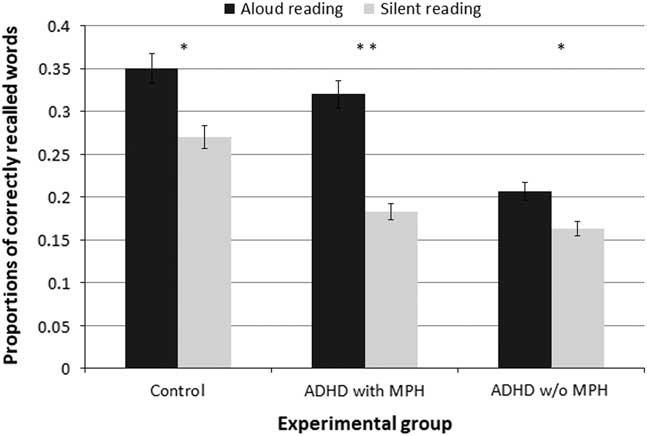
Figure 1 shows the free recall tests results. Plotted are the proportions of words recalled for the two learning conditions, reading silently and reading aloud, across the different experimental groups. Visual inspection reveals the superiority of vocal production over silent reading for all groups, a PE. Control participants outperformed the ADHD participants with MPH (mainly for the silent words), which in turn, showed better memory performance than ADHD participants without MPH, only for the aloud words.
Proportions of correctly recalled words for the subsets of silent and aloud words for the three experimental groups. The error bars are standard errors of their respective means. The asterisk (*) represents a significant difference at p<.05. Two asterisks (**) represent a significant difference at p<.01.

Statistical analysis supported these impressions. As a first step, to reveal the effect of MPH on the PE within the ADHD group, a repeated measures ANOVA was conducted, with treatment type (with/without MPH) and learning condition (aloud/silent reading) as within-subjects factors. This analysis yielded a main effect for treatment, as the recall rates were higher with than without MPH (with MPH: M=0.25, SD=0.13; without MPH: M=0.18, SD=0.09), F(1,19)=19.83; p<.001; η p 2 =.51. A main effect for learning condition was also found, with higher recall rates for aloud versus silent reading (aloud words: M=0.26, SD=0.13; silent words: M=0.17, SD=0.09); F(1,19)=18.31, p<.001, η p 2 =.49. In addition, a significant interaction indicated that after taking MPH, the PE size was larger for the ADHD participants, F(1,19)=5.36, p<.05, η p 2 =.22. Paired sampled (one tailed) t tests verified the PE significance for each treatment type, ADHD without MPH: t(19)=1.77, p<.05; ADHD with MPH: t(19)=4.22, p<.001. Specifically, aloud words were better recalled with MPH (with MPH: M=.32; without MPH: M=.21), t(19)=4.11, p<.001, whereas silent words recall did not differ with and without MPH (with MPH: M=.18; without MPH: M=.16; t<1).
As a second step, we evaluated the effect of vocal production on memory performance between the control group and the ADHD with MPH group, using another mixed measures ANOVA, with group (ADHD with MPH/ control) as a between-subject factor and learning condition (aloud/ silent reading) as a within-subject factor. Total recall rates for the controls were greater than for the ADHD with MPH group (control: M=0.31, SD=0.13; ADHD with MPH: M=0.25, SD=0.13), F(1,39)=4.12, p<.05, η p 2 =.095. A main effect for learning condition was also found, with better recall for aloud than silent words (aloud words: M=0.33; SD=0.13; silent words: M=0.23; SD=0.12), F(1,39)=21.63, p<.001, η p 2 =.357. The interaction between these factors was insignificant, F(1,39)=1.61, p>.05.
Even though this latter interaction was not significant, two independent t tests were performed. These analyses were of clinical importance, directly comparing both learning conditions between the control and the ADHD with MPH groups. Comparing the learning conditions between these groups revealed that the control group performed better than the ADHD with MPH group only in the silent reading condition (controls: M=.27; ADHD with MPH: M=.18), t(39)=2.52, p<.05. However, both group showed comparable performance in the aloud conditions, controls: M=.35, ADHD with MPH: M=.32, t<1. The PE for the control group was also significant, t(20)=2.38, p<.05.
DISCUSSION
The goal of the present study was to assess the efficiency of a simple mnemonic device, that is, vocal production, in a group of adults with ADHD. As vocalization involves focusing attention toward a selected portion of the study material (Mama et al., Reference Mama, Fostick and Icht2018), we assumed that it would enhance verbal learning, especially with MPH. We evaluated long-term memory performance (recall) in a group of adults with ADHD, with and without MPH, and in a group of healthy controls, using a PE paradigm.
In line with previous evidence from the PE literature, memory benefit was found for words learned by vocal production (relative to no production), a PE, in all groups. Overall memory performance (aloud and silent words recall) was worst for the ADHD without MPH, and the PE size (the difference between aloud and silent words) was relatively small. When taking a dose of MPH, the same participants showed a significant improvement in memory performance, due to higher recall rates of the aloud words (regardless of task order). Consequently, the PE was larger for this group of adults with ADHD with MPH. Comparing the performance of the ADHD with MPH to that of the controls revealed similar recall rates for the aloud words. In other words, when adults with ADHD with MPH read words aloud, they remembered them at approximately the same level as the non-ADHD control participants. Finally, controls recalled more silent words than ADHD with MPH.
This pattern of results supports the combination of MPH and vocalization in improving long-term verbal memory for adults with ADHD. Undoubtedly, using MPH enhances attention. But, it is not sufficient in improving memory, as no difference was observed in the number of silent words recalled between the two treatment conditions (with and without MPH). However, the combined effect of MPH and vocal production yielded a significant improvement, as adults with ADHD with MPH recalled more aloud words than without MPH. Note, since there was no placebo condition in the experimental design, we cannot overrule a placebo effect. However, the fact that the memory improvement was noted exclusively for the aloud words suggests a genuine, real effect of the MPH.
From a theoretical perspective, our findings are consistent with the attentional account of the PE (Mama et al., Reference Mama, Fostick and Icht2018), which ascribes the PE to higher attention levels the participants allocate to the aloud words. As MPH enhances attention, it improved the aloud words memory. Note that these results do not fully negate the distinctiveness account (MacLeod et al., Reference MacLeod, Gopie, Hourihan, Neary and Ozubko2010), suggesting that the item-specific processing required by production tasks helps make the produced items distinct relative to the backdrop of non-produced items. Accordingly, MPH might improve the ability of the participants to use the distinctiveness heuristics.
Skodzik et al. (Reference Skodzik, Holling and Pedersen2017) concluded that the long-term memory deficits shown by adults with ADHD likely result from problems in the initial learning of new material. Various cognitive processes affect the encoding of information into memory, such as attention, executive functioning, working memory, or mnemonic strategies. Each one (or a combination of some) may play a role in explaining the learning deficits observed in adults with ADHD. Clinically, vocalization seems to be a potentially helpful learning strategy, as it can be easily applied while learning verbal material.
The current results are in accord with previous findings. For example, Volkow et al. (Reference Volkow, Wang, Fowler, Telang, Maynard, Logan and ... Zhu2004) found that MPH enhanced the saliency of an academic task (solving mathematical problems), making it more interesting and motivating. The enhanced interest for the task could increase attention and improve performance. The authors suggested that this could be one of the mechanisms underlying MPH’s therapeutic effects and recommended using educational strategies that make schoolwork more interesting as non-pharmacological interventions to treat ADHD. Vocal production can be easily used as such a strategy.
Many academic situations involve studying and memorizing written material (e.g., word lists in a foreign language, Qian, Reference Qian1996; text, Chan, McDermott, & Roediger, Reference Chan, McDermott and Roediger2006). Adults with ADHD may encounter difficulties in such situations, as the literature indicates failures to deploy effective strategies (O’Neill & Douglas, Reference O’Neill and Douglas1996) and difficulties in strategy use (e.g., subvocal articulatory rehearsal, semantic clustering) in this population (Egeland, Nordby Johansen, & Ueland, Reference Egeland, Nordby Johansen and Ueland2010; Sigi Hale, Bookheimer, McGough, Phillips, & McCracken, Reference Sigi Hale, Bookheimer, McGough, Phillips and McCracken2007). Hence, identifying and adapting appropriate memorization strategies for this group is clinically important. The current results show that vocalization may be used as an effective mnemonic for adults with ADHD (especially with MPH), improving memory for written material. As noted by Ozubko et al. (Reference Ozubko, Hourihan and MacLeod2012), “It is difficult to imagine a simpler technique for improving retention during studying” (p. 726).
LIMITATIONS AND FUTURE RECOMMENDATIONS
This study may be limited by several factors. First, measures of general or global cognitive level (intelligence) were not examined in the current study. Memory is a fundamental cognitive function, and, as such, is related to the general cognitive level. Future studies may directly assess these abilities, better understanding the correlates between overall cognitive level and the PE. Second, due to the limited sample size, the effect of comorbid factors common in adults with ADHD (e.g., substance use, anxiety, depression) on long-term memory performance was not tested, and future studies may address this issue. Finally, in view of the notion that distinctiveness is relative (MacLeod et al., Reference MacLeod, Gopie, Hourihan, Neary and Ozubko2010), the PE is typically found in mixed lists, containing words studied aloud and words studied silently. A similar experimental design was used in the current study. Future studies may assess the PE with pure lists, where all words are learned in a similar manner at study (all read aloud or all read silently). Such a design eliminates the relative distinctiveness of a subset of the study words, allowing an examination of the attention approach.
ACKNOWLEDGMENT
The authors report that they have no conflicts of interests and no financial disclosures.