INTRODUCTION
Parasites must prevent host death to ensure the success of transmission and the support of resources. As unavoidable host mortality rises with increasing resource exploitation, virulence tradeoff becomes a critical concern (Alizon et al. Reference Alizon, Hurford, Mideo and van Baalen2009). One strategy for achieving virulence tradeoff is to reduce host fecundity to divert damage from the host (Hurd, Reference Hurd2001). Such parasites not only destroy or alter host gonad tissues (i.e. castration) (Baudoin, Reference Baudoin1975), but also interfere in the host's development of sexually dimorphic structures contributing to reproduction and mating behaviours (i.e. intersexuality) (Wülker, Reference Wülker1964; Hurd, Reference Hurd and Webster2009). This behaviour resembles the virulence tradeoff caused by unbalanced energy exploitation (Hall et al. Reference Hall, Becker and Ca'ceres2007), which occurs in numerous parasitic systems (Wülker, Reference Wülker1964; Baudoin, Reference Baudoin1975; Hurd, Reference Hurd and Webster2009), provides an initial direction for the study of host–parasite interactions.
Horsehair worms (Phylum: Nematomorpha) are known as the castrators of terrestrial definitive hosts (Biron et al. Reference Biron, Ponton, Joly, Menigoz, Hanelt and Thomas2005; Lafferty and Kuris, Reference Lafferty and Kuris2009). Larval horsehair worms live in aquatic environments and enter definitive hosts through aquatic paratenic hosts (Hanelt et al. Reference Hanelt, Thomas and Schmidt-Rhaesa2005). Before parasitizing the definitive host, a larval worm is approximately 50 μm in length. The larva then grows larger to fill most of the host body cavity during development inside the definitive host. Despite the intense resource demands caused by the extreme size increase of the worm, the parasites generally do not kill the hosts before emerging. Instead, the parasites ‘manipulate’ the hosts’ development and consequently cause the host to experience unique symptoms. The infected hosts are castrated and prevented from producing eggs (Biron et al. Reference Biron, Ponton, Joly, Menigoz, Hanelt and Thomas2005). In addition, researchers have observed that hosts infected by horsehair worms and other ecologically close parasites, such as the mermithid, often exhibited intersexuality. Hosts including Metrioptera brachyptera, Pholidoptera sp., Pterostichus niger, Blaps mucronata, Vespula germanica (Wülker, Reference Wülker1964), midges (Chironomidae) (Rempel, Reference Rempel1940), biting midges (Ceratopogonidae) (McKeever et al. Reference McKeever, Brickle and Hagan1997), grasshoppers (Acrididae) (Rowell, Reference Rowell2000), mayflies (Baetidae) (Vance, Reference Vance1996) and mantids (Roy, Reference Roy2003) have been reported to exhibit parasite-induced intersexuality. These morphological alterations indicate that the parasite creates a unique developmental pathway in the host. However, few statistical comparisons in which a large sample size was used have been performed because of the difficulty of sample collection, particularly for parasites with variable life cycles (Hanelt et al. Reference Hanelt, Grother and Janovy2001) and those with a low infection rate (Looney et al. Reference Looney, Hanelt and Zack2012). Therefore, despite the frequency of reported findings, most of these findings cannot provide a comprehensive understanding of the influence of such parasites.
The objective of this study was to determine the influence of parasites on mantids of both sexes, which may include parasite-induced host resource reallocation in sexual characteristic development. Mantids are common hosts of horsehair worms in tropical and subtropical regions (Schmidt-Rhaesa and Ehrmann, Reference Schmidt-Rhaesa and Ehrmann2001) and have been observed to undergo intersexuality after being infected. Roy (Reference Roy2003) discovered 1 horsehair-worm-infected male mantid, Tarachodella monticola, with extremely small wings that resembled those of female adults. A similar phenomenon was observed in the male holotype of Parastagmatoptera abnormis, which was suspected to be the ‘parasite-induced’ synonym of Parastagmatoptera flavoguttata, based on its feminized wing pigmentation, small genitalia, and small ocelli, the sizes of which were between those of healthy male and female P. flavoguttata (Lombardo and Umbriaco, Reference Lombardo and Umbriaco2011). The distinct sexual dimorphism of mantids is most likely derived from their diverse mating behaviours. Compared with the female mantid, the male mantid, as a sex-pheromone receptor (Robinson and Robinson, Reference Robinson and Robinson1979), typically possesses stronger wings (Robinson and Robinson, Reference Robinson and Robinson1979; Roy, Reference Roy2003; Béthoux, Reference Béthoux2010; Lombardo and Umbriaco, Reference Lombardo and Umbriaco2011), longer mid and hind legs (termed walking legs) (Prete et al. Reference Prete, Hurd, Branstrator and Johnson2002), and denser grooved basiconic sensilla, which are hypothesized to be the sensory organ of the sex pheromone (Slifer, Reference Slifer1968; Hurd et al. Reference Hurd, Prete, Jones, Singh, Co and Portman2004; Holwell et al. Reference Holwell, Barry and Herberstein2007; Allen et al. Reference Allen, Barry and Holwell2012). By contrast, the front legs (also called the raptorial legs), which are mainly involved in preying, of female mantids are longer than those of male mantids (Prete et al. Reference Prete, Hurd, Branstrator and Johnson2002). In this study, we compared sexually dimorphic characteristics, including wing length, wing shape, leg length, density and distribution of antennal sensilla, number of antennal segments and the internal sex organs of field-collected mantids (Hierodula formosana) of both sexes and various infection statuses caused by parasitic horsehair worms (Chordodes formosanus). Researchers have typically used the juvenilization hypothesis (retention of juvenile characteristics) to explain the causation of intersexuality and reproductive inhibition (Baudoin, Reference Baudoin1975; Hurd, Reference Hurd and Webster2009); therefore, we also examined the antennae of last-instar male and female mantids.
MATERIALS AND METHODS
Sample collection and preservation
A total of 197 mantids (H. formosana), including 188 adults (89 males and 99 females) and 9 nymphs (5 males and 4 females), were collected at 4 sites in Northern Taiwan between 2006 and 2013. These 4 sites were Xindian (New Taipei City) (24°89′20·21″N, 121°56″93·51″E), Taipei Zoo (Taipei City) (24°99″24·53″N, 121°58″93·66″E), Jiaushi (Yilan County) (24°83′23·16″N, 121°74′67·84″E) and Taroko National Park (Hualien County) (24°17′01·41″N, 121°61′04·99″E).
Forty adult mantids were prepared for the dissection of their internal sex organs. To separate horsehair worms (C. formosanus) from the host mantids, the hosts were first immersed in water for 1–5 min. Mantid samples were preserved at −80 °C until dissection.
The remaining 148 adults were used to measure the external morphology of the antennae, legs and wings. The parasites and hosts were separated using a similar method. The sexes of the mantid adults were determined by examining the external genitalia and the last abdominal sterna. The status of infection was determined by the presence or absence of worms. The number of worms per host was counted. Both the worms and hosts were preserved in 75% ethanol for the following examinations.
The sex of the horsehair worm was determined by examining the posterior end of the body, which appears round and slightly swollen in females but narrowed in males (Chiu et al. Reference Chiu, Huang, Wu and Shiao2011).
Nine nymphal mantids (all uninfected) were reared in a walk-in incubator (28 ± 1 °C, 70–90% RH, 12L:12D photoperiod). Each mantid was confined in a plastic container (20 cm in diameter and 10·5 cm in height). When the wing pad became plump, the nymphs were anesthetized on ice and one of the antennae were removed and preserved in 75% ethanol for morphological examination. Since the antennal characters might change during each nymphal stage, all nymphs with 1 antenna cut were reared to adulthood to ensure that the cut antennae were from last-instar nymphs.
Dissection of internal reproductive organs
The reproductive organs of the 40 adult mantids were dissected under a stereomicroscope (Leica S8APO stereomicroscope, Wetzlar, Germany). The abdomen and the internal sex organs were removed in phosphate-buffered saline (PBS) buffer (KCl, 0·2 g; KH2PO4, 0·24 g; Na2HPO4, 1·44 g; NaCl, 8 g; in 800 mL of distilled water) and fixed in 75% ethanol for at least 5 min. The structural components of the internal sex organs were identified based on descriptions provided by Winnick et al. (Reference Winnick, Holwell and Herberstein2009). To study the effects of infection on the structure of reproductive organs, the number of ovarioles, size of testes, and size of seminal vesicles were recorded for comparison. The number of ovarioles was counted under a microscope. The testes and seminal vesicles were photographed using a camera (Nikon D700, Tokyo, Japan), and the sizes (areas) were measured using the polygon selection function in ImageJ 1.47 (Abràmoff et al. Reference Abràmoff, Magalhães and Ram2004).
Measurement of external morphological traits
The morphological traits of the antennae of adults and nymphs, including (1) density of the grooved basiconic sensillum on antennae, (2) the first segment bearing grooved basiconic sensilla, and (3) the total number of antennal segments, were examined using a scanning electron microscope (SEM) (JEOL JSM-5600, Tokyo, Japan) or a light microscope (Olympus BH-2, PM-10AD, Tokyo, Japan). Other traits specific to adults, including (1) pronotum length, (2) raptorial leg length, (3) mid leg length, (4) hind leg length, (5) forewing length, (6) hindwing length and (7) forewing shape, were examined and photographed using a camera (Nikon COOLPIX P6000, Tokyo, Japan).
Measurement of antennal characteristics
A total of 54 antennae were examined using an SEM following the protocol described by Hurd et al. (Reference Hurd, Prete, Jones, Singh, Co and Portman2004) and Allen et al. (Reference Allen, Barry and Holwell2012). The antennae were sequentially dehydrated in 75, 95 and 100% ethanol, and 2:1, 1:1, 1:2 and 0:1 ethanol–acetone mixtures, each for 15 min. Samples were then critical-point-dried, gold-sputter-coated and examined under an SEM at a magnification of 200–10 000. The remaining 107 antennae were examined using a light microscope.
To estimate the density of grooved basiconic sensilla on each antennal flagellum, we categorized the morphologies of the sensilla into 3 types (large trichoid sensilla, small trichoid sensilla and grooved basiconic sensilla (Fig. 1A)) according to the description provided by Hurd et al. (Reference Hurd, Prete, Jones, Singh, Co and Portman2004). The frequency distributions of their lengths were estimated by choosing 3 sensilla of each type from 24 samples (4 uninfected male adults, 4 uninfected female adults, 4 infected male adults, 4 infected female adults, 4 nymphal males and 4 nymphal females). Among the 3 types of sensilla, the grooved basiconic sensillum is considered to be the sex pheromone receptor and exhibits distinct sexual dimorphism (Slifer, Reference Slifer1968; Hurd et al. Reference Hurd, Prete, Jones, Singh, Co and Portman2004). The density of grooved basiconic sensilla was calculated using the average number of sensilla per 25 × 25 μm2 on each selected antennal flagella. One antennal flagellum was selected for every 10 segments from the 10th to 100th segment; thus, 10 antennal segments were selected from each sample. The narrow median strip of each antennal segment was first divided into 16–96 cells of 25 × 25 μm2 (Fig. 1B). The total number of grooved basiconic sensilla in this narrow median strip was counted and then divided by the number of square areas. In addition to the sensillum density, the first segment bearing grooved basiconic sensilla and the total number of flagellum segments were also recorded (samples with incomplete or broken antennae were not included in the analysis of the total number of segments).
Three types of antennal sensilla (large trichoid sensilla, small trichoid sensilla, and grooved basiconic sensilla) on the mantids (Hierodula formosana) (A), and the method used to calculate the density of the grooved basiconic sensilla (B). The narrow median strip (dotted line area) of each antennal segment was first divided into 16–96 cells of 25-μm2 areas. The total number of grooved basiconic sensilla in this narrow median strip was counted and then divided by the number of square areas. In this example, 9 grooved basiconic sensilla were identified in the narrow median strip, which was divided into 16 square areas. Thus, the density was 0·5625.

Measurement of wing, leg and pronotum characteristics
Wings, legs and pronota were removed from specimens and preserved in 75% ethanol solution. The wings were unfolded, flattened and covered by a transparent plastic slide. All dissected parts were photographed using a camera with a scale of 1 mm.
Pronotum and leg lengths were measured according to the description provided by Prete et al. (Reference Prete, Klimek and Grossman1990, Reference Prete, Hurd, Branstrator and Johnson2002). The pronotum was measured from the rostral-most to the caudal-most midpoint of the prothoracic tergum. The leg was measured from the coxa to the end of the tarsus (the length of the tarsus was not included in the analysis of raptorial legs). The wings were measured according to sclerotized wing venation, as described by Roy (Reference Roy, Prete, Wells, Wells and Hurd2005). The length of the forewing was measured from the base of the costal vein to the end of the second radial vein, which is the visually longest wing length. The length of the hindwing was measured from the base of the costal vein to the end of the radial posterior vein. The measurements were performed using the segmented line function in ImageJ 1.47, and calibrated spatially to the scale included in each picture.
Measurement of forewing shape characteristics
The forewing shape index was computed using the following formula:
 $$(BR - AR)/(BR + AR)$$
where AR is the area above the radial vein and BR is the area below the radial vein. A high shape index indicates the relatively large area below the radial vein. The area of each part was measured using the polygon selection function in ImageJ 1.47.
Statistical analysis
Continuous data were expressed as mean ± standard deviation. P values less than 0·05 were considered statistically significant. The normality of data was tested using a Pearson's chi-square test. The homogeneity of variance in the analysis of covariance (ANCOVA) was tested using a Breusch–Pagan test.
The number of ovariole per ovary, area of the testes and area of the seminal vesicles were compared between the infected and uninfected hosts. When the data exhibited normal distribution, comparisons were performed using a 2-tailed Student's t-test with unequal variance. When data did not exhibit normal distribution, the Mann–Whitney U-test was used for comparison. Pronotum length and forewing shape index were also compared using a 2-tailed Student's t-test with unequal variance for each sex. Multiple comparisons of Student's t-test results with P values adjusted using Bonferroni correction were performed to compare antennal characteristics, including the density of the grooved basiconic sensilla, the first segment bearing grooved basiconic sensilla, and the total number of flagellum segments. Data that were not normally distributed were also analysed using the Mann–Whitney U-test.
The leg length and wing length were rescaled based on body size. Body size was determined by the length of the pronotum rather than the full body length, which may vary if the soft abdomen contains a horsehair worm. The data compared in this study were first separated into 2 groups by the sex (uninfected male adult + infected male adult and uninfected female adult + infected female adult) and tested for variance homogeneity and slope (β1) homogeneity in each group using a linear regression model (character length ~ infection + pronotum length + error). Data that were consistent with the assumption of homogeneity of variance were analysed using ANCOVA, with sex and infection status as independent variables. The effects of infection and sexual dimorphism on leg length and wing length were tested by comparing the vertical shift of the regression lines of each characteristic against the pronotum length. If the assumption of homogeneity of variance was violated, the trait lengths were rescaled by dividing the value by the pronotum length, and the ratios were compared using Student's t-test (normally distributed data) or the Mann–Whitney U-test (non-normally distributed data).
All statistical analyses were performed using R (version 3.1·0, R Development Core Team, 2014) with the base package, as well as the ‘nortest’ and ‘car’ packages downloaded from the R Web site (http://www.r-project.org/).
RESULTS
Basic infection parameters
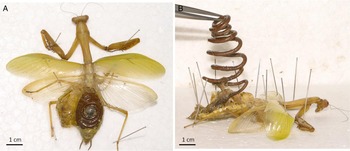
A total of 194 horsehair worms were collected from the 50 infected male adult and 75 infected female adult hosts (Fig. 2). The infection rate is not displayed here because the locomotor activity of the infected mantid adults may have been altered (most of the infected mantids were collected during the daytime, and the uninfected mantids were mainly collected at night). The mean infection intensity of an infected male adult was 1·66 ± 1·36 (1–8) worms per host, and 1·48 ± 0·92 (1–6) worms in an infected female adult. The sex ratios (male:female) of the parasites were approximately 1:1 in hosts of either sex (in male hosts: 38:45, in female hosts: 55:56).
Dorsal (A) and lateral (B) view of a female mantid, Hierodula formosana, harboring a female horsehair worm, Chordodes formosanus.

Internal reproductive organs (Figs 3 and 4)
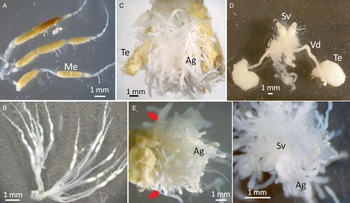
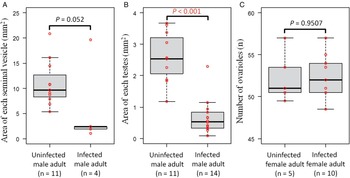
Uninfected female adults possessed a pair of ovaries with 52·3 ± 3·01 (49–58) ovarioles, a heart-shaped spermatheca, and a pair of clustered female accessory glands. The components of the internal reproductive organs of the infected female adults were similar to those of the uninfected female adults. The average number of ovarioles in each ovary of the infected female adults was 52·2 ± 2·74 (42–57), which is similar to that of the uninfected adult females (t = 0·0624, P = 0·9519) (Fig. 4A). Although the components of the internal reproductive organs were not influenced by worms, no mature eggs (Fig. 3B) were discovered in the infected female adults, whereas all 5 uninfected adult females contained mature eggs, which can be judged by having the yellow yolk inside (Fig. 3A) (4 females contained 1–221 mature eggs each, 1 laid eggs with an ootheca before dissection).
Internal sex organs of adult mantids, Hierodula formosana. (A) ovarioles with mature eggs (yellow eggs) of an uninfected female adult. (B) Ovarioles of an infected female adult. (C–D) Internal sex organs of uninfected male adults without (C) or with (D) removing the accessory glands. (E–F) Dorsal (E) and ventral (F) view of internal sex organs of the infected male adults. The red arrows in (E) is where the testes should be in uninfected male adults but was disappeared in infected male adults. Ag: accessory glands, Me: mature eggs, Sv: paired seminal vesicles, Te: testis, Vd: vas deferens.

Parasitic effect of the horsehair worm (Chordodes formosanus) on the size and number of internal sex organs (seminal vesicles (A), testes (B), and ovarioles (C)) of infected and uninfected mantid adults (Hierodula formosana). The gray boxes indicate the median and 25th and 75th percentiles of trait values (red dots). Whiskers indicate the maximal and minimal data values, except for outliers. P values indicate the results of testing the differences in median between the uninfected and infected individuals by using the Mann–Whitney U test.

The uninfected male adults possessed a pair of testes with a long vas deferens, paired fusiform seminal vesicles (Figs 3C–D) and a cluster of male accessory glands (Fig. 3C). The area of a testis is 10·96 ± 4·53 (5·34–20·83) mm2. The seminal vesicle (area of the seminal vesicle is 2·56 ± 0·80 (1·053–3·849) mm2) is located at the end of the vas deferens. The male accessory glands are located directly above the seminal vesicles. In the infected male adults, testes disappeared (Fig. 3E) (in 9 infected males) or were extremely atrophic (in 4 infected males); only 1 infected male adult contained testes of normal size. The average area of each testis in the 5 infected male adults was 5·491 ± 7·94 (1·05–19·653) mm2, which was slightly smaller than that in the uninfected male adults (U = 45, P = 0·052) (Fig. 4B). Seminal vesicles were identified in all the infected male adults (Fig. 3F), but the average size (0·67 ± 0·55 (0·086–2·6) mm2) was smaller than that of the uninfected male adults (U = 149, P < 0·001) (Fig. 4C) and the shape was nearly round. The male accessory glands were fewer and scattered in most of the infected male adults.
Antennal characteristics (Figs 1, 5, 6; Table 1)
Morphology of the 3 types of sensilla
According to the description provided by Hurd et al. (Reference Hurd, Prete, Jones, Singh, Co and Portman2004), 3 types of antennal sensilla (large trichoid sensilla, small trichoid sensilla and grooved basiconic sensilla) exist (Fig. 1A) based on SEM observations. The sensilla can be easily distinguished by the length and characteristics of the surface. The large trichoid sensilla are the longest and thickest tapered sensilla (76·35 ± 33·656 (35·02–152·09) μm) with longitudinal ridges. They form a single ring around the distal third of each segment. Small trichoid sensilla and grooved basiconic sensilla are scattered over a segment. Small trichoid sensilla are long (38·77 ± 7·717 (21·81–56·78) μm) tapered sensilla with a pitted surface, and grooved basiconic sensilla are short (11·39 ± 1·808 (6·69–14·75) μm) and nearly columelliform with slightly longitudinal grooves. These 3 types of antennal sensilla were observed on the antennae of all the examined samples. In the following comparison of density and distribution of the grooved basiconic sensilla, number of the sensilla shorter than 18 μm were counted.
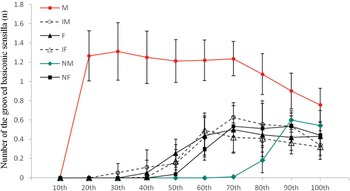
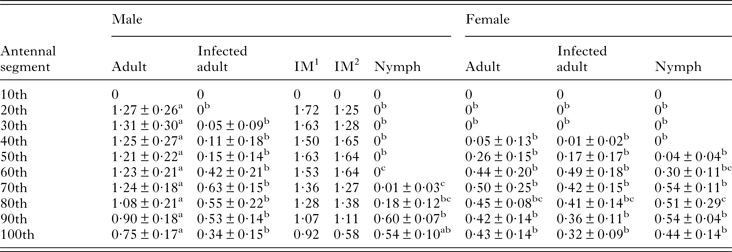
Parasitic effect of the horsehair worm (Chordodes formosanus) on the mean (± standard deviation) number of grooved basiconic sensilla per 25 μm2 on 10 selected segments of antennal flagella of infected and uninfected mantid adults (Hierodula formosana). M: uninfected male adult, IM: infected male adult, F: uninfected female adult, IF: infected female adult, NM: last-instar male nymph, NF: last-instar female nymph.

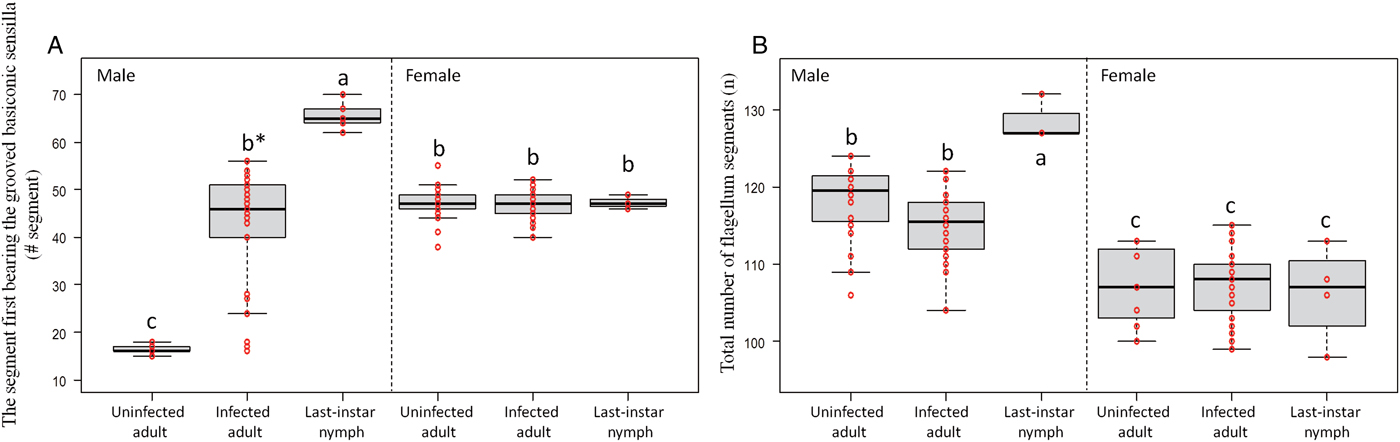
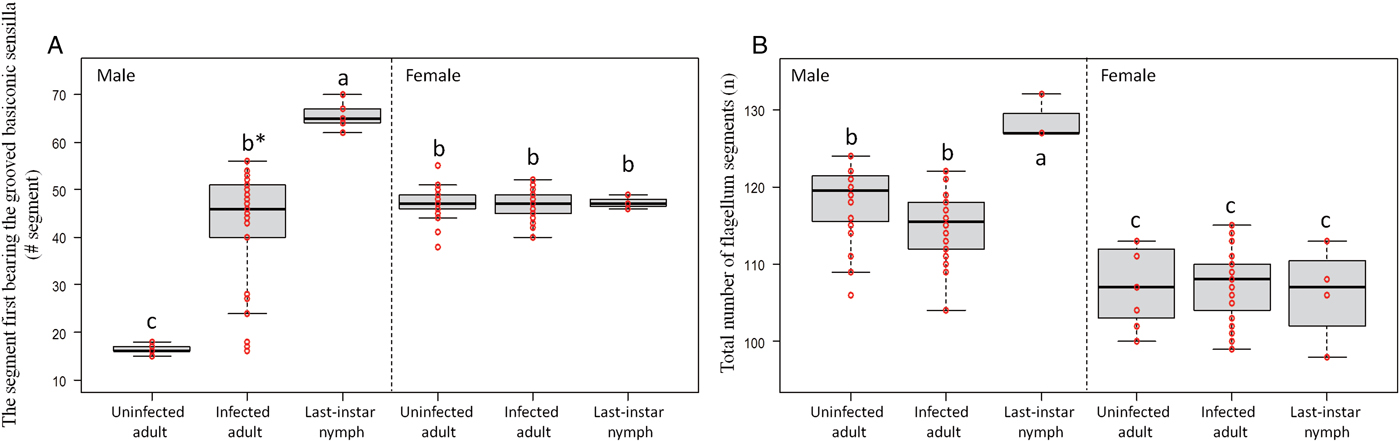
Parasitic effect of the horsehair worm (Chordodes formosanus) on the antennal characteristics of the first flagellum segment bearing the grooved basiconic sensilla (A) and the total numbers of flagellum segments (B) of infected and uninfected mantids, Hierodula formosana. The gray boxes indicate the median and 25th and 75th percentiles of trait values (red dots). Whiskers indicate the maximal and minimal data values, except for outliers. Letters indicate significant pairwise differences (multiple comparisons conducted using a Student’s t-test with Bonferroni correction, P < 0·05). Statistical analysis of the infected adult males (asterisks) in (A) was performed using the Mann–Whitney U test because of the violation of normality.
Densities of grooved basiconic sensilla (number per 25 × 25 μm2) on antennal flagella of H. formosana
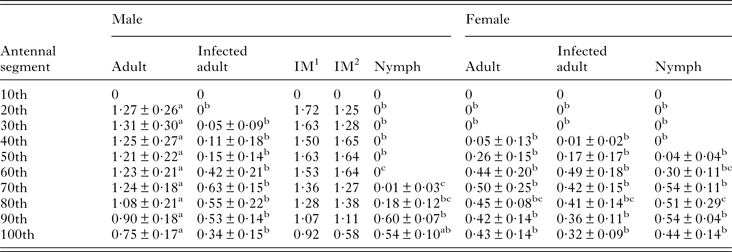
Densities were calculated for 10 selected segments of antennal flagella (one was selected for every 10 segments from the 10th to the 100th segment, and 10 antennal segments were selected from each sample).
a–c Letters indicate significant pairwise differences (multiple comparisons conducted using a Student's t-test with Bonferroni correction, P < 0·05) across the various categories for each segment. The Mann–Whitney U-test was performed to verify the bias caused by the violation of normality.
1–2 Datasets from 2 infected male adults, which were considered outliers because they exhibited higher similarity with the uninfected male adults than with the infected male adults.
Density of grooved basiconic sensilla on each segment
The results of statistical analysis are displayed in Table 1 and Fig. 5. The average numbers of grooved basiconic sensilla in each 25 × 25 μm2 were sexually dimorphic in uninfected adults, and the patterns differed among the male samples (uninfected adults, infected adults and nymphal individuals). The density of the grooved basiconic sensilla was significantly higher in the uninfected male adults than in the uninfected female adults in most segments (20th to 100th), except for the 10th segment. The densities of all the female samples (uninfected adults, infected adults and nymphal individuals) displayed no significant differences in most segments, except for the 80th segment of nymphal females, which possessed fewer grooved basiconic sensilla than did the 80th segment of uninfected and infected adult females. The antennae of infected male adults exhibited higher similarity to those of the female samples than to those of the uninfected male adults, because of the significantly low density of the grooved basiconic sensilla. The grooved basiconic sensilla appeared only on the distal antennal segments of the male nymphs, and the densities after the 90th segment did not differ significantly from those of the female samples and the infected male adults. During these analyses, we discarded the antennal data from 2 of the infected male adults because they differed significantly from the other 9 infected male adult samples. The 2 discarded samples exhibited characteristics similar to those of the uninfected adult males, rather than the other infected male adults. We suspect that probably some male hosts were not or slightly affected after being infected. Therefore, we removed them from this comparison, but maintained the data isolated in Table 1.
First segment bearing grooved basiconic sensilla
The results of the statistical analysis are shown in Fig. 6A. After discarding the antennae without sufficient segments, the antennae of 26 uninfected male adults, 34 infected male adults, 17 uninfected female adults, 61 infected female adults, 5 male nymphs and 4 female nymphs were analysed. The grooved basiconic sensilla typically begin distribution from a specific segment to the end of an antenna. This starting segment was more anterior on the antenna of the uninfected male adults (segment 16·42 ± 0·81 (16–18)) than on those of the uninfected female adults (segment 47·10 ± 3·85 (38–55)). Similar to the results for the sensillum densities, the starting segment of the uninfected female adults was similar to that of the infected female adults (segment 46·51 ± 2·8 (40–52)), and the female nymphs (segment 47·25 ± 1·26 (46–49)). The starting segment of most of the infected male adults (26 individuals, segment 40–56) was between the values of the female samples, but 8 infected male adults exhibited extremely low starting segment values (segment 16–28). The average starting segment of the total infected male adults was 47·62 ± 4·53 (16–56). The starting segment of the grooved basiconic sensilla on the antennae of the male nymphs was located on the posterior segment (segment 65·60 ± 3·05 (62–70)) in our samples.
Total number of flagellum segments
The results of statistical analysis are displayed in Fig. 6B. After discarding the antennae without full segments, antennae of 20 uninfected male adults, 22 infected male adults, 7 uninfected female adults, 35 infected female adults, 4 male nymphs and 4 female nymphs were analysed. The numbers of flagellum segments were sexually dimorphic and not affected by infection in either sex. The antennae of the male samples possessed higher numbers of flagellum segments than those of the female samples. Among the male samples, the numbers of antenna of the uninfected male adults (118·00 ± 4·99 (106–124)) and the infected male adults (114·50 ± 4·30 (104–122)) exhibited no significant difference, but were lower than those of the male nymphs (128·25 ± 2·50 (127–132)). Among the female samples, no difference was observed among the uninfected female adults (107·14 ± 5·34 (100–113)), the infected female adults (107·17 ± 3·99 (99–115)) and the female nymphs (106·25 ± 6·24 (98–113)).
Pronotum, wing and leg characteristics (Tables 2–3, Figs 7 and 8)
Pronotum length
The pronotum length was sexually dimorphic and influenced by infection in both sexes. The pronotum lengths of the uninfected male adults (23·20 ± 1·281 (20·40–25·58) mm) were shorter than those of the uninfected female adults (27·07 ± 1·320 (24·74–29·67) mm) (t = 9·98, P < 0·001) and both infected male adults (21·38 ± 1·661 (18·66–24·68) mm) and infected female adults (24·43 ± 2·186 (20·67–30·39) mm) exhibited decreases in pronotum length after being infected (male: t = 4·97, P < 0·001; female: t = 6·51, P < 0·001).
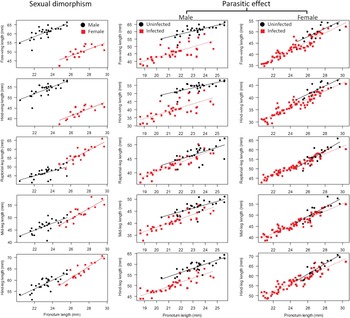
Sexual dimorphism and parasitic effects of the horsehair worm (Chordodes formosanus) on the legs and wing lengths of infected mantids (Hierodula formosana). The lines inside the plots are linear regression lines generated using the data set of each plot.

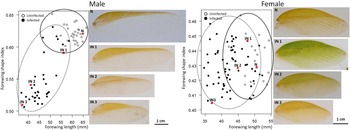
Parasitic effects of the horsehair worm (Chordodes formosanus) on the forewing shapes of infected mantids (Hierodula formosana). The forewing shape index was calculated to determine the difference between the area above (AR) and below (BR) the radial vein. The formula for calculating the forewing shape index is (BR − AR)/(BR + AR). The black solid circles indicate the infected hosts, and the open circles indicate the uninfected hosts. The large circles surrounding each group (sold line for uninfected hosts, and dashed line for infected hosts) were determined subjectively to approximately include all data points of each group. The four red squares (N: uninfected hosts, IN1–3: infected hosts) in each graph are the trait values corresponding to the pictures of wings on the right side.

Leg length
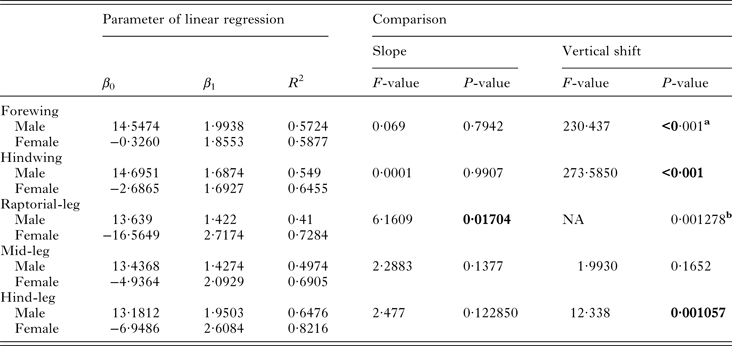
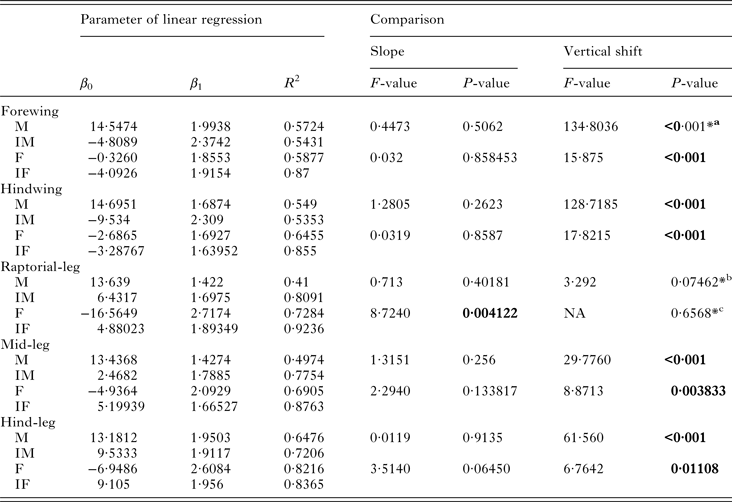
After being rescaled to body size, the uninfected male adults possessed longer hind legs than did the females, and the uninfected female adults possessed longer raptorial legs than did the males (Table 2, Fig. 7). The horsehair worm infection caused shortening of the walking legs (mid and hind legs) in the hosts of either sex (Table 3, Fig. 7). In contrast to the walking legs, no parasitic effects on the raptorial legs were observed. The differences between the infected and uninfected males were not significant (P = 0·07462); therefore, we re-examined the ratio of raptorial leg length to pronotum length using the Mann–Whitney U-test and obtained the same result (U = 612, P = 0·147).
Sexual dimorphism of H. formosana
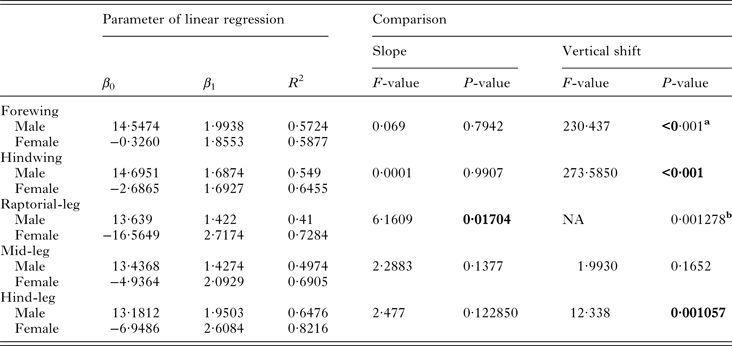
Results of ANCOVA using pronotum length as a covariate and the length of wings and legs as independent variables. Bold fonts indicate those results of significant difference with P value less than 0·05.
a The difference in the ratio of the trait to the pronotum length was analysed using a Student's t-test because the homogeneity of variances was violated.
b The difference in the ratio of the trait to the pronotum length was analysed using the Mann–Whitney U-test because the homogeneity of β 1 was violated.
Parasitic effects on male and female mantids (H. formosana)
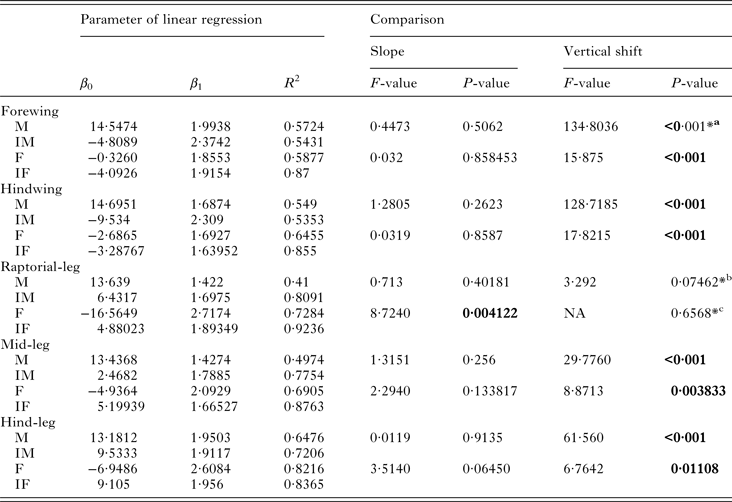
Results of ANCOVA using pronotum length as a covariate and the length of wings and legs as independent variables. Bold fonts indicate those results of significant difference with P value less than 0·05. (M: male, IM: infected male, F: female, IF: infected female).
a The difference in the ratio of the trait to the pronotum length was analysed using a Student's t-test because the homogeneity of variances was violated.
b The difference between uninfected males and infected males was marginally significant based on ANCOVA analysis; therefore, the ratio of raptorial leg length to pronotum length was verified using the Mann–Whitney U-test, which indicated no significant difference (U = 612, P = 0·147).
c The difference in the ratio of the trait to the pronotum length was analysed using a Student's t-test because the homogeneity of β 1 was violated.
Wing length
One broken forewing each from 2 uninfected female adults, and 1 hindwing each (for a total of 2 hindwings) from 1 uninfected and 1 infected female adult were discarded. After being rescaled to body size, the wing lengths were sexually dimorphic and influenced by infection in both sexes. The length of the forewings and hindwings were longer in the uninfected male adults than in the uninfected female adults (Table 2 and Fig. 7). Similar to the results for the walking legs, the horsehair worm infection caused shortening of the wings (forewings and hindwings) in hosts of either sex (Table 3). The decrease in wing length in the infected female adults was less obvious than that in the infected male adults (Fig. 7).
Forewing shape
One broken forewing each from 2 uninfected female adults, and 1 hindwing each (for a total of 2 hindwings) from 1 uninfected and 1 infected female adult were discarded. Forewing shape was sexually dimorphic and influenced by infection in the infected males. The shape indices were higher in the uninfected male adults than that in the uninfected female adults (male, 0·621 ± 0·012; female, 0·43 ± 0·014, t = 68·68, P < 0·001), which indicates the smaller AR area (area above the radial vein) in the male forewings than in the female forewings. Parasitic effects on forewing shape were only observed in the infected male adults. The shape indices of the infected female adults (0·43 ± 0·013) exhibited no significant difference from that of the uninfected female adults (t = 137·06, P = 0·589). The average shape indices of the infected male adults (0·55 ± 0·036) were significantly less than those of the uninfected male adults (U = 951, P < 0·0001). This indicated relatively smaller BR areas in the infected specimens than in the uninfected specimens (Fig. 8).
DISCUSSION
In the present study, we determined that horsehair worms (C. formosanus) cause castration, allometry and intersexuality (feminized male) in mantid hosts (H. formosana).
Influence on the internal sex organs of hosts
Castration induced by horsehair worms was confirmed by the absence of or extremely small testes in most of the infected males. Lacking of matured eggs in the infected females might support the parasitic castration but it could also be caused by the delaying egg development, especially for those of ovariole number which did not change. These 2 phenomena suggest that the parasitic effect on gonads was likely to be a developmental alteration instead of direct destruction: first, the number of ovarioles in the infected females was almost the same as that in the uninfected females (Fig. 4C). Second, 1 infected male mantid harbouring 3 mature worms maintained normal-sized internal organs. The presence of ovarioles may also explain the rapid recovery of egg production in previously infected crickets after releasing harboured worms (Biron et al. Reference Biron, Ponton, Joly, Menigoz, Hanelt and Thomas2005).
Morphological change: allometry and intersexuality
Regarding changes in external morphologies, 2 parasitic effects were observed in the infected samples. Allometric growth occurred in infected hosts of either sex and intersexuality (feminization) occurred in the infected males. Allometric growth originates from the nonproportional decrease in the size of wings and walking legs against the body size of the infected hosts (Fig. 7). Roy (Reference Roy2003) previously recorded an extremely short wing length of an infected male mantid, and considered the phenomenon to be a result of intersexuality. Wings and walking legs are sexually dimorphic characteristics (Fig. 7), and the changes in them theoretically correlate with the definition of intersexuality (Wülker, Reference Wülker1964). However, these changes could be a general effect of the infection. ‘Real’ intersexuality, in which the changes are sex dependent, occurred in the distribution of antennal sensilla (Fig. 6A) and wing shape (Fig. 8). These parasitic effects, which did not occur in the infected females, caused a decrease in the density of antennal sensilla and abnormal wing shape in infected males, causing the males to become partially feminized.
Hypothesis of the juvenilization that cause intersexuality
The feminine characteristics of the infected males suggested that the sexual differentiation of an insect is regulated by external factors. However, the sexual differentiation of an insect is typically considered autonomous and determined by the insect's own genes (Negri and Pellecchia, Reference Negri, Pellecchia and Dubey2012), despite recent evidence still being considered controversial (de Loof and Huybrechts, Reference de Loof and Huybrechts1998; DeFalco et al. Reference DeFalco, Camara, Le Bras and Van Doren2008). To resolve this conflict, several researchers have suggested juvenilization to explain parasitic intersexuality or reproductive inhibition (Baudoin, Reference Baudoin1975; Hurd, Reference Hurd and Webster2009). The hypothesis of juvenilization suggests that parasites can block the structural development of a host at the early stage of ontogeny (Baudoin, Reference Baudoin1975). Similar to most bisexual organisms, male mantids typically evolve structures related to mating, and females conserve energy to produce eggs (Hurd, Reference Hurd and Webster2009). Therefore, the structures of adult males could be changed before sexual maturity through parasitic juvenilization, rather than these changes being the result of femalization.
In the present study of H. formosana, the horsehair-worm-infected adults maintained several nymphal characteristics, including the total number of antennal segments in both sexes (Fig. 6B), and the first segment bearing grooved basiconic sensilla in the females (Fig. 6A). These characteristics were not influenced by the parasite. The number of flagellum segments in the last-instar male nymphs was significantly higher than that of the adult males. Schafer (Reference Schafer2005) also observed this phenomenon, which may be caused by mechanical damage. The antennal characteristic affected by the infection was the first segment bearing grooved basiconic sensilla in the infected males, whose trait values were between those of the last-instar nymphs and the uninfected male adults (Fig. 6A), and may have been caused by incomplete juvenilization.
Our evidence suggests that the hypothesized juvenilization may act through a pathway similar to that of the insect hormone that causes development. Juvenile hormones (or analogues) can block insect metamorphosis (Klowden, Reference Klowden and Klowden2007). Treatment using a juvenile hormone analogue has been demonstrated to create nymphal antennae in adult cockroaches (Ramaswamy and Gupta, Reference Ramaswamy and Gupta1981; Kotaki et al. Reference Kotaki, Shinada, Kaihara, Ohfune and Numata2011) and abnormal wings in adult mantids (Harron and Yager, Reference Harron and Yager1996). These hormonal influences are similar to the parasitic effects on the antennae (Fig. 6A) and wings (Fig. 8) in the infected males observed in the present study. Parasites of microsporidia (Fisher and Sanborn, Reference Fisher and Sanborn1962; Down et al. Reference Down, Bell, Bryning, Kirkbride-Smith, Edwards and Weaver2008) and cestodes (Hurd, Reference Hurd and Webster2009) also increase the hormone titre in the infected hosts, and cause juvenile characteristics to occur in pupal and adult mealworms infected by microsporidia (Fisher and Sanborn, Reference Fisher and Sanborn1962).
Considerable evidence supports the hypothesis of juvenilization, but further study is required because no solid and direct evidence has been obtained. In addition, the antennal characteristics of infected males may not completely match the scenario of juvenilization. Regardless of how the parasites affect hosts, castration and intersexuality may reflect the success of parasites in achieving virulence tradeoff by exploiting the resources of the host reproductive system.
Allometry as an index for the strategy of unbalanced host energy exploitation
In addition to intersexuality induced by horsehair worms, the nonproportional reduction in the lengths of wings and walking legs (morphological allometry) may indicate unbalanced energy exploitation. Based on the concept of reduced host fecundity by parasites, reduction in structures contributing to locomotion is relatively harmless to host survival. Such morphological allometry, which retains resources and supports host survival, can be triggered by parasites, or automatically activated by the host itself under specific circumstances. A decrease in the length of the walking legs (mid and hind legs) but not in the raptorial legs has been observed in giant water bugs (Lethocerus deyrolli), not as a result of parasitic infection but as a result of reduced food supply (Ohba et al. Reference Ohba, Tatsuta and Sasaki2006).
Concluding remarks
Unbalanced host energy exploitation, regardless of whether it is initiated by parasites or the hosts themselves, could be used to explain the castration and the 2 patterns of morphological alteration, intersexuality and allometry, observed in the present study. In this paper, we discussed the morphological changes that occurred in mantids because of parasitic influences. However, the horsehair worm typically drives the host into water (Thomas et al. Reference Thomas, Schmidt-Rhaesa, Martin, Manu, Durand and Renaud2002); therefore, we did not eliminate the possibility that the horsehair worm alters host behaviour through the morphological changes in the host. Although no reasonable connection has been established between them, the functional changes caused by the altered morphology should be considered further. Maximizing resource exploitation without killing the host is most likely a common approach used in most host–parasite systems. In future studies, determining the role of sophisticated chemical and physical pathways, particularly the mechanism of intersexuality could be useful in elucidating the coevolution of these parasites with their hosts.
ACKNOWLEDGEMENTS
The authors deeply appreciate the assistance provided by Wei-Ti Tsai, Hsing-Yu Chou, and Chun-Kai Wang during sample collection, Toshinori Okuyama for providing suggestions for data analysis, and Lun-Hsien Chang for also providing suggestions.
FINANCIAL SUPPORT
This work was supported by the National Science Council, Taiwan (NSC101-2631-H-002-004) and the Bureau of Animal and Plant Health Inspection and Quarantine, Council of Agriculture, Taiwan (103AS-10.2.2-BQ-B5(3)).