

Introduction
Since the arrival of humans to the eastern Polynesian islands, more native land birds have become extinct than currently exist (Steadman Reference Steadman1989). The region is one of the world’s most threatened biodiversity hotspots and suffers the highest rates of bird extinction as a proportion of species of any region on the planet (CEPF 2008). The plight of the South Pacific’s avifauna is exemplified by the Vini genus of lorikeets. Of the five extant species, four are threatened (IUCN 2018), while two species (V. vidici and V. sinotoi) became extinct following human colonisation (Steadman and Zarriello Reference Steadman and Zarriello1987, Steadman Reference Steadman2006).
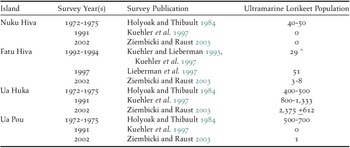
The Ultramarine Lorikeet Vini ultramarina is the most threatened extant species in the Vini genus and one of the most threatened species of the subfamily Loriinae. Listed as ‘Critically Endangered’ (IUCN 2018) and on CITES Appendix 1 (CITES 2017), it is recognized within the Pacific region and internationally as a species of high priority for conservation action (Wilson Reference Wilson, Snyder, McGowan, Gilardi and Grajal2000, Sherley Reference Sherley2001). The species is endemic to the northern Marquesas islands of Nuku Hiva, Ua Pou, and Ua Huka, though it may have once ranged more widely in the archipelago (Steadman Reference Steadman1989). Population estimates in the mid-1970s suggested there were 250–300 pairs residing on Ua Pou, 200–250 pairs on Ua Huka, and 40–150 individuals on Nuku Hiva (Table 1; Holyoak Reference Holyoak1975, Holyoak and Thibault Reference Holyoak and Thibault1984). Populations on Ua Pou and Nuku Hiva subsequently declined drastically such that by the mid-1990s, searches failed to find any birds, and the species was considered possibly extinct on both islands (Kuehler et al. Reference Kuehler, Lieberman, Varney, Unitt, Sulpice, Azua and Tehevini1997). Individuals were subsequently observed on Ua Pou and Nuku Hiva in the late 1990s, but it is not known whether these were vagrants or from surviving relict populations (Raust Reference Raust1998, Reference Raust1999, Meyer Reference Meyer2000).
Summary of previous surveys for Ultramarine Lorikeets on Marquesan Islands.

* Individuals translocated from Ua Huka
Historically, Vini lorikeet population declines have been attributed to habitat loss and degradation due to deforestation, grazing, invasive species, agriculture, poaching, fires, and tropical storms. However, the decline of the Ultramarine Lorikeet from Nuku Hiva and Ua Pou, and from Fatu Hiva to where it was previously translocated (Kuehler et al. Reference Kuehler, Lieberman, Varney, Unitt, Sulpice, Azua and Tehevini1997), coincides with the introduction of the black rat Rattus rattus. Black rats are known to have decimated bird populations on numerous islands (Atkinson Reference Atkinson and Moors1985) and have been present on islands of Nuku Hiva since 1915, Ua Pou since 1980, and confirmed on Fatu Hiva in February of 2000 (Thibault and Meyer Reference Thibault and and Meyer2000).
In an effort to secure additional Ultramarine Lorikeet populations, 29 individuals were translocated from Ua Huka to Fatu Hiva, an inhabited but black rat-free island in the southern Marquesas, between 1992 and 1994 (Table 1; Kuehler and Lieberman Reference Kuehler and Lieberman1993, Kuehler et al. Reference Kuehler, Lieberman, Varney, Unitt, Sulpice, Azua and Tehevini1997). Although a 1997 survey indicated that the population had increased to 51 individuals (Lieberman et al. Reference Lieberman, Kuehler, Varney, Unitt, Sulpice, Azua and Tehevini1997), black rats were subsequently discovered on the island in 2000 (Thibault and Meyer Reference Thibault and and Meyer2000). Extensive searches and anecdotal information from residents found that the lorikeet population had subsequently declined drastically, and was estimated to number between 3 and 8 individuals in 2002 (Ziembicki and Raust Reference Ziembicki and Raust2003, Ziembicki et al. Reference Ziembicki, Raust and Blanvillain2003), suggesting that black rats are likely to have almost exterminated the species on Fatu Hiva. The only remaining robust population of Ultramarine Lorikeets was confined to the small, rat-free island of Ua Huka with approximate estimates of between 1,000 and 1,500 individuals in 1991 (Seitre and Seitre Reference Seitre and Seitre1991, Kuehler et al. Reference Kuehler, Lieberman, Varney, Unitt, Sulpice, Azua and Tehevini1997).
Despite the precarious status of the species, there have been no comprehensive, systematic surveys of the Ultramarine Lorikeet on Ua Huka, and no studies of its biology. In this paper we present findings from the first systematic surveys of the species (conducted in 2002 and 2009), document diet and habitat preferences, and examine the key threats facing the species. We conclude with a discussion of key priorities and recommendations for the future protection of the species.
Methods
Study area
The Marquesas Islands are among the most geographically isolated oceanic islands in the world. They are situated in the southeast Pacific Ocean approximately 4,850 km from Mexico, the nearest continental region, and 1,400 km from the French Polynesian capital of Papeete. There are 12 islands in the group stretching 350 km from north-west to south-east. Six are inhabited, with a total population of approximately 9,800 people (ISPF - INSEE 2017).
The islands are small, volcanic outcrops characterised by rugged, irregular relief with a total land area of approximately 1,050 km2. Rainfall on the islands fluctuates significantly (approximately 50–280 cm per year), but is generally higher on islands farther south, with Fatu Iva and Ua Huka having the highest and lowest rainfalls of the inhabited islands, respectively (DIRPF-Meteo France, unpubl. data). Topography, variable climate, human cultivation, and deforestation have resulted in diverse microhabitats on individual islands and variability in vegetation between islands. Generally, vegetation varies from dry shrubland, grasslands, and forest at low altitudes, to rainforest and cloud forest on the upper windward slopes and summits, with proportionately more woodland and mixed forest vegetation types in the islands further to the south.
Many of the islands have been subject to intensive grazing from introduced herbivores (goats, cattle, sheep and horses), sporadic fires, and tropical storms, resulting in large cleared areas of grassland and weed infestations. Villages have extensive cultivated gardens that include many introduced fruiting and flowering plants, and most village families have additional small plots nearby consisting of coconut palm Cocos nucifera, banana Musa spp., papaya Carica spp., breadfruit Artocarpus spp. and mango Mangifera spp. plantations.
As the only remaining island with a robust population of the Ultramarine Lorikeet, Ua Huka was the primary focus of this study. The island is located 1,424 km north-east of Tahiti, approximately 9 degrees south of the equator. It has an area of 84.5 km2, composed of valleys and ridges up to 857 m high, and a population of just under 600 people living mainly in three villages.
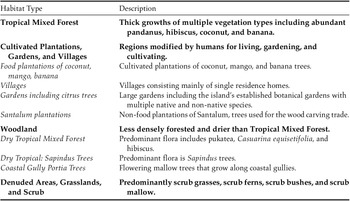
Habitat definitions and vegetation map
Habitat types on Ua Huka were divided into four broad categories based on a vegetation association map of the island (Delerue Reference Delerue2006), which was validated and corrected where necessary by ground-truthing during the 2009 survey and using Google 2010 satellite imagery. The four broad categories were initially divided into nine smaller regions (Table 2). Although we conducted transects in all nine of the sub-regions, due to low detections in some of the smaller sub-regions of the Cultivated Plantations, Gardens, and Villages and Woodland habitats, we calculated pooled population estimates across the four main habitat categories. We used the same estimates of habitat availability to calculate lorikeet population estimates for each survey period (2002 and 2009) based on the assumption that there was minimal change in area of the four habitat categories between survey periods.
Description of the four major habitat types divided into nine total sub-regions of Ua Huka.

The survey map was created with QGIS Version 3.8.2 (2019) using native tools and libraries. This software is free and open-source under the GNU General Public Use License. The data contained in the map exists within the public domain, is open data under the ODdL license, was acquired with permission, or was created in the course of the study.
Base layers for the island’s boundaries, transportation, and population centers were extracted from the OpenStreetMap (2019) database. A digital elevation model (DEM) was sourced from the National Aeronautics and Space Administration’s (NASA) Shuttle Radar Topography Mission (SRTM) 1-arc-second global dataset, version 3 (USGS 2015). From this DEM, 50m elevation contours were extracted. Additionally, a shaded relief overlay and watershed boundaries were produced from the DEM using the SAGA Terrain Analysis processing library (Conrad et al. Reference Conrad, Bechtel, Bock, Dietrich, Fischer, Gerlitz, Wehberg, Wichmann and Böhner2015).
The habitat zones defined for the survey map were adapted from the vegetation map of Delerue (Reference Delerue2006), using both supervised and unsupervised image classification algorithms from the SAGA Image Analysis processing library (Conrad et al. Reference Conrad, Bechtel, Bock, Dietrich, Fischer, Gerlitz, Wehberg, Wichmann and Böhner2015). Correlating zones were then aggregated into the bird habitat zones presented in the map.
GPS tracks of the transects were imported into the program and the map was rendered in the UTM Zone 7 South (EPSG:32707) coordinate system. This coordinate system is widely used and was chosen to minimize normal spatial distortions involved in displaying any two-dimensional map.
Population surveys
This study presents results from two surveys conducted independently in 2002 (Ziembicki) and 2009 (Doukas). Although we employed different methods, they are complementary, and allow for comparison of results after considering appropriate caveats discussed below.
2002 surveys
The first set of surveys were conducted between May and July 2002 on the four islands within the Ultramarine Lorikeet’s contemporary range: Nuku Hiva, Ua Pou, Ua Huka, and Fatu Iva. Timed searches were conducted on Nuku Hiva, Ua Pou and Fatu Hiva, but systematic, quantified surveys were conducted only on Ua Huka, the only remaining island with a notable population of the lorikeets.
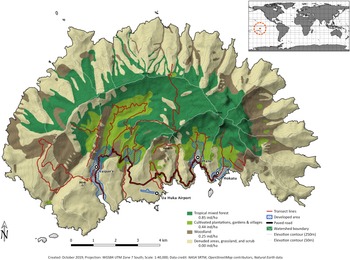
A total of 33 fixed line transects were established in three of the broad habitat associations on Ua Huka in 2002 ranging from sea level to the highest peaks in the center of the island (Figure 1). Surveys were not conducted during this survey period in the denuded areas and grassland habitat association. Transects of 400 m in length were walked over a 20-minute time period, with all birds (of all species) seen or heard within 50 m of the center transect line counted. Additional detailed information was recorded for the lorikeets including flock size, number of juvenile individuals, activity, feeding plant (if applicable) and substrate used. Each transect was surveyed on three separate occasions between 06h00 (dawn) and 10h30 over a period of five weeks (n = 24 survey days) under similar weather conditions. Data were pooled for each site and for each habitat type, and a density estimate of lorikeets with standard error calculated for each of the three habitats. Total lorikeet population size for Ua Huka was estimated by multiplying the density for each habitat by the hectares of available habitat on the island and then adding estimates for all habitat types.
Map of survey transect locations and Ultramarine Lorikeet densities in the four primary habitat types on the island of Ua Huka.

2009 surveys
The second systematic survey concentrated on Ua Huka and was conducted over 12 days in September 2009. A total of 54 line transects ranging in length from 195 to 3,760 m were established across Ua Huka aiming to cover all habitats and maximise the area surveyed on the island (Figure 1). Three transect lines included the open and scrub-dominated habitats characteristic of much of the northern regions of the island. Although considered sub-optimal habitat for the lorikeet, this area had not been surveyed before, and so it was important to determine whether lorikeets used this habitat type. Surveys consisted of walking each transect line and recording all lorikeets seen or heard within 60 m of each side. All surveys were conducted between 06h00 (dawn) and 10h30 or between 15h00 and 18h00 (dusk). When the survey was complete, the area of each transect in each habitat was calculated by multiplying each transect length by transect width (120m) and then summing the transect areas of the habitat. The population density (individuals/ha) was calculated by dividing the number of Ultramarine Lorikeets detected in each habitat by the transect area of each habitat. The total population in each habitat was estimated by multiplying the density of Ultramarine Lorikeets in each habitat by the estimated area of the habitat. Due to the emphasis on conducting line transects that comprehensively covered the island in 2009, each transect could only be surveyed once, and no statistical estimate of error could be calculated for the total population estimate that year.
Although the 2002 and 2009 surveys differed in the duration of the surveys and the number of transects (Table S1 in the online supplementary material), the surveys are broadly comparable for estimating populations due to their similar approaches (systematic line transects) and calculation of density estimates by habitat type.
Diet
In 2002 and 2009, diet was determined by opportunistic observations both during systematic surveys and general behavioural observations between 06h00 and 10h30, and between 15h00 and 18h00.
Results
Habitats of Ua Huka
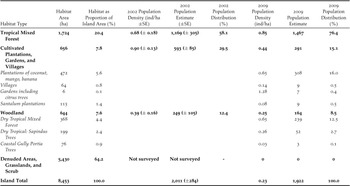
There are four broad habitats of Ua Huka that we defined for the study. Denuded Areas, Grasslands, and Scrub (DAGS) is the largest, covering 64.2% of the island. Tropical Mixed Forest (TMF) contains a mix of tropical vegetation including banana, coconut, hibiscus, and pandanus, covering 20.4% of the island. Cultivated Plantations, Gardens, and Villages (CPGV) covers 7.8% of the island. Woodland covers 7.6% of the island (Figure 1; Table 3).
Habitat area and population estimates derived from 2002 and 2009 surveys of Ultramarine Lorikeets on Ua Huka. For raw counts of birds detected in each habitat in 2009, see Supplementary Table S2.

The CPGV habitat is marked by human modifications and was sub-divided into four sub-regions: 1) horticultural plantations of coconut, mango, and banana trees; 2) villages; 3) gardens including citrus trees; and 4) Santalum plantations.
The Woodland habitat is typically lower elevation, less densely vegetated, and drier than the TMF habitat. It consists of three subregions: 1) dry tropical mixed forest; 2) Sapindus trees; and 3) coastal gully portia trees Thespesia populnea.
Population status
Surveys conducted in 2002 on Ua Huka estimated a total population on the island of 2,011 ± 284 lorikeets. This compares to a similar estimate of approximately 1,922 in 2009 (Table 3), which is well within the range of error of the 2002 count.
Mean flock size across habitats was 1.7 birds (range: 1–17 birds), reflecting that most observations were of one or two individuals, and indicating that the species is not particularly gregarious. Most observations of larger flocks were in food-rich areas, especially those dense in fruiting or flowering trees.
Habitat preferences
In the 2002 surveys, the highest densities of lorikeets were observed within the CPGV habitat association (0.90 individuals/ha), followed by TMF (0.68 individuals/ha) and Woodland (0.39 individuals/ha) (Table 3). This contrasts to the 2009 surveys, where the highest densities were found in the TMF habitat, at 0.85 individuals/ha, followed by the CPGV habitat (0.44 individuals/ha) and 0.25 individuals/ha in the Woodland habitat. No lorikeets were found in the DAGS habitat. Overall, for both survey periods, the TMF habitat supported most lorikeets owing to its greater total area (Table 3).
While Ultramarine Lorikeets were observed in regions of CPGV that consisted of coconut, mango, and banana trees, they were rarely observed during the 2009 surveys in areas dominated only by coconut trees. In contrast, they were commonly observed here in 2002. During both survey periods, however, they were not commonly detected in plantations of Santalum, important trees to the local wood carving trade.
Notably, the CPGV habitat included a “botanical gardens” region of 5.5 ha containing a large variety of different tree and shrub species. It accounts for only 0.1% of the island’s total area, but had the highest densities of Ultramarine Lorikeets on the island at 1.81 individuals/ha in 2002 and 1.28 individuals/ha in 2009 (Table 3). Our observations of diet corroborate these findings, as the most commonly used food items are found in the cultivated gardens.
Diet
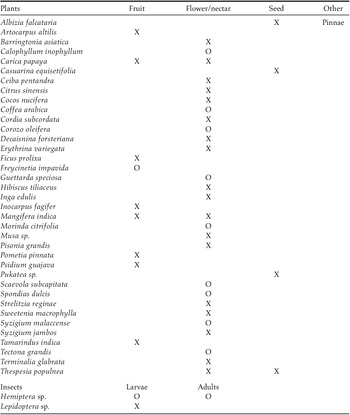
Ultramarine Lorikeets consume a broad range of food resources, but typical of all lorikeets, they are nectivorous, favouring fruits, flowers and nectar of their preferred plant species (Table 4). While their diet is largely plant-based, they have been occasionally observed consuming insects and their larvae.
Food resources consumed by the Ultramarine Lorikeet on Ua Huka. X = Consumed food items observed in this study. O = Food items consumed according to the literature but not observed in the current study (Sources: Holyoak and Thibault Reference Holyoak and Thibault1984, Meyer Reference Meyer1996, Kuehler et al. Reference Kuehler, Lieberman, Varney, Unitt, Sulpice, Azua and Tehevini1997).

Discussion
Population status
The inherent vulnerability of Vini lorikeets, and many insular birds in general, is a function of their naturally small population sizes, their confinement to islands that may be subject to rapid environmental changes, and their susceptibility to introduced predators or competitors of continental origin. Our independently derived estimates surveyed seven years apart are very similar and well within error estimates of one another, suggesting the population has remained relatively robust and stable between these time periods.
It should be noted that the relative estimate of lorikeets in the 2002 survey presented here (2,011 ± 284 individuals) differs slightly from the estimate originally reported in Ziembicki and Raust (Reference Ziembicki and Raust2003) (2,375 ± 612 individuals) due to recalculation of overall lorikeet abundance based on an updated and more accurate vegetation map of Ua Huka developed by Delerue in 2006, compared with a coarser map used for the original 2002 estimate.
A key aspect of the species’ population stability is the fact that black rats do not inhabit the island. Black rats have decimated populations of various birds, including other members of the Vini genus, on many islands throughout the Pacific and beyond (Atkinson Reference Atkinson and Moors1985, Hay Reference Hay1986, Seitre and Seitre Reference Seitre and Seitre1991), whereas their control has been shown to increase the breeding success of a variety of bird and parrot species (e.g. Moors et al. Reference Moors, Atkinson and Sherley1992, Nelson et al. Reference Nelson, Woodworth, Fancy, Lindsey and Tweed2002, Moorhouse et al. Reference Moorhouse, Green, Dilks, Powlesland, Moran, Taylor, Jones, Knegtmans, Wills, Pryde, Fraser, August and August2003). Invasion of neighbouring Marquesan islands by the black rat has led to the rapid disappearance of the lorikeet on those islands (Seitre and Seitre Reference Seitre and Seitre1992). If the black rat invades Ua Huka, then the Ultramarine Lorikeet will almost definitely become extinct within a few years, as has been observed on the other Marquesan islands.
To the best of our knowledge, Ua Huka remains black rat free, and in the absence of any other major environmental changes since our survey periods, we assume the Vini ultramarina population remains stable. Nevertheless, the species was upgraded from ‘Endangered’ to ‘Critically Endangered’ by IUCN in 2018 (Birdlife International 2020), owing to its occurrence only on Ua Huka, its extreme susceptibility to black rat predation, the potential introduction of rats to Ua Huka given limited capacity for quarantine, and the potential impacts of other stochastic environmental events, such as natural disasters or disease.
Habitat use
Throughout their respective ranges, Vini lorikeets are found in diverse habitats and have adapted well to small-scale land use modifications as a result of selected agricultural and horticultural practices. Indeed, they are commonly observed in village gardens and plantations (Holyoak and Thibault Reference Holyoak and Thibault1984, Seitre and Seitre Reference Seitre and Seitre1991) and appear to have benefited from a greater range and more consistently available food supply. This situation is analogous to that of other lorikeet species; for example, Musk Glossopsitta concinna and Rainbow Lorikeet Trichoglossus haematodus populations have adapted and increased in suburban Australian towns and cities as a result of a more abundant and consistent food supply (Paton et al. Reference Paton, Carpenter and Sinclair1994).
In this study we reported the highest overall numbers of Ultramarine Lorikeets during both survey periods in tropical mixed forests owing to the greater area this habitat represents. However, the relative densities of lorikeets differed between survey periods with higher densities found in the CPGV habitat grouping in 2002, but higher densities found in the TMF habitat in 2009. While we do not have relative phenological data between the survey periods to make comparisons, it is possible that these differences are explained by seasonal differences in habitat use associated with fruiting and flowering phenology. The consistent presence of lorikeets observed in monocultures of coconut trees that were flowering abundantly in 2002, and their absence from such areas in 2009, may in large part explain this difference. Further study of such potential seasonal differences in habitat use and detailed phenological information are required.
Threats
Loss of habitat over broader scales (particularly on islands) inevitably results in population declines of sensitive species and results in habitat fragmentation that may amplify the potential effects of introduced predators (Oehler and Litvaitis Reference Oehler and Litvaitis1996), and possibly introduced competitors in remaining favourable habitats. Habitat loss and degradation due to high levels of grazing by introduced herbivores, sporadic fires, and tropical storms have converted large areas of Ua Huka’s dry woodland and forest to grasslands or fields of introduced invasive weeds such as Leucaena leucocephala (WWF/IUCN 1994-1995).
Additional evidence of deforestation was observed during the 2009 survey. Some of the tropical mixed forest has been replaced by cultivation of coconut and Santalum trees that are important to the economy of the island. It was observed during the 2009 survey that cultivated forests containing only a single type of tree do not support large numbers of Ultramarine Lorikeets (although, as noted above, there may be seasonal differences in habitat use). Overall, replacement of tropical mixed forests with cultivated forests of single tree species (particularly those that are not used for feeding, shelter or nesting) would reduce the amount of available habitat for Ultramarine Lorikeets, potentially resulting in population declines.
Other potential threats to lorikeet populations include those of other anthropomorphic origin, such as hunting, trading, and introducing competitors such as honeybees that compete for nectar and tree hollows for nesting sites (Oldroyd et al. Reference Oldroyd, Lawler and Crozier1994, Hansen et al. Reference Hansen, Olesen and Jones2002). Historically, hunting for food and feathers was considered a serious threat to some Vini species, including the Ultramarine Lorikeet (Seitre and Seitre Reference Seitre and Seitre1992, Ziembicki and Raust Reference Ziembicki and Raust2006). The use of feathers from Kuhl’s lorikeet Vini kuhlii for adornment was a common occurrence that is believed to have been responsible for the demise of the species in parts of its original range, especially within the Cook Islands (Watling Reference Watling1995). Although trapping for food, feathers, and the pet trade was a problem for most Vini lorikeet populations in the past (Steadman Reference Steadman1989), the extent of hunting and trapping for local consumption is believed to be negligible due to increased awareness of their threatened status. Poaching for the international pet trade of Psittacidae species is an acknowledged threat globally, but its significance to Ultramarine Lorikeet is believed to have declined due to the heightened awareness of resident Marquesans to the plight of Vini, and as such, the risk is probably negligible compared to the relative effects of other threats the genus faces.
Introduced avian diseases, including avian malaria (Samuel et al. Reference Samuel, Woodworth, Atkinson, Hart and LaPointe2015) and birdpox (van Riper et al. Reference Van Riper, Van Riper and Hansen2002), are significant factors responsible for the decline of forest birds in Hawaii, and may be a threat to birds in the Marquesas. However, there is no information at this stage regarding the presence of disease in the islands, although the relative proximity and natural, cultural, and historical connections between the island archipelagos suggest disease may be a potential threat. Further investigation of this potential threat is warranted.
Whilst the lorikeets seem to tolerate some degree of anthropogenic and habitat related threats, nest predation by the black rat is considered the main threat to survival of the species. Lorikeets are particularly susceptible to nest predation because they nest in tree hollows which black rats also readily use as nesting and roosting sites. Black rat predation on avifauna compared with other rat species is generally more devastating because of their agility and ability to climb trees, which allows them to exploit a diet that includes bird eggs and chicks (Foster et al. Reference Foster, King, Patty and Miller2011). Nest predation and competition for hollows is likely to be of particular concern where hollows are in short supply or in areas where black rat populations are particularly large. To date, eradication of black rats from Marquesan islands with established black rat populations has not been feasible.
Priority recommendations and current actions for conservation and research
Biosecurity measures
The highest conservation priority for the Ultramarine Lorikeet is to prevent the establishment of black rats on Ua Huka. The greatest chance for the accidental introduction of rats to Ua Huka is through stowaways in cargo that arrive by ship, and to a lesser degree by plane. Multiple biosecurity measures have been or are being developed to minimise the chances of establishment of black rats on the island through increased biosecurity at ports, monitoring for black rats, and development of rapid response protocols in case of rat invasions. However, these efforts require constant resourcing, adequate oversight, and further assessment of their efficacy.
First, the potential of rat stowaways on vessels is being minimised through biosecurity measures at ports of origin and on vessels and needs to continue in a systematic and consistent manner. Rat traps were provided to the local council for use at the wharf of Ua Huka, with the intent of trapping any rats from incoming ships (Ziembicki and Raust Reference Ziembicki and Raust2003, Reference Ziembicki and Raust2004). These bait station traps were not consistently used, due to local concerns that children might be exposed to poison if they tamper with them (Ziembicki and Raust Reference Ziembicki and Raust2004). Live traps are now routinely deployed in the wharf area both during and immediately after the arrival of cargo ships by local Service du Développement Rural employee and quarantine officer, Mr. Robert Sulpice.
Second, continuous and comprehensive survey and monitoring for black rats on Ua Huka through the establishment of monitoring stations at key points (boat landings, the airport, and in population centres) is necessary. This effort could be enhanced through the establishment of additional and more effective traps and bait stations and use of camera traps, as well as dogs trained to detect rats. In 2018, a rat-detecting dog was trained to search incoming shipments to Ua Huka and to find and catch black rats. This method is still being refined, as the dog detects all rats, including the Pacific Rat Rattus exulans that is believed to have arrived with early Polynesian settlers and is not considered a threat to lorikeets (Tuhuna Sulpice pers. comm. 2018).
Lastly, implementation of contingency plans and rapid response capacity is required to eradicate rats as soon as possible following detection. There is already some capacity for such efforts within the archipelago. In collaboration with the Fatu Hiva Monarch Conservation Program, we initiated a preliminary, localised rat eradication effort in the Punahitahi valley on Fatu Hiva in 2002. Following approval from local authorities, this site was chosen as a favourable initial target site for rat control because of 1) a confirmed presence of black rats in the valley, 2) its proximity to the village of Omoa, 3) the valley’s relatively narrow layout allowing for a concentrated effort, and 4) the identification of several Fatu Hiva monarch Pomarea whitneyi territories, including presence of potentially favourable nesting trees. Using funding available through the Fatu Hiva Monarch Conservation Program, a local government employee was trained and employed to conduct the baiting programme and continues to be responsible for checking and re-baiting bait stations within the valley. Such rat control and eradication efforts would be required on a larger, more coordinated scale on Ua Huka, should black rats arrive there.
Artificial nest sites and protection of nesting trees
We recommend that new rat-resistant nest boxes be designed and tested to determine whether Ultramarine Lorikeets will use them. This should occur in conjunction with protection of existing known nesting trees through the placement of protective metal sheet bands around tree trunks and pruning of adjoining branches to prevent rats from accessing them. Although there are currently abundant natural tree nesting sites on Ua Huka, these artificial and protected nest sites could be essential in the event that the black rat invades the island. In the event of a rat infestation, lorikeets that use protected, rat-proof nests may have greater breeding success and survivorship rates that will be critical to the ongoing viability of the population.
Systematic monitoring and ecological research
Periodic, comprehensive surveys of Ultramarine Lorikeets are needed to track population health, and these should be conducted more regularly, particularly if the threat of rat invasion increases or is suspected to have occurred on Ua Huka. While in our surveys we used relatively simple fixed-transect methods, the use of Distance Sampling (Thomas et al. Reference Thomas, Buckland, Rexstad, Laake, Strindberg, Hedley, Bishop, Marques and Burnham2010) would add further rigour and precision to future surveys to take into account imperfect detection of individuals. Nevertheless, the similarity of our independently derived population estimates provides the most robust baseline measure for the species to date.
Future research, potentially using telemetry, camera traps and other technologies, should also aim to better understand specific habitat requirements, breeding areas, and movements of the species. Such knowledge may also help mitigate the impacts of rats on Ua Pou (where a relict population may exist) or on Ua Huka should rats arrive. For example, particularly important breeding areas could be targeted for rat control during the breeding season, to offset impacts of nest predation as much as possible.
Captive breeding and translocation
Given the extreme vulnerability of the Ultramarine Lorikeet to black rat invasion, serious consideration needs to be given to the establishment of secure, viable populations on other islands, and/or captive breeding populations either in situ on Ua Huka, or elsewhere. At the least, contingency plans for establishing such “guarantee” populations expeditiously are required in the case of the arrival of black rats on Ua Huka.
There are currently limited options for translocation of the species to black rat-free islands within the species’ known historical range, although some smaller Marquesan Islands may offer potential options. Any such attempt, however, will require comprehensive assessment of habitat suitability, climate, and availability and seasonality of food resources, as well as confirmation of the rat-free status of such islands.
Although costly, advances in rat eradication and control programmes on relatively large, rugged islands elsewhere (Keitt et al. Reference Keitt, Campbell, Saunders, Clout, Wang, Heinz, Newton, Tershy, Veitch, Clout and Towns2011) also offer potential hope for future rat eradication programs in the Marquesas. In any case, lorikeet translocations must ensure comprehensive quarantine and rat control programs on target islands to prevent reinvasion. The demise of the initially expanding translocated population of Ultramarine Lorikeet on Fatu Hiva attests to the vulnerability of the species following the arrival of black rats there (Ziembicki et al. Reference Ziembicki, Raust and Blanvillain2003).
There has been some preliminary consideration and planning for an in situ captive breeding programme for Ultramarine Lorikeets on Ua Huka. However, any such set-up will require considerable resources and expertise on the island. Although this may be possible, the establishment of such a programme could be initially located in a region currently with sufficient resources and breeding expertise such as Tahiti, or a specialised breeding facility such as Loro Parque in the Canary Islands. This would enable the development of species-specific expertise in husbandry and breeding biology which could subsequently be further developed in situ.
Any removal of individuals from Ua Huka for translocation or captive breeding programmes must also consider local community aspirations and potential impacts on Ua Huka’s population, including implications on the genetics of the source and translocated populations. To that end, a study of the population genetics of the species is warranted before populations decrease further, in order to inform future captive breeding or translocation efforts and ensure the best possible founder population is potentially established.
Supplementary Material
To view supplementary material for this article, please visit http://doi.org/10.1017/S0959270921000022.
Acknowledgements
The authors would like to thank the people of French Polynesia who supported this work, including Robert and Dolores Sulpice, Tuhuna Sulpice, Maurice and Delphine Rootuehine, Mr. Leon Litchle, Christelle and Charles Fournier, Benjamin Teikihuavanaka, Ranka Aunoa, and Daniel Naudin on Ua Huka; Toti Teikiehuupoko and family on Ua Pou; the mayor of Fatu Hiva Mr. Marcel Bouyer, Mareko, Gregoire (Tia) and family on Fatu Hiva; and Yvonne Katupa of Nuku Hiva. The authors would also like to thank the Office of Rural Development of French Polynesia, Alain Reinhard, Florian Delerue, and Google for mapping resources, and cartographer Eric Mosbaugh. Additionally, the authors would like to thank the Service de l’Economie Rurale Hokatu, the Service du Développement Rural - secteur agricole des Marquises, and the members of Société d’Ornithologie de Polynésie (SOP) Manu including Guillaume Albar, Dr. Anne Gouni, and Dr. Caroline Blainvillain for logistical resources and support. Philippe Raust was instrumental in organizing logistics for surveys conducted by Mark Ziembicki. The work conducted here was funded or supported in-kind by several organizations including SOP Manu, Wing and a Prayer Loriinae Preservation and Restoration, World Parrot Trust, Loro Parque Foundation, and a small grant from the Birds Australia Parrot Association. Finally, this manuscript was improved by the comments and revisions of two anonymous referees, and we thank them for their insights and suggestions.